Notes by Soumyodeep Mukherjee1
Notes by Soumyodeep Mukherjee
2
POWERTRUCKS
Contains its own source of motive power.
Power trucks are divided into several categories of equipment.
Classified into six groups
A. Mode of action
B. Power source
C. Type of wheel
D. Mode of control
E. Height of lift
F. Mode of travel
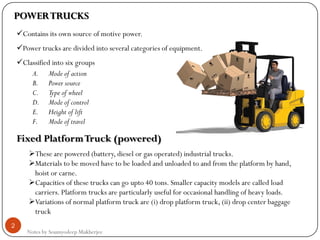
Fixed PlatformTruck (powered)
These are powered (battery, diesel or gas operated) industrial trucks.
Materials to be moved have to be loaded and unloaded to and from the platform by hand,
hoist or carne.
Capacities of these trucks can go upto 40 tons. Smaller capacity models are called load
carriers. Platform trucks are particularly useful for occasional handling of heavy loads.
Variations of normal platform truck are (i) drop platform truck, (ii) drop center baggage
truck
Notes by Soumyodeep Mukherjee
3
Platform LiftTruck (powered)
These equipment are a particular type of powered platform truck, whose platform can be raised
and lowered to handle loads on skids.
Pallet LiftTruck (powered)
• These are basically old versions of fork-lift trucks.
• Low-lift models are used for movement of materials only while the high-lift models
are used for stacking of pallet/skids one over another or in storage racks.
FORK LIFTTRUCKS
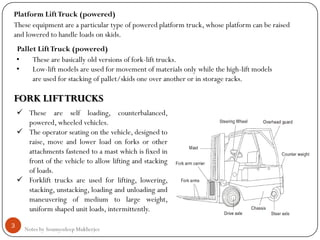
 These are self loading, counterbalanced,
powered, wheeled vehicles.
 The operator seating on the vehicle, designed to
raise, move and lower load on forks or other
attachments fastened to a mast which is fixed in
front of the vehicle to allow lifting and stacking
of loads.
 Forklift trucks are used for lifting, lowering,
stacking, unstacking, loading and unloading and
maneuvering of medium to large weight,
uniform shaped unit loads, intermittently.
Notes by Soumyodeep Mukherjee4
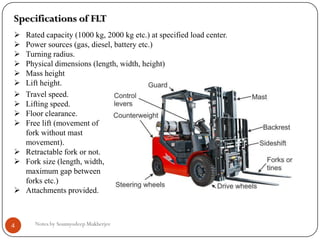
Specifications of FLT
 Rated capacity (1000 kg, 2000 kg etc.) at specified load center.
 Power sources (gas, diesel, battery etc.)
 Turning radius.
 Physical dimensions (length, width, height)
 Mass height
 Lift height.
 Travel speed.
 Lifting speed.
 Floor clearance.
 Free lift (movement of
fork without mast
movement).
 Retractable fork or not.
 Fork size (length, width,
maximum gap between
forks etc.)
 Attachments provided.
Notes by Soumyodeep Mukherjee5
Capacity rating of FLT
 FLT’s are specified for a rated capacity at a specified load centre.
 Load centre is the distance from the heel (vertical face) of the forks to the assumed c.g. of the load.
 The moment of the load about the front wheel does not exceed that of the counter-loaded body of
truck.
Rated capacity of the FLT is X kg and load centre is Y mm. Let the distance
between front wheels to heel of the fork (distance A to B) is Z mm.
Then true capacity of the FLT is
= X × (load centre + distance A to B)
True capacity of the FLT = X × (Y + Z) kg.mm.
If a load is to be carried whose c.g. ‘‘C’’ is
at a distance of P mm from the heel of the
forks (distance B to C = P), then the
maximum safe weight ‘‘W’’ that can be
carried is given by the equation:
W = [X × (Y + Z)] / [Z+P] kg
Notes by Soumyodeep Mukherjee6
Turning Radius and AisleWidth
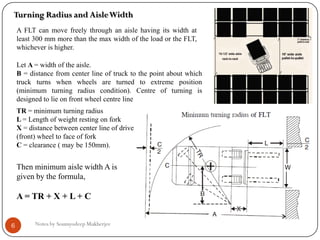
A FLT can move freely through an aisle having its width at
least 300 mm more than the max width of the load or the FLT,
whichever is higher.
Let A = width of the aisle.
B = distance from center line of truck to the point about which
truck turns when wheels are turned to extreme position
(minimum turning radius condition). Centre of turning is
designed to lie on front wheel centre line
TR = minimum turning radius
L = Length of weight resting on fork
X = distance between center line of drive
(front) wheel to face of fork
C = clearance ( may be 150mm).
Then minimum aisle width A is
given by the formula,
A = TR + X + L + C
Notes by Soumyodeep Mukherjee7
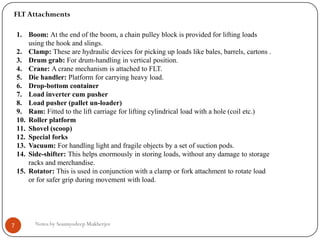
FLT Attachments
1. Boom: At the end of the boom, a chain pulley block is provided for lifting loads
using the hook and slings.
2. Clamp: These are hydraulic devices for picking up loads like bales, barrels, cartons .
3. Drum grab: For drum-handling in vertical position.
4. Crane: A crane mechanism is attached to FLT.
5. Die handler: Platform for carrying heavy load.
6. Drop-bottom container
7. Load inverter cum pusher
8. Load pusher (pallet un-loader)
9. Ram: Fitted to the lift carriage for lifting cylindrical load with a hole (coil etc.)
10. Roller platform
11. Shovel (scoop)
12. Special forks
13. Vacuum: For handling light and fragile objects by a set of suction pods.
14. Side-shifter: This helps enormously in storing loads, without any damage to storage
racks and merchandise.
15. Rotator: This is used in conjunction with a clamp or fork attachment to rotate load
or for safer grip during movement with load.
Notes by Soumyodeep Mukherjee8
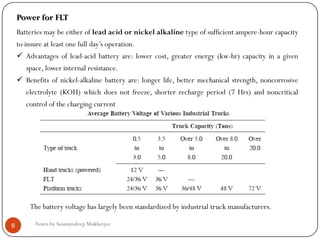
Power for FLT
Batteries may be either of lead acid or nickel alkaline type of sufficient ampere-hour capacity
to insure at least one full day’s operation.
 Advantages of lead-acid battery are: lower cost, greater energy (kw-hr) capacity in a given
space, lower internal resistance.
 Benefits of nickel-alkaline battery are: longer life, better mechanical strength, noncorrosive
electrolyte (KOH) which does not freeze, shorter recharge period (7 Hrs) and noncritical
control of the charging current
The battery voltage has largely been standardized by industrial truck manufacturers.
Notes by Soumyodeep Mukherjee9
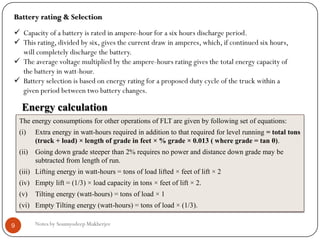
Battery rating & Selection
 Capacity of a battery is rated in ampere-hour for a six hours discharge period.
 This rating, divided by six, gives the current draw in amperes, which, if continued six hours,
will completely discharge the battery.
 The average voltage multiplied by the ampere-hours rating gives the total energy capacity of
the battery in watt-hour.
 Battery selection is based on energy rating for a proposed duty cycle of the truck within a
given period between two battery changes.
Energy calculation
The energy consumptions for other operations of FLT are given by following set of equations:
(i) Extra energy in watt-hours required in addition to that required for level running = total tons
(truck + load) × length of grade in feet × % grade × 0.013 ( where grade = tan θ).
(ii) Going down grade steeper than 2% requires no power and distance down grade may be
subtracted from length of run.
(iii) Lifting energy in watt-hours = tons of load lifted × feet of lift × 2
(iv) Empty lift = (1/3) × load capacity in tons × feet of lift × 2.
(v) Tilting energy (watt-hours) = tons of load × 1
(vi) Empty Tilting energy (watt-hours) = tons of load × (1/3).

Fork Lift Truck

  • 1.
  • 2.
    Notes by SoumyodeepMukherjee 2 POWERTRUCKS Contains its own source of motive power. Power trucks are divided into several categories of equipment. Classified into six groups A. Mode of action B. Power source C. Type of wheel D. Mode of control E. Height of lift F. Mode of travel Fixed PlatformTruck (powered) These are powered (battery, diesel or gas operated) industrial trucks. Materials to be moved have to be loaded and unloaded to and from the platform by hand, hoist or carne. Capacities of these trucks can go upto 40 tons. Smaller capacity models are called load carriers. Platform trucks are particularly useful for occasional handling of heavy loads. Variations of normal platform truck are (i) drop platform truck, (ii) drop center baggage truck
  • 3.
    Notes by SoumyodeepMukherjee 3 Platform LiftTruck (powered) These equipment are a particular type of powered platform truck, whose platform can be raised and lowered to handle loads on skids. Pallet LiftTruck (powered) • These are basically old versions of fork-lift trucks. • Low-lift models are used for movement of materials only while the high-lift models are used for stacking of pallet/skids one over another or in storage racks. FORK LIFTTRUCKS  These are self loading, counterbalanced, powered, wheeled vehicles.  The operator seating on the vehicle, designed to raise, move and lower load on forks or other attachments fastened to a mast which is fixed in front of the vehicle to allow lifting and stacking of loads.  Forklift trucks are used for lifting, lowering, stacking, unstacking, loading and unloading and maneuvering of medium to large weight, uniform shaped unit loads, intermittently.
  • 4.
    Notes by SoumyodeepMukherjee4 Specifications of FLT  Rated capacity (1000 kg, 2000 kg etc.) at specified load center.  Power sources (gas, diesel, battery etc.)  Turning radius.  Physical dimensions (length, width, height)  Mass height  Lift height.  Travel speed.  Lifting speed.  Floor clearance.  Free lift (movement of fork without mast movement).  Retractable fork or not.  Fork size (length, width, maximum gap between forks etc.)  Attachments provided.
  • 5.
    Notes by SoumyodeepMukherjee5 Capacity rating of FLT  FLT’s are specified for a rated capacity at a specified load centre.  Load centre is the distance from the heel (vertical face) of the forks to the assumed c.g. of the load.  The moment of the load about the front wheel does not exceed that of the counter-loaded body of truck. Rated capacity of the FLT is X kg and load centre is Y mm. Let the distance between front wheels to heel of the fork (distance A to B) is Z mm. Then true capacity of the FLT is = X × (load centre + distance A to B) True capacity of the FLT = X × (Y + Z) kg.mm. If a load is to be carried whose c.g. ‘‘C’’ is at a distance of P mm from the heel of the forks (distance B to C = P), then the maximum safe weight ‘‘W’’ that can be carried is given by the equation: W = [X × (Y + Z)] / [Z+P] kg
  • 6.
    Notes by SoumyodeepMukherjee6 Turning Radius and AisleWidth A FLT can move freely through an aisle having its width at least 300 mm more than the max width of the load or the FLT, whichever is higher. Let A = width of the aisle. B = distance from center line of truck to the point about which truck turns when wheels are turned to extreme position (minimum turning radius condition). Centre of turning is designed to lie on front wheel centre line TR = minimum turning radius L = Length of weight resting on fork X = distance between center line of drive (front) wheel to face of fork C = clearance ( may be 150mm). Then minimum aisle width A is given by the formula, A = TR + X + L + C
  • 7.
    Notes by SoumyodeepMukherjee7 FLT Attachments 1. Boom: At the end of the boom, a chain pulley block is provided for lifting loads using the hook and slings. 2. Clamp: These are hydraulic devices for picking up loads like bales, barrels, cartons . 3. Drum grab: For drum-handling in vertical position. 4. Crane: A crane mechanism is attached to FLT. 5. Die handler: Platform for carrying heavy load. 6. Drop-bottom container 7. Load inverter cum pusher 8. Load pusher (pallet un-loader) 9. Ram: Fitted to the lift carriage for lifting cylindrical load with a hole (coil etc.) 10. Roller platform 11. Shovel (scoop) 12. Special forks 13. Vacuum: For handling light and fragile objects by a set of suction pods. 14. Side-shifter: This helps enormously in storing loads, without any damage to storage racks and merchandise. 15. Rotator: This is used in conjunction with a clamp or fork attachment to rotate load or for safer grip during movement with load.
  • 8.
    Notes by SoumyodeepMukherjee8 Power for FLT Batteries may be either of lead acid or nickel alkaline type of sufficient ampere-hour capacity to insure at least one full day’s operation.  Advantages of lead-acid battery are: lower cost, greater energy (kw-hr) capacity in a given space, lower internal resistance.  Benefits of nickel-alkaline battery are: longer life, better mechanical strength, noncorrosive electrolyte (KOH) which does not freeze, shorter recharge period (7 Hrs) and noncritical control of the charging current The battery voltage has largely been standardized by industrial truck manufacturers.
  • 9.
    Notes by SoumyodeepMukherjee9 Battery rating & Selection  Capacity of a battery is rated in ampere-hour for a six hours discharge period.  This rating, divided by six, gives the current draw in amperes, which, if continued six hours, will completely discharge the battery.  The average voltage multiplied by the ampere-hours rating gives the total energy capacity of the battery in watt-hour.  Battery selection is based on energy rating for a proposed duty cycle of the truck within a given period between two battery changes. Energy calculation The energy consumptions for other operations of FLT are given by following set of equations: (i) Extra energy in watt-hours required in addition to that required for level running = total tons (truck + load) × length of grade in feet × % grade × 0.013 ( where grade = tan θ). (ii) Going down grade steeper than 2% requires no power and distance down grade may be subtracted from length of run. (iii) Lifting energy in watt-hours = tons of load lifted × feet of lift × 2 (iv) Empty lift = (1/3) × load capacity in tons × feet of lift × 2. (v) Tilting energy (watt-hours) = tons of load × 1 (vi) Empty Tilting energy (watt-hours) = tons of load × (1/3).