PRESENTATION ON
COMPREHENSIVE FORENSIC
NURSING CARE OF VICTIM AND
FAMILY
INTRODUCTION
Forensic :
• It is derived from Latin word forensis, meaning “in open
court or public”
• Forensic means related to or associated with legal issues
• Finding evidence to solve a crime.
Forensic Science:
• It is the application of scientific methods and principles to
questions of law.
• Any science used for the purposes of the law is considered
as forensic science.
Trauma:
• It is an exposure to actual or threatened death, serious injury
or violence.
• Trauma/assault has lasting effects on victim’s physical,
psychological, social and spiritual well-being.
Victim:
• The victim is a term for a person who has suffered or has
been exposed to physical, mental, emotional or economic
harm and whose fundamental rights have been violated e.g
neglect, physical abuse, sexual assault, violence etc
• Immediate family members and dependents of such victims
may also be called victims if they suffer harm while
assisting victims or preventing victimization.
Survivor:
It refers to an individual who is going or has gone through
the recovery process.
Perpetrator:
It refers to a person who committed a crime or a violent or
harmful act.
Forensic Nurse:
• Nurse who provides specialized care for patients who are
victims and perpetrators of trauma ( both intentional and
unintentional).
• They play an integral role in bridging the gap between law
and medicine.
Forensic Nursing:
• It is the application of nursing sciences to public or legal
proceedings.
• Practice of forensic nursing facilitates connections among
the health care, social services and criminal justice, systems
to assist victims, perpetrators and their families to receive
assistance and resources.
Comprehensive forensic nursing:
It can be defined as holistic nursing care covering, physical
health, mental health and social issues of a victim of
violence and all those persons affected by violence on the
victim and interested in the welfare of the patients.
Importance of Comprehensive Forensic
Nursing for Victims and Families:
• Comprehensive Forensic Nursing care will start from the
crime of scene and providing support to the victim and
taking care of the current problems and taking care of
associated morbidities, collective evidence, caring for the
survivors and caring for the families & friends.
• It prevents future harm to the victims.
• Helps in bringing better care through the study of
epidemiology of the crimes and doing the further research
for the better care of the victims and their families.
Cont.
• It is helpful in cases of interpersonal violence.
• It is also very helpful in intentional and unintentional
violence.
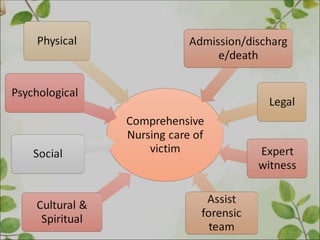
Comprehensive nursing care of victims:
It includes the following:
Physical Health:
• It is the first and foremost duty of the healthcare
professional to address acute problems and provide
treatment for the same.
• Information should be sent to the police as soon as possible
but under no circumstances treatment should be delayed.
CONT….
• Physical examination and treatment includes:
• Brief history of the incident.
1.Accidental/suicidal/homicidal/intentional.
2.Weapons, time, position, sequence etc.
(when/where/why/what/who).
3.Informed consent:
 Provides complete information, be signed by the survivor if
he/she is >12 yrs. & by the guardian/parents if she he/ is less
than 12 yrs.
 Female victim should be examined in the presence of female
relative.
 Medico-legal report (MLR) should not be written in the
presence of a police officer, patient’s relatives or any other
interested party.
 When victim brought to emergency send the information to
the police station.
 Consent of the victim/injured/guardian is not needed for
labelling a case as “MLC” and for further police
information.
4.Particulars of injuries (type, size, shape, location of
wound, direction of the wound, duration of injuries).
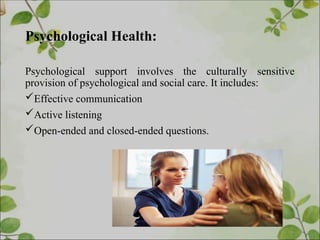
Psychological Health:
Psychological support involves the culturally sensitive
provision of psychological and social care. It includes:
Effective communication
Active listening
Open-ended and closed-ended questions.
Psychosocial Health:
• Psychosocial support involves the culturally sensitive
provision of psychological and social care.
• Identify the relationship with others and develop the
environment of trust.
• Be nonjudgmental and supportive.
• Provide practical care and support to his/her concerns but
does not intrude.
Cultural and Spiritual Health:
It includes sociocultural factors such as:
Race, ethnic background, religious beliefs, beliefs about health
and illness, sexuality, mental and physical disability status,
and traditions also impacts the thoughts, affect and behavior of
the forensic nurse, as well as her patients.
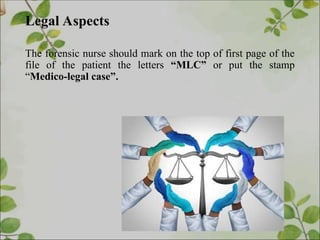
Legal Aspects
The forensic nurse should mark on the top of first page of the
file of the patient the letters “MLC” or put the stamp
“Medico-legal case”.
Cont…
Medico-legal report (MLR): Document that describes the
examination findings and opinion of doctor prepared for the
purpose of litigation. It must includes:
Complete list of injuries along with a body diagram (body
chart).
Color photographs of injuries.
Nature and duration of injuries (as per Sec. 320 IPC).
Weapons used to inflict the injury.
•The MLR should be handed over to the police immediately
after examination.
Assist Forensic Team in Care Beyond
Scope of Her Practice
• Help in photographic documentation of the injuries.
• She/he has unique position in the emergency care to attend
family members and provide support.
• They work together with multidisciplinary team members
and consultants and medical professionals and the police.
• Provide referrals for follow up care.
• Crime victims face a higher risk of PTSD, depression,
suicide, and medical complications than other patients,
forensic nurses can improve both legal outcomes and quality
of life for these patients.
Admission and Discharge/Referral/Death of
Victim of Violence:
• Admission and discharge:
No MLC should be discharged or leave against medical
advice (LAMA) without information to the police.
If the patient is not serious and can take care of himself, he
may be discharged on his own request, after taking in
writing that he has explained the possible outcome of
discharge.
While discharging or referring discharge card must be
complete with summary, treatment, and instructions to be
followed after discharge.
Inform to the police immediately in case of abscond.
Cont…
• Referral cases: If patient is serious and proper arrangements
are not available, then he/she should be referred to higher
centre for treatment with full details clearly stating that
MLR could not be prepared due to seriousness of the patient.
Cont…
• Death of a person as MLC:
Inform to the police immediately after death of a
person.
Body should be shifted with dignity and proper identity
and tag to the mortuary for preservation.
The name of the person transporting the body shall be
recorded.
Complete chain of custody of the dead body shall be
maintained.
Medico-legal postmortem examination is done to
determine the cause of death.
Death certificate is not issued, even if the patient was
admitted.
Cont…
• Patient is MLC but not admitted:
Entry shall be made in the OPD register. MLR be prepared
by the doctor on duty in emergency (ER).
A copy of the MLR should be given to the patient only on
request.
Role / Functions of Forensic Nurse in
Comprehensive Forensic Care of victims
and families:
1. Visit the crime scene.
2. Assessment of the victim.
3. Support to the victims.
4. Care of the current problem.
5. Care of the associated morbidities.
6. Evidence collection.
7. Evidence preservation & dispatch of evidence.
8. Documentation.
Cont….
9. Presenting the evidence from the right perspective in the
courts.
10. Care of the survivors.
11. Care of the families & friends.
12. Prevention of the crime.
13. Advocacy of the victims and survivors.
14. Epidemiology and research.
1. Visit the crime scene:
• It will help forensic nurse in having first- hand
information and initial assessment.
• Know the history of occurrence of the crime and
simultaneously they can observe the crime scene.
• This will help in the better assessment of the crime
scene and victims and thus can provide better
comprehensive forensic nursing care to the victims and
survivors.
2. Assessment of the victims:
• First assess the victims of violence.
• Medico-legal and medical histories are taken and care can be
provided for both components.
3. Support to the victims:
• After the initial assessment, urgent support can be provided
at the crime scene in the form of first aid and then can be
referred to the appropriate institution saving valuable time
for saving the lives of the injured or incapacitated people.
• Psychological support at these precious moments will also
be of great use towards comprehensive forensic nursing care.
4. Care of the current problem:
• It involves taking care of the injuries, psychological support
and social support.
• Physical care of the injuries is possible at the crime scene as
well as in the emergency departments of the hospitals.
• Take care that while taking care of the injuries that evidence
is not weakened or destroyed during this process.
Cont…
• In one of the studies in the USA in the age group of 1-44
years Injuries including due to violence are one of the major
causes of disability and mortality.
• One-third of the emergency patients were due to injuries and
90% of these were seen by a nurse. This data tells the
importance of forensic nursing in emergency departments.
5. Care of the associated morbidities:
• Victims of violence may have pre-existing diseases.
• Treatment of these diseases may get interrupted in these
situations.
• Get the history of these diseases and can help in providing
timely treatment for these diseases so that no emergency
arises during these situations.
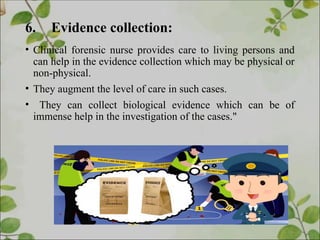
6. Evidence collection:
• Clinical forensic nurse provides care to living persons and
can help in the evidence collection which may be physical or
non-physical.
• They augment the level of care in such cases.
• They can collect biological evidence which can be of
immense help in the investigation of the cases."
7. Evidence preservation & dispatch of
evidence:
• Evidence collected may become weak if it is not properly
preserved. Evidence can be preserved depending upon the
type of evidence.
• They can be of vital help in packing, labelling and
dispatching this evidence to the concerned officials.
• Keeping the chain of evidence intact is an important issue
and utmost care should be given to maintain it.
8. Documentation:
• Documentation is a very important step and forensic nurses
are taught to document what they observe, collect and
intervene in a particular situation.
• Photo documentation is also an important aspect and
forensic nurses may utilize this avenue too.
• Documenting all the processes will be of intense importance
in providing comprehensive forensic nursing care to the
victims.
Cont…
• Presenting the evidence from the right perspective in the
courts.
• Forensic nurses will be considered expert witnesses and they
can give evidence in court for the work done by them.
• This will help the victims in getting justice and this will
improve the lives of the people through crime reduction.
9. Presenting the evidence from the right
perspective in the courts:
• Forensic nurses will be considered expert witness and they
can give evidence in court for the work done by them.
• This will help the victims in getting justice and this will
improve the lives of the people through crime reduction.
10.Care of victims and survivors:
• Types of care: Comprehensive care can be provided in
different settings." Compassionate care is the need of the
hours in most of the situations being faced by forensic
nurses.“
• Hospital care: There are specialists in forensic nursing who
can provide comprehensive care in hospital settings.
• Usually they work in the emergency unit of the hospital and
usually work in collaboration with the medical officers or
medical examiners.
• Victims of violence need a different type of care.
• Need an evaluation that what needs to be done and then a
plan to be prepared for the management of the cases.
• Victims, survivors and their family members need holistic
and comprehensive care which can be effectively done by
forensic nurses because of their knowledge, skills and
aptitude acquired during their teaching and training.
• This will include immediate care after the violence and the
long-term care of the victims.
• All needed to be handled carefully and empathetically.
11.Care of family members & friends:
• Family members are anxious and afraid and forensic nurses
can calm them down and provide the required support due to
their good communication skills.
• They can also provide the family members with
psychological counselling if required.
12.Prevention of violence & crimes:
• Forensic nurses can play a crucial role in the prevention of
violence.
• Prevention of interpersonal violence will save a lot of money
for governments and communities.
• Prevention can be done at all levels from the primary level to
the tertiary level.
13.Advocacy of the survivors
• Forensic nurses in addition to other roles can also be good
advocates of the victims and survivors."
14. Epidemiology and Research
• Research is required to make our approach evidence-based
and this evidence needs to be developed for comprehensive
forensic nursing care for the victims of crime, survivors of
the crime and their families.
• We need to also know the epidemiology of various crimes to
understand the prevalence of crime in a particular region of
our country and the necessary support to be made available
and funds to be allocated for this purpose.
• National Crime Record Bureau is a good source of the
epidemiology of the various crimes reported in India.
Role of Comprehensive Forensic Nurse in
Other Issues:
• Rights of the victims and offenders: Forensic nurses
should know and understand that victims as well as
offenders have certain rights and they must know and
respect these rights.
• By respecting the rights, better nursing care will be provided
to the victims and survivors.
• Autonomy of the patient: Respect the autonomy of the
patient.
• Never breach the confidentiality of the patient.
• Justice and Fair treatment: According to the Human rights
office of the United Nations victims must have access to
justice and fair treatment.
• Such victims should be dealt with compassion as well as
respect.
Responsibilities of Forensic Nurse as a Witness
in Comprehensive Care of Victims and families:
• A witness is a person who gives sworn testimony (evidence)
in a court of law as regards facts and/or inferences that can
be drawn from the following:
Common/ordinary/percipient witness (includes direct
observations, give evidences acc. to Sec. 118 IEA).
Expert/skilled witness.
Hostile witness (bribe/intimidation).
Comprehensive Forensic Nurse As Expert
Witness:
• A nurse expert witness acquires specific expertise and
competencies.
• Held to higher standards of relevant education and experience.
• Prepare herself well in time with the case documents and review the
notes before reaching the court.
• Should convey impartiality.
• Assertive patient advocacy is appropriate in the hospital setting, but
not in the court law.
• Testifies as to her opinion about some element of the case.
THANK YOU

726201456-Forensic-Nursing for students ppt

  • 1.
  • 2.
    INTRODUCTION Forensic : • Itis derived from Latin word forensis, meaning “in open court or public” • Forensic means related to or associated with legal issues • Finding evidence to solve a crime. Forensic Science: • It is the application of scientific methods and principles to questions of law. • Any science used for the purposes of the law is considered as forensic science.
  • 3.
    Trauma: • It isan exposure to actual or threatened death, serious injury or violence. • Trauma/assault has lasting effects on victim’s physical, psychological, social and spiritual well-being.
  • 4.
    Victim: • The victimis a term for a person who has suffered or has been exposed to physical, mental, emotional or economic harm and whose fundamental rights have been violated e.g neglect, physical abuse, sexual assault, violence etc • Immediate family members and dependents of such victims may also be called victims if they suffer harm while assisting victims or preventing victimization.
  • 5.
    Survivor: It refers toan individual who is going or has gone through the recovery process. Perpetrator: It refers to a person who committed a crime or a violent or harmful act.
  • 6.
    Forensic Nurse: • Nursewho provides specialized care for patients who are victims and perpetrators of trauma ( both intentional and unintentional). • They play an integral role in bridging the gap between law and medicine. Forensic Nursing: • It is the application of nursing sciences to public or legal proceedings. • Practice of forensic nursing facilitates connections among the health care, social services and criminal justice, systems to assist victims, perpetrators and their families to receive assistance and resources.
  • 7.
    Comprehensive forensic nursing: Itcan be defined as holistic nursing care covering, physical health, mental health and social issues of a victim of violence and all those persons affected by violence on the victim and interested in the welfare of the patients.
  • 8.
    Importance of ComprehensiveForensic Nursing for Victims and Families: • Comprehensive Forensic Nursing care will start from the crime of scene and providing support to the victim and taking care of the current problems and taking care of associated morbidities, collective evidence, caring for the survivors and caring for the families & friends. • It prevents future harm to the victims. • Helps in bringing better care through the study of epidemiology of the crimes and doing the further research for the better care of the victims and their families.
  • 9.
    Cont. • It ishelpful in cases of interpersonal violence. • It is also very helpful in intentional and unintentional violence.
  • 11.
    Comprehensive nursing careof victims: It includes the following: Physical Health: • It is the first and foremost duty of the healthcare professional to address acute problems and provide treatment for the same. • Information should be sent to the police as soon as possible but under no circumstances treatment should be delayed.
  • 12.
    CONT…. • Physical examinationand treatment includes: • Brief history of the incident. 1.Accidental/suicidal/homicidal/intentional. 2.Weapons, time, position, sequence etc. (when/where/why/what/who). 3.Informed consent:  Provides complete information, be signed by the survivor if he/she is >12 yrs. & by the guardian/parents if she he/ is less than 12 yrs.
  • 13.
     Female victimshould be examined in the presence of female relative.  Medico-legal report (MLR) should not be written in the presence of a police officer, patient’s relatives or any other interested party.  When victim brought to emergency send the information to the police station.  Consent of the victim/injured/guardian is not needed for labelling a case as “MLC” and for further police information. 4.Particulars of injuries (type, size, shape, location of wound, direction of the wound, duration of injuries).
  • 14.
    Psychological Health: Psychological supportinvolves the culturally sensitive provision of psychological and social care. It includes: Effective communication Active listening Open-ended and closed-ended questions.
  • 15.
    Psychosocial Health: • Psychosocialsupport involves the culturally sensitive provision of psychological and social care. • Identify the relationship with others and develop the environment of trust. • Be nonjudgmental and supportive. • Provide practical care and support to his/her concerns but does not intrude.
  • 16.
    Cultural and SpiritualHealth: It includes sociocultural factors such as: Race, ethnic background, religious beliefs, beliefs about health and illness, sexuality, mental and physical disability status, and traditions also impacts the thoughts, affect and behavior of the forensic nurse, as well as her patients.
  • 17.
    Legal Aspects The forensicnurse should mark on the top of first page of the file of the patient the letters “MLC” or put the stamp “Medico-legal case”.
  • 18.
    Cont… Medico-legal report (MLR):Document that describes the examination findings and opinion of doctor prepared for the purpose of litigation. It must includes: Complete list of injuries along with a body diagram (body chart). Color photographs of injuries. Nature and duration of injuries (as per Sec. 320 IPC). Weapons used to inflict the injury. •The MLR should be handed over to the police immediately after examination.
  • 19.
    Assist Forensic Teamin Care Beyond Scope of Her Practice • Help in photographic documentation of the injuries. • She/he has unique position in the emergency care to attend family members and provide support. • They work together with multidisciplinary team members and consultants and medical professionals and the police.
  • 20.
    • Provide referralsfor follow up care. • Crime victims face a higher risk of PTSD, depression, suicide, and medical complications than other patients, forensic nurses can improve both legal outcomes and quality of life for these patients.
  • 21.
    Admission and Discharge/Referral/Deathof Victim of Violence: • Admission and discharge: No MLC should be discharged or leave against medical advice (LAMA) without information to the police. If the patient is not serious and can take care of himself, he may be discharged on his own request, after taking in writing that he has explained the possible outcome of discharge.
  • 22.
    While discharging orreferring discharge card must be complete with summary, treatment, and instructions to be followed after discharge. Inform to the police immediately in case of abscond.
  • 23.
    Cont… • Referral cases:If patient is serious and proper arrangements are not available, then he/she should be referred to higher centre for treatment with full details clearly stating that MLR could not be prepared due to seriousness of the patient.
  • 24.
    Cont… • Death ofa person as MLC: Inform to the police immediately after death of a person. Body should be shifted with dignity and proper identity and tag to the mortuary for preservation. The name of the person transporting the body shall be recorded. Complete chain of custody of the dead body shall be maintained. Medico-legal postmortem examination is done to determine the cause of death. Death certificate is not issued, even if the patient was admitted.
  • 25.
    Cont… • Patient isMLC but not admitted: Entry shall be made in the OPD register. MLR be prepared by the doctor on duty in emergency (ER). A copy of the MLR should be given to the patient only on request.
  • 26.
    Role / Functionsof Forensic Nurse in Comprehensive Forensic Care of victims and families: 1. Visit the crime scene. 2. Assessment of the victim. 3. Support to the victims. 4. Care of the current problem. 5. Care of the associated morbidities. 6. Evidence collection. 7. Evidence preservation & dispatch of evidence. 8. Documentation.
  • 27.
    Cont…. 9. Presenting theevidence from the right perspective in the courts. 10. Care of the survivors. 11. Care of the families & friends. 12. Prevention of the crime. 13. Advocacy of the victims and survivors. 14. Epidemiology and research.
  • 28.
    1. Visit thecrime scene: • It will help forensic nurse in having first- hand information and initial assessment. • Know the history of occurrence of the crime and simultaneously they can observe the crime scene. • This will help in the better assessment of the crime scene and victims and thus can provide better comprehensive forensic nursing care to the victims and survivors.
  • 29.
    2. Assessment ofthe victims: • First assess the victims of violence. • Medico-legal and medical histories are taken and care can be provided for both components.
  • 30.
    3. Support tothe victims: • After the initial assessment, urgent support can be provided at the crime scene in the form of first aid and then can be referred to the appropriate institution saving valuable time for saving the lives of the injured or incapacitated people. • Psychological support at these precious moments will also be of great use towards comprehensive forensic nursing care.
  • 31.
    4. Care ofthe current problem: • It involves taking care of the injuries, psychological support and social support. • Physical care of the injuries is possible at the crime scene as well as in the emergency departments of the hospitals. • Take care that while taking care of the injuries that evidence is not weakened or destroyed during this process.
  • 32.
    Cont… • In oneof the studies in the USA in the age group of 1-44 years Injuries including due to violence are one of the major causes of disability and mortality. • One-third of the emergency patients were due to injuries and 90% of these were seen by a nurse. This data tells the importance of forensic nursing in emergency departments.
  • 33.
    5. Care ofthe associated morbidities: • Victims of violence may have pre-existing diseases. • Treatment of these diseases may get interrupted in these situations. • Get the history of these diseases and can help in providing timely treatment for these diseases so that no emergency arises during these situations.
  • 34.
    6. Evidence collection: •Clinical forensic nurse provides care to living persons and can help in the evidence collection which may be physical or non-physical. • They augment the level of care in such cases. • They can collect biological evidence which can be of immense help in the investigation of the cases."
  • 35.
    7. Evidence preservation& dispatch of evidence: • Evidence collected may become weak if it is not properly preserved. Evidence can be preserved depending upon the type of evidence. • They can be of vital help in packing, labelling and dispatching this evidence to the concerned officials. • Keeping the chain of evidence intact is an important issue and utmost care should be given to maintain it.
  • 36.
    8. Documentation: • Documentationis a very important step and forensic nurses are taught to document what they observe, collect and intervene in a particular situation. • Photo documentation is also an important aspect and forensic nurses may utilize this avenue too. • Documenting all the processes will be of intense importance in providing comprehensive forensic nursing care to the victims.
  • 37.
    Cont… • Presenting theevidence from the right perspective in the courts. • Forensic nurses will be considered expert witnesses and they can give evidence in court for the work done by them. • This will help the victims in getting justice and this will improve the lives of the people through crime reduction.
  • 38.
    9. Presenting theevidence from the right perspective in the courts: • Forensic nurses will be considered expert witness and they can give evidence in court for the work done by them. • This will help the victims in getting justice and this will improve the lives of the people through crime reduction.
  • 39.
    10.Care of victimsand survivors: • Types of care: Comprehensive care can be provided in different settings." Compassionate care is the need of the hours in most of the situations being faced by forensic nurses.“ • Hospital care: There are specialists in forensic nursing who can provide comprehensive care in hospital settings. • Usually they work in the emergency unit of the hospital and usually work in collaboration with the medical officers or medical examiners.
  • 40.
    • Victims ofviolence need a different type of care. • Need an evaluation that what needs to be done and then a plan to be prepared for the management of the cases. • Victims, survivors and their family members need holistic and comprehensive care which can be effectively done by forensic nurses because of their knowledge, skills and aptitude acquired during their teaching and training.
  • 41.
    • This willinclude immediate care after the violence and the long-term care of the victims. • All needed to be handled carefully and empathetically.
  • 42.
    11.Care of familymembers & friends: • Family members are anxious and afraid and forensic nurses can calm them down and provide the required support due to their good communication skills. • They can also provide the family members with psychological counselling if required.
  • 43.
    12.Prevention of violence& crimes: • Forensic nurses can play a crucial role in the prevention of violence. • Prevention of interpersonal violence will save a lot of money for governments and communities. • Prevention can be done at all levels from the primary level to the tertiary level.
  • 44.
    13.Advocacy of thesurvivors • Forensic nurses in addition to other roles can also be good advocates of the victims and survivors."
  • 45.
    14. Epidemiology andResearch • Research is required to make our approach evidence-based and this evidence needs to be developed for comprehensive forensic nursing care for the victims of crime, survivors of the crime and their families. • We need to also know the epidemiology of various crimes to understand the prevalence of crime in a particular region of our country and the necessary support to be made available and funds to be allocated for this purpose. • National Crime Record Bureau is a good source of the epidemiology of the various crimes reported in India.
  • 46.
    Role of ComprehensiveForensic Nurse in Other Issues: • Rights of the victims and offenders: Forensic nurses should know and understand that victims as well as offenders have certain rights and they must know and respect these rights. • By respecting the rights, better nursing care will be provided to the victims and survivors. • Autonomy of the patient: Respect the autonomy of the patient. • Never breach the confidentiality of the patient.
  • 47.
    • Justice andFair treatment: According to the Human rights office of the United Nations victims must have access to justice and fair treatment. • Such victims should be dealt with compassion as well as respect.
  • 48.
    Responsibilities of ForensicNurse as a Witness in Comprehensive Care of Victims and families: • A witness is a person who gives sworn testimony (evidence) in a court of law as regards facts and/or inferences that can be drawn from the following: Common/ordinary/percipient witness (includes direct observations, give evidences acc. to Sec. 118 IEA). Expert/skilled witness. Hostile witness (bribe/intimidation).
  • 49.
    Comprehensive Forensic NurseAs Expert Witness: • A nurse expert witness acquires specific expertise and competencies. • Held to higher standards of relevant education and experience. • Prepare herself well in time with the case documents and review the notes before reaching the court. • Should convey impartiality. • Assertive patient advocacy is appropriate in the hospital setting, but not in the court law. • Testifies as to her opinion about some element of the case.
  • 50.