Download to read offline
![International Journal of Network Security & Its Applications (IJNSA), Vol.4, No.2, March 2012
122
configuration settings of specific users, groups, hardware, software, and networks. However,
hackers often explore and alter the keys and values in Windows Registry to attack a computer
or leave a backdoor. However, the operations that hackers performed could be found by
investigators as evidences. This paper introduces the basics of Windows Registry, and discusses
how the Windows Registry keys and subkeys can be applied in intrusion detection.
This paper is organized as follows: Section 2 introduces the Windows Registry basics and the
structure of Windows Registry. Section 3 examines forensic keys in Windows Registry. Section
4 discusses how to apply forensic keys in intrusion detection.
2. THE WINDOWS REGISTRY BASICS
Windows Registry is a central repository or hierarchical database of configuration data for the
operating system and most of its programs [1]. It contains abundant information that has
potential evidential value in forensic analysis [11]. Windows Registry Editor can be used to
access Windows Registry. Windows Registry Editor can be started by using the “run”
command to run the “regedit.exe” file. Figure 1 shows the Windows Registry Editor when it is
started.
Figure 1. Windows Registry Editor
2.1. The History of Windows Registry
The root of Microsoft operating system was MS-DOS, which was a command line operating
system. In the DOS age, there was no registry but two files designed to store the configuration
information: “config.sys” and “autoexec.bat”. “Config.sys” was used to load the device drivers
and “autoexec.bat” was used to store the configurations of running programs and other
environmental variables [8]. When the first graphical interface operating system of Microsoft,
Windows 3.0, was released, these two files used in MS-DOS were replaced by INI files. These
files were used to store the configuration settings of the computers.
In Windows 95, a hierarchical database named Registry was introduced [6]. Although the
Registry of Windows 95/98 has the similar structure as Windows XP/Vista/7, the amount of
data in Windows XP/Vista/7 Registry has grown tremendously. The Registry in Windows
XP/Vista/7 has a more stable and complex structure than Windows 98/95/2000. In addition, the
structure of Windows XP registry could be considered as the basis of modern Windows](https://image.slidesharecdn.com/0312nsa09-190617091615/75/FORENSIC-ANALYSIS-OF-WINDOWS-REGISTRY-AGAINST-INTRUSION-2-2048.jpg)
![International Journal of Network Security & Its Applications (IJNSA), Vol.4, No.2, March 2012
123
Registry. Although Windows Vista/7 Registry has more content than Windows XP registry, it
has very similar structures, keys, subkeys, and values as Windows XP registry.
2.2. The Structure of Windows Registry
The Windows Registry Editor is divided into two panels (Figure 1), the left one is key panel
and the right one is value panel. In the left panel, there are five root keys,
HKEY_CLASSES_ROOT, HKEY_CURRENT_USER, HKEY_LOCAL_MACHINE,
HKEY_USERS, and HKEY_CURRENT_CONFIG. These root keys form the basic structure of
Window Registry. However, this structure is just a logical structure [9]. Among these five root
keys, only two root keys, HKEY_LOCAL_MACHINE and HKEY_USERS, have physical files
or hives. These two keys are called master keys. The other three keys are derived keys since
they are derived from the two master keys and their subkeys, or, they only offer symbolic links
to the two master keys and their subkeys [1].The five root keys and their subkeys are described
below.
(1) HKEY_LOCAL_MACHINE (abbr. HKLM). HKLM is the first master key. It contains
all of the configuration settings of a computer. When a computer startups, the local machine
settings will boot before the individual user settings. If we double-click this entry in Windows
Registry Editor, five subkeys will be listed: HARDWARE, SAM, SECURITY, SOFTWARE,
and SYSTEM. The information contained by these subkeys are listed below:
• HARDWARE is used to store the information of hardware devices that a computer
detects when the computer starts up. So, the subkeys in HARDWARE are also created
during the booting process.
• SAM is the abbreviation of Security Account Manager which is a local security
database. Subkeys in SAM contain the setting data of users and work groups.
• SECURITY includes a local security database in SAM and a strict ACL is used to
manage the users who could access the database [8].
• SOFTWARE includes all of the configuration settings of programs. Information on the
programs is stored in a standard format: HKLMSoftwareVendorProgramVersion.
• SYSTEM contains the configuration settings of hardware drivers and services. The key
path is HKEY_LOCAL_MACHINESYSTEMControlSetXXX, where XXX is a three
digital number from 000, as shown in Figure 2.
Figure 2. HKEY_LOCAL_MACHINE Root Key and Its Subkeys](https://image.slidesharecdn.com/0312nsa09-190617091615/75/FORENSIC-ANALYSIS-OF-WINDOWS-REGISTRY-AGAINST-INTRUSION-3-2048.jpg)
![International Journal of Network Security & Its Applications (IJNSA), Vol.4, No.2, March 2012
124
(2) HKEY_USERS (abbr. HKU). HKU is another master key. It contains all of the per-user
settings such as current console user and other users who logged on this computer before.
Double-click this entry, we can see at least three kinds of subkeys listed: KEFAUTL, SID, and
SID_CLASS [1]. SID is security identifier which refers to the current console. SID-CLASSES
contains per user class registration and file association. Usually, we could see S-1-5-18, S-1-5-
19, and S-1-5-20, which represents Local System Account, Local Service Account, and
Network Service Account respectively [3].
Unlike the above two keys, HKEY_CLASSES_ROOT (abbr. HKCR),
HKEY_CURRENT_USER (abbr. HKCU), and HKEY_CURRENT_CONFIG (abbr. HKCC)
are derived keys and they only link to the two master keys and their subkeys.
(3) HKEY_CLASSES_ROOT (abbr. HKCR). HKCR contains two keys:
HKLMSOFTWAREClasses and HKCUSoftwareClasses. The first one refers to the default
registration classes, and the second one refers to per user registration classes and file
associations.
(4) HKEY_CURRENT_USER (abbr. HKCU). HKCU links to a subkey of HKU, HKUSID.
This key allows all of the Windows programs and applications to create, access, modify, and
store the information of current console user without determining which user is logging in [10].
Under the root key HKCU, there are also five subkeys: Environment, Identities, Network,
Software, and Volatile Environment.
• Environment is about the environmental configurations.
• Identities are related to Outlook Express.
• Network contains settings to connect the mapped network drive.
• Software refers to the user application settings.
• Volatile Environment is used to define the environmental variables according to
different users who logon a computer.
(5) HKEY_CURRENT_CONFIG (abbr. HKCC). HKCC is an image of the hardware
configuration profiles. HKLMSYSTEMCurrentControlSetHardwareCurrent, is also a link to
HKLMSYSTEMControlSetHardware ProfielsXXXX, where XXXX is a four digital number
from 0000.
2.3. Values
If we compare the Windows folders and files with Windows Registry, then the keys and
subkeys could be considered as folders and sub folders, and the values of a key could be
considered as the files in a folder. Just like a file of Windows, a value also has its properties.
Name, type, and data are the three components of a value. Every value has a unique name. The
naming regulations are also similar to those of files. Some special characters such as “?”, “”,
and so on could not appear in the name of a value [5]. There are six major types of values:
string, multistring, expandable string, binary, Dword, and Qword.
• String values are the easiest to understand because data in this type is recorded in plain
text in English.](https://image.slidesharecdn.com/0312nsa09-190617091615/75/FORENSIC-ANALYSIS-OF-WINDOWS-REGISTRY-AGAINST-INTRUSION-4-2048.jpg)
![International Journal of Network Security & Its Applications (IJNSA), Vol.4, No.2, March 2012
125
• Multistring values include a list of strings with ASCII code 00 separating these strings
[4].
• Expandable string is another variant of string value. Expandable string contains special
variables such as %SYSTEMROOT%, %USERPROFILE% and so on. These variables
could replace some special path easily. For example, if we want to locate the folder
X:Documents and SettingsusernameDesktop, the %USERPROFIEL%Desktop could
be used no matter on which drive windows are installed and which user logs on.
• Binary value also stores string but the data is displayed in hex format and the
information stored is always related to hardware [7].
• Unlike the above value types, the data stored in Dword and Qword are not strings of
characters. There are two numbers in Dword and Qword types: 1 and 0 (usually 1 for
enable and 0 for disable). In some cases, numbers within 60 are used to indicate data
related to timeout settings. However, the difference between Dword and Qword is that
Dword stores 32-bit data and Qword stores 64-bit data [6].
2.4. Hives
Hives are the physical files of the two master keys in Windows Registry stored on hard drive.
The tree format we view through Windows Registry Editor, as shown in Figure 1, is a logical
structure of the five root keys. If we use forensic tools to view the Windows Registry in an
offline environment or view the Registry remotely, only the two master keys will be listed. So
only the two master keys and their subkeys have hives. The hives of HKLM’s subkeys are
stored at %SYSTEMROOT%System32config, and the hives of HKU’s subkeys are stored at
%USERPFOFILE%.
3. RELATED WORK
Derrick J. Farmer explores the Windows registry by examine the MRU List, UserAssist,
Wireless Networks, USB devices, Internet Explorer, Windows passwords, instance message
applications and etc. [3] Lih Wern Won discussed the data hided in Windows registry in his
research and illustrate some techniques to hide data into the registry and registry keys.[4] Both
researchers agree that Windows registry is a very important source for forensics evidence and
understanding the type of data could reside in the registry is crucial in the forensic analysis
process.[3][4]
4. FINDINGS ON FORENSIC KEYS
Because the five root keys have different functions, the subkeys under them have different
functions as well. During this research, every subkey of the five root keys was checked. The
keys and subkeys that have forensic value were filtered and organized into three sections:
software, hardware, and network, as shown in Table 1. Windows Registry Editor is the main
tool used to view the Registry. AccessData’s Registry Viewer (Demo version) [2] was also
used during the research process. However, because of the limitations of the demo version, lots
of functions are disabled.](https://image.slidesharecdn.com/0312nsa09-190617091615/75/FORENSIC-ANALYSIS-OF-WINDOWS-REGISTRY-AGAINST-INTRUSION-5-2048.jpg)
![International Journal of Network Security & Its Applications (IJNSA), Vol.4, No.2, March 2012
131
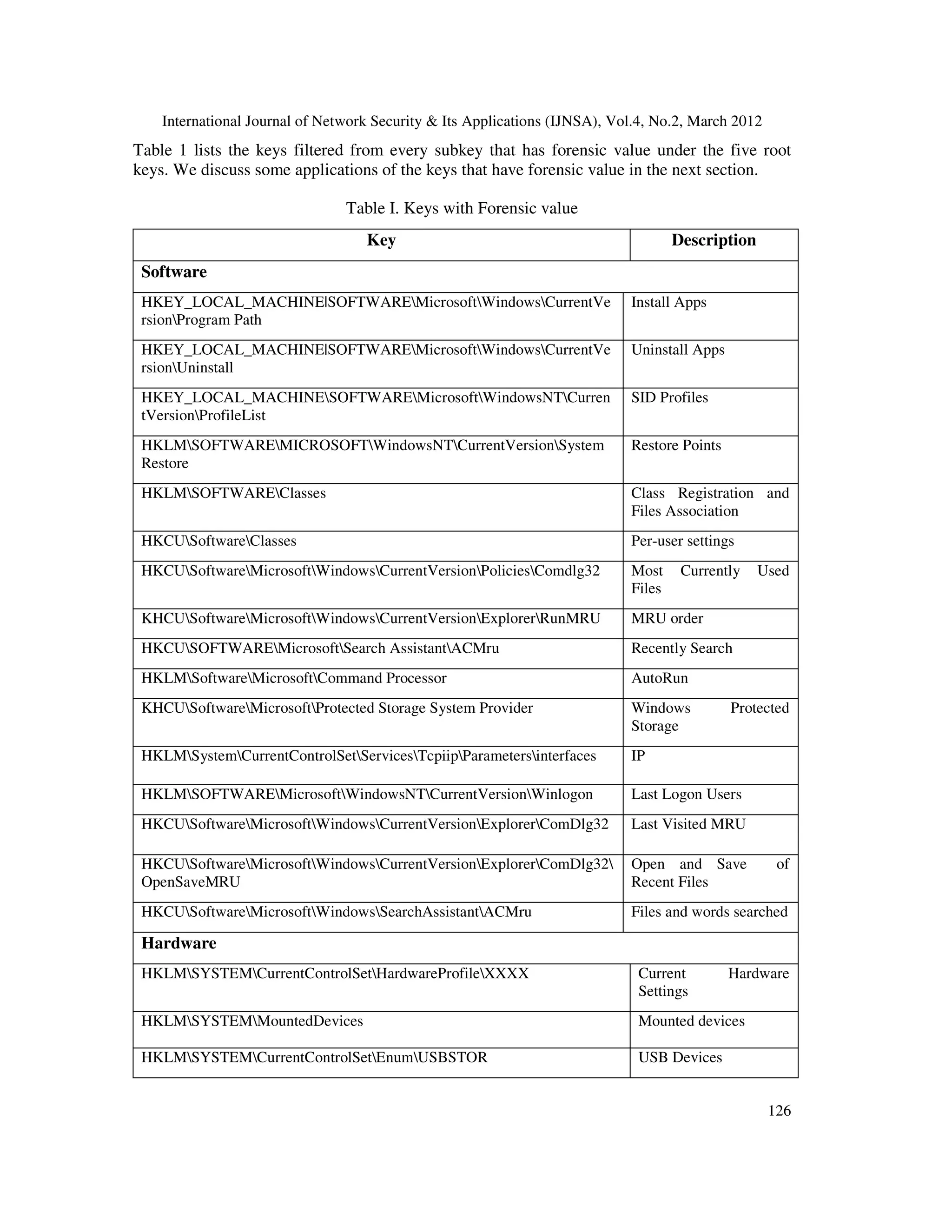
Figure 8. SIDs inWindows Registry
Figure 8 shows there are two users in this computer. The longest string is S-1-5-21-602162358-
839522115-1957994488-1004. “S” indicates that the following string is a SID. The first
number “1” is the revision number. The third part is the authorized level which ranges from 0 to
5. The fourth part is the local or domain machine identifier. In this example, 602162358-
839522115-1957994488 is the local computer identifier. The last part “1004” is a relative
identifier which is also a unique number within a local computer or domain [2].
However, what we see here is just a set of numbers. If there are large amount of strings of
numbers, and we are not familiar with the settings of a computer, then we could not know
which user a SID stands for. In Registry Forensics, it is necessary to map SIDs to users. The
mapping between SIDs and users is stored in SAM, a local security database. With the help of
specific forensic tools, this problem could be resolved easily. If forensic tools are not available,
there is also a manual method that could be used to identify the users. In a Windows system, the
username could appear in “My Documents”. If we could find the relationship between SIDs
and “My documents”, we may resolve the mapping of SIDs to users.
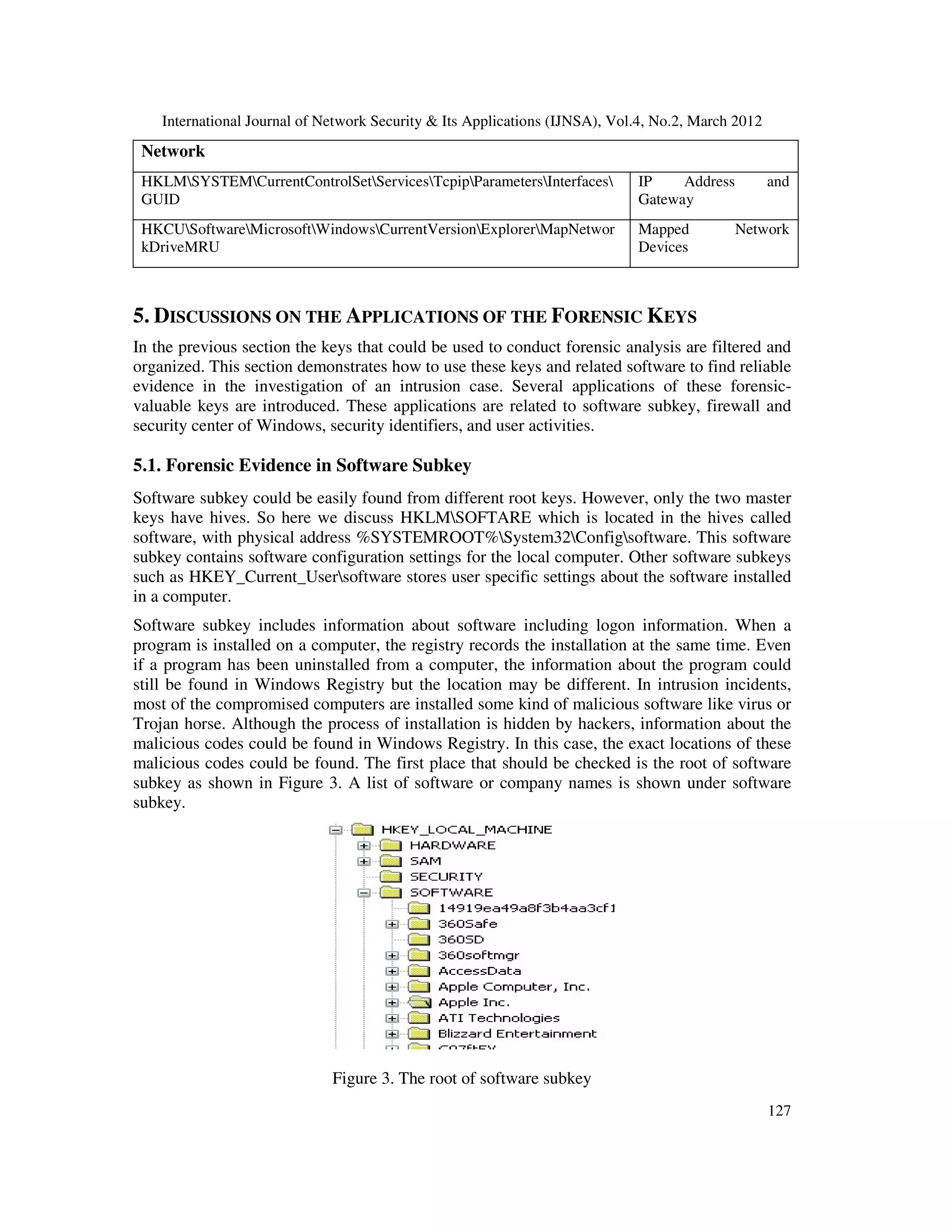
Figure 9. Profile Image Path in Registry
Fortunately, This is possible. HKLMSOFTWAREMicrosoftWindows
NTCurrentVersionProfileList offers a set of subkeys like HKU. The SID S-1-5-21-
602162358-839522115-1957994488-1004 could also be found here. Locate S-1-5-21-
602162358-839522115-1957994488-1004 and check its value. A value named
ProfileImagePath as shown in Figure 9 indicates the path of “My documents” and the username
of the SID is “Hoayang Xie”. The other SID ended with 500 is the default username
“administrator”. In Figure 8, we find that the two SIDs are identical except for the last section
which means the two users are in the same domain. Therefore SIDs can also be used to define
which domain a user belongs to.
As a unique identifier, SID is very important. In real cases, investigators always use SIDs to
look for the targets they want to focus on. If they use professional forensics tools, they could
resolve every part of the SID, which may provide more useful information for forensics.
5.4. Forensics Evidence about System Access through User Activities
User activities include all of the actions that users have performed on a computer. Here we only
focus on those actions that may provide useful information for investigation. In Windows
Registry, most of the user activities are recorded in “ntuser.dat”. Just as the software hive stores](https://image.slidesharecdn.com/0312nsa09-190617091615/75/FORENSIC-ANALYSIS-OF-WINDOWS-REGISTRY-AGAINST-INTRUSION-11-2048.jpg)
![International Journal of Network Security & Its Applications (IJNSA), Vol.4, No.2, March 2012
132
all of the configuration settings of local machine, the “ntuser.dat” stores all of the settings for
specific users. HKCUSoftware subkey contains information about the installed software, and
the major activities that the users performed on the software. In addition, this software subkey
also includes specific user data such as searches, command, username, password, and so on.
The first location we need to discuss is Most Currently Used (MRU) which is used to store
commands and usernames that users entered. For example, the “run” command always
displays a drop down list which lists the recent commands that was entered into the “run”
dialogue. In Windows Registry, we could also find many keys with a suffix MRU.
HKCUSoftwareMicrosoftWindowsCurrentVersionExplorerRunMRU stores the
information in the “run” command drop down list. According to the order of the values in the
value panel, we could know which command is the most recent one. Advanced hackers always
use “run” command rather than graphical interface. When an investigator investigates an
intruder’s computer, according to the commands the intruder entered and the timestamps, the
investigator may be able to decide what the intruder did and when. Besides the “run”
commands, other actions could also be recorded such as the URL typed in Internet Explorer,
the opened DOC files, and so on. Rich information about MRU is stored in different subkeys
and they could offer important clues in a real case.
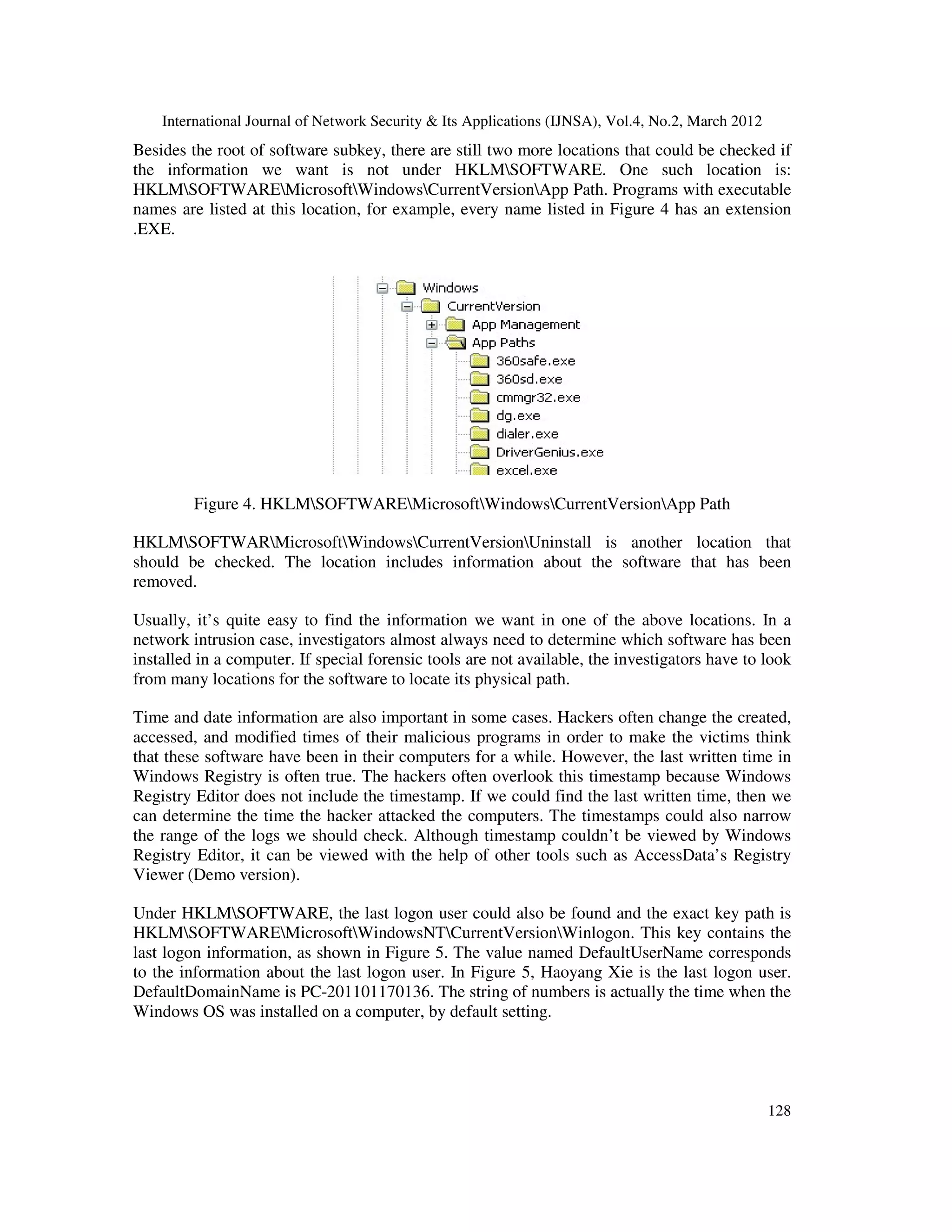
Another important location an investigator has to check is UserAssist key which includes
significant information about users’ activities. The key path of UserAssist is
HKCUSoftwareMicrosoftWindowsCurrentVersionExplorerUserAssist{75048700-EF1F-
11D0-9888-006097DEACF9}Count, as shown in Figure 10. This subkey contains a list of
values with odd names. Actually, the value names are encoded by ROT 13 which means that
the character is rotated 13 characters. With professional forensic tools, the names could be
decoded easily.
Figure 10. The key path of UserAssist
The data of the values can offer very useful evidences. The data is 16-byte. The first 4-byte is
for unknown information at this time; the next 4-byte is a counter designed to record the times a
program has been run [2]. The last 8-byte is a Windows 64-bit timestamp which indicates the
last time a program was run. The counter, the middle 4-byte, starts with number 6 when a
program runs for the first time. Compared with the counter, the timestamp indicated by the last
8 bytes is more important. Some professional tools, such as AccessData’s Registry View (Full
License) [12] and EnCase [13], could decode all of the data including the timestamps, counters,
and value names. If these tools are unavailable, we could use another free tool Dcode (Demo)
[14] to decode the data. For example, the second value’s last 8-byte data is 88 37 3a ba f1 cb
01, which is decoded to “Sun, 03 April 2011 04:47:25 UTC”, as shown in Figure 11.](https://image.slidesharecdn.com/0312nsa09-190617091615/75/FORENSIC-ANALYSIS-OF-WINDOWS-REGISTRY-AGAINST-INTRUSION-12-2048.jpg)
![International Journal of Network Security & Its Applications (IJNSA), Vol.4, No.2, March 2012
133
.
Figure 11. Decode the data of the values using Dcode
Besides these, there is still more information about user activities such as the information about
Protected Storage System Provider, which stores some usernames and passwords. However,
without professional forensic software, we could not read the information. In addition, there is
still more information about MRU which could be found at different locations for different
programs.
6. CONCLUSION
Windows Registry Forensics is a very important branch of computer and network forensics.
The real cases are more complex and different forensic tools need to be used together to
achieve enough evidence. This paper focuses on Windows Registry Forensics. Keys and
subkeys that have forensic value are filtered from Windows Registry and organized. They could
be considered as tools to investigate Windows Registry in real cases. As part of Windows
Registry forensics, this paper discusses the applications of the forensic keys against intrusion.
However, the keys filtered and organized in this paper are not all of the keys that have forensic
values. Windows Registry is huge and the research on it continues. Even if we have known
every key, subkey, and value of Windows Registry, we still have to consider how to use them
in real cases since the intrusion cases will not be the same every time.
REFERENCES
[1] Anson, S., & Bunting, S. (2007). Mastering Windows Network Forensics and Investigation.
Indianapolis: Sybex.
[2] Carvey, H. (2011). Windows Registry Forensics: Advanced Digital Forensic Analysis of the
Windows Registry. Burlington: Syngress.
[3] Farmer, D. J. (n.d.). A forensic analysis of the Windows Registry. Retrieved March 13, 2011,
from http://www.forensicfocus.com/downloads/windows-registry-quick-reference.pdf
[4] Ferri, V. (n.d.). Registry Data Types. Retrieved March 13, 2011, from
http://pubs.logicalexpressions.com/pub0009/LPMArticle.asp?ID=361
[5] Fisher, T. (n.d.). Registry Value. Retrieved March 10, 2011, from About.com PC Support:
http://pcsupport.about.com/od/termsv/g/registryvalue.htm
[6] Honeycutt, J. (2005). Microsoft Windows Registry Guide. Redmond: Microsoft Press.](https://image.slidesharecdn.com/0312nsa09-190617091615/75/FORENSIC-ANALYSIS-OF-WINDOWS-REGISTRY-AGAINST-INTRUSION-13-2048.jpg)
![International Journal of Network Security & Its Applications (IJNSA), Vol.4, No.2, March 2012
134
[7] Ivens, K. (2001, March 19). Registry Data Types. Retrieved March 14, 2011, from
http://www.windowsitpro.com/article/registry2/registry-data-types.aspx
[8] Kamara, L. (n.d.). The Windows Registry Overview. Retrieved March 11, 2011, from
http://ezinearticles.com/?The-Windows-Registry-Overview&id=2274356
[9] Microsoft Corp. (n.d.). Registry Editor overview. Retrieved March 11, 2011, from
http://www.microsoft.com/resources/documentation/windows/xp/all/proddocs/en-
us/regedit_overview.mspx?mfr=true
[10] Microsoft. (2008, February 4). Microsoft Support. Retrieved March 11, 2011, from Windows
registry information for advanced users: http://support.microsoft.com/kb/256986
[11] Wong, L. W. (n.d.). Forensic Analysis of the Windows Registry. Retrieved March 15, 2011,
from http://www.forensicfocus.com/downloads/forensic-analysis-windows-registry.pdf134
[12] AccessData, Registry Viewer. Retrieved February 17, 2012, from
http://accessdata.com/support/adownloads
[13] Guidance Software, EnCase Forensic, Retrieved February 20, 2012, from
http://www.guidancesoftware.com/forensic.htm
[14] Digital Detective, Free Tool-DCode. Retrieved February 20, 2012, from http://www.digital-
detective.co.uk/freetools/decode.asp](https://image.slidesharecdn.com/0312nsa09-190617091615/75/FORENSIC-ANALYSIS-OF-WINDOWS-REGISTRY-AGAINST-INTRUSION-14-2048.jpg)

This paper discusses the significance of Windows registry forensics in aiding computer and network investigations, focusing on its structure and the keys with forensic value. It covers the organization of the Windows registry, detailing its root keys and how forensic analysis can retrieve evidence related to intrusion detection. The authors illustrate the applications of forensic keys to uncover evidence of software installations and potential malicious actions by hackers.


