presentation by : Nisha Burman
Vikrant kumar
Prince kumar
Amisha Sinha
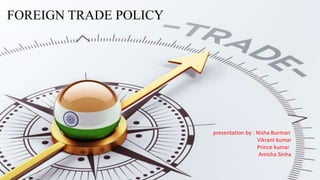
FOREIGN TRADE POLICY
What is foreign trade
• Foreign trade is exchange of capital, goods, and services across international
borders or territories. In most countries, it represents a significant share of gross
domestic product (GDP).
What is foreign trade policy
• Foreign trade policies also known as EXIM policies
• It is basically government actions, especially tariffs, import quotas,
and export subsidies, designed to increase net exports by promoting
exports or restricting imports
Objectives of foreign trade policy
• To accelerate the economy from low level of economic activities to
high level of economic activities by making it a globally oriented
vibrant economy and to derive maximum benefits from expanding
global market opportunities.
• To stimulate sustained economic growth by providing access to
essential raw materials, intermediates, components, consumables
and capital goods required for augmenting production.
Contd…..
• To enhance the techno local strength and efficiency of Indian
agriculture, industry and services, thereby, improving their
competitiveness.
• To generate employment.
• Opportunities and encourage the attainment of internationally
accepted standards of quality.
• To provide quality consumer products at reasonable prices.
Foreign trade policy of India is divided into two phases
• Foreign trade policy before 1991
• Foreign trade policy after 1991
Phase of Indian foreign trade policy before 1991
• Phase I 1947-48 : 1955-56
• Phase II 1956-57 : 1967-68
• Phase III 1968-69 : 1974-75
• Phase IV 1975-76 : 1989-90
Main highlights of phase I
• Liberalization of foreign trade was adopted as the goal of trade policy
• Export control was relaxed
• Export duties were relaxed
• Export quotas were abolished
• Incentive was provided in order to enhance export
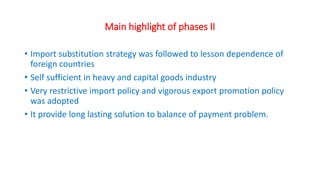
Main highlight of phases II
• Import substitution strategy was followed to lesson dependence of
foreign countries
• Self sufficient in heavy and capital goods industry
• Very restrictive import policy and vigorous export promotion policy
was adopted
• It provide long lasting solution to balance of payment problem.
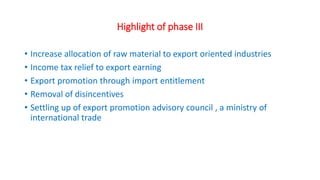
Highlight of phase III
• Increase allocation of raw material to export oriented industries
• Income tax relief to export earning
• Export promotion through import entitlement
• Removal of disincentives
• Settling up of export promotion advisory council , a ministry of
international trade
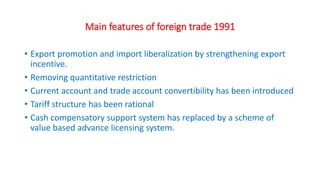
Main features of foreign trade 1991
• Export promotion and import liberalization by strengthening export
incentive.
• Removing quantitative restriction
• Current account and trade account convertibility has been introduced
• Tariff structure has been rational
• Cash compensatory support system has replaced by a scheme of
value based advance licensing system.
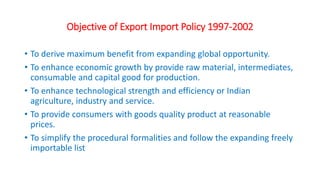
Objective of Export Import Policy 1997-2002
• To derive maximum benefit from expanding global opportunity.
• To enhance economic growth by provide raw material, intermediates,
consumable and capital good for production.
• To enhance technological strength and efficiency or Indian
agriculture, industry and service.
• To provide consumers with goods quality product at reasonable
prices.
• To simplify the procedural formalities and follow the expanding freely
importable list
Export –Import policy 2002-2007
Objectives
• To facilitate sustained growth in export to attain a share of at least 1
% of global merchandise trade.
• To stimulate economic growth by provide access to essential raw
material, intermediate, and capital goods for production and provide
service.
• To enhance technology strength and efficiency of Indian agriculture,
industry and service.
• To provide consumers with good quality goods and service at
internationality competitive price
Highlights of Foreign Trade Policy 2004-2009
• Push to export to garner 1.5% of world share by export $150 billion
worth of merchandise.
• Hundred percent FDI would be permitted for develop infrastructure.
• FDI permitted up to 100 percent to establish and develop free trade
and warehousing zone, each to have a Rs.100 crore outlay.
• Import of seed, bulbs and fibers liberalized.
• New policy exempts all goods and service export form service tax.
Foreign Trade Policy 2009-2014
objectives
• The main objective of policy is to achieving an annual export growth
of 15% with an annual export target of us $ 200 billion by march
2011.
• In remaining 3 years of foreign trade policy up to 2014, the country
should be able to come back on the high export growth of around
25%p.a.
• By 2014, the expect to double India’s export of goods and service.
• The long term policy objective for the government is to double India’s
share in global trade in 2020
Objective of 2015- 20 FTP
• Increase exports to $900 billion by 2019-20, from $466 billion in
2013-14
• Raise India's share in world exports from 2% to 3.5%.
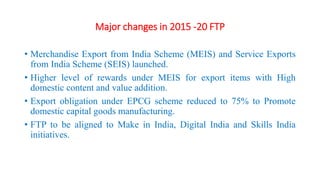
Major changes in 2015 -20 FTP
• Merchandise Export from India Scheme (MEIS) and Service Exports
from India Scheme (SEIS) launched.
• Higher level of rewards under MEIS for export items with High
domestic content and value addition.
• Export obligation under EPCG scheme reduced to 75% to Promote
domestic capital goods manufacturing.
• FTP to be aligned to Make in India, Digital India and Skills India
initiatives.
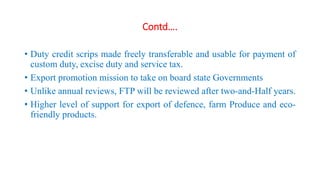
Contd….
• Duty credit scrips made freely transferable and usable for payment of
custom duty, excise duty and service tax.
• Export promotion mission to take on board state Governments
• Unlike annual reviews, FTP will be reviewed after two-and-Half years.
• Higher level of support for export of defence, farm Produce and eco-
friendly products.
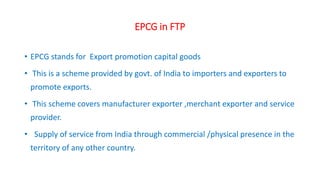
EPCG in FTP
• EPCG stands for Export promotion capital goods
• This is a scheme provided by govt. of India to importers and exporters to
promote exports.
• This scheme covers manufacturer exporter ,merchant exporter and service
provider.
• Supply of service from India through commercial /physical presence in the
territory of any other country.
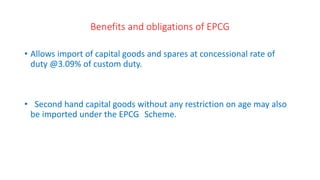
Benefits and obligations of EPCG
• Allows import of capital goods and spares at concessional rate of
duty @3.09% of custom duty.
• Second hand capital goods without any restriction on age may also
be imported under the EPCG Scheme.
Foreign trade policy

Foreign trade policy

  • 1.
    presentation by :Nisha Burman Vikrant kumar Prince kumar Amisha Sinha FOREIGN TRADE POLICY
  • 2.
    What is foreigntrade • Foreign trade is exchange of capital, goods, and services across international borders or territories. In most countries, it represents a significant share of gross domestic product (GDP).
  • 3.
    What is foreigntrade policy • Foreign trade policies also known as EXIM policies • It is basically government actions, especially tariffs, import quotas, and export subsidies, designed to increase net exports by promoting exports or restricting imports
  • 4.
    Objectives of foreigntrade policy • To accelerate the economy from low level of economic activities to high level of economic activities by making it a globally oriented vibrant economy and to derive maximum benefits from expanding global market opportunities. • To stimulate sustained economic growth by providing access to essential raw materials, intermediates, components, consumables and capital goods required for augmenting production.
  • 5.
    Contd….. • To enhancethe techno local strength and efficiency of Indian agriculture, industry and services, thereby, improving their competitiveness. • To generate employment. • Opportunities and encourage the attainment of internationally accepted standards of quality. • To provide quality consumer products at reasonable prices.
  • 6.
    Foreign trade policyof India is divided into two phases • Foreign trade policy before 1991 • Foreign trade policy after 1991
  • 7.
    Phase of Indianforeign trade policy before 1991 • Phase I 1947-48 : 1955-56 • Phase II 1956-57 : 1967-68 • Phase III 1968-69 : 1974-75 • Phase IV 1975-76 : 1989-90
  • 8.
    Main highlights ofphase I • Liberalization of foreign trade was adopted as the goal of trade policy • Export control was relaxed • Export duties were relaxed • Export quotas were abolished • Incentive was provided in order to enhance export
  • 9.
    Main highlight ofphases II • Import substitution strategy was followed to lesson dependence of foreign countries • Self sufficient in heavy and capital goods industry • Very restrictive import policy and vigorous export promotion policy was adopted • It provide long lasting solution to balance of payment problem.
  • 10.
    Highlight of phaseIII • Increase allocation of raw material to export oriented industries • Income tax relief to export earning • Export promotion through import entitlement • Removal of disincentives • Settling up of export promotion advisory council , a ministry of international trade
  • 11.
    Main features offoreign trade 1991 • Export promotion and import liberalization by strengthening export incentive. • Removing quantitative restriction • Current account and trade account convertibility has been introduced • Tariff structure has been rational • Cash compensatory support system has replaced by a scheme of value based advance licensing system.
  • 12.
    Objective of ExportImport Policy 1997-2002 • To derive maximum benefit from expanding global opportunity. • To enhance economic growth by provide raw material, intermediates, consumable and capital good for production. • To enhance technological strength and efficiency or Indian agriculture, industry and service. • To provide consumers with goods quality product at reasonable prices. • To simplify the procedural formalities and follow the expanding freely importable list
  • 13.
    Export –Import policy2002-2007 Objectives • To facilitate sustained growth in export to attain a share of at least 1 % of global merchandise trade. • To stimulate economic growth by provide access to essential raw material, intermediate, and capital goods for production and provide service. • To enhance technology strength and efficiency of Indian agriculture, industry and service. • To provide consumers with good quality goods and service at internationality competitive price
  • 14.
    Highlights of ForeignTrade Policy 2004-2009 • Push to export to garner 1.5% of world share by export $150 billion worth of merchandise. • Hundred percent FDI would be permitted for develop infrastructure. • FDI permitted up to 100 percent to establish and develop free trade and warehousing zone, each to have a Rs.100 crore outlay. • Import of seed, bulbs and fibers liberalized. • New policy exempts all goods and service export form service tax.
  • 15.
    Foreign Trade Policy2009-2014 objectives • The main objective of policy is to achieving an annual export growth of 15% with an annual export target of us $ 200 billion by march 2011. • In remaining 3 years of foreign trade policy up to 2014, the country should be able to come back on the high export growth of around 25%p.a. • By 2014, the expect to double India’s export of goods and service. • The long term policy objective for the government is to double India’s share in global trade in 2020
  • 16.
    Objective of 2015-20 FTP • Increase exports to $900 billion by 2019-20, from $466 billion in 2013-14 • Raise India's share in world exports from 2% to 3.5%.
  • 17.
    Major changes in2015 -20 FTP • Merchandise Export from India Scheme (MEIS) and Service Exports from India Scheme (SEIS) launched. • Higher level of rewards under MEIS for export items with High domestic content and value addition. • Export obligation under EPCG scheme reduced to 75% to Promote domestic capital goods manufacturing. • FTP to be aligned to Make in India, Digital India and Skills India initiatives.
  • 18.
    Contd…. • Duty creditscrips made freely transferable and usable for payment of custom duty, excise duty and service tax. • Export promotion mission to take on board state Governments • Unlike annual reviews, FTP will be reviewed after two-and-Half years. • Higher level of support for export of defence, farm Produce and eco- friendly products.
  • 19.
    EPCG in FTP •EPCG stands for Export promotion capital goods • This is a scheme provided by govt. of India to importers and exporters to promote exports. • This scheme covers manufacturer exporter ,merchant exporter and service provider. • Supply of service from India through commercial /physical presence in the territory of any other country.
  • 20.
    Benefits and obligationsof EPCG • Allows import of capital goods and spares at concessional rate of duty @3.09% of custom duty. • Second hand capital goods without any restriction on age may also be imported under the EPCG Scheme.