Foreign Health Care Policy
Why look overseas?Many countries mandate health care for all their citizensThe Commonwealth Fund’s 2007 health policy survey compared U.S. system with 6 nations: Australia, Canada, Germany, the Netherlands, New Zealand, and the U.K.2007- The U.S.A. spent $6697 per capita on health expenses2007- Canada spent $3326 per capita (next highest)23% of Americans prevented by expense to fill prescriptions13% of Australians could not afford to fill prescriptions20% of Americans and Australians experienced medical error while under care
How do the others pay for insurance?Single payer modelTax payers and employers pay into national fundPays for regular treatment and prescriptionsProviders are compensated through fundMulti payer modelBoth private and public funds are usedEmployers can opt to pay for insurance or buy into government planSelf-employed are given many affordable plansDisadvantaged get subsidized or free insuranceBoth models utilize price-control mechanisms
Canada’s Health PolicyPublic administration, comprehensiveness, universality, portability and accessibilityThe Federal-Provincial Arrangements and Established Programs Financing Act of 1977Provided block funding to provincesConcern that funds were diverted for non-health activitiesCanada Health Act of 1984Established criteria to be met in order to receive federal fundsProvinces given 3 years to comply
Canada Health Act		Universal health insurance coverage for all CanadiansFinanced through federal government and provincial revenuesServices are mostly fee-for-service basisNearly half of the estimated $100 billion budget spent on hospitals and physiciansPhysicians exhibit direct influence on health care costsOther health care professionals may be more effective and less expensiveIncludes nurses, chiropractors and midwives
Canada Health ActGuaranteed health care, not access to conditions leading to good healthDetermining factors:  SES, age, gender, occupationSES—affects mortality, morbidity, disabilityAge—affected mostly by the young and the elderlyGender—women may live longer, but have more health problemsOccupation—may be affected by hazardous working conditionsNeeds to shift focus onto maintaining and improving health from different dimensionsDevelop and promote programs that enhance overall wellnessHealth interventions starting with young children
Taiwan’s Health PolicyPromoting social equity, raising efficiency, elevating the quality of care and forging a national consensusNational Health Insurance (NHI) enacted in 1995Original goal was to improve access to health careSocial insurance program organized by the federal governmentOperated by the Bureau of National Health InsuranceFour committees—The NHI dispute mediation committee, NHI medical expenditure negotiations committee and NHI task forceRequired enrollment for all Taiwanese citizens and any legal residentsPayroll-based premiumsSubsidies for the disadvantaged
NHIPremiums set by ability to pay and pooling of resourcesTaiwan’s population is subdivided into 6 groups Groups 1-3 pay based on income, 4-6 based on average premiums paid by general populationCivil servants, teachers, self-employedOccupational union members, foreign crewFarmers, fishermenMilitaryLow income workersUnemployed
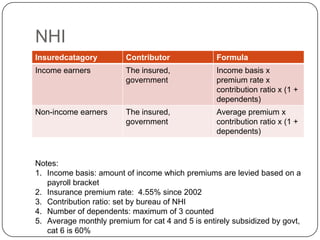
NHINotes:Income basis: amount of income which premiums are levied based on a payroll bracketInsurance premium rate:  4.55% since 2002Contribution ratio: set by bureau of NHINumber of dependents: maximum of 3 countedAverage monthly premium for cat 4 and 5 is entirely subsidized by govt, cat 6 is 60%
NHI  Financing—not for profitRequired by law to maintain reserve fund for at least one monthFunded mostly by  paid premiums Rates are reviewed bi-annually adjusted once since 1994Private sector employees pay 30%, employer or registration organization 60%, government pays 10%Pay for service copay by the insuredCopay is higher at medical centers and hospitals than in clinicsCopayment exemption for patients with catastrophic illnesses, childbirth, veterans, disadvantaged, children under age 3Other financial sources include fines on overdue premiums, lottery, tax surcharge on cigarettes
NHICurrently NHI focus is shifting to quality of care: 3 goalsExpand patients’ knowledge by making information on quality and services transparentPay greater attention to quality of medical services delivered to the disadvantagedGreater emphasis on patient safetyNow includes holistic care for chronic ailments Global budgeting system initiated in 1998 Targeted dental, traditional Chinese medicine, Western medicine clinics and hospitalsHelped to prevent supplier induced demand
NHI Access to Health Care	As of December 2008 98% of all health care facilities were contracted with NHIInsured members receive a card that enables him to choose any contracted facility for treatmentCut waiting times to visit a doctorInsured members receive reimbursement for emergency procedures performed overseasSince 2006, insurance premiums can be deducted from income taxes
Germany’s Health CareThree health insurance options for GermansGovernment regulated public health insurance GKV Private health insurance PKV  A combination of bothThe health insurance reform of 2007 requires all German residents to be insured for at least hospital and outpatient medical treatmentMeant to drive competitions between insurance providersIn order to reduce costs, out of pocket expenses have risen
GKVMost popular among Germans (approx. 70 million people)Membership compulsory for citizens earning less than 48,600 Euro annuallyCompetition is based on service not pricePremiums are 15.5% of monthly incomeMaximum threshold is 570 EuroApproximately 45% is paid by employerBenefits to the insured In-patient hospital careOut-patient care with registered doctorsBasic dental care
PKVPrivate Medical InsuranceCovers wider choice of medical and dental treatment than GKVPrivate insurance holders may receive more specialized servicePremium costs are higher than GKVPrices are based on benefits chosen as well as age, gender, and pre-existing conditionsPremiums are traditionally per person rather than per familyPrivate insurance companies cannot cancel a policy if the insured submits a claim10% of monthly premiums are put aside to help stabilize premium prices after retirement
 Benefits from these modelsCanada-  Canada offers similar patents for prescription drugs as in the U.S. but they regulate drug prices on all patented drugs 	Patented Medicines Review BoardCanadian health care encompasses the idea that all Canadians are entitled to accessible affordable health careTaiwan-The insured is given freedom to choose doctors and services as well as their venuesAlternative and Chinese medicine are offered through NHIGermany-By regulating premium rates in any GKV, competition is based on performance and benefit to the insured rather than priceThere are several options for PKV benefits that can supplement GKV

Foreign Health Policy

  • 1.
  • 2.
    Why look overseas?Manycountries mandate health care for all their citizensThe Commonwealth Fund’s 2007 health policy survey compared U.S. system with 6 nations: Australia, Canada, Germany, the Netherlands, New Zealand, and the U.K.2007- The U.S.A. spent $6697 per capita on health expenses2007- Canada spent $3326 per capita (next highest)23% of Americans prevented by expense to fill prescriptions13% of Australians could not afford to fill prescriptions20% of Americans and Australians experienced medical error while under care
  • 3.
    How do theothers pay for insurance?Single payer modelTax payers and employers pay into national fundPays for regular treatment and prescriptionsProviders are compensated through fundMulti payer modelBoth private and public funds are usedEmployers can opt to pay for insurance or buy into government planSelf-employed are given many affordable plansDisadvantaged get subsidized or free insuranceBoth models utilize price-control mechanisms
  • 4.
    Canada’s Health PolicyPublicadministration, comprehensiveness, universality, portability and accessibilityThe Federal-Provincial Arrangements and Established Programs Financing Act of 1977Provided block funding to provincesConcern that funds were diverted for non-health activitiesCanada Health Act of 1984Established criteria to be met in order to receive federal fundsProvinces given 3 years to comply
  • 5.
    Canada Health Act Universalhealth insurance coverage for all CanadiansFinanced through federal government and provincial revenuesServices are mostly fee-for-service basisNearly half of the estimated $100 billion budget spent on hospitals and physiciansPhysicians exhibit direct influence on health care costsOther health care professionals may be more effective and less expensiveIncludes nurses, chiropractors and midwives
  • 6.
    Canada Health ActGuaranteedhealth care, not access to conditions leading to good healthDetermining factors: SES, age, gender, occupationSES—affects mortality, morbidity, disabilityAge—affected mostly by the young and the elderlyGender—women may live longer, but have more health problemsOccupation—may be affected by hazardous working conditionsNeeds to shift focus onto maintaining and improving health from different dimensionsDevelop and promote programs that enhance overall wellnessHealth interventions starting with young children
  • 7.
    Taiwan’s Health PolicyPromotingsocial equity, raising efficiency, elevating the quality of care and forging a national consensusNational Health Insurance (NHI) enacted in 1995Original goal was to improve access to health careSocial insurance program organized by the federal governmentOperated by the Bureau of National Health InsuranceFour committees—The NHI dispute mediation committee, NHI medical expenditure negotiations committee and NHI task forceRequired enrollment for all Taiwanese citizens and any legal residentsPayroll-based premiumsSubsidies for the disadvantaged
  • 8.
    NHIPremiums set byability to pay and pooling of resourcesTaiwan’s population is subdivided into 6 groups Groups 1-3 pay based on income, 4-6 based on average premiums paid by general populationCivil servants, teachers, self-employedOccupational union members, foreign crewFarmers, fishermenMilitaryLow income workersUnemployed
  • 9.
    NHINotes:Income basis: amountof income which premiums are levied based on a payroll bracketInsurance premium rate: 4.55% since 2002Contribution ratio: set by bureau of NHINumber of dependents: maximum of 3 countedAverage monthly premium for cat 4 and 5 is entirely subsidized by govt, cat 6 is 60%
  • 10.
    NHI Financing—notfor profitRequired by law to maintain reserve fund for at least one monthFunded mostly by paid premiums Rates are reviewed bi-annually adjusted once since 1994Private sector employees pay 30%, employer or registration organization 60%, government pays 10%Pay for service copay by the insuredCopay is higher at medical centers and hospitals than in clinicsCopayment exemption for patients with catastrophic illnesses, childbirth, veterans, disadvantaged, children under age 3Other financial sources include fines on overdue premiums, lottery, tax surcharge on cigarettes
  • 11.
    NHICurrently NHI focusis shifting to quality of care: 3 goalsExpand patients’ knowledge by making information on quality and services transparentPay greater attention to quality of medical services delivered to the disadvantagedGreater emphasis on patient safetyNow includes holistic care for chronic ailments Global budgeting system initiated in 1998 Targeted dental, traditional Chinese medicine, Western medicine clinics and hospitalsHelped to prevent supplier induced demand
  • 12.
    NHI Access toHealth Care As of December 2008 98% of all health care facilities were contracted with NHIInsured members receive a card that enables him to choose any contracted facility for treatmentCut waiting times to visit a doctorInsured members receive reimbursement for emergency procedures performed overseasSince 2006, insurance premiums can be deducted from income taxes
  • 13.
    Germany’s Health CareThreehealth insurance options for GermansGovernment regulated public health insurance GKV Private health insurance PKV A combination of bothThe health insurance reform of 2007 requires all German residents to be insured for at least hospital and outpatient medical treatmentMeant to drive competitions between insurance providersIn order to reduce costs, out of pocket expenses have risen
  • 14.
    GKVMost popular amongGermans (approx. 70 million people)Membership compulsory for citizens earning less than 48,600 Euro annuallyCompetition is based on service not pricePremiums are 15.5% of monthly incomeMaximum threshold is 570 EuroApproximately 45% is paid by employerBenefits to the insured In-patient hospital careOut-patient care with registered doctorsBasic dental care
  • 15.
    PKVPrivate Medical InsuranceCoverswider choice of medical and dental treatment than GKVPrivate insurance holders may receive more specialized servicePremium costs are higher than GKVPrices are based on benefits chosen as well as age, gender, and pre-existing conditionsPremiums are traditionally per person rather than per familyPrivate insurance companies cannot cancel a policy if the insured submits a claim10% of monthly premiums are put aside to help stabilize premium prices after retirement
  • 16.
    Benefits fromthese modelsCanada- Canada offers similar patents for prescription drugs as in the U.S. but they regulate drug prices on all patented drugs Patented Medicines Review BoardCanadian health care encompasses the idea that all Canadians are entitled to accessible affordable health careTaiwan-The insured is given freedom to choose doctors and services as well as their venuesAlternative and Chinese medicine are offered through NHIGermany-By regulating premium rates in any GKV, competition is based on performance and benefit to the insured rather than priceThere are several options for PKV benefits that can supplement GKV

Editor's Notes

  • #5 Block funding is a set amount of federal money for each province based on population which would be paid partly in cash and partly in tax pointsSpent on health but provinces didn’t have to match expenditures with the fed. Non health activities included road building.After 3 yrs provinces had to end all extra billing and user charges
  • #6 Influence of doctors includes # and types of procedures and interventions offered
  • #7 SES, conditions like hbp, respiratory disease, mental health disorders. Womens health issues includes heart disease (often undetected) , eating disordersHazardous work conditions include, chemicals radiation, loud noises
  • #11 Copay is based on referral to hospitals and encourages people to use gap's or Chinese medicine clinics first.