The Affordable Care Act, Behavioral Health and Implications For Rural Communities William J. Hudock Senior Public Health Advisor Substance Use and Mental Health Services Administration
Patient Protection and Affordable Care Act (ACA) The Act Does Several Things: Expands Insurance Coverage Institutes Insurance Reforms Builds Infrastructure To Provide Improved Health Outcomes Puts In Motion Structural Changes To How Healthcare Delivery Is Structured & Financed Goals of Act Are To: Increase Access Provide Comprehensive Care    Better Health Outcomes Control Costs
Most Provisions of ACA Are Implemented Over The Next Four Years Phased Implementation Is Needed To: Build Needed Infrastructure Plan and Implement Provisions Well Changes To Benefits and Insurance Reforms Began To Be Implemented In 2010 Some Provisions Must Be Implemented Over Several Years Major Coverage Expansion Occurs in 2014 Longer-term Benefits Result From Sum of Structural and Cultural Changes
Expanded Health Insurance Coverage - 2014 Insurance Coverage Expands From 83% to 94% Individual Mandate Applies Subsidies For Those Under 400% FPL Medicaid Eligibility Set At 133% FPL + 5% Income Disregard = 138% FPL Medicaid Expands from 34 to 50 Million 25 Million Get Insurance Through State Exchanges Pre-existing Condition Limitation Prohibited – 129 Million Americans Protected
Result of Coverage Expansion Result of Change in Coverage for non-elderly individuals (by 2019) 158 M will have coverage through employers 50 M will have coverage through Medicaid/CHIP 25 M will have coverage through exchanges 26 M will have coverage through non-group plans 26 M will remain uninsured Source:  Congressional Budget Office
Impact on Rural Populations Rural Populations Currently More Apt To Be Uninsured 36% of Employers Don’t Offer Coverage 40% of Self-Employed Not Insured 30.6% of Rural Population Eligible for Subsidies Adults and Children More Apt To Qualify For Current and Expanded Medicaid Coverage Source: Rural Policy Research Institute
Impact on Coverage Expansion  Prior to implementation of coverage expansion: 39% of individuals served by State Mental Health Authorities have no insurance 61% of the individuals served by State Substance Abuse Agencies have no insurance Many of these individuals will be covered in 2014 (or sooner)—most likely by the expansion in Medicaid
What Do We Know About the  Newly Covered?  Annual Insurance Coverage 47% of poor adults have insurance at some point in the year 35% are uninsured all year 18% are insured all year 60% forgo medical care due to coverage Conditions are more acute when they present Care is more costly Source:  Center on Budget and Policy Priorities
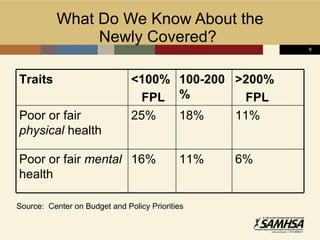
What Do We Know About the  Newly Covered?  Source:  Center on Budget and Policy Priorities Traits <100% FPL  100-200%  >200% FPL Poor or fair  physical  health 25% 18% 11% Poor or fair  mental  health 16% 11% 6%
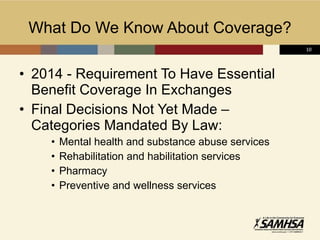
What Do We Know About Coverage? 2014 - Requirement To Have Essential Benefit Coverage In Exchanges Final Decisions Not Yet Made – Categories Mandated By Law: Mental health and substance abuse services Rehabilitation and habilitation services Pharmacy Preventive and wellness services
Provisions Of Interest To Rural Areas National Quality Strategy Core Principles Include All Service Locations & Goal To Eliminate Disparities in Care Workforce Provisions Address Health Professional Shortages – Loan Repayment and Scholarships through National Health Service Corps. Major Increases in Federally Qualified Health Centers Incentives to Adopt Electronic Health Records Increased Focus on Telemedicine
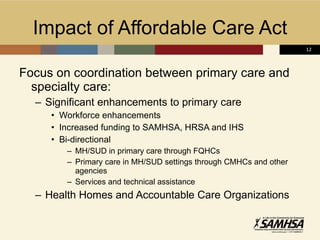
Impact of Affordable Care Act  Focus on coordination between primary care and specialty care: Significant enhancements to primary care Workforce enhancements Increased funding to SAMHSA, HRSA and IHS Bi-directional  MH/SUD in primary care through FQHCs Primary care in MH/SUD settings through CMHCs and other agencies Services and technical assistance Health Homes and Accountable Care Organizations
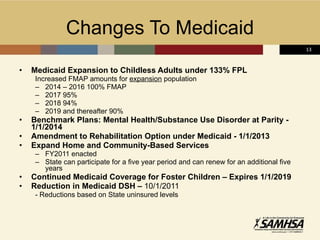
Changes To Medicaid Medicaid Expansion to Childless Adults under 133% FPL  Increased FMAP amounts for  expansion  population 2014 – 2016 100% FMAP 2017 95% 2018 94% 2019 and thereafter 90% Benchmark Plans: Mental Health/Substance Use Disorder at Parity - 1/1/2014 Amendment to Rehabilitation Option under Medicaid - 1/1/2013 Expand Home and Community-Based Services FY2011 enacted State can participate for a five year period and can renew for an additional five years Continued Medicaid Coverage for Foster Children – Expires 1/1/2019 Reduction in Medicaid DSH –  10/1/2011 - Reductions based on State uninsured levels
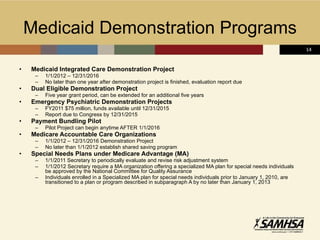
Medicaid Demonstration Programs Medicaid Integrated Care Demonstration Project 1/1/2012 – 12/31/2016 No later than one year after demonstration project is finished, evaluation report due Dual Eligible Demonstration Project Five year grant period, can be extended for an additional five years Emergency Psychiatric Demonstration Projects FY2011 $75 million, funds available until 12/31/2015 Report due to Congress by 12/31/2015 Payment Bundling Pilot Pilot Project can begin anytime AFTER 1/1/2016 Medicare Accountable Care Organizations 1/1/2012 – 12/31/2016 Demonstration Project  No later than 1/1/2012 establish shared saving program  Special Needs Plans under Medicare Advantage (MA) 1/1/2011 Secretary to periodically evaluate and revise risk adjustment system 1/1/2012 Secretary require a MA organization offering a specialized MA plan for special needs individuals be approved by the National Committee for Quality Assurance Individuals enrolled in a Specialized MA plan for special needs individuals prior to January 1, 2010, are transitioned to a plan or program described in subparagraph A by no later than January 1, 2013
Elements of Expanded Coverage 1/1/2014
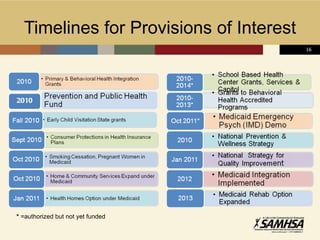
Timelines for Provisions of Interest *  =authorized but not yet funded 2010
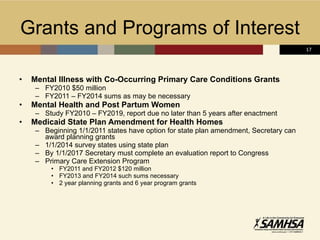
Grants and Programs of Interest Mental Illness with Co-Occurring Primary Care Conditions Grants FY2010 $50 million FY2011 – FY2014 sums as may be necessary Mental Health and Post Partum Women Study FY2010 – FY2019, report due no later than 5 years after enactment Medicaid State Plan Amendment for Health Homes Beginning 1/1/2011 states have option for state plan amendment, Secretary can award planning grants 1/1/2014 survey states using state plan  By 1/1/2017 Secretary must complete an evaluation report to Congress Primary Care Extension Program FY2011 and FY2012 $120 million FY2013 and FY2014 such sums necessary 2 year planning grants and 6 year program grants
Grants and Programs of Interest Maternal, Infant and Early Childhood Home Visiting Program No later than  6 months after enactment States conduct a needs assessment Report due 3 years after the initial start of the program Final report due 12/31/2015 FY2010 $100 million  FY2011 $250 million FY2012 $350 million  FY2013 $400 million FY2014 $400 million School-Based Health Centers include Mental Health/Substance Use Disorders Grants FY2010 – FY2014 National Prevention Strategy 7/1/2010 – 1/1/2015 submit annual National Prevention and Health Promotion Strategy Report to Congress and President Grants to Accredited Programs and Mental Health Organizations for training Behavioral Health Professionals FY2010 – FY2013 Varied Amounts Available
Provisions of Health Reform Now In Place Consumer Protections  Protect 194 million Americans with private insurance : Insurers can no longer deny children under 19 coverage for a preexisting condition Insurance companies can’t cancel your policy if you get sick or have not committed fraud no more lifetime caps on how much insurers will pay You have a right to appeal, including external appeal
Provisions of Health Reform Now In Place Additions To Coverage: Medicare prescription drug beneficiaries who hit the so-called ā€˜doughnut hole’ gap in catastrophic coverage will receive 50% discount on brand name drugs this year. Over 1 million seniors in ā€˜doughnut hole’ received $250 checks in 2010  Consumers in  new  health plans will be able to:  Receive cost-free preventive services such as screenings, vaccinations and counseling without any out-of-pocket costs.  Keep young adults on a parent’s plan until age 26 Choose a primary care doctor, ob/gyn and pediatrician Use the nearest emergency room without penalty
Final Thoughts ACA Will Meaningfully Help Those Who Are At Risk For or Need Behavioral Health Services Change Is Complex and Imperfect – It Takes Time New Partnerships and Ways of Doing Business Will Be Needed We Who Serve Others Will Need To Keep Up With The Changes We Need To Keep Our Compass On True North
True North For SAMHSA Four Simple Truths: Behavioral Health Is Essential To Health Prevention Works Treatment Is Effective People Recover
Ā 

ACA Implications in Mental Health

  • 1.
    The Affordable CareAct, Behavioral Health and Implications For Rural Communities William J. Hudock Senior Public Health Advisor Substance Use and Mental Health Services Administration
  • 2.
    Patient Protection andAffordable Care Act (ACA) The Act Does Several Things: Expands Insurance Coverage Institutes Insurance Reforms Builds Infrastructure To Provide Improved Health Outcomes Puts In Motion Structural Changes To How Healthcare Delivery Is Structured & Financed Goals of Act Are To: Increase Access Provide Comprehensive Care  Better Health Outcomes Control Costs
  • 3.
    Most Provisions ofACA Are Implemented Over The Next Four Years Phased Implementation Is Needed To: Build Needed Infrastructure Plan and Implement Provisions Well Changes To Benefits and Insurance Reforms Began To Be Implemented In 2010 Some Provisions Must Be Implemented Over Several Years Major Coverage Expansion Occurs in 2014 Longer-term Benefits Result From Sum of Structural and Cultural Changes
  • 4.
    Expanded Health InsuranceCoverage - 2014 Insurance Coverage Expands From 83% to 94% Individual Mandate Applies Subsidies For Those Under 400% FPL Medicaid Eligibility Set At 133% FPL + 5% Income Disregard = 138% FPL Medicaid Expands from 34 to 50 Million 25 Million Get Insurance Through State Exchanges Pre-existing Condition Limitation Prohibited – 129 Million Americans Protected
  • 5.
    Result of CoverageExpansion Result of Change in Coverage for non-elderly individuals (by 2019) 158 M will have coverage through employers 50 M will have coverage through Medicaid/CHIP 25 M will have coverage through exchanges 26 M will have coverage through non-group plans 26 M will remain uninsured Source: Congressional Budget Office
  • 6.
    Impact on RuralPopulations Rural Populations Currently More Apt To Be Uninsured 36% of Employers Don’t Offer Coverage 40% of Self-Employed Not Insured 30.6% of Rural Population Eligible for Subsidies Adults and Children More Apt To Qualify For Current and Expanded Medicaid Coverage Source: Rural Policy Research Institute
  • 7.
    Impact on CoverageExpansion Prior to implementation of coverage expansion: 39% of individuals served by State Mental Health Authorities have no insurance 61% of the individuals served by State Substance Abuse Agencies have no insurance Many of these individuals will be covered in 2014 (or sooner)—most likely by the expansion in Medicaid
  • 8.
    What Do WeKnow About the Newly Covered? Annual Insurance Coverage 47% of poor adults have insurance at some point in the year 35% are uninsured all year 18% are insured all year 60% forgo medical care due to coverage Conditions are more acute when they present Care is more costly Source: Center on Budget and Policy Priorities
  • 9.
    What Do WeKnow About the Newly Covered? Source: Center on Budget and Policy Priorities Traits <100% FPL 100-200% >200% FPL Poor or fair physical health 25% 18% 11% Poor or fair mental health 16% 11% 6%
  • 10.
    What Do WeKnow About Coverage? 2014 - Requirement To Have Essential Benefit Coverage In Exchanges Final Decisions Not Yet Made – Categories Mandated By Law: Mental health and substance abuse services Rehabilitation and habilitation services Pharmacy Preventive and wellness services
  • 11.
    Provisions Of InterestTo Rural Areas National Quality Strategy Core Principles Include All Service Locations & Goal To Eliminate Disparities in Care Workforce Provisions Address Health Professional Shortages – Loan Repayment and Scholarships through National Health Service Corps. Major Increases in Federally Qualified Health Centers Incentives to Adopt Electronic Health Records Increased Focus on Telemedicine
  • 12.
    Impact of AffordableCare Act Focus on coordination between primary care and specialty care: Significant enhancements to primary care Workforce enhancements Increased funding to SAMHSA, HRSA and IHS Bi-directional MH/SUD in primary care through FQHCs Primary care in MH/SUD settings through CMHCs and other agencies Services and technical assistance Health Homes and Accountable Care Organizations
  • 13.
    Changes To MedicaidMedicaid Expansion to Childless Adults under 133% FPL Increased FMAP amounts for expansion population 2014 – 2016 100% FMAP 2017 95% 2018 94% 2019 and thereafter 90% Benchmark Plans: Mental Health/Substance Use Disorder at Parity - 1/1/2014 Amendment to Rehabilitation Option under Medicaid - 1/1/2013 Expand Home and Community-Based Services FY2011 enacted State can participate for a five year period and can renew for an additional five years Continued Medicaid Coverage for Foster Children – Expires 1/1/2019 Reduction in Medicaid DSH – 10/1/2011 - Reductions based on State uninsured levels
  • 14.
    Medicaid Demonstration ProgramsMedicaid Integrated Care Demonstration Project 1/1/2012 – 12/31/2016 No later than one year after demonstration project is finished, evaluation report due Dual Eligible Demonstration Project Five year grant period, can be extended for an additional five years Emergency Psychiatric Demonstration Projects FY2011 $75 million, funds available until 12/31/2015 Report due to Congress by 12/31/2015 Payment Bundling Pilot Pilot Project can begin anytime AFTER 1/1/2016 Medicare Accountable Care Organizations 1/1/2012 – 12/31/2016 Demonstration Project No later than 1/1/2012 establish shared saving program Special Needs Plans under Medicare Advantage (MA) 1/1/2011 Secretary to periodically evaluate and revise risk adjustment system 1/1/2012 Secretary require a MA organization offering a specialized MA plan for special needs individuals be approved by the National Committee for Quality Assurance Individuals enrolled in a Specialized MA plan for special needs individuals prior to January 1, 2010, are transitioned to a plan or program described in subparagraph A by no later than January 1, 2013
  • 15.
    Elements of ExpandedCoverage 1/1/2014
  • 16.
    Timelines for Provisionsof Interest * =authorized but not yet funded 2010
  • 17.
    Grants and Programsof Interest Mental Illness with Co-Occurring Primary Care Conditions Grants FY2010 $50 million FY2011 – FY2014 sums as may be necessary Mental Health and Post Partum Women Study FY2010 – FY2019, report due no later than 5 years after enactment Medicaid State Plan Amendment for Health Homes Beginning 1/1/2011 states have option for state plan amendment, Secretary can award planning grants 1/1/2014 survey states using state plan By 1/1/2017 Secretary must complete an evaluation report to Congress Primary Care Extension Program FY2011 and FY2012 $120 million FY2013 and FY2014 such sums necessary 2 year planning grants and 6 year program grants
  • 18.
    Grants and Programsof Interest Maternal, Infant and Early Childhood Home Visiting Program No later than 6 months after enactment States conduct a needs assessment Report due 3 years after the initial start of the program Final report due 12/31/2015 FY2010 $100 million FY2011 $250 million FY2012 $350 million FY2013 $400 million FY2014 $400 million School-Based Health Centers include Mental Health/Substance Use Disorders Grants FY2010 – FY2014 National Prevention Strategy 7/1/2010 – 1/1/2015 submit annual National Prevention and Health Promotion Strategy Report to Congress and President Grants to Accredited Programs and Mental Health Organizations for training Behavioral Health Professionals FY2010 – FY2013 Varied Amounts Available
  • 19.
    Provisions of HealthReform Now In Place Consumer Protections Protect 194 million Americans with private insurance : Insurers can no longer deny children under 19 coverage for a preexisting condition Insurance companies can’t cancel your policy if you get sick or have not committed fraud no more lifetime caps on how much insurers will pay You have a right to appeal, including external appeal
  • 20.
    Provisions of HealthReform Now In Place Additions To Coverage: Medicare prescription drug beneficiaries who hit the so-called ā€˜doughnut hole’ gap in catastrophic coverage will receive 50% discount on brand name drugs this year. Over 1 million seniors in ā€˜doughnut hole’ received $250 checks in 2010 Consumers in new health plans will be able to: Receive cost-free preventive services such as screenings, vaccinations and counseling without any out-of-pocket costs. Keep young adults on a parent’s plan until age 26 Choose a primary care doctor, ob/gyn and pediatrician Use the nearest emergency room without penalty
  • 21.
    Final Thoughts ACAWill Meaningfully Help Those Who Are At Risk For or Need Behavioral Health Services Change Is Complex and Imperfect – It Takes Time New Partnerships and Ways of Doing Business Will Be Needed We Who Serve Others Will Need To Keep Up With The Changes We Need To Keep Our Compass On True North
  • 22.
    True North ForSAMHSA Four Simple Truths: Behavioral Health Is Essential To Health Prevention Works Treatment Is Effective People Recover
  • 23.

Editor's Notes

  • #5Ā The biggest change created under the Affordable Care Act is the expansion of health insurance coverage to almost all Americans. This is accomplished through several interrelated initiatives: The first is a mandate that all Americans have credible health insurance coverage. While there are provisions for those who for religious reasons cannot participate, this mandate applies to virtually all citizens and legal residents. To make this mandate affordable, the law provides for premium subsidies for all individuals and families who earn less than 400% of the federal poverty level or $44,300 for an individual and $88,000 for a family of four. These subsidies are set on a sliding scale to make coverage affordable. Medicaid eligibility is set at 133% of the federal poverty level or $14,400 for an individual and $28,000 for a family of four. Importantly, eligibility restrictions that have excluded men and childless women in many states are removed. Through these changes Medicaid enrollment is expected to increase from 34 to 50 million. The federal government will pay 100% of the cost for newly eligible individuals from 2014 through 2016. The reimbursement rate to states declines to 95% in 2017 and gradually is reduced to 90% after 2019. The law establishes state insurance exchanges through which individuals, small employers and eventually all employers will be able to purchase health insurance.
  • #20Ā On September 23 rd , the 6 month anniversary of the passage of the Affordable Care Act a number of consumer protections provided by the legislation took effect that impact 194 million Americans who have private insurance and anyone planning to buy it. Insurers can no longer deny children coverage for a preexisting condition. Young adults can stay on their parents’ policy until they turn 26. Insurance companies can’t cancel your policy if you get sick, no more lifetime caps on how much insurers will pay, and preventive care, such as cancer screenings, will be covered completely at no cost to you.ā€ small business tax credits, high-risk pools, expanded coverage for adult
  • #21Ā Starting in 2011, seniors who fall into the donut hole will receive a 50% discount on brand-name drugs. The discount for generic drugs will be 7%. Those figures will rise over the years, eventually reaching a total 75% discount that effectively will eliminate the gap in 2020.