CLOUD SERVICE BROKERING 
Anand Chaganty & 
Prasanna Raman Sridhar 
Company: Infosys Limited
INTRODUCTION 
TOPIC 
UM CORE 
LEARNING 
ODCA U: Cloud Service Brokering 
A what is guide to one of the emerging hot topics 
in Cloud Computing 
Presentation offers a definition of the cloud 
broker’s role and describes the value that a 
cloud broker brings to the service chain. 
Learn the multiple dimensions of a cloud 
broker with insights into the various roles 
and responsibilities involved. 
2
AGENDA 
1. What is a Cloud Service Broker? 
2. Why Use a Broker? 
3. Type of Brokerage 
4. Composition of a Cloud Broker 
5. Value Proposition 
6. Cloud Broker Service Models 
7. Blueprint for Broker Capabilities 
8. Best Practices 
9. Required Industry Actions 
10.Key Take-Aways 
11.Conclusion 
3
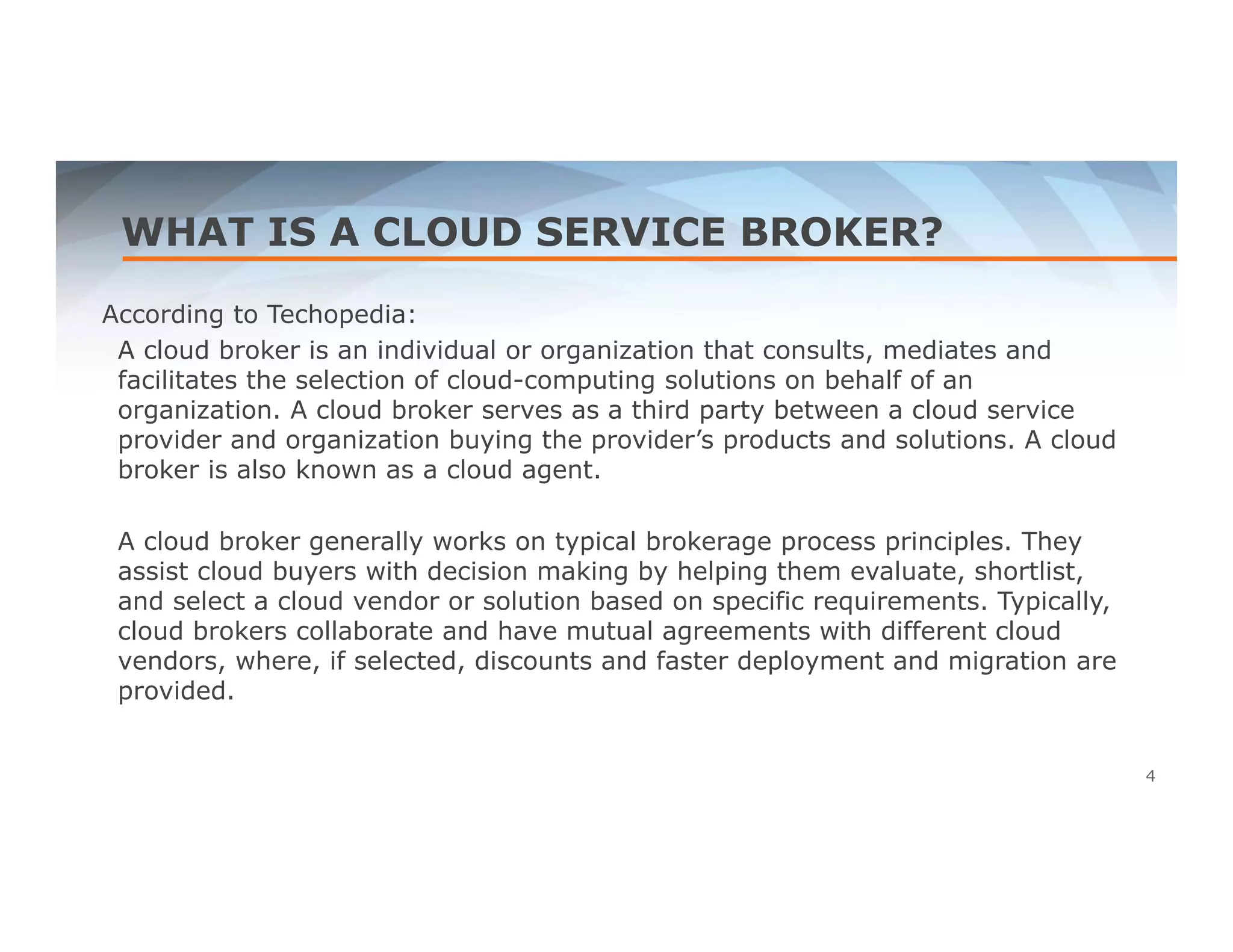
WHAT IS A CLOUD SERVICE BROKER? 
According to Techopedia: 
A cloud broker is an individual or organization that consults, mediates and 
facilitates the selection of cloud-computing solutions on behalf of an 
organization. A cloud broker serves as a third party between a cloud service 
provider and organization buying the provider’s products and solutions. A cloud 
broker is also known as a cloud agent. 
A cloud broker generally works on typical brokerage process principles. They 
assist cloud buyers with decision making by helping them evaluate, shortlist, 
and select a cloud vendor or solution based on specific requirements. Typically, 
cloud brokers collaborate and have mutual agreements with different cloud 
vendors, where, if selected, discounts and faster deployment and migration are 
provided. 
4
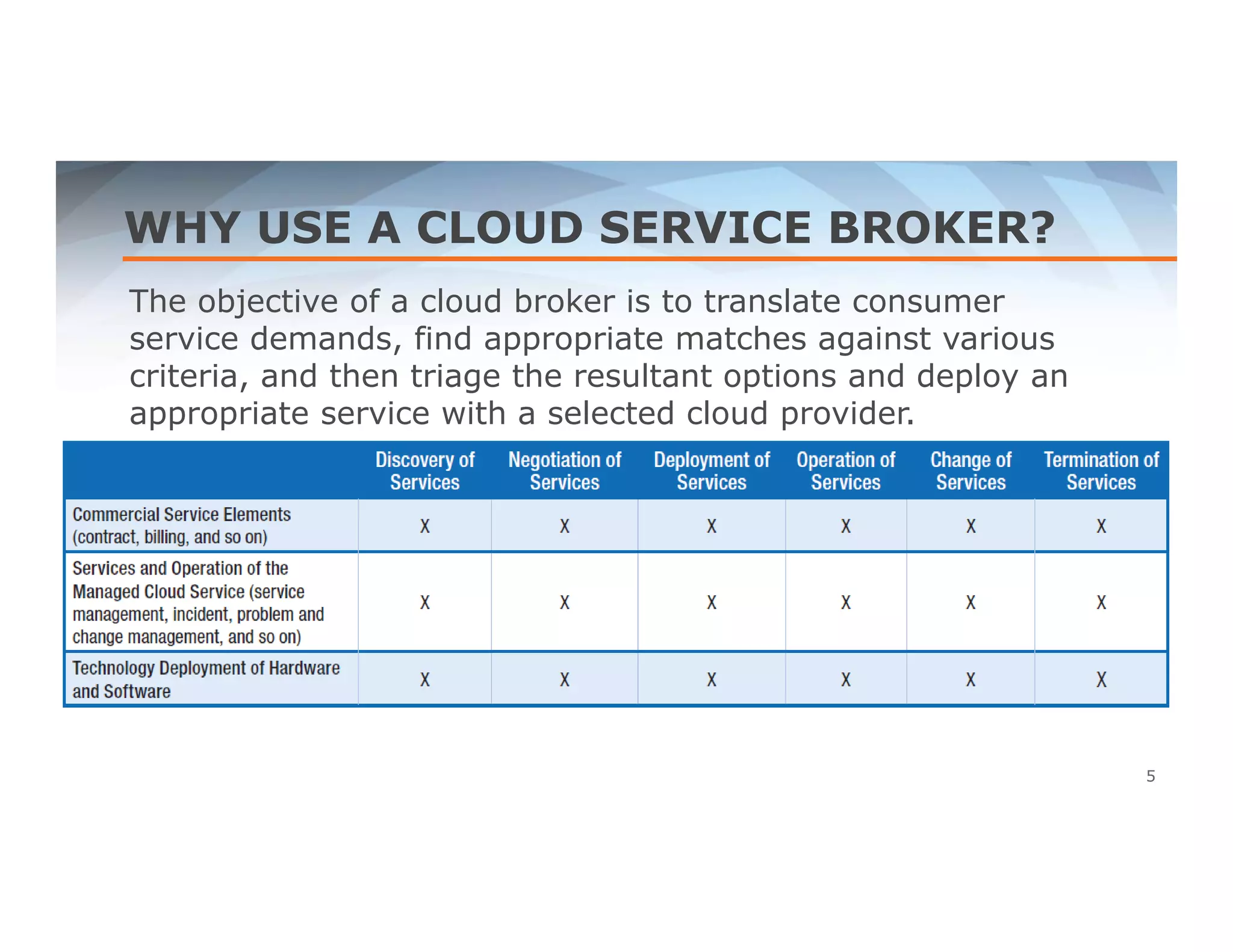
WHY USE A CLOUD SERVICE BROKER? 
The objective of a cloud broker is to translate consumer 
service demands, find appropriate matches against various 
criteria, and then triage the resultant options and deploy an 
appropriate service with a selected cloud provider. 
5
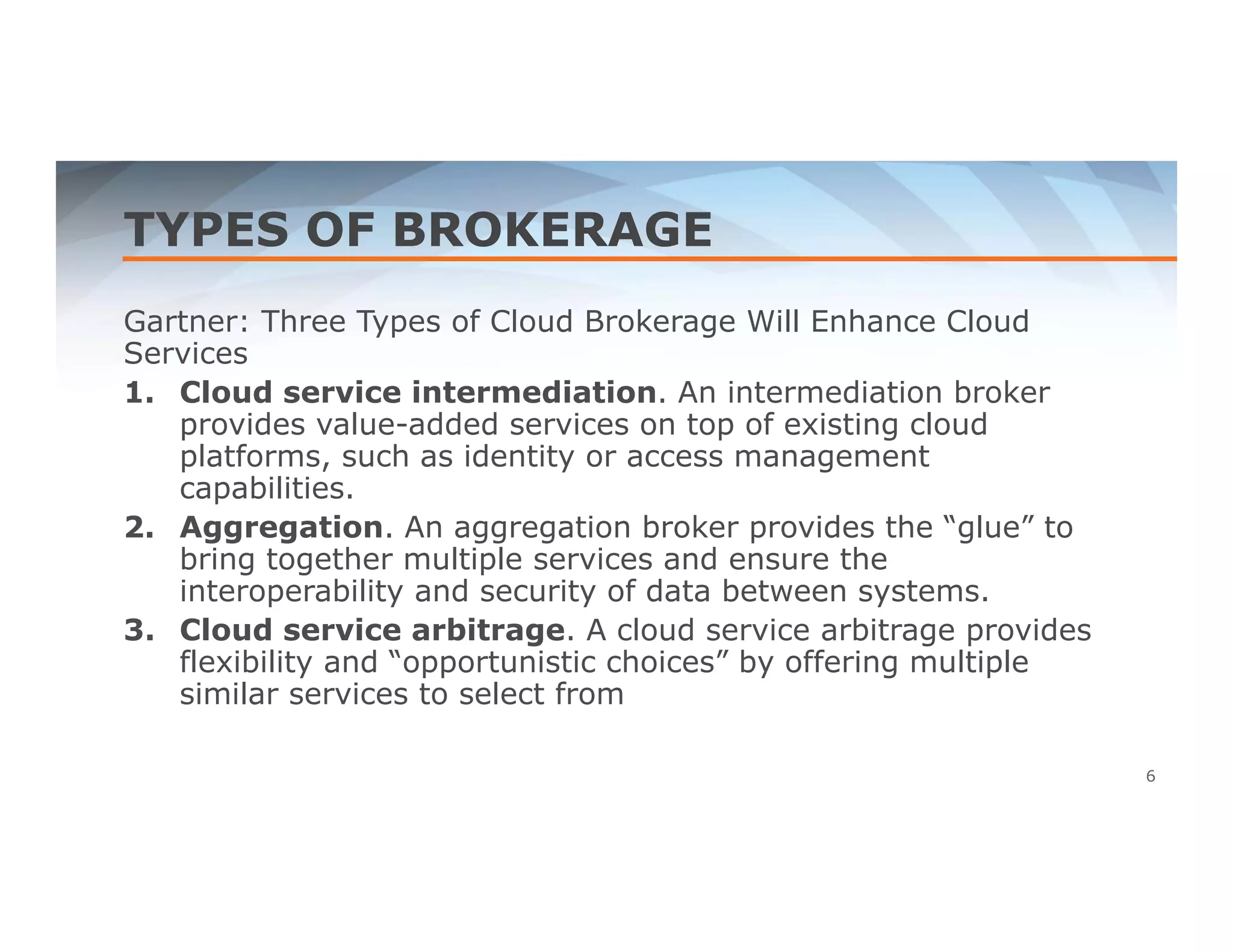
TYPES OF BROKERAGE 
Gartner: Three Types of Cloud Brokerage Will Enhance Cloud 
Services 
1. Cloud service intermediation. An intermediation broker 
provides value-added services on top of existing cloud 
platforms, such as identity or access management 
capabilities. 
2. Aggregation. An aggregation broker provides the “glue” to 
bring together multiple services and ensure the 
interoperability and security of data between systems. 
3. Cloud service arbitrage. A cloud service arbitrage provides 
flexibility and “opportunistic choices” by offering multiple 
similar services to select from 
6
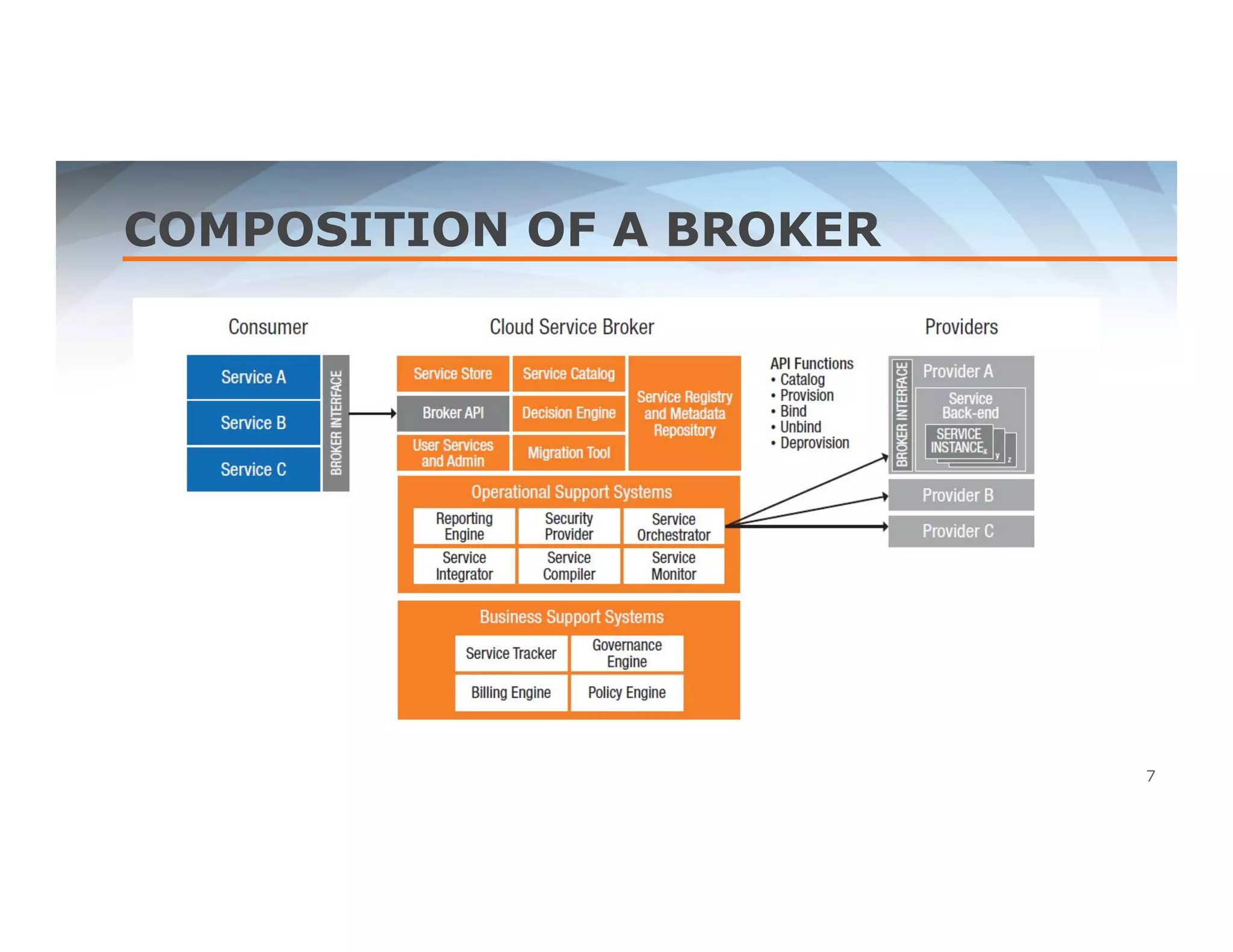
COMPOSITION OF A BROKER 
7
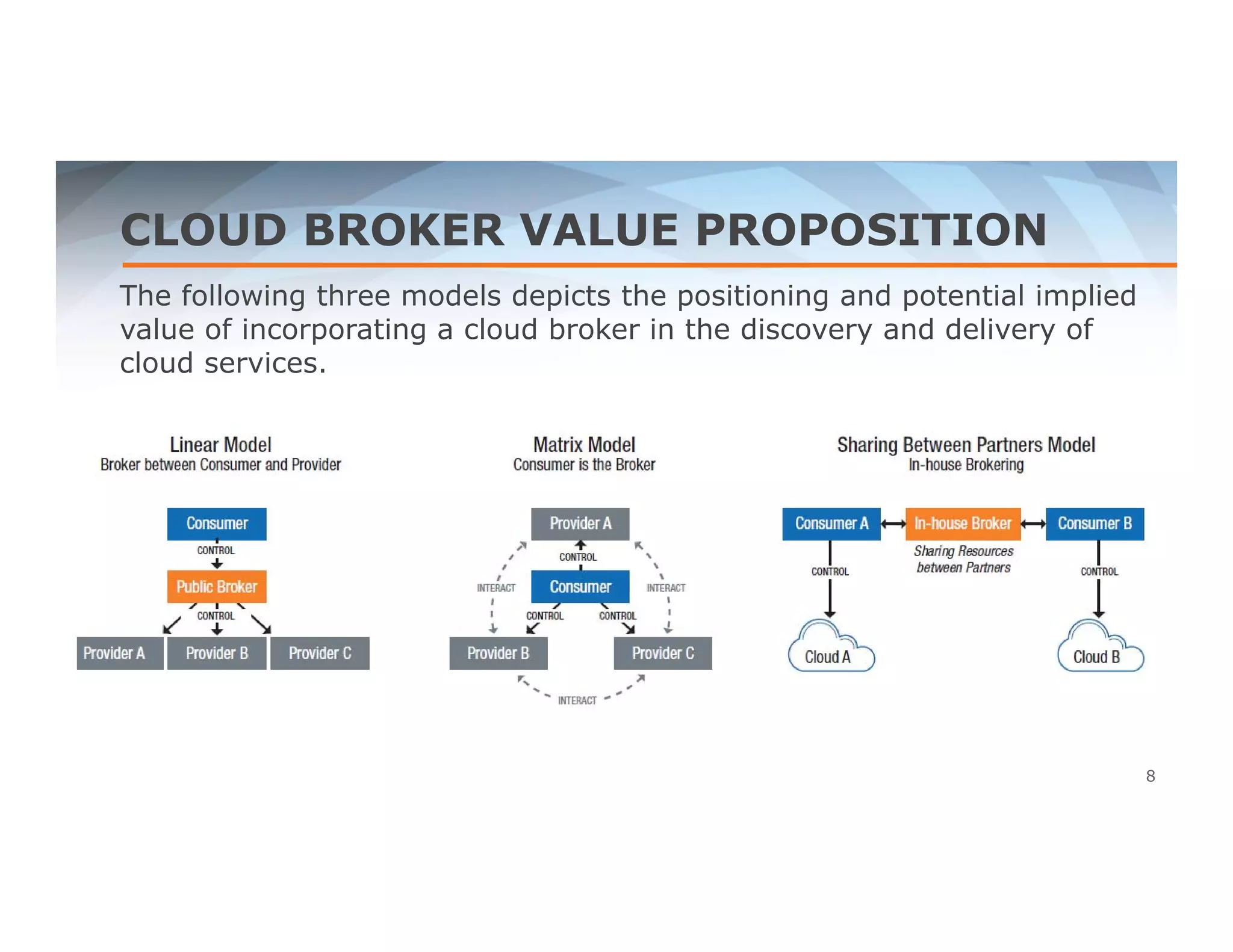
CLOUD BROKER VALUE PROPOSITION 
The following three models depicts the positioning and potential implied 
value of incorporating a cloud broker in the discovery and delivery of 
cloud services. 
8
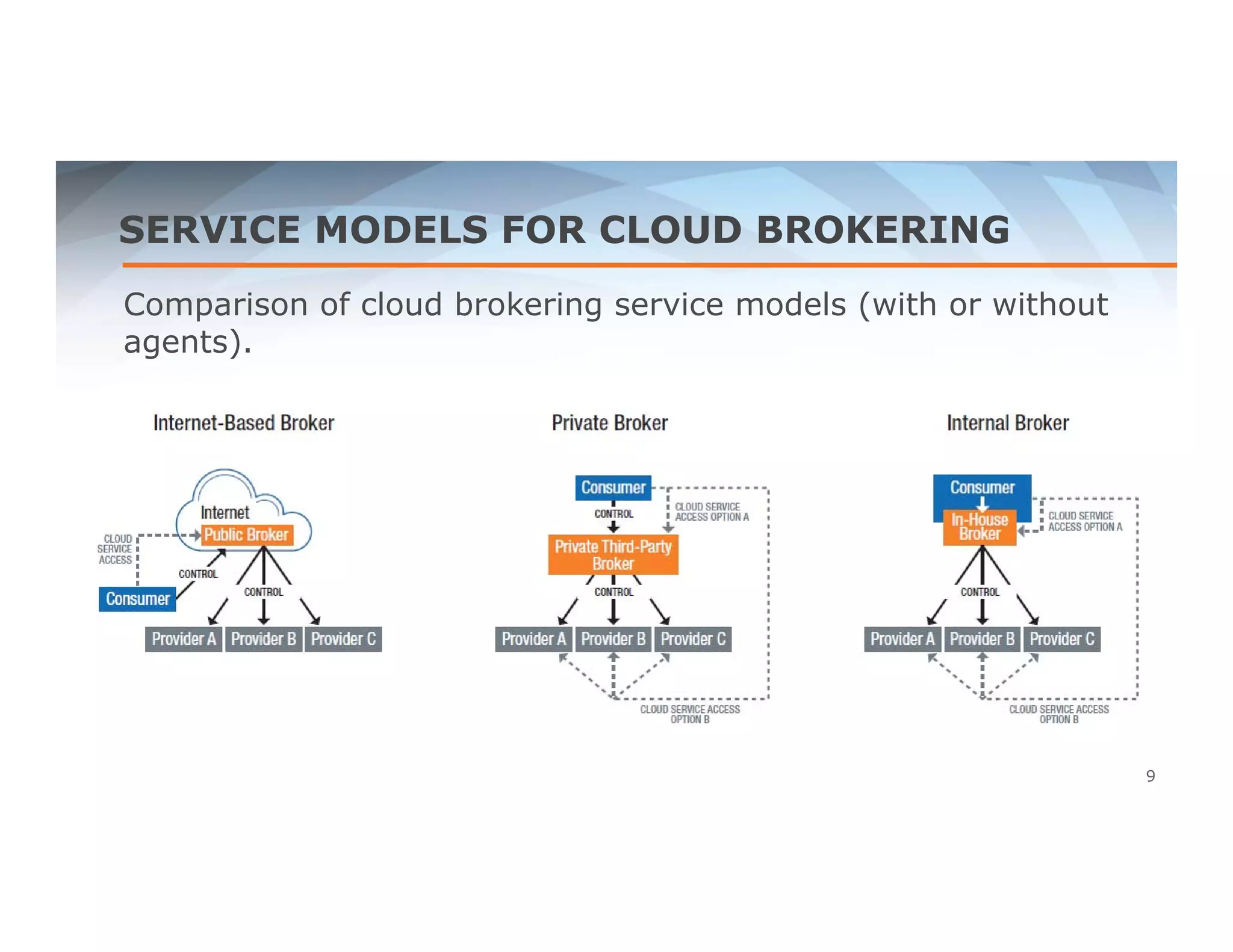
SERVICE MODELS FOR CLOUD BROKERING 
Comparison of cloud brokering service models (with or without 
agents). 
9
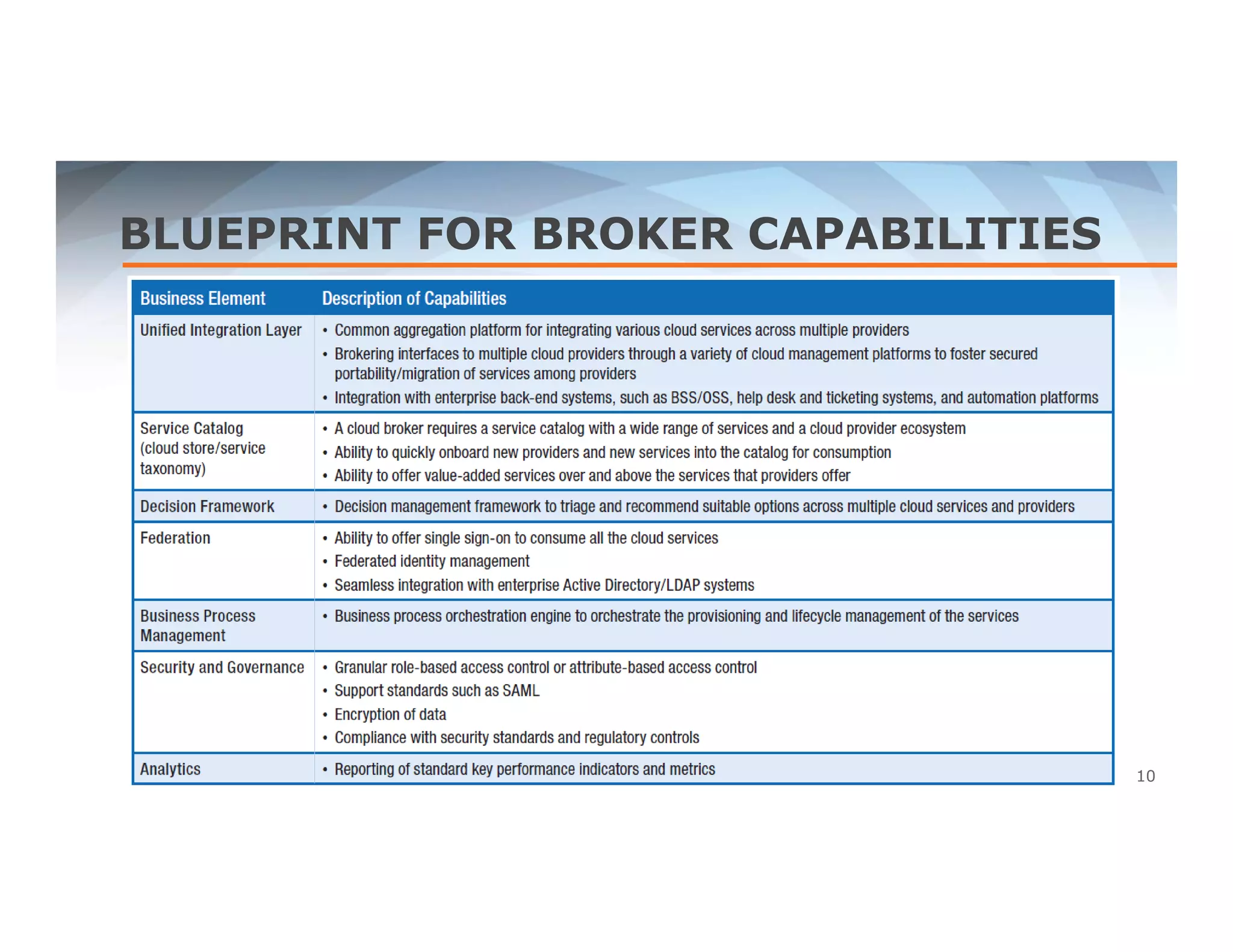
BLUEPRINT FOR BROKER CAPABILITIES 
10
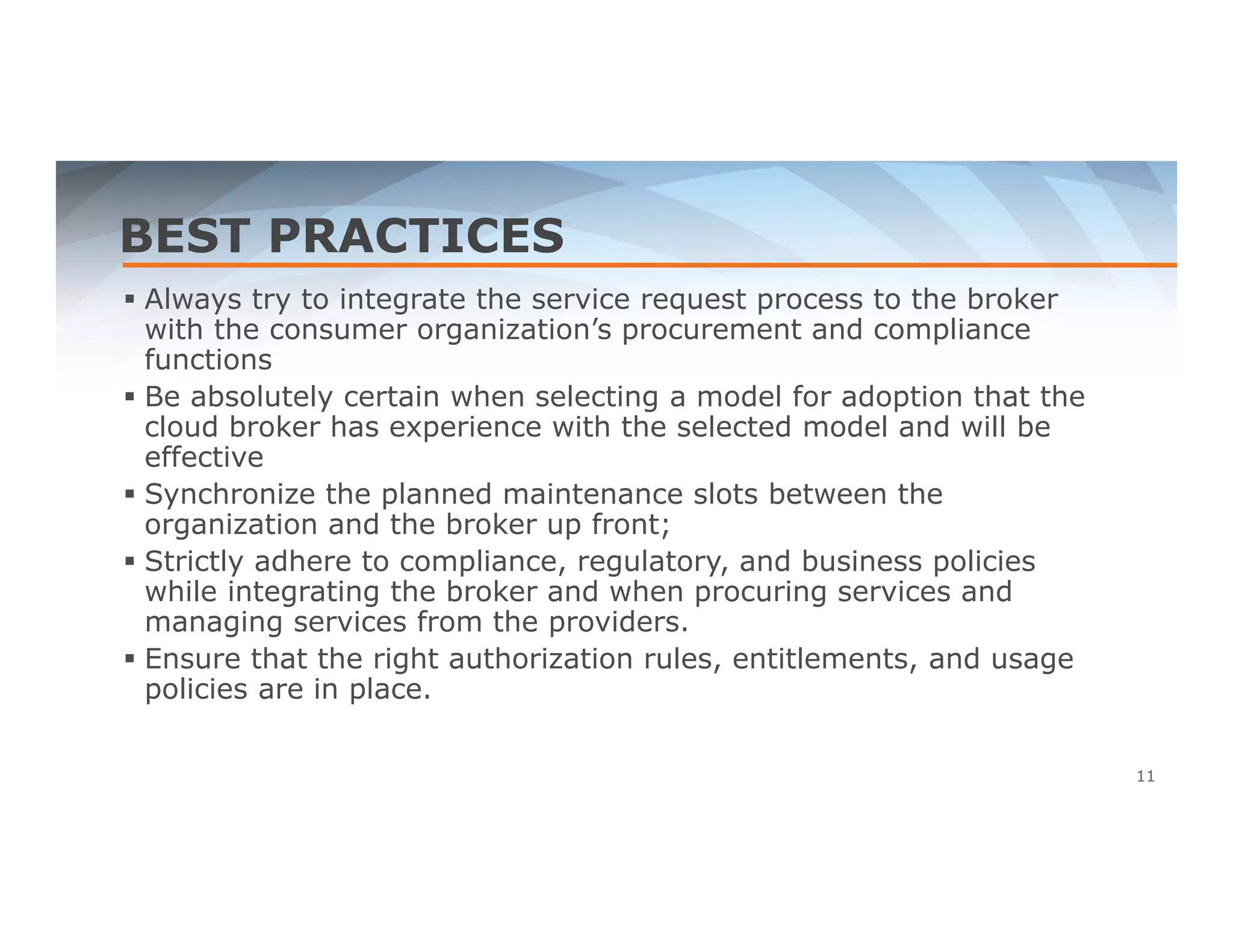
BEST PRACTICES 
 Always try to integrate the service request process to the broker 
with the consumer organization’s procurement and compliance 
functions 
 Be absolutely certain when selecting a model for adoption that the 
cloud broker has experience with the selected model and will be 
effective 
 Synchronize the planned maintenance slots between the 
organization and the broker up front; 
 Strictly adhere to compliance, regulatory, and business policies 
while integrating the broker and when procuring services and 
managing services from the providers. 
 Ensure that the right authorization rules, entitlements, and usage 
policies are in place. 
11
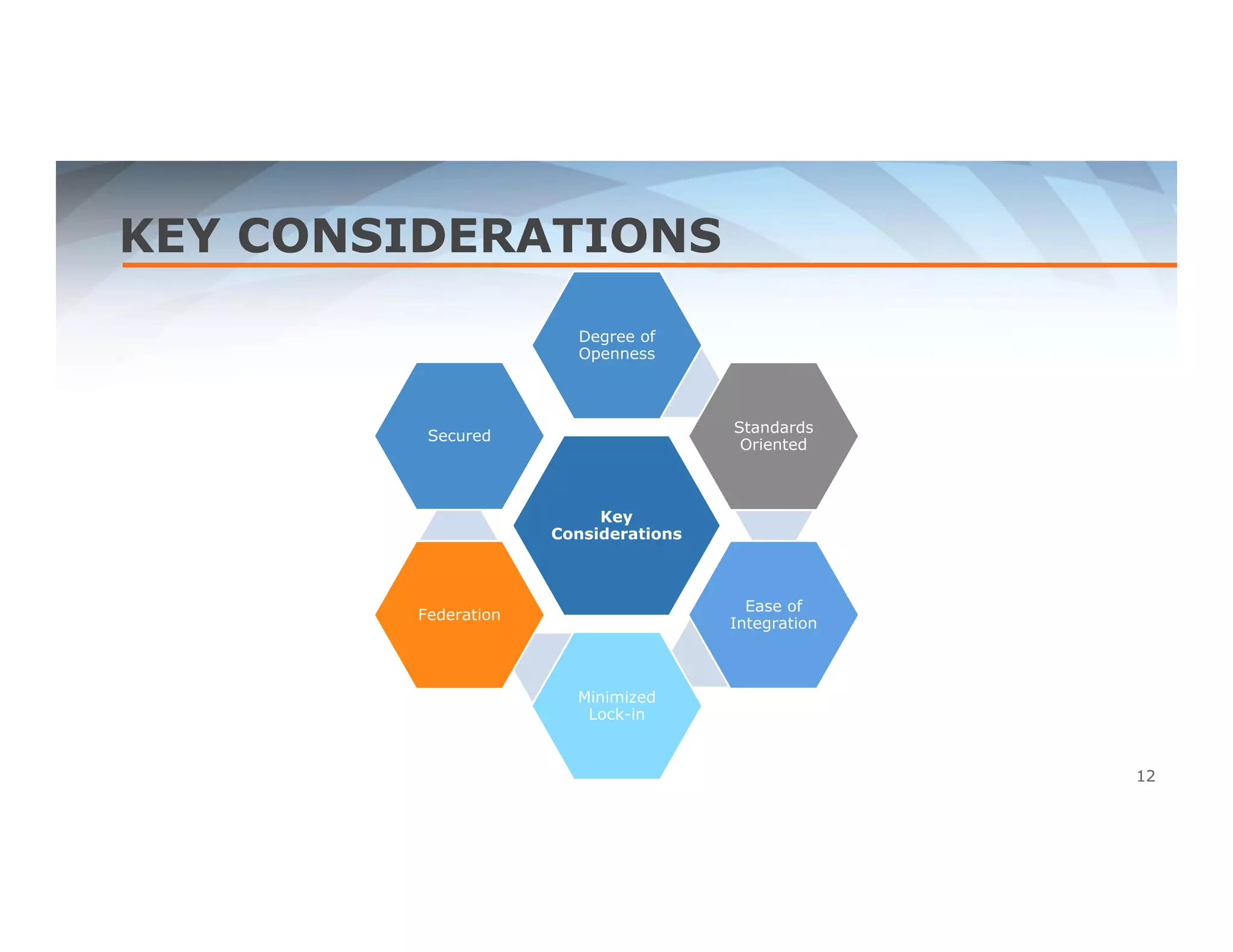
KEY CONSIDERATIONS 
Degree of 
Openness 
Key 
Considerations 
Standards 
Oriented 
Ease of 
Integration 
Minimized 
Lock-in 
Secured 
Federation 
12
REQUIRED INDUSTRY ACTIONS 
From the individual perspectives of cloud brokers, cloud 
providers, and cloud consumers, we recommend these actions to 
further the adoption of cloud service brokerages: 
 Brokers: Provide catalog templates that guide the consumer 
more accurately in defining their original demand statements. 
 Providers: Identify and integrate standards and common 
definitions for service elements and parameters, which brokers 
can more easily parse and triage for comparison. 
 Consumers: Demand standards-based services and product 
definitions, to reduce lock-in and improve portability. 
13
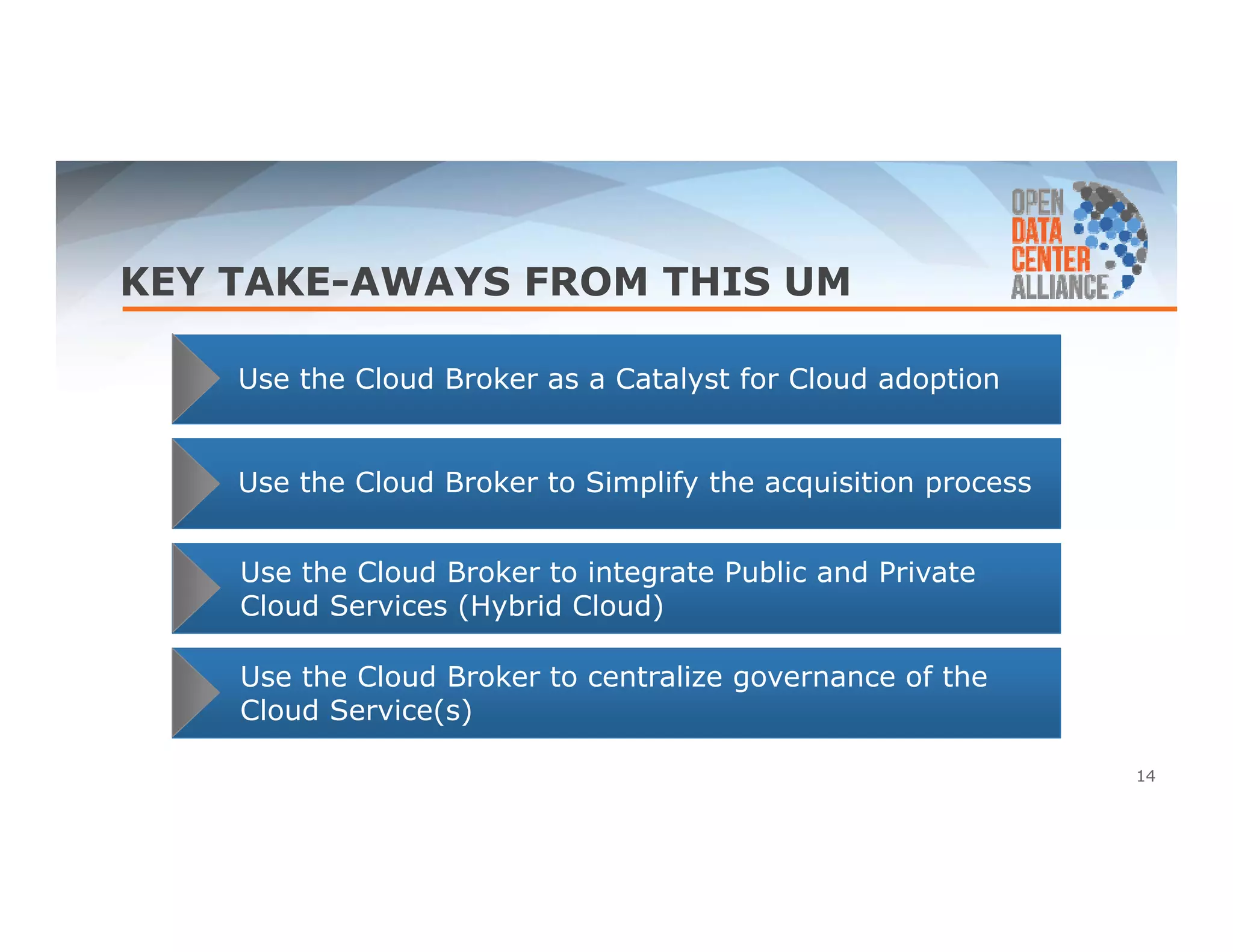
KEY TAKE-AWAYS FROM THIS UM 
Use the Cloud Broker as a Catalyst for Cloud adoption 
Use the Cloud Broker to Simplify the acquisition process 
Use the Cloud Broker to integrate Public and Private 
Cloud Services (Hybrid Cloud) 
Use the Cloud Broker to centralize governance of the 
Cloud Service(s) 
14
CONCLUSION 
 An organization first consider its own organizational structure, 
internal needs, and special differences. Then, on the basis of 
these considerations, select and structure the appropriate cloud 
broker model, solution, and approaches. 
 In some cases the “common” business functions are federated 
between multiple (somewhat different) business units, and in 
other organizations these common functions may be completely 
centralized. 
 We recommend that the organization take these factors into 
account when developing an appropriate broker function and 
determining how it can foster the achievement of business goals 
and objectives. 
 There is no “one size fits all” answer! 
15
16
 ©2014 Open Data Center Alliance, Inc. ALL RIGHTS RESERVED. 
17
APPENDIX 
Process & Usage Scenarios 
18
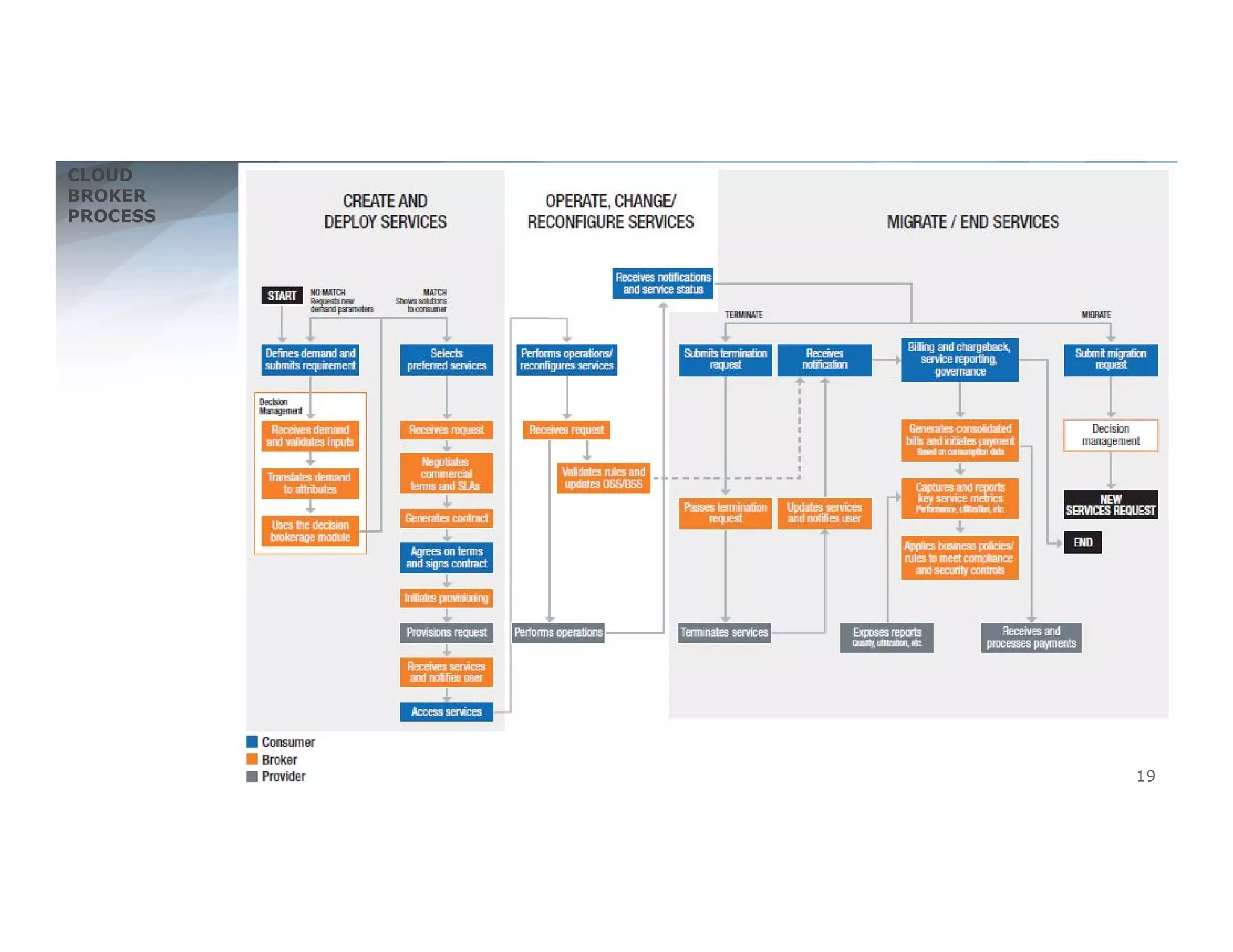
CLOUD 
BROKER 
PROCESS 
19
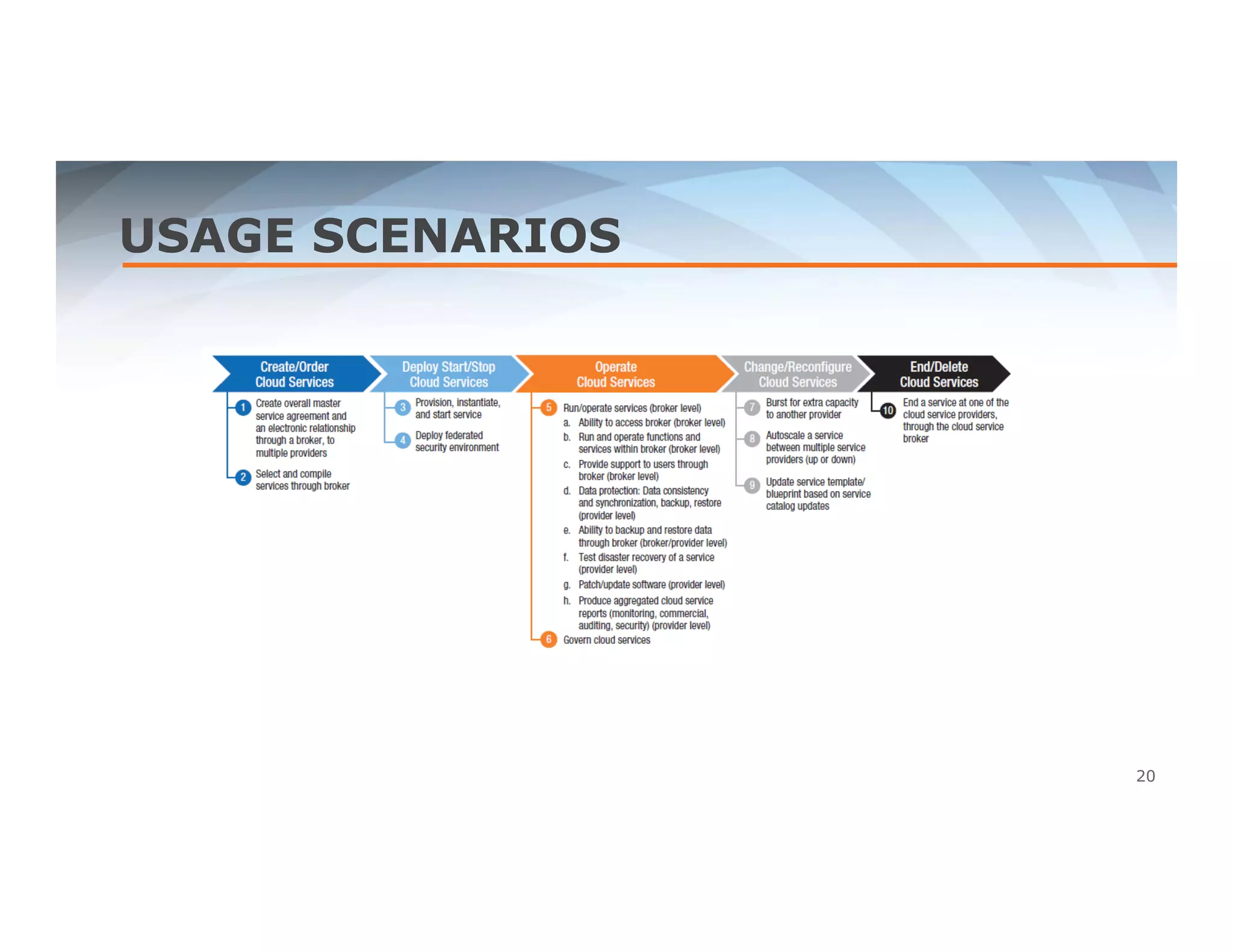
USAGE SCENARIOS 
20

Forecast 2014: Cloud Service Brokering

  • 1.
    CLOUD SERVICE BROKERING Anand Chaganty & Prasanna Raman Sridhar Company: Infosys Limited
  • 2.
    INTRODUCTION TOPIC UMCORE LEARNING ODCA U: Cloud Service Brokering A what is guide to one of the emerging hot topics in Cloud Computing Presentation offers a definition of the cloud broker’s role and describes the value that a cloud broker brings to the service chain. Learn the multiple dimensions of a cloud broker with insights into the various roles and responsibilities involved. 2
  • 3.
    AGENDA 1. Whatis a Cloud Service Broker? 2. Why Use a Broker? 3. Type of Brokerage 4. Composition of a Cloud Broker 5. Value Proposition 6. Cloud Broker Service Models 7. Blueprint for Broker Capabilities 8. Best Practices 9. Required Industry Actions 10.Key Take-Aways 11.Conclusion 3
  • 4.
    WHAT IS ACLOUD SERVICE BROKER? According to Techopedia: A cloud broker is an individual or organization that consults, mediates and facilitates the selection of cloud-computing solutions on behalf of an organization. A cloud broker serves as a third party between a cloud service provider and organization buying the provider’s products and solutions. A cloud broker is also known as a cloud agent. A cloud broker generally works on typical brokerage process principles. They assist cloud buyers with decision making by helping them evaluate, shortlist, and select a cloud vendor or solution based on specific requirements. Typically, cloud brokers collaborate and have mutual agreements with different cloud vendors, where, if selected, discounts and faster deployment and migration are provided. 4
  • 5.
    WHY USE ACLOUD SERVICE BROKER? The objective of a cloud broker is to translate consumer service demands, find appropriate matches against various criteria, and then triage the resultant options and deploy an appropriate service with a selected cloud provider. 5
  • 6.
    TYPES OF BROKERAGE Gartner: Three Types of Cloud Brokerage Will Enhance Cloud Services 1. Cloud service intermediation. An intermediation broker provides value-added services on top of existing cloud platforms, such as identity or access management capabilities. 2. Aggregation. An aggregation broker provides the “glue” to bring together multiple services and ensure the interoperability and security of data between systems. 3. Cloud service arbitrage. A cloud service arbitrage provides flexibility and “opportunistic choices” by offering multiple similar services to select from 6
  • 7.
  • 8.
    CLOUD BROKER VALUEPROPOSITION The following three models depicts the positioning and potential implied value of incorporating a cloud broker in the discovery and delivery of cloud services. 8
  • 9.
    SERVICE MODELS FORCLOUD BROKERING Comparison of cloud brokering service models (with or without agents). 9
  • 10.
    BLUEPRINT FOR BROKERCAPABILITIES 10
  • 11.
    BEST PRACTICES Always try to integrate the service request process to the broker with the consumer organization’s procurement and compliance functions  Be absolutely certain when selecting a model for adoption that the cloud broker has experience with the selected model and will be effective  Synchronize the planned maintenance slots between the organization and the broker up front;  Strictly adhere to compliance, regulatory, and business policies while integrating the broker and when procuring services and managing services from the providers.  Ensure that the right authorization rules, entitlements, and usage policies are in place. 11
  • 12.
    KEY CONSIDERATIONS Degreeof Openness Key Considerations Standards Oriented Ease of Integration Minimized Lock-in Secured Federation 12
  • 13.
    REQUIRED INDUSTRY ACTIONS From the individual perspectives of cloud brokers, cloud providers, and cloud consumers, we recommend these actions to further the adoption of cloud service brokerages:  Brokers: Provide catalog templates that guide the consumer more accurately in defining their original demand statements.  Providers: Identify and integrate standards and common definitions for service elements and parameters, which brokers can more easily parse and triage for comparison.  Consumers: Demand standards-based services and product definitions, to reduce lock-in and improve portability. 13
  • 14.
    KEY TAKE-AWAYS FROMTHIS UM Use the Cloud Broker as a Catalyst for Cloud adoption Use the Cloud Broker to Simplify the acquisition process Use the Cloud Broker to integrate Public and Private Cloud Services (Hybrid Cloud) Use the Cloud Broker to centralize governance of the Cloud Service(s) 14
  • 15.
    CONCLUSION  Anorganization first consider its own organizational structure, internal needs, and special differences. Then, on the basis of these considerations, select and structure the appropriate cloud broker model, solution, and approaches.  In some cases the “common” business functions are federated between multiple (somewhat different) business units, and in other organizations these common functions may be completely centralized.  We recommend that the organization take these factors into account when developing an appropriate broker function and determining how it can foster the achievement of business goals and objectives.  There is no “one size fits all” answer! 15
  • 16.
  • 17.
     ©2014 OpenData Center Alliance, Inc. ALL RIGHTS RESERVED. 17
  • 18.
    APPENDIX Process &Usage Scenarios 18
  • 19.
  • 20.