Water Law and Policy
in the United States

State Affairs Director Chad A. Forcey
ChadForcey@irrigation.org
What is the purpose of the Irrigation Association?

Vision
Be the recognized authority on
irrigation.
Mission
Promote efficient irrigation.
Unifying Statement
Ensure water is available for
irrigation for future generations.
What‟s our biggest challenge in State Affairs?

To Promote Efficiency.

And efficiency can mitigate
problems related to the
diverse water resources
of the United States.
Water Resources
in the United
States
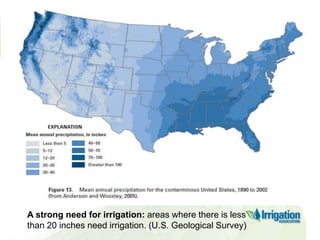
A strong need for irrigation: areas where there is less
than 20 inches need irrigation. (U.S. Geological Survey)
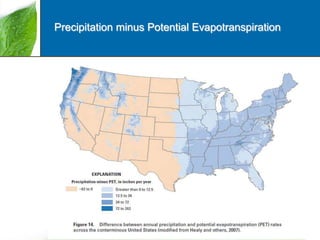
Precipitation minus Potential Evapotranspiration
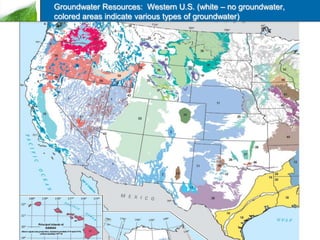
Groundwater Resources: Western U.S. (white – no groundwater,
colored areas indicate various types of groundwater)
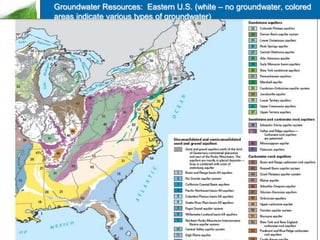
Groundwater Resources: Eastern U.S. (white – no groundwater, colored
areas indicate various types of groundwater)
Water Law and Policy
in the United States
Common Law vs. Statutory water rights:

• Common law riparian water rights: many states in
the Northeast, Midwest and South – You own your water, and you can use water on your land,
and beneath, as you chose, provided you do not negatively
impact public health, welfare, and safety.
– Rainwater may/may not be yours.

• Statutory water rights: states in the West and
Southwest– Water is owned by the state (or federal government in
some cases), and is yours to use after receipt of state or
federal permit.
– Rainwater may/or may not be yours.
Use of Surface/Subsurface Water for Irrigation:

• If your state has common law riparian water rights:
– Very few, if any, restrictions for irrigation.

• If your state is has statutory water rights:
– Farmgate distribution: controlled by state/federal permit.
– Landscape irrigation: controlled by state law, such as AB
1881 in California.

• Restrictions due to drought:
– Challenging aspect of water law and policy.
– The IA is heavily involved in this issue.
– More to come later in the presentation …
Use of Municipal Water for Irrigation:

• Governed by backflow process, paid for by end
user:
– Backflow device installation, repair and testing – governed
by state/local permitting, licensing, and certification.

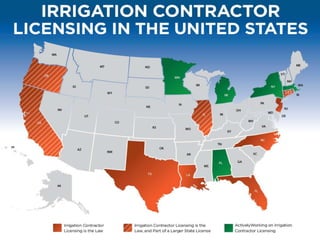
• Governed by irrigation contractor licensing, in
certain states.
• Restrictions due to drought (we‟ll discuss later in the
presentation).
Where do we have licensing?
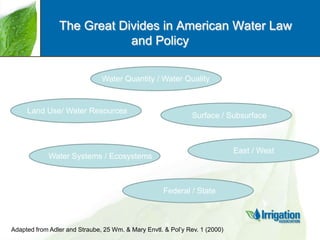
The Great Divides in American Water Law
and Policy
Water Quantity / Water Quality

Land Use/ Water Resources

Surface / Subsurface

East / West

Water Systems / Ecosystems

Federal / State

Adapted from Adler and Straube, 25 Wm. & Mary Envtl. & Pol‟y Rev. 1 (2000)
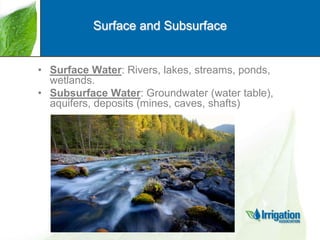
Surface and Subsurface

• Surface Water: Rivers, lakes, streams, ponds,
wetlands.
• Subsurface Water: Groundwater (water table),
aquifers, deposits (mines, caves, shafts)
Federal Water Legislation

• CWA (1972): The Clean Water Act brought the
federal government into the surface water regulation
business, and has driven state policy ever since.
• Since 1972, two thirds of all states have placed some legal
constraint on the authority of state and local government
officials to adopt aquatic resource protections beyond
“waters of the U.S.”
– Stringency limitations
– Property-based limitations
– Combinations of the two

• Half the states have some provisions that extend
protections beyond “waters of the U.S.”
– Some pre-date stringency limitations and may not be retro-active
– Limitations may only be partial
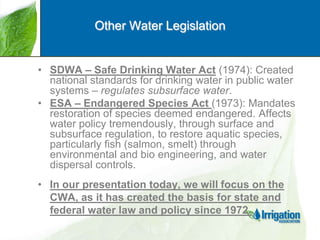
Other Water Legislation

• SDWA – Safe Drinking Water Act (1974): Created
national standards for drinking water in public water
systems – regulates subsurface water.
• ESA – Endangered Species Act (1973): Mandates
restoration of species deemed endangered. Affects
water policy tremendously, through surface and
subsurface regulation, to restore aquatic species,
particularly fish (salmon, smelt) through
environmental and bio engineering, and water
dispersal controls.
• In our presentation today, we will focus on the
CWA, as it has created the basis for state and
federal water law and policy since 1972.
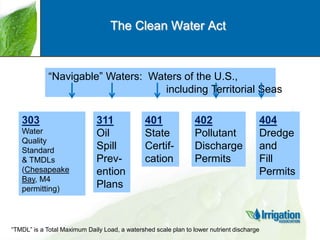
The Clean Water Act

“Navigable” Waters: Waters of the U.S.,
including Territorial Seas
303
Water
Quality
Standard
& TMDLs
(Chesapeake
Bay, M4
permitting)

311
Oil
Spill
Prevention
Plans

401
State
Certifcation

402
Pollutant
Discharge
Permits

404
Dredge
and
Fill
Permits

“TMDL” is a Total Maximum Daily Load, a watershed scale plan to lower nutrient discharge
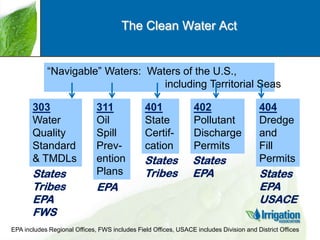
The Clean Water Act

“Navigable” Waters: Waters of the U.S.,
including Territorial Seas
303
Water
Quality
Standard
& TMDLs

States
Tribes
EPA
FWS

311
Oil
Spill
Prevention
Plans

EPA

401
State
Certifcation

402
Pollutant
Discharge
Permits

States
Tribes

States
EPA

404
Dredge
and
Fill
Permits

States
EPA
USACE

EPA includes Regional Offices, FWS includes Field Offices, USACE includes Division and District Offices
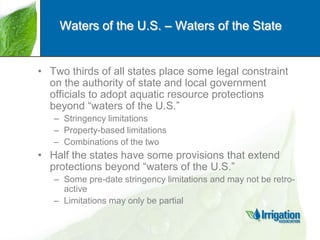
Waters of the U.S. – Waters of the State

• Two thirds of all states place some legal constraint
on the authority of state and local government
officials to adopt aquatic resource protections
beyond “waters of the U.S.”
– Stringency limitations
– Property-based limitations
– Combinations of the two

• Half the states have some provisions that extend
protections beyond “waters of the U.S.”
– Some pre-date stringency limitations and may not be retroactive
– Limitations may only be partial
A Short History of Waters of the U.S.

• CWA (1972): legislative history indicate term should
be “construed as broad as the Commerce Clause
allows”
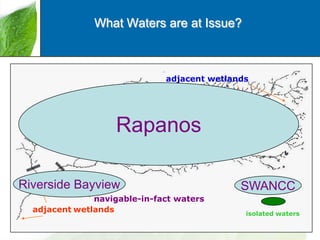
• Riverside Bayview (1985): “navigable waters”
include wetlands adjacent to other jurisdictional
waters
• SWANCC (2001):

– presence/habitat for migratory birds not
sufficient as sole basis for CWA jurisdiction
– affected “isolated” waters
– reasoning suggested some connection to
navigability needed
The Rapanos Decision (2006)

• Issues: does CWA cover non-navigable tributaries
and their adjacent wetlands?
• Result: nine justices and five opinions, with none
having a majority of votes. Remanded.
– Plurality/Scalia: Jurisdictional if “relatively permanent” or
“seasonal” rivers, or wetlands with “continuous surface
connection” to such waters.
– EPA/USACE guidance currently reflects these principles.
New EPA Regulation

• The EPA is writing a rule to clarify the definition of
“waters of the United States”, as the Supreme Court
ordered they do, for the sake of regulatory certainty.
• This will potentially bring a greater scope of waters
under its authority.
• Lawsuits are sure to follow, as the new rule is due
out by March of this year.
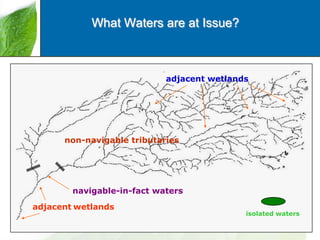
What Waters are at Issue?

adjacent wetlands

non-navigable tributaries

navigable-in-fact waters
adjacent wetlands

isolated waters
What Waters are at Issue?

adjacent wetlands

Rapanos

non-navigable tributaries

Riverside Bayview
navigable-in-fact waters
adjacent wetlands
9-6-07

SWANCC
isolated waters
25
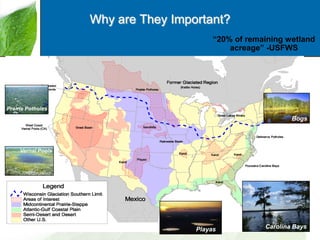
Why are They Important?
“20% of remaining wetland
acreage” -USFWS

Prairie Potholes

Bogs

Vernal Pools

Playas

26Carolina Bays
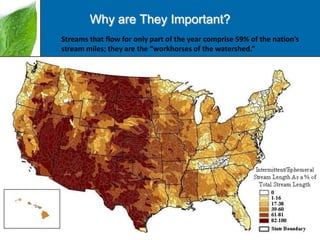
Why are They Important?
Streams that flow for only part of the year comprise 59% of the nation’s
stream miles; they are the “workhorses of the watershed.”
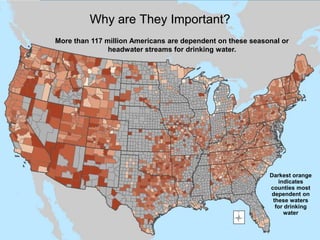
Why are They Important?
More than 117 million Americans are dependent on these seasonal or
headwater streams for drinking water.

Darkest orange
indicates
counties most
dependent on
these waters
for drinking
water
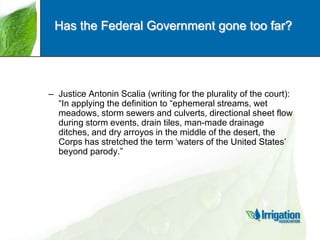
Has the Federal Government gone too far?

– Justice Antonin Scalia (writing for the plurality of the court):
“In applying the definition to “ephemeral streams, wet
meadows, storm sewers and culverts, directional sheet flow
during storm events, drain tiles, man-made drainage
ditches, and dry arroyos in the middle of the desert, the
Corps has stretched the term „waters of the United States‟
beyond parody.”
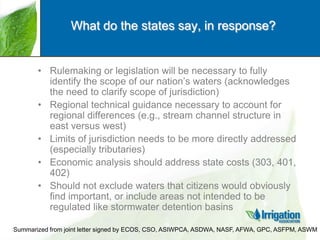
What do the states say, in response?

• Rulemaking or legislation will be necessary to fully
identify the scope of our nation‟s waters (acknowledges
the need to clarify scope of jurisdiction)
• Regional technical guidance necessary to account for
regional differences (e.g., stream channel structure in
east versus west)
• Limits of jurisdiction needs to be more directly addressed
(especially tributaries)
• Economic analysis should address state costs (303, 401,
402)
• Should not exclude waters that citizens would obviously
find important, or include areas not intended to be
regulated like stormwater detention basins
Summarized from joint letter signed by ECOS, CSO, ASIWPCA, ASDWA, NASF, AFWA, GPC, ASFPM, ASWM
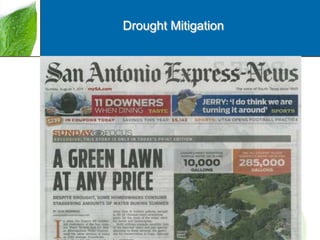
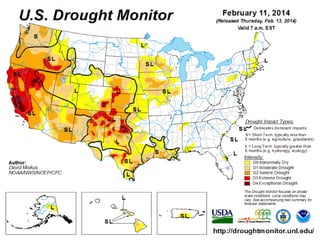
Drought Mitigation
Drought Mitigation
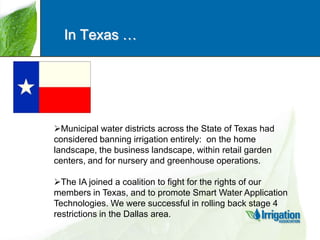
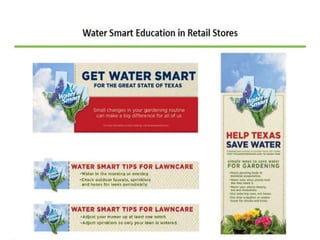
In Texas …

Municipal water districts across the State of Texas had
considered banning irrigation entirely: on the home
landscape, the business landscape, within retail garden
centers, and for nursery and greenhouse operations.
The IA joined a coalition to fight for the rights of our
members in Texas, and to promote Smart Water Application
Technologies. We were successful in rolling back stage 4
restrictions in the Dallas area.
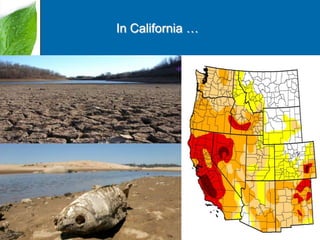
In California …
California Mitigation

•

Hiring a qualified irrigation professional for irrigation system installation and
maintenance. These qualified individuals include:
– Irrigation professionals certified by the IA‟s Select Certified program.
– Irrigation professionals certified by the CLCA‟s Certified Water Manager
program.
– California state licensed landscape contractors.

•

Installing efficient irrigation products and technologies, such as:
– Drip irrigation.
– Microspray irrigation.
– Irrigation smart controllers labeled by the U.S. EPA WaterSense program.

•

Having an irrigation system audited for distribution uniformity and checked for
underground leaks. If necessary, systems should be repaired by qualified
irrigation professionals.
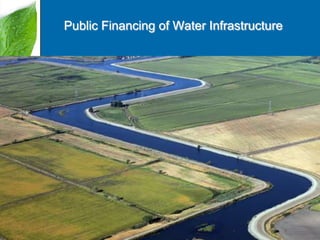
Public Financing of Water Infrastructure
California

 California: The California Water Bond
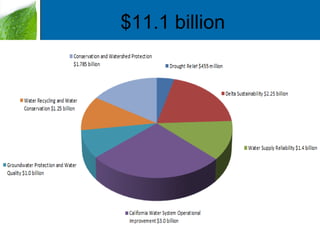
CA is considering passage of an $11.1 billion initiative to
upgrade the state‟s outdated water system. This project is
necessary to increase California‟s water resources after over
a decade of drought, large population increases, extreme
pressures on farmland, and needs in the nation‟s largest
irrigated landscape sector.
$11.1 billion
What kinds of projects are
needed?
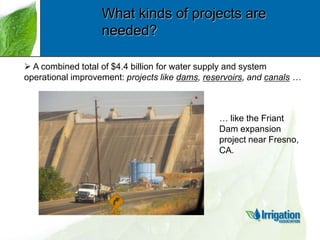
 A combined total of $4.4 billion for water supply and system
operational improvement: projects like dams, reservoirs, and canals …

… like the Friant
Dam expansion
project near Fresno,
CA.
Reservoir Upgrades

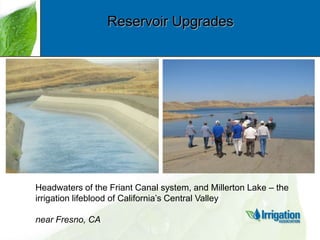
Headwaters of the Friant Canal system, and Millerton Lake – the
irrigation lifeblood of California‟s Central Valley
near Fresno, CA
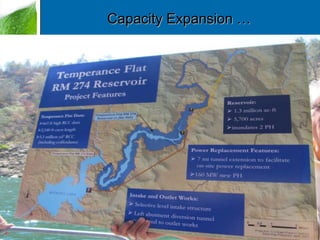
Capacity Expansion …
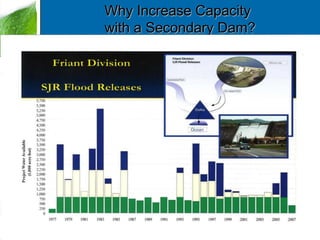
Why Increase Capacity
with a Secondary Dam?
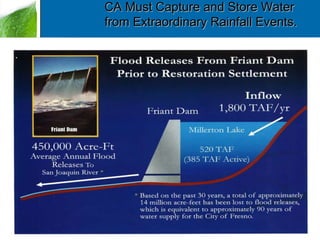
CA Must Capture and Store Water
from Extraordinary Rainfall Events.
 Price tag for the
Friant Dam
expansion:
$4.1 billion
Let‟s work together, and make a difference!

ChadForcey@irrigation.org

Water Law and Policy in the U.S.

  • 1.
    Water Law andPolicy in the United States State Affairs Director Chad A. Forcey ChadForcey@irrigation.org
  • 2.
    What is thepurpose of the Irrigation Association? Vision Be the recognized authority on irrigation. Mission Promote efficient irrigation. Unifying Statement Ensure water is available for irrigation for future generations.
  • 3.
    What‟s our biggestchallenge in State Affairs? To Promote Efficiency. And efficiency can mitigate problems related to the diverse water resources of the United States.
  • 4.
  • 5.
    A strong needfor irrigation: areas where there is less than 20 inches need irrigation. (U.S. Geological Survey)
  • 6.
  • 7.
    Groundwater Resources: WesternU.S. (white – no groundwater, colored areas indicate various types of groundwater)
  • 8.
    Groundwater Resources: EasternU.S. (white – no groundwater, colored areas indicate various types of groundwater)
  • 9.
    Water Law andPolicy in the United States
  • 10.
    Common Law vs.Statutory water rights: • Common law riparian water rights: many states in the Northeast, Midwest and South – You own your water, and you can use water on your land, and beneath, as you chose, provided you do not negatively impact public health, welfare, and safety. – Rainwater may/may not be yours. • Statutory water rights: states in the West and Southwest– Water is owned by the state (or federal government in some cases), and is yours to use after receipt of state or federal permit. – Rainwater may/or may not be yours.
  • 11.
    Use of Surface/SubsurfaceWater for Irrigation: • If your state has common law riparian water rights: – Very few, if any, restrictions for irrigation. • If your state is has statutory water rights: – Farmgate distribution: controlled by state/federal permit. – Landscape irrigation: controlled by state law, such as AB 1881 in California. • Restrictions due to drought: – Challenging aspect of water law and policy. – The IA is heavily involved in this issue. – More to come later in the presentation …
  • 12.
    Use of MunicipalWater for Irrigation: • Governed by backflow process, paid for by end user: – Backflow device installation, repair and testing – governed by state/local permitting, licensing, and certification. • Governed by irrigation contractor licensing, in certain states. • Restrictions due to drought (we‟ll discuss later in the presentation).
  • 13.
    Where do wehave licensing?
  • 14.
    The Great Dividesin American Water Law and Policy Water Quantity / Water Quality Land Use/ Water Resources Surface / Subsurface East / West Water Systems / Ecosystems Federal / State Adapted from Adler and Straube, 25 Wm. & Mary Envtl. & Pol‟y Rev. 1 (2000)
  • 15.
    Surface and Subsurface •Surface Water: Rivers, lakes, streams, ponds, wetlands. • Subsurface Water: Groundwater (water table), aquifers, deposits (mines, caves, shafts)
  • 16.
    Federal Water Legislation •CWA (1972): The Clean Water Act brought the federal government into the surface water regulation business, and has driven state policy ever since. • Since 1972, two thirds of all states have placed some legal constraint on the authority of state and local government officials to adopt aquatic resource protections beyond “waters of the U.S.” – Stringency limitations – Property-based limitations – Combinations of the two • Half the states have some provisions that extend protections beyond “waters of the U.S.” – Some pre-date stringency limitations and may not be retro-active – Limitations may only be partial
  • 17.
    Other Water Legislation •SDWA – Safe Drinking Water Act (1974): Created national standards for drinking water in public water systems – regulates subsurface water. • ESA – Endangered Species Act (1973): Mandates restoration of species deemed endangered. Affects water policy tremendously, through surface and subsurface regulation, to restore aquatic species, particularly fish (salmon, smelt) through environmental and bio engineering, and water dispersal controls. • In our presentation today, we will focus on the CWA, as it has created the basis for state and federal water law and policy since 1972.
  • 18.
    The Clean WaterAct “Navigable” Waters: Waters of the U.S., including Territorial Seas 303 Water Quality Standard & TMDLs (Chesapeake Bay, M4 permitting) 311 Oil Spill Prevention Plans 401 State Certifcation 402 Pollutant Discharge Permits 404 Dredge and Fill Permits “TMDL” is a Total Maximum Daily Load, a watershed scale plan to lower nutrient discharge
  • 19.
    The Clean WaterAct “Navigable” Waters: Waters of the U.S., including Territorial Seas 303 Water Quality Standard & TMDLs States Tribes EPA FWS 311 Oil Spill Prevention Plans EPA 401 State Certifcation 402 Pollutant Discharge Permits States Tribes States EPA 404 Dredge and Fill Permits States EPA USACE EPA includes Regional Offices, FWS includes Field Offices, USACE includes Division and District Offices
  • 20.
    Waters of theU.S. – Waters of the State • Two thirds of all states place some legal constraint on the authority of state and local government officials to adopt aquatic resource protections beyond “waters of the U.S.” – Stringency limitations – Property-based limitations – Combinations of the two • Half the states have some provisions that extend protections beyond “waters of the U.S.” – Some pre-date stringency limitations and may not be retroactive – Limitations may only be partial
  • 21.
    A Short Historyof Waters of the U.S. • CWA (1972): legislative history indicate term should be “construed as broad as the Commerce Clause allows” • Riverside Bayview (1985): “navigable waters” include wetlands adjacent to other jurisdictional waters • SWANCC (2001): – presence/habitat for migratory birds not sufficient as sole basis for CWA jurisdiction – affected “isolated” waters – reasoning suggested some connection to navigability needed
  • 22.
    The Rapanos Decision(2006) • Issues: does CWA cover non-navigable tributaries and their adjacent wetlands? • Result: nine justices and five opinions, with none having a majority of votes. Remanded. – Plurality/Scalia: Jurisdictional if “relatively permanent” or “seasonal” rivers, or wetlands with “continuous surface connection” to such waters. – EPA/USACE guidance currently reflects these principles.
  • 23.
    New EPA Regulation •The EPA is writing a rule to clarify the definition of “waters of the United States”, as the Supreme Court ordered they do, for the sake of regulatory certainty. • This will potentially bring a greater scope of waters under its authority. • Lawsuits are sure to follow, as the new rule is due out by March of this year.
  • 24.
    What Waters areat Issue? adjacent wetlands non-navigable tributaries navigable-in-fact waters adjacent wetlands isolated waters
  • 25.
    What Waters areat Issue? adjacent wetlands Rapanos non-navigable tributaries Riverside Bayview navigable-in-fact waters adjacent wetlands 9-6-07 SWANCC isolated waters 25
  • 26.
    Why are TheyImportant? “20% of remaining wetland acreage” -USFWS Prairie Potholes Bogs Vernal Pools Playas 26Carolina Bays
  • 27.
    Why are TheyImportant? Streams that flow for only part of the year comprise 59% of the nation’s stream miles; they are the “workhorses of the watershed.”
  • 28.
    Why are TheyImportant? More than 117 million Americans are dependent on these seasonal or headwater streams for drinking water. Darkest orange indicates counties most dependent on these waters for drinking water
  • 29.
    Has the FederalGovernment gone too far? – Justice Antonin Scalia (writing for the plurality of the court): “In applying the definition to “ephemeral streams, wet meadows, storm sewers and culverts, directional sheet flow during storm events, drain tiles, man-made drainage ditches, and dry arroyos in the middle of the desert, the Corps has stretched the term „waters of the United States‟ beyond parody.”
  • 30.
    What do thestates say, in response? • Rulemaking or legislation will be necessary to fully identify the scope of our nation‟s waters (acknowledges the need to clarify scope of jurisdiction) • Regional technical guidance necessary to account for regional differences (e.g., stream channel structure in east versus west) • Limits of jurisdiction needs to be more directly addressed (especially tributaries) • Economic analysis should address state costs (303, 401, 402) • Should not exclude waters that citizens would obviously find important, or include areas not intended to be regulated like stormwater detention basins Summarized from joint letter signed by ECOS, CSO, ASIWPCA, ASDWA, NASF, AFWA, GPC, ASFPM, ASWM
  • 31.
  • 32.
  • 33.
    In Texas … Municipalwater districts across the State of Texas had considered banning irrigation entirely: on the home landscape, the business landscape, within retail garden centers, and for nursery and greenhouse operations. The IA joined a coalition to fight for the rights of our members in Texas, and to promote Smart Water Application Technologies. We were successful in rolling back stage 4 restrictions in the Dallas area.
  • 38.
  • 39.
    California Mitigation • Hiring aqualified irrigation professional for irrigation system installation and maintenance. These qualified individuals include: – Irrigation professionals certified by the IA‟s Select Certified program. – Irrigation professionals certified by the CLCA‟s Certified Water Manager program. – California state licensed landscape contractors. • Installing efficient irrigation products and technologies, such as: – Drip irrigation. – Microspray irrigation. – Irrigation smart controllers labeled by the U.S. EPA WaterSense program. • Having an irrigation system audited for distribution uniformity and checked for underground leaks. If necessary, systems should be repaired by qualified irrigation professionals.
  • 40.
    Public Financing ofWater Infrastructure
  • 41.
    California  California: TheCalifornia Water Bond CA is considering passage of an $11.1 billion initiative to upgrade the state‟s outdated water system. This project is necessary to increase California‟s water resources after over a decade of drought, large population increases, extreme pressures on farmland, and needs in the nation‟s largest irrigated landscape sector.
  • 42.
  • 43.
    What kinds ofprojects are needed?  A combined total of $4.4 billion for water supply and system operational improvement: projects like dams, reservoirs, and canals … … like the Friant Dam expansion project near Fresno, CA.
  • 44.
    Reservoir Upgrades Headwaters ofthe Friant Canal system, and Millerton Lake – the irrigation lifeblood of California‟s Central Valley near Fresno, CA
  • 45.
  • 47.
  • 48.
    CA Must Captureand Store Water from Extraordinary Rainfall Events.
  • 49.
     Price tagfor the Friant Dam expansion: $4.1 billion
  • 50.
    Let‟s work together,and make a difference! ChadForcey@irrigation.org

Editor's Notes

  • #32 The cost is an important part of the overall Water Bond.
  • #33 The cost is an important part of the overall Water Bond.
  • #42 In California, water shortages have prompted consideration of much-needed infrastructure improvements.
  • #43 The CA water bond, soon to reach the voters of CA in a referendum, would appropriate $11.1 billion for infrastructure. The IA is working with affiliates including the CA Landscape Contractors Association, and the CA Ag Irrigation Association, to see passage of this measure.
  • #44 Dam expansions top the list …
  • #45 I took a tour of the Friant Canal system near Fresno this year, and witnessed firsthand the improvements that are needed in one key system.
  • #46 Capacity expansion in the Friant system would more than double storage over the next 10 years. This is vital to solving CA’s water shortage challenges.
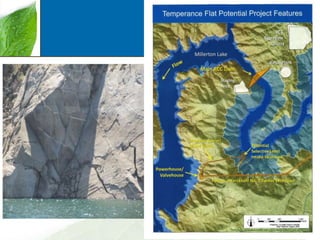
  • #47 In this slide, you can see an outcropping on Millerton Lake which provides a necessary geologic support for a secondary dam, proposed for more than two decades (but not yet built). The Water Bond would pay for this project.
  • #48 Why increase capacity with a secondary dam? To capture extraordinary rainfall events, as pictured in dark blue on the graph from 1977 to 2007. Most of the water generated by these events is lost in damaging floods, as storage capacity for the water does not yet exist.
  • #49 As this slide shows, 14 million acre feet of water has been lost over the last 30 years due to the lack of storage capacity in the Central Valley. This would be enough to supply Fresno with water for 90 years.
  • #50 The cost is an important part of the overall Water Bond.