1. The Hajj is the annual pilgrimage to Mecca, Saudi Arabia required of all able-bodied Muslims at least once in their lifetime.
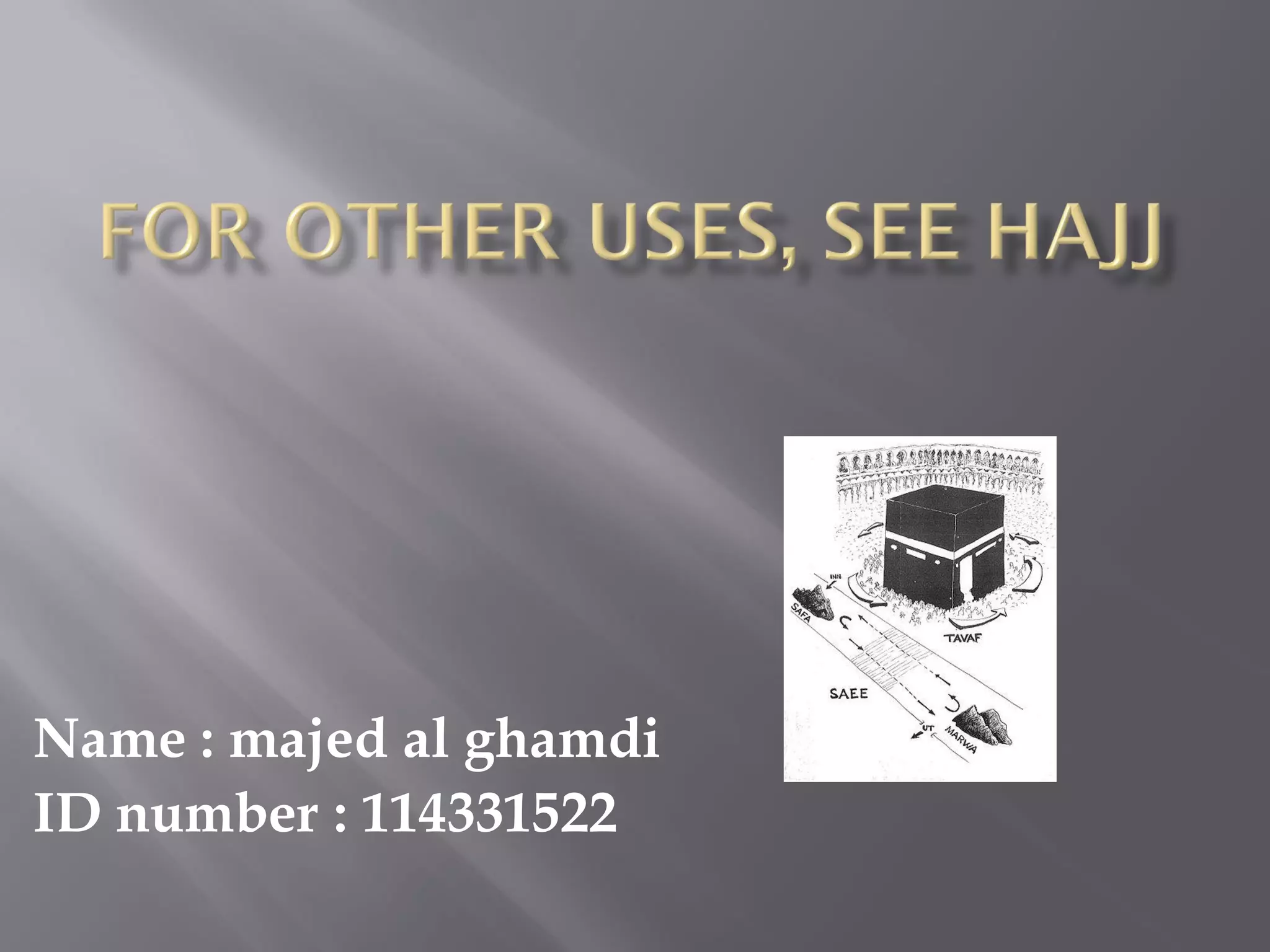
2. During the Hajj, pilgrims perform a series of rituals including circling the Kaaba seven times, running between the hills of Al-Safa and Al-Marwah, and throwing stones at pillars representing the devil.
3. Over 2 million pilgrims now participate in the Hajj each year, requiring advanced crowd control techniques due to the large numbers of people.

![
Ḥajj) is the annual pilgrimage to Mecca, The Hajj (Arabic:
Saudi Arabia. It is currently the largest annual pilgrimage in
the world,[1] and is the fifth pillar of Islam, a religious duty
that must be carried out at least once in their lifetime by
every able-bodied Muslim who can afford to do so. The Hajj
is a demonstration of the solidarity of the Muslim people,
and their submission to God (Allah in the Arabic
language).[2] The pilgrimage occurs from the 8th to 12th
day of Dhu al-Hijjah, the 12th and last month of the Islamic
calendar. Because the Islamic calendar is a lunar calendar,
eleven days shorter than the Gregorian calendar used in the
Western world, the Gregorian date of the Hajj changes from
year to year. In 2007, the Hajj was from December 17–21; in
2008 from December 6–10, and in 2009 it was from
November 25–29. Ihram is the name given to](https://image.slidesharecdn.com/forotherusesseehajj-121201085317-phpapp01/85/For-other-uses-see-hajj-2-320.jpg)
![l state in which Muslims live whilst on the pilgrimage.
The Hajj is associated with the life of Islamic prophet
Muhammad from the 7th century, but the ritual of pilgrimage to
Mecca is considered by Muslims to stretch back thousands of
years to the time of Ibrahim (Abraham). Pilgrims join
processions of hundreds of thousands of people, who
simultaneously converge on Mecca for the week of the Hajj, and
perform a series of rituals: Each person walks counter-clockwise
seven times about the Ka'bah, the cube-shaped building which
acts as the Muslim direction of prayer, kisses the Black Stone in
the corner of the Kaaba, runs back and forth between the hills of
Al-Safa and Al-Marwah, drinks from the Zamzam Well, goes to
the plains of Mount Arafat to stand in vigil, and throws stones
in a ritual Stoning of the Devil. The pilgrims then shave their
heads, perform a ritual of animal sacrifice, and celebrate the four
day global festival of Eid al-Adha.[3][4][5]](https://image.slidesharecdn.com/forotherusesseehajj-121201085317-phpapp01/85/For-other-uses-see-hajj-3-320.jpg)
![
As of 2009, about two million pilgrims participate in this annual
pilgrimage.[6][7] Crowd-control techniques have become critical,
and because of the large numbers of people, many of the rituals
have become more stylized. It is not necessary to kiss the Black
Stone, but merely to point at it on each circuit around the Kaaba.
Throwing pebbles was done at large pillars, which for safety
reasons in 2004 were changed to long walls with catch basins
below to catch the stones. The slaughter of an animal can be
done either personally, or by appointing someone else to do it,
and so forth.[8] But even with the crowd control techniques,
there are still many incidents during the Hajj, as pilgrims are
trampled in a crush, or ramps collapse under the weight of the
many visitors, causing hundreds of deaths. The Kingdom of
Saudi Arabia's Ministry of Hajj has a website, with the message,
"Be peaceful, orderly and kind. No crushing."](https://image.slidesharecdn.com/forotherusesseehajj-121201085317-phpapp01/85/For-other-uses-see-hajj-4-320.jpg)
![
The Hajj is based on a pilgrimage that was ancient even in the time of
Muhammad in the 7th Century. According to Hadith, elements of the Hajj trace
back to the time of Abraham (Ibrahim), around 2000 BC. It is believed that the
Prophet Ibrahim was ordered by God (Allah) to leave his wife Hajra and his
infant son Ismael alone in the desert. While he was gone, the child became
thirsty, and Hajra ran back and forth seven times searching for water for her son.
The baby cried and hit the ground with his foot (some versions of the story say
that an angel scraped his foot or the tip of his wing along the ground), and water
miraculously sprang forth. This source of water is today called the Well of
Zamzam.
Prior to Muhammad's era, each year tribes from all around the Arabian
peninsula would converge on Mecca, as part of the pilgrimage. The exact faith of
the tribes was not important at that time, and Christian Arabs were as likely to
make the pilgrimage as the pagans.[10] Muslim historians refer to the time
before Muhammad as al-Jahiliyah, the "Days of Ignorance", during which the
Kaaba contained hundreds of idols – totems of each of the tribes of the Arabian
peninsula, with idols of pagan gods such as Hubal, al-Lat, Uzza and Manat, and
also some representing Jesus, and Mary.[11]](https://image.slidesharecdn.com/forotherusesseehajj-121201085317-phpapp01/85/For-other-uses-see-hajj-5-320.jpg)