Jessie Tindoy, Jr. and Daisy Cuarteros
Footnote to Youth
Author’s Background
Jose Garcia Villa
Jose Garcia Villa (1908-1997) was a renowned
Filipino poet, writer, and visual artist. He is
considered one of the most influential literary
figures in the Philippines and is known for his
modernist approach to poetry, which broke
away from traditional forms and conventions.
Villa's works often featured
experimental structures, vivid imagery, and a
focus on the sound and musicality of
language. He spent much of his life in the
United States, where he was associated with
the literary and artistic scene of the New York
School.
Jose Garcia Villa
Villa's notable works include the poetry collections
"Have Come, Am Here" (1942) and "Selected Poems
and New" (1958), as well as the short story collection
"Footnote to Youth" (1933).
Background of the Work
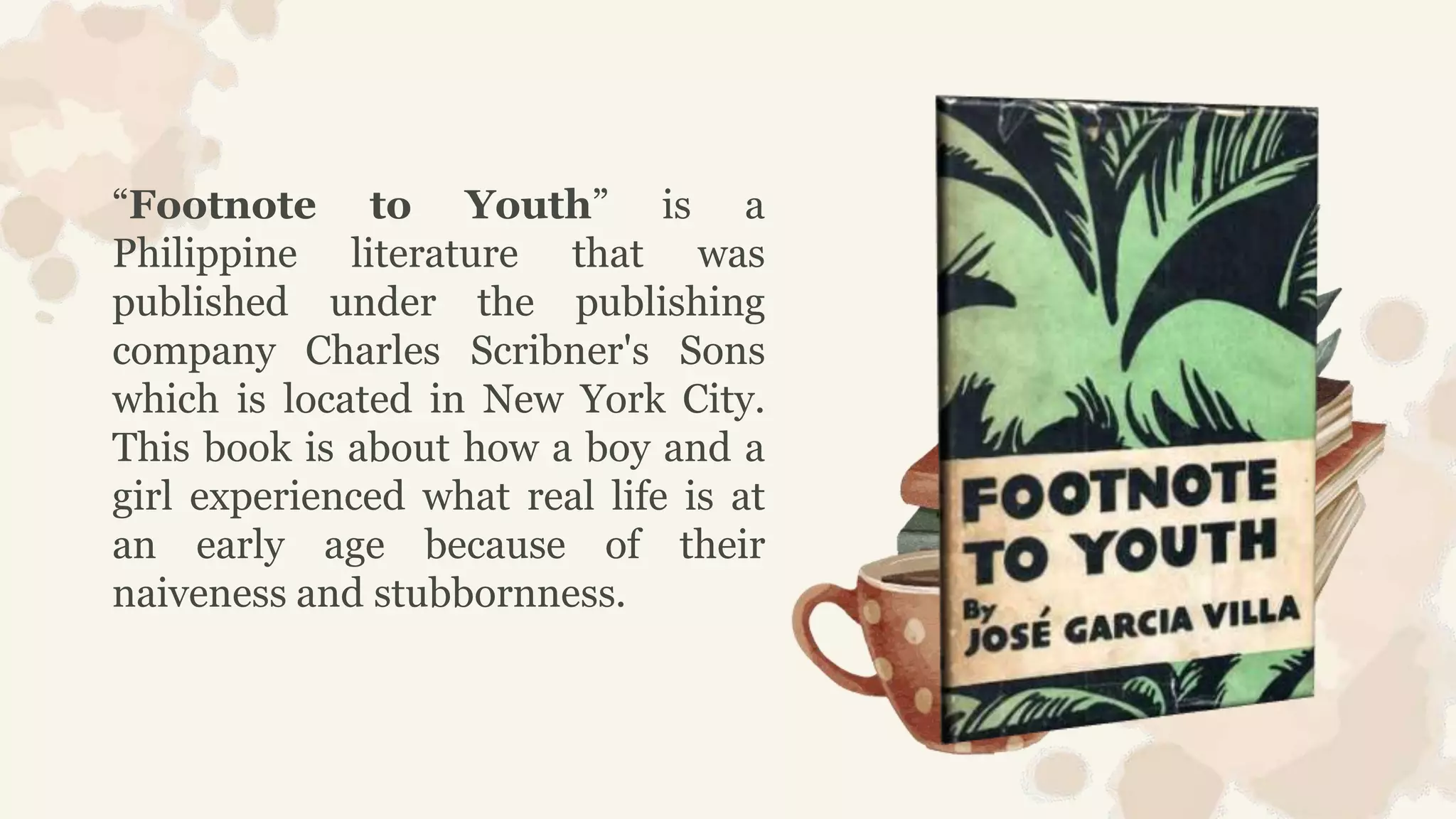
“Footnote to Youth” is a
Philippine literature that was
published under the publishing
company Charles Scribner's Sons
which is located in New York City.
This book is about how a boy and a
girl experienced what real life is at
an early age because of their
naiveness and stubbornness.
Characters
the protagonist of the
story, a young man who
marries Teang at the age
of 17 and dreams of having
a better life for himself
and his family.
Dodong's wife, who also
marries at a young age
and struggles to cope with
the difficulties of married
life and motherhood.
a farmer who advises
Dodong to wait until he is
older and more financially
stable before getting
married.
Dodong's eldest son, who
also got married at a
young age and is now
burdened with the
responsibilities of
providing for his family.
Dodong
Dodong’s Father
Teang
Blas
Tona
The girlfriend of Blas.
Setting
The story took place in a farm where the house
of the main character is located which speaks a
lot about the social conditions prevalent when
the short story was written in 1933.
Ten Major Events
1. Dodong and Teang get married at a very young
age, without the blessing of Dodong's parents.
2. Dodong dreams of owning his own piece of land
and providing for his family, but he discovers that
this is not easy to achieve.
3. Teang becomes pregnant shortly after they get
married, which puts a strain on their relationship.
4. Dodong's father advises him to wait until he is
older and more financially stable before starting a
family, but Dodong ignores him.
5. Teang gives birth to their first child, which
makes Dodong realize the difficulties of raising a
family at a young age.
6. Dodong becomes restless and dissatisfied with
his life, and starts to resent his wife and children.
7. Dodong's eldest son, Blas, also got married at a
young age and is now struggling to provide for his
family.
8. Dodong realizes that he has made a mistake by
getting married too young and without proper
planning.
9. Dodong and Teang's relationship deteriorates,
and they become distant from each other.
10. Dodong decides to leave his family and search
for a better life, but he realizes that his dreams may
never come true and he may never find happiness.
Point of View
"Footnote to Youth" is a short story written by Jose Garcia
Villa. The point of view used in the story is third-person
omniscient.
Third-person omniscient is a point of view where the
narrator is not a character in the story but knows the
thoughts and feelings of all the characters. In "Footnote to
Youth," the narrator describes the events that happen to the
characters and provides insights into their thoughts and
feelings.
For example, the narrator describes the character of
Dodong, his aspirations, and his emotions as he struggles
with the challenges of married life. The narrator also
provides insight into the perspectives of other characters
such as Dodong's parents, his wife Teang, and his children.
Implication of the Title
The title "Footnote to Youth" suggests
that the story is a commentary or an
addendum to the experience of young
people. A footnote is typically a reference,
comment, or explanation located at the
bottom of a page in a book or article. In
this case, the title suggests that the story
is a reflection on the challenges and
experiences that young people face as
they transition into adulthood.
THANK
YOU

Footnote to Youth.pptx

  • 1.
    Jessie Tindoy, Jr.and Daisy Cuarteros Footnote to Youth
  • 2.
  • 3.
    Jose Garcia Villa JoseGarcia Villa (1908-1997) was a renowned Filipino poet, writer, and visual artist. He is considered one of the most influential literary figures in the Philippines and is known for his modernist approach to poetry, which broke away from traditional forms and conventions. Villa's works often featured experimental structures, vivid imagery, and a focus on the sound and musicality of language. He spent much of his life in the United States, where he was associated with the literary and artistic scene of the New York School.
  • 4.
    Jose Garcia Villa Villa'snotable works include the poetry collections "Have Come, Am Here" (1942) and "Selected Poems and New" (1958), as well as the short story collection "Footnote to Youth" (1933).
  • 5.
  • 6.
    “Footnote to Youth”is a Philippine literature that was published under the publishing company Charles Scribner's Sons which is located in New York City. This book is about how a boy and a girl experienced what real life is at an early age because of their naiveness and stubbornness.
  • 7.
  • 8.
    the protagonist ofthe story, a young man who marries Teang at the age of 17 and dreams of having a better life for himself and his family. Dodong's wife, who also marries at a young age and struggles to cope with the difficulties of married life and motherhood. a farmer who advises Dodong to wait until he is older and more financially stable before getting married. Dodong's eldest son, who also got married at a young age and is now burdened with the responsibilities of providing for his family. Dodong Dodong’s Father Teang Blas Tona The girlfriend of Blas.
  • 9.
  • 10.
    The story tookplace in a farm where the house of the main character is located which speaks a lot about the social conditions prevalent when the short story was written in 1933.
  • 11.
  • 12.
    1. Dodong andTeang get married at a very young age, without the blessing of Dodong's parents. 2. Dodong dreams of owning his own piece of land and providing for his family, but he discovers that this is not easy to achieve. 3. Teang becomes pregnant shortly after they get married, which puts a strain on their relationship. 4. Dodong's father advises him to wait until he is older and more financially stable before starting a family, but Dodong ignores him. 5. Teang gives birth to their first child, which makes Dodong realize the difficulties of raising a family at a young age.
  • 13.
    6. Dodong becomesrestless and dissatisfied with his life, and starts to resent his wife and children. 7. Dodong's eldest son, Blas, also got married at a young age and is now struggling to provide for his family. 8. Dodong realizes that he has made a mistake by getting married too young and without proper planning. 9. Dodong and Teang's relationship deteriorates, and they become distant from each other. 10. Dodong decides to leave his family and search for a better life, but he realizes that his dreams may never come true and he may never find happiness.
  • 14.
  • 15.
    "Footnote to Youth"is a short story written by Jose Garcia Villa. The point of view used in the story is third-person omniscient. Third-person omniscient is a point of view where the narrator is not a character in the story but knows the thoughts and feelings of all the characters. In "Footnote to Youth," the narrator describes the events that happen to the characters and provides insights into their thoughts and feelings. For example, the narrator describes the character of Dodong, his aspirations, and his emotions as he struggles with the challenges of married life. The narrator also provides insight into the perspectives of other characters such as Dodong's parents, his wife Teang, and his children.
  • 16.
  • 17.
    The title "Footnoteto Youth" suggests that the story is a commentary or an addendum to the experience of young people. A footnote is typically a reference, comment, or explanation located at the bottom of a page in a book or article. In this case, the title suggests that the story is a reflection on the challenges and experiences that young people face as they transition into adulthood.
  • 18.