MyPyramid
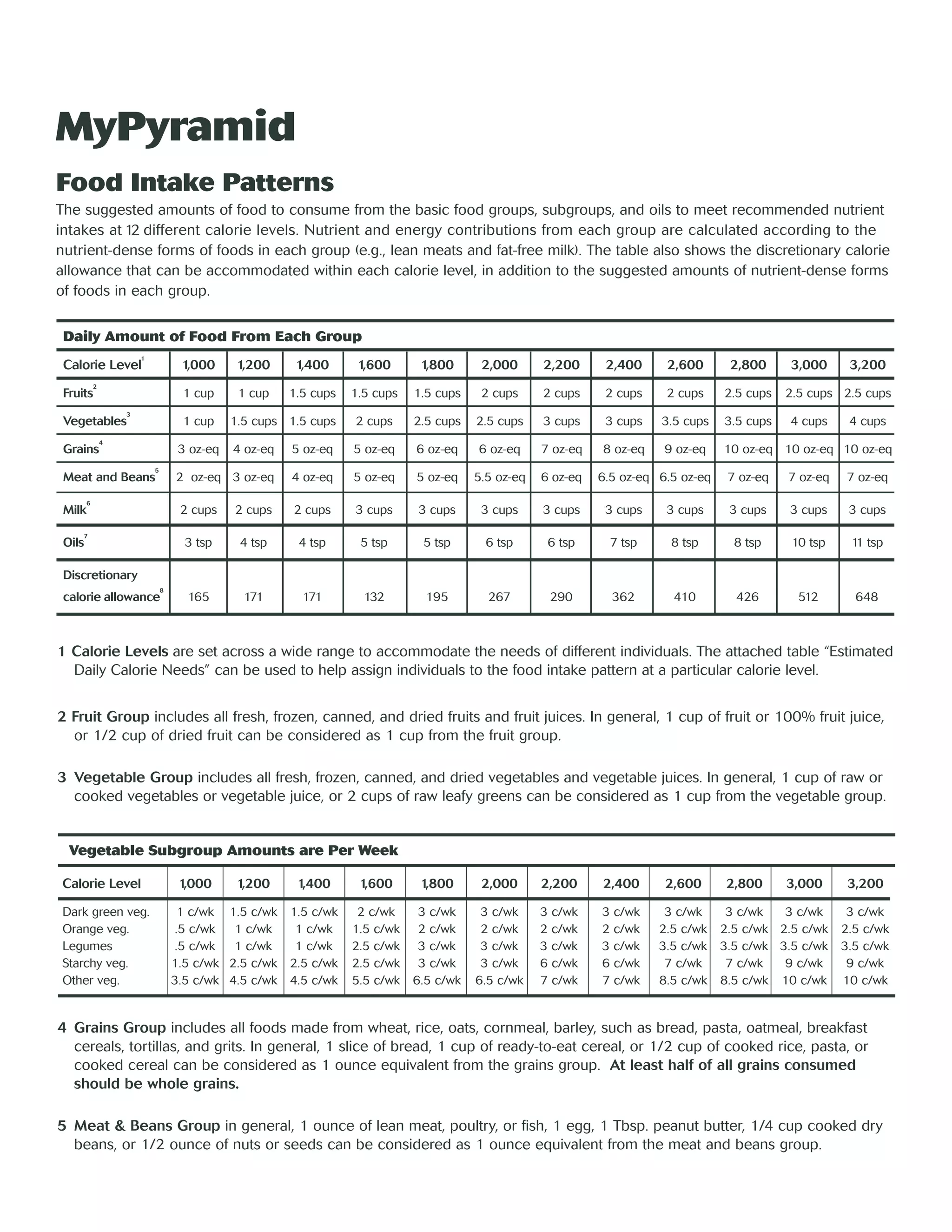
Food Intake Patterns
The suggested amounts of food to consume from the basic food groups, subgroups, and oils to meet recommended nutrient
intakes at 12 different calorie levels. Nutrient and energy contributions from each group are calculated according to the
nutrient-dense forms of foods in each group (e.g., lean meats and fat-free milk). The table also shows the discretionary calorie
allowance that can be accommodated within each calorie level, in addition to the suggested amounts of nutrient-dense forms
of foods in each group.


 Daily Amount of Food From Each Group
                        1
 Calorie Level                       1,000      1,200     1,400      1,600      1,800      2,000      2,200      2,400     2,600       2,800     3,000      3,200
            2
 Fruits                              1 cup      1 cup    1.5 cups   1.5 cups   1.5 cups    2 cups     2 cups     2 cups    2 cups     2.5 cups   2.5 cups 2.5 cups
                    3
 Vegetables                          1 cup     1.5 cups 1.5 cups    2 cups     2.5 cups   2.5 cups    3 cups     3 cups   3.5 cups    3.5 cups   4 cups     4 cups
                4
 Grains                              3 oz-eq   4 oz-eq   5 oz-eq    5 oz-eq    6 oz-eq    6 oz-eq     7 oz-eq   8 oz-eq    9 oz-eq    10 oz-eq 10 oz-eq 10 oz-eq
                            5
 Meat and Beans                     2 oz-eq 3 oz-eq      4 oz-eq    5 oz-eq    5 oz-eq    5.5 oz-eq   6 oz-eq   6.5 oz-eq 6.5 oz-eq    7 oz-eq   7 oz-eq   7 oz-eq
        6
 Milk                                2 cups    2 cups    2 cups     3 cups     3 cups      3 cups     3 cups     3 cups    3 cups      3 cups    3 cups     3 cups
     7
 Oils                                 3 tsp     4 tsp     4 tsp      5 tsp      5 tsp       6 tsp      6 tsp     7 tsp      8 tsp       8 tsp    10 tsp     1 tsp
                                                                                                                                                             1

 Discretionary
                                8
 calorie allowance                    165        171       171        132        195        267        290        362       410         426        512       648


1 Calorie Levels are set across a wide range to accommodate the needs of different individuals. The attached table “Estimated
  Daily Calorie Needs” can be used to help assign individuals to the food intake pattern at a particular calorie level.


2 Fruit Group includes all fresh, frozen, canned, and dried fruits and fruit juices. In general, 1 cup of fruit or 100% fruit juice,
  or 1/2 cup of dried fruit can be considered as 1 cup from the fruit group.

3 Vegetable Group includes all fresh, frozen, canned, and dried vegetables and vegetable juices. In general, 1 cup of raw or
  cooked vegetables or vegetable juice, or 2 cups of raw leafy greens can be considered as 1 cup from the vegetable group.


  Vegetable Subgroup Amounts are Per Week

Calorie Level                        1,000      1,200     1,400      1,600      1,800      2,000      2,200     2,400      2,600      2,800      3,000      3,200

Dark green veg.                       1 c/wk 1.5 c/wk 1.5 c/wk       2 c/wk     3 c/wk     3 c/wk     3 c/wk    3 c/wk     3 c/wk      3 c/wk   3 c/wk      3 c/wk
Orange veg.                          .5 c/wk  1 c/wk   1 c/wk       1.5 c/wk    2 c/wk     2 c/wk     2 c/wk    2 c/wk    2.5 c/wk    2.5 c/wk 2.5 c/wk    2.5 c/wk
Legumes                             .5 c/wk   1 c/wk   1 c/wk       2.5 c/wk    3 c/wk     3 c/wk     3 c/wk    3 c/wk    3.5 c/wk    3.5 c/wk 3.5 c/wk    3.5 c/wk
Starchy veg.                        1.5 c/wk 2.5 c/wk 2.5 c/wk      2.5 c/wk    3 c/wk     3 c/wk     6 c/wk    6 c/wk     7 c/wk      7 c/wk   9 c/wk      9 c/wk
Other veg.                          3.5 c/wk 4.5 c/wk 4.5 c/wk      5.5 c/wk   6.5 c/wk   6.5 c/wk    7 c/wk    7 c/wk    8.5 c/wk    8.5 c/wk 10 c/wk     10 c/wk


4 Grains Group includes all foods made from wheat, rice, oats, cornmeal, barley, such as bread, pasta, oatmeal, breakfast
  cereals, tortillas, and grits. In general, 1 slice of bread, 1 cup of ready-to-eat cereal, or 1/2 cup of cooked rice, pasta, or
  cooked cereal can be considered as 1 ounce equivalent from the grains group. At least half of all grains consumed
  should be whole grains.

5 Meat & Beans Group in general, 1 ounce of lean meat, poultry, or fish, 1 egg, 1 Tbsp. peanut butter, 1/4 cup cooked dry
  beans, or 1/2 ounce of nuts or seeds can be considered as 1 ounce equivalent from the meat and beans group.
6 Milk Group includes all fluid milk products and foods made from milk that retain their calcium content, such as yogurt and
  cheese. Foods made from milk that have little to no calcium, such as cream cheese, cream, and butter, are not part of the
  group. Most milk group choices should be fat-free or low-fat. In general, 1 cup of milk or yogurt, 1 1/2 ounces of natural
  cheese, or 2 ounces of processed cheese can be considered as 1 cup from the milk group.

7 Oils include fats from many different plants and from fish that are liquid at room temperature, such as canola, corn, olive,
  soybean, and sunflower oil. Some foods are naturally high in oils, like nuts, olives, some fish, and avocados. Foods that are
  mainly oil include mayonnaise, certain salad dressings, and soft margarine.

8 Discretionary Calorie Allowance is the remaining amount of calories in a food intake pattern after accounting for the
  calories needed for all food groups—using forms of foods that are fat-free or low-fat and with no added sugars.


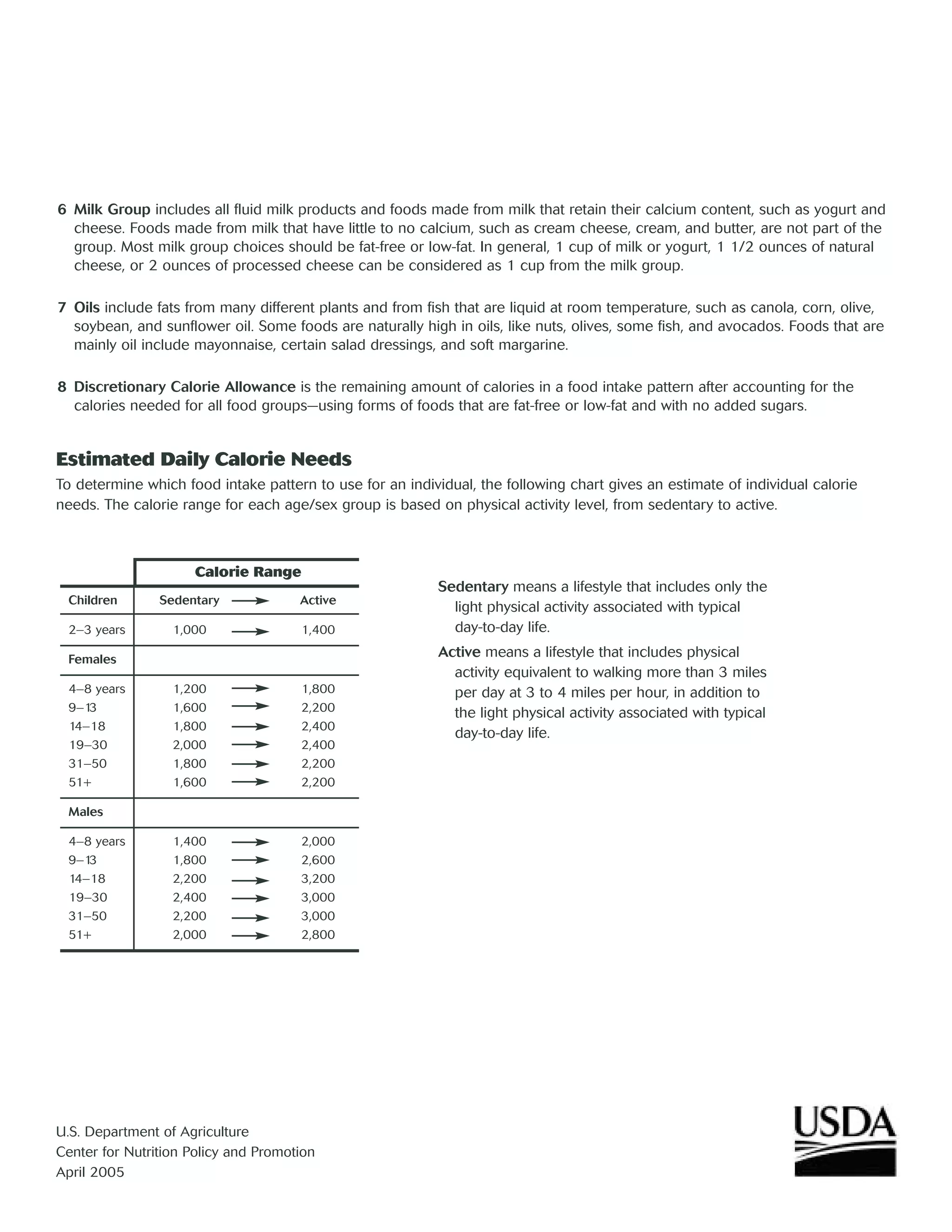
Estimated Daily Calorie Needs
To determine which food intake pattern to use for an individual, the following chart gives an estimate of individual calorie
needs. The calorie range for each age/sex group is based on physical activity level, from sedentary to active.


                     Calorie Range
                                                           Sedentary means a lifestyle that includes only the
 Children       Sedentary             Active
                                                             light physical activity associated with typical
 2–3 years        1,000               1,400                  day-to-day life.

 Females
                                                           Active means a lifestyle that includes physical
                                                             activity equivalent to walking more than 3 miles
 4–8 years        1,200               1,800                  per day at 3 to 4 miles per hour, in addition to
 9–13             1,600               2,200                  the light physical activity associated with typical
 14–18            1,800               2,400
                                                             day-to-day life.
 19–30            2,000               2,400
 31–50            1,800               2,200
 51+              1,600               2,200

 Males

 4–8 years        1,400               2,000
 9–13             1,800               2,600
 14–18            2,200               3,200
 19–30            2,400               3,000
 31–50            2,200               3,000
 51+              2,000               2,800


U.S. Department of Agriculture
Center for Nutrition Policy and Promotion
April 2005

Food Guide Pyramid

  • 1.
    MyPyramid Food Intake Patterns Thesuggested amounts of food to consume from the basic food groups, subgroups, and oils to meet recommended nutrient intakes at 12 different calorie levels. Nutrient and energy contributions from each group are calculated according to the nutrient-dense forms of foods in each group (e.g., lean meats and fat-free milk). The table also shows the discretionary calorie allowance that can be accommodated within each calorie level, in addition to the suggested amounts of nutrient-dense forms of foods in each group. Daily Amount of Food From Each Group 1 Calorie Level 1,000 1,200 1,400 1,600 1,800 2,000 2,200 2,400 2,600 2,800 3,000 3,200 2 Fruits 1 cup 1 cup 1.5 cups 1.5 cups 1.5 cups 2 cups 2 cups 2 cups 2 cups 2.5 cups 2.5 cups 2.5 cups 3 Vegetables 1 cup 1.5 cups 1.5 cups 2 cups 2.5 cups 2.5 cups 3 cups 3 cups 3.5 cups 3.5 cups 4 cups 4 cups 4 Grains 3 oz-eq 4 oz-eq 5 oz-eq 5 oz-eq 6 oz-eq 6 oz-eq 7 oz-eq 8 oz-eq 9 oz-eq 10 oz-eq 10 oz-eq 10 oz-eq 5 Meat and Beans 2 oz-eq 3 oz-eq 4 oz-eq 5 oz-eq 5 oz-eq 5.5 oz-eq 6 oz-eq 6.5 oz-eq 6.5 oz-eq 7 oz-eq 7 oz-eq 7 oz-eq 6 Milk 2 cups 2 cups 2 cups 3 cups 3 cups 3 cups 3 cups 3 cups 3 cups 3 cups 3 cups 3 cups 7 Oils 3 tsp 4 tsp 4 tsp 5 tsp 5 tsp 6 tsp 6 tsp 7 tsp 8 tsp 8 tsp 10 tsp 1 tsp 1 Discretionary 8 calorie allowance 165 171 171 132 195 267 290 362 410 426 512 648 1 Calorie Levels are set across a wide range to accommodate the needs of different individuals. The attached table “Estimated Daily Calorie Needs” can be used to help assign individuals to the food intake pattern at a particular calorie level. 2 Fruit Group includes all fresh, frozen, canned, and dried fruits and fruit juices. In general, 1 cup of fruit or 100% fruit juice, or 1/2 cup of dried fruit can be considered as 1 cup from the fruit group. 3 Vegetable Group includes all fresh, frozen, canned, and dried vegetables and vegetable juices. In general, 1 cup of raw or cooked vegetables or vegetable juice, or 2 cups of raw leafy greens can be considered as 1 cup from the vegetable group. Vegetable Subgroup Amounts are Per Week Calorie Level 1,000 1,200 1,400 1,600 1,800 2,000 2,200 2,400 2,600 2,800 3,000 3,200 Dark green veg. 1 c/wk 1.5 c/wk 1.5 c/wk 2 c/wk 3 c/wk 3 c/wk 3 c/wk 3 c/wk 3 c/wk 3 c/wk 3 c/wk 3 c/wk Orange veg. .5 c/wk 1 c/wk 1 c/wk 1.5 c/wk 2 c/wk 2 c/wk 2 c/wk 2 c/wk 2.5 c/wk 2.5 c/wk 2.5 c/wk 2.5 c/wk Legumes .5 c/wk 1 c/wk 1 c/wk 2.5 c/wk 3 c/wk 3 c/wk 3 c/wk 3 c/wk 3.5 c/wk 3.5 c/wk 3.5 c/wk 3.5 c/wk Starchy veg. 1.5 c/wk 2.5 c/wk 2.5 c/wk 2.5 c/wk 3 c/wk 3 c/wk 6 c/wk 6 c/wk 7 c/wk 7 c/wk 9 c/wk 9 c/wk Other veg. 3.5 c/wk 4.5 c/wk 4.5 c/wk 5.5 c/wk 6.5 c/wk 6.5 c/wk 7 c/wk 7 c/wk 8.5 c/wk 8.5 c/wk 10 c/wk 10 c/wk 4 Grains Group includes all foods made from wheat, rice, oats, cornmeal, barley, such as bread, pasta, oatmeal, breakfast cereals, tortillas, and grits. In general, 1 slice of bread, 1 cup of ready-to-eat cereal, or 1/2 cup of cooked rice, pasta, or cooked cereal can be considered as 1 ounce equivalent from the grains group. At least half of all grains consumed should be whole grains. 5 Meat & Beans Group in general, 1 ounce of lean meat, poultry, or fish, 1 egg, 1 Tbsp. peanut butter, 1/4 cup cooked dry beans, or 1/2 ounce of nuts or seeds can be considered as 1 ounce equivalent from the meat and beans group.
  • 2.
    6 Milk Groupincludes all fluid milk products and foods made from milk that retain their calcium content, such as yogurt and cheese. Foods made from milk that have little to no calcium, such as cream cheese, cream, and butter, are not part of the group. Most milk group choices should be fat-free or low-fat. In general, 1 cup of milk or yogurt, 1 1/2 ounces of natural cheese, or 2 ounces of processed cheese can be considered as 1 cup from the milk group. 7 Oils include fats from many different plants and from fish that are liquid at room temperature, such as canola, corn, olive, soybean, and sunflower oil. Some foods are naturally high in oils, like nuts, olives, some fish, and avocados. Foods that are mainly oil include mayonnaise, certain salad dressings, and soft margarine. 8 Discretionary Calorie Allowance is the remaining amount of calories in a food intake pattern after accounting for the calories needed for all food groups—using forms of foods that are fat-free or low-fat and with no added sugars. Estimated Daily Calorie Needs To determine which food intake pattern to use for an individual, the following chart gives an estimate of individual calorie needs. The calorie range for each age/sex group is based on physical activity level, from sedentary to active. Calorie Range Sedentary means a lifestyle that includes only the Children Sedentary Active light physical activity associated with typical 2–3 years 1,000 1,400 day-to-day life. Females Active means a lifestyle that includes physical activity equivalent to walking more than 3 miles 4–8 years 1,200 1,800 per day at 3 to 4 miles per hour, in addition to 9–13 1,600 2,200 the light physical activity associated with typical 14–18 1,800 2,400 day-to-day life. 19–30 2,000 2,400 31–50 1,800 2,200 51+ 1,600 2,200 Males 4–8 years 1,400 2,000 9–13 1,800 2,600 14–18 2,200 3,200 19–30 2,400 3,000 31–50 2,200 3,000 51+ 2,000 2,800 U.S. Department of Agriculture Center for Nutrition Policy and Promotion April 2005