Food Guide Pyramid
•The Food Guide Pyramid is a graphic guide of what to eat
each day. It will help people follow the Dietary Guidelines for
Americans.
• The Food Guide Pyramid was developed by the U.S.
Department of Agriculture (USDA) and supported by the U.S.
Department of Health and Human Services.
• The Dietary Guidelines provide advice for better health.
• Following the Dietary Guidelines can help reduce your
chances of developing certain diseases.
• The guidelines are designed for healthy Americans aged 2
and up.
4.
• The FoodGuide Pyramid is a new graphic to
help people think about healthy eating.
• The recommended number of servings for
some of the food groups is different on the
Pyramid than the recommendations found on
other food guides, such as the "Basic Four."
• The Pyramid is designed to help people get the
nutrients they need and avoid too much fat or
sugar.
5.
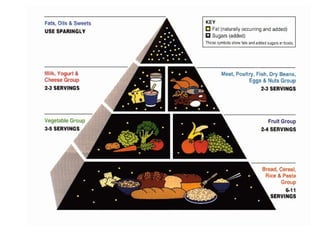
• The FoodGuide Pyramid emphasizes eating foods
from the five major food groups shown in the
pyramid's three lower levels.
• None of these major food groups is more important
than another - for good health, you need them all.
Each of these food groups provides some, but not all,
of the nutrients you need.
• Foods in one group can't replace those in another.
• Fats, oils and sweets are at the Pyramid tip. People
should use these sparingly.
6.
• The numberof servings people need depends on their
age, sex, size, and activity level.
• For example, an active male teenager needs more
servings than a less active, older woman.
• Almost everyone should have at least the lowest
number of servings in each range.
• Preschool children need the same variety of foods but
may need smaller servings.
• Be sure, however, that preschoolers eat or drink two
full servings from the milk group daily.
7.
Food Guide Pyramid–
A Guide to Daily Food Choices
• Bread, Cereal, Rice and Pasta Group (6-11 servings)
• This group includes foods from grains. You need the
most servings of these foods each day since they
provide the base of the pyramid. These foods provide
complex carbohydrates (starches), which are an
important source of energy, vitamins, minerals, and
fiber.
• What counts as a serving? 1 slice of bread, 11 ounce
of ready to eat cereal, and 1/2 cup of cooked cereal,
rice, or pasta.
8.
• Vegetable Group(3-5 servings)
• Vegetables provide vitamins, such as vitamins A and C, and
folate, and minerals, such as iron and magnesium. They are
naturally low in fat and also provide fiber.
• What counts as 1 serving? 1 cup of raw leafy vegetables,
1/2 cup of other vegetables - cooked or chopped raw; 3/4
cup of vegetable juice.
• Fruit Group
• Fruits and fruit juices provide important amounts of vitamin
A and C and potassium. They are low in fat and sodium.
• What counts as a serving? A medium apple, banana, or
orange; 1/2 cup of chopped, cooked or canned fruit; 3/4
cup of fruit juice.
9.
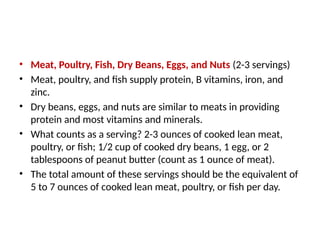
• Meat, Poultry,Fish, Dry Beans, Eggs, and Nuts (2-3 servings)
• Meat, poultry, and fish supply protein, B vitamins, iron, and
zinc.
• Dry beans, eggs, and nuts are similar to meats in providing
protein and most vitamins and minerals.
• What counts as a serving? 2-3 ounces of cooked lean meat,
poultry, or fish; 1/2 cup of cooked dry beans, 1 egg, or 2
tablespoons of peanut butter (count as 1 ounce of meat).
• The total amount of these servings should be the equivalent of
5 to 7 ounces of cooked lean meat, poultry, or fish per day.
10.
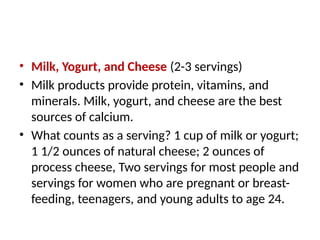
• Milk, Yogurt,and Cheese (2-3 servings)
• Milk products provide protein, vitamins, and
minerals. Milk, yogurt, and cheese are the best
sources of calcium.
• What counts as a serving? 1 cup of milk or yogurt;
1 1/2 ounces of natural cheese; 2 ounces of
process cheese, Two servings for most people and
servings for women who are pregnant or breast-
feeding, teenagers, and young adults to age 24.
11.
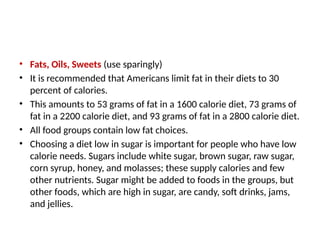
• Fats, Oils,Sweets (use sparingly)
• It is recommended that Americans limit fat in their diets to 30
percent of calories.
• This amounts to 53 grams of fat in a 1600 calorie diet, 73 grams of
fat in a 2200 calorie diet, and 93 grams of fat in a 2800 calorie diet.
• All food groups contain low fat choices.
• Choosing a diet low in sugar is important for people who have low
calorie needs. Sugars include white sugar, brown sugar, raw sugar,
corn syrup, honey, and molasses; these supply calories and few
other nutrients. Sugar might be added to foods in the groups, but
other foods, which are high in sugar, are candy, soft drinks, jams,
and jellies.
12.
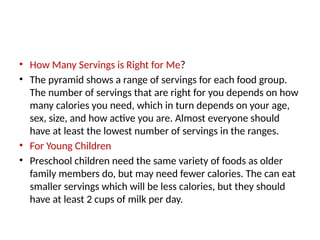
• How ManyServings is Right for Me?
• The pyramid shows a range of servings for each food group.
The number of servings that are right for you depends on how
many calories you need, which in turn depends on your age,
sex, size, and how active you are. Almost everyone should
have at least the lowest number of servings in the ranges.
• For Young Children
• Preschool children need the same variety of foods as older
family members do, but may need fewer calories. The can eat
smaller servings which will be less calories, but they should
have at least 2 cups of milk per day.
13.
• Combination foods
•For mixed foods, do the best you can to
estimate the food group servings. For
example, a slice of pizza has servings from the
bread group (crust), milk group (cheese) and
vegetable group (tomato).
14.
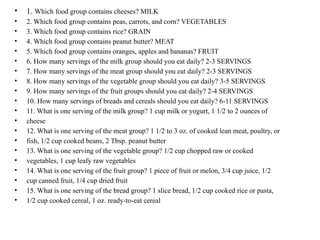
• 1. Whichfood group contains cheeses? MILK
• 2. Which food group contains peas, carrots, and corn? VEGETABLES
• 3. Which food group contains rice? GRAIN
• 4. Which food group contains peanut butter? MEAT
• 5. Which food group contains oranges, apples and bananas? FRUIT
• 6. How many servings of the milk group should you eat daily? 2-3 SERVINGS
• 7. How many servings of the meat group should you eat daily? 2-3 SERVINGS
• 8. How many servings of the vegetable group should you eat daily? 3-5 SERVINGS
• 9. How many servings of the fruit groups should you eat daily? 2-4 SERVINGS
• 10. How many servings of breads and cereals should you eat daily? 6-11 SERVINGS
• 11. What is one serving of the milk group? 1 cup milk or yogurt, 1 1/2 to 2 ounces of
• cheese
• 12. What is one serving of the meat group? 1 1/2 to 3 oz. of cooked lean meat, poultry, or
• fish, 1/2 cup cooked beans, 2 Tbsp. peanut butter
• 13. What is one serving of the vegetable group? 1/2 cup chopped raw or cooked
• vegetables, 1 cup leafy raw vegetables
• 14. What is one serving of the fruit group? 1 piece of fruit or melon, 3/4 cup juice, 1/2
• cup canned fruit, 1/4 cup dried fruit
• 15. What is one serving of the bread group? 1 slice bread, 1/2 cup cooked rice or pasta,
• 1/2 cup cooked cereal, 1 oz. ready-to-eat cereal