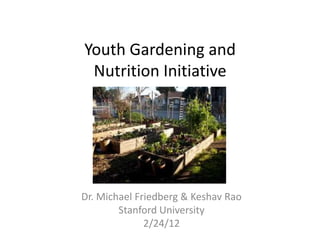
Youth Gardening and
 Nutrition Initiative


Dr. Michael Friedberg & Keshav Rao
        Stanford University
              2/24/12
About Us
• Community project to help
  lower and middle students
  in EPA learn about
  nutrition, gardening, and
  healthier diets
• Preventative program to
  fight childhood obesity
• Collaboration between
  Stanford Pediatrics (StAT
  Program), the Ecumenical
  Hunger Program, and
  Stanford undergraduates
• Website: www.ygni.org
Curriculum Overview
• 6 class curriculum covering:
  – Key nutritional concepts (40 min/class)
  – Gardening experiences (20 min/class)
  – Healthy recipes and cooking demonstrations (20
    min/class)
• Target Audience: Elementary/Middle School
  East Palo Alto students
• Weekly classes will be offered at the
  Ecumenical Hunger Program
Table of Contents
           Nutrition                 Gardening                     Recipes
Module 1   Intro to Healthy Eating   Planning “Pizza Garden” and   Yogurt Parfait
           and Gardening             Mini-Greenhouse Seed Trays    with granola
                                                                   and fruit
Module 2   Dangers of Added Fats     Setting up the “Pizza         Chicken Fingers
           and Sugars                Garden”
Module 3   Fruits & Veggies: Key     Placing & Installing the      Fruit
           Sources of Vitamins       Plants                        Smoothies
Module 4   Grains & Proteins         Create Your Own Compost       Fritatta
Module 5   Portion Control &         Maintaining & Growing the     Hummus
           Healthy Snacking          Garden
Module 6   Eating Healthy When       Harvesting & Transplanting    Garden Pizza
           Eating Out                Seedlings to Garden
Energy Balance


• Weight Gain:
ENERGY IN (Calories consumed) > ENERGY OUT (Calories burned)
• Same Weight:
ENERGY IN (Calories consumed) = ENERGY OUT (Calories burned)
• Weight Loss:
Energy IN (Calories consumed) < Energy Out (Calories burned)

Total Calories = Breakfast (300 cal) + Lunch (1200 cal) + Dinner (1500 cal) = 3000
Calories Burned = 2000 cal

Does the person gain weight?
200/700 calories from fat is < 30%
Type of Milk      Calories   Total Fat (g)   Protein (g) Calcium (% DV)

Fat Free Milk     90         0               9          30%

1% Low-fat Milk   120        2.5             11         35%

2% Reduced Fat    130        5               10         30%
Milk
Whole Milk        160        9               8          25%


                              Total Fat

                                 <

                                 >
                              Total Calcium, Protein
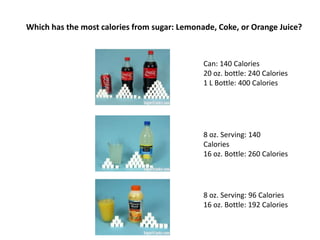
Which has the most calories from sugar: Lemonade, Coke, or Orange Juice?


                                              Can: 140 Calories
                                              20 oz. bottle: 240 Calories
                                              1 L Bottle: 400 Calories


                                              8 oz. Serving: 140
                                              Calories
                                              16 oz. Bottle: 260 Calories


                                              8 oz. Serving: 96 Calories
                                              16 oz. Bottle: 192 Calories
Portion Control
• Q1: How often do you Value-size, Supersize, Mega-size or “whatever-
  size” your burgers, sodas or fries?
   – Always
   – Sometimes
   – Never
• Q2: When you eat a packaged snack or dessert (like chips, crackers,
  cookies, or ice cream) do you usually:
   – Take out what you want and then put the package away
   – Take out what you want, but leave the package out, in case you want
     more.
   – Eat straight out of the package, sometimes until nothing is left.
• Q3: How often do you read the label on food packages to see what
  the serving size is?
   – Usually
   – Sometimes
   – Never
Serving Size: 4-6 oz


Serving Size: 40% of bag


Serving Size: 2 tbsp
Meat Group                            Milk Group
                 (for growth)                    (for bones and teeth)
Hardboiled egg                  Milk
Leftover meat                   Cheese Slices
Chicken leg                     Cheese Sticks
Peanut butter                   Cottage Cheese
Nuts or seeds                   Yogurt
Tofu                            Soy Milk
Beans


                 Grain Group                     Fruits and Vegetables
                 (for energy)                         (for vitality)
Pretzels                        Fresh Fruit slices-Apple, Orange, melon
Cheerios                        Banana, Pear, grapes
Kix cereals                     Canned fruit., applesauce
Bagels                          Strawberries
Rice cakes                      Steamed cold vegetables-broccoli,
Graham Crackers                 cauliflower
Tortillas                       Fresh celery sticks
Bread, various kinds            Fresh vegies-celery sticks, cucumber,
Popcorn, plain                  snow peas, carrots
                                Cherry tomatoes Frozen juice sticks
                                Juice- fruit and tomato
Eat Healthy Away from Home
Do

     Order a kids meal

     Share a meal with friends/family

     Ask for no mayo, dressing on the side

     Pack up half of a lunch/dinner in a to-go box
     before even starting the meal

     Ask if you could get the lunch-sized portion of
     dinner dishes

Don’t
     Supersize your meals unless you plan to share
     Order the largest size of drinks or main courses
     Go to all-you-can-eat buffets
Healthy Recipe: Yogurt Parfait
• Ingredients
    – ½ cup granola, low-fat
    – ¾ cup (6-oz container) vanilla or plain
      yogurt, low-fat
    – ½ cup fresh blueberries, raspberries, or
      sliced strawberries or bananas
• Set-up/Prep: Have students construct a
  healthy parfait by combining granola,
  yogurt, and fresh fruit
• Key Nutritional Information:
    – Serving Size: 1 ¾ cups
    – 15 g protein, 6 g fat, 2.5 g saturated fat,
      35% DV calcium, 20% DV Vitamin C


Source: Kidshealth.org
Healthy Recipe: Chicken Fingers
• Ingredients:
    – 1 4-oz. boneless, skinless chicken
      breast, rinsed, patted dry, and sliced into strips
      or 4 1-oz boneless, skinless chicken tenders
    – 1 egg or ¼ cup egg substitute or ¼ cup skim milk
    – 1/3 cup cereal flakes, crushed (preferably cereal
      with 3g or more of fiber per serving)
• Set-up/Prep:
    – Preheat oven to 350º F (176º C).
    – Dip chicken strips into egg, egg substitute, or
      skim milk.
    – Roll dipped chicken in high-fiber cereal to coat.
    – Place coated strips on nonstick baking sheet.
    – Bake for 18 to 20 minutes, turning after 9
      minutes, until chicken is done (it must be
      white, not pink, inside).
• Key Nutritional Info:
    – Serving size: 1 tender
    – 227 calories, 30 g protein, 3 g fat, 0.8 g sat. fat

                                                            Source: kidshealth.org
Healthy Recipe: Fruit Smoothie
   • Ingredients
       –   2 cups 1% milk
       –   1 fresh pitted mango
       –   1 small banana
       –   2 ice cubes
   • Set-up/Prep
       – Put all ingredients into a blender
         and blend until foamy. Kids can
         add more fruit and/or vegetables.
   • Key Nutritional Information:
       – Serving Size: ¾ Cup
       – 106 Calories, 2 g total fat, 1 g
         saturated fat, 157 mg calcium


Source: Delicious Heart-Healthy Latino Recipes
Healthy Recipe: Frittata


Source: Edible Schoolyard Project
Healthy Recipe: Hummus
          • Ingredients:
              –   2 cups canned garbanzo beans, drainer
              –   1/3 cup tahini, ¼ cup lemon juice
              –   1 tsp salt, 2 cloves garlic, 1 tbsp olive oil
              –   1 pinch paprika, 1 tsp fresh parsley
          • Set-up/Prep:
              – Place the garbanzo beans, tahini, lemon
                juice, salt and garlic in a blender or food
                processor. Blend until smooth.
              – Transfer mixture to a serving bowl. Drizzle
                olive oil over the garbanzo bean mixture.
                Sprinkle with paprika and parsley
          • Key Nutrition Info:
              – Serving Size: 1/16 of recipe
              – 77 calories, 4.3 g fat, 0.6 g sat fat, 5% DV
                protein, 12% DV folate


Source:
Healthy Recipe: Garden Pizza
•   Ingredients
     –   1 pint cherry tomatoes, 2 tbsp tomato paste
     –   8 fresh basil leaves, 2 tsp fresh oregano
     –   ¼ tsp salt, ½ tsp pepper, yellow cornmeal dusting
     –   1 pound Easy Whole-Wheat dough
     –   4 oz. fresh mozzarella cheese
     –   3 tbsp grated parmesan cheese
     –   4 baby zucchinis, 1 medium yellow bell pepper
•   Set-up/Prep
     – Place a pizza stone on the lowest rack; preheat oven
       to 450°F for at least 20 minutes
     – Roll out the dough and place on a cornmeal-dusted
       pizza peel or inverted baking sheet, using enough
       cornmeal so that the dough slides easily
     – .Slide the dough onto the preheated stone and cook
       until the bottom begins to crisp, about 3 minutes.
       Remove the crust, making sure the underside is
       covered with cornmeal
     – Quickly add the toppings and slide the pizza back
       onto the stone. Continue baking until the toppings
       are hot and the bottom of the crust has browned, 12
       to 15 minutes.
•   Key Nutritional Information:375 calories; 9 g fat
    (5 g sat, 1 g mono ); 26 mg cholesterol; 58 g
    carbohydrates; 17 g protein; 8 g fiber; 531 mg
    sodium;
                                                              Source: Eatingwell,com
Feedback
• Material
• Logistics
• Additional Needs (Cooking supplies, etc)

Focus Group Presentation (Ver 1.0)

  • 1.
    Youth Gardening and Nutrition Initiative Dr. Michael Friedberg & Keshav Rao Stanford University 2/24/12
  • 2.
    About Us • Communityproject to help lower and middle students in EPA learn about nutrition, gardening, and healthier diets • Preventative program to fight childhood obesity • Collaboration between Stanford Pediatrics (StAT Program), the Ecumenical Hunger Program, and Stanford undergraduates • Website: www.ygni.org
  • 3.
    Curriculum Overview • 6class curriculum covering: – Key nutritional concepts (40 min/class) – Gardening experiences (20 min/class) – Healthy recipes and cooking demonstrations (20 min/class) • Target Audience: Elementary/Middle School East Palo Alto students • Weekly classes will be offered at the Ecumenical Hunger Program
  • 4.
    Table of Contents Nutrition Gardening Recipes Module 1 Intro to Healthy Eating Planning “Pizza Garden” and Yogurt Parfait and Gardening Mini-Greenhouse Seed Trays with granola and fruit Module 2 Dangers of Added Fats Setting up the “Pizza Chicken Fingers and Sugars Garden” Module 3 Fruits & Veggies: Key Placing & Installing the Fruit Sources of Vitamins Plants Smoothies Module 4 Grains & Proteins Create Your Own Compost Fritatta Module 5 Portion Control & Maintaining & Growing the Hummus Healthy Snacking Garden Module 6 Eating Healthy When Harvesting & Transplanting Garden Pizza Eating Out Seedlings to Garden
  • 5.
    Energy Balance • WeightGain: ENERGY IN (Calories consumed) > ENERGY OUT (Calories burned) • Same Weight: ENERGY IN (Calories consumed) = ENERGY OUT (Calories burned) • Weight Loss: Energy IN (Calories consumed) < Energy Out (Calories burned) Total Calories = Breakfast (300 cal) + Lunch (1200 cal) + Dinner (1500 cal) = 3000 Calories Burned = 2000 cal Does the person gain weight?
  • 8.
  • 9.
    Type of Milk Calories Total Fat (g) Protein (g) Calcium (% DV) Fat Free Milk 90 0 9 30% 1% Low-fat Milk 120 2.5 11 35% 2% Reduced Fat 130 5 10 30% Milk Whole Milk 160 9 8 25% Total Fat < > Total Calcium, Protein
  • 10.
    Which has themost calories from sugar: Lemonade, Coke, or Orange Juice? Can: 140 Calories 20 oz. bottle: 240 Calories 1 L Bottle: 400 Calories 8 oz. Serving: 140 Calories 16 oz. Bottle: 260 Calories 8 oz. Serving: 96 Calories 16 oz. Bottle: 192 Calories
  • 14.
    Portion Control • Q1:How often do you Value-size, Supersize, Mega-size or “whatever- size” your burgers, sodas or fries? – Always – Sometimes – Never • Q2: When you eat a packaged snack or dessert (like chips, crackers, cookies, or ice cream) do you usually: – Take out what you want and then put the package away – Take out what you want, but leave the package out, in case you want more. – Eat straight out of the package, sometimes until nothing is left. • Q3: How often do you read the label on food packages to see what the serving size is? – Usually – Sometimes – Never
  • 15.
    Serving Size: 4-6oz Serving Size: 40% of bag Serving Size: 2 tbsp
  • 16.
    Meat Group Milk Group (for growth) (for bones and teeth) Hardboiled egg Milk Leftover meat Cheese Slices Chicken leg Cheese Sticks Peanut butter Cottage Cheese Nuts or seeds Yogurt Tofu Soy Milk Beans Grain Group Fruits and Vegetables (for energy) (for vitality) Pretzels Fresh Fruit slices-Apple, Orange, melon Cheerios Banana, Pear, grapes Kix cereals Canned fruit., applesauce Bagels Strawberries Rice cakes Steamed cold vegetables-broccoli, Graham Crackers cauliflower Tortillas Fresh celery sticks Bread, various kinds Fresh vegies-celery sticks, cucumber, Popcorn, plain snow peas, carrots Cherry tomatoes Frozen juice sticks Juice- fruit and tomato
  • 18.
    Eat Healthy Awayfrom Home Do Order a kids meal Share a meal with friends/family Ask for no mayo, dressing on the side Pack up half of a lunch/dinner in a to-go box before even starting the meal Ask if you could get the lunch-sized portion of dinner dishes Don’t Supersize your meals unless you plan to share Order the largest size of drinks or main courses Go to all-you-can-eat buffets
  • 19.
    Healthy Recipe: YogurtParfait • Ingredients – ½ cup granola, low-fat – ¾ cup (6-oz container) vanilla or plain yogurt, low-fat – ½ cup fresh blueberries, raspberries, or sliced strawberries or bananas • Set-up/Prep: Have students construct a healthy parfait by combining granola, yogurt, and fresh fruit • Key Nutritional Information: – Serving Size: 1 ¾ cups – 15 g protein, 6 g fat, 2.5 g saturated fat, 35% DV calcium, 20% DV Vitamin C Source: Kidshealth.org
  • 20.
    Healthy Recipe: ChickenFingers • Ingredients: – 1 4-oz. boneless, skinless chicken breast, rinsed, patted dry, and sliced into strips or 4 1-oz boneless, skinless chicken tenders – 1 egg or ¼ cup egg substitute or ¼ cup skim milk – 1/3 cup cereal flakes, crushed (preferably cereal with 3g or more of fiber per serving) • Set-up/Prep: – Preheat oven to 350º F (176º C). – Dip chicken strips into egg, egg substitute, or skim milk. – Roll dipped chicken in high-fiber cereal to coat. – Place coated strips on nonstick baking sheet. – Bake for 18 to 20 minutes, turning after 9 minutes, until chicken is done (it must be white, not pink, inside). • Key Nutritional Info: – Serving size: 1 tender – 227 calories, 30 g protein, 3 g fat, 0.8 g sat. fat Source: kidshealth.org
  • 21.
    Healthy Recipe: FruitSmoothie • Ingredients – 2 cups 1% milk – 1 fresh pitted mango – 1 small banana – 2 ice cubes • Set-up/Prep – Put all ingredients into a blender and blend until foamy. Kids can add more fruit and/or vegetables. • Key Nutritional Information: – Serving Size: ¾ Cup – 106 Calories, 2 g total fat, 1 g saturated fat, 157 mg calcium Source: Delicious Heart-Healthy Latino Recipes
  • 22.
    Healthy Recipe: Frittata Source:Edible Schoolyard Project
  • 23.
    Healthy Recipe: Hummus • Ingredients: – 2 cups canned garbanzo beans, drainer – 1/3 cup tahini, ¼ cup lemon juice – 1 tsp salt, 2 cloves garlic, 1 tbsp olive oil – 1 pinch paprika, 1 tsp fresh parsley • Set-up/Prep: – Place the garbanzo beans, tahini, lemon juice, salt and garlic in a blender or food processor. Blend until smooth. – Transfer mixture to a serving bowl. Drizzle olive oil over the garbanzo bean mixture. Sprinkle with paprika and parsley • Key Nutrition Info: – Serving Size: 1/16 of recipe – 77 calories, 4.3 g fat, 0.6 g sat fat, 5% DV protein, 12% DV folate Source:
  • 24.
    Healthy Recipe: GardenPizza • Ingredients – 1 pint cherry tomatoes, 2 tbsp tomato paste – 8 fresh basil leaves, 2 tsp fresh oregano – ¼ tsp salt, ½ tsp pepper, yellow cornmeal dusting – 1 pound Easy Whole-Wheat dough – 4 oz. fresh mozzarella cheese – 3 tbsp grated parmesan cheese – 4 baby zucchinis, 1 medium yellow bell pepper • Set-up/Prep – Place a pizza stone on the lowest rack; preheat oven to 450°F for at least 20 minutes – Roll out the dough and place on a cornmeal-dusted pizza peel or inverted baking sheet, using enough cornmeal so that the dough slides easily – .Slide the dough onto the preheated stone and cook until the bottom begins to crisp, about 3 minutes. Remove the crust, making sure the underside is covered with cornmeal – Quickly add the toppings and slide the pizza back onto the stone. Continue baking until the toppings are hot and the bottom of the crust has browned, 12 to 15 minutes. • Key Nutritional Information:375 calories; 9 g fat (5 g sat, 1 g mono ); 26 mg cholesterol; 58 g carbohydrates; 17 g protein; 8 g fiber; 531 mg sodium; Source: Eatingwell,com
  • 25.
    Feedback • Material • Logistics •Additional Needs (Cooking supplies, etc)

Editor's Notes

  • #2  Need additional manpower Fresh food (milk, cheese, etc) Recipes utilizing available material Donation of crockpots, juicer, other cooking supplies 10/11 tuesdays produce distribution Womens support group (2nd and 4thtuesdays)
  • #3 david@davidhillphotography.com
  • #20 Ensure there is enough food for students to bring home for snacksAllow students to create their own recipe book - More cost-effective fruit?  bananas, apples, Blenders,
  • #24 Can add whole wheat pita bread/tortillas, sliced red peppers, feta cheese, and olives Source: Eatingwell.com