Food and Beverage Management
Introduction
 Food & Beverage Functions
 Food for fuel
 Food for the overall experience
 Keeps group together

In one place

At one time
 Eases service strain in restaurants on site
“What can go wrong, will go wrong.”
Catered Events - Defined
 One host / sponsor
 One check / bill
 Same meal* * unless special dietary consideration
 Mandatory gratuity – 15%-22%
 Distributed to staff and/or management
Catered Events - Types
 On Premise
 facility with permanent kitchen and function rooms
 Locations – hotel, restaurant, convention center
 Permanent furniture and equipment
 Off Premise
 Transports food (prepared or to prepare on site)
 Locations – tents, museums, parks, attractions
 Equipment and furniture rentals
 Contract through RFP process
Catered Events - Types
 Off Premise (continued)
 Using Destination Management Companies
(DMC)

Locally based company who knows the locally based
venues, caterers and suppliers

A one-stop shop for the planner
 Transportation

Additional costs – additional coordination
 Weather

Always a challenge ( obstacle)

Back-up plans required
Catered Events - Types
 Conference Centers
 Complete Meeting Package (CMP)

Guest rooms, AV and all meals included in one price per
person

Continual breaks

Cafeteria style service

Special private banquets upon request
 Convention Centers and Stadiums
 Concession sands
 Restaurants
 Special Event catering
Catered Events - Hints
 Conduct site inspection
 Choose menu items appropriate to your group
 Age / Gender
 Profession / Ethnic background
 Purpose of event
 Custom menus
 Skill level
 Product availability
 Stay on top of food trends
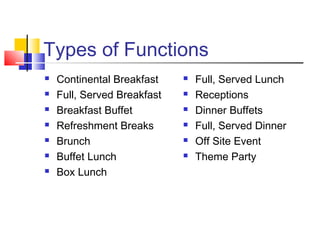
Types of Functions
 Continental Breakfast
 Full, Served Breakfast
 Breakfast Buffet
 Refreshment Breaks
 Brunch
 Buffet Lunch
 Box Lunch
 Full, Served Lunch
 Receptions
 Dinner Buffets
 Full, Served Dinner
 Off Site Event
 Theme Party
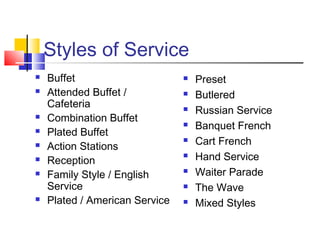
Styles of Service
 Buffet
 Attended Buffet /
Cafeteria
 Combination Buffet
 Plated Buffet
 Action Stations
 Reception
 Family Style / English
Service
 Plated / American Service
 Preset
 Butlered
 Russian Service
 Banquet French
 Cart French
 Hand Service
 Waiter Parade
 The Wave
 Mixed Styles
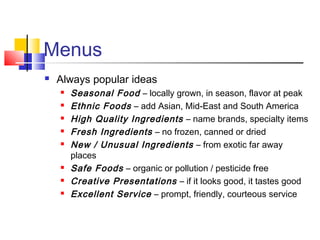
Menus
 Always popular ideas
 Seasonal Food – locally grown, in season, flavor at peak
 Ethnic Foods – add Asian, Mid-East and South America
 High Quality Ingredients – name brands, specialty items
 Fresh Ingredients – no frozen, canned or dried
 New / Unusual Ingredients – from exotic far away
places
 Safe Foods – organic or pollution / pesticide free
 Creative Presentations – if it looks good, it tastes good
 Excellent Service – prompt, friendly, courteous service
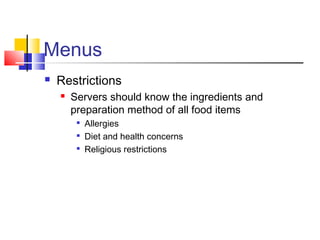
Menus
 Restrictions
 Servers should know the ingredients and
preparation method of all food items

Allergies

Diet and health concerns

Religious restrictions
Menus
 Restrictions
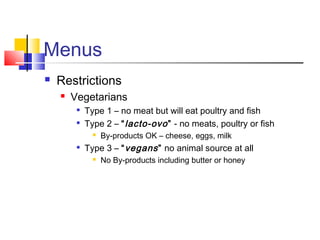
 Vegetarians

Type 1 – no meat but will eat poultry and fish

Type 2 – “lacto-ovo” - no meats, poultry or fish
 By-products OK – cheese, eggs, milk

Type 3 – “vegans” no animal source at all
 No By-products including butter or honey
Food Consumption Patterns
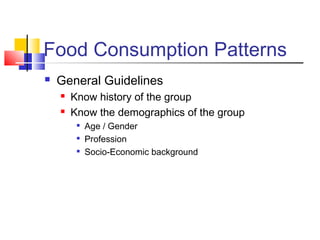
 General Guidelines
 Know history of the group
 Know the demographics of the group

Age / Gender

Profession

Socio-Economic background
Food Consumption Patterns
 General Guidelines
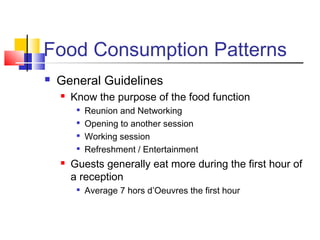
 Know the purpose of the food function

Reunion and Networking

Opening to another session

Working session

Refreshment / Entertainment
 Guests generally eat more during the first hour of
a reception

Average 7 hors d’Oeuvres the first hour
Food Consumption Patterns
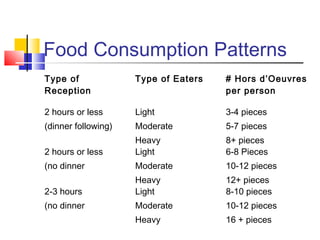
Type of
Reception
Type of Eaters # Hors d’Oeuvres
per person
2 hours or less
(dinner following)
Light
Moderate
Heavy
3-4 pieces
5-7 pieces
8+ pieces
2 hours or less
(no dinner
Light
Moderate
Heavy
6-8 Pieces
10-12 pieces
12+ pieces
2-3 hours
(no dinner
Light
Moderate
Heavy
8-10 pieces
10-12 pieces
16 + pieces
Food and Beverage Attrition
 The difference between the actual number of food-
and-beverage covers or revenue projections and the
number or formulas (percentages) agreed to in the
terms of the contract.
 Usually there is an allowable shortfall before
damages are assessed.
 Concessions may be lost
 Complimentary function space, labor or equipment
 Reassignment or reduction of space.
Amenities / Gifts
 Match the gift to the person
 Note their lifestyle or restrictions
 Provide something they like or use
 Avoid
 Cut fruit and cut cheese / Unpackaged crackers
 Consider alternatives
 Pretzels and beer / Cookies and milk
 Room service gift certificate
 Bottled water
 Spa massage or gift shop certificate
Beverage Events – the Why
 Refreshment Breaks
 A part of the educational programming
 Recommend 30 minutes

Re-focus attention

Personal business – phone calls, email

Mental rest, stretch and restroom
 Non-alcoholic drinks and snacks
 Receptions
 A part of Special Event Programming
 Socializing and Networking
 Alcohol and food options
Beverage Events – the What
 Categories of Liquor
 Beer – soft spirit
 Wine – soft spirit
 Spirits – hard liquor

Well Brands – less expensive “house” liquor or brand

Call Brands – mid-range price, specially requested

Premium Brands – high priced, high quality “Top Shelf”
Beverage Events – the What
 Categories of Liquor
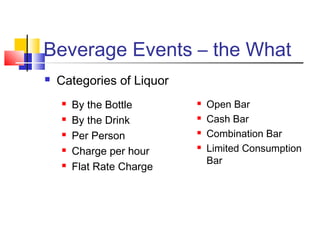
 By the Bottle
 By the Drink
 Per Person
 Charge per hour
 Flat Rate Charge
 Open Bar
 Cash Bar
 Combination Bar
 Limited Consumption
Bar
Beverage Events – the What
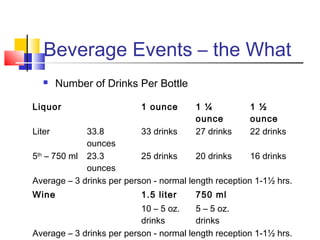
 Number of Drinks Per Bottle
Liquor 1 ounce 1 ¼
ounce
1 ½
ounce
Liter 33.8
ounces
33 drinks 27 drinks 22 drinks
5th
– 750 ml 23.3
ounces
25 drinks 20 drinks 16 drinks
Average – 3 drinks per person - normal length reception 1-1½ hrs.
Wine 1.5 liter 750 ml
10 – 5 oz.
drinks
5 – 5 oz.
drinks
Average – 3 drinks per person - normal length reception 1-1½ hrs.
Beverage Events – the Who
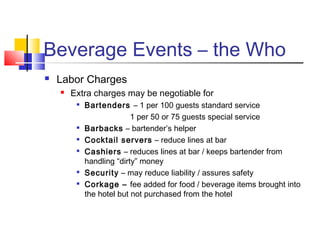
 Labor Charges
 Extra charges may be negotiable for

Bartenders – 1 per 100 guests standard service
1 per 50 or 75 guests special service

Barbacks – bartender’s helper

Cocktail servers – reduce lines at bar

Cashiers – reduces lines at bar / keeps bartender from
handling “dirty” money

Security – may reduce liability / assures safety

Corkage – fee added for food / beverage items brought into
the hotel but not purchased from the hotel
Hospitality Suites
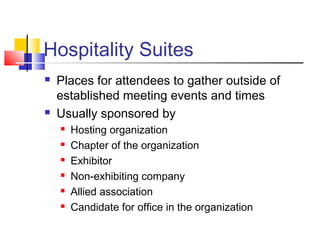
 Places for attendees to gather outside of
established meeting events and times
 Usually sponsored by
 Hosting organization
 Chapter of the organization
 Exhibitor
 Non-exhibiting company
 Allied association
 Candidate for office in the organization
Hospitality Suites
 Times
 Morning
 Afternoon
 Evening
 Space Assignments and Approval
 Control space so competitors are not next to each
other
 Organization gives approval for suite
 Guard against “Underground” Suites – not
assigned, approved or known about
Liquor Laws
 Vary from state to state and determine:
 Times of sale
 Days of sale
 Size of bottles sold
 Four types of illegal sales
 Sale to minors
 Sale to intoxicated persons
 Sales outside of legal hours
 Improper liquor license
Room Set Up
 What:
 Includes order and placement of tables, chairs,
décor, equipment, audio-visual, staging and dance
floor
 How:
 Banquet Event Orders (BEO)
 Room layout software programs
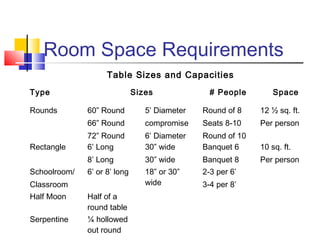
Room Space Requirements
Table Sizes and Capacities
Type Sizes # People Space
Rounds 60” Round
66” Round
72” Round
5’ Diameter
compromise
6’ Diameter
Round of 8
Seats 8-10
Round of 10
12 ½ sq. ft.
Per person
Rectangle 6’ Long
8’ Long
30” wide
30” wide
Banquet 6
Banquet 8
10 sq. ft.
Per person
Schoolroom/
Classroom
6’ or 8’ long 18” or 30”
wide
2-3 per 6’
3-4 per 8’
Half Moon Half of a
round table
Serpentine ¼ hollowed
out round
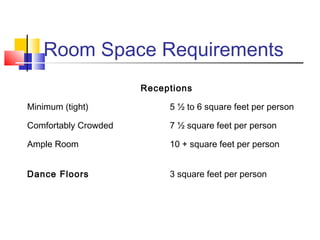
Room Space Requirements
Receptions
Minimum (tight) 5 ½ to 6 square feet per person
Comfortably Crowded 7 ½ square feet per person
Ample Room 10 + square feet per person
Dance Floors 3 square feet per person
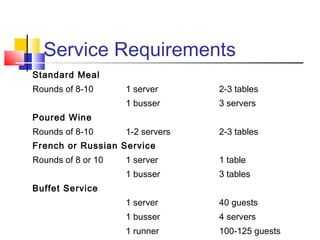
Service Requirements
Standard Meal
Rounds of 8-10 1 server 2-3 tables
1 busser 3 servers
Poured Wine
Rounds of 8-10 1-2 servers 2-3 tables
French or Russian Service
Rounds of 8 or 10 1 server 1 table
1 busser 3 tables
Buffet Service
1 server 40 guests
1 busser 4 servers
1 runner 100-125 guests
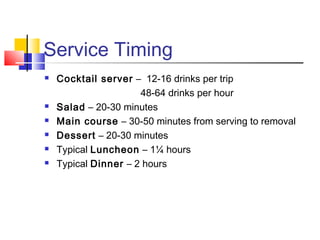
Service Timing
 Cocktail server – 12-16 drinks per trip
48-64 drinks per hour
 Salad – 20-30 minutes
 Main course – 30-50 minutes from serving to removal
 Dessert – 20-30 minutes
 Typical Luncheon – 1¼ hours
 Typical Dinner – 2 hours
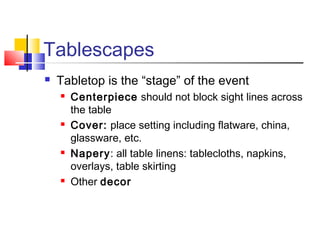
Tablescapes
 Tabletop is the “stage” of the event
 Centerpiece should not block sight lines across
the table
 Cover: place setting including flatware, china,
glassware, etc.
 Napery: all table linens: tablecloths, napkins,
overlays, table skirting
 Other decor
Review
 Introduction
 Catered Events
 Types of Functions
 Styles of Service
 Menus
 Food Consumption
Patterns
 Attrition
 Amenities or Gifts
 Beverage Events
 Hospitality Suites
 Rooms
 Service Timing

Food & Beverage Management

  • 1.
  • 2.
    Introduction  Food &Beverage Functions  Food for fuel  Food for the overall experience  Keeps group together  In one place  At one time  Eases service strain in restaurants on site “What can go wrong, will go wrong.”
  • 3.
    Catered Events -Defined  One host / sponsor  One check / bill  Same meal* * unless special dietary consideration  Mandatory gratuity – 15%-22%  Distributed to staff and/or management
  • 4.
    Catered Events -Types  On Premise  facility with permanent kitchen and function rooms  Locations – hotel, restaurant, convention center  Permanent furniture and equipment  Off Premise  Transports food (prepared or to prepare on site)  Locations – tents, museums, parks, attractions  Equipment and furniture rentals  Contract through RFP process
  • 5.
    Catered Events -Types  Off Premise (continued)  Using Destination Management Companies (DMC)  Locally based company who knows the locally based venues, caterers and suppliers  A one-stop shop for the planner  Transportation  Additional costs – additional coordination  Weather  Always a challenge ( obstacle)  Back-up plans required
  • 6.
    Catered Events -Types  Conference Centers  Complete Meeting Package (CMP)  Guest rooms, AV and all meals included in one price per person  Continual breaks  Cafeteria style service  Special private banquets upon request  Convention Centers and Stadiums  Concession sands  Restaurants  Special Event catering
  • 7.
    Catered Events -Hints  Conduct site inspection  Choose menu items appropriate to your group  Age / Gender  Profession / Ethnic background  Purpose of event  Custom menus  Skill level  Product availability  Stay on top of food trends
  • 8.
    Types of Functions Continental Breakfast  Full, Served Breakfast  Breakfast Buffet  Refreshment Breaks  Brunch  Buffet Lunch  Box Lunch  Full, Served Lunch  Receptions  Dinner Buffets  Full, Served Dinner  Off Site Event  Theme Party
  • 9.
    Styles of Service Buffet  Attended Buffet / Cafeteria  Combination Buffet  Plated Buffet  Action Stations  Reception  Family Style / English Service  Plated / American Service  Preset  Butlered  Russian Service  Banquet French  Cart French  Hand Service  Waiter Parade  The Wave  Mixed Styles
  • 10.
    Menus  Always popularideas  Seasonal Food – locally grown, in season, flavor at peak  Ethnic Foods – add Asian, Mid-East and South America  High Quality Ingredients – name brands, specialty items  Fresh Ingredients – no frozen, canned or dried  New / Unusual Ingredients – from exotic far away places  Safe Foods – organic or pollution / pesticide free  Creative Presentations – if it looks good, it tastes good  Excellent Service – prompt, friendly, courteous service
  • 11.
    Menus  Restrictions  Serversshould know the ingredients and preparation method of all food items  Allergies  Diet and health concerns  Religious restrictions
  • 12.
    Menus  Restrictions  Vegetarians  Type1 – no meat but will eat poultry and fish  Type 2 – “lacto-ovo” - no meats, poultry or fish  By-products OK – cheese, eggs, milk  Type 3 – “vegans” no animal source at all  No By-products including butter or honey
  • 13.
    Food Consumption Patterns General Guidelines  Know history of the group  Know the demographics of the group  Age / Gender  Profession  Socio-Economic background
  • 14.
    Food Consumption Patterns General Guidelines  Know the purpose of the food function  Reunion and Networking  Opening to another session  Working session  Refreshment / Entertainment  Guests generally eat more during the first hour of a reception  Average 7 hors d’Oeuvres the first hour
  • 15.
    Food Consumption Patterns Typeof Reception Type of Eaters # Hors d’Oeuvres per person 2 hours or less (dinner following) Light Moderate Heavy 3-4 pieces 5-7 pieces 8+ pieces 2 hours or less (no dinner Light Moderate Heavy 6-8 Pieces 10-12 pieces 12+ pieces 2-3 hours (no dinner Light Moderate Heavy 8-10 pieces 10-12 pieces 16 + pieces
  • 16.
    Food and BeverageAttrition  The difference between the actual number of food- and-beverage covers or revenue projections and the number or formulas (percentages) agreed to in the terms of the contract.  Usually there is an allowable shortfall before damages are assessed.  Concessions may be lost  Complimentary function space, labor or equipment  Reassignment or reduction of space.
  • 17.
    Amenities / Gifts Match the gift to the person  Note their lifestyle or restrictions  Provide something they like or use  Avoid  Cut fruit and cut cheese / Unpackaged crackers  Consider alternatives  Pretzels and beer / Cookies and milk  Room service gift certificate  Bottled water  Spa massage or gift shop certificate
  • 18.
    Beverage Events –the Why  Refreshment Breaks  A part of the educational programming  Recommend 30 minutes  Re-focus attention  Personal business – phone calls, email  Mental rest, stretch and restroom  Non-alcoholic drinks and snacks  Receptions  A part of Special Event Programming  Socializing and Networking  Alcohol and food options
  • 19.
    Beverage Events –the What  Categories of Liquor  Beer – soft spirit  Wine – soft spirit  Spirits – hard liquor  Well Brands – less expensive “house” liquor or brand  Call Brands – mid-range price, specially requested  Premium Brands – high priced, high quality “Top Shelf”
  • 20.
    Beverage Events –the What  Categories of Liquor  By the Bottle  By the Drink  Per Person  Charge per hour  Flat Rate Charge  Open Bar  Cash Bar  Combination Bar  Limited Consumption Bar
  • 21.
    Beverage Events –the What  Number of Drinks Per Bottle Liquor 1 ounce 1 ¼ ounce 1 ½ ounce Liter 33.8 ounces 33 drinks 27 drinks 22 drinks 5th – 750 ml 23.3 ounces 25 drinks 20 drinks 16 drinks Average – 3 drinks per person - normal length reception 1-1½ hrs. Wine 1.5 liter 750 ml 10 – 5 oz. drinks 5 – 5 oz. drinks Average – 3 drinks per person - normal length reception 1-1½ hrs.
  • 22.
    Beverage Events –the Who  Labor Charges  Extra charges may be negotiable for  Bartenders – 1 per 100 guests standard service 1 per 50 or 75 guests special service  Barbacks – bartender’s helper  Cocktail servers – reduce lines at bar  Cashiers – reduces lines at bar / keeps bartender from handling “dirty” money  Security – may reduce liability / assures safety  Corkage – fee added for food / beverage items brought into the hotel but not purchased from the hotel
  • 23.
    Hospitality Suites  Placesfor attendees to gather outside of established meeting events and times  Usually sponsored by  Hosting organization  Chapter of the organization  Exhibitor  Non-exhibiting company  Allied association  Candidate for office in the organization
  • 24.
    Hospitality Suites  Times Morning  Afternoon  Evening  Space Assignments and Approval  Control space so competitors are not next to each other  Organization gives approval for suite  Guard against “Underground” Suites – not assigned, approved or known about
  • 25.
    Liquor Laws  Varyfrom state to state and determine:  Times of sale  Days of sale  Size of bottles sold  Four types of illegal sales  Sale to minors  Sale to intoxicated persons  Sales outside of legal hours  Improper liquor license
  • 26.
    Room Set Up What:  Includes order and placement of tables, chairs, décor, equipment, audio-visual, staging and dance floor  How:  Banquet Event Orders (BEO)  Room layout software programs
  • 27.
    Room Space Requirements TableSizes and Capacities Type Sizes # People Space Rounds 60” Round 66” Round 72” Round 5’ Diameter compromise 6’ Diameter Round of 8 Seats 8-10 Round of 10 12 ½ sq. ft. Per person Rectangle 6’ Long 8’ Long 30” wide 30” wide Banquet 6 Banquet 8 10 sq. ft. Per person Schoolroom/ Classroom 6’ or 8’ long 18” or 30” wide 2-3 per 6’ 3-4 per 8’ Half Moon Half of a round table Serpentine ¼ hollowed out round
  • 28.
    Room Space Requirements Receptions Minimum(tight) 5 ½ to 6 square feet per person Comfortably Crowded 7 ½ square feet per person Ample Room 10 + square feet per person Dance Floors 3 square feet per person
  • 29.
    Service Requirements Standard Meal Roundsof 8-10 1 server 2-3 tables 1 busser 3 servers Poured Wine Rounds of 8-10 1-2 servers 2-3 tables French or Russian Service Rounds of 8 or 10 1 server 1 table 1 busser 3 tables Buffet Service 1 server 40 guests 1 busser 4 servers 1 runner 100-125 guests
  • 30.
    Service Timing  Cocktailserver – 12-16 drinks per trip 48-64 drinks per hour  Salad – 20-30 minutes  Main course – 30-50 minutes from serving to removal  Dessert – 20-30 minutes  Typical Luncheon – 1¼ hours  Typical Dinner – 2 hours
  • 31.
    Tablescapes  Tabletop isthe “stage” of the event  Centerpiece should not block sight lines across the table  Cover: place setting including flatware, china, glassware, etc.  Napery: all table linens: tablecloths, napkins, overlays, table skirting  Other decor
  • 32.
    Review  Introduction  CateredEvents  Types of Functions  Styles of Service  Menus  Food Consumption Patterns  Attrition  Amenities or Gifts  Beverage Events  Hospitality Suites  Rooms  Service Timing