Fonality Moves UC Dashboard Into Cloud
InformationWeek Review

January 27, 2011 · By Kevin Casey


Cloud provider Fonality recently launched a new Unified Communications (UC) dashboard, as the company tries
to build its share of the budget-conscious small and midsize business (SMB) market.


Fonality CEO Dean Mansfield said that market was largely underserved by IP telephony and UC vendors before
his company arrived on the scene six years ago. It’s an elevator pitch that has an increasingly familiar ring: Get
enterprise-grade technology for SMB prices. But Mansfield, formerly an executive with NetSuite, said that there
is a gap between low-end “prosumer” solutions and upmarket heavy hitters such as Cisco and Avaya, and that’s
where Fonality sees its opportunity.


“You’ve got really complex, expensive, hardware-based
solutions from the enterprise trying to be forced down.
You’ve got limited functionality, limited reliability VoIP
solutions trying to be pushed up,” Mansfield said.

“The main reason why I’m here is that I couldn’t find a
single company that was dedicated to
serving the midmarket.”

Mansfield defined the SMB market as firms with between
20 and 250 employees. Fonality’s current 20,000-customer
base extends beyond both ends of that range, but Man-
sfield said the “vast majority” of the company’s business
falls within that segment.

“I would say our real sweet spot for our business today is
between 20 and 70 or 80 seats,” he said. “That’s the real
market we’re attacking.”

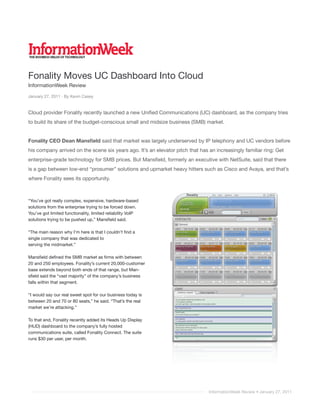
To that end, Fonality recently added its Heads Up Display
(HUD) dashboard to the company’s fully hosted
communications suite, called Fonality Connect. The suite
runs $30 per user, per month.


                                                                                InformationWeek Review • January 27, 2011
Among HUD’s features:                                         Mansfield said the trend of smaller companies driving

Presence and activity monitoring, drag-and-drop call          cloud adoption -- regardless of the application -- is likely to

management, visual voicemail, voicemail-to-text, secure       continue, especially given the increased mobility of SMBs.

chat, conferencing, call recording, photo caller ID, email,   (Fonality will launch a mobile version of HUD later this

and text. Previously, HUD was only available as part of the   year.) Likewise, he thinks that trend has much to do with

company’s Finality Pro product, which offers customized,      the significant investment that many large companies have

on-premises solutions for companies that, say, want to        made in data centers and other IT infrastructure, and their

keep their legacy phone service rather than switch to VoIP.   unwillingness to sink those costs to move into the cloud.


Re-engineering its HUD product as a hosted service was        “This is a technology that’s driven upwards, not

driven by current customers with on-premises UC solutions     enterprise-down,” Mansfield said. He likes to use Citibank

that wanted to move into the cloud, according to Mans-        as an example, pointing out that the company has little

field, who added that the trend was especially noticeable     incentive to move into the cloud because of their spending

among businesses with fewer than 50 employees.                on premises-based infrastructure.


“They don’t want servers, and I think telephony is the last   “Can you imagine the CIO going in front of the board at

great frontier of this,” Mansfield said.                      Citibank and saying ‘You know what? We don’t need all

                                                              of those data centers anymore because we’re going to

Though part of Fonality’s approach is to tout the             move to the cloud.’ He’s just talked himself out of a job,

potential for businesses to slash their phone bills,          right?” Mansfield said. “I think enterprises, and also big

compared with traditional telecom providers such as           government, are very, very invested in managing their own

AT&T or Verizon, Mansfield doesn’t necessarily see those      solutions.”

companies as competitors.


“Why halve someone’s phone bill when they’re paying it?”

Mansfield said. “I don’t really see them either having the

appetite financially or from a technology standpoint to be

able to compete on this level.”


                                                                                InformationWeek Review • January 27, 2011

Fon review information_week_021611

  • 1.
    Fonality Moves UCDashboard Into Cloud InformationWeek Review January 27, 2011 · By Kevin Casey Cloud provider Fonality recently launched a new Unified Communications (UC) dashboard, as the company tries to build its share of the budget-conscious small and midsize business (SMB) market. Fonality CEO Dean Mansfield said that market was largely underserved by IP telephony and UC vendors before his company arrived on the scene six years ago. It’s an elevator pitch that has an increasingly familiar ring: Get enterprise-grade technology for SMB prices. But Mansfield, formerly an executive with NetSuite, said that there is a gap between low-end “prosumer” solutions and upmarket heavy hitters such as Cisco and Avaya, and that’s where Fonality sees its opportunity. “You’ve got really complex, expensive, hardware-based solutions from the enterprise trying to be forced down. You’ve got limited functionality, limited reliability VoIP solutions trying to be pushed up,” Mansfield said. “The main reason why I’m here is that I couldn’t find a single company that was dedicated to serving the midmarket.” Mansfield defined the SMB market as firms with between 20 and 250 employees. Fonality’s current 20,000-customer base extends beyond both ends of that range, but Man- sfield said the “vast majority” of the company’s business falls within that segment. “I would say our real sweet spot for our business today is between 20 and 70 or 80 seats,” he said. “That’s the real market we’re attacking.” To that end, Fonality recently added its Heads Up Display (HUD) dashboard to the company’s fully hosted communications suite, called Fonality Connect. The suite runs $30 per user, per month. InformationWeek Review • January 27, 2011
  • 2.
    Among HUD’s features: Mansfield said the trend of smaller companies driving Presence and activity monitoring, drag-and-drop call cloud adoption -- regardless of the application -- is likely to management, visual voicemail, voicemail-to-text, secure continue, especially given the increased mobility of SMBs. chat, conferencing, call recording, photo caller ID, email, (Fonality will launch a mobile version of HUD later this and text. Previously, HUD was only available as part of the year.) Likewise, he thinks that trend has much to do with company’s Finality Pro product, which offers customized, the significant investment that many large companies have on-premises solutions for companies that, say, want to made in data centers and other IT infrastructure, and their keep their legacy phone service rather than switch to VoIP. unwillingness to sink those costs to move into the cloud. Re-engineering its HUD product as a hosted service was “This is a technology that’s driven upwards, not driven by current customers with on-premises UC solutions enterprise-down,” Mansfield said. He likes to use Citibank that wanted to move into the cloud, according to Mans- as an example, pointing out that the company has little field, who added that the trend was especially noticeable incentive to move into the cloud because of their spending among businesses with fewer than 50 employees. on premises-based infrastructure. “They don’t want servers, and I think telephony is the last “Can you imagine the CIO going in front of the board at great frontier of this,” Mansfield said. Citibank and saying ‘You know what? We don’t need all of those data centers anymore because we’re going to Though part of Fonality’s approach is to tout the move to the cloud.’ He’s just talked himself out of a job, potential for businesses to slash their phone bills, right?” Mansfield said. “I think enterprises, and also big compared with traditional telecom providers such as government, are very, very invested in managing their own AT&T or Verizon, Mansfield doesn’t necessarily see those solutions.” companies as competitors. “Why halve someone’s phone bill when they’re paying it?” Mansfield said. “I don’t really see them either having the appetite financially or from a technology standpoint to be able to compete on this level.” InformationWeek Review • January 27, 2011