Nino Guy Cassuto ART Unit Drouot Paris
Follow up Children after Sperm Injection
Kiev 20 – 21 June 2014
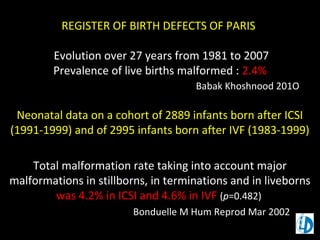
REGISTER OF BIRTH DEFECTS OF PARIS
Evolution over 27 years from 1981 to 2007
Prevalence of live births malformed : 2.4%
Babak Khoshnood 201O
Neonatal data on a cohort of 2889 infants born after ICSI
(1991-1999) and of 2995 infants born after IVF (1983-1999)
Total malformation rate taking into account major
malformations in stillborns, in terminations and in liveborns
was 4.2% in ICSI and 4.6% in IVF (p=0.482)
Bonduelle M Hum Reprod Mar 2002
Hansen et al.
METHODS Meta-analysis ;
25 studies
7 selected
RESULTS Combined group of IVF
and ICSI children
both singleton and
multiples
OR 1.40 [1.28-1.53]
Singleton
OR 1.35 [1.20-1.51]
2.27
2.04
1.64
1.53
1.39
1.36
1.4095%ci 1.28-1.53
Human Reprod 2005; 21;328-338
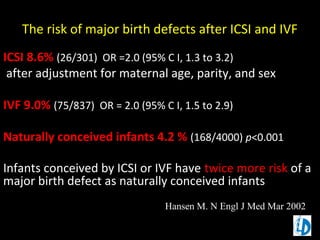
The risk of major birth defects after ICSI and IVF
ICSI 8.6% (26/301) OR =2.0 (95% C I, 1.3 to 3.2)
after adjustment for maternal age, parity, and sex
IVF 9.0% (75/837) OR = 2.0 (95% C I, 1.5 to 2.9)
Naturally conceived infants 4.2 % (168/4000) p<0.001
Infants conceived by ICSI or IVF have twice more risk of a
major birth defect as naturally conceived infants
Hansen M. N Engl J Med Mar 2002
Rimm et al.
J Assisted Reprod Gent 2005; 21:437-443
OR 1.29 [1.01-1.67]
V: IVF Study X: ICSI Study C: Combined study
METHODS Meta-analysis ;
44 studies
19 selected
RESULTS Combined group of IVF and
ICSI children
both singleton and multiples
versus
Spontaneous
OR 1.29 [1.01-1.67]
Children born after assisted fertilization have an
increased rate of major congenital anomalies
IVF and ICSI children and Other ART vs. Spontaneous
Increased risk for C. A. OR = 1.3 (95% CI, 1.1–1.6)
The risk was increased for boys more often than girls
Klemetti Fertil Steril 2005
Zhu et al.
Methods Danish national birth cohort; 1997-2003
Congenital malformation at singletons birth (register(
tried to untangle difference in risk associated with the technology and
the risk that may be associated with infertility per se
By choosing a group of infertility problems (time to pregnancy >12 months(
Population
A 50,897 without infertility problem - conceived spontaneously
B 5,764 with infertility problem - conceived spontaneously
C 4,588 with infertility problem - after infertility treatment
Results A 5.0% 1.0
B vs. A 6.0% 1.20 [1.07-1.35]
C vs. A 6.7% 1.39 [1.23-1.57]
Adjusted for Maternal age, pre-pregnancy BMI, smoking, alcohol intake, occupational status
Conclusion A significant risk for CM was evident in the group with infertility problems that
conceived spontaneously as compared to SC and even higher in the group that
received infertility treatments
suggesting that infertility by itself could be an in-depended risk factor
BMJ. 2006;333:679
Birth defects in children conceived by IVF and ICSI
A meta-analysis
46 studies children conceived by IVF and/or ICSI (124,468)
compared with spontaneously conceived children
Risk estimation OR = 1.37 (95% CI: 1.26-1.48)
24 studies on birth defects in children conceived by
IVF (46,890) / ICSI (27,754) No risk difference
Wen Fertil Steril Jun 2012
AND THEN ???
Data collection
• Prospective study population based
• Conducted from 2005 to 2010
• Population of infertile couples included for ICSI and IMSI
• All patients signed and agreed received a detailed
questionnaires
• At the birth and 4, 9, 12 and 24 months
Study design
Prospective follow up cohort study
Performed from 2005 to 2010 in only one ART unit
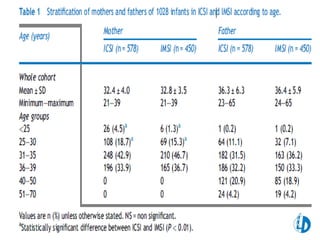
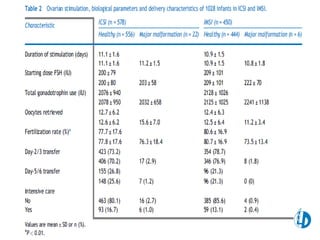
1039 Infants were included
1.09% could not follow up
1028 Infants studied
578 From ICSI (56%)
450 From IMSI (44%)
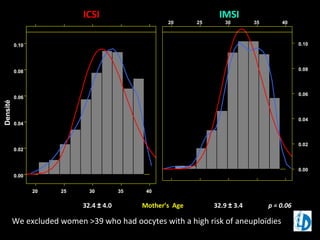
Densité
32.4 ± 4.0 Mother’s Age 32.9 ± 3.4 p = 0.06
0.00
0.02
0.04
0.06
0.08
0.10
20 25 30 35 40
ICSI IMSI
20 25 30 35 40
0.00
0.02
0.04
0.06
0.08
0.10
We excluded women >39 who had oocytes with a high risk of aneuploïdies
0.00
0.02
0.04
0.06
0.08
0.10
20 25 30 35 40
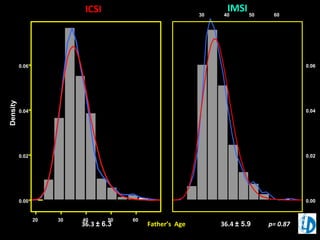
36.3 ± 6.3 Father’s Age 36.4 ± 5.9 p= 0.87
Density
0.00
0.02
0.04
0.06
20 30 40 50 60
20 30 40 50 60
0.00
0.02
0.04
0.06
ICSI IMSI
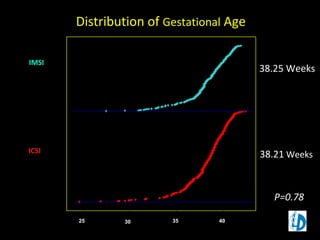
Distribution of Gestational Age
IMSI
ICSI
25 30 35 40
38.25 Weeks
38.21 Weeks
P=0.78
ICSI
IMSI
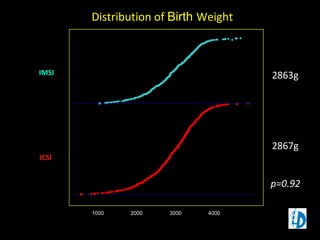
1000 2000 3000 4000
2867g
2863g
p=0.92
Distribution of Birth Weight
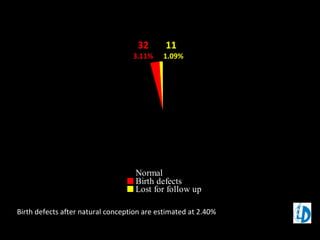
Normal
Birth defects
Lost for follow up
996
96.89%
11
1.09%
32
3.11%
Birth defects after natural conception are estimated at 2.40%
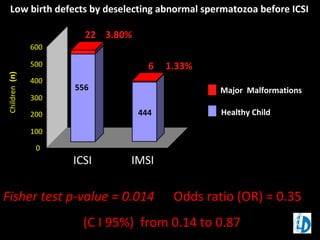
0
100
200
300
400
500
600
Children(n)
ICSI IMSI
Major Malformations
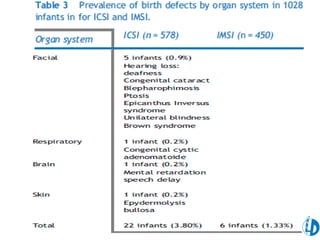
22 3.80%
6 1.33%
556
444
Fisher test p-value = 0.014 Odds ratio (OR) = 0.35
(C I 95%) from 0.14 to 0.87
Healthy Child
Low birth defects by deselecting abnormal spermatozoa before ICSI
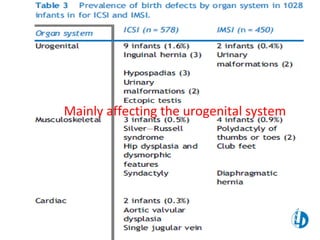
Mainly affecting the urogenital system
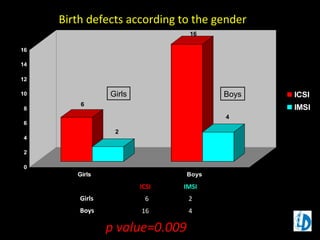
6
2
16
4
0
2
4
6
8
10
12
14
16
Girls Boys
ICSI
IMSI
p value=0.009
ICSI IMSI
Girls 6 2
Boys 16 4
Birth defects according to the gender
Girls Boys
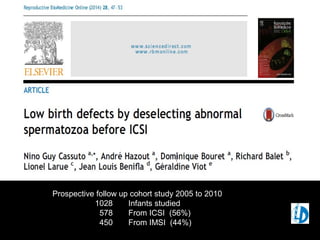
Prospective follow up cohort study 2005 to 2010
1028 Infants studied
578 From ICSI (56%)
450 From IMSI (44%)
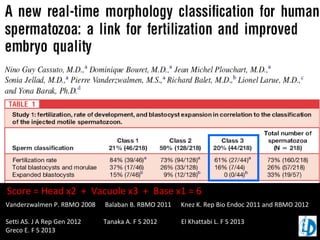
Score = Head x2 + Vacuole x3 + Base x1 = 6
Vanderzwalmen P. RBMO 2008 Balaban B. RBMO 2011 Knez K. Rep Bio Endoc 2011 and RBMO 2012
Setti AS. J A Rep Gen 2012 Tanaka A. F S 2012 El Khattabi L. F S 2013
Greco E. F S 2013
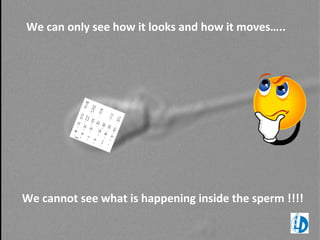
We cannot see what is happening inside the sperm !!!!
We can only see how it looks and how it moves…..
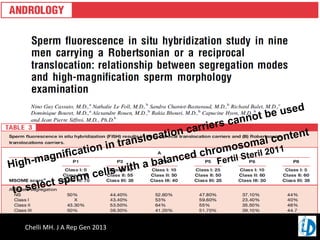
High-magnification in translocation carriers cannot be used
to select sperm cells with a balanced chromosomal content
Fertil Steril 2011
Chelli MH. J A Rep Gen 2013
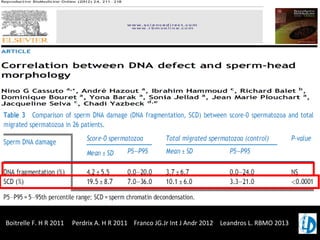
Boitrelle F. H R 2011 Perdrix A. H R 2011 Franco JG.Jr Int J Andr 2012 Leandros L. RBMO 2013
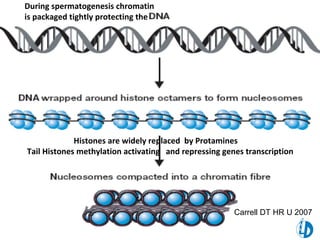
During spermatogenesis chromatin
is packaged tightly protecting the
Histones are widely replaced by Protamines
Tail Histones methylation activating and repressing genes transcription
Carrell DT HR U 2007
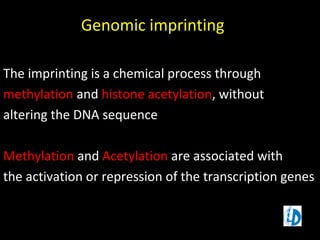
Genomic imprinting
The imprinting is a chemical process through
methylation and histone acetylation, without
altering the DNA sequence
Methylation and Acetylation are associated with
the activation or repression of the transcription genes
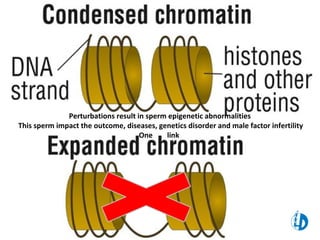
Perturbations result in sperm epigenetic abnormalities
This sperm impact the outcome, diseases, genetics disorder and male factor infertility
One link
DNA Abnormalities tests
Predictive value
Risk evaluation
Spermatozoa fixed and stained
One tool and one link in live
Observation and Morphology
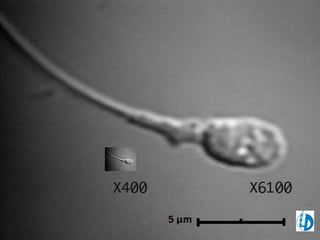
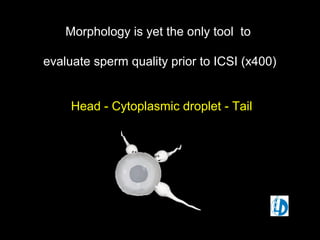
Morphology is yet the only tool toMorphology is yet the only tool to
evaluate sperm quality prior to ICSI (x400)evaluate sperm quality prior to ICSI (x400)
Head - Cytoplasmic droplet - TailHead - Cytoplasmic droplet - Tail
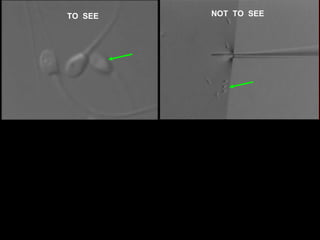
NOT TO SEETO SEE
ConclusionsConclusions
1 High magnification permits to deselect the worst
spermatozoon.
2 Highlights the impact of the DNA spermatozoa on
the outcome.
3 ICSI risk to select abnormal spermatozoa and
to increase by 3 the risk of major malformations
Thanks

Follow up Children after Sperm Injection

  • 1.
    Nino Guy CassutoART Unit Drouot Paris Follow up Children after Sperm Injection Kiev 20 – 21 June 2014
  • 3.
    REGISTER OF BIRTHDEFECTS OF PARIS Evolution over 27 years from 1981 to 2007 Prevalence of live births malformed : 2.4% Babak Khoshnood 201O Neonatal data on a cohort of 2889 infants born after ICSI (1991-1999) and of 2995 infants born after IVF (1983-1999) Total malformation rate taking into account major malformations in stillborns, in terminations and in liveborns was 4.2% in ICSI and 4.6% in IVF (p=0.482) Bonduelle M Hum Reprod Mar 2002
  • 4.
    Hansen et al. METHODSMeta-analysis ; 25 studies 7 selected RESULTS Combined group of IVF and ICSI children both singleton and multiples OR 1.40 [1.28-1.53] Singleton OR 1.35 [1.20-1.51] 2.27 2.04 1.64 1.53 1.39 1.36 1.4095%ci 1.28-1.53 Human Reprod 2005; 21;328-338
  • 5.
    The risk ofmajor birth defects after ICSI and IVF ICSI 8.6% (26/301) OR =2.0 (95% C I, 1.3 to 3.2) after adjustment for maternal age, parity, and sex IVF 9.0% (75/837) OR = 2.0 (95% C I, 1.5 to 2.9) Naturally conceived infants 4.2 % (168/4000) p<0.001 Infants conceived by ICSI or IVF have twice more risk of a major birth defect as naturally conceived infants Hansen M. N Engl J Med Mar 2002
  • 6.
    Rimm et al. JAssisted Reprod Gent 2005; 21:437-443 OR 1.29 [1.01-1.67] V: IVF Study X: ICSI Study C: Combined study METHODS Meta-analysis ; 44 studies 19 selected RESULTS Combined group of IVF and ICSI children both singleton and multiples versus Spontaneous OR 1.29 [1.01-1.67]
  • 7.
    Children born afterassisted fertilization have an increased rate of major congenital anomalies IVF and ICSI children and Other ART vs. Spontaneous Increased risk for C. A. OR = 1.3 (95% CI, 1.1–1.6) The risk was increased for boys more often than girls Klemetti Fertil Steril 2005
  • 8.
    Zhu et al. MethodsDanish national birth cohort; 1997-2003 Congenital malformation at singletons birth (register( tried to untangle difference in risk associated with the technology and the risk that may be associated with infertility per se By choosing a group of infertility problems (time to pregnancy >12 months( Population A 50,897 without infertility problem - conceived spontaneously B 5,764 with infertility problem - conceived spontaneously C 4,588 with infertility problem - after infertility treatment Results A 5.0% 1.0 B vs. A 6.0% 1.20 [1.07-1.35] C vs. A 6.7% 1.39 [1.23-1.57] Adjusted for Maternal age, pre-pregnancy BMI, smoking, alcohol intake, occupational status Conclusion A significant risk for CM was evident in the group with infertility problems that conceived spontaneously as compared to SC and even higher in the group that received infertility treatments suggesting that infertility by itself could be an in-depended risk factor BMJ. 2006;333:679
  • 9.
    Birth defects inchildren conceived by IVF and ICSI A meta-analysis 46 studies children conceived by IVF and/or ICSI (124,468) compared with spontaneously conceived children Risk estimation OR = 1.37 (95% CI: 1.26-1.48) 24 studies on birth defects in children conceived by IVF (46,890) / ICSI (27,754) No risk difference Wen Fertil Steril Jun 2012 AND THEN ???
  • 10.
    Data collection • Prospectivestudy population based • Conducted from 2005 to 2010 • Population of infertile couples included for ICSI and IMSI • All patients signed and agreed received a detailed questionnaires • At the birth and 4, 9, 12 and 24 months
  • 11.
    Study design Prospective followup cohort study Performed from 2005 to 2010 in only one ART unit 1039 Infants were included 1.09% could not follow up 1028 Infants studied 578 From ICSI (56%) 450 From IMSI (44%)
  • 12.
    Densité 32.4 ± 4.0Mother’s Age 32.9 ± 3.4 p = 0.06 0.00 0.02 0.04 0.06 0.08 0.10 20 25 30 35 40 ICSI IMSI 20 25 30 35 40 0.00 0.02 0.04 0.06 0.08 0.10 We excluded women >39 who had oocytes with a high risk of aneuploïdies 0.00 0.02 0.04 0.06 0.08 0.10 20 25 30 35 40
  • 13.
    36.3 ± 6.3Father’s Age 36.4 ± 5.9 p= 0.87 Density 0.00 0.02 0.04 0.06 20 30 40 50 60 20 30 40 50 60 0.00 0.02 0.04 0.06 ICSI IMSI
  • 16.
    Distribution of GestationalAge IMSI ICSI 25 30 35 40 38.25 Weeks 38.21 Weeks P=0.78
  • 17.
    ICSI IMSI 1000 2000 30004000 2867g 2863g p=0.92 Distribution of Birth Weight
  • 18.
    Normal Birth defects Lost forfollow up 996 96.89% 11 1.09% 32 3.11% Birth defects after natural conception are estimated at 2.40%
  • 19.
    0 100 200 300 400 500 600 Children(n) ICSI IMSI Major Malformations 223.80% 6 1.33% 556 444 Fisher test p-value = 0.014 Odds ratio (OR) = 0.35 (C I 95%) from 0.14 to 0.87 Healthy Child Low birth defects by deselecting abnormal spermatozoa before ICSI
  • 20.
    Mainly affecting theurogenital system
  • 22.
    6 2 16 4 0 2 4 6 8 10 12 14 16 Girls Boys ICSI IMSI p value=0.009 ICSIIMSI Girls 6 2 Boys 16 4 Birth defects according to the gender Girls Boys
  • 23.
    Prospective follow upcohort study 2005 to 2010 1028 Infants studied 578 From ICSI (56%) 450 From IMSI (44%)
  • 25.
    Score = Headx2 + Vacuole x3 + Base x1 = 6 Vanderzwalmen P. RBMO 2008 Balaban B. RBMO 2011 Knez K. Rep Bio Endoc 2011 and RBMO 2012 Setti AS. J A Rep Gen 2012 Tanaka A. F S 2012 El Khattabi L. F S 2013 Greco E. F S 2013
  • 26.
    We cannot seewhat is happening inside the sperm !!!! We can only see how it looks and how it moves…..
  • 27.
    High-magnification in translocationcarriers cannot be used to select sperm cells with a balanced chromosomal content Fertil Steril 2011 Chelli MH. J A Rep Gen 2013
  • 28.
    Boitrelle F. HR 2011 Perdrix A. H R 2011 Franco JG.Jr Int J Andr 2012 Leandros L. RBMO 2013
  • 29.
    During spermatogenesis chromatin ispackaged tightly protecting the Histones are widely replaced by Protamines Tail Histones methylation activating and repressing genes transcription Carrell DT HR U 2007
  • 30.
    Genomic imprinting The imprintingis a chemical process through methylation and histone acetylation, without altering the DNA sequence Methylation and Acetylation are associated with the activation or repression of the transcription genes
  • 31.
    Perturbations result insperm epigenetic abnormalities This sperm impact the outcome, diseases, genetics disorder and male factor infertility One link
  • 32.
    DNA Abnormalities tests Predictivevalue Risk evaluation Spermatozoa fixed and stained One tool and one link in live Observation and Morphology
  • 33.
    Morphology is yetthe only tool toMorphology is yet the only tool to evaluate sperm quality prior to ICSI (x400)evaluate sperm quality prior to ICSI (x400) Head - Cytoplasmic droplet - TailHead - Cytoplasmic droplet - Tail
  • 34.
  • 35.
    ConclusionsConclusions 1 High magnificationpermits to deselect the worst spermatozoon. 2 Highlights the impact of the DNA spermatozoa on the outcome. 3 ICSI risk to select abnormal spermatozoa and to increase by 3 the risk of major malformations
  • 36.