BY:
Why Folded Dipole?
To achieve good directional pattern characteristics and at the same time provide good matching
to practical coaxial lines with 50- or 75-ohm characteristic impedances, the length of a single wire
element is usually chosen to be λ∕4 ≤ l < λ. The most widely used dipole is that whose overall length
is l ≃ λ∕2, and which has an input impedance of Zin ≃ 73 + j42.5 and directivity of D0 ≃ 1.643. In
practice, there are other very common transmission lines whose characteristic impedance is much higher than 50 or 75
ohms. For example, a “twin-lead” transmission line (usually two parallel wires
separated by about 5/16 in. and embedded in a low-loss plastic material used for support and spacing)
is widely used for TV applications and has a characteristic impedance of about 300 ohms.
In order to provide good matching characteristics, variations of the single dipole element must be
Used, One such is the Folded Dipole.
it serves as a step-up impedance transformer (approximately by a factor of 4 when l = λ∕2) of the single-element impedance.
The folded dipole is a very popular wire antenna, for a number of reasons:
• Impedance properties
• Ease of construction;
• Structural rigidity ,
• Wider bandwidth than λ/2 dipole
STRUCTURE:
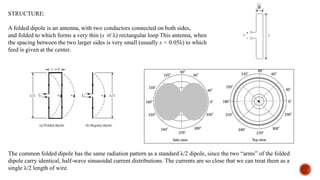
A folded dipole is an antenna, with two conductors connected on both sides,
and folded to which forms a very thin (s ≪ λ) rectangular loop This antenna, when
the spacing between the two larger sides is very small (usually s < 0.05λ) to which
feed is given at the center.
s
The common folded dipole has the same radiation pattern as a standard λ/2 dipole, since the two “arms” of the folded
dipole carry identical, half-wave sinusoidal current distributions. The currents are so close that we can treat them as a
single λ/2 length of wire.
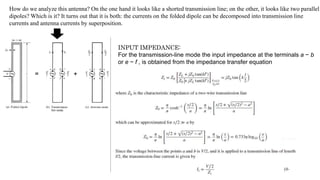
How do we analyze this antenna? On the one hand it looks like a shorted transmission line; on the other, it looks like two parallel
dipoles? Which is it? It turns out that it is both: the currents on the folded dipole can be decomposed into transmission line
currents and antenna currents by superposition.
INPUT IMPEDANCE:
For the transmission-line mode the input impedance at the terminals a − b
or e − f , is obtained from the impedance transfer equation
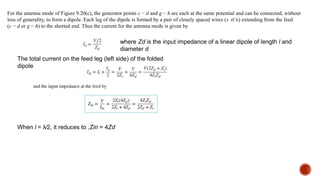
For the antenna mode of Figure 9.20(c), the generator points c − d and g − h are each at the same potential and can be connected, without
loss of generality, to form a dipole. Each leg of the dipole is formed by a pair of closely spaced wires (s ≪ λ) extending from the feed
(c − d or g − h) to the shorted end. Thus the current for the antenna mode is given by
where Zd is the input impedance of a linear dipole of length l and
diameter d
The total current on the feed leg (left side) of the folded
dipole
When l = λ∕2, it reduces to ,Zin = 4Zd
Folded DIPOLE           ;           l     .pptx

Folded DIPOLE ; l .pptx

  • 1.
  • 2.
    Why Folded Dipole? Toachieve good directional pattern characteristics and at the same time provide good matching to practical coaxial lines with 50- or 75-ohm characteristic impedances, the length of a single wire element is usually chosen to be λ∕4 ≤ l < λ. The most widely used dipole is that whose overall length is l ≃ λ∕2, and which has an input impedance of Zin ≃ 73 + j42.5 and directivity of D0 ≃ 1.643. In practice, there are other very common transmission lines whose characteristic impedance is much higher than 50 or 75 ohms. For example, a “twin-lead” transmission line (usually two parallel wires separated by about 5/16 in. and embedded in a low-loss plastic material used for support and spacing) is widely used for TV applications and has a characteristic impedance of about 300 ohms. In order to provide good matching characteristics, variations of the single dipole element must be Used, One such is the Folded Dipole. it serves as a step-up impedance transformer (approximately by a factor of 4 when l = λ∕2) of the single-element impedance. The folded dipole is a very popular wire antenna, for a number of reasons: • Impedance properties • Ease of construction; • Structural rigidity , • Wider bandwidth than λ/2 dipole
  • 3.
    STRUCTURE: A folded dipoleis an antenna, with two conductors connected on both sides, and folded to which forms a very thin (s ≪ λ) rectangular loop This antenna, when the spacing between the two larger sides is very small (usually s < 0.05λ) to which feed is given at the center. s The common folded dipole has the same radiation pattern as a standard λ/2 dipole, since the two “arms” of the folded dipole carry identical, half-wave sinusoidal current distributions. The currents are so close that we can treat them as a single λ/2 length of wire.
  • 4.
    How do weanalyze this antenna? On the one hand it looks like a shorted transmission line; on the other, it looks like two parallel dipoles? Which is it? It turns out that it is both: the currents on the folded dipole can be decomposed into transmission line currents and antenna currents by superposition. INPUT IMPEDANCE: For the transmission-line mode the input impedance at the terminals a − b or e − f , is obtained from the impedance transfer equation
  • 5.
    For the antennamode of Figure 9.20(c), the generator points c − d and g − h are each at the same potential and can be connected, without loss of generality, to form a dipole. Each leg of the dipole is formed by a pair of closely spaced wires (s ≪ λ) extending from the feed (c − d or g − h) to the shorted end. Thus the current for the antenna mode is given by where Zd is the input impedance of a linear dipole of length l and diameter d The total current on the feed leg (left side) of the folded dipole When l = λ∕2, it reduces to ,Zin = 4Zd