International Journal of Trend in Scientific Research and Development (IJTSRD)
Volume 4 Issue 4, June 2020 Available Online: www.ijtsrd.com e-ISSN: 2456 – 6470
@ IJTSRD | Unique Paper ID – IJTSRD31616 | Volume – 4 | Issue – 4 | May-June 2020 Page 1604
Foldable World
Foldable Phones Potential of Devastating UI and UX
Ashish Kumar Mishra
MET–ICS, Mumbai Education Trust, Mumbai, Maharashtra, India
ABSTRACT
The document resembles the possible UX disaster that upcoming foldable
phones and devices and brings along with requirements and demands. This
document covers the whole possibilities of destruction that will be done
because of these changes, and what are thepossibilitiestoovercomeandisthe
change really required to bring in.
KEYWORDS: foldable, UI, UX, User Interface, screen ratio, device, phones
How to cite this paper: Ashish Kumar
Mishra "Foldable World" Published in
International Journal
of Trend in Scientific
Research and
Development(ijtsrd),
ISSN: 2456-6470,
Volume-4 | Issue-4,
June 2020, pp.1604-
1607, URL:
www.ijtsrd.com/papers/ijtsrd31616.pdf
Copyright © 2020 by author(s) and
International Journal ofTrendinScientific
Research and Development Journal. This
is an Open Access article distributed
under the terms of
the Creative
CommonsAttribution
License (CC BY 4.0)
(http://creativecommons.org/licenses/by
/4.0)
I. LATENT UX MISFORTUNES
Since there are nocomprehensiveorgeneral understandable
based guidelines for how a foldable phone should serve,
companies are flowing millionsofdollarsintopresumptions.
More so, they are preparing to think about the quandaries
along with their clients. Such a variation of the market can
only be described by the window of possibilitieswhileApple
nods.
This is an engaging approach and people’s curiosity is
stirring too, but this is more regard than a raving will buy.
With this, as a design firm, we are worried about how our
apps and websites are going to attend these phones.
The advantages are real and before the clientsbounceon the
succession, let’s take a look at the slightest blemishes in the
User Experience of a foldable phone.
II. FOLDABLE PHONES SOFAR
A. Microsoft Andromeda
Depended on the Surface pattern, Andromeda is buttonless,
with a stylus and what resembles to be an intelligent folding
technology practicing ultrasound. The renders accessible,
however, and the declared WindowLiteOSmakeitresemble
more similar to ones of a tablet PC hybrid better than a
phone.
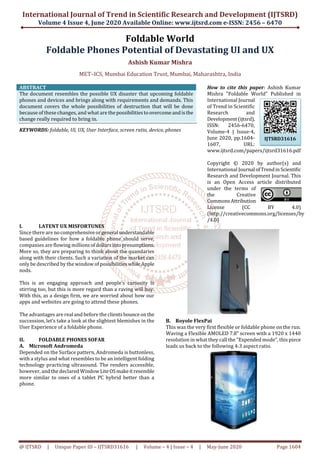
B. Royole FlexPai
This was the very first flexible or foldable phone on the run.
Waving a Flexible AMOLED 7.8” screen with a 1920 x 1440
resolution in what they call the "Expended mode", this piece
leads us back to the following 4:3 aspect ratio.
IJTSRD31616
International Journal of Trend in Scientific Research and Development (IJTSRD) @ www.ijtsrd.com eISSN: 2456-6470
@ IJTSRD | Unique Paper ID – IJTSRD31616 | Volume – 4 | Issue – 4 | May-June 2020 Page 1605
C. TCL Dragon Hinge
TCL showed five (!) foldable devices with a registered
folding mechanism called ‘Dragon Hinge’ each of them with
varying screen size and also folded area — a 7.2”, a
pocketbook like vertical foldable phone, a double-display
device, and something that views like a higher variant of a
Galaxy Fold.
D. Huawei Mate X
This is one of the two heavyweights of the foldable world till
now. With 8” OLED wrapped-around screen, it’s a
flabbergastingly slim piece because of ‘Falcon Wing’ hinge
technology. The screen is on the exterior which presents it a
dual-screen phone when it’s folded. Unfolded, it’s an
approximately square tablet with a more abundant grip bar
on the side and no indent on the screen.
E. Samsung Galaxy Fold
Possibly the most prominent title in the foldable phone
application is Samsung Galaxy Fold. It’s an unyielding piece
with a 20-part dual-axis flap of the 7.3” screen. The more
immediate models directed to the bloggers did get wrecked
for an inexperienced screen film creation and necessity of
heed for the thing. The Galaxy Fold has an indent and a pleat
with a 3:4 aspect ratio transformingitintoa differentlevel of
a hurdle for creators to bargain with.
III. THE FUTURE OF THE FOLD
It’s difficult to foretell whether this technology will become
over dated or will be drift, but it could surely use a lot more
attention. Especially in the screen appearance ratio and the
technology of the fold.
Let’s look at the giants who haven’t yet made a statement as
to are they are toward the foldable phone.
Xiaomi, a giant well popular for the product and its
varieties range among the competition.
Motorola yet though on the obverse side of the
promotion, is there and appreciated for its hardware
originality, hasn’t put out a foldable notion.
Google is almost kissing the foldable business.
Apple still hasn’t uttered anything.
As for technology, the two-fold isnottheexclusivewaya
phone can display. Inscribe a parchment fold, a
clamshell fold, and a z/flyer fold ideas.
IV. CONCERNS
A. Aspect Ratio
The image in the appearance is the screen. The whole
foldable idea is bias on the faith that you can transform your
phone into a tablet. With most utmost tablets on the market
pitching a 4:3 viewpoint ratio, it presents sensation that a
phone-tablet combination is 4:3 unfolded as well. That
delivers a folded mechanism 3:2.
No other among these ratios allow a reliable video-watching
feeling which is 16:9 or 18:9. A 4:3 aspect ratio is beneficial
for achieving tasks and operating in a variety of text and
graphic editors, like an iPad but it needs a more significant
resolution that a foldable device is not proficient in.
International Journal of Trend in Scientific Research and Development (IJTSRD) @ www.ijtsrd.com eISSN: 2456-6470
@ IJTSRD | Unique Paper ID – IJTSRD31616 | Volume – 4 | Issue – 4 | May-June 2020 Page 1606
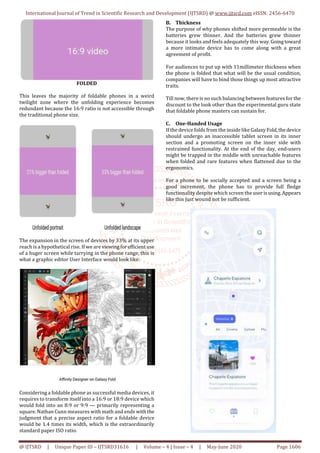
FOLDED
This leaves the majority of foldable phones in a weird
twilight zone where the unfolding experience becomes
redundant because the 16:9 ratio is not accessible through
the traditional phone size.
The expansion in the screen of devices by 33% at its upper
reach is a hypothetical rise. If we are viewingfor efficient use
of a huger screen while tarrying in the phone range, this is
what a graphic editor User Interface would look like:
Considering a foldable phone as successful media devices, it
requires to transform itself into a 16:9 or 18:9 device which
would fold into an 8:9 or 9:9 — primarily representing a
square. Nathan Cunn measures with math and ends withthe
judgment that a precise aspect ratio for a foldable device
would be 1.4 times its width, which is the extraordinarily
standard paper ISO ratio.
B. Thickness
The purpose of why phones shifted more permeable is the
batteries grew thinner. And the batteries grew thinner
because it looks and feels adequately this way.Goingtoward
a more intimate device has to come along with a great
agreement of profit.
For audiences to put up with 11millimeter thickness when
the phone is folded that what will be the usual condition,
companies will have to bind those things up most attractive
traits.
Till now, there is no such balancing between features for the
discount to the look other than the experimental guru state
that foldable phone masters can sustain for.
C. One-Handed Usage
If the device folds from the inside like GalaxyFold,thedevice
should undergo an inaccessible tablet screen in its inner
section and a promoting screen on the inner side with
restrained functionality. At the end of the day, end-users
might be trapped in the middle with unreachable features
when folded and rare features when flattened due to the
ergonomics.
For a phone to be socially accepted and a screen being a
good increment, the phone has to provide full fledge
functionality despite which screen the userisusing.Appears
like this just wound not be sufficient.
International Journal of Trend in Scientific Research and Development (IJTSRD) @ www.ijtsrd.com eISSN: 2456-6470
@ IJTSRD | Unique Paper ID – IJTSRD31616 | Volume – 4 | Issue – 4 | May-June 2020 Page 1607
D. Screen Exposure
The (AM)OLED screen is found to be the most costly portion
of the foldable phone yet on fascinating models, the screen
comprises of the complete outer-part of the cell phones
which makes the screen itself a body.
The front-facing screen is the most vulnerable part of the
phone that cannot be protected in the current form factor.
It would never have a tough case of shield glass. And every
time you drop it, it crash-lands on the screen although.
There should be a better and appropriatemechanismtodeal
will such ware and tare of devices screen. Conceivably a
better folding technique could help.
E. The Spine
Since the philosophy of the foldable phone is unique but
casual because it hints of a book, businesses have to analyze
the spine of the phone which technically also includes a part
of the screen.
The arch that the spine impactsareextraordinaryplacesthat
can’t be blended into a full-screen user experience. it will
bend the words, distort the content, and just interlope with
the task at hand.
V. BUILDING APPS FOR FOLDABLES
Android 10 (Application Interface level 29) sums more
assistance for foldable devices and various folding ideas.
Unfolding the device to accommodate a larger screen might
have a convincing impact on users:
A larger screen usually meansa moremulti-dimensional
existence.
Users can perform many tasks with Multi-Window
features and can put a positive impact on the user.
Screen size, density, or ratio might get changed because
of folding and unfolding. This is not a distinct challenge
in Android development. It already befalls in these non-
folding circumstances:
Phones: shifting between portrait and landscape mode.
Chrome OS running in desktop mode: resizing Android
apps.
Cell phones with multiple or supplementary screens.
REFERENCES
[1] www.uxplanet.org
[2] www.behance.net
[3] www.developer.android.com
[4] The Elements of User Experience: User-centered
Design for the Web
[5] A Project Guide to UX Design: For User Experience
Designers in the Field Or in the Making Carolyn
Chandler

Foldable World

  • 1.
    International Journal ofTrend in Scientific Research and Development (IJTSRD) Volume 4 Issue 4, June 2020 Available Online: www.ijtsrd.com e-ISSN: 2456 – 6470 @ IJTSRD | Unique Paper ID – IJTSRD31616 | Volume – 4 | Issue – 4 | May-June 2020 Page 1604 Foldable World Foldable Phones Potential of Devastating UI and UX Ashish Kumar Mishra MET–ICS, Mumbai Education Trust, Mumbai, Maharashtra, India ABSTRACT The document resembles the possible UX disaster that upcoming foldable phones and devices and brings along with requirements and demands. This document covers the whole possibilities of destruction that will be done because of these changes, and what are thepossibilitiestoovercomeandisthe change really required to bring in. KEYWORDS: foldable, UI, UX, User Interface, screen ratio, device, phones How to cite this paper: Ashish Kumar Mishra "Foldable World" Published in International Journal of Trend in Scientific Research and Development(ijtsrd), ISSN: 2456-6470, Volume-4 | Issue-4, June 2020, pp.1604- 1607, URL: www.ijtsrd.com/papers/ijtsrd31616.pdf Copyright © 2020 by author(s) and International Journal ofTrendinScientific Research and Development Journal. This is an Open Access article distributed under the terms of the Creative CommonsAttribution License (CC BY 4.0) (http://creativecommons.org/licenses/by /4.0) I. LATENT UX MISFORTUNES Since there are nocomprehensiveorgeneral understandable based guidelines for how a foldable phone should serve, companies are flowing millionsofdollarsintopresumptions. More so, they are preparing to think about the quandaries along with their clients. Such a variation of the market can only be described by the window of possibilitieswhileApple nods. This is an engaging approach and people’s curiosity is stirring too, but this is more regard than a raving will buy. With this, as a design firm, we are worried about how our apps and websites are going to attend these phones. The advantages are real and before the clientsbounceon the succession, let’s take a look at the slightest blemishes in the User Experience of a foldable phone. II. FOLDABLE PHONES SOFAR A. Microsoft Andromeda Depended on the Surface pattern, Andromeda is buttonless, with a stylus and what resembles to be an intelligent folding technology practicing ultrasound. The renders accessible, however, and the declared WindowLiteOSmakeitresemble more similar to ones of a tablet PC hybrid better than a phone. B. Royole FlexPai This was the very first flexible or foldable phone on the run. Waving a Flexible AMOLED 7.8” screen with a 1920 x 1440 resolution in what they call the "Expended mode", this piece leads us back to the following 4:3 aspect ratio. IJTSRD31616
  • 2.
    International Journal ofTrend in Scientific Research and Development (IJTSRD) @ www.ijtsrd.com eISSN: 2456-6470 @ IJTSRD | Unique Paper ID – IJTSRD31616 | Volume – 4 | Issue – 4 | May-June 2020 Page 1605 C. TCL Dragon Hinge TCL showed five (!) foldable devices with a registered folding mechanism called ‘Dragon Hinge’ each of them with varying screen size and also folded area — a 7.2”, a pocketbook like vertical foldable phone, a double-display device, and something that views like a higher variant of a Galaxy Fold. D. Huawei Mate X This is one of the two heavyweights of the foldable world till now. With 8” OLED wrapped-around screen, it’s a flabbergastingly slim piece because of ‘Falcon Wing’ hinge technology. The screen is on the exterior which presents it a dual-screen phone when it’s folded. Unfolded, it’s an approximately square tablet with a more abundant grip bar on the side and no indent on the screen. E. Samsung Galaxy Fold Possibly the most prominent title in the foldable phone application is Samsung Galaxy Fold. It’s an unyielding piece with a 20-part dual-axis flap of the 7.3” screen. The more immediate models directed to the bloggers did get wrecked for an inexperienced screen film creation and necessity of heed for the thing. The Galaxy Fold has an indent and a pleat with a 3:4 aspect ratio transformingitintoa differentlevel of a hurdle for creators to bargain with. III. THE FUTURE OF THE FOLD It’s difficult to foretell whether this technology will become over dated or will be drift, but it could surely use a lot more attention. Especially in the screen appearance ratio and the technology of the fold. Let’s look at the giants who haven’t yet made a statement as to are they are toward the foldable phone. Xiaomi, a giant well popular for the product and its varieties range among the competition. Motorola yet though on the obverse side of the promotion, is there and appreciated for its hardware originality, hasn’t put out a foldable notion. Google is almost kissing the foldable business. Apple still hasn’t uttered anything. As for technology, the two-fold isnottheexclusivewaya phone can display. Inscribe a parchment fold, a clamshell fold, and a z/flyer fold ideas. IV. CONCERNS A. Aspect Ratio The image in the appearance is the screen. The whole foldable idea is bias on the faith that you can transform your phone into a tablet. With most utmost tablets on the market pitching a 4:3 viewpoint ratio, it presents sensation that a phone-tablet combination is 4:3 unfolded as well. That delivers a folded mechanism 3:2. No other among these ratios allow a reliable video-watching feeling which is 16:9 or 18:9. A 4:3 aspect ratio is beneficial for achieving tasks and operating in a variety of text and graphic editors, like an iPad but it needs a more significant resolution that a foldable device is not proficient in.
  • 3.
    International Journal ofTrend in Scientific Research and Development (IJTSRD) @ www.ijtsrd.com eISSN: 2456-6470 @ IJTSRD | Unique Paper ID – IJTSRD31616 | Volume – 4 | Issue – 4 | May-June 2020 Page 1606 FOLDED This leaves the majority of foldable phones in a weird twilight zone where the unfolding experience becomes redundant because the 16:9 ratio is not accessible through the traditional phone size. The expansion in the screen of devices by 33% at its upper reach is a hypothetical rise. If we are viewingfor efficient use of a huger screen while tarrying in the phone range, this is what a graphic editor User Interface would look like: Considering a foldable phone as successful media devices, it requires to transform itself into a 16:9 or 18:9 device which would fold into an 8:9 or 9:9 — primarily representing a square. Nathan Cunn measures with math and ends withthe judgment that a precise aspect ratio for a foldable device would be 1.4 times its width, which is the extraordinarily standard paper ISO ratio. B. Thickness The purpose of why phones shifted more permeable is the batteries grew thinner. And the batteries grew thinner because it looks and feels adequately this way.Goingtoward a more intimate device has to come along with a great agreement of profit. For audiences to put up with 11millimeter thickness when the phone is folded that what will be the usual condition, companies will have to bind those things up most attractive traits. Till now, there is no such balancing between features for the discount to the look other than the experimental guru state that foldable phone masters can sustain for. C. One-Handed Usage If the device folds from the inside like GalaxyFold,thedevice should undergo an inaccessible tablet screen in its inner section and a promoting screen on the inner side with restrained functionality. At the end of the day, end-users might be trapped in the middle with unreachable features when folded and rare features when flattened due to the ergonomics. For a phone to be socially accepted and a screen being a good increment, the phone has to provide full fledge functionality despite which screen the userisusing.Appears like this just wound not be sufficient.
  • 4.
    International Journal ofTrend in Scientific Research and Development (IJTSRD) @ www.ijtsrd.com eISSN: 2456-6470 @ IJTSRD | Unique Paper ID – IJTSRD31616 | Volume – 4 | Issue – 4 | May-June 2020 Page 1607 D. Screen Exposure The (AM)OLED screen is found to be the most costly portion of the foldable phone yet on fascinating models, the screen comprises of the complete outer-part of the cell phones which makes the screen itself a body. The front-facing screen is the most vulnerable part of the phone that cannot be protected in the current form factor. It would never have a tough case of shield glass. And every time you drop it, it crash-lands on the screen although. There should be a better and appropriatemechanismtodeal will such ware and tare of devices screen. Conceivably a better folding technique could help. E. The Spine Since the philosophy of the foldable phone is unique but casual because it hints of a book, businesses have to analyze the spine of the phone which technically also includes a part of the screen. The arch that the spine impactsareextraordinaryplacesthat can’t be blended into a full-screen user experience. it will bend the words, distort the content, and just interlope with the task at hand. V. BUILDING APPS FOR FOLDABLES Android 10 (Application Interface level 29) sums more assistance for foldable devices and various folding ideas. Unfolding the device to accommodate a larger screen might have a convincing impact on users: A larger screen usually meansa moremulti-dimensional existence. Users can perform many tasks with Multi-Window features and can put a positive impact on the user. Screen size, density, or ratio might get changed because of folding and unfolding. This is not a distinct challenge in Android development. It already befalls in these non- folding circumstances: Phones: shifting between portrait and landscape mode. Chrome OS running in desktop mode: resizing Android apps. Cell phones with multiple or supplementary screens. REFERENCES [1] www.uxplanet.org [2] www.behance.net [3] www.developer.android.com [4] The Elements of User Experience: User-centered Design for the Web [5] A Project Guide to UX Design: For User Experience Designers in the Field Or in the Making Carolyn Chandler