OR:


fog
       HOW I
      LEARNED
      TO STOP
      WORRYING
       AND
      LOVE THE

      CLOUD
geemus (Wesley Beary)
web: github.com/geemus
twitter: @geemus
employer and sponsor
web: engineyard.com
twitter: @engineyard
API driven on demand services

CLOUD   core: compute, dns, storage
        also: kvs, load balance, ...
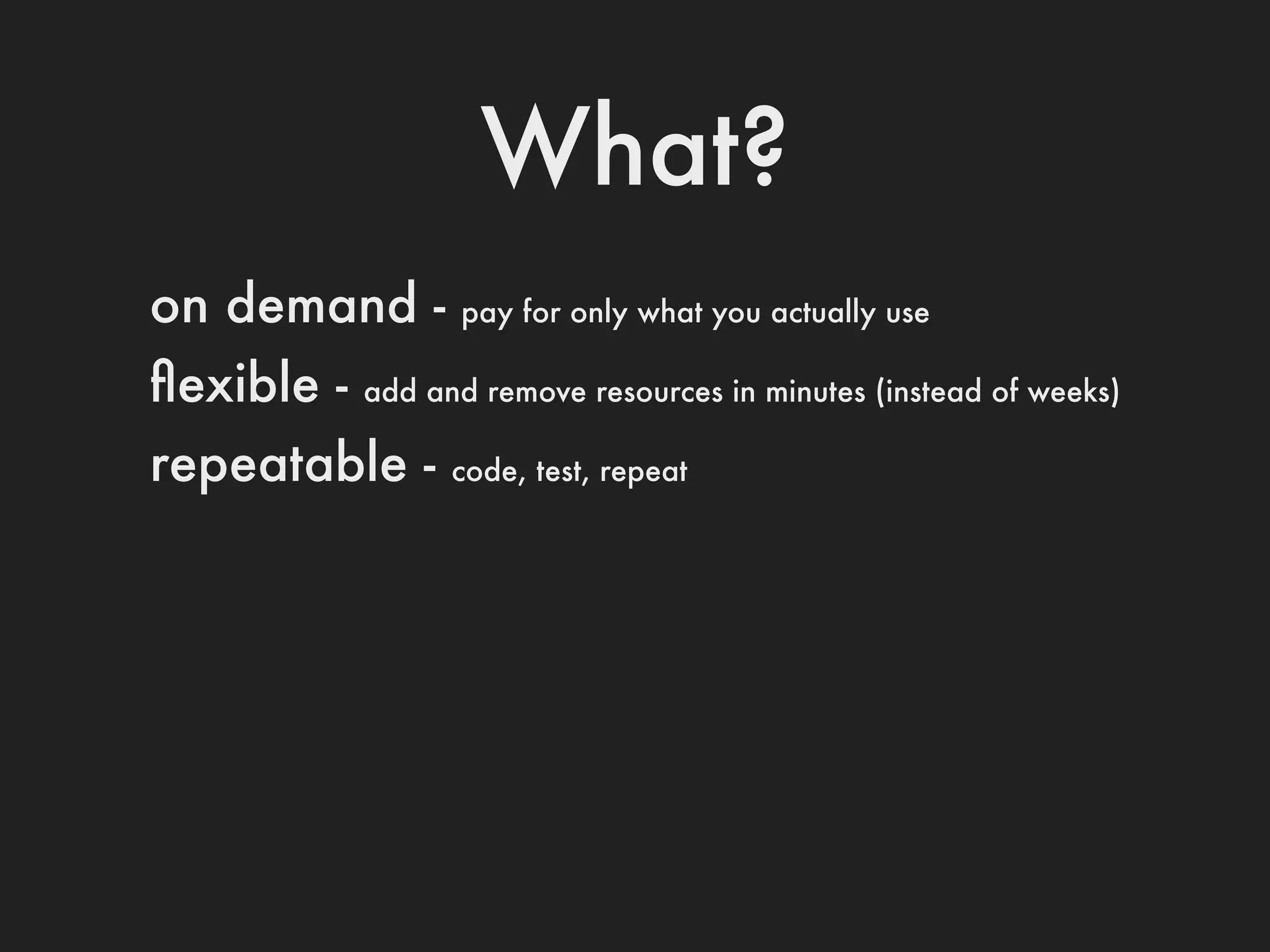
What?
What?
on demand -   pay for only what you actually use
What?
on demand -       pay for only what you actually use

flexible -   add and remove resources in minutes (instead of weeks)
What?
on demand -       pay for only what you actually use

flexible -   add and remove resources in minutes (instead of weeks)

repeatable -      code, test, repeat
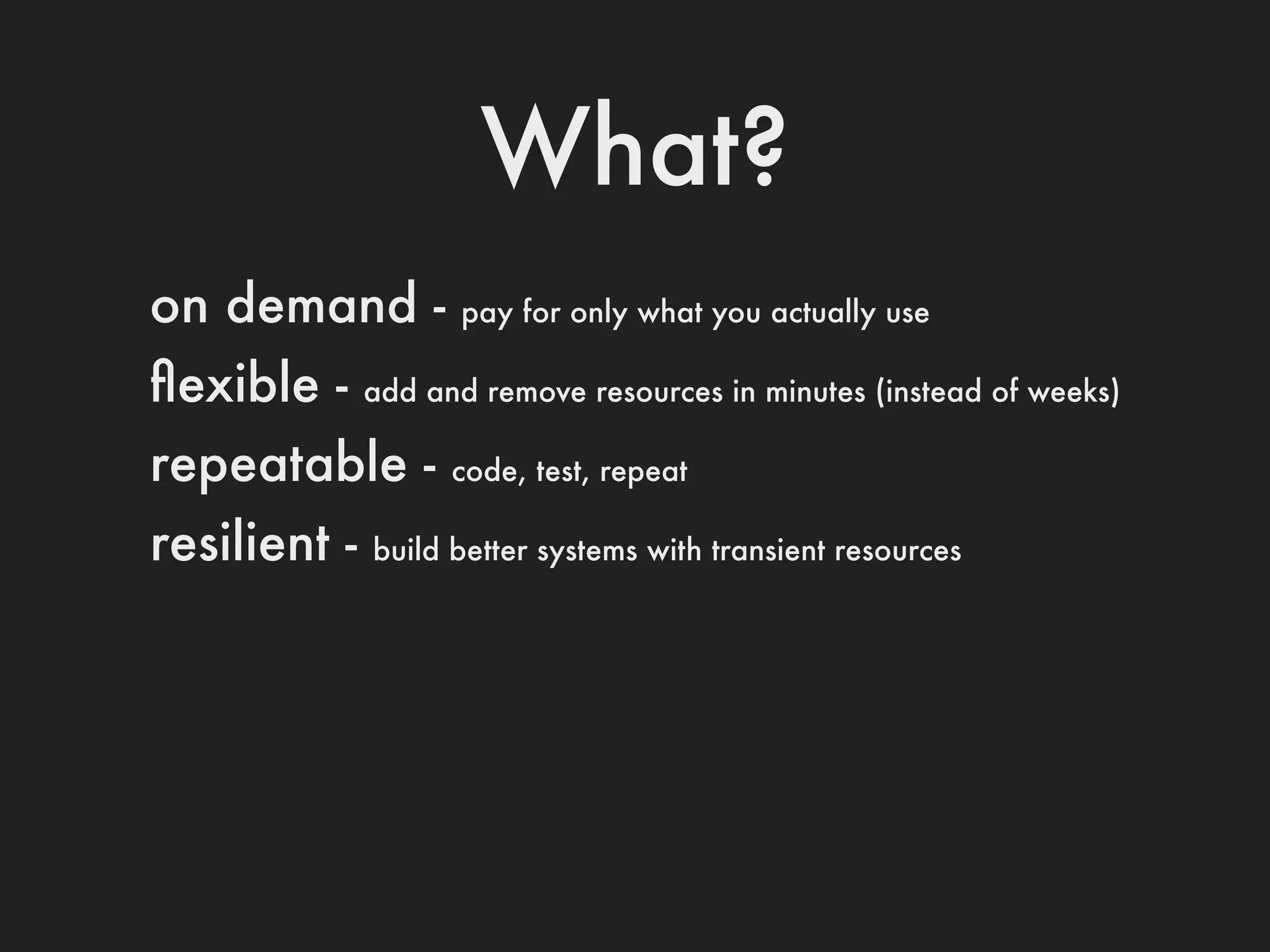
What?
on demand -         pay for only what you actually use

flexible -     add and remove resources in minutes (instead of weeks)

repeatable -        code, test, repeat

resilient -   build better systems with transient resources
But, but...
But, but...
option overload -   which provider should I use
But, but...
option overload -       which provider should I use

intimidating -   each service requires separate expertise
But, but...
option overload -              which provider should I use

intimidating -        each service requires separate expertise

tools -   vastly different API’s built on varying levels of quality
Ruby cloud services
web: github.com/geemus/fog
twitter: @fog
Why?
Why?
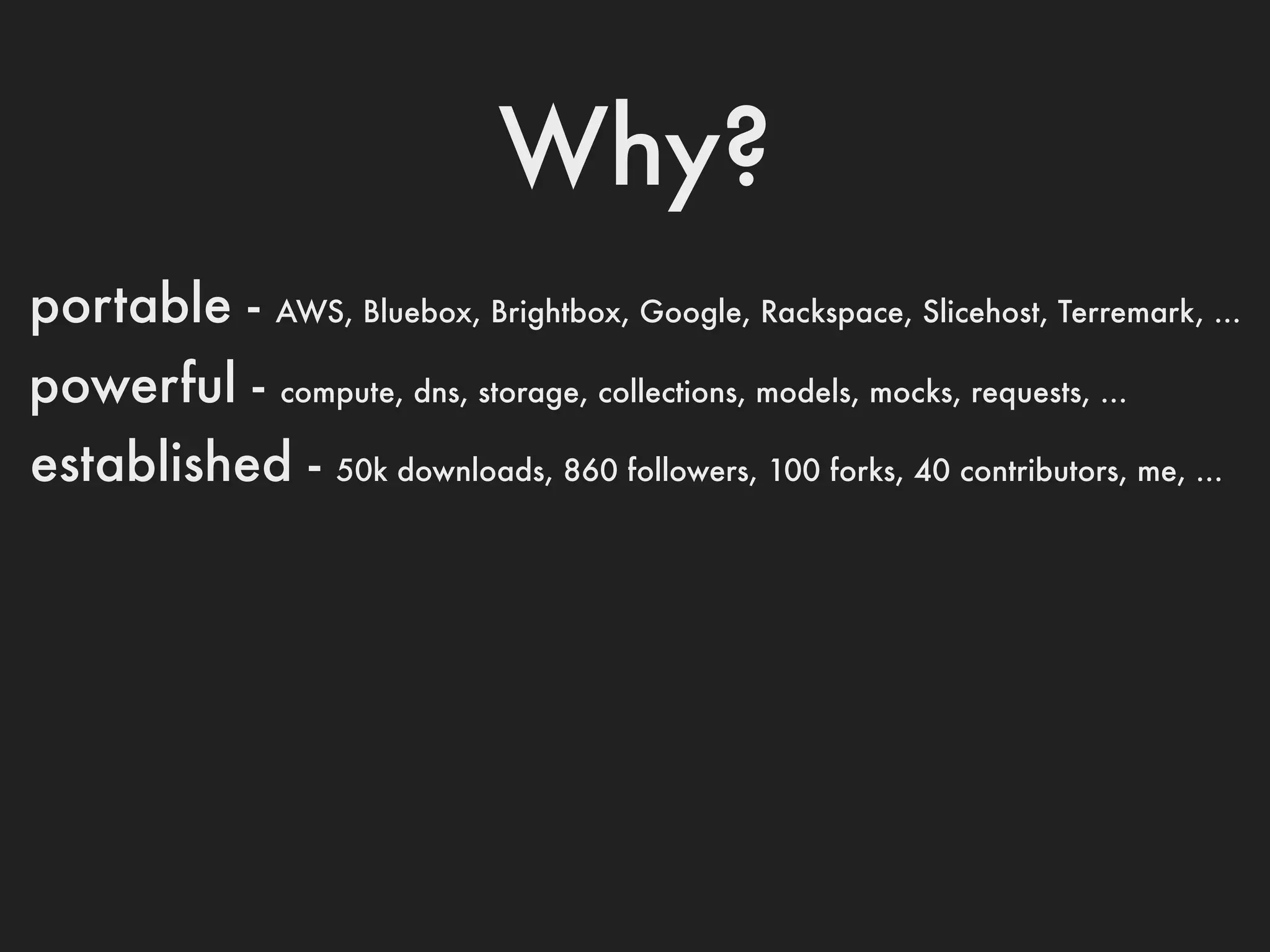
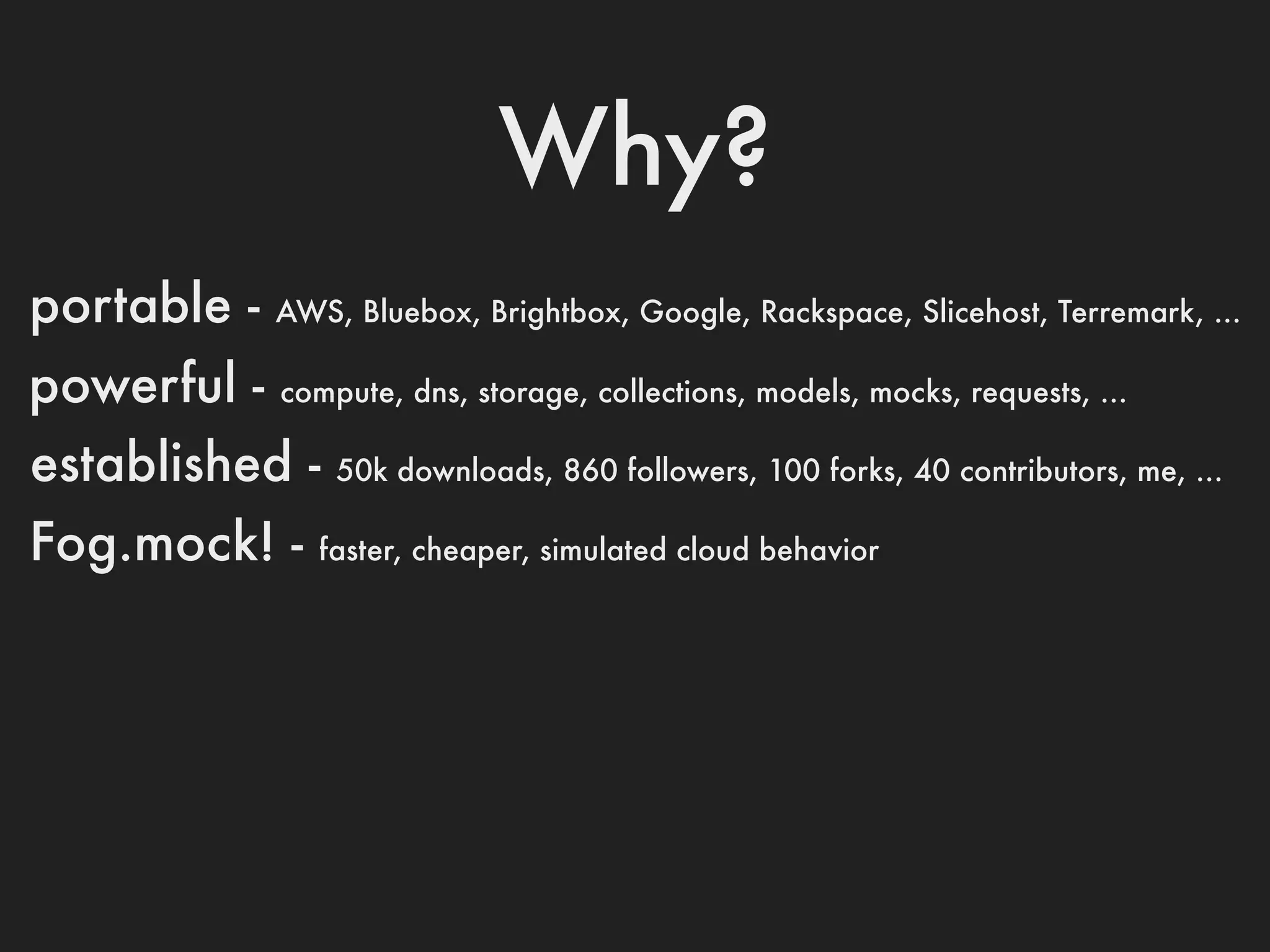
portable -   AWS, Bluebox, Brightbox, Google, Rackspace, Slicehost, Terremark, ...
Why?
portable -   AWS, Bluebox, Brightbox, Google, Rackspace, Slicehost, Terremark, ...

powerful -   compute, dns, storage, collections, models, mocks, requests, ...
Why?
portable -   AWS, Bluebox, Brightbox, Google, Rackspace, Slicehost, Terremark, ...

powerful -   compute, dns, storage, collections, models, mocks, requests, ...

established -    50k downloads, 860 followers, 100 forks, 40 contributors, me, ...
Why?
portable -   AWS, Bluebox, Brightbox, Google, Rackspace, Slicehost, Terremark, ...

powerful -   compute, dns, storage, collections, models, mocks, requests, ...

established -    50k downloads, 860 followers, 100 forks, 40 contributors, me, ...

Fog.mock! -     faster, cheaper, simulated cloud behavior
Who?
Who?
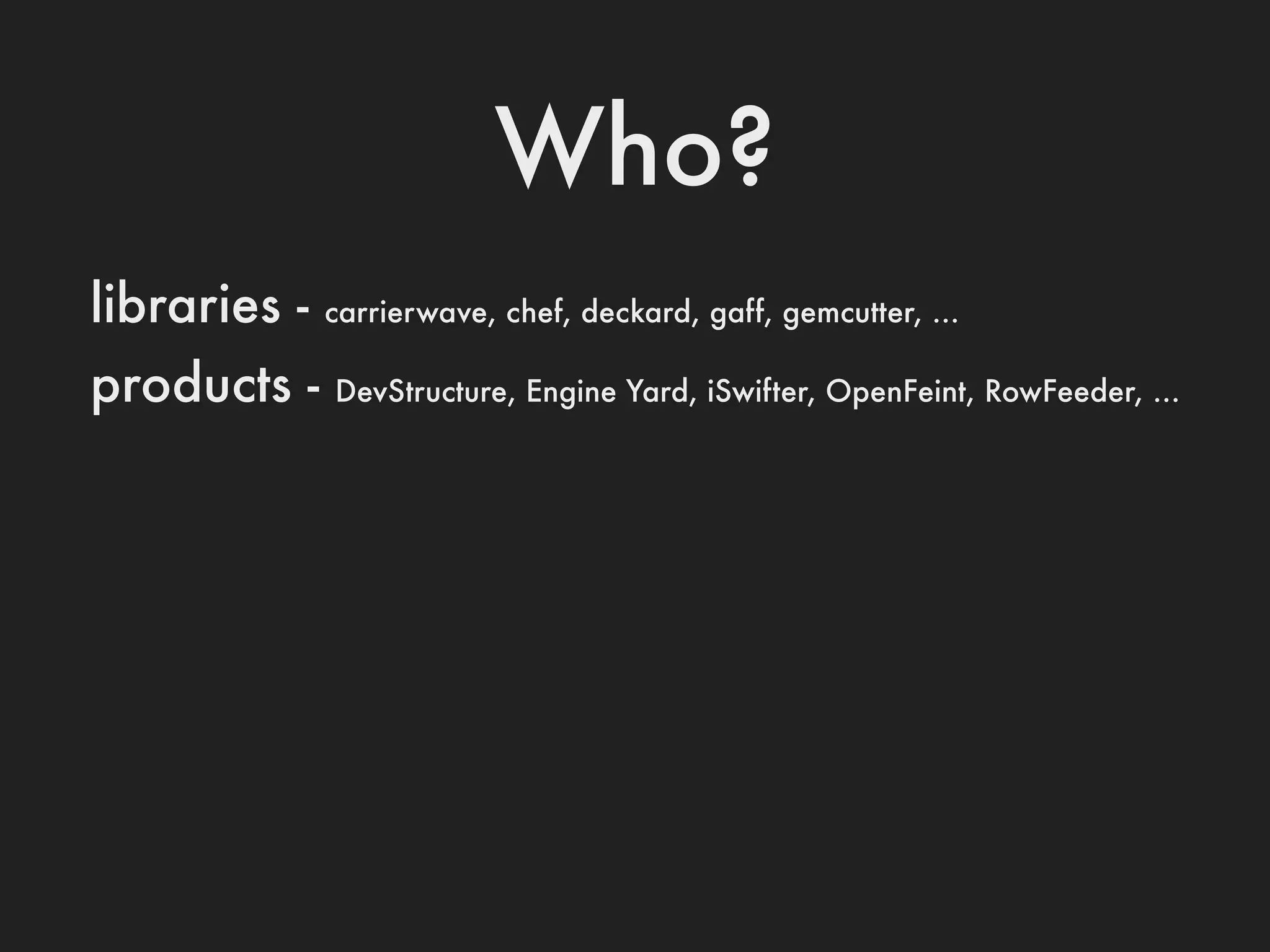
libraries -   carrierwave, chef, deckard, gaff, gemcutter, ...

products -    DevStructure, Engine Yard, iSwifter, OpenFeint, RowFeeder, ...
What?
What?
That’s great and all but   I don’t have a use case...
What?
That’s great and all but   I don’t have a use case...
uptime -       because who wants a busted web site?
Setup
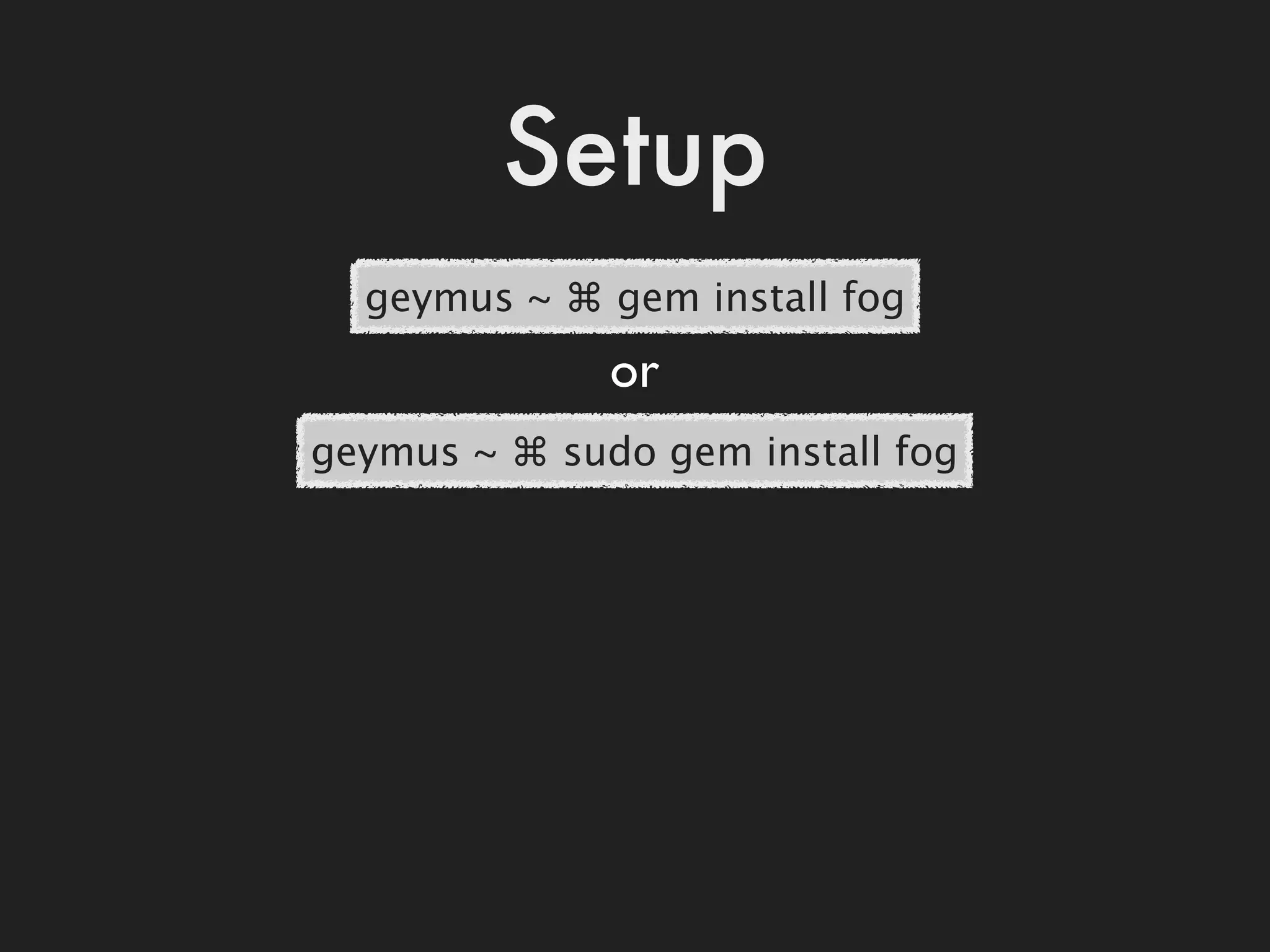
  geymus ~ ⌘ gem install fog
              or
geymus ~ ⌘ sudo gem install fog
Get Connected


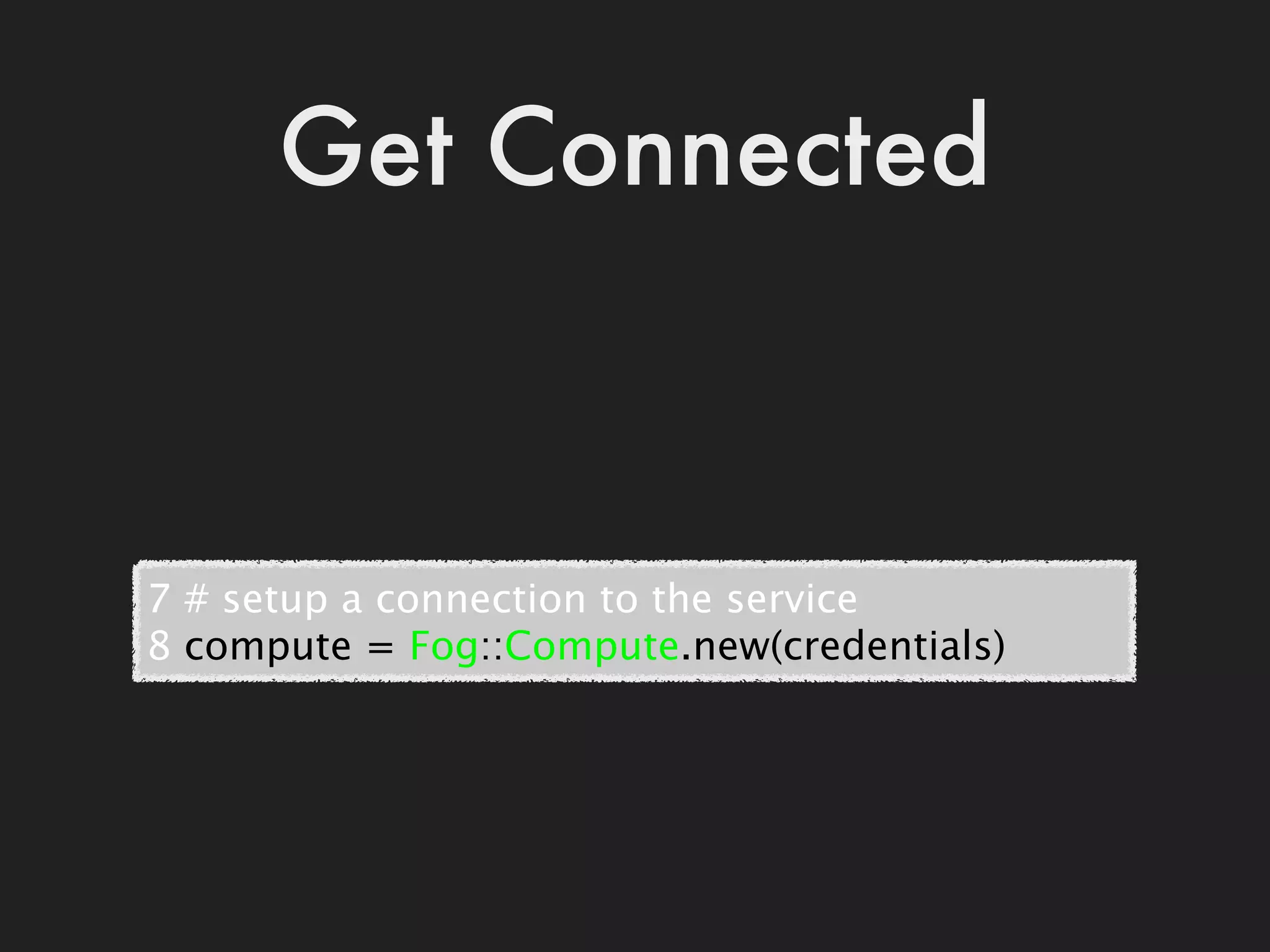
7 # setup a connection to the service
8 compute = Fog::Compute.new(credentials)
Get Connected
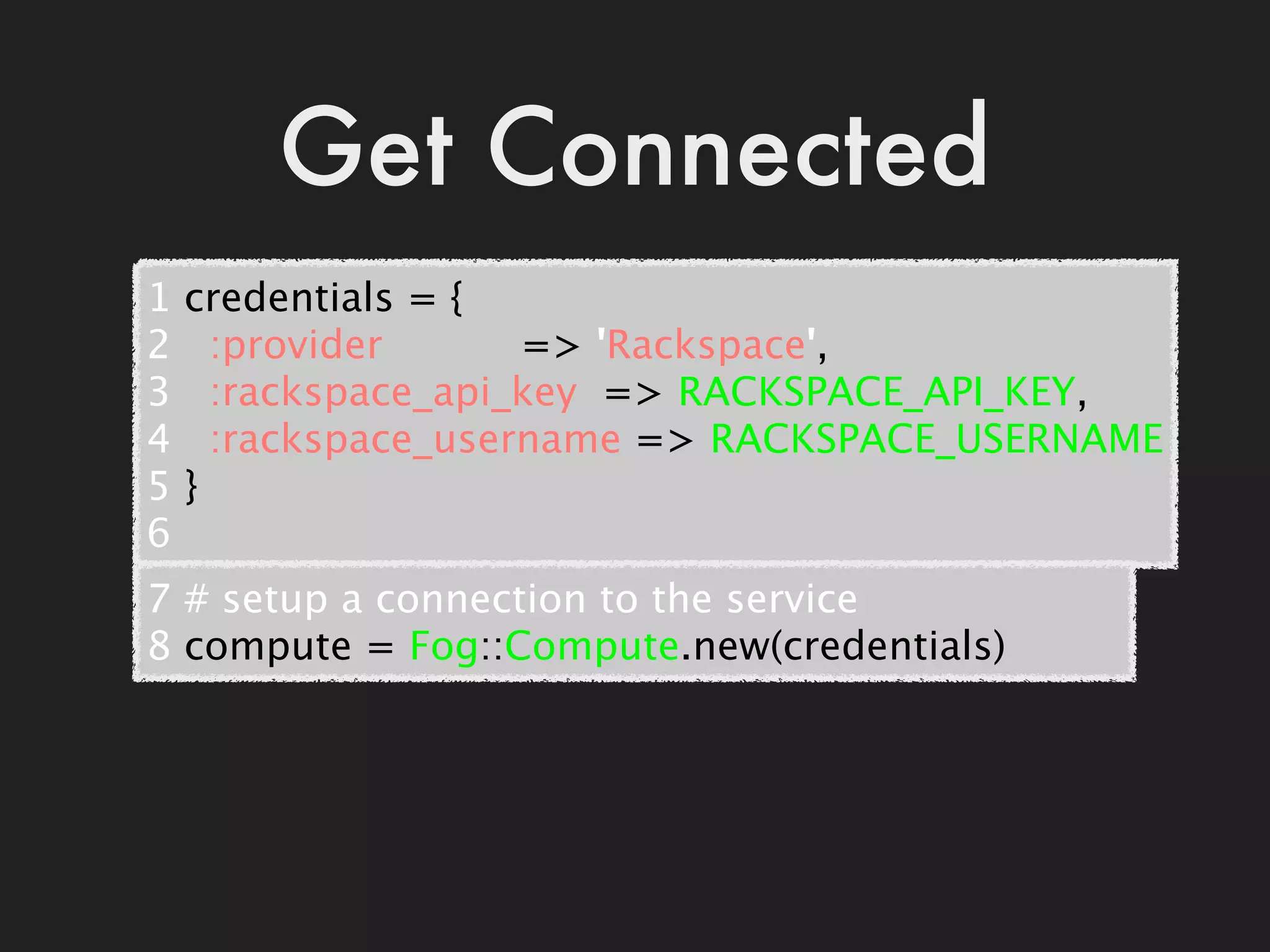
1   credentials = {
2     :provider           => 'Rackspace',
3     :rackspace_api_key  => RACKSPACE_API_KEY,
4     :rackspace_username => RACKSPACE_USERNAME
5   }
6
7 # setup a connection to the service
8 compute = Fog::Compute.new(credentials)
Bootstrap


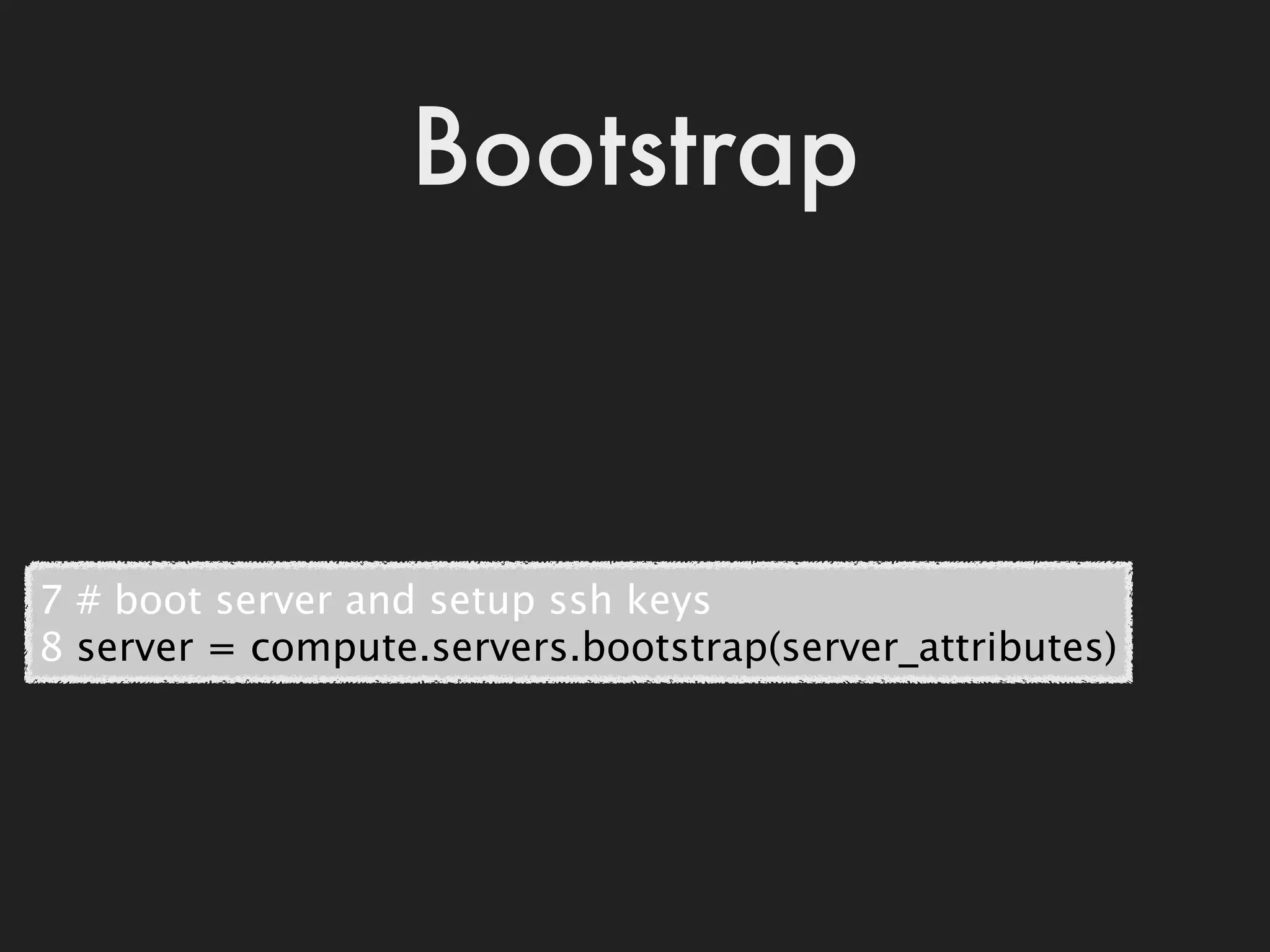
7 # boot server and setup ssh keys
8 server = compute.servers.bootstrap(server_attributes)
Bootstrap
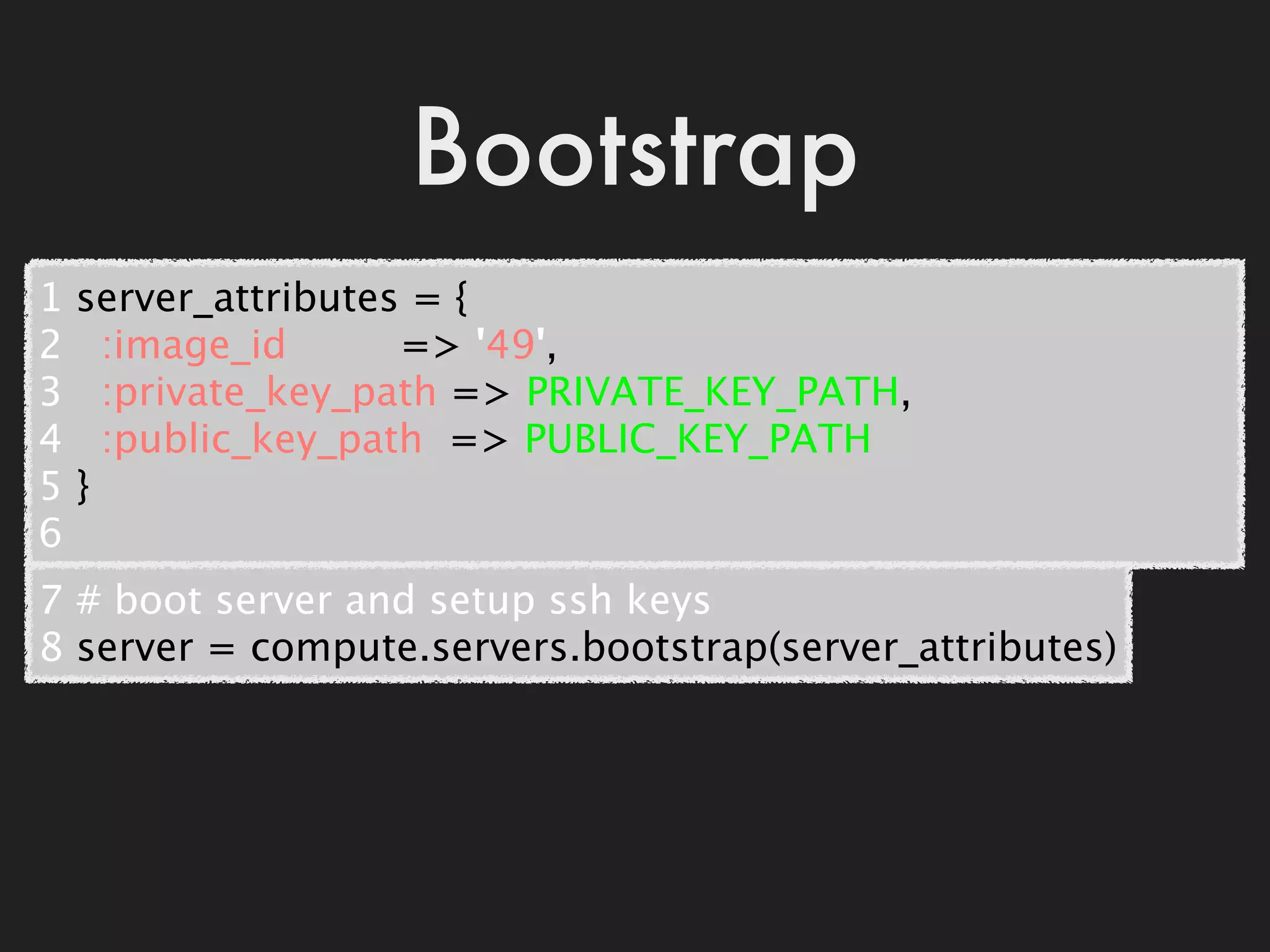
1   server_attributes = {
2     :image_id         => '49',
3     :private_key_path => PRIVATE_KEY_PATH,
4     :public_key_path  => PUBLIC_KEY_PATH
5   }
6
7 # boot server and setup ssh keys
8 server = compute.servers.bootstrap(server_attributes)
Servers?
Servers?
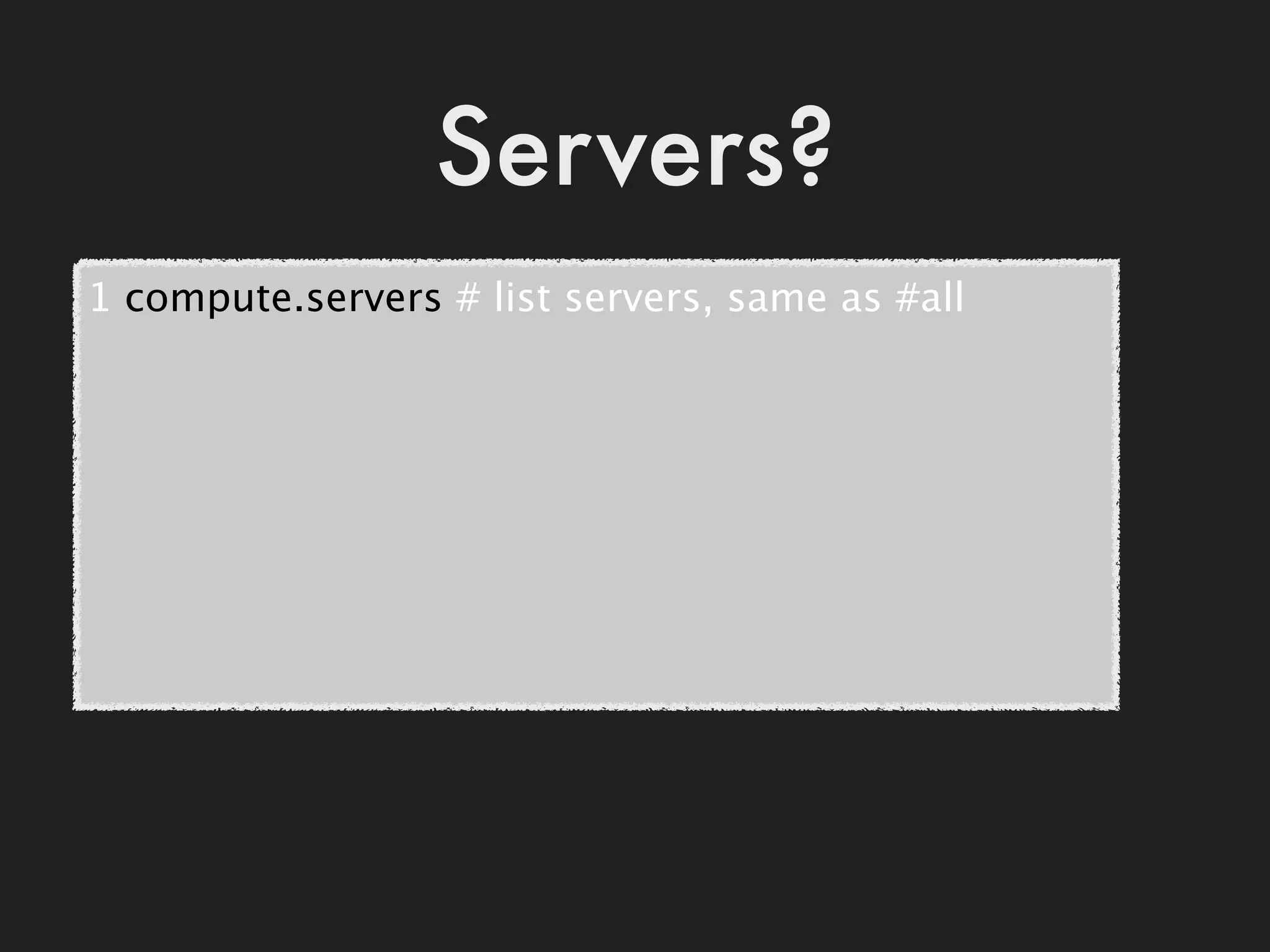
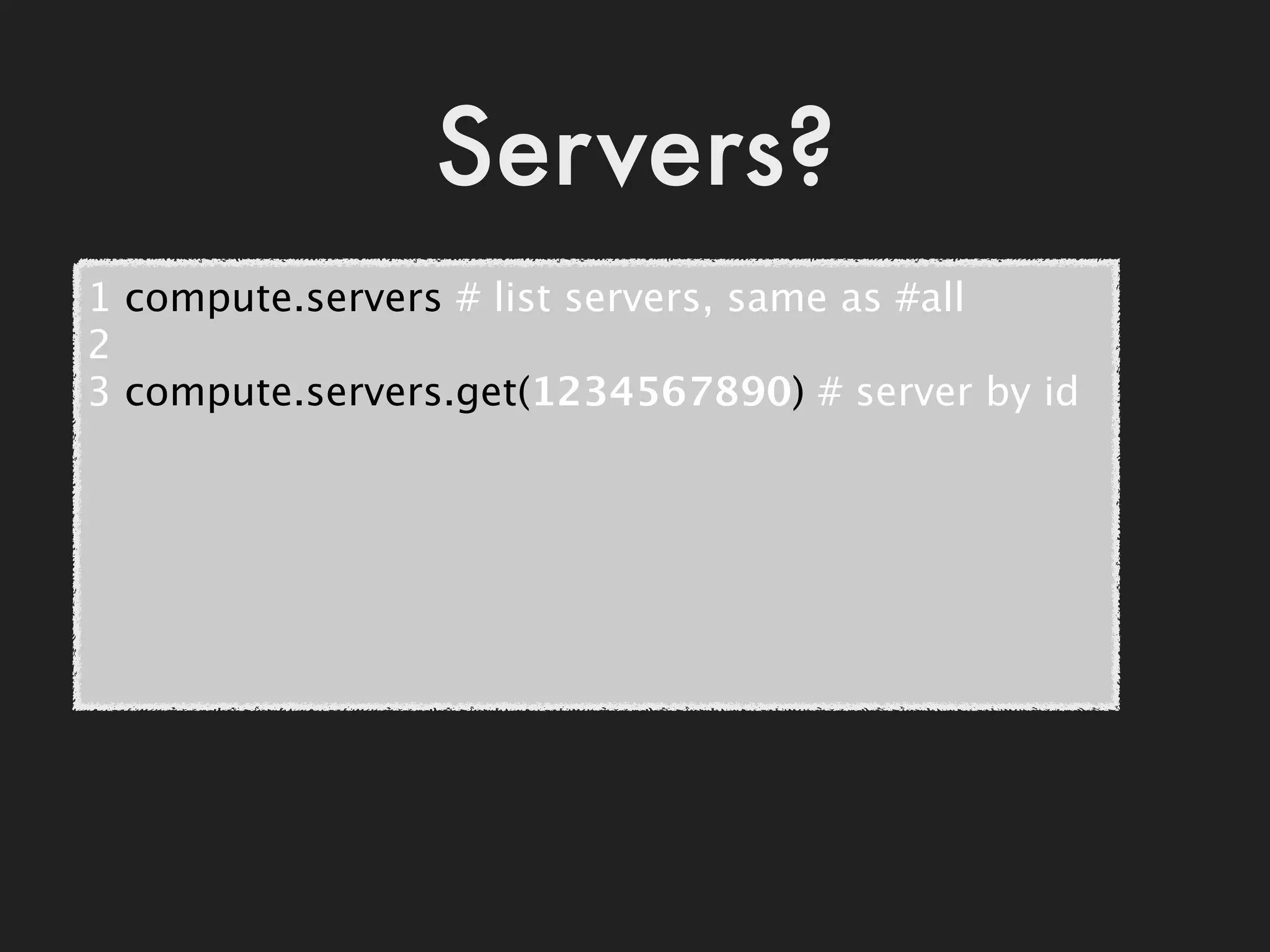
1 compute.servers # list servers, same as #all
Servers?
1 compute.servers # list servers, same as #all
2
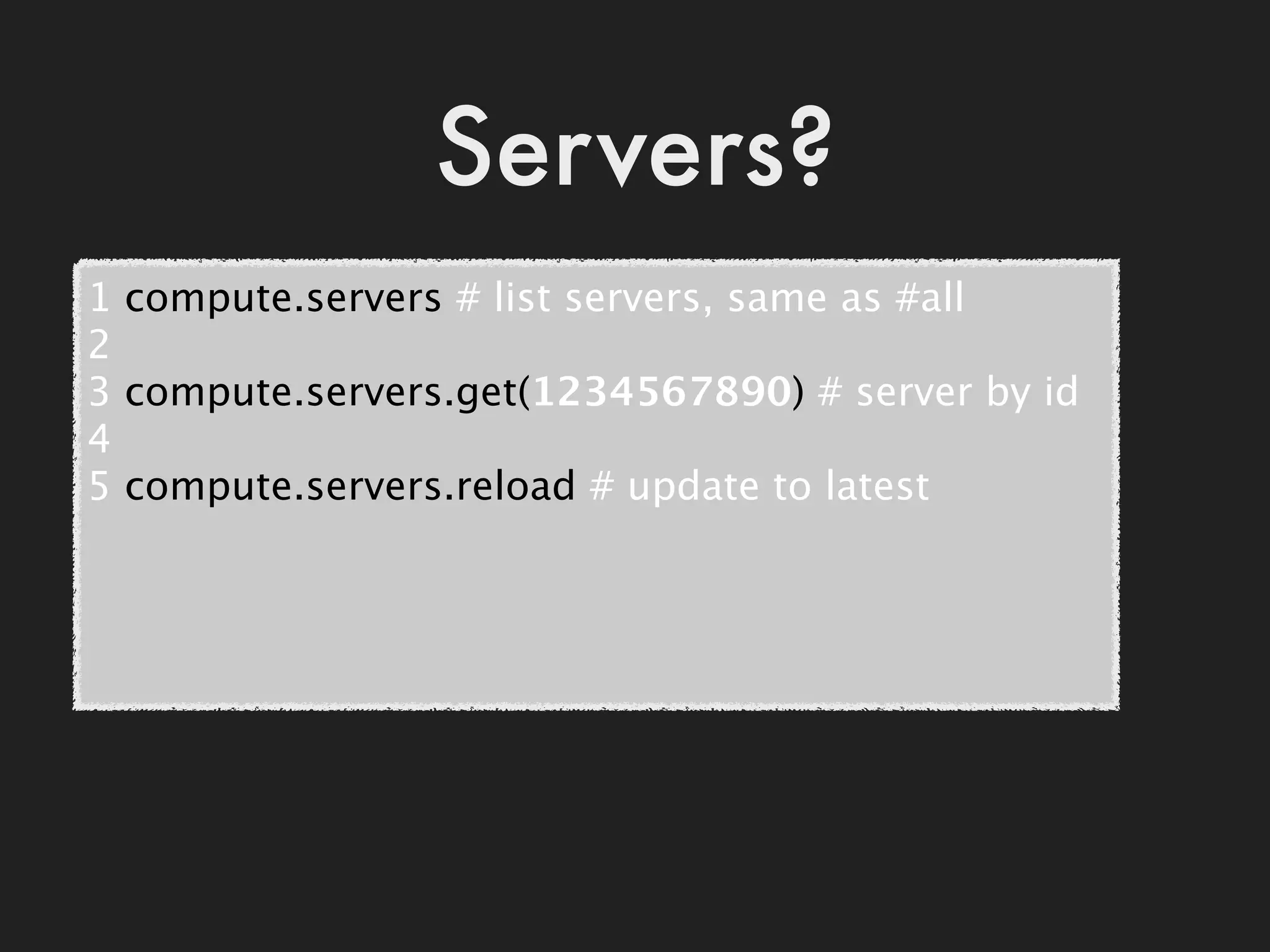
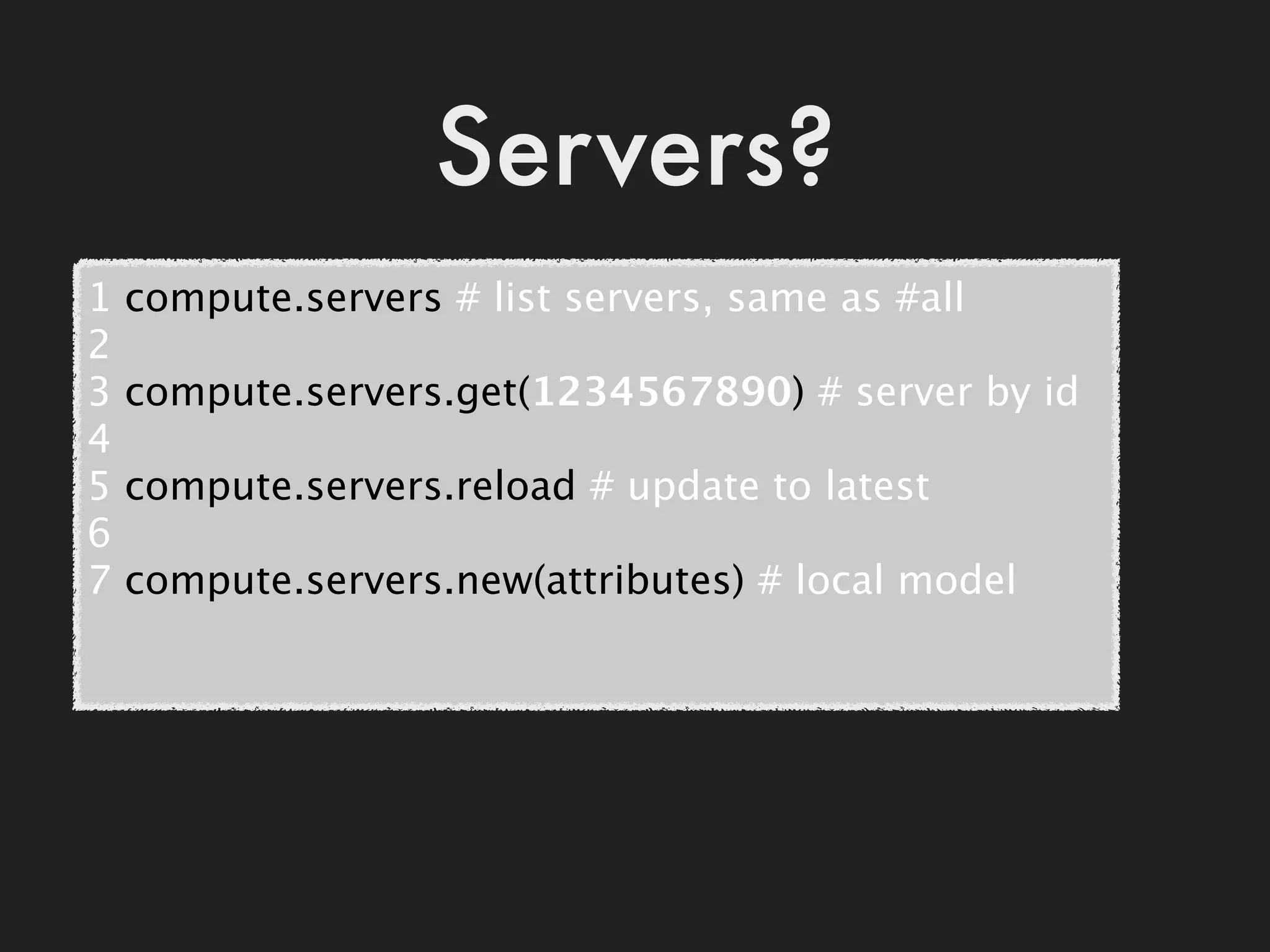
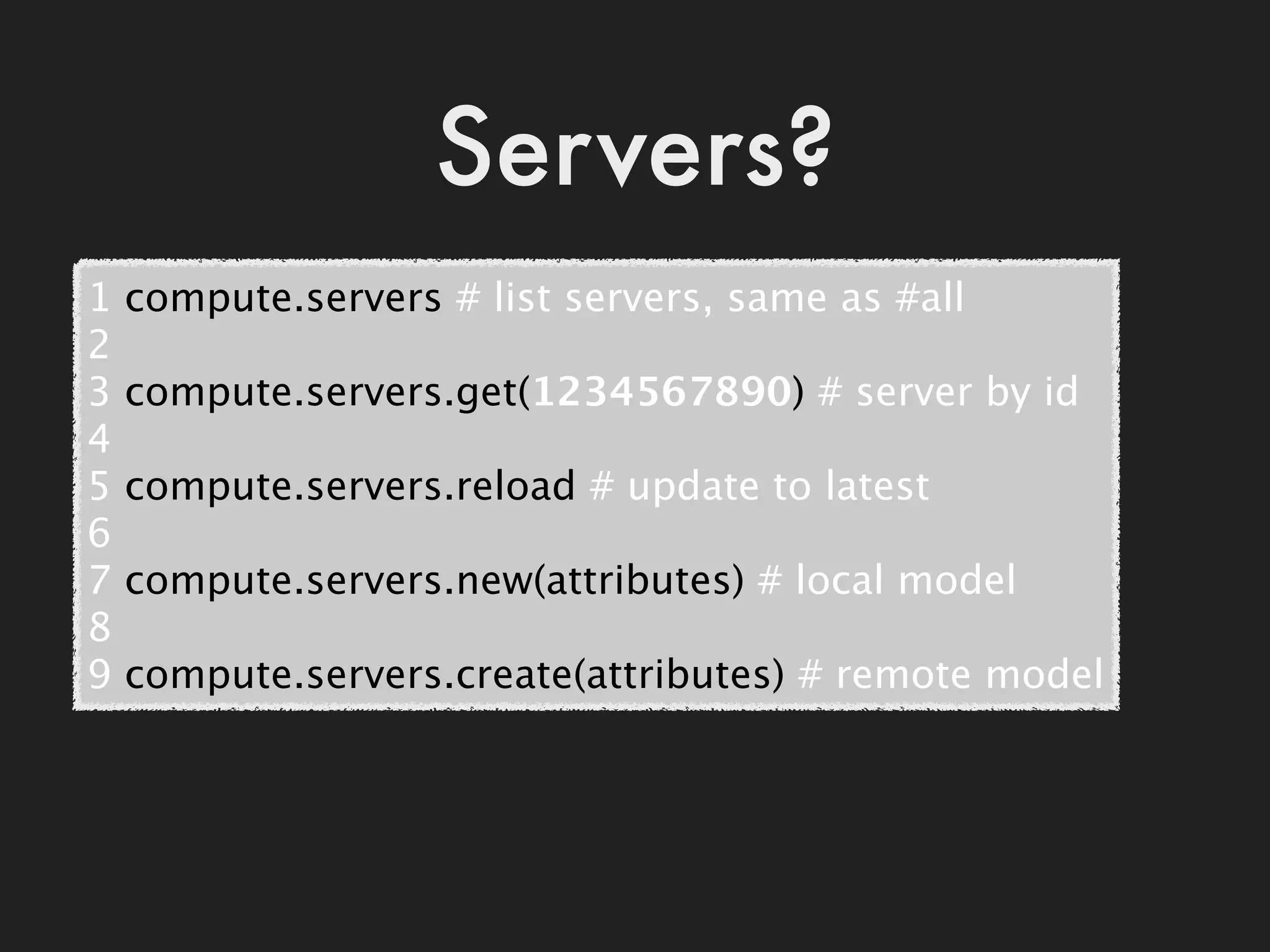
3 compute.servers.get(1234567890) # server by id
Servers?
1 compute.servers # list servers, same as #all
2
3 compute.servers.get(1234567890) # server by id
4
5 compute.servers.reload # update to latest
Servers?
1   compute.servers # list servers, same as #all
2
3   compute.servers.get(1234567890) # server by id
4
5   compute.servers.reload # update to latest
6
7   compute.servers.new(attributes) # local model
Servers?
1   compute.servers # list servers, same as #all
2
3   compute.servers.get(1234567890) # server by id
4
5   compute.servers.reload # update to latest
6
7   compute.servers.new(attributes) # local model
8
9   compute.servers.create(attributes) # remote model
bootstrap?
bootstrap?
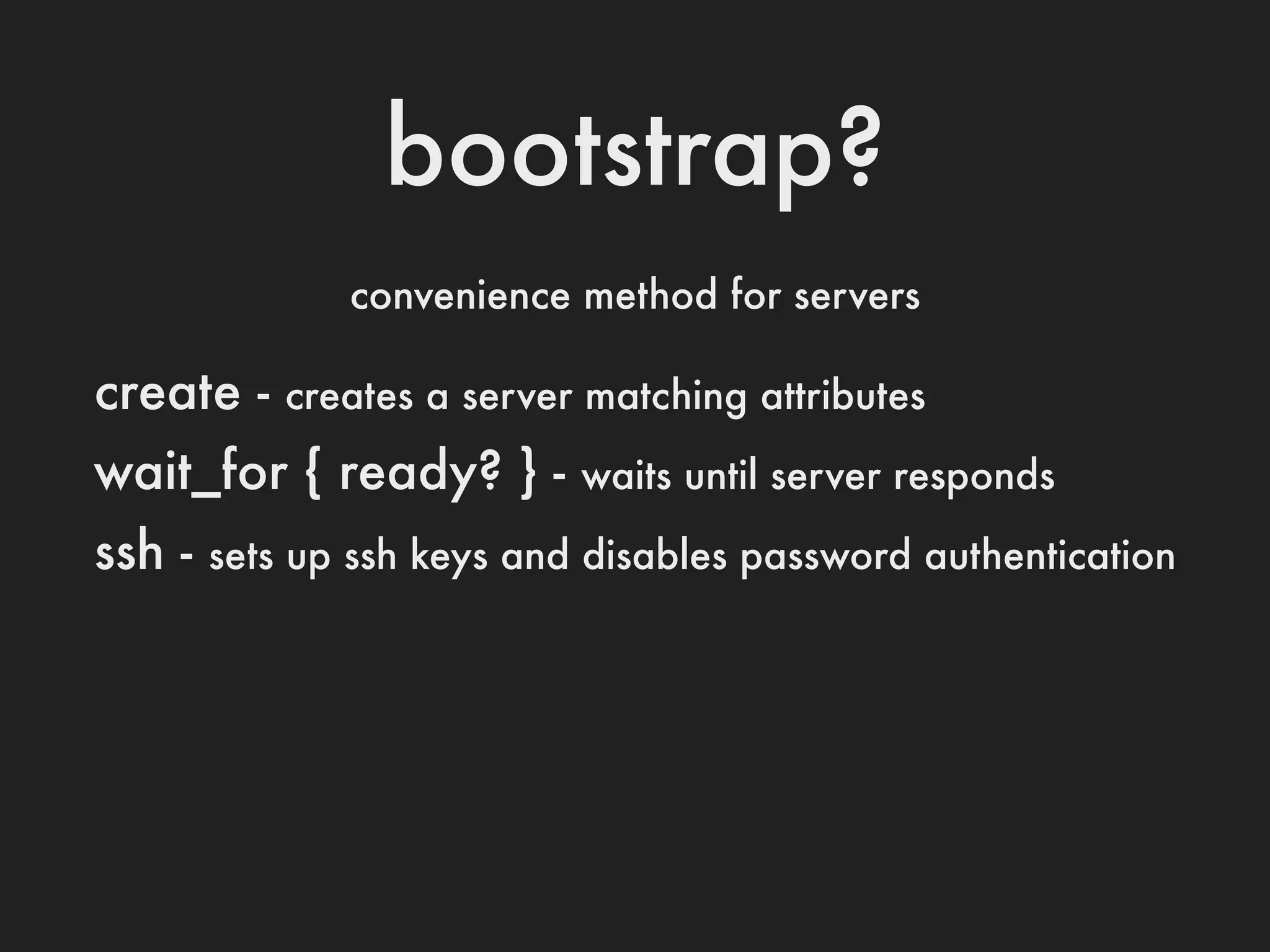
convenience method for servers
bootstrap?
               convenience method for servers

create -    creates a server matching attributes

wait_for { ready? } -       waits until server responds

ssh -   sets up ssh keys and disables password authentication
ping
ping
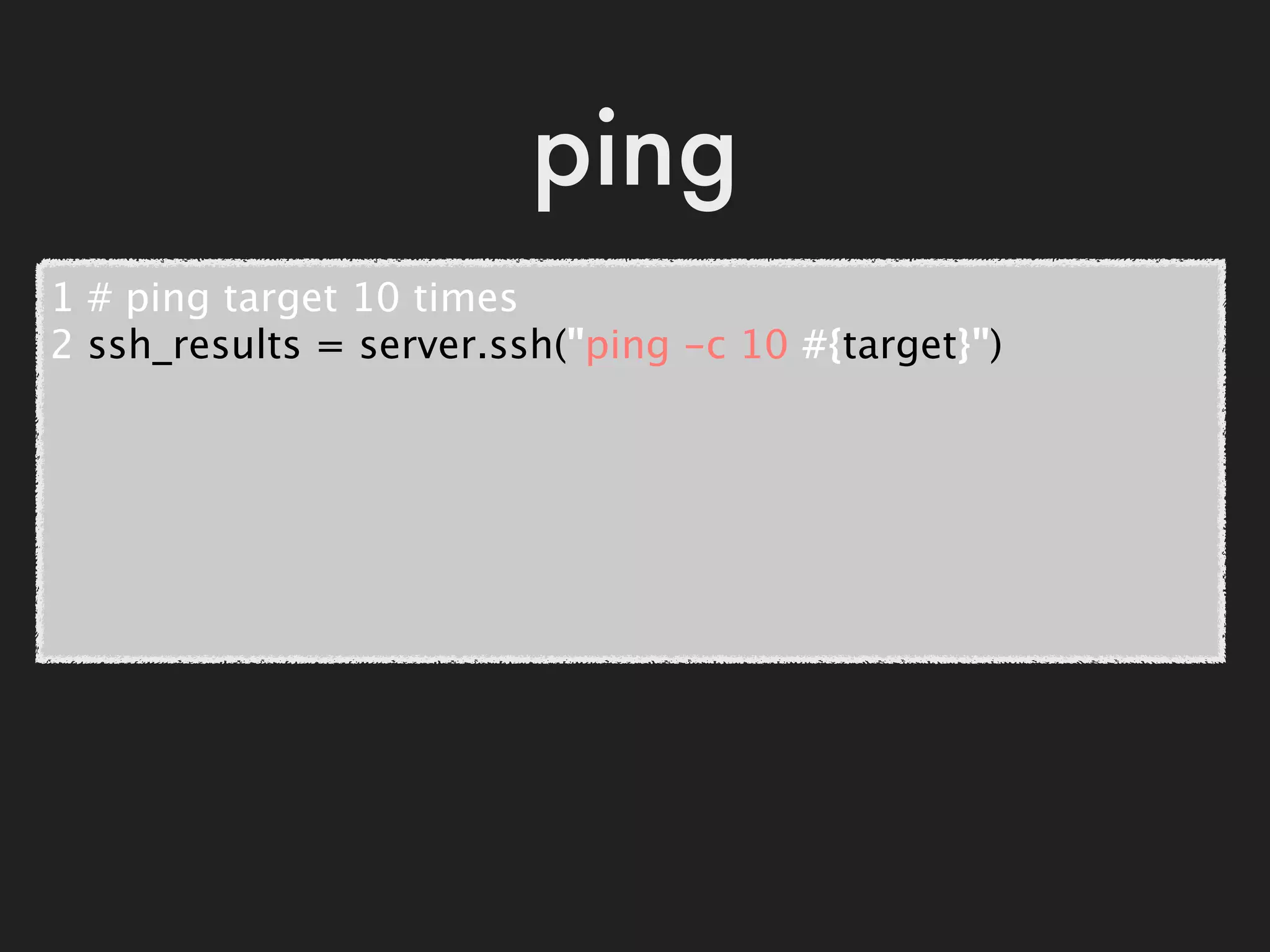
1 # ping target 10 times
2 ssh_results = server.ssh("ping -c 10 #{target}")
ping
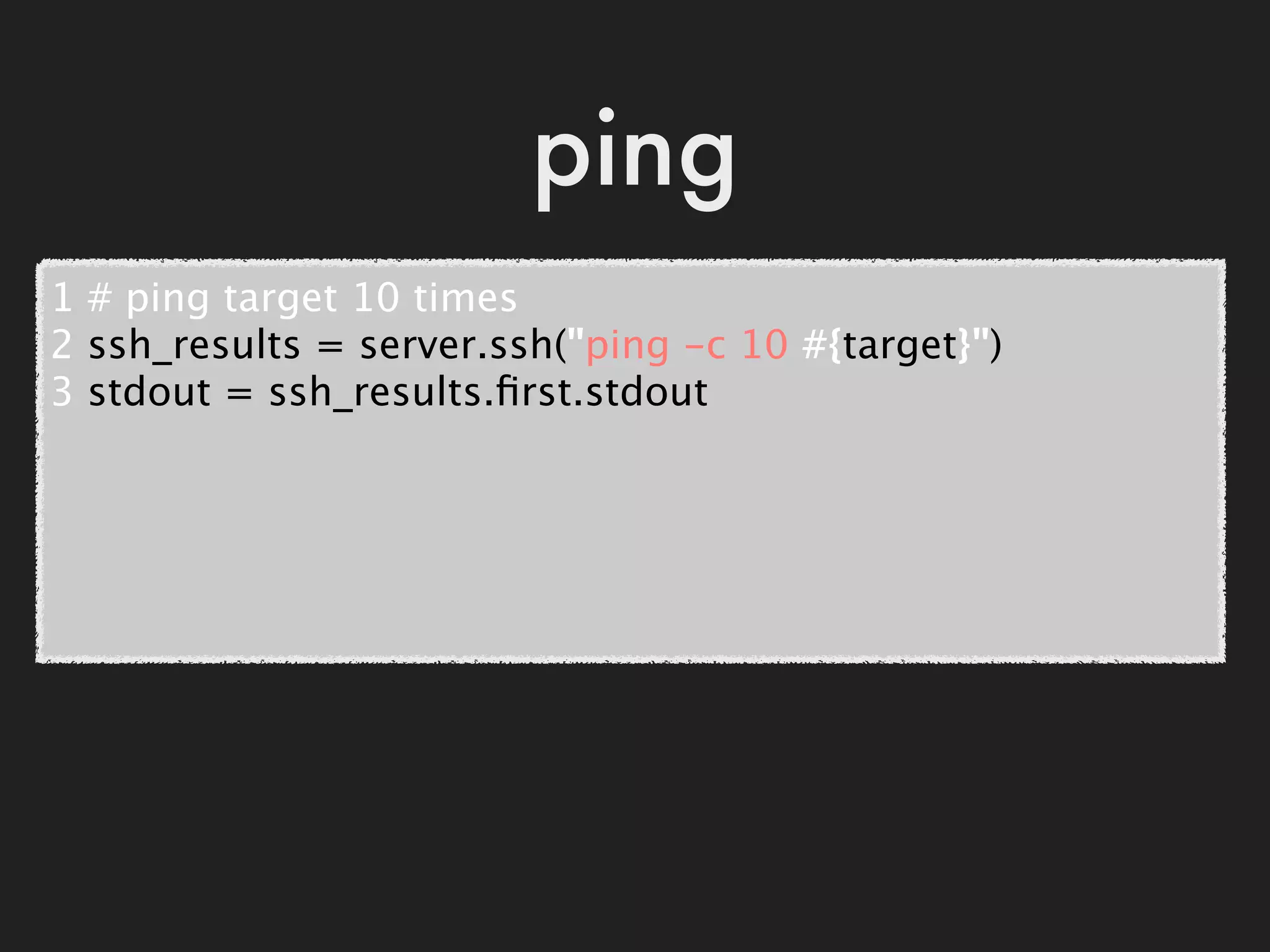
1 # ping target 10 times
2 ssh_results = server.ssh("ping -c 10 #{target}")
3 stdout = ssh_results.first.stdout
ping
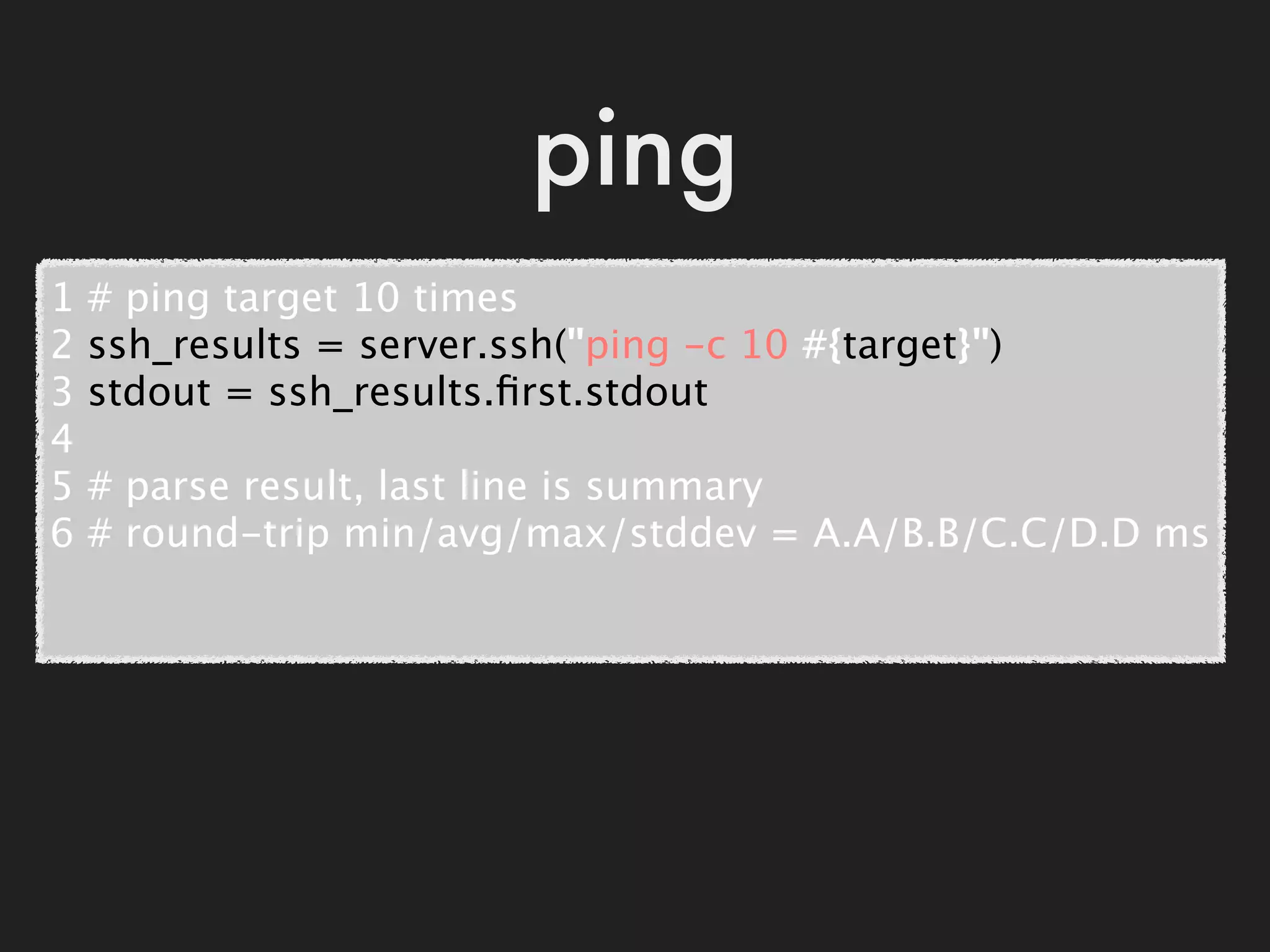
1   # ping target 10 times
2   ssh_results = server.ssh("ping -c 10 #{target}")
3   stdout = ssh_results.first.stdout
4
5   # parse result, last line is summary
6   # round-trip min/avg/max/stddev = A.A/B.B/C.C/D.D ms
ping
1   # ping target 10 times
2   ssh_results = server.ssh("ping -c 10 #{target}")
3   stdout = ssh_results.first.stdout
4
5   # parse result, last line is summary
6   # round-trip min/avg/max/stddev = A.A/B.B/C.C/D.D ms
7   stats = stdout.split("/n").last.split(' ')[-2]
8   min, avg, max, stddev = stats.split('/')
ping
1   # ping target 10 times
2   ssh_results = server.ssh("ping -c 10 #{target}")
3   stdout = ssh_results.first.stdout
4
5   # parse result, last line is summary
6   # round-trip min/avg/max/stddev = A.A/B.B/C.C/D.D ms
7   stats = stdout.split("/n").last.split(' ')[-2]
8   min, avg, max, stddev = stats.split('/')

          NOTE: most complex code was string parsing!?!
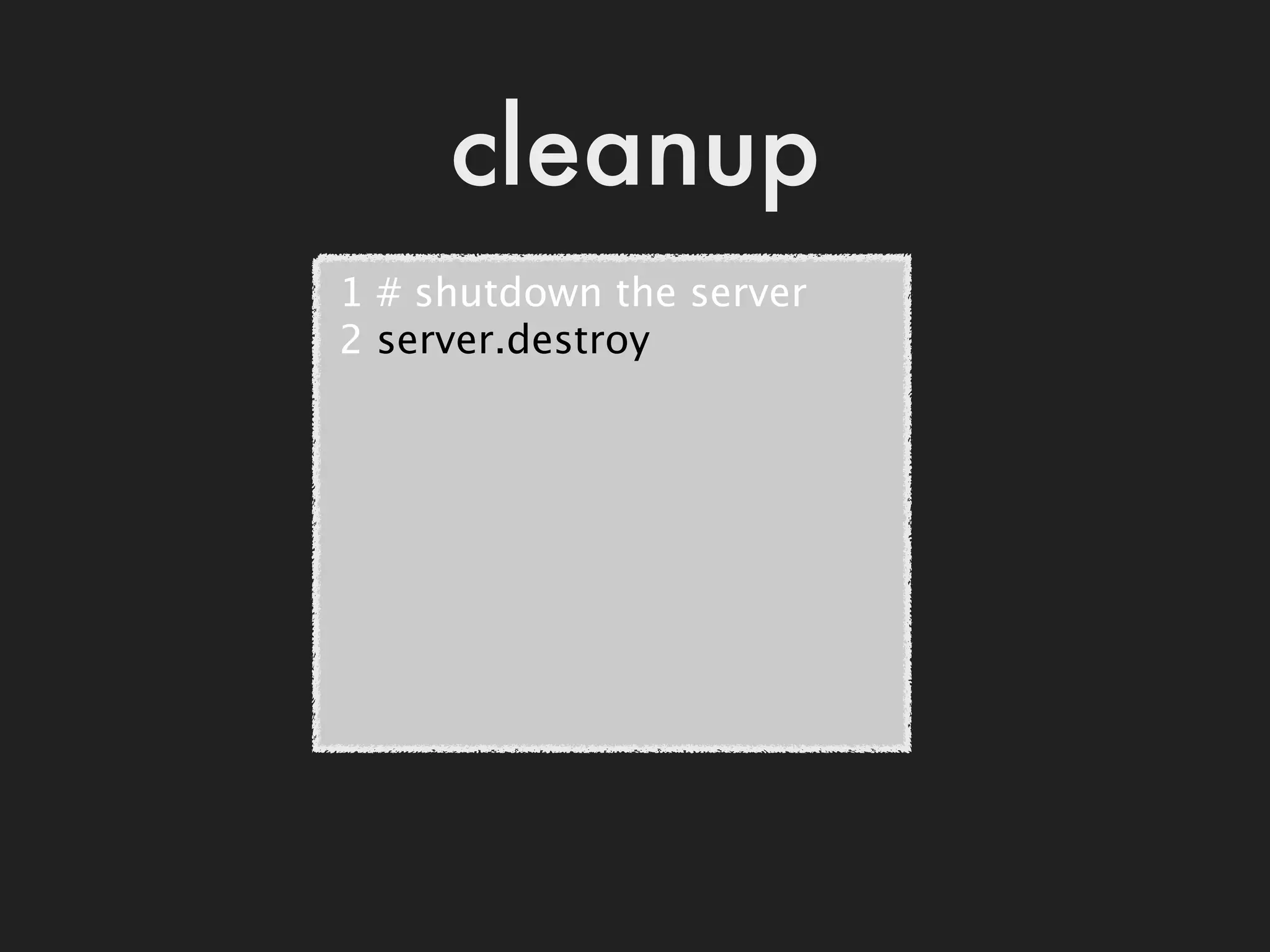
cleanup
cleanup
 1 # shutdown the server
 2 server.destroy
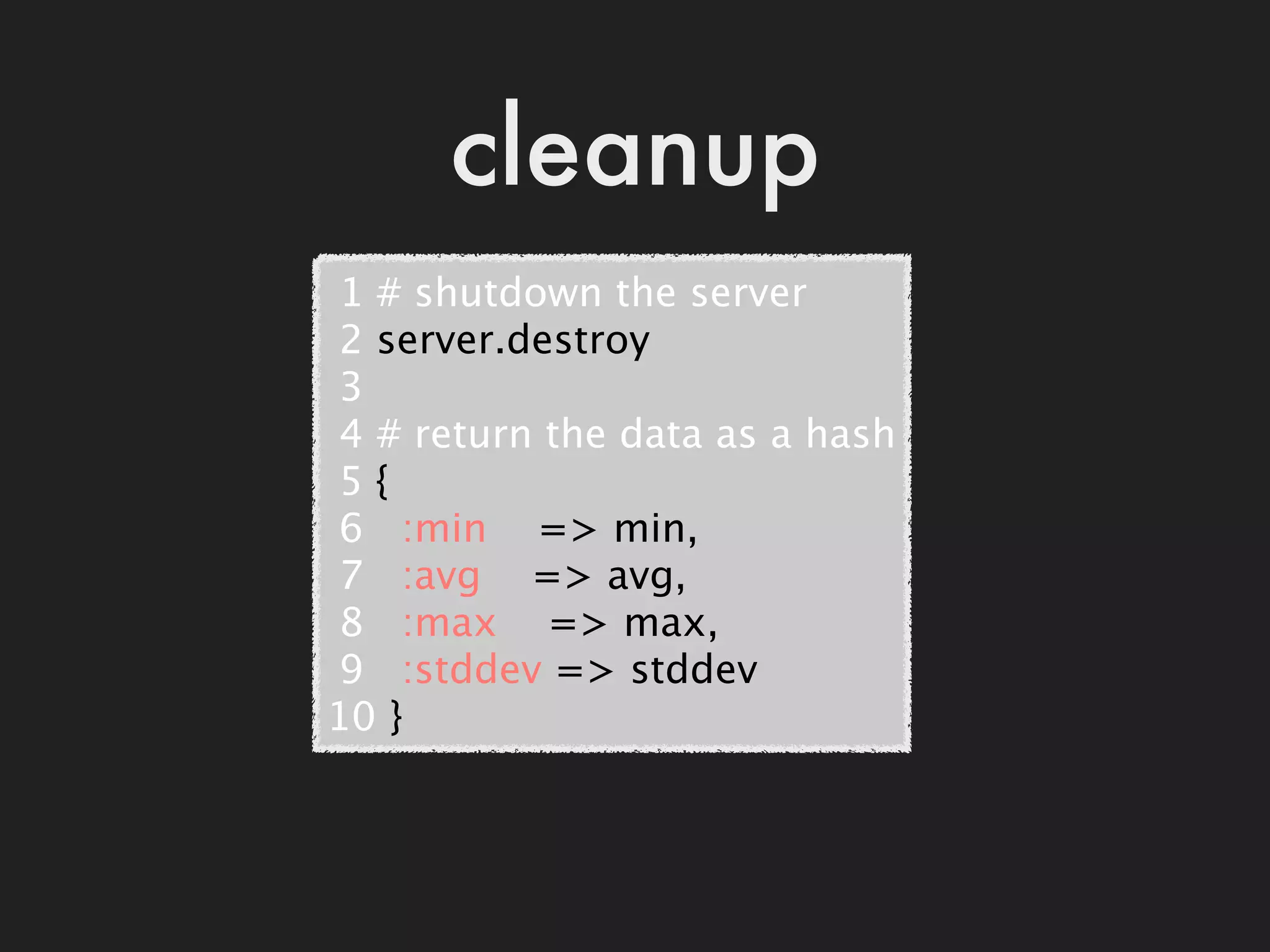
cleanup
 1 # shutdown the server
 2 server.destroy
 3
 4 # return the data as a hash
 5 {
 6   :min    => min,
 7   :avg    => avg,
 8   :max    => max,
 9   :stddev => stddev
10 }
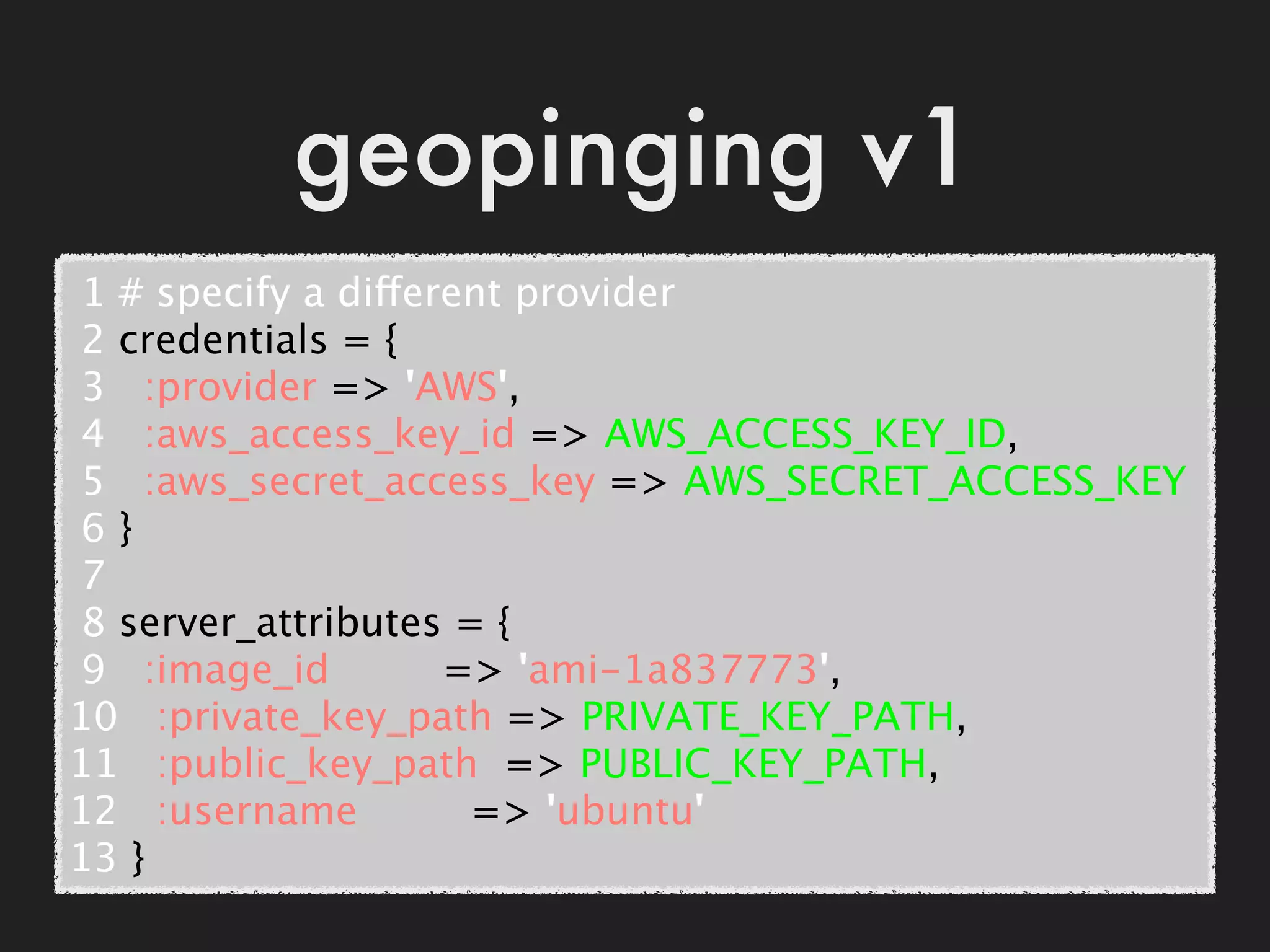
geopinging v1
 1 # specify a different provider
 2 credentials = {
 3   :provider => 'AWS',
 4   :aws_access_key_id => AWS_ACCESS_KEY_ID,
 5   :aws_secret_access_key => AWS_SECRET_ACCESS_KEY
 6 }
 7
 8 server_attributes = {
 9   :image_id         => 'ami-1a837773',
10   :private_key_path => PRIVATE_KEY_PATH,
11   :public_key_path  => PUBLIC_KEY_PATH,
12   :username         => 'ubuntu'
13 }
geopinging v2
1   # specify a different aws region
2   # ['ap-southeast-1', 'eu-west-1', 'us-west-1]
3   credentials.merge!({
4     :region => 'eu-west-1'
5   })
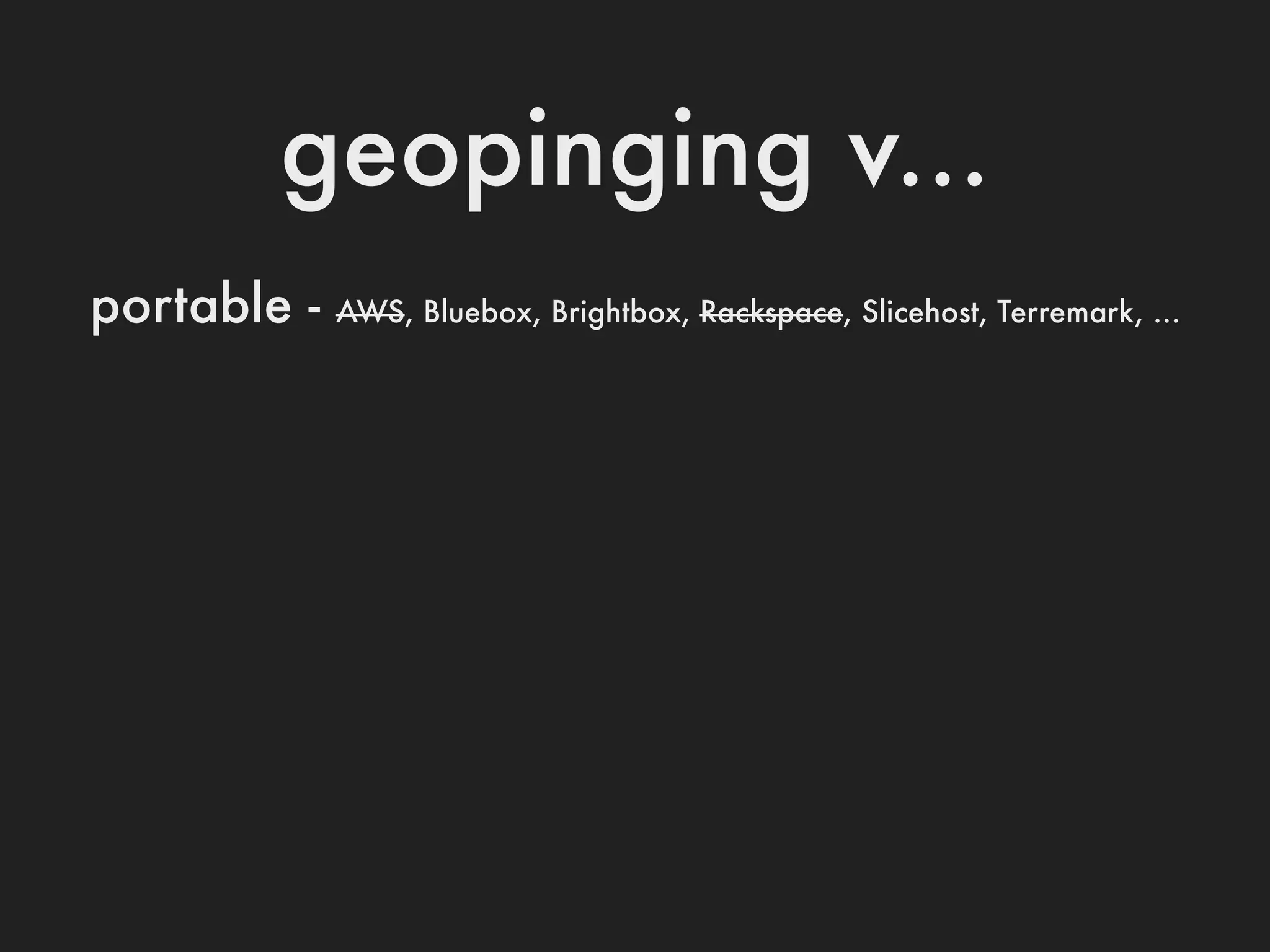
geopinging v...
portable -   AWS, Bluebox, Brightbox, Rackspace, Slicehost, Terremark, ...
geopinging v...
portable -   AWS, Bluebox, Brightbox, Rackspace, Slicehost, Terremark, ...

                 lather, rinse, repeat
How?
That is awesome, but   how did you know...
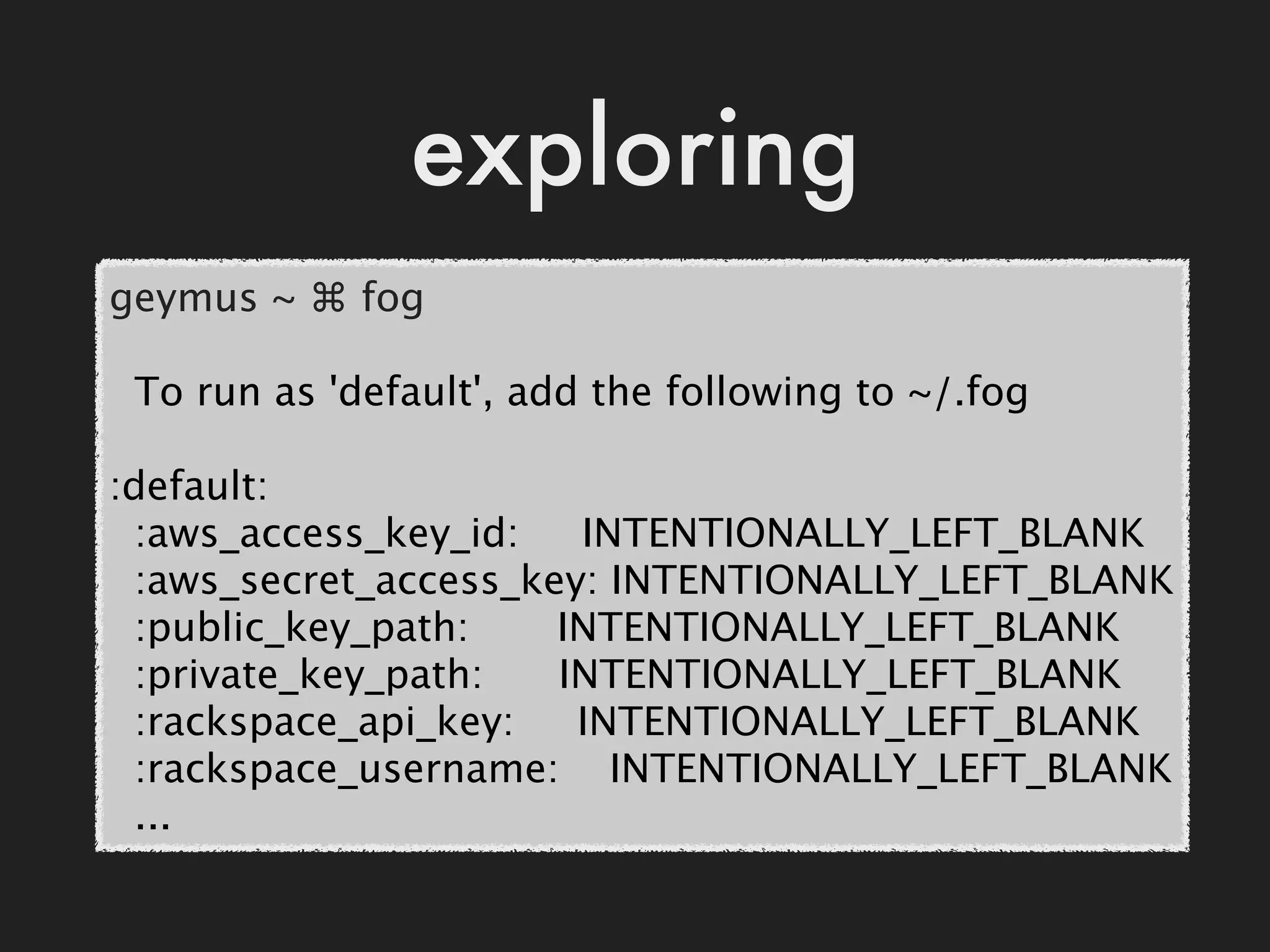
exploring
geymus ~ ⌘ fog

  To run as 'default', add the following to ~/.fog

:default:
  :aws_access_key_id:     INTENTIONALLY_LEFT_BLANK
  :aws_secret_access_key: INTENTIONALLY_LEFT_BLANK
  :public_key_path:       INTENTIONALLY_LEFT_BLANK
  :private_key_path:      INTENTIONALLY_LEFT_BLANK
  :rackspace_api_key:     INTENTIONALLY_LEFT_BLANK
  :rackspace_username:    INTENTIONALLY_LEFT_BLANK
  ...
sign posts
sign posts
geymus ~ ⌘ fog
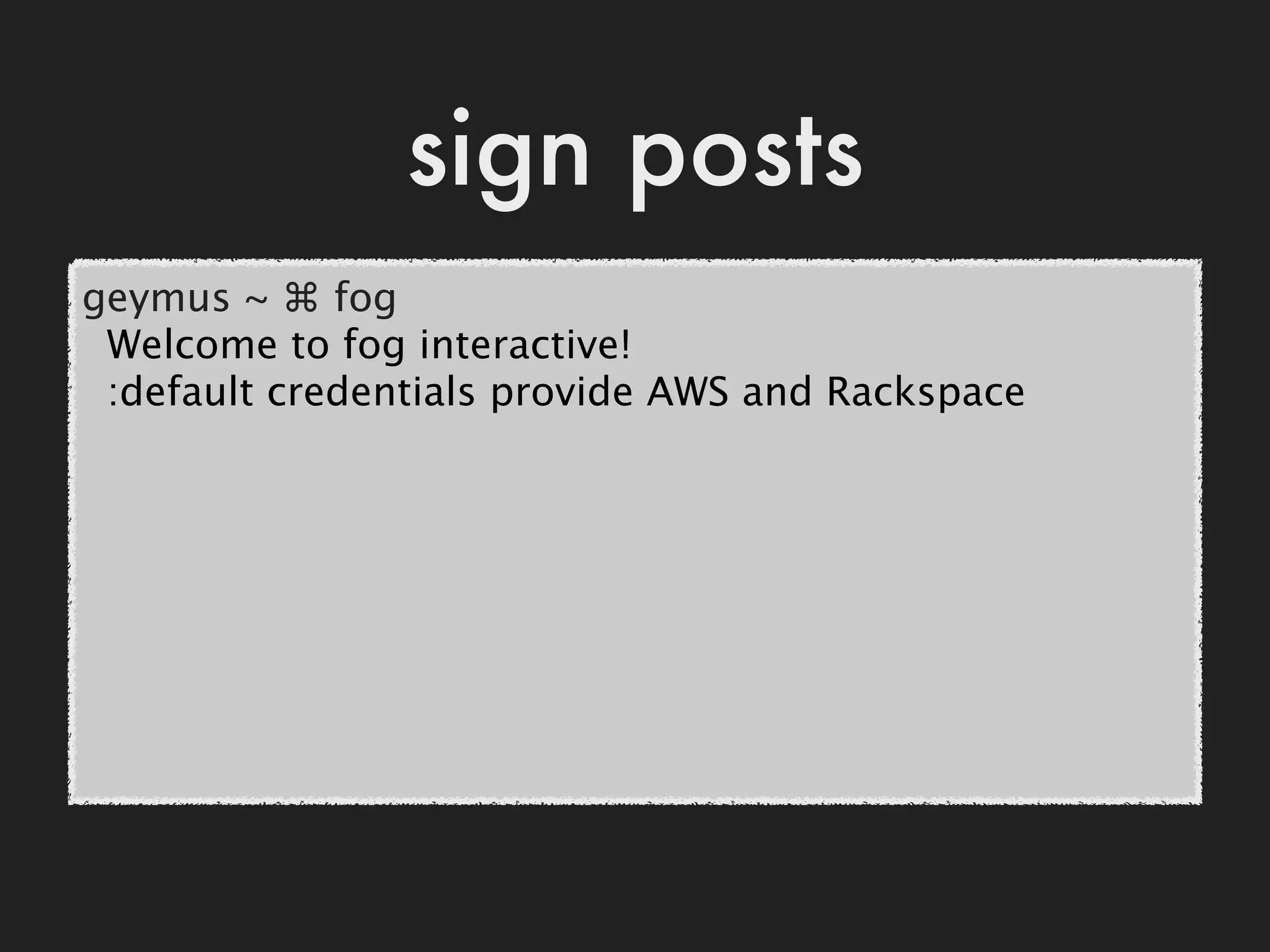
sign posts
geymus ~ ⌘ fog
 Welcome to fog interactive!
 :default credentials provide AWS and Rackspace
sign posts
geymus ~ ⌘ fog
 Welcome to fog interactive!
 :default credentials provide AWS and Rackspace
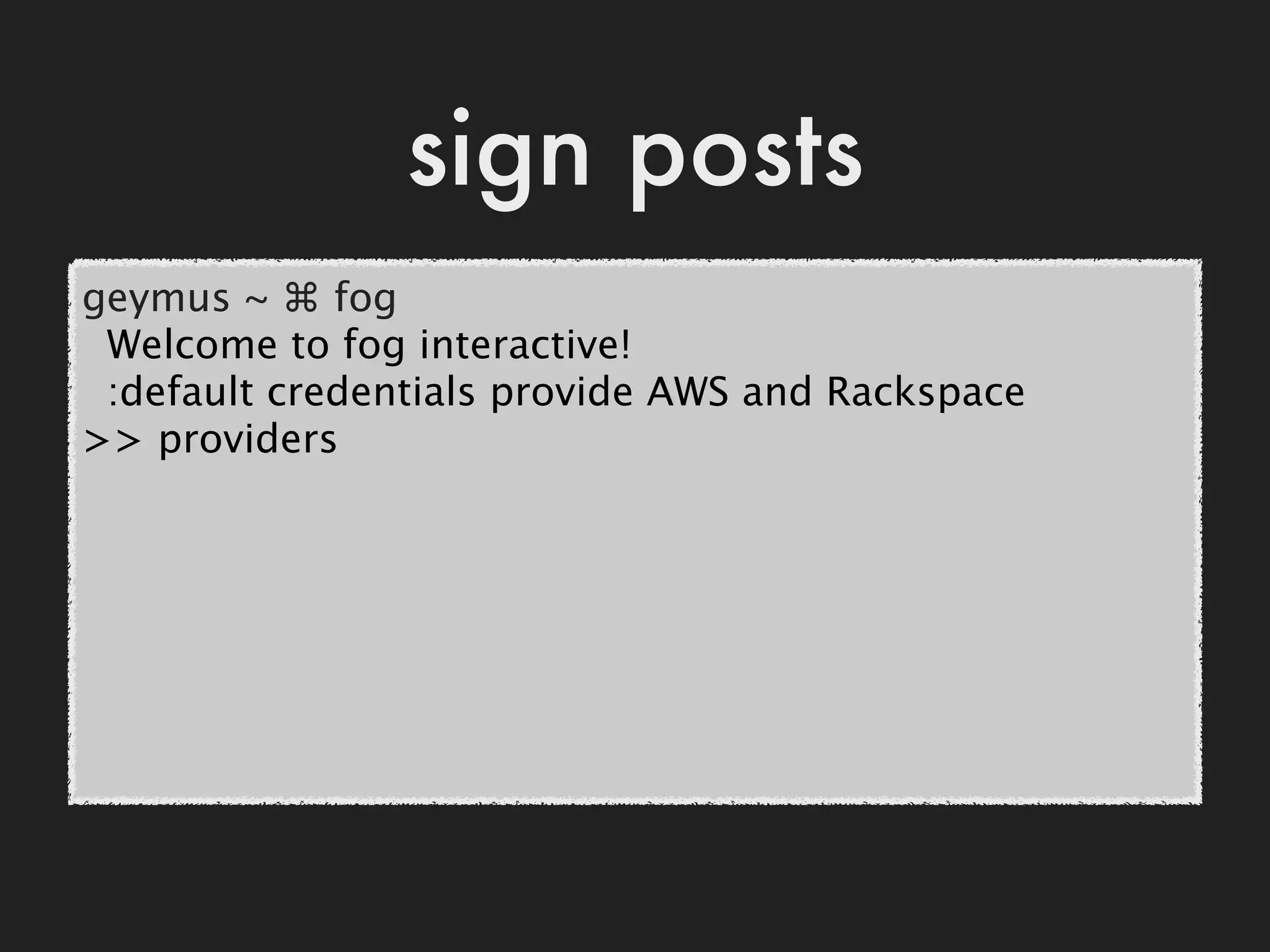
>> providers
sign posts
geymus ~ ⌘ fog
 Welcome to fog interactive!
 :default credentials provide AWS and Rackspace
>> providers
[AWS, Rackspace]
sign posts
geymus ~ ⌘ fog
 Welcome to fog interactive!
 :default credentials provide AWS and Rackspace
>> providers
[AWS, Rackspace]
>> Rackspace.collections
sign posts
geymus ~ ⌘ fog
  Welcome to fog interactive!
  :default credentials provide AWS and Rackspace
>> providers
[AWS, Rackspace]
>> Rackspace.collections
[:directories, :files, :flavors, :images, :servers]
sign posts
geymus ~ ⌘ fog
  Welcome to fog interactive!
  :default credentials provide AWS and Rackspace
>> providers
[AWS, Rackspace]
>> Rackspace.collections
[:directories, :files, :flavors, :images, :servers]
>> Rackspace[:compute]
sign posts
geymus ~ ⌘ fog
  Welcome to fog interactive!
  :default credentials provide AWS and Rackspace
>> providers
[AWS, Rackspace]
>> Rackspace.collections
[:directories, :files, :flavors, :images, :servers]
>> Rackspace[:compute]
#<Fog::Rackspace::Compute ...>
sign posts
geymus ~ ⌘ fog
  Welcome to fog interactive!
  :default credentials provide AWS and Rackspace
>> providers
[AWS, Rackspace]
>> Rackspace.collections
[:directories, :files, :flavors, :images, :servers]
>> Rackspace[:compute]
#<Fog::Rackspace::Compute ...>
>> Rackspace[:compute].requests
sign posts
geymus ~ ⌘ fog
  Welcome to fog interactive!
  :default credentials provide AWS and Rackspace
>> providers
[AWS, Rackspace]
>> Rackspace.collections
[:directories, :files, :flavors, :images, :servers]
>> Rackspace[:compute]
#<Fog::Rackspace::Compute ...>
>> Rackspace[:compute].requests
[:confirm_resized_server, ..., :update_server]
requests?
requests?
>> Rackspace[:compute].list_servers
requests?
>> Rackspace[:compute].list_servers
#<Excon::Response:0x________
requests?
>> Rackspace[:compute].list_servers
#<Excon::Response:0x________
@body = {
  "servers" => []
},
requests?
>> Rackspace[:compute].list_servers
#<Excon::Response:0x________
@body = {
  "servers" => []
},
@headers = {
  "X-PURGE-KEY"=>"/______/servers",
  ...,
  "Connection"=>"keep-alive"
},
requests?
>> Rackspace[:compute].list_servers
#<Excon::Response:0x________
@body = {
  "servers" => []
},
@headers = {
  "X-PURGE-KEY"=>"/______/servers",
  ...,
  "Connection"=>"keep-alive"
},
@status=200>
sanity check
sanity check
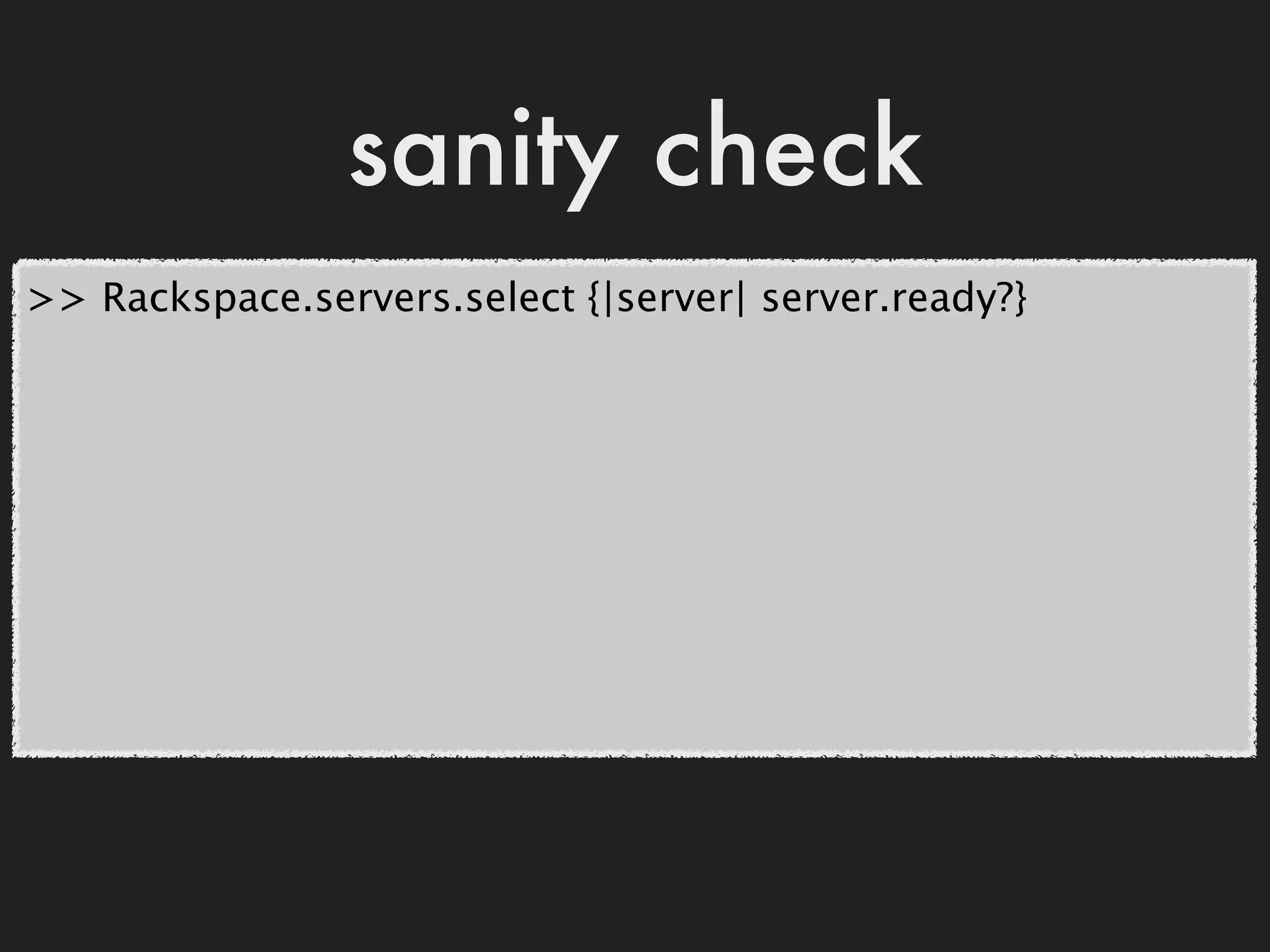
>> Rackspace.servers.select {|server| server.ready?}
sanity check
>> Rackspace.servers.select {|server| server.ready?}
 <Fog::Rackspace::Compute::Servers
  filters={}
  []
 >
sanity check
>> Rackspace.servers.select {|server| server.ready?}
 <Fog::Rackspace::Compute::Servers
  filters={}
  []
 >
>> AWS.servers.select {|server| server.ready?}
sanity check
>> Rackspace.servers.select {|server| server.ready?}
 <Fog::Rackspace::Compute::Servers
  filters={}
  []
 >
>> AWS.servers.select {|server| server.ready?}
 <Fog::AWS::Compute::Servers
  []
 >
sanity check
>> Rackspace.servers.select {|server| server.ready?}
 <Fog::Rackspace::Compute::Servers
  filters={}
  []
 >
>> AWS.servers.select {|server| server.ready?}
 <Fog::AWS::Compute::Servers
  []
 >
>> exit
finding images
finding images
>> Rackspace.images.table([:id, :name])
finding images
>> Rackspace.images.table([:id, :name])
 +---------
+------------------------------------------+
 | id  | name                         |
 +---------
+------------------------------------------+
 | 49   | Ubuntu 10.04 LTS (lucid)      |
 +---------
+------------------------------------------+
 ...
finding images
>> Rackspace.images.table([:id, :name])
 +---------
+------------------------------------------+
 | id  | name                          |
 +---------
+------------------------------------------+
 | 49   | Ubuntu 10.04 LTS (lucid)        |
 +---------
+------------------------------------------+
 ...
>> AWS.images # I use alestic.com listing
finding images
>> Rackspace.images.table([:id, :name])
  +---------
+------------------------------------------+
  | id  | name                         |
  +---------
+------------------------------------------+
  | 49   | Ubuntu 10.04 LTS (lucid)       |
  +---------
+------------------------------------------+
  ...
>> AWS.images # I use alestic.com listing
...
exploring...
exploring...
  It takes   forever!
exploring...
    It takes   forever!
  It’s so   expensive!
exploring...
        It takes   forever!
      It’s so   expensive!
A warm welcome for   Fog.mock!
Mocks!
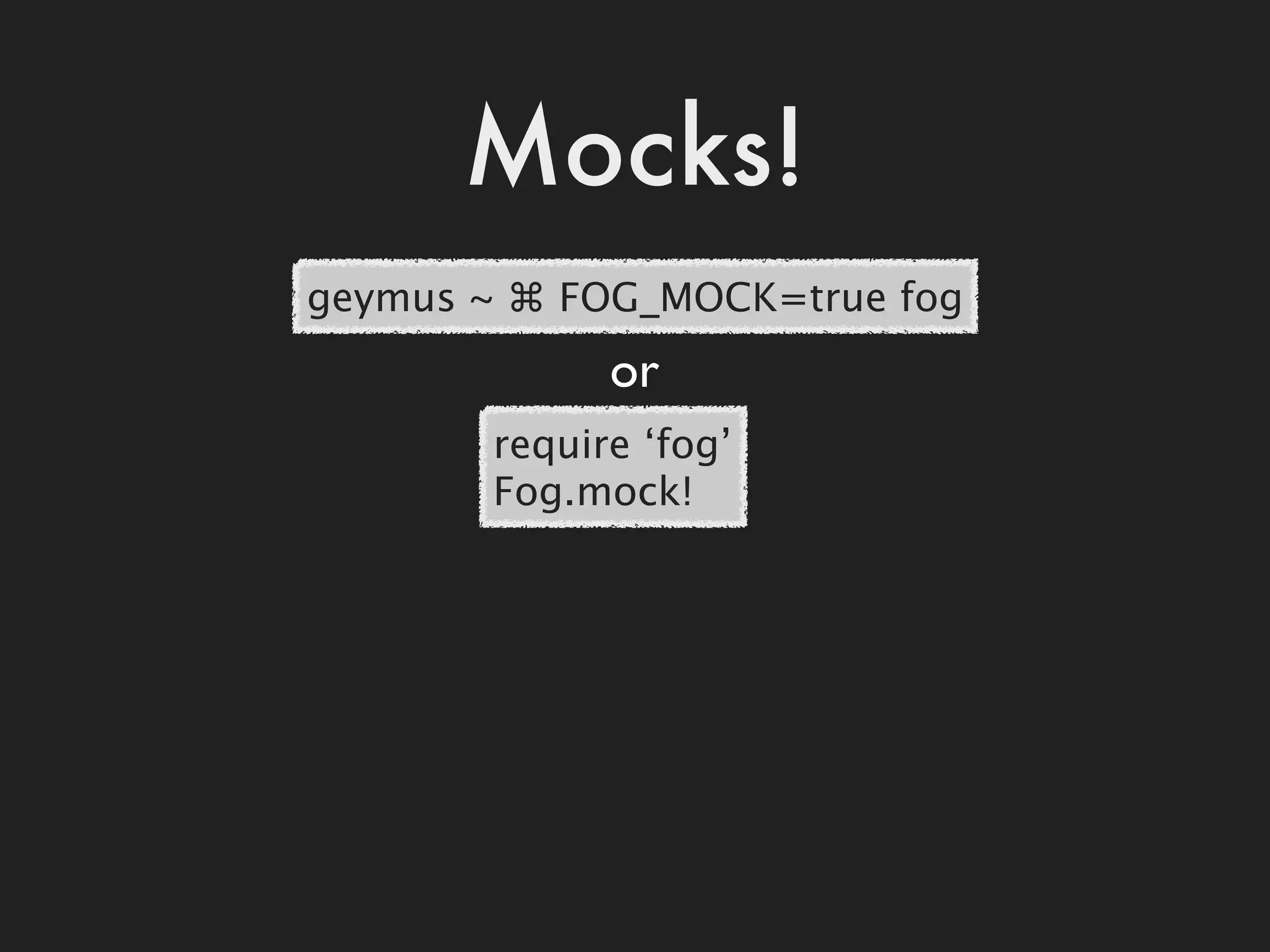
geymus ~ ⌘ FOG_MOCK=true fog
             or
       require ‘fog’
       Fog.mock!
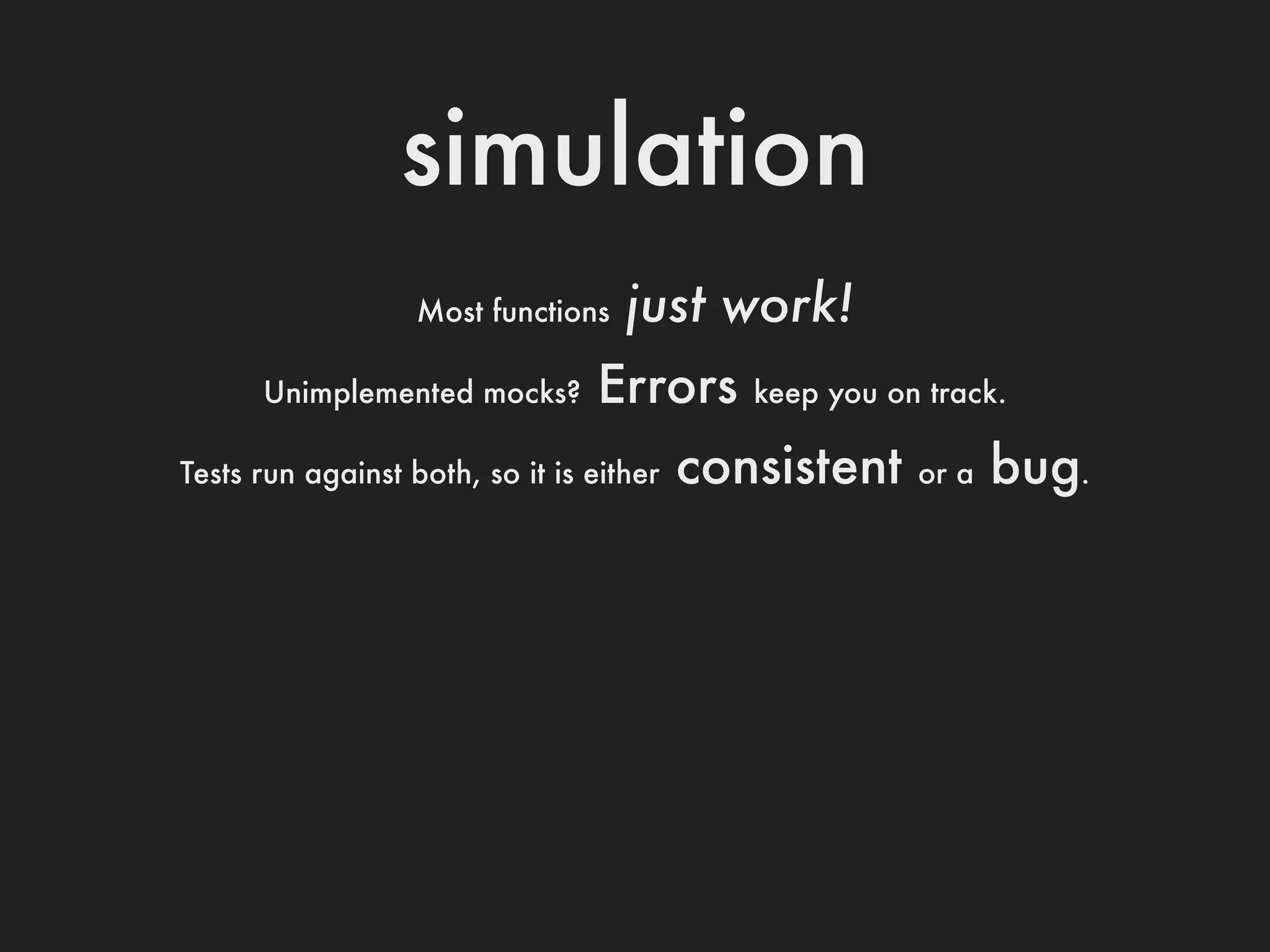
simulation
simulation
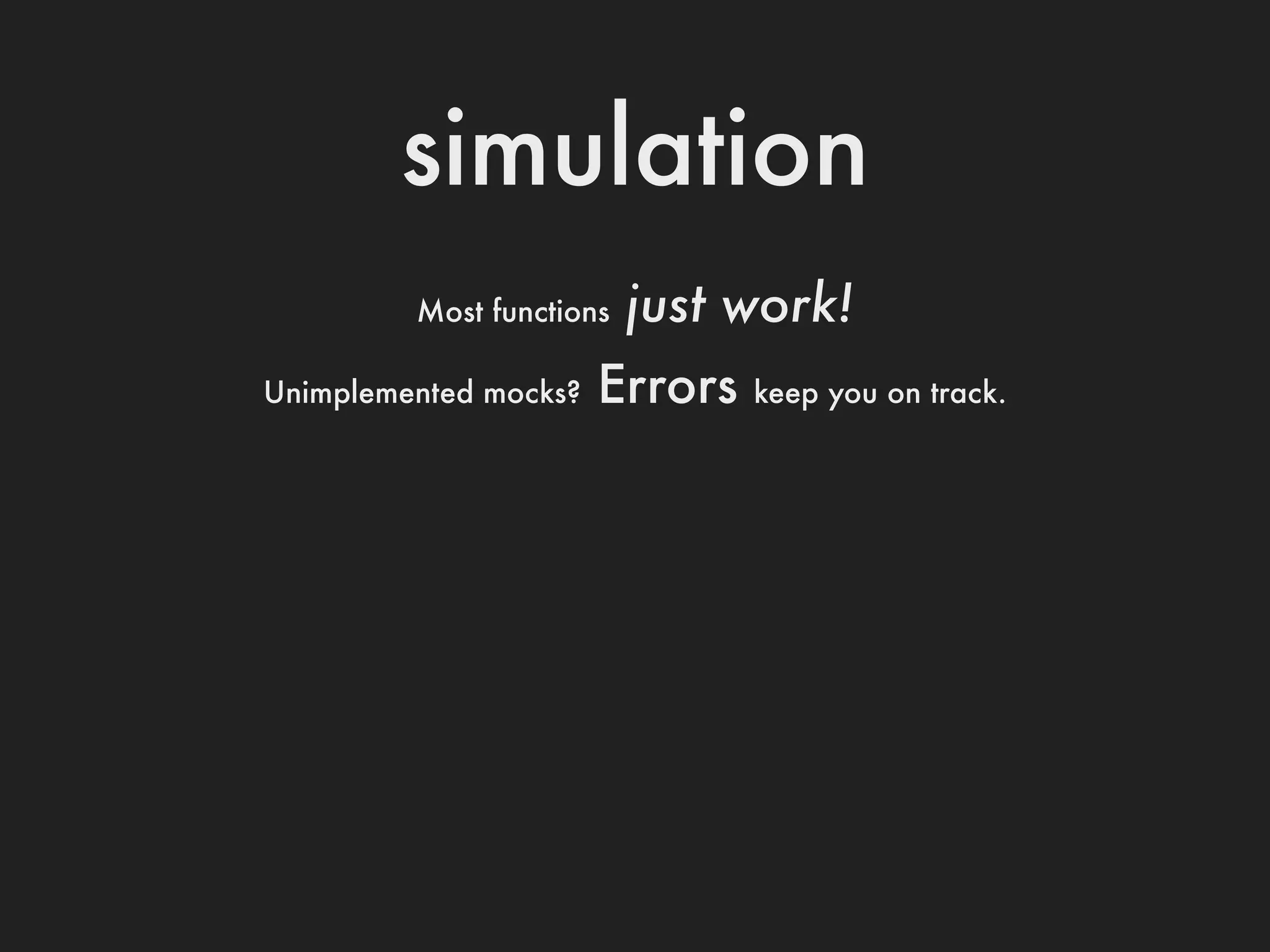
Most functions   just work!
simulation
         Most functions   just work!
Unimplemented mocks?   Errors   keep you on track.
simulation
                   Most functions   just work!
      Unimplemented mocks?       Errors      keep you on track.

Tests run against both, so it is either   consistent    or a   bug.
Back to Business
  I have a bunch of data   now what?
Back to Business
  I have a bunch of data   now what?
   storage -       aggregating cloud data
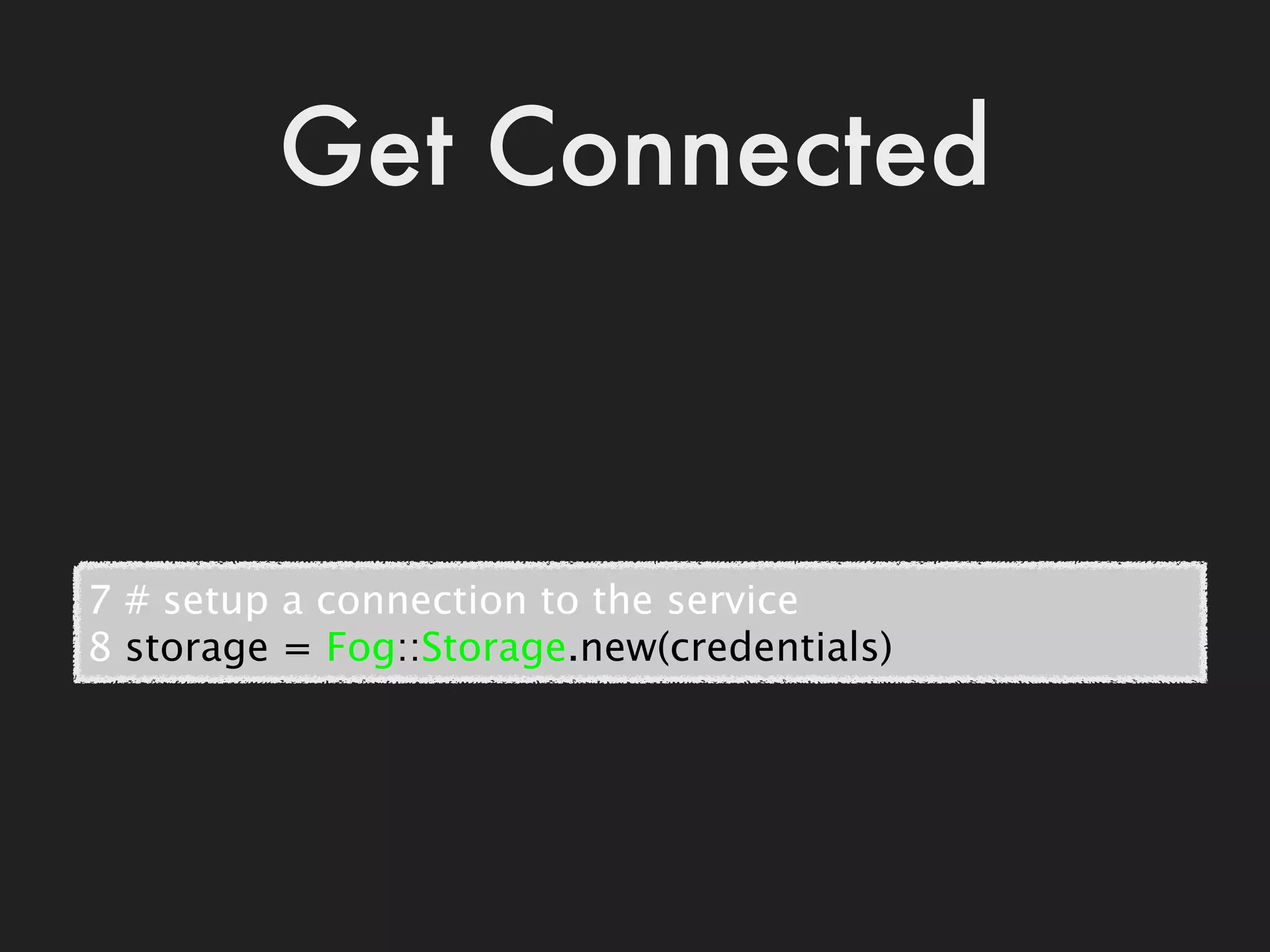
Get Connected


7 # setup a connection to the service
8 storage = Fog::Storage.new(credentials)
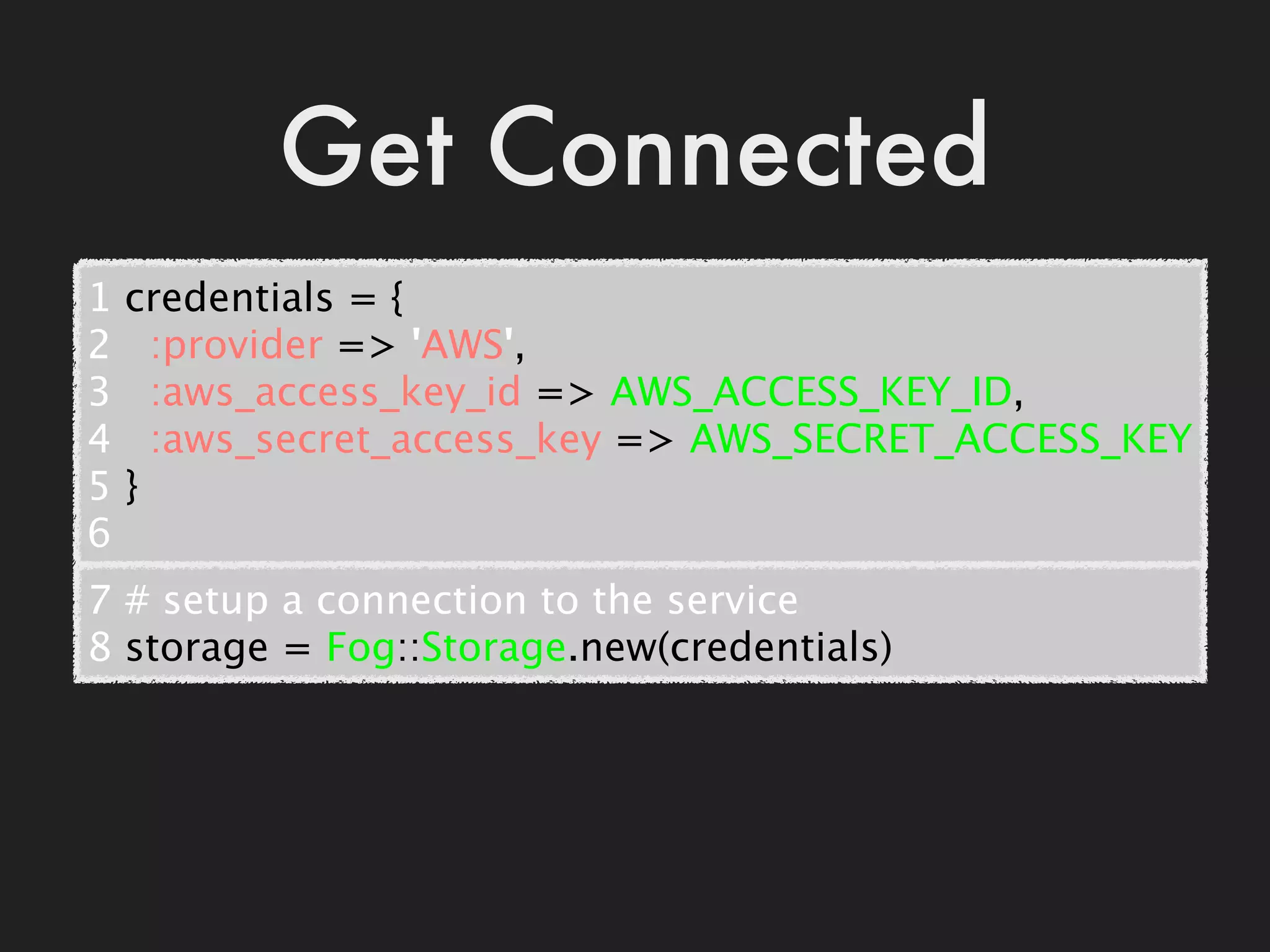
Get Connected
1   credentials = {
2     :provider => 'AWS',
3     :aws_access_key_id => AWS_ACCESS_KEY_ID,
4     :aws_secret_access_key => AWS_SECRET_ACCESS_KEY
5   }
6
7 # setup a connection to the service
8 storage = Fog::Storage.new(credentials)
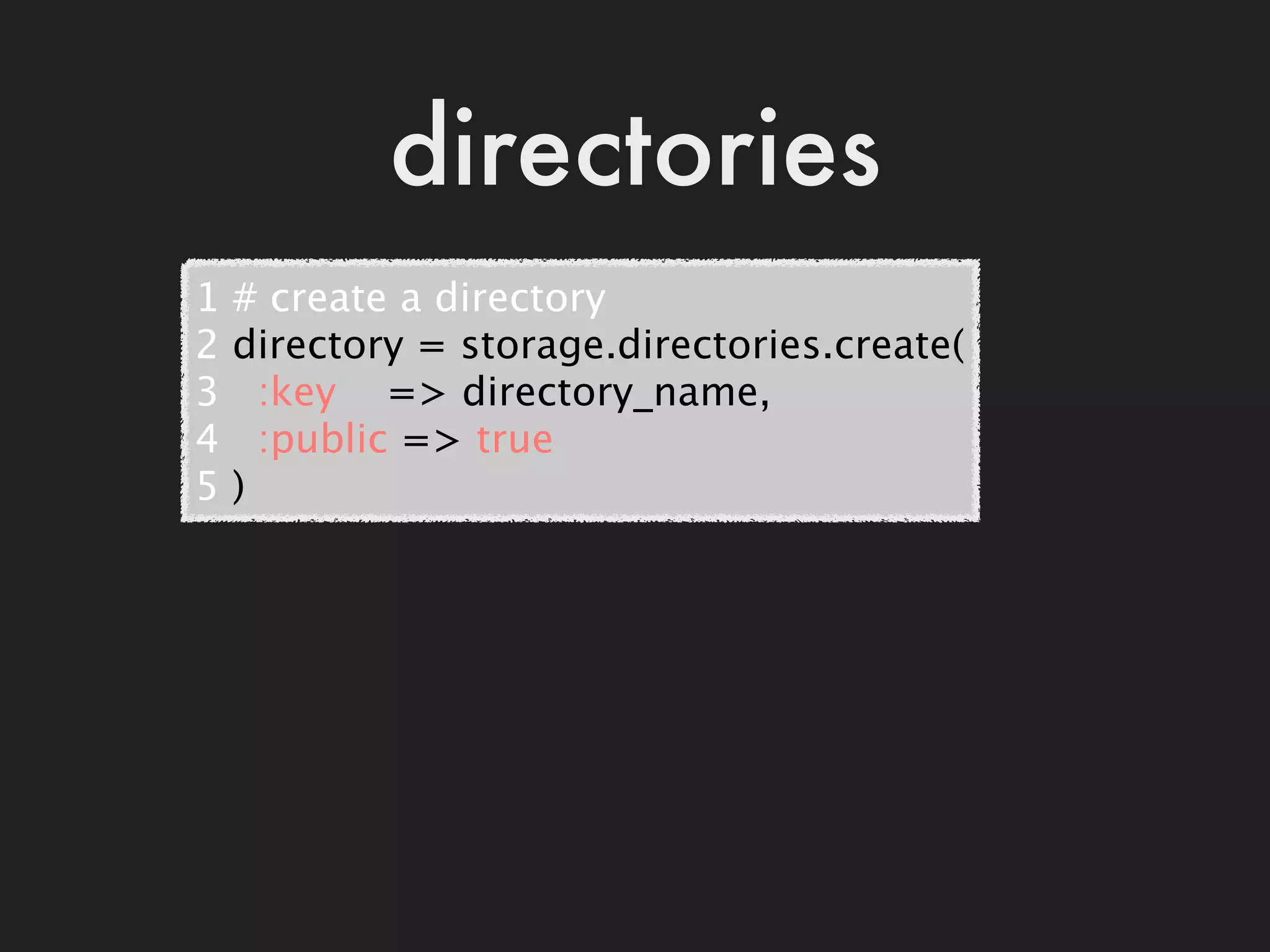
directories
1   # create a directory
2   directory = storage.directories.create(
3     :key    => directory_name,
4     :public => true
5   )
files
files
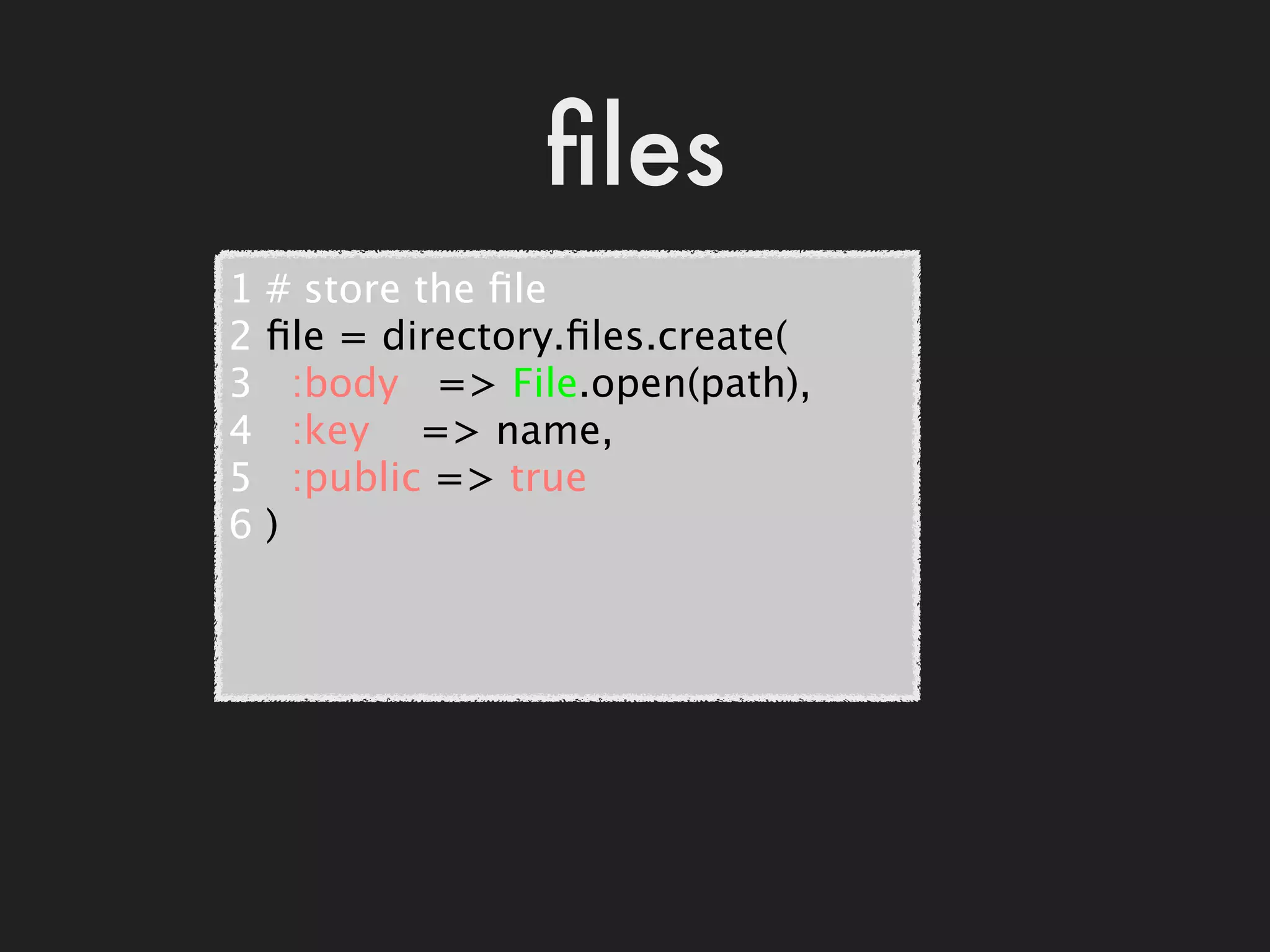
1   # store the file
2   file = directory.files.create(
3     :body   => File.open(path),
4     :key    => name,
5     :public => true
6   )
files
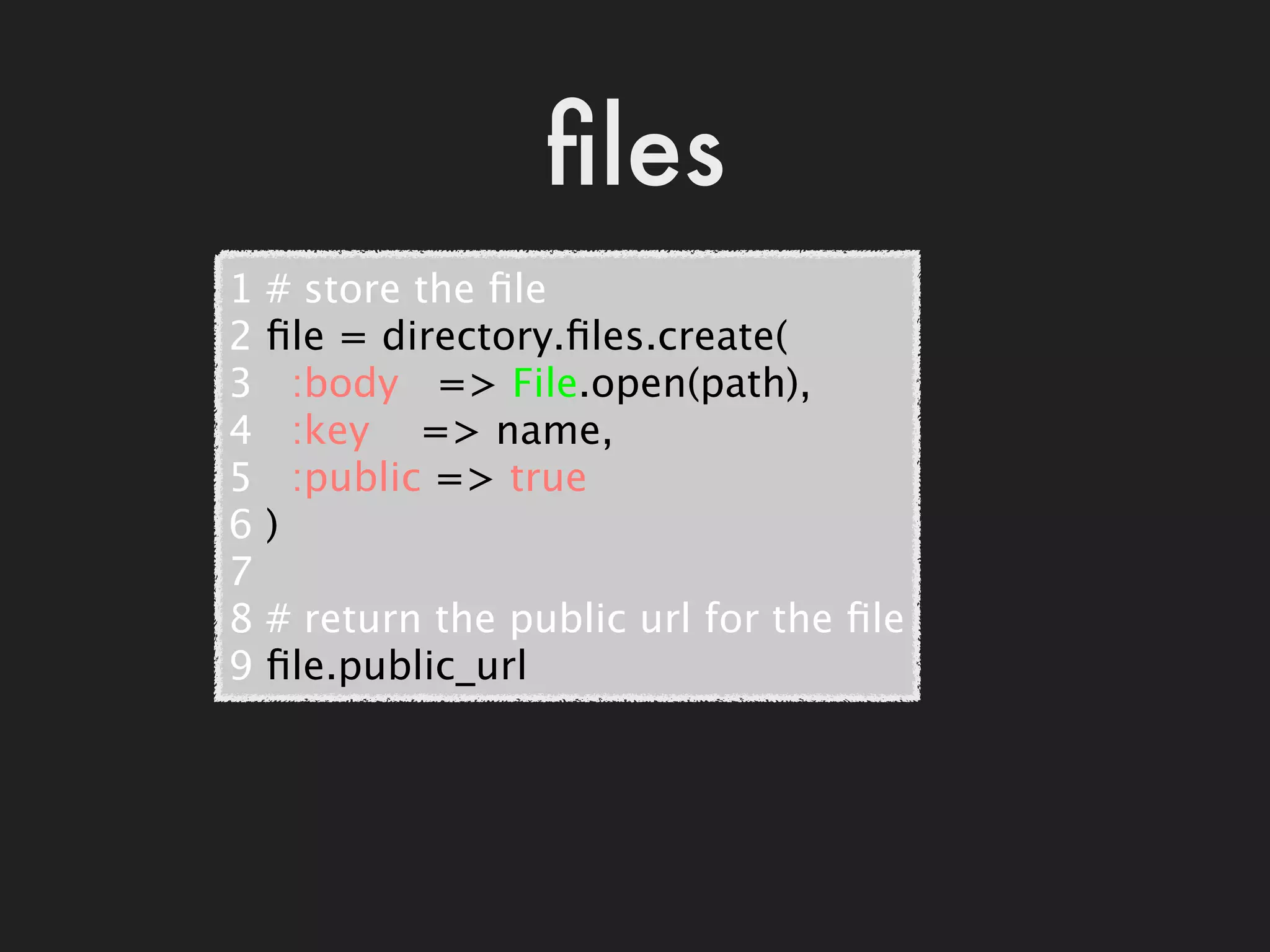
1   # store the file
2   file = directory.files.create(
3     :body   => File.open(path),
4     :key    => name,
5     :public => true
6   )
7
8   # return the public url for the file
9   file.public_url
geostorage
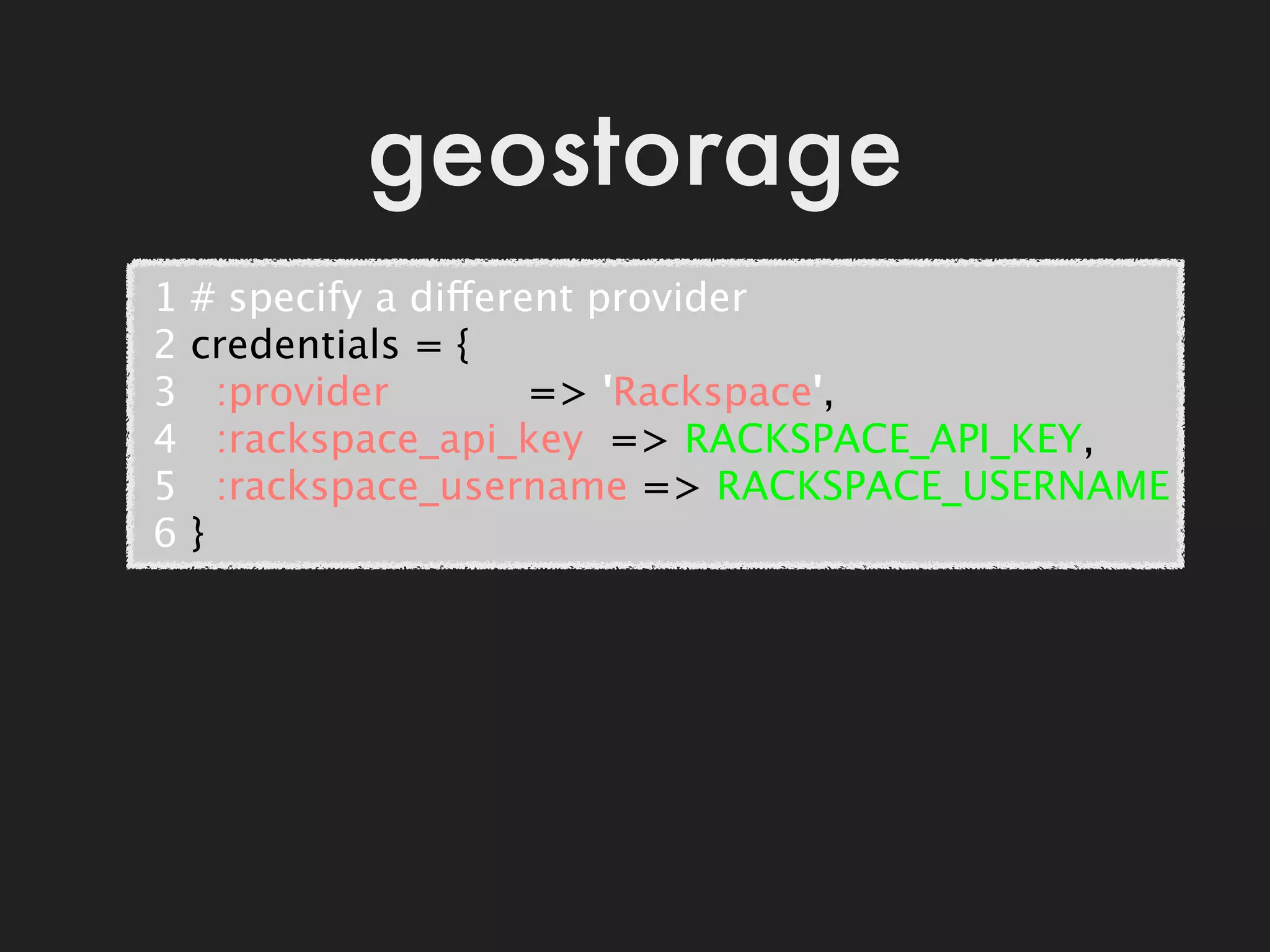
 1   # specify a different provider
 2   credentials = {
 3     :provider           => 'Rackspace',
 4     :rackspace_api_key  => RACKSPACE_API_KEY,
 5     :rackspace_username => RACKSPACE_USERNAME
 6   }
cleanup
cleanup
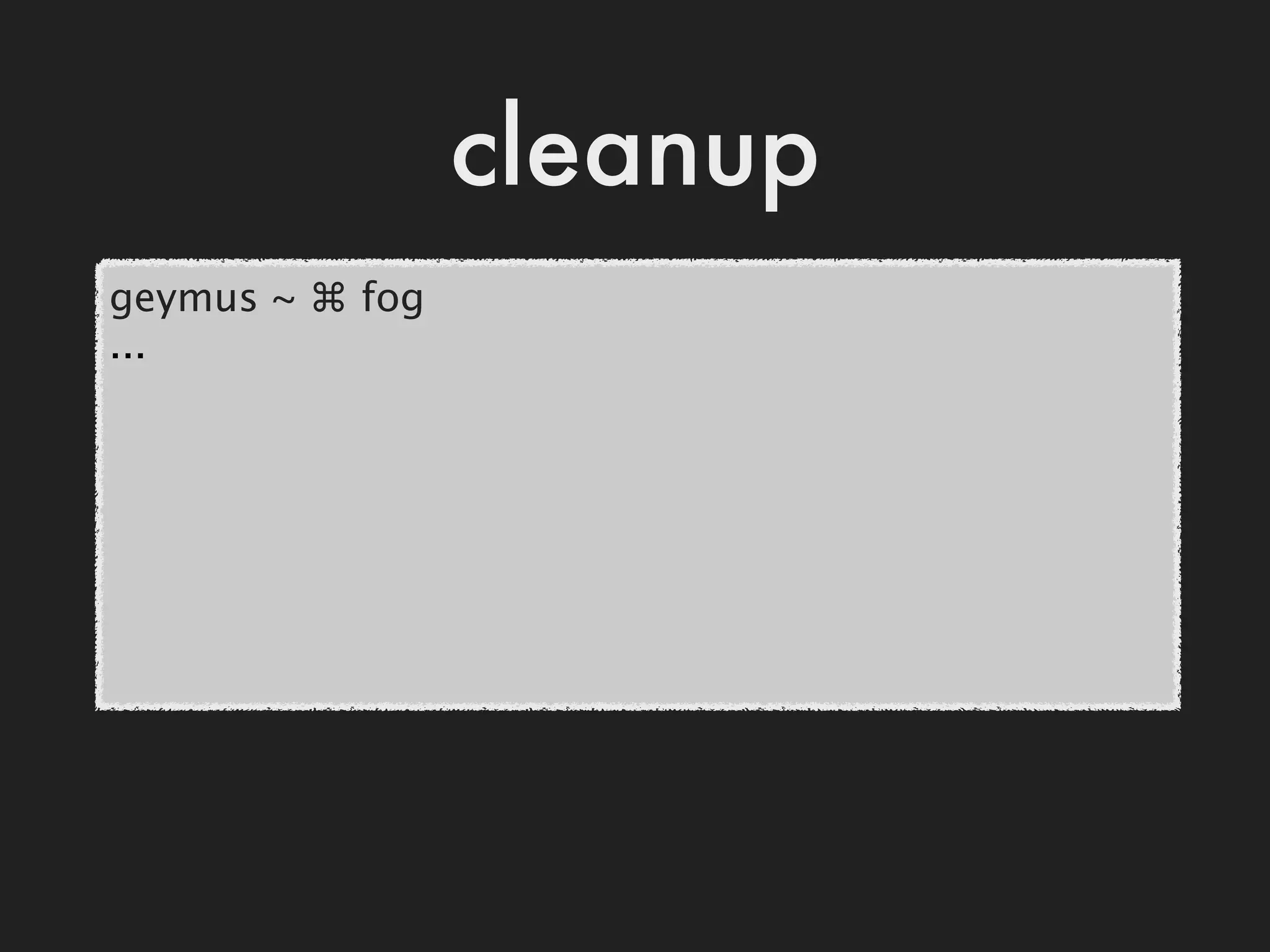
geymus ~ ⌘ fog
...
cleanup
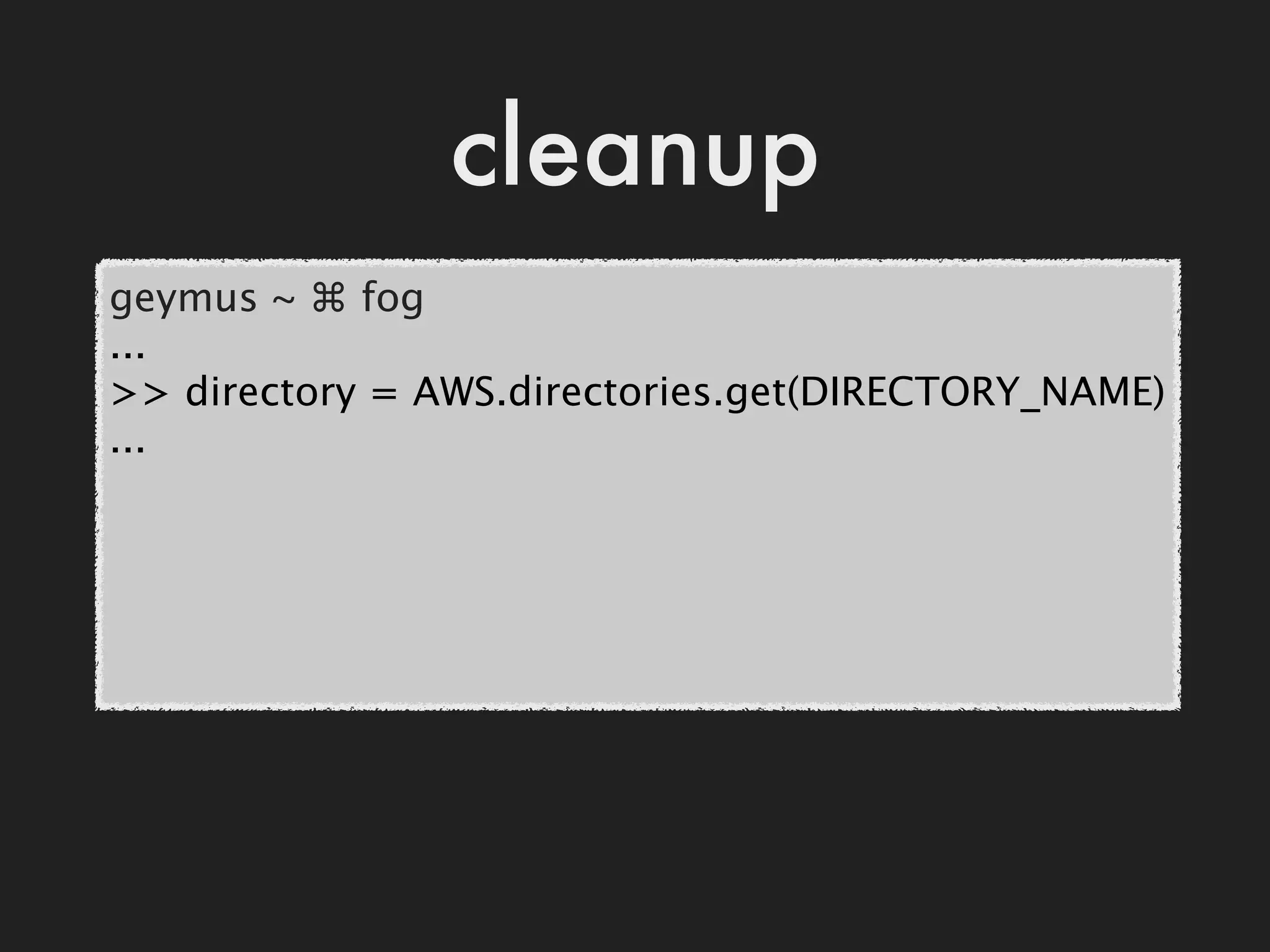
geymus ~ ⌘ fog
...
>> directory = AWS.directories.get(DIRECTORY_NAME)
...
cleanup
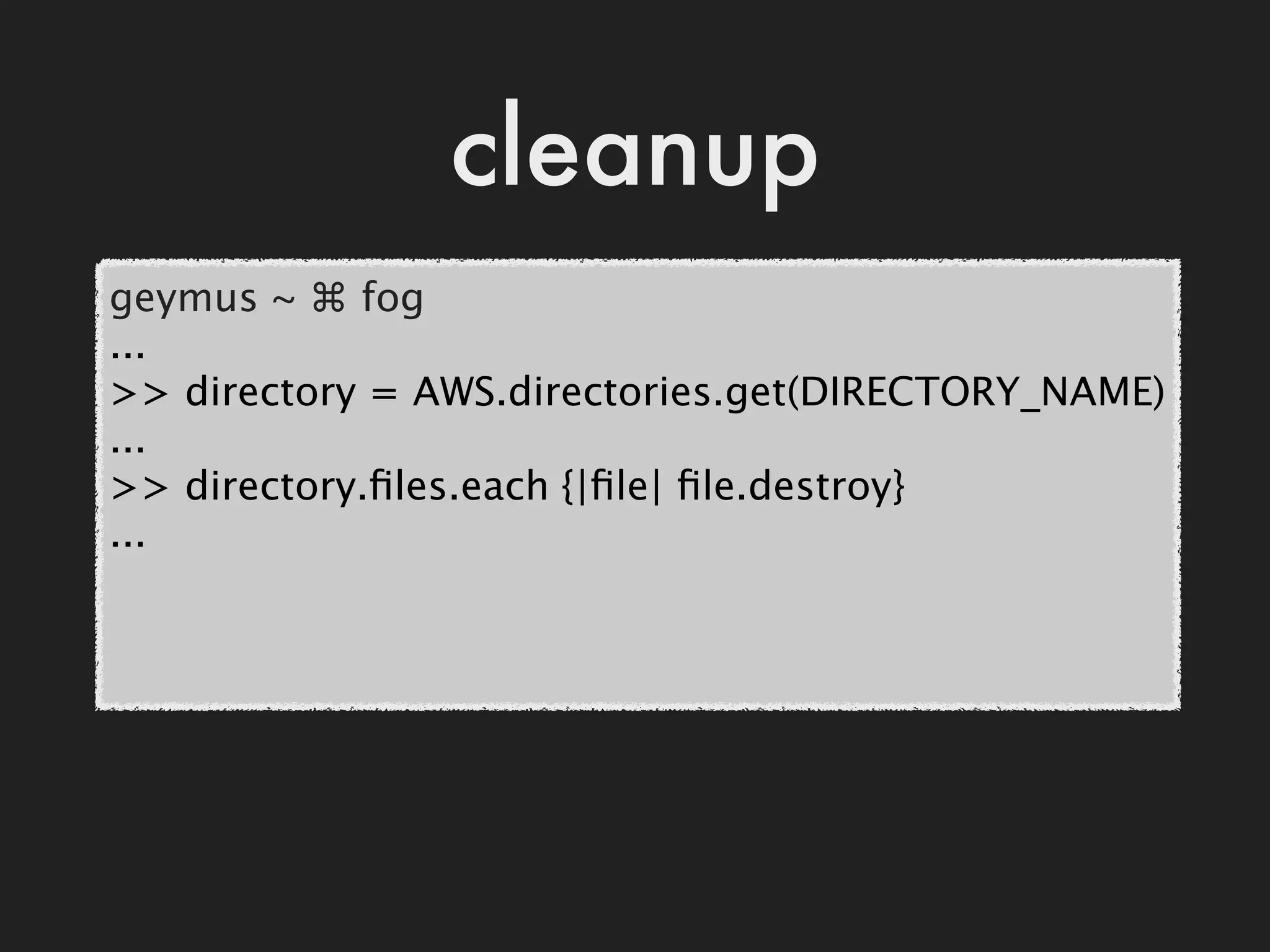
geymus ~ ⌘ fog
...
>> directory = AWS.directories.get(DIRECTORY_NAME)
...
>> directory.files.each {|file| file.destroy}
...
cleanup
geymus ~ ⌘ fog
...
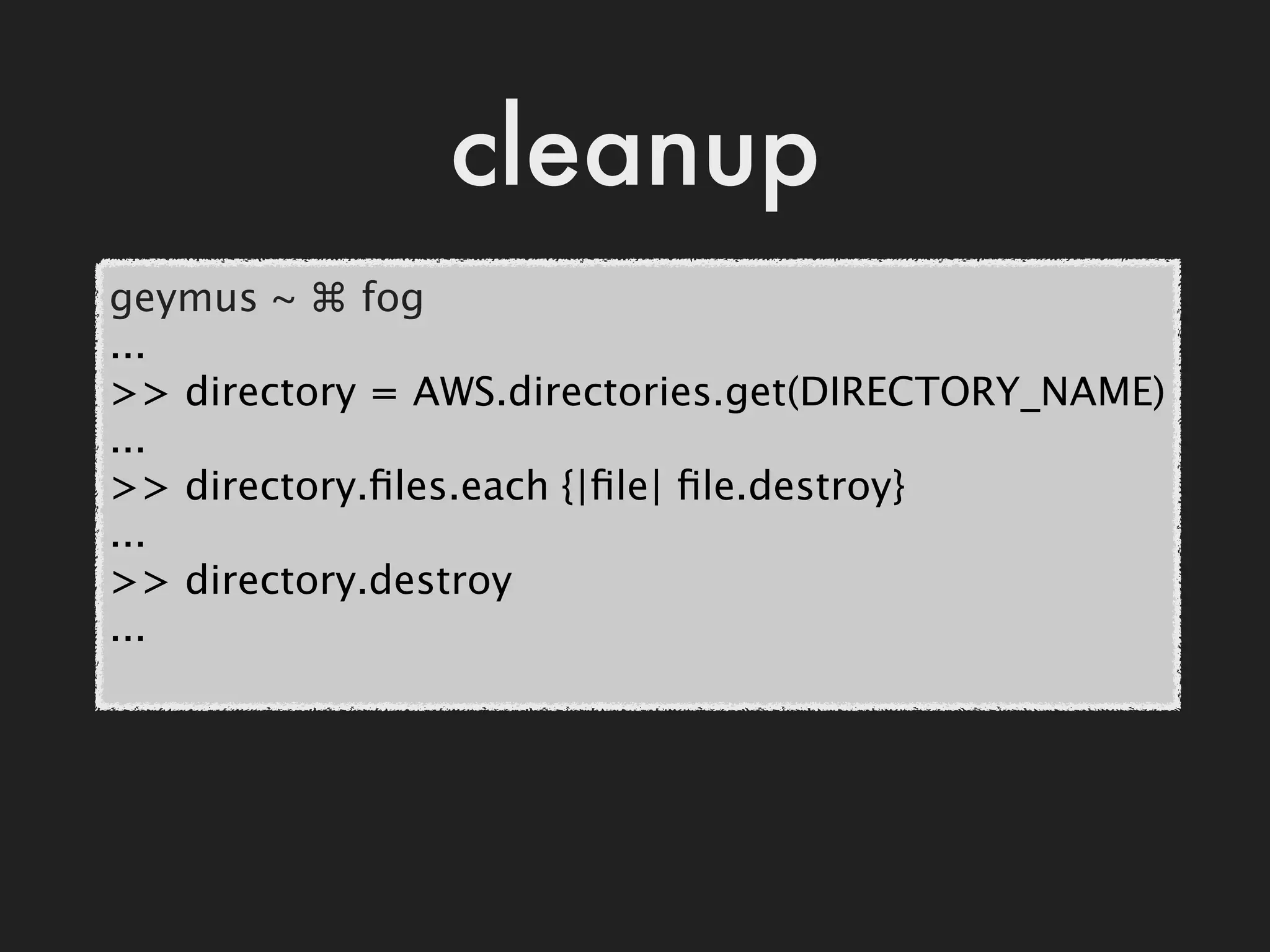
>> directory = AWS.directories.get(DIRECTORY_NAME)
...
>> directory.files.each {|file| file.destroy}
...
>> directory.destroy
...
cleanup
geymus ~ ⌘ fog
...
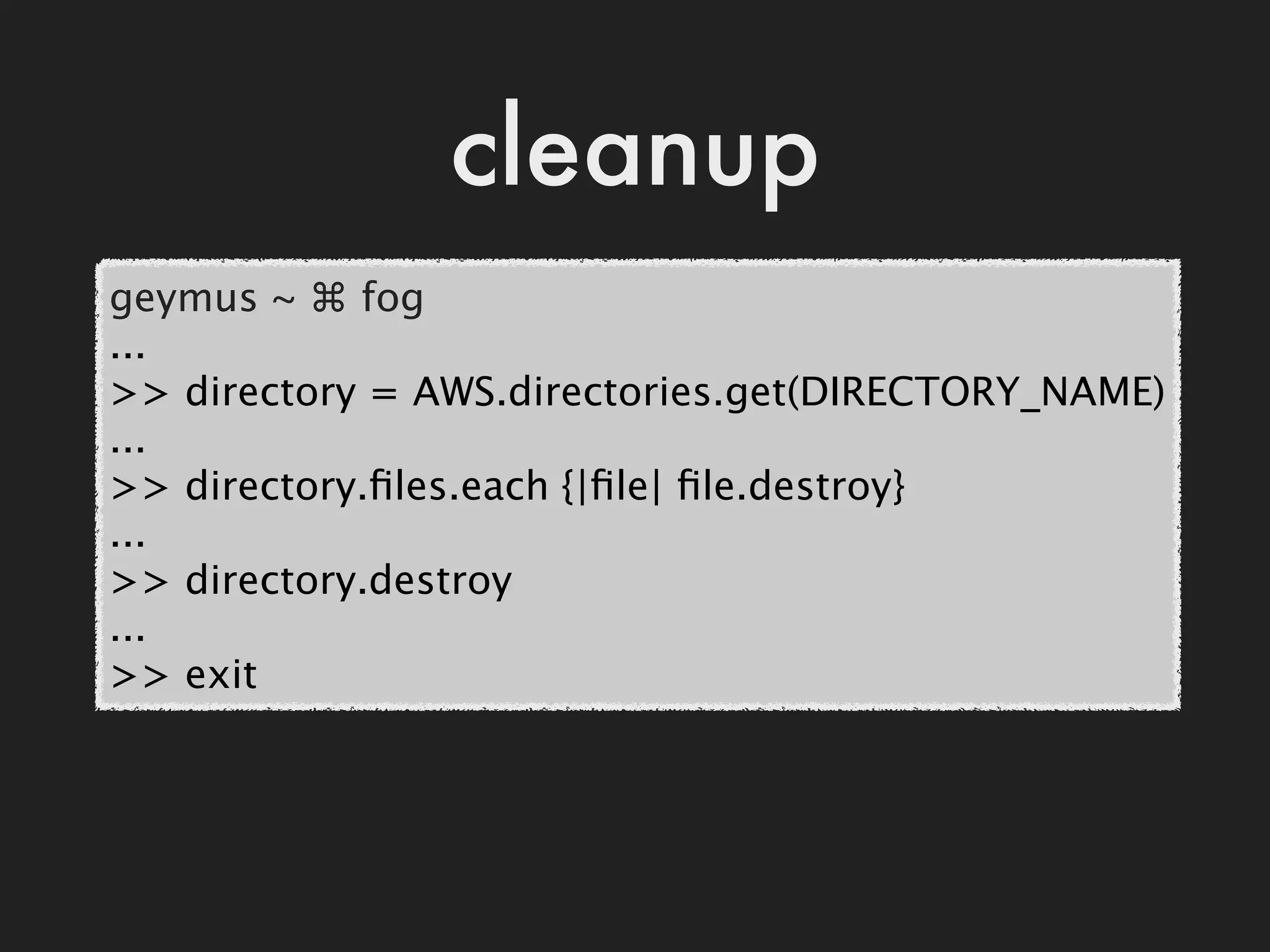
>> directory = AWS.directories.get(DIRECTORY_NAME)
...
>> directory.files.each {|file| file.destroy}
...
>> directory.destroy
...
>> exit
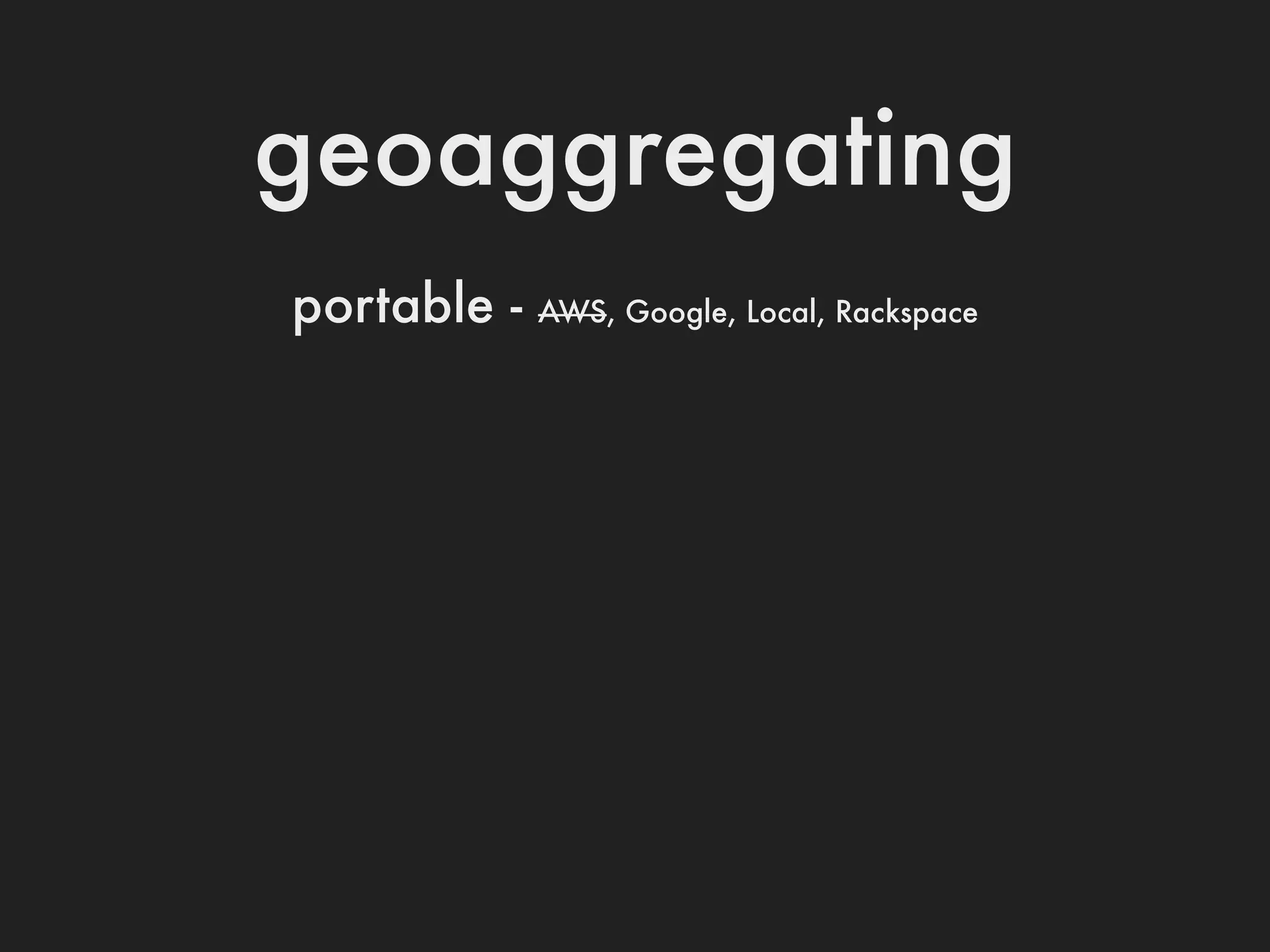
geoaggregating
portable -   AWS, Google, Local, Rackspace
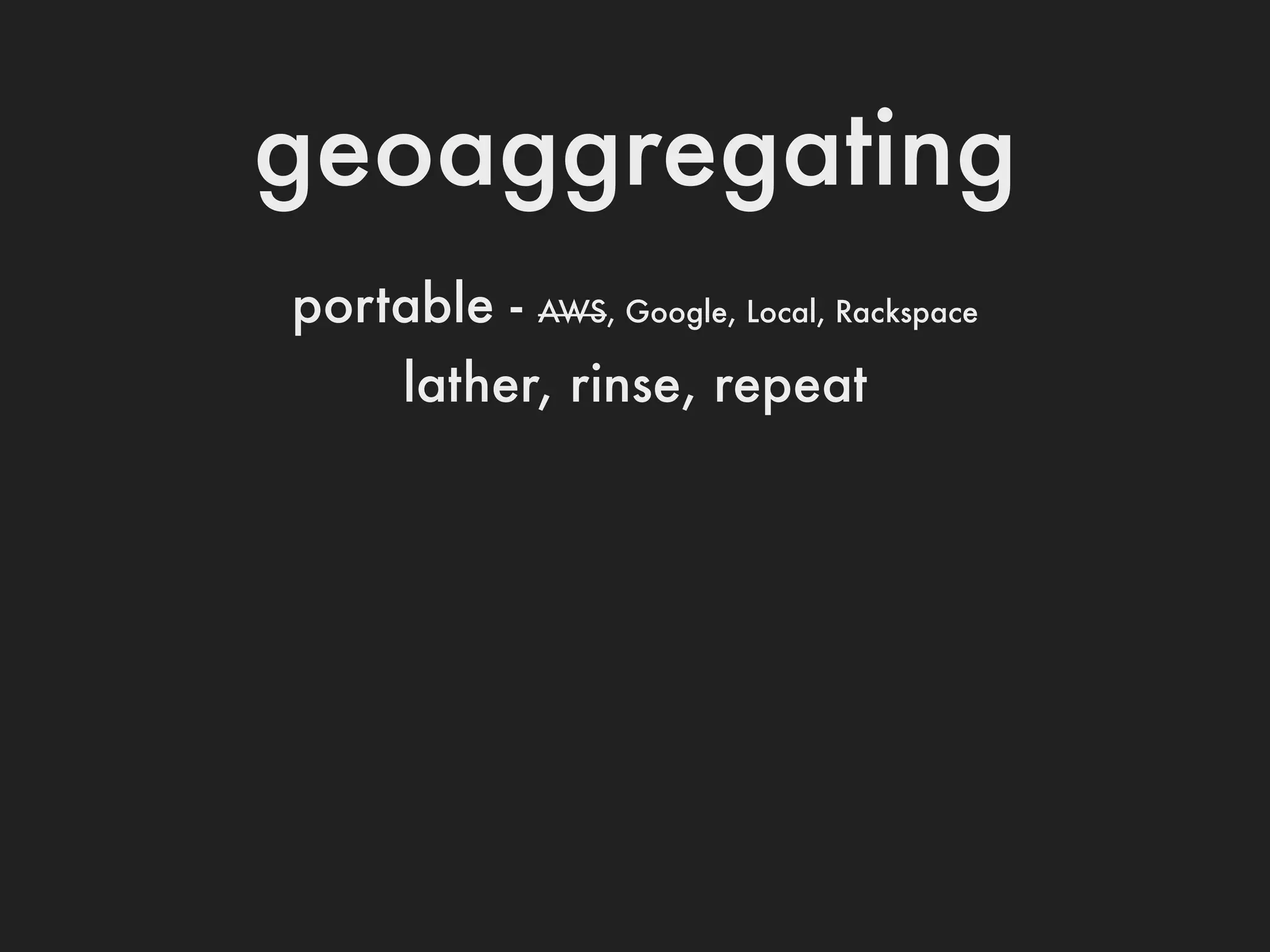
geoaggregating
portable -   AWS, Google, Local, Rackspace

    lather, rinse, repeat
Phase 3: Profit
I’ve got the data, but how do I   freemium?
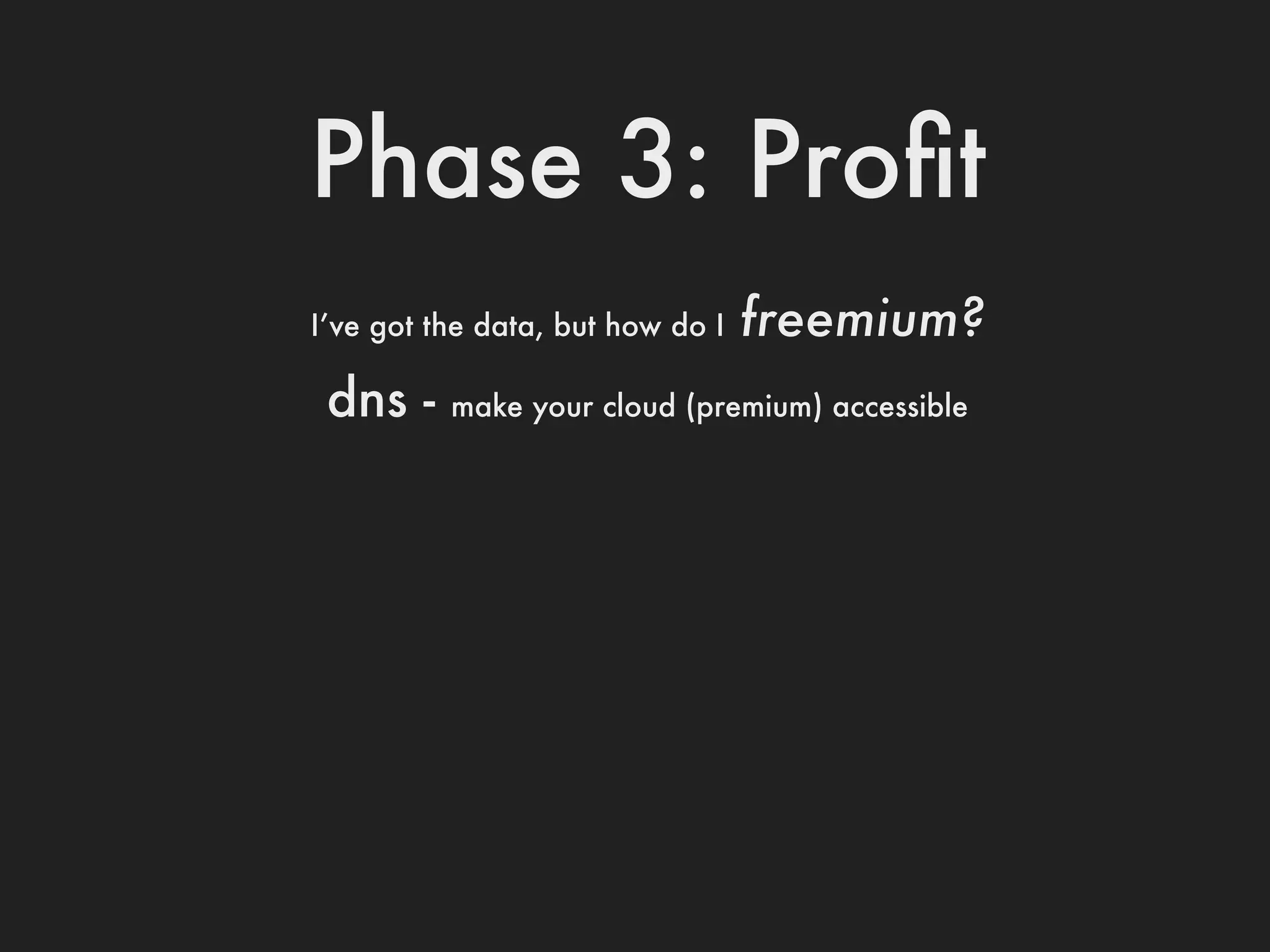
Phase 3: Profit
I’ve got the data, but how do I   freemium?
 dns -    make your cloud (premium) accessible
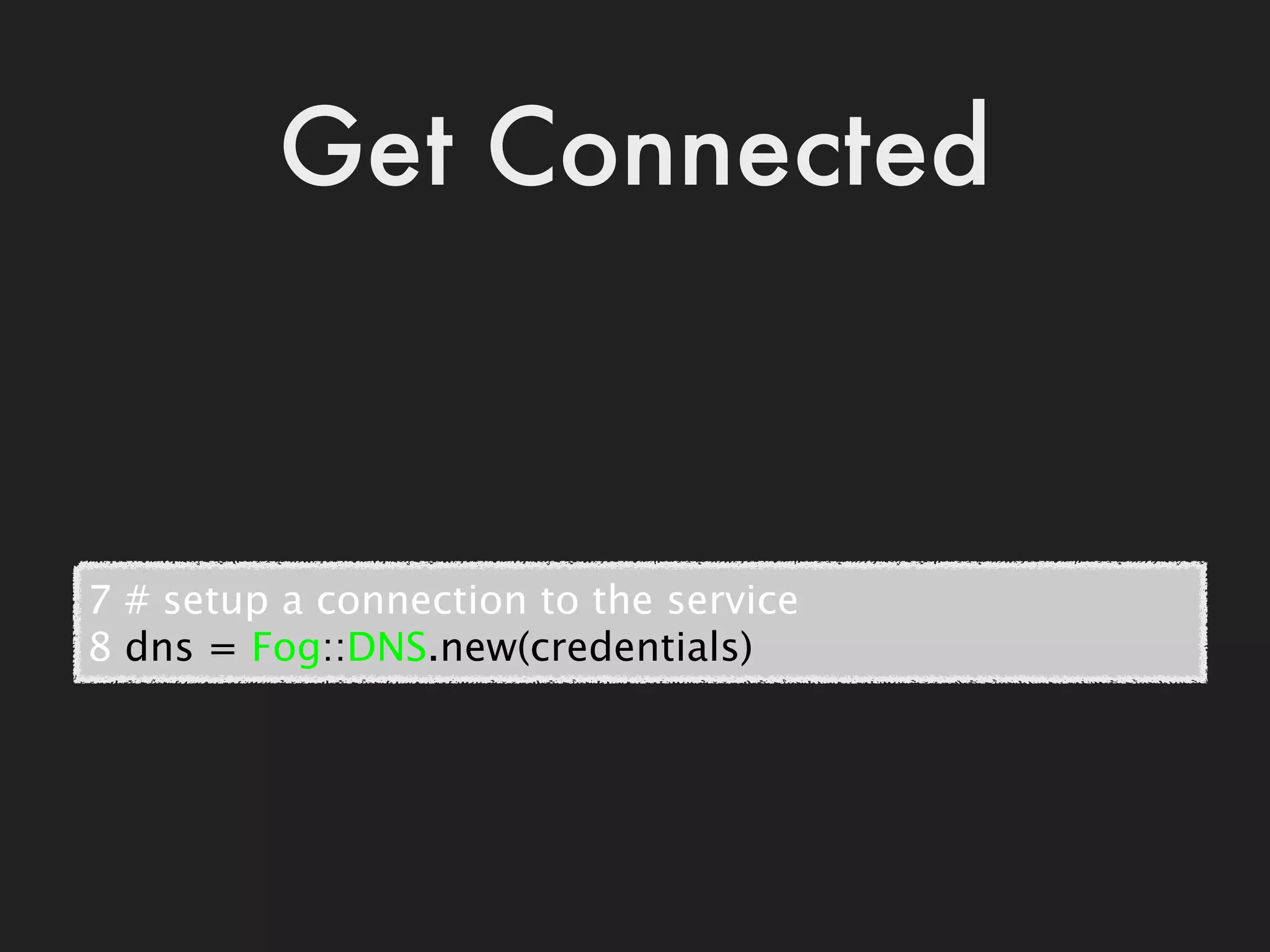
Get Connected


7 # setup a connection to the service
8 dns = Fog::DNS.new(credentials)
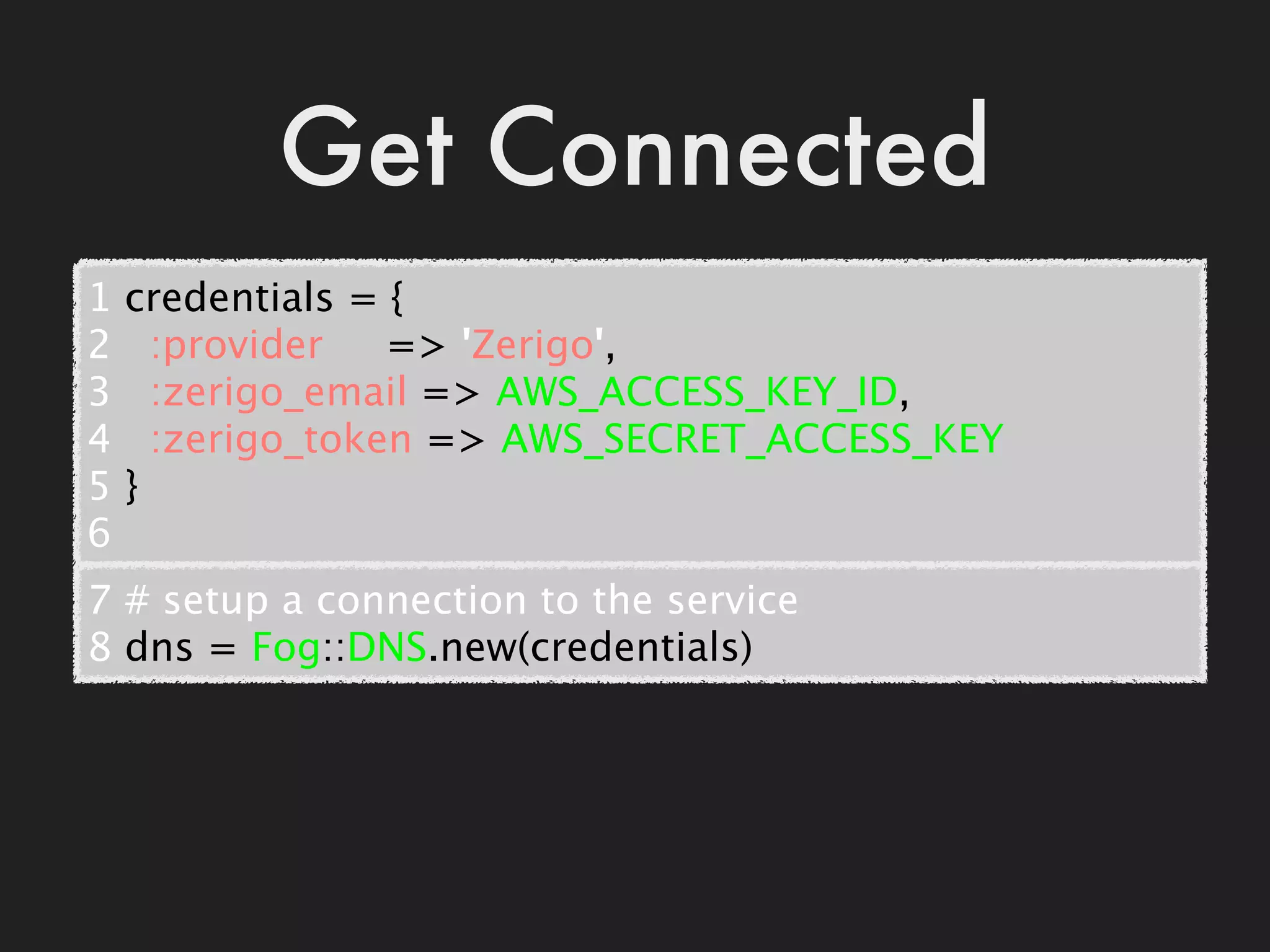
Get Connected
1   credentials = {
2     :provider  => 'Zerigo',
3     :zerigo_email => AWS_ACCESS_KEY_ID,
4     :zerigo_token => AWS_SECRET_ACCESS_KEY
5   }
6
7 # setup a connection to the service
8 dns = Fog::DNS.new(credentials)
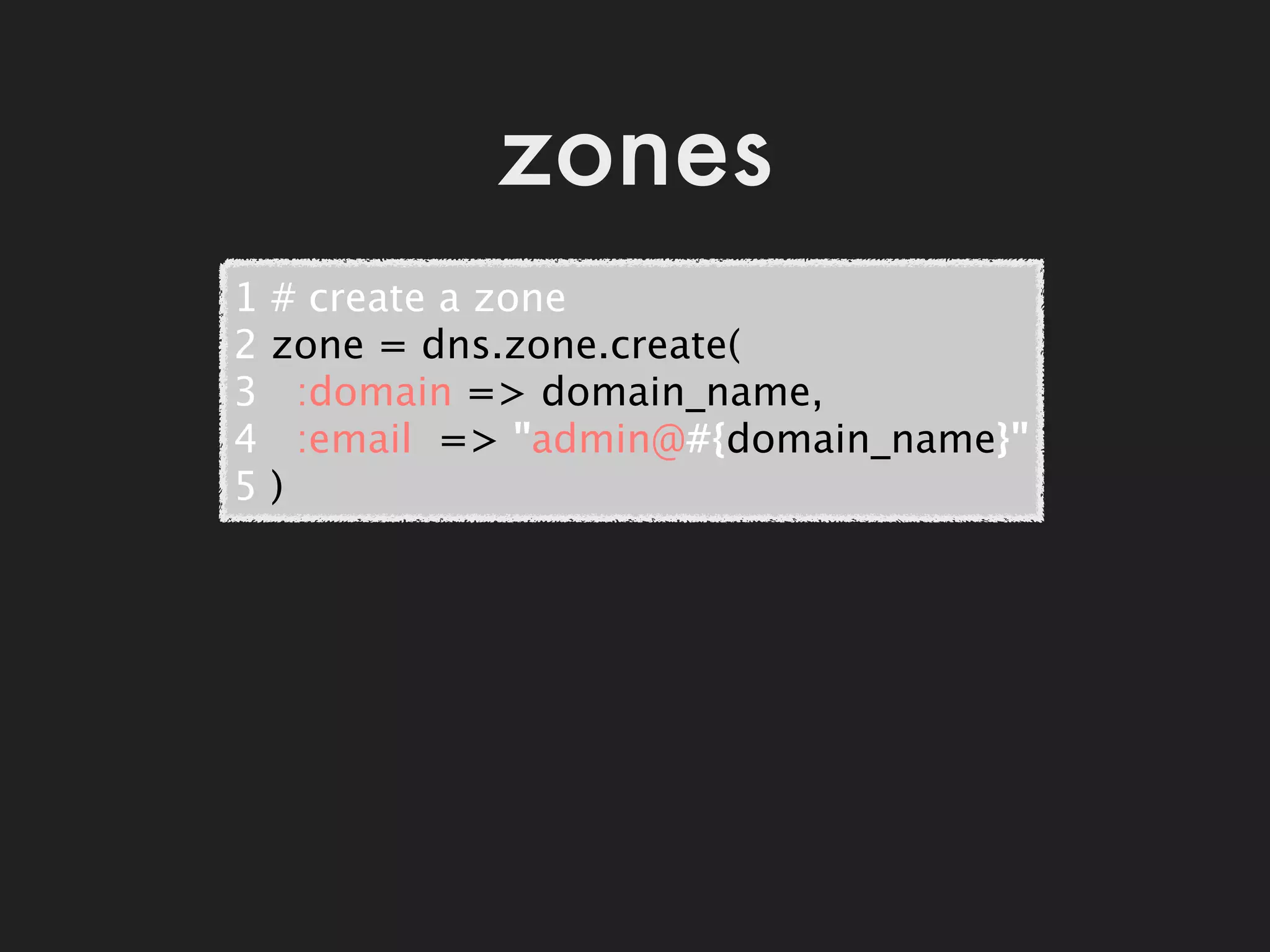
zones
1   # create a zone
2   zone = dns.zone.create(
3     :domain => domain_name,
4     :email  => "admin@#{domain_name}"
5   )
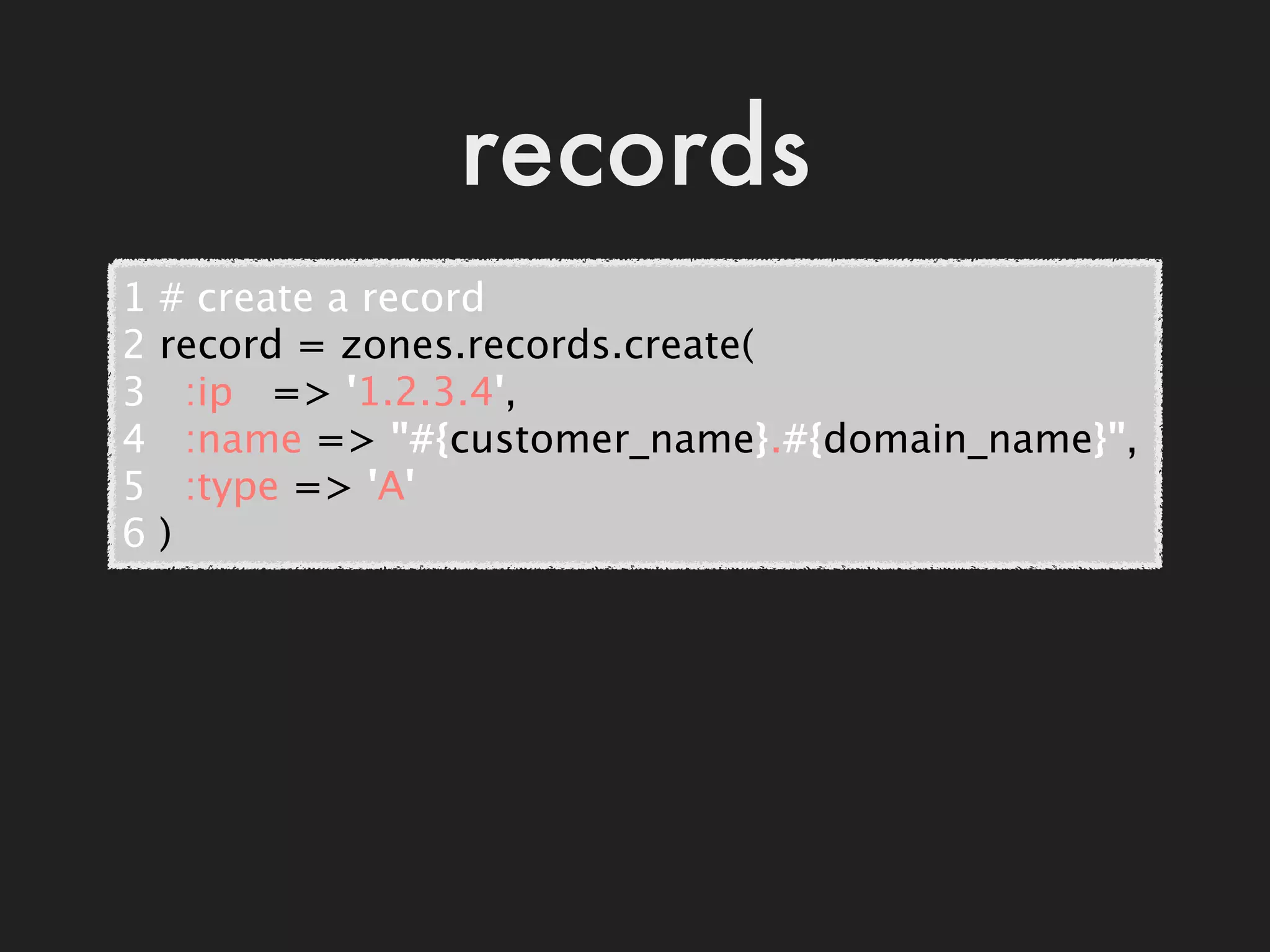
records
1   # create a record
2   record = zones.records.create(
3     :ip   => '1.2.3.4',
4     :name => "#{customer_name}.#{domain_name}",
5     :type => 'A'
6   )
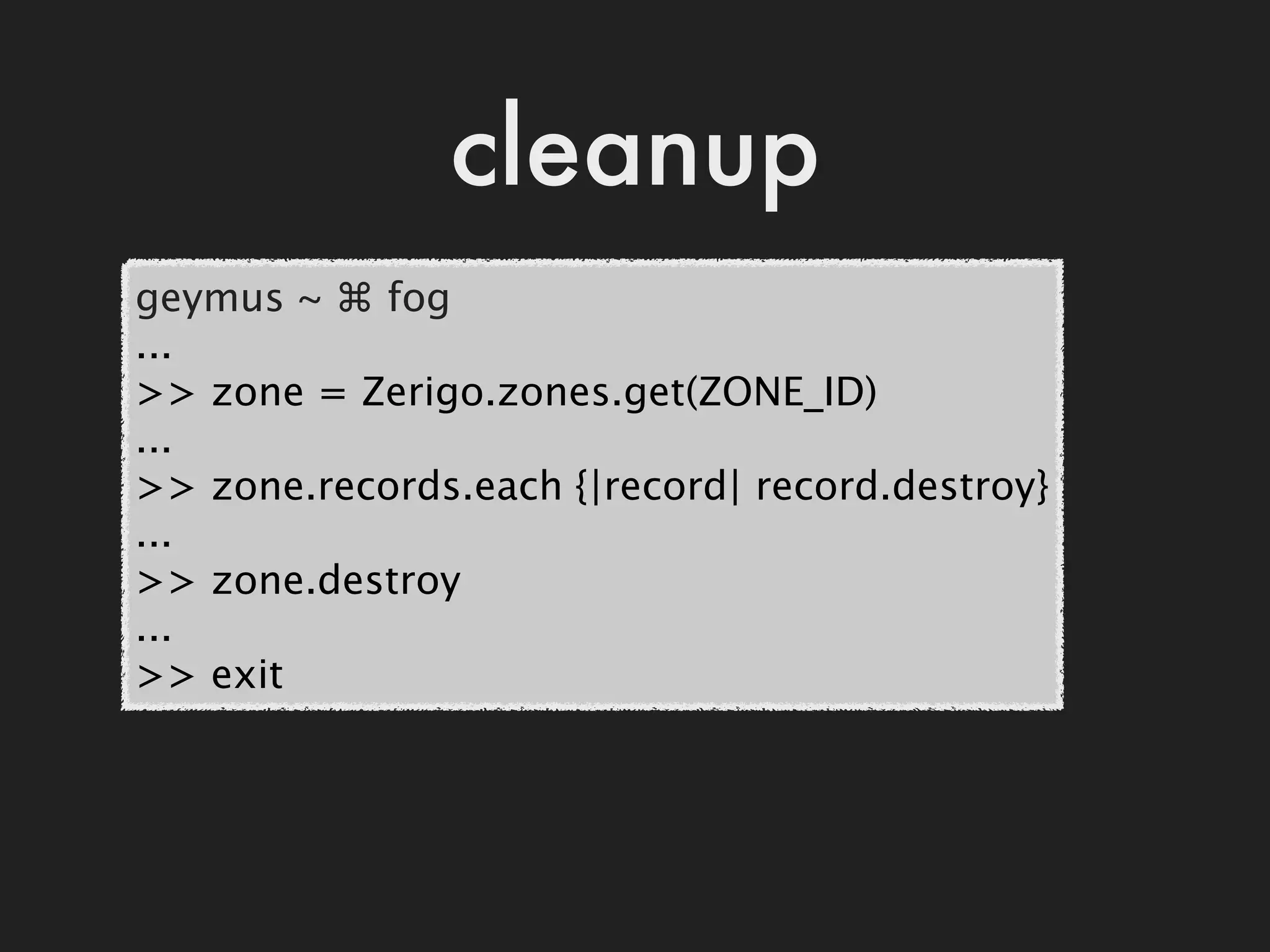
cleanup
geymus ~ ⌘ fog
...
>> zone = Zerigo.zones.get(ZONE_ID)
...
>> zone.records.each {|record| record.destroy}
...
>> zone.destroy
...
>> exit
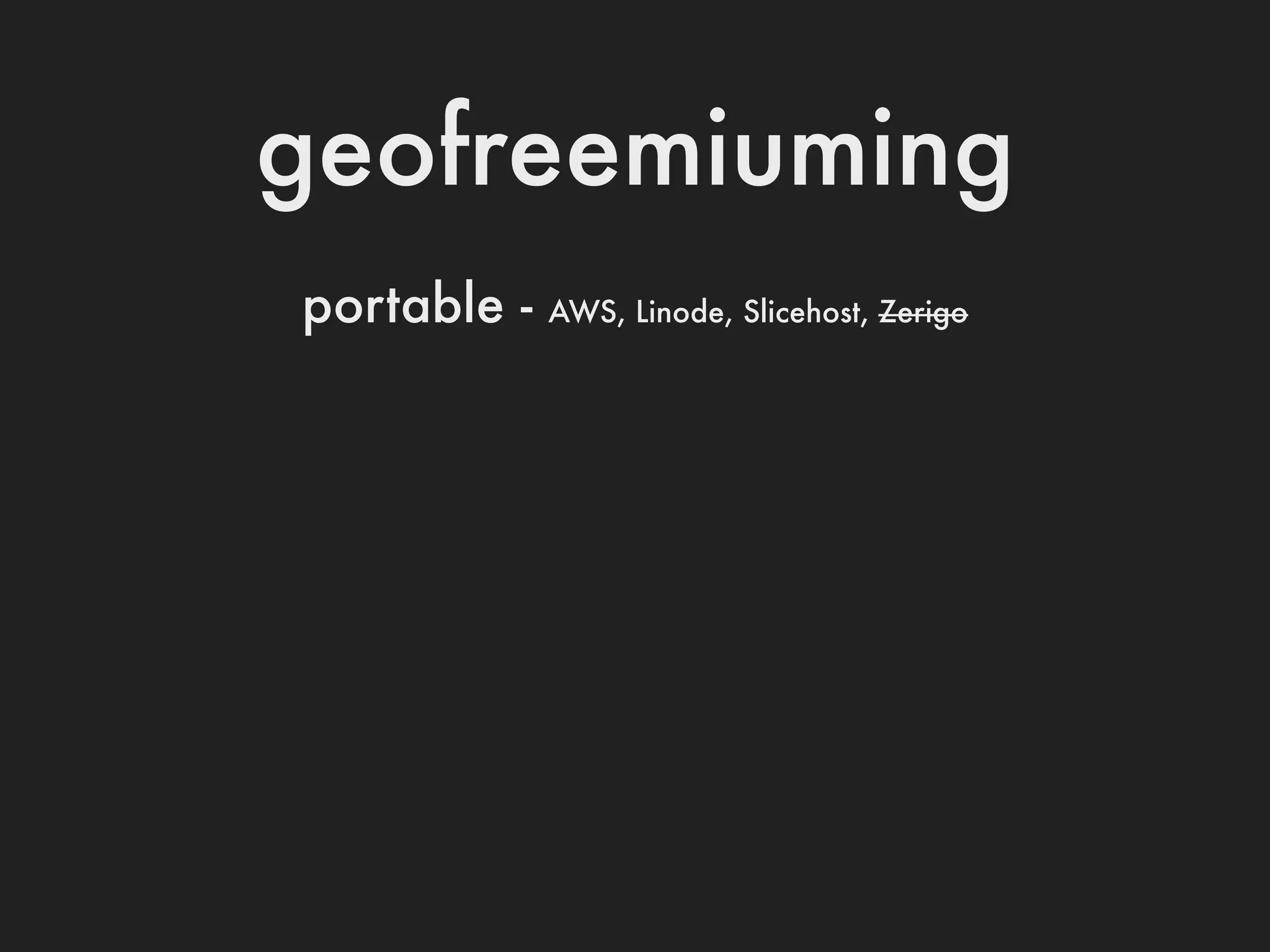
geofreemiuming
portable -   AWS, Linode, Slicehost, Zerigo
geofreemiuming
portable -   AWS, Linode, Slicehost, Zerigo

    lather, rinse, repeat
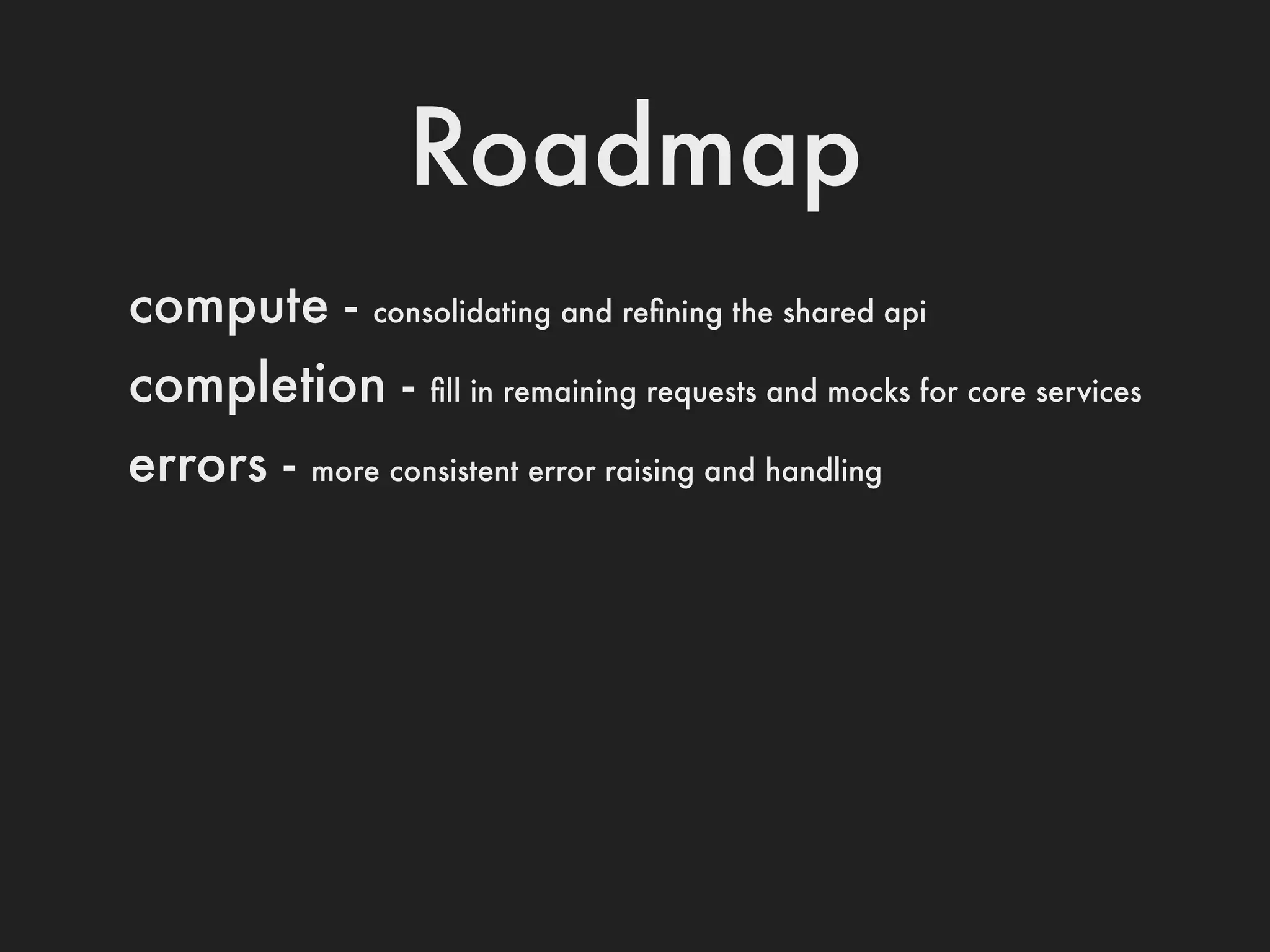
Roadmap
Roadmap
compute -   consolidating and refining the shared api
Roadmap
compute -   consolidating and refining the shared api

completion -    fill in remaining requests and mocks for core services
Roadmap
compute -      consolidating and refining the shared api

completion -       fill in remaining requests and mocks for core services

errors -   more consistent error raising and handling
Roadmap
compute -      consolidating and refining the shared api

completion -       fill in remaining requests and mocks for core services

errors -   more consistent error raising and handling

documentation -           blog posts, examples, fog.io
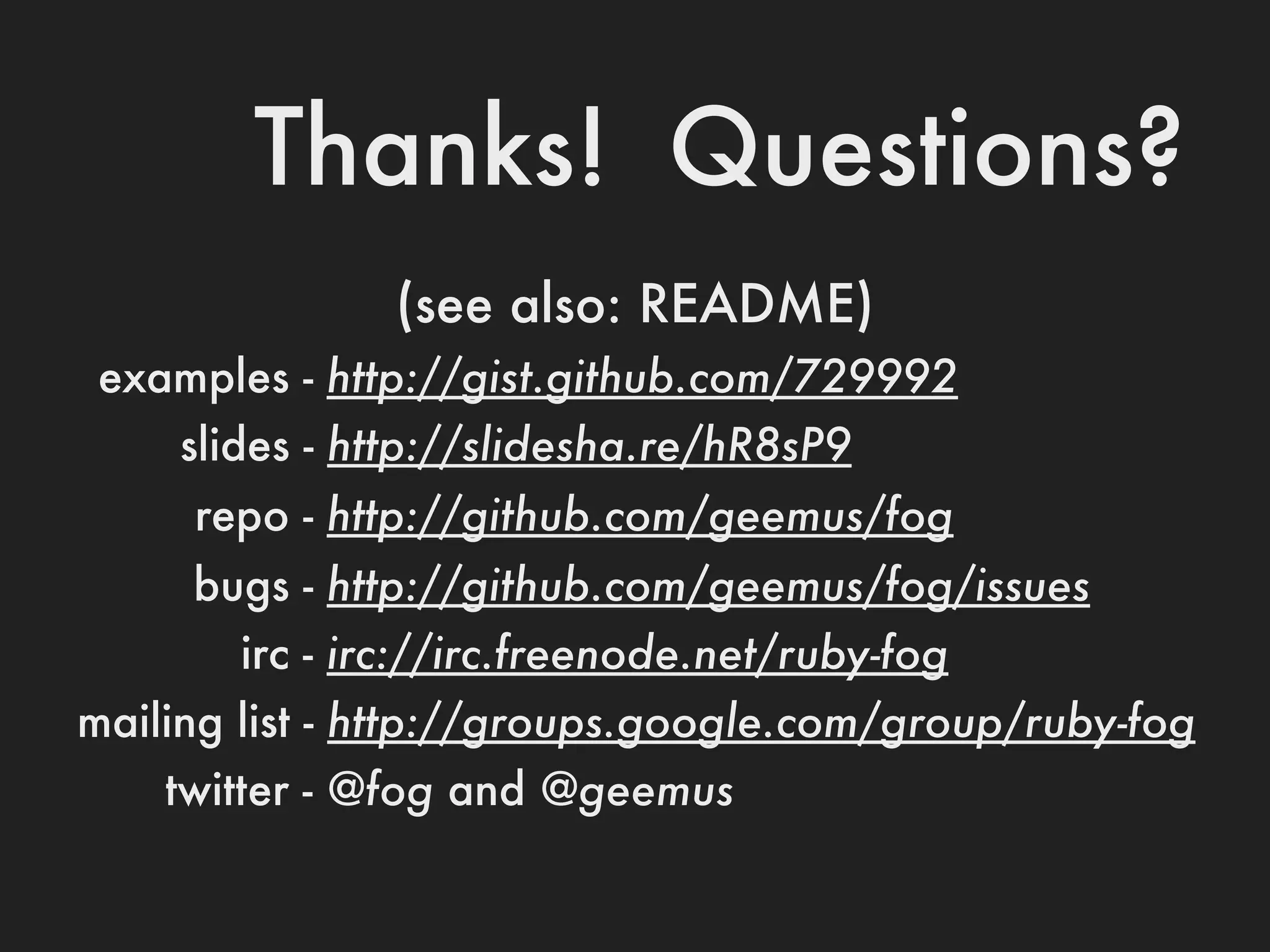
Thanks!
Thanks! Questions?
               (see also: README)
 examples - http://gist.github.com/729992
    slides - http://slidesha.re/hR8sP9
     repo - http://github.com/geemus/fog
     bugs - http://github.com/geemus/fog/issues
       irc - irc://irc.freenode.net/ruby-fog
mailing list - http://groups.google.com/group/ruby-fog
    twitter - @fog and @geemus

How I Learned to Stop Worrying and Love the Cloud - Wesley Beary, Engine Yard

  • 1.
    OR: fog HOW I LEARNED TO STOP WORRYING AND LOVE THE CLOUD
  • 2.
    geemus (Wesley Beary) web:github.com/geemus twitter: @geemus
  • 3.
    employer and sponsor web:engineyard.com twitter: @engineyard
  • 4.
    API driven ondemand services CLOUD core: compute, dns, storage also: kvs, load balance, ...
  • 5.
  • 6.
    What? on demand - pay for only what you actually use
  • 7.
    What? on demand - pay for only what you actually use flexible - add and remove resources in minutes (instead of weeks)
  • 8.
    What? on demand - pay for only what you actually use flexible - add and remove resources in minutes (instead of weeks) repeatable - code, test, repeat
  • 9.
    What? on demand - pay for only what you actually use flexible - add and remove resources in minutes (instead of weeks) repeatable - code, test, repeat resilient - build better systems with transient resources
  • 10.
  • 11.
    But, but... option overload- which provider should I use
  • 12.
    But, but... option overload- which provider should I use intimidating - each service requires separate expertise
  • 13.
    But, but... option overload- which provider should I use intimidating - each service requires separate expertise tools - vastly different API’s built on varying levels of quality
  • 14.
    Ruby cloud services web:github.com/geemus/fog twitter: @fog
  • 15.
  • 16.
    Why? portable - AWS, Bluebox, Brightbox, Google, Rackspace, Slicehost, Terremark, ...
  • 17.
    Why? portable - AWS, Bluebox, Brightbox, Google, Rackspace, Slicehost, Terremark, ... powerful - compute, dns, storage, collections, models, mocks, requests, ...
  • 18.
    Why? portable - AWS, Bluebox, Brightbox, Google, Rackspace, Slicehost, Terremark, ... powerful - compute, dns, storage, collections, models, mocks, requests, ... established - 50k downloads, 860 followers, 100 forks, 40 contributors, me, ...
  • 19.
    Why? portable - AWS, Bluebox, Brightbox, Google, Rackspace, Slicehost, Terremark, ... powerful - compute, dns, storage, collections, models, mocks, requests, ... established - 50k downloads, 860 followers, 100 forks, 40 contributors, me, ... Fog.mock! - faster, cheaper, simulated cloud behavior
  • 20.
  • 21.
    Who? libraries - carrierwave, chef, deckard, gaff, gemcutter, ... products - DevStructure, Engine Yard, iSwifter, OpenFeint, RowFeeder, ...
  • 22.
  • 23.
    What? That’s great andall but I don’t have a use case...
  • 24.
    What? That’s great andall but I don’t have a use case... uptime - because who wants a busted web site?
  • 25.
    Setup geymus~ ⌘ gem install fog or geymus ~ ⌘ sudo gem install fog
  • 26.
    Get Connected 7 #setup a connection to the service 8 compute = Fog::Compute.new(credentials)
  • 27.
    Get Connected 1 credentials = { 2   :provider           => 'Rackspace', 3   :rackspace_api_key  => RACKSPACE_API_KEY, 4   :rackspace_username => RACKSPACE_USERNAME 5 } 6 7 # setup a connection to the service 8 compute = Fog::Compute.new(credentials)
  • 28.
    Bootstrap 7 # bootserver and setup ssh keys 8 server = compute.servers.bootstrap(server_attributes)
  • 29.
    Bootstrap 1 server_attributes = { 2   :image_id         => '49', 3   :private_key_path => PRIVATE_KEY_PATH, 4   :public_key_path  => PUBLIC_KEY_PATH 5 } 6 7 # boot server and setup ssh keys 8 server = compute.servers.bootstrap(server_attributes)
  • 30.
  • 31.
    Servers? 1 compute.servers #list servers, same as #all
  • 32.
    Servers? 1 compute.servers #list servers, same as #all 2 3 compute.servers.get(1234567890) # server by id
  • 33.
    Servers? 1 compute.servers #list servers, same as #all 2 3 compute.servers.get(1234567890) # server by id 4 5 compute.servers.reload # update to latest
  • 34.
    Servers? 1 compute.servers # list servers, same as #all 2 3 compute.servers.get(1234567890) # server by id 4 5 compute.servers.reload # update to latest 6 7 compute.servers.new(attributes) # local model
  • 35.
    Servers? 1 compute.servers # list servers, same as #all 2 3 compute.servers.get(1234567890) # server by id 4 5 compute.servers.reload # update to latest 6 7 compute.servers.new(attributes) # local model 8 9 compute.servers.create(attributes) # remote model
  • 36.
  • 37.
  • 38.
    bootstrap? convenience method for servers create - creates a server matching attributes wait_for { ready? } - waits until server responds ssh - sets up ssh keys and disables password authentication
  • 39.
  • 40.
    ping 1 # pingtarget 10 times 2 ssh_results = server.ssh("ping -c 10 #{target}")
  • 41.
    ping 1 # pingtarget 10 times 2 ssh_results = server.ssh("ping -c 10 #{target}") 3 stdout = ssh_results.first.stdout
  • 42.
    ping 1 # ping target 10 times 2 ssh_results = server.ssh("ping -c 10 #{target}") 3 stdout = ssh_results.first.stdout 4 5 # parse result, last line is summary 6 # round-trip min/avg/max/stddev = A.A/B.B/C.C/D.D ms
  • 43.
    ping 1 # ping target 10 times 2 ssh_results = server.ssh("ping -c 10 #{target}") 3 stdout = ssh_results.first.stdout 4 5 # parse result, last line is summary 6 # round-trip min/avg/max/stddev = A.A/B.B/C.C/D.D ms 7 stats = stdout.split("/n").last.split(' ')[-2] 8 min, avg, max, stddev = stats.split('/')
  • 44.
    ping 1 # ping target 10 times 2 ssh_results = server.ssh("ping -c 10 #{target}") 3 stdout = ssh_results.first.stdout 4 5 # parse result, last line is summary 6 # round-trip min/avg/max/stddev = A.A/B.B/C.C/D.D ms 7 stats = stdout.split("/n").last.split(' ')[-2] 8 min, avg, max, stddev = stats.split('/') NOTE: most complex code was string parsing!?!
  • 45.
  • 46.
    cleanup  1 # shutdownthe server  2 server.destroy
  • 47.
    cleanup  1 # shutdownthe server  2 server.destroy  3  4 # return the data as a hash  5 {  6   :min    => min,  7   :avg    => avg,  8   :max    => max,  9   :stddev => stddev 10 }
  • 48.
    geopinging v1  1 #specify a different provider  2 credentials = {  3   :provider => 'AWS',  4   :aws_access_key_id => AWS_ACCESS_KEY_ID,  5   :aws_secret_access_key => AWS_SECRET_ACCESS_KEY  6 }  7  8 server_attributes = {  9   :image_id         => 'ami-1a837773', 10   :private_key_path => PRIVATE_KEY_PATH, 11   :public_key_path  => PUBLIC_KEY_PATH, 12   :username         => 'ubuntu' 13 }
  • 49.
    geopinging v2 1 # specify a different aws region 2 # ['ap-southeast-1', 'eu-west-1', 'us-west-1] 3 credentials.merge!({ 4   :region => 'eu-west-1' 5 })
  • 50.
    geopinging v... portable - AWS, Bluebox, Brightbox, Rackspace, Slicehost, Terremark, ...
  • 51.
    geopinging v... portable - AWS, Bluebox, Brightbox, Rackspace, Slicehost, Terremark, ... lather, rinse, repeat
  • 52.
    How? That is awesome,but how did you know...
  • 53.
    exploring geymus ~ ⌘fog   To run as 'default', add the following to ~/.fog :default:   :aws_access_key_id:     INTENTIONALLY_LEFT_BLANK   :aws_secret_access_key: INTENTIONALLY_LEFT_BLANK   :public_key_path:       INTENTIONALLY_LEFT_BLANK   :private_key_path:      INTENTIONALLY_LEFT_BLANK   :rackspace_api_key:     INTENTIONALLY_LEFT_BLANK   :rackspace_username:    INTENTIONALLY_LEFT_BLANK ...
  • 54.
  • 55.
  • 56.
    sign posts geymus ~⌘ fog Welcome to fog interactive! :default credentials provide AWS and Rackspace
  • 57.
    sign posts geymus ~⌘ fog Welcome to fog interactive! :default credentials provide AWS and Rackspace >> providers
  • 58.
    sign posts geymus ~⌘ fog Welcome to fog interactive! :default credentials provide AWS and Rackspace >> providers [AWS, Rackspace]
  • 59.
    sign posts geymus ~⌘ fog Welcome to fog interactive! :default credentials provide AWS and Rackspace >> providers [AWS, Rackspace] >> Rackspace.collections
  • 60.
    sign posts geymus ~⌘ fog Welcome to fog interactive! :default credentials provide AWS and Rackspace >> providers [AWS, Rackspace] >> Rackspace.collections [:directories, :files, :flavors, :images, :servers]
  • 61.
    sign posts geymus ~⌘ fog Welcome to fog interactive! :default credentials provide AWS and Rackspace >> providers [AWS, Rackspace] >> Rackspace.collections [:directories, :files, :flavors, :images, :servers] >> Rackspace[:compute]
  • 62.
    sign posts geymus ~⌘ fog Welcome to fog interactive! :default credentials provide AWS and Rackspace >> providers [AWS, Rackspace] >> Rackspace.collections [:directories, :files, :flavors, :images, :servers] >> Rackspace[:compute] #<Fog::Rackspace::Compute ...>
  • 63.
    sign posts geymus ~⌘ fog Welcome to fog interactive! :default credentials provide AWS and Rackspace >> providers [AWS, Rackspace] >> Rackspace.collections [:directories, :files, :flavors, :images, :servers] >> Rackspace[:compute] #<Fog::Rackspace::Compute ...> >> Rackspace[:compute].requests
  • 64.
    sign posts geymus ~⌘ fog Welcome to fog interactive! :default credentials provide AWS and Rackspace >> providers [AWS, Rackspace] >> Rackspace.collections [:directories, :files, :flavors, :images, :servers] >> Rackspace[:compute] #<Fog::Rackspace::Compute ...> >> Rackspace[:compute].requests [:confirm_resized_server, ..., :update_server]
  • 65.
  • 66.
  • 67.
  • 68.
  • 69.
    requests? >> Rackspace[:compute].list_servers #<Excon::Response:0x________ @body ={ "servers" => [] }, @headers = { "X-PURGE-KEY"=>"/______/servers", ..., "Connection"=>"keep-alive" },
  • 70.
    requests? >> Rackspace[:compute].list_servers #<Excon::Response:0x________ @body ={ "servers" => [] }, @headers = { "X-PURGE-KEY"=>"/______/servers", ..., "Connection"=>"keep-alive" }, @status=200>
  • 71.
  • 72.
  • 73.
    sanity check >> Rackspace.servers.select{|server| server.ready?} <Fog::Rackspace::Compute::Servers filters={} [] >
  • 74.
    sanity check >> Rackspace.servers.select{|server| server.ready?} <Fog::Rackspace::Compute::Servers filters={} [] > >> AWS.servers.select {|server| server.ready?}
  • 75.
    sanity check >> Rackspace.servers.select{|server| server.ready?} <Fog::Rackspace::Compute::Servers filters={} [] > >> AWS.servers.select {|server| server.ready?} <Fog::AWS::Compute::Servers [] >
  • 76.
    sanity check >> Rackspace.servers.select{|server| server.ready?} <Fog::Rackspace::Compute::Servers filters={} [] > >> AWS.servers.select {|server| server.ready?} <Fog::AWS::Compute::Servers [] > >> exit
  • 77.
  • 78.
  • 79.
    finding images >> Rackspace.images.table([:id,:name]) +--------- +------------------------------------------+ | id | name | +--------- +------------------------------------------+ | 49 | Ubuntu 10.04 LTS (lucid) | +--------- +------------------------------------------+ ...
  • 80.
    finding images >> Rackspace.images.table([:id,:name]) +--------- +------------------------------------------+ | id | name | +--------- +------------------------------------------+ | 49 | Ubuntu 10.04 LTS (lucid) | +--------- +------------------------------------------+ ... >> AWS.images # I use alestic.com listing
  • 81.
    finding images >> Rackspace.images.table([:id,:name]) +--------- +------------------------------------------+ | id | name | +--------- +------------------------------------------+ | 49 | Ubuntu 10.04 LTS (lucid) | +--------- +------------------------------------------+ ... >> AWS.images # I use alestic.com listing ...
  • 82.
  • 83.
    exploring... Ittakes forever!
  • 84.
    exploring... It takes forever! It’s so expensive!
  • 85.
    exploring... It takes forever! It’s so expensive! A warm welcome for Fog.mock!
  • 86.
    Mocks! geymus ~ ⌘FOG_MOCK=true fog or require ‘fog’ Fog.mock!
  • 87.
  • 88.
  • 89.
    simulation Most functions just work! Unimplemented mocks? Errors keep you on track.
  • 90.
    simulation Most functions just work! Unimplemented mocks? Errors keep you on track. Tests run against both, so it is either consistent or a bug.
  • 91.
    Back to Business I have a bunch of data now what?
  • 92.
    Back to Business I have a bunch of data now what? storage - aggregating cloud data
  • 93.
    Get Connected 7 #setup a connection to the service 8 storage = Fog::Storage.new(credentials)
  • 94.
    Get Connected 1 credentials = { 2   :provider => 'AWS', 3   :aws_access_key_id => AWS_ACCESS_KEY_ID, 4   :aws_secret_access_key => AWS_SECRET_ACCESS_KEY 5 } 6 7 # setup a connection to the service 8 storage = Fog::Storage.new(credentials)
  • 95.
    directories 1 # create a directory 2 directory = storage.directories.create( 3   :key    => directory_name, 4   :public => true 5 )
  • 96.
  • 97.
    files 1 # store the file 2 file = directory.files.create( 3   :body   => File.open(path), 4   :key    => name, 5   :public => true 6 )
  • 98.
    files 1 # store the file 2 file = directory.files.create( 3   :body   => File.open(path), 4   :key    => name, 5   :public => true 6 ) 7 8 # return the public url for the file 9 file.public_url
  • 99.
    geostorage  1 # specify a different provider  2 credentials = {  3   :provider           => 'Rackspace',  4   :rackspace_api_key  => RACKSPACE_API_KEY,  5   :rackspace_username => RACKSPACE_USERNAME  6 }
  • 100.
  • 101.
  • 102.
    cleanup geymus ~ ⌘fog ... >> directory = AWS.directories.get(DIRECTORY_NAME) ...
  • 103.
    cleanup geymus ~ ⌘fog ... >> directory = AWS.directories.get(DIRECTORY_NAME) ... >> directory.files.each {|file| file.destroy} ...
  • 104.
    cleanup geymus ~ ⌘fog ... >> directory = AWS.directories.get(DIRECTORY_NAME) ... >> directory.files.each {|file| file.destroy} ... >> directory.destroy ...
  • 105.
    cleanup geymus ~ ⌘fog ... >> directory = AWS.directories.get(DIRECTORY_NAME) ... >> directory.files.each {|file| file.destroy} ... >> directory.destroy ... >> exit
  • 106.
    geoaggregating portable - AWS, Google, Local, Rackspace
  • 107.
    geoaggregating portable - AWS, Google, Local, Rackspace lather, rinse, repeat
  • 108.
    Phase 3: Profit I’vegot the data, but how do I freemium?
  • 109.
    Phase 3: Profit I’vegot the data, but how do I freemium? dns - make your cloud (premium) accessible
  • 110.
    Get Connected 7 #setup a connection to the service 8 dns = Fog::DNS.new(credentials)
  • 111.
    Get Connected 1 credentials = { 2   :provider  => 'Zerigo', 3   :zerigo_email => AWS_ACCESS_KEY_ID, 4   :zerigo_token => AWS_SECRET_ACCESS_KEY 5 } 6 7 # setup a connection to the service 8 dns = Fog::DNS.new(credentials)
  • 112.
    zones 1 # create a zone 2 zone = dns.zone.create( 3   :domain => domain_name, 4   :email  => "admin@#{domain_name}" 5 )
  • 113.
    records 1 # create a record 2 record = zones.records.create( 3   :ip   => '1.2.3.4', 4   :name => "#{customer_name}.#{domain_name}", 5   :type => 'A' 6 )
  • 114.
    cleanup geymus ~ ⌘fog ... >> zone = Zerigo.zones.get(ZONE_ID) ... >> zone.records.each {|record| record.destroy} ... >> zone.destroy ... >> exit
  • 115.
    geofreemiuming portable - AWS, Linode, Slicehost, Zerigo
  • 116.
    geofreemiuming portable - AWS, Linode, Slicehost, Zerigo lather, rinse, repeat
  • 117.
  • 118.
    Roadmap compute - consolidating and refining the shared api
  • 119.
    Roadmap compute - consolidating and refining the shared api completion - fill in remaining requests and mocks for core services
  • 120.
    Roadmap compute - consolidating and refining the shared api completion - fill in remaining requests and mocks for core services errors - more consistent error raising and handling
  • 121.
    Roadmap compute - consolidating and refining the shared api completion - fill in remaining requests and mocks for core services errors - more consistent error raising and handling documentation - blog posts, examples, fog.io
  • 122.
  • 123.
    Thanks! Questions? (see also: README) examples - http://gist.github.com/729992 slides - http://slidesha.re/hR8sP9 repo - http://github.com/geemus/fog bugs - http://github.com/geemus/fog/issues irc - irc://irc.freenode.net/ruby-fog mailing list - http://groups.google.com/group/ruby-fog twitter - @fog and @geemus