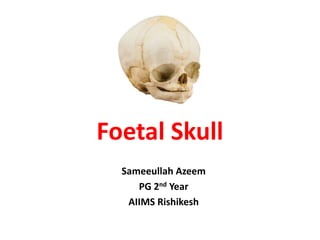
Foetal Skull
Sameeullah Azeem
PG 2nd Year
AIIMS Rishikesh
Contents
• Regions of foetal skull
• Bones
• Sutures
• Fontanelles
• MCQs
Introduction
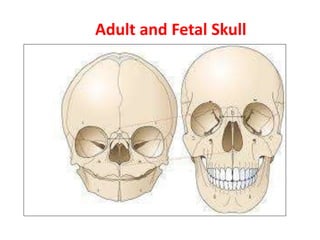
• At birth, the calvaria is large in proportion to
other skeletal parts, reflecting cerebral
maturation.
• The facial region is relatively small and
constitutes only about one-eighth of the
neonatal skull, whereas it constitutes about
half of the adult skull.
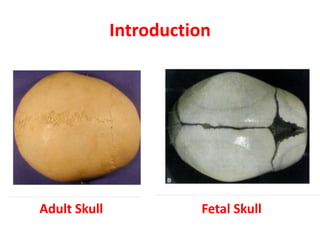
Introduction
Adult Skull Fetal Skull
Adult and Fetal Skull
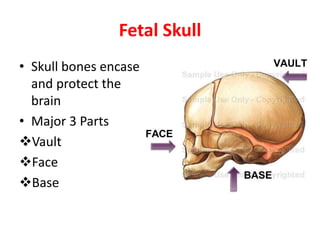
Fetal Skull
• Skull bones encase
and protect the
brain
• Major 3 Parts
Vault
Face
Base
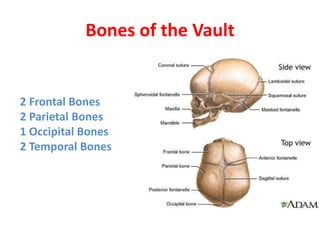
Bones of the Vault
2 Frontal Bones
2 Parietal Bones
1 Occipital Bones
2 Temporal Bones
Vault
• Large, dome shaped part above an imaginary
line drawn between the orbital ridges and
nape of the neck
• Base
Base comprises bones that firmly united to
protect the vital centers in the medula
oblangata
Face
Comprises of 14 bones that are firmly united and are
non-compressible
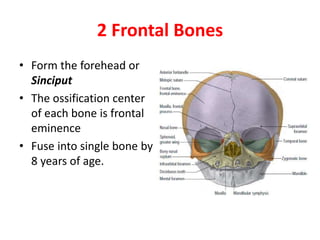
2 Frontal Bones
• Form the forehead or
Sinciput
• The ossification center
of each bone is frontal
eminence
• Fuse into single bone by
8 years of age.
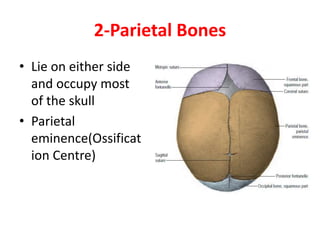
2-Parietal Bones
• Lie on either side
and occupy most
of the skull
• Parietal
eminence(Ossificat
ion Centre)
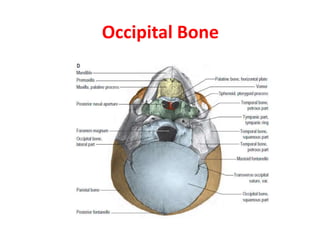
Occipital Bone
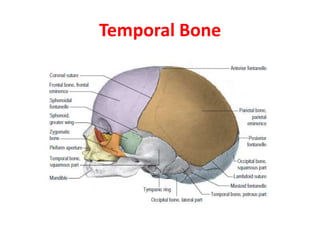
Temporal Bone
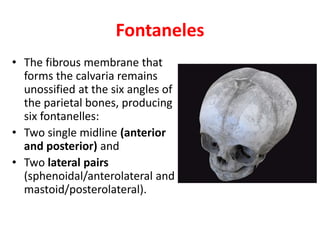
Fontaneles
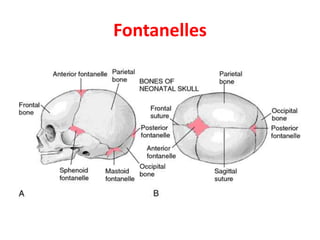
• The fibrous membrane that
forms the calvaria remains
unossified at the six angles of
the parietal bones, producing
six fontanelles:
• Two single midline (anterior
and posterior) and
• Two lateral pairs
(sphenoidal/anterolateral and
mastoid/posterolateral).
Fontanelles
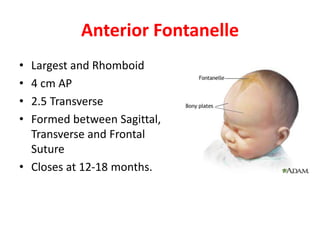
Anterior Fontanelle
• Largest and Rhomboid
• 4 cm AP
• 2.5 Transverse
• Formed between Sagittal,
Transverse and Frontal
Suture
• Closes at 12-18 months.
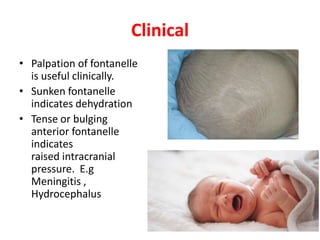
Clinical
• Palpation of fontanelle
is useful clinically.
• Sunken fontanelle
indicates dehydration
• Tense or bulging
anterior fontanelle
indicates
raised intracranial
pressure. E.g
Meningitis ,
Hydrocephalus
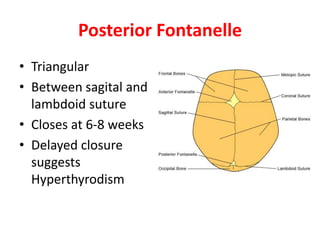
Posterior Fontanelle
• Triangular
• Between sagital and
lambdoid suture
• Closes at 6-8 weeks
• Delayed closure
suggests
Hyperthyrodism
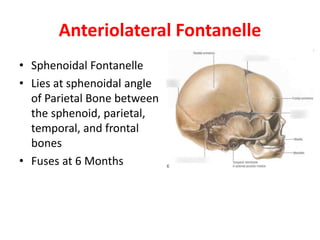
Anteriolateral Fontanelle
• Sphenoidal Fontanelle
• Lies at sphenoidal angle
of Parietal Bone between
the sphenoid, parietal,
temporal, and frontal
bones
• Fuses at 6 Months
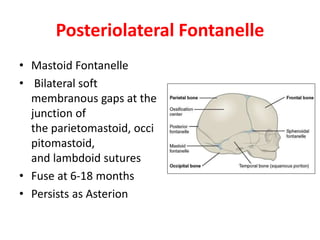
Posteriolateral Fontanelle
• Mastoid Fontanelle
• Bilateral soft
membranous gaps at the
junction of
the parietomastoid, occi
pitomastoid,
and lambdoid sutures
• Fuse at 6-18 months
• Persists as Asterion
Sutures
Metopic Suture
• Also known as median
frontal suture
• Vertical fibrous joint that
divides the two halves of the
frontal bone runs cross the
frontal bone from
the nasion to the bregma.
• Fusion 3-9 months
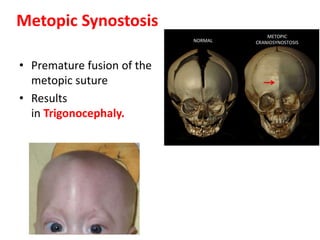
Metopic Synostosis
• Premature fusion of the
metopic suture
• Results
in Trigonocephaly.
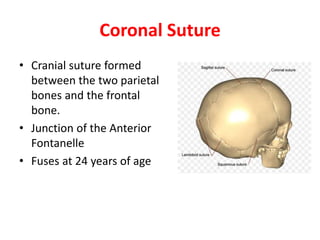
Coronal Suture
• Cranial suture formed
between the two parietal
bones and the frontal
bone.
• Junction of the Anterior
Fontanelle
• Fuses at 24 years of age
Oxycephaly
• Craniosynostosis in which
top of the skull is pointed or
conical due to premature
closure of the coronal
suture.
• Most severe form of
craniosynostosis.
• Characterised by
• 8th cranial nerve lesion
• Optic nerve compression
• Mental deficiency
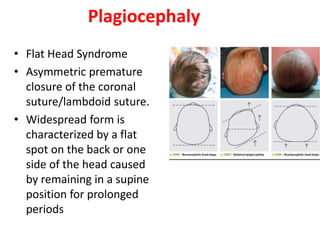
Plagiocephaly
• Flat Head Syndrome
• Asymmetric premature
closure of the coronal
suture/lambdoid suture.
• Widespread form is
characterized by a flat
spot on the back or one
side of the head caused
by remaining in a supine
position for prolonged
periods
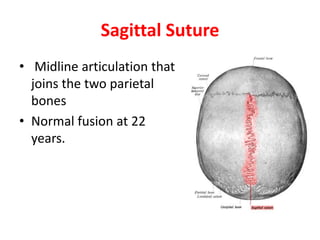
Sagittal Suture
• Midline articulation that
joins the two parietal
bones
• Normal fusion at 22
years.
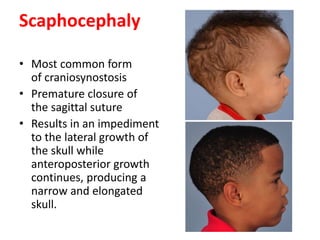
Scaphocephaly
• Most common form
of craniosynostosis
• Premature closure of
the sagittal suture
• Results in an impediment
to the lateral growth of
the skull while
anteroposterior growth
continues, producing a
narrow and elongated
skull.
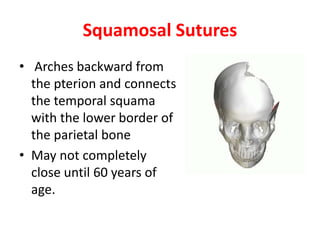
Squamosal Sutures
• Arches backward from
the pterion and connects
the temporal squama
with the lower border of
the parietal bone
• May not completely
close until 60 years of
age.
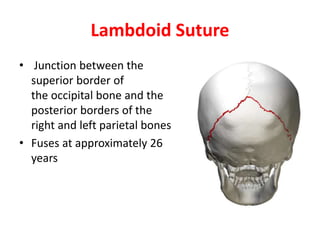
Lambdoid Suture
• Junction between the
superior border of
the occipital bone and the
posterior borders of the
right and left parietal bones
• Fuses at approximately 26
years
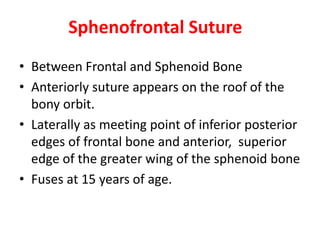
Sphenofrontal Suture
• Between Frontal and Sphenoid Bone
• Anteriorly suture appears on the roof of the
bony orbit.
• Laterally as meeting point of inferior posterior
edges of frontal bone and anterior, superior
edge of the greater wing of the sphenoid bone
• Fuses at 15 years of age.
Questions
• 1) At what age the anterior fontanelle fuse?
a) 12-18 Months
b) 18-36 Months
c) 6-12 Months
d) 3-6 Months
Ans : A
• 2) A mother bought her 1 month old baby in the OPD
with the complaint of fever. The physician did the
physical examination and found raised intracranial
pressure. Which of the following fontanelles suggest
the same after proper palpation ?
a) Anterior
b) Posterior
c) Sphenoidal
d) Mastoid
Ans : A
3) Trigonocephaly results from which of the
following Synostosis?
a) Lambdoid
b) Sagital
c) Coronal
d) Mitopic
Ans: D
Bibilography
Grays Anatomy 41st Edition
Radiopedia

Foetal Skull Anatomy

  • 1.
    Foetal Skull Sameeullah Azeem PG2nd Year AIIMS Rishikesh
  • 2.
    Contents • Regions offoetal skull • Bones • Sutures • Fontanelles • MCQs
  • 3.
    Introduction • At birth,the calvaria is large in proportion to other skeletal parts, reflecting cerebral maturation. • The facial region is relatively small and constitutes only about one-eighth of the neonatal skull, whereas it constitutes about half of the adult skull.
  • 4.
  • 5.
  • 6.
    Fetal Skull • Skullbones encase and protect the brain • Major 3 Parts Vault Face Base
  • 7.
    Bones of theVault 2 Frontal Bones 2 Parietal Bones 1 Occipital Bones 2 Temporal Bones
  • 8.
    Vault • Large, domeshaped part above an imaginary line drawn between the orbital ridges and nape of the neck • Base Base comprises bones that firmly united to protect the vital centers in the medula oblangata Face Comprises of 14 bones that are firmly united and are non-compressible
  • 9.
    2 Frontal Bones •Form the forehead or Sinciput • The ossification center of each bone is frontal eminence • Fuse into single bone by 8 years of age.
  • 10.
    2-Parietal Bones • Lieon either side and occupy most of the skull • Parietal eminence(Ossificat ion Centre)
  • 11.
  • 12.
  • 13.
    Fontaneles • The fibrousmembrane that forms the calvaria remains unossified at the six angles of the parietal bones, producing six fontanelles: • Two single midline (anterior and posterior) and • Two lateral pairs (sphenoidal/anterolateral and mastoid/posterolateral).
  • 14.
  • 15.
    Anterior Fontanelle • Largestand Rhomboid • 4 cm AP • 2.5 Transverse • Formed between Sagittal, Transverse and Frontal Suture • Closes at 12-18 months.
  • 16.
    Clinical • Palpation offontanelle is useful clinically. • Sunken fontanelle indicates dehydration • Tense or bulging anterior fontanelle indicates raised intracranial pressure. E.g Meningitis , Hydrocephalus
  • 17.
    Posterior Fontanelle • Triangular •Between sagital and lambdoid suture • Closes at 6-8 weeks • Delayed closure suggests Hyperthyrodism
  • 18.
    Anteriolateral Fontanelle • SphenoidalFontanelle • Lies at sphenoidal angle of Parietal Bone between the sphenoid, parietal, temporal, and frontal bones • Fuses at 6 Months
  • 19.
    Posteriolateral Fontanelle • MastoidFontanelle • Bilateral soft membranous gaps at the junction of the parietomastoid, occi pitomastoid, and lambdoid sutures • Fuse at 6-18 months • Persists as Asterion
  • 20.
  • 21.
    Metopic Suture • Alsoknown as median frontal suture • Vertical fibrous joint that divides the two halves of the frontal bone runs cross the frontal bone from the nasion to the bregma. • Fusion 3-9 months
  • 22.
    Metopic Synostosis • Prematurefusion of the metopic suture • Results in Trigonocephaly.
  • 23.
    Coronal Suture • Cranialsuture formed between the two parietal bones and the frontal bone. • Junction of the Anterior Fontanelle • Fuses at 24 years of age
  • 24.
    Oxycephaly • Craniosynostosis inwhich top of the skull is pointed or conical due to premature closure of the coronal suture. • Most severe form of craniosynostosis. • Characterised by • 8th cranial nerve lesion • Optic nerve compression • Mental deficiency
  • 25.
    Plagiocephaly • Flat HeadSyndrome • Asymmetric premature closure of the coronal suture/lambdoid suture. • Widespread form is characterized by a flat spot on the back or one side of the head caused by remaining in a supine position for prolonged periods
  • 26.
    Sagittal Suture • Midlinearticulation that joins the two parietal bones • Normal fusion at 22 years.
  • 27.
    Scaphocephaly • Most commonform of craniosynostosis • Premature closure of the sagittal suture • Results in an impediment to the lateral growth of the skull while anteroposterior growth continues, producing a narrow and elongated skull.
  • 28.
    Squamosal Sutures • Archesbackward from the pterion and connects the temporal squama with the lower border of the parietal bone • May not completely close until 60 years of age.
  • 29.
    Lambdoid Suture • Junctionbetween the superior border of the occipital bone and the posterior borders of the right and left parietal bones • Fuses at approximately 26 years
  • 30.
    Sphenofrontal Suture • BetweenFrontal and Sphenoid Bone • Anteriorly suture appears on the roof of the bony orbit. • Laterally as meeting point of inferior posterior edges of frontal bone and anterior, superior edge of the greater wing of the sphenoid bone • Fuses at 15 years of age.
  • 32.
  • 33.
    • 1) Atwhat age the anterior fontanelle fuse? a) 12-18 Months b) 18-36 Months c) 6-12 Months d) 3-6 Months Ans : A
  • 34.
    • 2) Amother bought her 1 month old baby in the OPD with the complaint of fever. The physician did the physical examination and found raised intracranial pressure. Which of the following fontanelles suggest the same after proper palpation ? a) Anterior b) Posterior c) Sphenoidal d) Mastoid Ans : A
  • 35.
    3) Trigonocephaly resultsfrom which of the following Synostosis? a) Lambdoid b) Sagital c) Coronal d) Mitopic Ans: D
  • 36.