FMP Research
Sam Williams
Existing products
Adam Curtis – Bitter
Lake
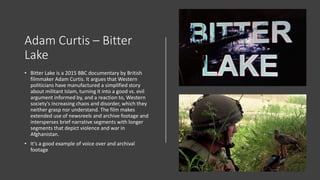
• Bitter Lake is a 2015 BBC documentary by British
filmmaker Adam Curtis. It argues that Western
politicians have manufactured a simplified story
about militant Islam, turning it into a good vs. evil
argument informed by, and a reaction to, Western
society's increasing chaos and disorder, which they
neither grasp nor understand. The film makes
extended use of newsreels and archive footage and
intersperses brief narrative segments with longer
segments that depict violence and war in
Afghanistan.
• It’s a good example of voice over and archival
footage
Tim Hetherington and
Sebastian Junger – Restrepo
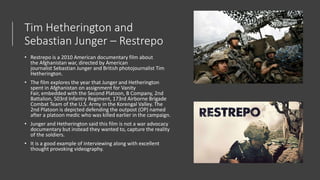
• Restrepo is a 2010 American documentary film about
the Afghanistan war, directed by American
journalist Sebastian Junger and British photojournalist Tim
Hetherington.
• The film explores the year that Junger and Hetherington
spent in Afghanistan on assignment for Vanity
Fair, embedded with the Second Platoon, B Company, 2nd
Battalion, 503rd Infantry Regiment, 173rd Airborne Brigade
Combat Team of the U.S. Army in the Korengal Valley. The
2nd Platoon is depicted defending the outpost (OP) named
after a platoon medic who was killed earlier in the campaign.
• Junger and Hetherington said this film is not a war advocacy
documentary but instead they wanted to, capture the reality
of the soldiers.
• It is a good example of interviewing along with excellent
thought provoking videography.
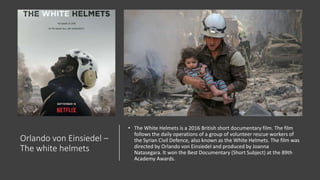
Orlando von Einsiedel –
The white helmets
• The White Helmets is a 2016 British short documentary film. The film
follows the daily operations of a group of volunteer rescue workers of
the Syrian Civil Defence, also known as the White Helmets. The film was
directed by Orlando von Einsiedel and produced by Joanna
Natasegara. It won the Best Documentary (Short Subject) at the 89th
Academy Awards.
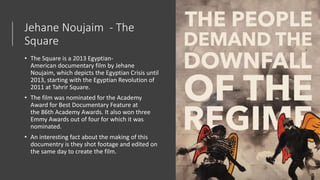
Jehane Noujaim - The
Square
• The Square is a 2013 Egyptian-
American documentary film by Jehane
Noujaim, which depicts the Egyptian Crisis until
2013, starting with the Egyptian Revolution of
2011 at Tahrir Square.
• The film was nominated for the Academy
Award for Best Documentary Feature at
the 86th Academy Awards. It also won three
Emmy Awards out of four for which it was
nominated.
• An interesting fact about the making of this
documentry is they shot footage and edited on
the same day to create the film.
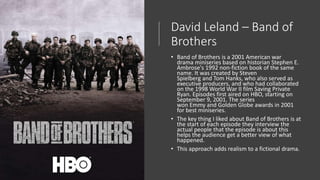
David Leland – Band of
Brothers
• Band of Brothers is a 2001 American war
drama miniseries based on historian Stephen E.
Ambrose's 1992 non-fiction book of the same
name. It was created by Steven
Spielberg and Tom Hanks, who also served as
executive producers, and who had collaborated
on the 1998 World War II film Saving Private
Ryan. Episodes first aired on HBO, starting on
September 9, 2001. The series
won Emmy and Golden Globe awards in 2001
for best miniseries.
• The key thing I liked about Band of Brothers is at
the start of each episode they interview the
actual people that the episode is about this
helps the audience get a better view of what
happened.
• This approach adds realism to a fictional drama.
Audience research
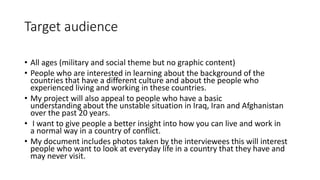
Target audience
• All ages (military and social theme but no graphic content)
• People who are interested in learning about the background of the
countries that have a different culture and about the people who
experienced living and working in these countries.
• My project will also appeal to people who have a basic
understanding about the unstable situation in Iraq, Iran and Afghanistan
over the past 20 years.
• I want to give people a better insight into how you can live and work in
a normal way in a country of conflict.
• My document includes photos taken by the interviewees this will interest
people who want to look at everyday life in a country that they have and
may never visit.
Secondary audience info
Documentary Techniques
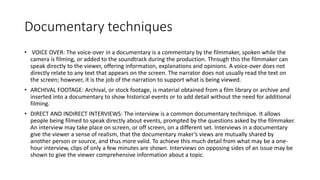
Documentary techniques
• VOICE OVER: The voice-over in a documentary is a commentary by the filmmaker, spoken while the
camera is filming, or added to the soundtrack during the production. Through this the filmmaker can
speak directly to the viewer, offering information, explanations and opinions. A voice-over does not
directly relate to any text that appears on the screen. The narrator does not usually read the text on
the screen; however, it is the job of the narration to support what is being viewed.
• ARCHIVAL FOOTAGE: Archival, or stock footage, is material obtained from a film library or archive and
inserted into a documentary to show historical events or to add detail without the need for additional
filming.
• DIRECT AND INDIRECT INTERVIEWS: The interview is a common documentary technique. It allows
people being filmed to speak directly about events, prompted by the questions asked by the filmmaker.
An interview may take place on screen, or off screen, on a different set. Interviews in a documentary
give the viewer a sense of realism, that the documentary maker’s views are mutually shared by
another person or source, and thus more valid. To achieve this much detail from what may be a one-
hour interview, clips of only a few minutes are shown. Interviews on opposing sides of an issue may be
shown to give the viewer comprehensive information about a topic.
Specific Techniques
Voice Overs
• The use of historical or recorded live video footage with a voice-over narration is
a time-tested technique for documentary filmmaking. With this technique, the
information provided by the voice-over enhances the story being shown and told
in the film/video itself.
• The voice-over in a documentary is a commentary by the filmmaker, spoken
while the camera is filming, or added to the soundtrack during the production.
Through this the filmmaker can speak directly to the viewer, offering information,
explanations and opinions. A voice-over does not directly relate to any text that
appears on the screen. The narrator does not usually read the text on the screen;
however, it is the job of the narration to support what is being viewed.
Archival footage
• Archival, or stock footage, is material obtained from a film library or archive and
inserted into a documentary to show historical events or to add detail without
the need for additional filming. This can include still images as well as archival
film. The concept of archival footage can be extended to include the photography
of historical material from archives which are used to illustrate a documentary
film and is also the main reason why archive footage is especially important to
historical documentary filmmaking.
• In the past documentary's consisted of basic talking head interviews intercut with
old footage and photographs, much of it randomly selected and presented.
Ethics of conflict journalism
International law
• There are many actions and laws have been passed to protect journalists in
conflict zones. For example, the Genever conventions grants special protections
to journalists in war zones.
• In 2012 all the major UN agencies agreed a comprehensive Action Plan on the
Safety of Journalists
• The illegality of attacks on journalists and news media derives from the
protection granted to civilians and civilian objects under international
humanitarian law, and from the fact that the media, even when used for
propaganda purposes, cannot be considered as military objectives except in
special cases. In other words, while no specific status exists for journalists and the
equipment they use, both journalists and their equipment benefit from the
general protection enjoyed by civilians and civilian objects unless they make an
effective contribution to military action.
Ethics
• Journalist have many ethical responsibility's when reporting in a war zone for
many reasons, some of those are that the people that they interview are trusting
them to protect them from the people that they may be painting in a bad light,
this is becoming more and more relevant due to the rise in 24-hour news and the
availability of news reports on the internet. Not protecting the identity of a victim
and/or a survivor can often lead to devastating consequences for the
interviewee. There have been many examples of poor ethics by journalists more
recently in the after math of the attacks on the Yazidis by ISIS in 2014. A Human
Rights Lawer interviewed 90 women about their treatment by international
media.
Ethics ctd
• Another example of unethical practices was seen by the news outlet France 24 on
the 12th December 2019 when they interviewed Sadou Yahia’s a farmer in Mail
when they failed to blur his face and displayed his full name. The following day a
group of ISIS solders kidnapped and executed him Infront of his village. According
to an investigation France 24 knew that their outlet was very popular in west
Africa and the family of Yahia say that he wouldn’t have been murdered if they
had blurred out his face and not shown his full name. France 24 saw loads of back
lash when the news report came out it also raised the question of journalist's
responsibilities to the person they are interviewing. As this was a death that was
completely avoidable.
• My view is that the reporting of this would still have had impact for the media
channel even if his face had been blurred.

FMP Research.pptx

  • 1.
  • 2.
  • 3.
    Adam Curtis –Bitter Lake • Bitter Lake is a 2015 BBC documentary by British filmmaker Adam Curtis. It argues that Western politicians have manufactured a simplified story about militant Islam, turning it into a good vs. evil argument informed by, and a reaction to, Western society's increasing chaos and disorder, which they neither grasp nor understand. The film makes extended use of newsreels and archive footage and intersperses brief narrative segments with longer segments that depict violence and war in Afghanistan. • It’s a good example of voice over and archival footage
  • 4.
    Tim Hetherington and SebastianJunger – Restrepo • Restrepo is a 2010 American documentary film about the Afghanistan war, directed by American journalist Sebastian Junger and British photojournalist Tim Hetherington. • The film explores the year that Junger and Hetherington spent in Afghanistan on assignment for Vanity Fair, embedded with the Second Platoon, B Company, 2nd Battalion, 503rd Infantry Regiment, 173rd Airborne Brigade Combat Team of the U.S. Army in the Korengal Valley. The 2nd Platoon is depicted defending the outpost (OP) named after a platoon medic who was killed earlier in the campaign. • Junger and Hetherington said this film is not a war advocacy documentary but instead they wanted to, capture the reality of the soldiers. • It is a good example of interviewing along with excellent thought provoking videography.
  • 5.
    Orlando von Einsiedel– The white helmets • The White Helmets is a 2016 British short documentary film. The film follows the daily operations of a group of volunteer rescue workers of the Syrian Civil Defence, also known as the White Helmets. The film was directed by Orlando von Einsiedel and produced by Joanna Natasegara. It won the Best Documentary (Short Subject) at the 89th Academy Awards.
  • 6.
    Jehane Noujaim -The Square • The Square is a 2013 Egyptian- American documentary film by Jehane Noujaim, which depicts the Egyptian Crisis until 2013, starting with the Egyptian Revolution of 2011 at Tahrir Square. • The film was nominated for the Academy Award for Best Documentary Feature at the 86th Academy Awards. It also won three Emmy Awards out of four for which it was nominated. • An interesting fact about the making of this documentry is they shot footage and edited on the same day to create the film.
  • 7.
    David Leland –Band of Brothers • Band of Brothers is a 2001 American war drama miniseries based on historian Stephen E. Ambrose's 1992 non-fiction book of the same name. It was created by Steven Spielberg and Tom Hanks, who also served as executive producers, and who had collaborated on the 1998 World War II film Saving Private Ryan. Episodes first aired on HBO, starting on September 9, 2001. The series won Emmy and Golden Globe awards in 2001 for best miniseries. • The key thing I liked about Band of Brothers is at the start of each episode they interview the actual people that the episode is about this helps the audience get a better view of what happened. • This approach adds realism to a fictional drama.
  • 8.
  • 9.
    Target audience • Allages (military and social theme but no graphic content) • People who are interested in learning about the background of the countries that have a different culture and about the people who experienced living and working in these countries. • My project will also appeal to people who have a basic understanding about the unstable situation in Iraq, Iran and Afghanistan over the past 20 years. • I want to give people a better insight into how you can live and work in a normal way in a country of conflict. • My document includes photos taken by the interviewees this will interest people who want to look at everyday life in a country that they have and may never visit.
  • 10.
  • 11.
  • 12.
    Documentary techniques • VOICEOVER: The voice-over in a documentary is a commentary by the filmmaker, spoken while the camera is filming, or added to the soundtrack during the production. Through this the filmmaker can speak directly to the viewer, offering information, explanations and opinions. A voice-over does not directly relate to any text that appears on the screen. The narrator does not usually read the text on the screen; however, it is the job of the narration to support what is being viewed. • ARCHIVAL FOOTAGE: Archival, or stock footage, is material obtained from a film library or archive and inserted into a documentary to show historical events or to add detail without the need for additional filming. • DIRECT AND INDIRECT INTERVIEWS: The interview is a common documentary technique. It allows people being filmed to speak directly about events, prompted by the questions asked by the filmmaker. An interview may take place on screen, or off screen, on a different set. Interviews in a documentary give the viewer a sense of realism, that the documentary maker’s views are mutually shared by another person or source, and thus more valid. To achieve this much detail from what may be a one- hour interview, clips of only a few minutes are shown. Interviews on opposing sides of an issue may be shown to give the viewer comprehensive information about a topic.
  • 13.
  • 14.
    Voice Overs • Theuse of historical or recorded live video footage with a voice-over narration is a time-tested technique for documentary filmmaking. With this technique, the information provided by the voice-over enhances the story being shown and told in the film/video itself. • The voice-over in a documentary is a commentary by the filmmaker, spoken while the camera is filming, or added to the soundtrack during the production. Through this the filmmaker can speak directly to the viewer, offering information, explanations and opinions. A voice-over does not directly relate to any text that appears on the screen. The narrator does not usually read the text on the screen; however, it is the job of the narration to support what is being viewed.
  • 15.
    Archival footage • Archival,or stock footage, is material obtained from a film library or archive and inserted into a documentary to show historical events or to add detail without the need for additional filming. This can include still images as well as archival film. The concept of archival footage can be extended to include the photography of historical material from archives which are used to illustrate a documentary film and is also the main reason why archive footage is especially important to historical documentary filmmaking. • In the past documentary's consisted of basic talking head interviews intercut with old footage and photographs, much of it randomly selected and presented.
  • 16.
  • 17.
    International law • Thereare many actions and laws have been passed to protect journalists in conflict zones. For example, the Genever conventions grants special protections to journalists in war zones. • In 2012 all the major UN agencies agreed a comprehensive Action Plan on the Safety of Journalists • The illegality of attacks on journalists and news media derives from the protection granted to civilians and civilian objects under international humanitarian law, and from the fact that the media, even when used for propaganda purposes, cannot be considered as military objectives except in special cases. In other words, while no specific status exists for journalists and the equipment they use, both journalists and their equipment benefit from the general protection enjoyed by civilians and civilian objects unless they make an effective contribution to military action.
  • 18.
    Ethics • Journalist havemany ethical responsibility's when reporting in a war zone for many reasons, some of those are that the people that they interview are trusting them to protect them from the people that they may be painting in a bad light, this is becoming more and more relevant due to the rise in 24-hour news and the availability of news reports on the internet. Not protecting the identity of a victim and/or a survivor can often lead to devastating consequences for the interviewee. There have been many examples of poor ethics by journalists more recently in the after math of the attacks on the Yazidis by ISIS in 2014. A Human Rights Lawer interviewed 90 women about their treatment by international media.
  • 19.
    Ethics ctd • Anotherexample of unethical practices was seen by the news outlet France 24 on the 12th December 2019 when they interviewed Sadou Yahia’s a farmer in Mail when they failed to blur his face and displayed his full name. The following day a group of ISIS solders kidnapped and executed him Infront of his village. According to an investigation France 24 knew that their outlet was very popular in west Africa and the family of Yahia say that he wouldn’t have been murdered if they had blurred out his face and not shown his full name. France 24 saw loads of back lash when the news report came out it also raised the question of journalist's responsibilities to the person they are interviewing. As this was a death that was completely avoidable. • My view is that the reporting of this would still have had impact for the media channel even if his face had been blurred.