11MARCH 2017
FMCG
For updated information, please visit www.ibef.orgMARCH 2017
22MARCH 2017 For updated information, please visit www.ibef.org
❖ Executive Summary…………….……….….3
❖ Advantage India………………………….…5
❖ Market Overview and Trends…………...…7
❖ Porters Five Forces Analysis ...……….....21
❖ Strategies Adopted……………………..…23
❖ Growth Drivers………………………….….25
❖ Opportunities………………………….…...36
❖ Success Stories………………………..….40
❖ Useful Information………………………....44
FMCG
MARCH 2017
33MARCH 2017 For updated information, please visit www.ibef.org
EXECUTIVE SUMMARY … (1/2)
Source: World Bank, Emami Reports, Dabur Reports, AC Nielsen,
Notes: F (Forecast)
FMCG
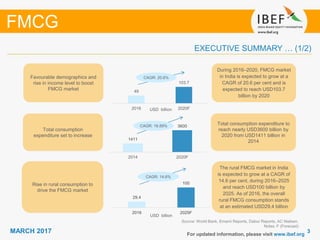
Favourable demographics and
rise in income level to boost
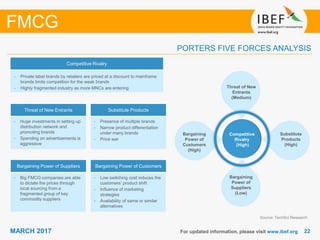
FMCG market
CAGR: 20.6%
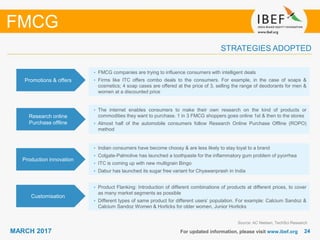
Total consumption
expenditure set to increase
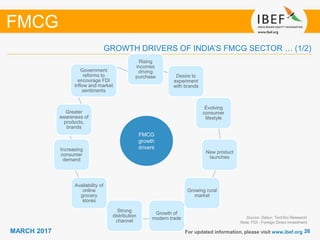
Total consumption expenditure to
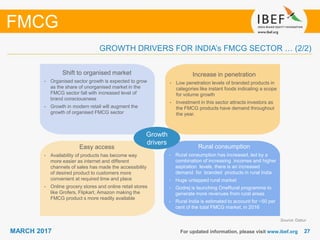
reach nearly USD3600 billion by
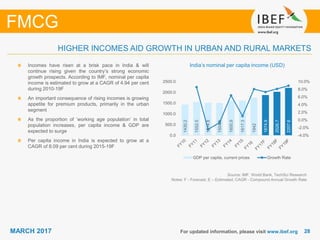
2020 from USD1411 billion in
2014
CAGR: 16.89%
1411
3600
2014 2020F
The rural FMCG market in India
is expected to grow at a CAGR of
14.6 per cent, during 2016–2025
and reach USD100 billion by
2025. As of 2016, the overall
rural FMCG consumption stands
at an estimated USD29.4 billion
Rise in rural consumption to
drive the FMCG market
CAGR: 14.6%
During 2016–2020, FMCG market
in India is expected to grow at a
CAGR of 20.6 per cent and is
expected to reach USD103.7
billion by 2020
49
103.7
2016 2020FUSD billion
29.4
100
2016 2025F
USD billion
44MARCH 2017 For updated information, please visit www.ibef.org
EXECUTIVE SUMMARY … (2/2)
Source: Emami Reports, Dabur Reports, AC Nielsen, McKinsey Global Institute (MGI) titled The Bird of Gold, TechSci Research
Note: Germany population is estimated to reach 81.26 million by 2016
Notes: F–Forecast; E-Estimated
FMCG
160
267
2011 2016
CAGR: 10.8%
CAGR: 4.11%
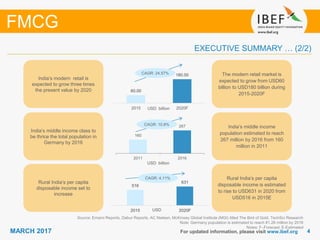
India’s modern retail is
expected to grow three times
the present value by 2020
India’s middle income class to
be thrice the total population in
Germany by 2016
Rural India’s per capita
disposable income set to
increase
The modern retail market is
expected to grow from USD60
billion to USD180 billion during
2015-2020F
India’s middle income
population estimated to reach
267 million by 2016 from 160
million in 2011
Rural India’s per capita
disposable income is estimated
to rise to USD631 in 2020 from
USD516 in 2015E
CAGR: 24.57%
60.00
180.00
2015 2020FUSD billion
USD billion
USD
516
631
2015 2020F
ADVANTAGE INDIA
FMCG
66MARCH 2017
Growing demand
For updated information, please visit www.ibef.org
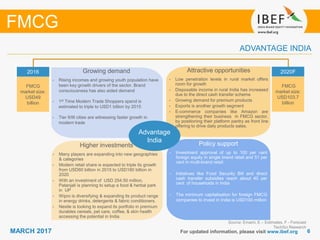
ADVANTAGE INDIA
Source: Emami, E – Estimates, F - Forecast
TechSci Research
2016
FMCG
market size:
USD49
billion
2020F
FMCG
market size:
USD103.7
billion
FMCG
Advantage
India
Growing demand
• Rising incomes and growing youth population have
been key growth drivers of the sector. Brand
consciousness has also aided demand
• 1st Time Modern Trade Shoppers spend is
estimated to triple to USD1 billion by 2015
• Tier II/III cities are witnessing faster growth in
modern trade
Higher investments
• Many players are expanding into new geographies
& categories
• Modern retail share is expected to triple its growth
from USD60 billion in 2015 to USD180 billion in
2020
• With an investment of USD 254.50 million,
Patanjali is planning to setup a food & herbal park
in UP
• Wipro is diversifying & expanding its product range
in energy drinks, detergents & fabric conditioners.
• Nestle is looking to expand its portfolio in premium
durables cereals, pet care, coffee, & skin health
accessing the potential in India.
Attractive opportunities
• Low penetration levels in rural market offers
room for growth
• Disposable income in rural India has increased
due to the direct cash transfer scheme
• Growing demand for premium products
• Exports is another growth segment
• E-commerce companies like Amazon are
strengthening their business in FMCG sector,
by positioning their platform pantry as front line
offering to drive daily products sales.
Policy support
• Investment approval of up to 100 per cent
foreign equity in single brand retail and 51 per
cent in multi-brand retail
• Initiatives like Food Security Bill and direct
cash transfer subsidies reach about 40 per
cent of households in India
• The minimum capitalisation for foreign FMCG
companies to invest in India is USD100 million
MARKET OVERVIEW AND TRENDS
FMCG
88MARCH 2017 For updated information, please visit www.ibef.org
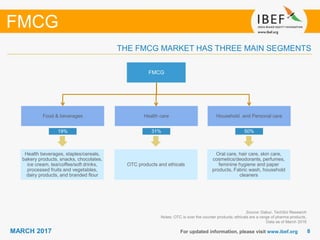
THE FMCG MARKET HAS THREE MAIN SEGMENTS
Source: Dabur, TechSci Research
Notes: OTC is over the counter products; ethicals are a range of pharma products,
Data as of March 2016
FMCG
FMCG
Household and Personal careFood & beverages
Oral care, hair care, skin care,
cosmetics/deodorants, perfumes,
feminine hygiene and paper
products, Fabric wash, household
cleaners
Health beverages, staples/cereals,
bakery products, snacks, chocolates,
ice cream, tea/coffee/soft drinks,
processed fruits and vegetables,
dairy products, and branded flour
Health care
OTC products and ethicals
50%19% 31%
99MARCH 2017 For updated information, please visit www.ibef.org
EVOLUTION OF THE INDIAN FMCG SECTOR
Source: Dabur Annual Report, Economic Times, Emami Annual Report, Mckinsey Global Institute, CII, TechSci Research
FMCG
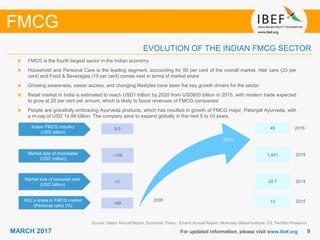
FMCG is the fourth largest sector in the Indian economy
Household and Personal Care is the leading segment, accounting for 50 per cent of the overall market. Hair care (23 per
cent) and Food & Beverages (19 per cent) comes next in terms of market share
Growing awareness, easier access, and changing lifestyles have been the key growth drivers for the sector
Retail market in India is estimated to reach USD1 trillion by 2020 from USD600 billion in 2015, with modern trade expected
to grow at 20 per cent per annum, which is likely to boost revenues of FMCG companies
People are gracefully embracing Ayurveda products, which has resulted in growth of FMCG major, Patanjali Ayurveda, with
a m-cap of USD 14.94 billion. The company aims to expand globally in the next 5 to 10 years.
Indian FMCG industry
(USD billion)
Market size of chocolates
(USD million)
Market size of personal care
(USD billion)
HUL’s share in FMCG market
(Personal care) (%)
>50
<3
<100
9.0
13
22.7
1,441
49
2000
2015
2016
2015
2015
2015
1010MARCH 2017 For updated information, please visit www.ibef.org
STRONG GROWTH IN THE INDIAN FMCG SECTOR
FMCG
Source: Booz & Company, Dabur, AC Nielsen, TechSci Research,
Note: F - Forecast
Trends in FMCG revenues over the years
(USD billion)
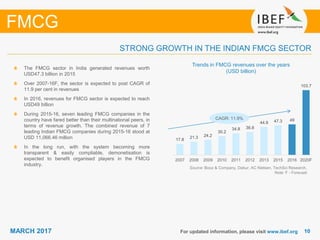
The FMCG sector in India generated revenues worth
USD47.3 billion in 2015
Over 2007-16F, the sector is expected to post CAGR of
11.9 per cent in revenues
In 2016, revenues for FMCG sector is expected to reach
USD49 billion
During 2015-16, seven leading FMCG companies in the
country have fared better than their multinational peers, in
terms of revenue growth. The combined revenue of 7
leading Indian FMCG companies during 2015-16 stood at
USD 11,066.46 million
In the long run, with the system becoming more
transparent & easily compliable, demonetisation is
expected to benefit organised players in the FMCG
industry.
CAGR: 11.9%
17.8
21.3 24.2
30.2
34.8 36.8
44.9 47.3 49
103.7
2007 2008 2009 2010 2011 2012 2013 2015 2016 2020F
1111MARCH 2017 For updated information, please visit www.ibef.org
FOOD AND PERSONAL CARE MAKE UP TWO-THIRDS OF REVENUES … (1/2)
FMCG
Source: Dabur, TechSci Research
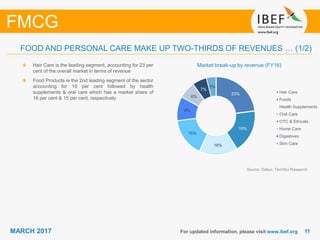
Hair Care is the leading segment, accounting for 23 per
cent of the overall market in terms of revenue
Food Products is the 2nd leading segment of the sector
accounting for 19 per cent followed by health
supplements & oral care which has a market share of
16 per cent & 15 per cent, respectively
Market break-up by revenue (FY16)
23%
19%
16%
15%
9%
6%
7%
5%
Hair Care
Foods
Health Supplements
Oral Care
OTC & Ethicals
Home Care
Digestives
Skin Care
1212MARCH 2017 For updated information, please visit www.ibef.org
THE URBAN MARKET ACCOUNTS FOR A MAJOR CHUNK OF REVENUES
FMCG
Source: Emami, TechSci Research
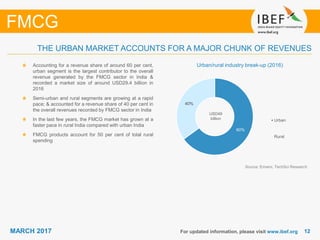
Urban/rural industry break-up (2016)Accounting for a revenue share of around 60 per cent,
urban segment is the largest contributor to the overall
revenue generated by the FMCG sector in India &
recorded a market size of around USD29.4 billion in
2016
Semi-urban and rural segments are growing at a rapid
pace; & accounted for a revenue share of 40 per cent in
the overall revenues recorded by FMCG sector in India
In the last few years, the FMCG market has grown at a
faster pace in rural India compared with urban India
FMCG products account for 50 per cent of total rural
spending
USD49
billion
60%
40%
Urban
Rural
1313MARCH 2017 For updated information, please visit www.ibef.org
FMCG
Source: Fortis Healthcare Limited, McKinsey Quarterly, NCAER, TechSci Research
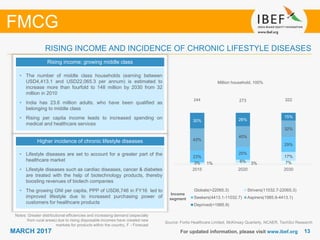
RISING INCOME AND INCIDENCE OF CHRONIC LIFESTYLE DISEASES
Rising income; growing middle class
• The number of middle class households (earning between
USD4,413.1 and USD22,065.3 per annum) is estimated to
increase more than fourfold to 148 million by 2030 from 32
million in 2010
• India has 23.6 million adults, who have been qualified as
belonging to middle class
• Rising per capita income leads to increased spending on
medical and healthcare services
Higher incidence of chronic lifestyle diseases
• Lifestyle diseases are set to account for a greater part of the
healthcare market
• Lifestyle diseases such as cardiac diseases, cancer & diabetes
are treated with the help of biotechnology products, thereby
boosting revenues of biotech companies
• The growing GNI per capita, PPP of USD6,746 in FY16 led to
improved lifestyle due to increased purchasing power of
customers for healthcare products
Notes: Greater distributional efficiencies and increasing demand (especially
from rural areas) due to rising disposable incomes have created new
markets for products within the country, F - Forecast
Million household, 100%
Income
segment
244 273 322
1% 3% 7%3% 6%
17%23%
25%
29%
43%
40%
32%
30% 26%
15%
2015 2020 2030
Globals(>22065.3) Strivers(11032.7-22065.3)
Seekers(4413.1-11032.7) Aspirers(1985.9-4413.1)
Deprived(<1985.9)
1414MARCH 2017 For updated information, please visit www.ibef.org
RURAL SEGMENT QUICKLY CATCHING UP … (1/3)
Source: Mckinsey Global Institute: The Bird of gold AC Nielsen,
TechSci Research
Note: F – Forecast
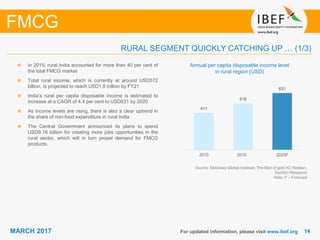
Annual per capita disposable income level
in rural region (USD)
In 2015, rural India accounted for more than 40 per cent of
the total FMCG market
Total rural income, which is currently at around USD572
billion, is projected to reach USD1.8 trillion by FY21
India’s rural per capita disposable income is estimated to
increase at a CAGR of 4.4 per cent to USD631 by 2020
As income levels are rising, there is also a clear uptrend in
the share of non-food expenditure in rural India
The Central Government announced its plans to spend
USD9.16 billion for creating more jobs opportunities in the
rural sector, which will in turn propel demand for FMCG
products.
FMCG
411
516
631
2010 2015E 2020F
1515MARCH 2017 For updated information, please visit www.ibef.org
Source: AC Nielsen, TechSci Research, Dabur Reports
Notes: E-Estimated
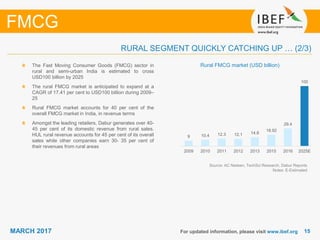
Rural FMCG market (USD billion)The Fast Moving Consumer Goods (FMCG) sector in
rural and semi-urban India is estimated to cross
USD100 billion by 2025
The rural FMCG market is anticipated to expand at a
CAGR of 17.41 per cent to USD100 billion during 2009–
25
Rural FMCG market accounts for 40 per cent of the
overall FMCG market in India, in revenue terms
Amongst the leading retailers, Dabur generates over 40-
45 per cent of its domestic revenue from rural sales.
HUL rural revenue accounts for 45 per cent of its overall
sales while other companies earn 30- 35 per cent of
their revenues from rural areas
FMCG
RURAL SEGMENT QUICKLY CATCHING UP … (2/3)
9 10.4 12.3 12.1 14.8
18.92
29.4
100
2009 2010 2011 2012 2013 2015 2016 2025E
1616MARCH 2017
INCREASING SALES OF TOP FMCG COMPANIES
For updated information, please visit www.ibef.org
FMCG
Source: Company Websites
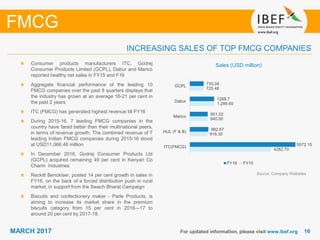
Sales (USD million)Consumer products manufacturers ITC, Godrej
Consumer Products Limited (GCPL), Dabur and Marico
reported healthy net sales in FY15 and F16
Aggregate financial performance of the leading 10
FMCG companies over the past 8 quarters displays that
the industry has grown at an average 16-21 per cent in
the past 2 years
ITC (FMCG) has generated highest revenue till FY16
During 2015-16, 7 leading FMCG companies in the
country have fared better than their multinational peers,
in terms of revenue growth. The combined revenue of 7
leading Indian FMCG companies during 2015-16 stood
at USD11,066.46 million
In December 2016, Godrej Consumer Products Ltd
(GCPL) acquired remaining 49 per cent in Kenyan Co
Charm Industries
Reckitt Benckiser, posted 14 per cent growth in sales in
FY16, on the back of a forced distribution push in rural
market, in support from the Swach Bharat Campaign
Biscuits and confectionery maker - Parle Products, is
aiming to increase its market share in the premium
biscuits category from 15 per cent in 2016—17 to
around 20 per cent by 2017-18.
4282.70
916.30
940.00
1,295.60
725.48
5572.15
982.67
951.02
1288.7
735.04
ITC(FMCG)
HUL (F & B)
Marico
Dabur
GCPL
FY16 FY15
1717MARCH 2017 For updated information, please visit www.ibef.org
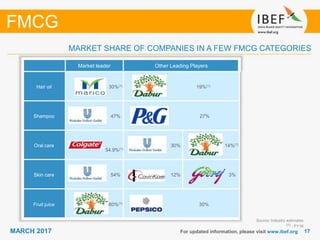
MARKET SHARE OF COMPANIES IN A FEW FMCG CATEGORIES
FMCG
Market leader Other Leading Players
Hair oil 30%(1) 19%(1)
Shampoo 47% 27%
Oral care
54.9%(1)
30% 14%(1)
Skin care 54% 12% 3%
Fruit juice 60%(1) 30%
Source: Industry estimates
(1) : FY16
1818MARCH 2017 For updated information, please visit www.ibef.org
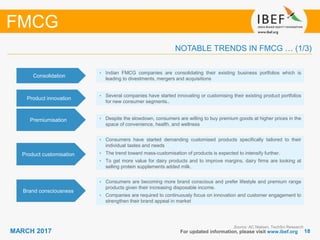
NOTABLE TRENDS IN FMCG … (1/3)
Source: AC Nielsen, TechSci Research
FMCG
Premiumisation • Despite the slowdown, consumers are willing to buy premium goods at higher prices in the
space of convenience, health, and wellness
Product customisation
• Consumers have started demanding customised products specifically tailored to their
individual tastes and needs
• The trend toward mass-customisation of products is expected to intensify further.
• To get more value for dairy products and to improve margins, dairy firms are looking at
selling protein supplements added milk.
Brand consciousness
• Consumers are becoming more brand conscious and prefer lifestyle and premium range
products given their increasing disposable income.
• Companies are required to continuously focus on innovation and customer engagement to
strengthen their brand appeal in market
Consolidation
• Indian FMCG companies are consolidating their existing business portfolios which is
leading to divestments, mergers and acquisitions
Product innovation
• Several companies have started innovating or customising their existing product portfolios
for new consumer segments..
1919MARCH 2017 For updated information, please visit www.ibef.org
FMCG
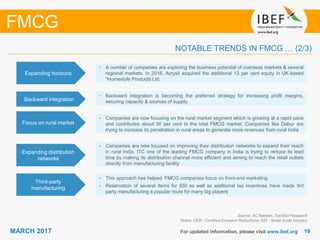
NOTABLE TRENDS IN FMCG … (2/3)
Third-party
manufacturing
• This approach has helped FMCG companies focus on front-end marketing
• Reservation of several items for SSI as well as additional tax incentives have made 3rd
party manufacturing a popular route for many big players
Source: AC Nielsen, TechSci Research
Notes: CER - Certified Emission Reductions; SSI - Small Scale Industry
Focus on rural market
• Companies are now focusing on the rural market segment which is growing at a rapid pace
and contributes about 50 per cent to the total FMCG market. Companies like Dabur are
trying to increase its penetration in rural areas to generate more revenues from rural India
Expanding distribution
networks
• Companies are now focused on improving their distribution networks to expand their reach
in rural India. ITC one of the leading FMCG company in India is trying to reduce its lead
time by making its distribution channel more efficient and aiming to reach the retail outlets
directly from manufacturing facility
Expanding horizons
• A number of companies are exploring the business potential of overseas markets & several
regional markets. In 2016, Acrysil acquired the additional 13 per cent equity in UK-based
"Homestyle Products Ltd.
Backward integration
• Backward integration is becoming the preferred strategy for increasing profit margins,
securing capacity & sources of supply.
2020MARCH 2017 For updated information, please visit www.ibef.org
FMCG
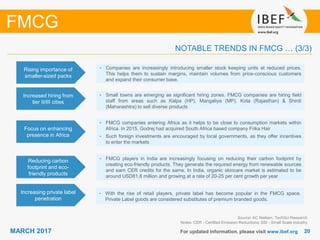
NOTABLE TRENDS IN FMCG … (3/3)
Focus on enhancing
presence in Africa
• FMCG companies entering Africa as it helps to be close to consumption markets within
Africa. In 2015, Godrej had acquired South Africa based company Frika Hair
• Such foreign investments are encouraged by local governments, as they offer incentives
to enter the markets
Reducing carbon
footprint and eco-
friendly products
• FMCG players in India are increasingly focusing on reducing their carbon footprint by
creating eco-friendly products. They generate the required energy from renewable sources
and earn CER credits for the same. In India, organic skincare market is estimated to be
around USD81.8 million and growing at a rate of 20-25 per cent growth per year
Increasing private label
penetration
• With the rise of retail players, private label has become popular in the FMCG space.
Private Label goods are considered substitutes of premium branded goods.
Source: AC Nielsen, TechSci Research
Notes: CER - Certified Emission Reductions; SSI - Small Scale Industry
Rising importance of
smaller-sized packs
• Companies are increasingly introducing smaller stock keeping units at reduced prices.
This helps them to sustain margins, maintain volumes from price-conscious customers
and expand their consumer base.
Increased hiring from
tier II/III cities
• Small towns are emerging as significant hiring zones. FMCG companies are hiring field
staff from areas such as Kalpa (HP), Mangaliya (MP), Kota (Rajasthan) & Shirdi
(Maharashtra) to sell diverse products
PORTERS FIVE FORCES ANALYSIS
FMCG
2222MARCH 2017 For updated information, please visit www.ibef.org
PORTERS FIVE FORCES ANALYSIS
Source: TechSci Research
FMCG
Competitive Rivalry
• Private label brands by retailers are priced at a discount to mainframe
brands limits competition for the weak brands
• Highly fragmented industry as more MNCs are entering
Threat of New Entrants Substitute Products
Bargaining Power of Suppliers Bargaining Power of Customers
• Huge investments in setting up
distribution network and
promoting brands
• Spending on advertisements is
aggressive
• Big FMCG companies are able
to dictate the prices through
local sourcing from a
fragmented group of key
commodity suppliers
• Low switching cost induces the
customers’ product shift
• Influence of marketing
strategies
• Availability of same or similar
alternatives
• Presence of multiple brands
• Narrow product differentiation
under many brands
• Price war
Competitive
Rivalry
(High)
Threat of New
Entrants
(Medium)
Substitute
Products
(High)
Bargaining
Power of
Customers
(High)
Bargaining
Power of
Suppliers
(Low)
STRATEGIES ADOPTED
FMCG
2424MARCH 2017 For updated information, please visit www.ibef.org
STRATEGIES ADOPTED
FMCG
Source: AC Nielsen, TechSci Research
• FMCG companies are trying to influence consumers with intelligent deals
• Firms like ITC offers combo deals to the consumers. For example, in the case of soaps &
cosmetics; 4 soap cases are offered at the price of 3, selling the range of deodorants for men &
women at a discounted price
• The internet enables consumers to make their own research on the kind of products or
commodities they want to purchase. 1 in 3 FMCG shoppers goes online 1st & then to the stores
• Almost half of the automobile consumers follow Research Online Purchase Offline (ROPO)
method
• Indian consumers have become choosy & are less likely to stay loyal to a brand
• Colgate-Palmolive has launched a toothpaste for the inflammatory gum problem of pyorrhea
• ITC is coming up with new multigrain Bingo
• Dabur has launched its sugar free variant for Chyawanprash in India
Promotions & offers
Research online
Purchase offline
Production innovation
• Product Flanking: Introduction of different combinations of products at different prices, to cover
as many market segments as possible
• Different types of same product for different users’ population. For example: Calcium Sandoz &
Calcium Sandoz Women & Horlicks for older women, Junior Horlicks
Customisation
GROWTH DRIVERS
FMCG
2626MARCH 2017 For updated information, please visit www.ibef.org
GROWTH DRIVERS OF INDIA’S FMCG SECTOR … (1/2)
Source: Dabur, TechSci Research
Note: FDI - Foreign Direct Investment
FMCG
Rising
incomes
driving
purchase Desire to
experiment
with brands
Evolving
consumer
lifestyle
New product
launches
Growing rural
market
Growth of
modern trade
Strong
distribution
channel
Availability of
online
grocery
stores
Increasing
consumer
demand
Greater
awareness of
products,
brands
Government
reforms to
encourage FDI
inflow and market
sentiments
FMCG
growth
drivers
2727MARCH 2017 For updated information, please visit www.ibef.org
GROWTH DRIVERS FOR INDIA’s FMCG SECTOR … (2/2)
Source: Dabur
FMCG
Growth
drivers
Increase in penetration
• Low penetration levels of branded products in
categories like instant foods indicating a scope
for volume growth
• Investment in this sector attracts investors as
the FMCG products have demand throughout
the year.
Rural consumption
• Rural consumption has increased, led by a
combination of increasing incomes and higher
aspiration levels, there is an increased
demand for branded products in rural India
• Huge untapped rural market
• Godrej is launching OneRural programme to
generate more revenues from rural areas
• Rural India is estimated to account for ~50 per
cent of the total FMCG market, in 2016
Shift to organised market
• Organised sector growth is expected to grow
as the share of unorganised market in the
FMCG sector fall with increased level of
brand consciousness
• Growth in modern retail will augment the
growth of organised FMCG sector
Easy access
• Availability of products has become way
more easier as internet and different
channels of sales has made the accessibility
of desired product to customers more
convenient at required time and place
• Online grocery stores and online retail stores
like Grofers, Flipkart, Amazon making the
FMCG product s more readily available
2828MARCH 2017 For updated information, please visit www.ibef.org
HIGHER INCOMES AID GROWTH IN URBAN AND RURAL MARKETS
FMCG
Source: IMF, World Bank, TechSci Research
Notes: F - Forecast, E – Estimated, CAGR - Compound Annual Growth Rate
India’s nominal per capita income (USD)Incomes have risen at a brisk pace in India & will
continue rising given the country’s strong economic
growth prospects. According to IMF, nominal per capita
income is estimated to grow at a CAGR of 4.94 per cent
during 2010-19F
An important consequence of rising incomes is growing
appetite for premium products, primarily in the urban
segment
As the proportion of ‘working age population’ in total
population increases, per capita income & GDP are
expected to surge
Per capita income in India is expected to grow at a
CAGR of 8.09 per cent during 2015-19F
1430.2
1552.5
1514.8
1504.5
1600.9
1617.3
1942
1874.9
2026.7
2207.6
-4.0%
-2.0%
0.0%
2.0%
4.0%
6.0%
8.0%
10.0%
0.0
500.0
1000.0
1500.0
2000.0
2500.0
GDP per capita, current prices Growth Rate
2929MARCH 2017 For updated information, please visit www.ibef.org
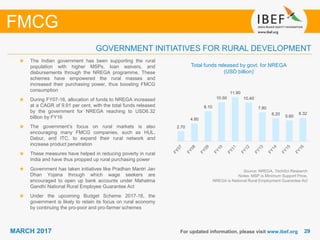
GOVERNMENT INITIATIVES FOR RURAL DEVELOPMENT
FMCG
Source: NREGA, TechSci Research
Notes: MSP is Minimum Support Price,
NREGA is National Rural Employment Guarantee Act
Total funds released by govt. for NREGA
(USD billion)
The Indian government has been supporting the rural
population with higher MSPs, loan waivers, and
disbursements through the NREGA programme. These
schemes have empowered the rural masses and
increased their purchasing power, thus boosting FMCG
consumption
During FY07-16, allocation of funds to NREGA increased
at a CAGR of 9.91 per cent, with the total funds released
by the government for NREGA reaching to USD6.32
billion by FY16
The government’s focus on rural markets is also
encouraging many FMCG companies, such as HUL,
Dabur, and ITC, to expand their rural network and
increase product penetration
These measures have helped in reducing poverty in rural
India and have thus propped up rural purchasing power
Government has taken initiatives like Pradhan Mantri Jan
Dhan Yojana through which wage seekers are
encouraged to open up bank accounts under Mahatma
Gandhi National Rural Employee Guarantee Act
Under the upcoming Budget Scheme 2017-18, the
government is likely to retain its focus on rural economy
by continuing the pro-poor and pro-farmer schemes
2.70
4.80
8.10
10.50
11.90
10.40
7.80
6.20
5.60
6.32
3030MARCH 2017 For updated information, please visit www.ibef.org
FDI INFLOWS RISE OVER THE YEARS
FMCG
Source: DIPP, TechSci Research
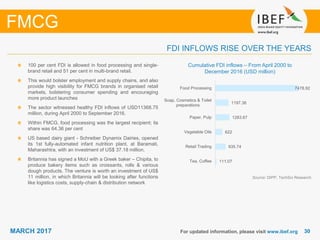
Cumulative FDI inflows – From April 2000 to
December 2016 (USD million)
100 per cent FDI is allowed in food processing and single-
brand retail and 51 per cent in multi-brand retail.
This would bolster employment and supply chains, and also
provide high visibility for FMCG brands in organised retail
markets, bolstering consumer spending and encouraging
more product launches
The sector witnessed healthy FDI inflows of USD11368.75
million, during April 2000 to September 2016.
Within FMCG, food processing was the largest recipient; its
share was 64.36 per cent
US based dairy giant - Schreiber Dynamix Dairies, opened
its 1st fully-automated infant nutrition plant, at Baramati,
Maharashtra, with an investment of US$ 37.18 million.
Britannia has signed a MoU with a Greek baker – Chipita, to
produce bakery items such as croissants, rolls & various
dough products. The venture is worth an investment of US$
11 million, in which Britannia will be looking after functions
like logistics costs, supply-chain & distribution network
111.07
935.74
622
1283.67
1197.36
7478.92
Tea, Coffee
Retail Trading
Vegetable Oils
Paper, Pulp
Soap, Cosmetics & Toilet
preparations
Food Processing
3131MARCH 2017 For updated information, please visit www.ibef.org
POLICY AND REGULATORY FRAMEWORK … (1/2)
FMCG
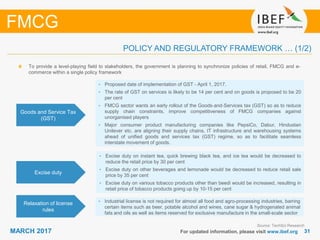
Goods and Service Tax
(GST)
• Proposed date of implementation of GST - April 1, 2017.
• The rate of GST on services is likely to be 14 per cent and on goods is proposed to be 20
per cent
• FMCG sector wants an early rollout of the Goods‐and‐Services tax (GST) so as to reduce
supply chain constraints, improve competitiveness of FMCG companies against
unorganised players
• Major consumer product manufacturing companies like PepsiCo, Dabur, Hindustan
Unilever etc. are aligning their supply chains, IT infrastructure and warehousing systems
ahead of unified goods and services tax (GST) regime, so as to facilitate seamless
interstate movement of goods.
Excise duty
• Excise duty on instant tea, quick brewing black tea, and ice tea would be decreased to
reduce the retail price by 30 per cent
• Excise duty on other beverages and lemonade would be decreased to reduce retail sale
price by 35 per cent
• Excise duty on various tobacco products other than beedi would be increased, resulting in
retail price of tobacco products going up by 10-15 per cent
Relaxation of license
rules
• Industrial license is not required for almost all food and agro-processing industries, barring
certain items such as beer, potable alcohol and wines, cane sugar & hydrogenated animal
fats and oils as well as items reserved for exclusive manufacture in the small-scale sector
Source: TechSci Research
To provide a level-playing field to stakeholders, the government is planning to synchronize policies of retail, FMCG and e-
commerce within a single policy framework
3232MARCH 2017 For updated information, please visit www.ibef.org
FMCG
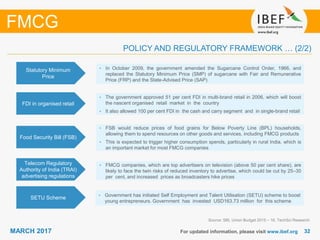
Food Security Bill (FSB)
• FSB would reduce prices of food grains for Below Poverty Line (BPL) households,
allowing them to spend resources on other goods and services, including FMCG products
• This is expected to trigger higher consumption spends, particularly in rural India, which is
an important market for most FMCG companies
Telecom Regulatory
Authority of India (TRAI)
advertising regulations
• FMCG companies, which are top advertisers on television (above 50 per cent share), are
likely to face the twin risks of reduced inventory to advertise, which could be cut by 25–30
per cent, and increased prices as broadcasters hike prices
Source: SBI, Union Budget 2015 – 16, TechSci Research
POLICY AND REGULATORY FRAMEWORK … (2/2)
SETU Scheme
• Government has initiated Self Employment and Talent Utilisation (SETU) scheme to boost
young entrepreneurs. Government has invested USD163.73 million for this scheme
FDI in organised retail
• The government approved 51 per cent FDI in multi-brand retail in 2006, which will boost
the nascent organised retail market in the country
• It also allowed 100 per cent FDI in the cash and carry segment and in single-brand retail
Statutory Minimum
Price
• In October 2009, the government amended the Sugarcane Control Order, 1966, and
replaced the Statutory Minimum Price (SMP) of sugarcane with Fair and Remunerative
Price (FRP) and the State-Advised Price (SAP)
3333MARCH 2017 For updated information, please visit www.ibef.org
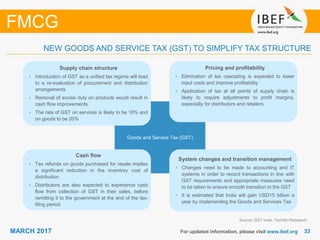
NEW GOODS AND SERVICE TAX (GST) TO SIMPLIFY TAX STRUCTURE
Source: GST India, TechSci Research
Goods and Service Tax (GST)
System changes and transition management
• Changes need to be made to accounting and IT
systems in order to record transactions in line with
GST requirements and appropriate measures need
to be taken to ensure smooth transition to the GST
• It is estimated that India will gain USD15 billion a
year by implementing the Goods and Services Tax
Supply chain structure
• Introduction of GST as a unified tax regime will lead
to a re-evaluation of procurement and distribution
arrangements
• Removal of excise duty on products would result in
cash flow improvements
• The rate of GST on services is likely to be 16% and
on goods to be 20%
Cash flow
• Tax refunds on goods purchased for resale implies
a significant reduction in the inventory cost of
distribution
• Distributors are also expected to experience cash
flow from collection of GST in their sales, before
remitting it to the government at the end of the tax-
filing period
Pricing and profitability
• Elimination of tax cascading is expected to lower
input costs and improve profitability
• Application of tax at all points of supply chain is
likely to require adjustments to profit margins,
especially for distributors and retailers
FMCG
3434MARCH 2017 For updated information, please visit www.ibef.org
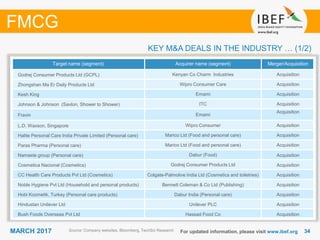
KEY M&A DEALS IN THE INDUSTRY … (1/2)
Source: Company websites, Bloomberg, TechSci Research
FMCG
Target name (segment) Acquirer name (segment) Merger/Acquisition
Godrej Consumer Products Ltd (GCPL) Kenyan Co Charm Industries Acquisition
Zhongshan Ma Er Daily Products Ltd Wipro Consumer Care Acquisition
Kesh King Emami Acquisition
Johnson & Johnson (Savlon, Shower to Shower) ITC Acquisition
Fravin Emami
Acquisition
L.D. Waxson, Singapore Wipro Consumer Acquisition
Halite Personal Care India Private Limited (Personal care) Marico Ltd (Food and personal care) Acquisition
Paras Pharma (Personal care) Marico Ltd (Food and personal care) Acquisition
Namaste group (Personal care) Dabur (Food) Acquisition
Cosmetica Nacional (Cosmetics) Godrej Consumer Products Ltd Acquisition
CC Health Care Products Pvt Ltd (Cosmetics) Colgate-Palmolive India Ltd (Cosmetics and toiletries) Acquisition
Noble Hygiene Pvt Ltd (Household and personal products) Bennett Coleman & Co Ltd (Publishing) Acquisition
Hobi Kozmetik, Turkey (Personal care products) Dabur India (Personal care) Acquisition
Hindustan Unilever Ltd Unilever PLC Acquisition
Bush Foods Overseas Pvt Ltd Hassad Food Co Acquisition
3535MARCH 2017 For updated information, please visit www.ibef.org
FMCG
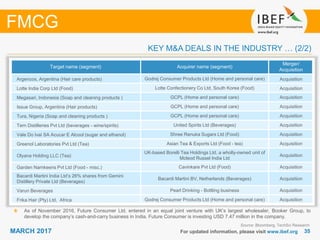
KEY M&A DEALS IN THE INDUSTRY … (2/2)
Target name (segment) Acquirer name (segment)
Merger/
Acquisition
Argencos, Argentina (Hair care products) Godrej Consumer Products Ltd (Home and personal care) Acquisition
Lotte India Corp Ltd (Food) Lotte Confectionery Co Ltd, South Korea (Food) Acquisition
Megasari, Indonesia (Soap and cleaning products ) GCPL (Home and personal care) Acquisition
Issue Group, Argentina (Hair products) GCPL (Home and personal care) Acquisition
Tura, Nigeria (Soap and cleaning products ) GCPL (Home and personal care) Acquisition
Tern Distilleries Pvt Ltd (beverages - wine/spirits) United Spirits Ltd (Beverages) Acquisition
Vale Do Ivai SA Acucar E Alcool (sugar and ethanol) Shree Renuka Sugars Ltd (Food) Acquisition
Greenol Laboratories Pvt Ltd (Tea) Asian Tea & Exports Ltd (Food - tea) Acquisition
Olyana Holding LLC (Tea)
UK-based Borelli Tea Holdings Ltd, a wholly-owned unit of
Mcleod Russel India Ltd
Acquisition
Garden Namkeens Pvt Ltd (Food - misc.) Cavinkare Pvt Ltd (Food) Acquisition
Bacardi Martini India Ltd’s 26% shares from Gemini
Distillery Private Ltd (Beverages)
Bacardi Martini BV, Netherlands (Beverages) Acquisition
Varun Beverages Pearl Drinking - Bottling business Acquisition
Frika Hair (Pty) Ltd, Africa Godrej Consumer Products Ltd (Home and personal care) Acquisition
Source: Bloomberg, TechSci Research
As of November 2016, Future Consumer Ltd. entered in an equal joint venture with UK’s largest wholesaler, Booker Group, to
develop the company’s cash-and-carry business in India. Future Consumer is investing USD 7.47 million in the company.
OPPORTUNITIES
FMCG
3737MARCH 2017 For updated information, please visit www.ibef.org
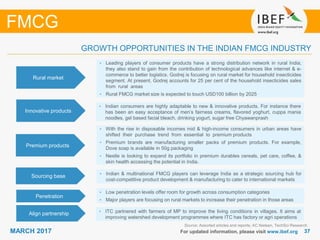
GROWTH OPPORTUNITIES IN THE INDIAN FMCG INDUSTRY
Source: Assorted articles and reports; AC Nielsen, TechSci Research
FMCG
Rural market
• Leading players of consumer products have a strong distribution network in rural India;
they also stand to gain from the contribution of technological advances like internet & e-
commerce to better logistics. Godrej is focusing on rural market for household insecticides
segment. At present, Godrej accounts for 25 per cent of the household insecticides sales
from rural areas
• Rural FMCG market size is expected to touch USD100 billion by 2025
Innovative products
• Indian consumers are highly adaptable to new & innovative products. For instance there
has been an easy acceptance of men’s fairness creams, flavored yoghurt, cuppa mania
noodles, gel based facial bleach, drinking yogurt, sugar free Chyawanprash
Premium products
• With the rise in disposable incomes mid & high-income consumers in urban areas have
shifted their purchase trend from essential to premium products
• Premium brands are manufacturing smaller packs of premium products. For example,
Dove soap is available in 50g packaging
• Nestle is looking to expand its portfolio in premium durables cereals, pet care, coffee, &
skin health accessing the potential in India.
Sourcing base • Indian & multinational FMCG players can leverage India as a strategic sourcing hub for
cost-competitive product development & manufacturing to cater to international markets
Penetration
• Low penetration levels offer room for growth across consumption categories
• Major players are focusing on rural markets to increase their penetration in those areas
Align partnership • ITC partnered with farmers of MP to improve the living conditions in villages. It aims at
improving watershed development programmes where ITC has factory or agri operations
3838MARCH 2017 For updated information, please visit www.ibef.org
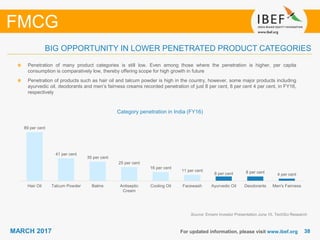
BIG OPPORTUNITY IN LOWER PENETRATED PRODUCT CATEGORIES
Source: Emami Investor Presentation June 15, TechSci Research
FMCG
Penetration of many product categories is still low. Even among those where the penetration is higher, per capita
consumption is comparatively low, thereby offering scope for high growth in future
Penetration of products such as hair oil and talcum powder is high in the country, however, some major products including
ayurvedic oil, deodorants and men’s fairness creams recorded penetration of just 8 per cent, 8 per cent 4 per cent, in FY16,
respectively
Category penetration in India (FY16)
89 per cent
41 per cent
35 per cent
25 per cent
16 per cent
11 per cent
8 per cent 8 per cent
4 per cent
Hair Oil Talcum Powder Balms Antiseptic
Cream
Cooling Oil Facewash Ayurvedic Oil Deodorants Men's Fairness
3939MARCH 2017 For updated information, please visit www.ibef.org
INCREASING FMCG SHARE IN MODERN RETAIL
Source: TCS Report, AC Nielsen, TechSci Research
Note: E- Estimated
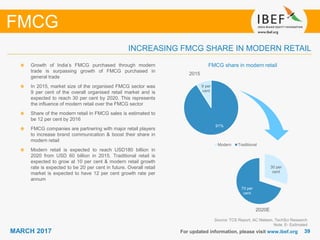
FMCG share in modern retailGrowth of India’s FMCG purchased through modern
trade is surpassing growth of FMCG purchased in
general trade
In 2015, market size of the organised FMCG sector was
9 per cent of the overall organised retail market and is
expected to reach 30 per cent by 2020. This represents
the influence of modern retail over the FMCG sector
Share of the modern retail in FMCG sales is estimated to
be 12 per cent by 2016
FMCG companies are partnering with major retail players
to increase brand communication & boost their share in
modern retail
Modern retail is expected to reach USD180 billion in
2020 from USD 60 billion in 2015. Traditional retail is
expected to grow at 10 per cent & modern retail growth
rate is expected to be 20 per cent in future. Overall retail
market is expected to have 12 per cent growth rate per
annum
FMCG
30 per
cent
70 per
cent
2020E
Modern Traditional
2015
91%
9 per
cent
SUCCESS STORIES
FMCG
4141MARCH 2017 For updated information, please visit www.ibef.org
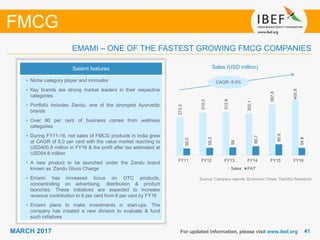
EMAMI – ONE OF THE FASTEST GROWING FMCG COMPANIES
Source: Company reports, Economic Times, TechSci Research
Sales (USD million)
FMCG
Salient features
• Niche category player and innovator
• Key brands are strong market leaders in their respective
categories
• Portfolio includes Zandu, one of the strongest Ayurvedic
brands
• Over 80 per cent of business comes from wellness
categories
• During FY11-16, net sales of FMCG products in India grew
at CAGR of 8.0 per cent with the value market reaching to
USD400.9 million in FY16 & the profit after tax estimated at
USD54.8 million
• A new product to be launched under the Zandu brand
known as ‘Zandu Gluco Charge
• Emami has increased focus on OTC products,
concentrating on advertising, distribution & product
launches. These initiatives are expected to increase
revenue contribution to 8 per cent from 6 per cent by FY16
• Emami plans to make investments in start-ups. The
company has created a new division to evaluate & fund
such initiatives
CAGR: 8.0%
273.3
310.2
312.8
302.1
367.8
400.9
50.2
55.2
58
66.7
80.6
54.8
FY11 FY12 FY13 FY14 FY15 FY16
Sales PAT
4242MARCH 2017 For updated information, please visit www.ibef.org
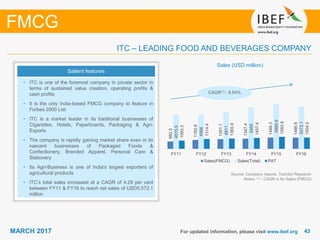
DABUR – RIDING ON STRONG BRAND EQUITY IN INDIA
Source: Dabur Annual Report 2015-16, TechSci Research
Sales (USD million)
FMCG
Salient features
• Among top four FMCG companies in India
• 14 brands with turnover of USD16.6 million with 3
brands over USD165.9 million
• Wide distribution network covering 2.8 million retailers
across the country
• 17 world-class manufacturing plants catering to needs
of diverse markets
• Dabur’s Vision Plan for 2011-15, successfully got
completed with the sales of USD1,295.6 million
recording a growth of 9.7%
• In 2016, Dabur registered sales of FMCG products
worth USD1,288.7 million growing at a CAGR of 7.6%
over FY11-16
• The company plans to acquire the personal care, hair
care and creams businesses of CTL group based in
South Africa, at an estimated cost of USD 1.5 million
• In January 2017, NewU, a beauty retail venture of
Dabur, announced plans of bringing Sri Lankan beauty
products brand - Spice Island, to India to strengthen
their portfolio
CAGR: 7.6%
894.3
1126.3
1132.4
1172.9
1295.6
1288.7
124.9
136.5
139.9
151
177.5
191.8
FY11 FY12 FY13 FY14 FY15 FY16
Sales PAT
4343MARCH 2017 For updated information, please visit www.ibef.org
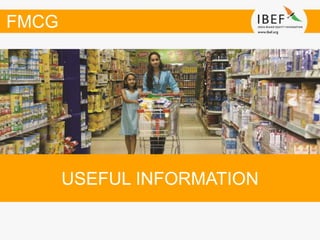
ITC – LEADING FOOD AND BEVERAGES COMPANY
FMCG
Source: Company reports, TechSci Research
Notes: (1) - CAGR is for Sales (FMCG)
Sales (USD million)
Salient features
• ITC is one of the foremost company in private sector in
terms of sustained value creation, operating profits &
cash profits
• It is the only India-based FMCG company to feature in
Forbes 2000 List
• ITC is a market leader in its traditional businesses of
Cigarettes, Hotels, Paperboards, Packaging & Agri-
Exports
• The company is rapidly gaining market share even in its
nascent businesses of Packaged Foods &
Confectionery, Branded Apparel, Personal Care &
Stationery
• Its Agri-Business is one of India's largest exporters of
agricultural products
• ITC’s total sales increased at a CAGR of 4.29 per cent
between FY11 & FY16 to reach net sales of USD5,572.1
million
CAGR(1) : 8.64%
982.5
1182.8
1291.1
1347.4
1499.3
1486.6
4515.5
4566
4911
5455
5985.9
5572.1
1093.3
1314.4
1365.9
1457.4
1593.9
1504.0
FY11 FY12 FY13 FY14 FY15 FY16
Sales(FMCG) Sales(Total) PAT
USEFUL INFORMATION
FMCG
4545MARCH 2017
INDUSTRY ASSOCIATIONS … (1/3)
Indian Dairy Association
Secretary (Establishment)
Indian Dairy Association, Sector-IV, New Delhi –110022
Phone: 91-11-26170781, 26165355, 26179780
Fax: 91 11 26174719
E-mail: ida@nde.vsnl.net.in
Website: www.indairyasso.org
All India Bread Manufacturers’ Association
PHD House, 4/2, Siri Institutional Area, August Kranti Marg,
New Delhi –110016
Phone: 91-11-26515137; Fax: 91-11-26855450
E-mail: aibma@rediffmail.com; mallika@phdcci.in
Website: www.aibma.com
All India Food Preservers’ Association
206, Aurobindo Place Market Complex
Hauz Khas, New Delhi –110016
Phone: 91-11-26510860, 26518848; Fax: 91-11-26510860
Website: www.aifpa.net
For updated information, please visit www.ibef.org
FMCG
4646MARCH 2017
INDUSTRY ASSOCIATIONS … (2/3)
Federation of Biscuit Manufacturers of India
PHD House, 4/2, Siri Institutional Area, August Kranti Marg, New
Delhi –110016
Phone: 91-11-26515137; Fax: 91-11-26855450
E-mail: fbmi@rediffmail.com; mallika@phdcci.in
Website: www.biscuitfederation.com
Indian Soap & Toiletries Manufacturers’ Association
Raheja Centre, 6th Floor, Room No 614, Backbay Reclamation,
Mumbai – 400021
Phone: 91-22-2824115; Fax: 91-22-22853649
E-mail: istma@bom3.vsnl.net.in
Indian Soft Drinks Manufacturers' Association
702, Ansal Bhawan, 16 KG Marg, New Delhi – 110001
Phone: 91-11-46470200; Fax: 91-11-23327747
For updated information, please visit www.ibef.org
FMCG
4747MARCH 2017
INDUSTRY ASSOCIATIONS … (3/3)
The Solvent Extractors' Association of India
142, Jolly Maker Chambers, No 2, 14th Floor, 225, Nariman Point,
Mumbai – 400021
Tel: 91-22-22021475, 22822979; Fax: 91-22-22021692
E-mail: solvent@mtnl.net.in
Website: www.seaofindia.com
Vanaspati Manufacturers’ Association of India
903, Akashdeep Building, 26-A, Barakhamba Road,
New Delhi –110001
Phone: 91-11-23312640; Fax: 91-11-23315698
For updated information, please visit www.ibef.org
FMCG
4848MARCH 2017
GLOSSARY
FDI: Foreign Direct Investment
MSP: Minimum Selling Price
NREGA: National Rural Employment Guarantee Act
FY: Indian Financial Year (April to March)
So FY09 implies April 2008 to March 2009
SEZ: Special Economic Zone
MoU: Memorandum of Understanding
Wherever applicable, numbers have been rounded off to the nearest whole number
For updated information, please visit www.ibef.org
FMCG
4949MARCH 2017
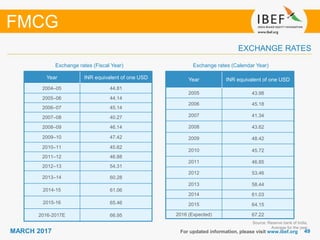
Exchange rates (Fiscal Year)
For updated information, please visit www.ibef.org
EXCHANGE RATES
Exchange rates (Calendar Year)
FMCG
Year INR equivalent of one USD
2004–05 44.81
2005–06 44.14
2006–07 45.14
2007–08 40.27
2008–09 46.14
2009–10 47.42
2010–11 45.62
2011–12 46.88
2012–13 54.31
2013–14 60.28
2014-15 61.06
2015-16 65.46
2016-2017E 66.95
Source: Reserve bank of India,
Average for the year
Year INR equivalent of one USD
2005 43.98
2006 45.18
2007 41.34
2008 43.62
2009 48.42
2010 45.72
2011 46.85
2012 53.46
2013 58.44
2014 61.03
2015 64.15
2016 (Expected) 67.22
5050MARCH 2017
India Brand Equity Foundation (IBEF) engaged TechSci to prepare this presentation and the same has been prepared
by TechSci in consultation with IBEF.
All rights reserved. All copyright in this presentation and related works is solely and exclusively owned by IBEF. The
same may not be reproduced, wholly or in part in any material form (including photocopying or storing it in any
medium by electronic means and whether or not transiently or incidentally to some other use of this presentation),
modified or in any manner communicated to any third party except with the written approval of IBEF.
This presentation is for information purposes only. While due care has been taken during the compilation of this
presentation to ensure that the information is accurate to the best of TechSci and IBEF’s knowledge and belief, the
content is not to be construed in any manner whatsoever as a substitute for professional advice.
TechSci and IBEF neither recommend nor endorse any specific products or services that may have been mentioned in
this presentation and nor do they assume any liability or responsibility for the outcome of decisions taken as a result of
any reliance placed on this presentation.
Neither TechSci nor IBEF shall be liable for any direct or indirect damages that may arise due to any act or omission
on the part of the user due to any reliance placed or guidance taken from any portion of this presentation.
For updated information, please visit www.ibef.org
DISCLAIMER
FMCG

FMCG Sectore Report - March 2017

  • 1.
    11MARCH 2017 FMCG For updatedinformation, please visit www.ibef.orgMARCH 2017
  • 2.
    22MARCH 2017 Forupdated information, please visit www.ibef.org ❖ Executive Summary…………….……….….3 ❖ Advantage India………………………….…5 ❖ Market Overview and Trends…………...…7 ❖ Porters Five Forces Analysis ...……….....21 ❖ Strategies Adopted……………………..…23 ❖ Growth Drivers………………………….….25 ❖ Opportunities………………………….…...36 ❖ Success Stories………………………..….40 ❖ Useful Information………………………....44 FMCG MARCH 2017
  • 3.
    33MARCH 2017 Forupdated information, please visit www.ibef.org EXECUTIVE SUMMARY … (1/2) Source: World Bank, Emami Reports, Dabur Reports, AC Nielsen, Notes: F (Forecast) FMCG Favourable demographics and rise in income level to boost FMCG market CAGR: 20.6% Total consumption expenditure set to increase Total consumption expenditure to reach nearly USD3600 billion by 2020 from USD1411 billion in 2014 CAGR: 16.89% 1411 3600 2014 2020F The rural FMCG market in India is expected to grow at a CAGR of 14.6 per cent, during 2016–2025 and reach USD100 billion by 2025. As of 2016, the overall rural FMCG consumption stands at an estimated USD29.4 billion Rise in rural consumption to drive the FMCG market CAGR: 14.6% During 2016–2020, FMCG market in India is expected to grow at a CAGR of 20.6 per cent and is expected to reach USD103.7 billion by 2020 49 103.7 2016 2020FUSD billion 29.4 100 2016 2025F USD billion
  • 4.
    44MARCH 2017 Forupdated information, please visit www.ibef.org EXECUTIVE SUMMARY … (2/2) Source: Emami Reports, Dabur Reports, AC Nielsen, McKinsey Global Institute (MGI) titled The Bird of Gold, TechSci Research Note: Germany population is estimated to reach 81.26 million by 2016 Notes: F–Forecast; E-Estimated FMCG 160 267 2011 2016 CAGR: 10.8% CAGR: 4.11% India’s modern retail is expected to grow three times the present value by 2020 India’s middle income class to be thrice the total population in Germany by 2016 Rural India’s per capita disposable income set to increase The modern retail market is expected to grow from USD60 billion to USD180 billion during 2015-2020F India’s middle income population estimated to reach 267 million by 2016 from 160 million in 2011 Rural India’s per capita disposable income is estimated to rise to USD631 in 2020 from USD516 in 2015E CAGR: 24.57% 60.00 180.00 2015 2020FUSD billion USD billion USD 516 631 2015 2020F
  • 5.
  • 6.
    66MARCH 2017 Growing demand Forupdated information, please visit www.ibef.org ADVANTAGE INDIA Source: Emami, E – Estimates, F - Forecast TechSci Research 2016 FMCG market size: USD49 billion 2020F FMCG market size: USD103.7 billion FMCG Advantage India Growing demand • Rising incomes and growing youth population have been key growth drivers of the sector. Brand consciousness has also aided demand • 1st Time Modern Trade Shoppers spend is estimated to triple to USD1 billion by 2015 • Tier II/III cities are witnessing faster growth in modern trade Higher investments • Many players are expanding into new geographies & categories • Modern retail share is expected to triple its growth from USD60 billion in 2015 to USD180 billion in 2020 • With an investment of USD 254.50 million, Patanjali is planning to setup a food & herbal park in UP • Wipro is diversifying & expanding its product range in energy drinks, detergents & fabric conditioners. • Nestle is looking to expand its portfolio in premium durables cereals, pet care, coffee, & skin health accessing the potential in India. Attractive opportunities • Low penetration levels in rural market offers room for growth • Disposable income in rural India has increased due to the direct cash transfer scheme • Growing demand for premium products • Exports is another growth segment • E-commerce companies like Amazon are strengthening their business in FMCG sector, by positioning their platform pantry as front line offering to drive daily products sales. Policy support • Investment approval of up to 100 per cent foreign equity in single brand retail and 51 per cent in multi-brand retail • Initiatives like Food Security Bill and direct cash transfer subsidies reach about 40 per cent of households in India • The minimum capitalisation for foreign FMCG companies to invest in India is USD100 million
  • 7.
  • 8.
    88MARCH 2017 Forupdated information, please visit www.ibef.org THE FMCG MARKET HAS THREE MAIN SEGMENTS Source: Dabur, TechSci Research Notes: OTC is over the counter products; ethicals are a range of pharma products, Data as of March 2016 FMCG FMCG Household and Personal careFood & beverages Oral care, hair care, skin care, cosmetics/deodorants, perfumes, feminine hygiene and paper products, Fabric wash, household cleaners Health beverages, staples/cereals, bakery products, snacks, chocolates, ice cream, tea/coffee/soft drinks, processed fruits and vegetables, dairy products, and branded flour Health care OTC products and ethicals 50%19% 31%
  • 9.
    99MARCH 2017 Forupdated information, please visit www.ibef.org EVOLUTION OF THE INDIAN FMCG SECTOR Source: Dabur Annual Report, Economic Times, Emami Annual Report, Mckinsey Global Institute, CII, TechSci Research FMCG FMCG is the fourth largest sector in the Indian economy Household and Personal Care is the leading segment, accounting for 50 per cent of the overall market. Hair care (23 per cent) and Food & Beverages (19 per cent) comes next in terms of market share Growing awareness, easier access, and changing lifestyles have been the key growth drivers for the sector Retail market in India is estimated to reach USD1 trillion by 2020 from USD600 billion in 2015, with modern trade expected to grow at 20 per cent per annum, which is likely to boost revenues of FMCG companies People are gracefully embracing Ayurveda products, which has resulted in growth of FMCG major, Patanjali Ayurveda, with a m-cap of USD 14.94 billion. The company aims to expand globally in the next 5 to 10 years. Indian FMCG industry (USD billion) Market size of chocolates (USD million) Market size of personal care (USD billion) HUL’s share in FMCG market (Personal care) (%) >50 <3 <100 9.0 13 22.7 1,441 49 2000 2015 2016 2015 2015 2015
  • 10.
    1010MARCH 2017 Forupdated information, please visit www.ibef.org STRONG GROWTH IN THE INDIAN FMCG SECTOR FMCG Source: Booz & Company, Dabur, AC Nielsen, TechSci Research, Note: F - Forecast Trends in FMCG revenues over the years (USD billion) The FMCG sector in India generated revenues worth USD47.3 billion in 2015 Over 2007-16F, the sector is expected to post CAGR of 11.9 per cent in revenues In 2016, revenues for FMCG sector is expected to reach USD49 billion During 2015-16, seven leading FMCG companies in the country have fared better than their multinational peers, in terms of revenue growth. The combined revenue of 7 leading Indian FMCG companies during 2015-16 stood at USD 11,066.46 million In the long run, with the system becoming more transparent & easily compliable, demonetisation is expected to benefit organised players in the FMCG industry. CAGR: 11.9% 17.8 21.3 24.2 30.2 34.8 36.8 44.9 47.3 49 103.7 2007 2008 2009 2010 2011 2012 2013 2015 2016 2020F
  • 11.
    1111MARCH 2017 Forupdated information, please visit www.ibef.org FOOD AND PERSONAL CARE MAKE UP TWO-THIRDS OF REVENUES … (1/2) FMCG Source: Dabur, TechSci Research Hair Care is the leading segment, accounting for 23 per cent of the overall market in terms of revenue Food Products is the 2nd leading segment of the sector accounting for 19 per cent followed by health supplements & oral care which has a market share of 16 per cent & 15 per cent, respectively Market break-up by revenue (FY16) 23% 19% 16% 15% 9% 6% 7% 5% Hair Care Foods Health Supplements Oral Care OTC & Ethicals Home Care Digestives Skin Care
  • 12.
    1212MARCH 2017 Forupdated information, please visit www.ibef.org THE URBAN MARKET ACCOUNTS FOR A MAJOR CHUNK OF REVENUES FMCG Source: Emami, TechSci Research Urban/rural industry break-up (2016)Accounting for a revenue share of around 60 per cent, urban segment is the largest contributor to the overall revenue generated by the FMCG sector in India & recorded a market size of around USD29.4 billion in 2016 Semi-urban and rural segments are growing at a rapid pace; & accounted for a revenue share of 40 per cent in the overall revenues recorded by FMCG sector in India In the last few years, the FMCG market has grown at a faster pace in rural India compared with urban India FMCG products account for 50 per cent of total rural spending USD49 billion 60% 40% Urban Rural
  • 13.
    1313MARCH 2017 Forupdated information, please visit www.ibef.org FMCG Source: Fortis Healthcare Limited, McKinsey Quarterly, NCAER, TechSci Research RISING INCOME AND INCIDENCE OF CHRONIC LIFESTYLE DISEASES Rising income; growing middle class • The number of middle class households (earning between USD4,413.1 and USD22,065.3 per annum) is estimated to increase more than fourfold to 148 million by 2030 from 32 million in 2010 • India has 23.6 million adults, who have been qualified as belonging to middle class • Rising per capita income leads to increased spending on medical and healthcare services Higher incidence of chronic lifestyle diseases • Lifestyle diseases are set to account for a greater part of the healthcare market • Lifestyle diseases such as cardiac diseases, cancer & diabetes are treated with the help of biotechnology products, thereby boosting revenues of biotech companies • The growing GNI per capita, PPP of USD6,746 in FY16 led to improved lifestyle due to increased purchasing power of customers for healthcare products Notes: Greater distributional efficiencies and increasing demand (especially from rural areas) due to rising disposable incomes have created new markets for products within the country, F - Forecast Million household, 100% Income segment 244 273 322 1% 3% 7%3% 6% 17%23% 25% 29% 43% 40% 32% 30% 26% 15% 2015 2020 2030 Globals(>22065.3) Strivers(11032.7-22065.3) Seekers(4413.1-11032.7) Aspirers(1985.9-4413.1) Deprived(<1985.9)
  • 14.
    1414MARCH 2017 Forupdated information, please visit www.ibef.org RURAL SEGMENT QUICKLY CATCHING UP … (1/3) Source: Mckinsey Global Institute: The Bird of gold AC Nielsen, TechSci Research Note: F – Forecast Annual per capita disposable income level in rural region (USD) In 2015, rural India accounted for more than 40 per cent of the total FMCG market Total rural income, which is currently at around USD572 billion, is projected to reach USD1.8 trillion by FY21 India’s rural per capita disposable income is estimated to increase at a CAGR of 4.4 per cent to USD631 by 2020 As income levels are rising, there is also a clear uptrend in the share of non-food expenditure in rural India The Central Government announced its plans to spend USD9.16 billion for creating more jobs opportunities in the rural sector, which will in turn propel demand for FMCG products. FMCG 411 516 631 2010 2015E 2020F
  • 15.
    1515MARCH 2017 Forupdated information, please visit www.ibef.org Source: AC Nielsen, TechSci Research, Dabur Reports Notes: E-Estimated Rural FMCG market (USD billion)The Fast Moving Consumer Goods (FMCG) sector in rural and semi-urban India is estimated to cross USD100 billion by 2025 The rural FMCG market is anticipated to expand at a CAGR of 17.41 per cent to USD100 billion during 2009– 25 Rural FMCG market accounts for 40 per cent of the overall FMCG market in India, in revenue terms Amongst the leading retailers, Dabur generates over 40- 45 per cent of its domestic revenue from rural sales. HUL rural revenue accounts for 45 per cent of its overall sales while other companies earn 30- 35 per cent of their revenues from rural areas FMCG RURAL SEGMENT QUICKLY CATCHING UP … (2/3) 9 10.4 12.3 12.1 14.8 18.92 29.4 100 2009 2010 2011 2012 2013 2015 2016 2025E
  • 16.
    1616MARCH 2017 INCREASING SALESOF TOP FMCG COMPANIES For updated information, please visit www.ibef.org FMCG Source: Company Websites Sales (USD million)Consumer products manufacturers ITC, Godrej Consumer Products Limited (GCPL), Dabur and Marico reported healthy net sales in FY15 and F16 Aggregate financial performance of the leading 10 FMCG companies over the past 8 quarters displays that the industry has grown at an average 16-21 per cent in the past 2 years ITC (FMCG) has generated highest revenue till FY16 During 2015-16, 7 leading FMCG companies in the country have fared better than their multinational peers, in terms of revenue growth. The combined revenue of 7 leading Indian FMCG companies during 2015-16 stood at USD11,066.46 million In December 2016, Godrej Consumer Products Ltd (GCPL) acquired remaining 49 per cent in Kenyan Co Charm Industries Reckitt Benckiser, posted 14 per cent growth in sales in FY16, on the back of a forced distribution push in rural market, in support from the Swach Bharat Campaign Biscuits and confectionery maker - Parle Products, is aiming to increase its market share in the premium biscuits category from 15 per cent in 2016—17 to around 20 per cent by 2017-18. 4282.70 916.30 940.00 1,295.60 725.48 5572.15 982.67 951.02 1288.7 735.04 ITC(FMCG) HUL (F & B) Marico Dabur GCPL FY16 FY15
  • 17.
    1717MARCH 2017 Forupdated information, please visit www.ibef.org MARKET SHARE OF COMPANIES IN A FEW FMCG CATEGORIES FMCG Market leader Other Leading Players Hair oil 30%(1) 19%(1) Shampoo 47% 27% Oral care 54.9%(1) 30% 14%(1) Skin care 54% 12% 3% Fruit juice 60%(1) 30% Source: Industry estimates (1) : FY16
  • 18.
    1818MARCH 2017 Forupdated information, please visit www.ibef.org NOTABLE TRENDS IN FMCG … (1/3) Source: AC Nielsen, TechSci Research FMCG Premiumisation • Despite the slowdown, consumers are willing to buy premium goods at higher prices in the space of convenience, health, and wellness Product customisation • Consumers have started demanding customised products specifically tailored to their individual tastes and needs • The trend toward mass-customisation of products is expected to intensify further. • To get more value for dairy products and to improve margins, dairy firms are looking at selling protein supplements added milk. Brand consciousness • Consumers are becoming more brand conscious and prefer lifestyle and premium range products given their increasing disposable income. • Companies are required to continuously focus on innovation and customer engagement to strengthen their brand appeal in market Consolidation • Indian FMCG companies are consolidating their existing business portfolios which is leading to divestments, mergers and acquisitions Product innovation • Several companies have started innovating or customising their existing product portfolios for new consumer segments..
  • 19.
    1919MARCH 2017 Forupdated information, please visit www.ibef.org FMCG NOTABLE TRENDS IN FMCG … (2/3) Third-party manufacturing • This approach has helped FMCG companies focus on front-end marketing • Reservation of several items for SSI as well as additional tax incentives have made 3rd party manufacturing a popular route for many big players Source: AC Nielsen, TechSci Research Notes: CER - Certified Emission Reductions; SSI - Small Scale Industry Focus on rural market • Companies are now focusing on the rural market segment which is growing at a rapid pace and contributes about 50 per cent to the total FMCG market. Companies like Dabur are trying to increase its penetration in rural areas to generate more revenues from rural India Expanding distribution networks • Companies are now focused on improving their distribution networks to expand their reach in rural India. ITC one of the leading FMCG company in India is trying to reduce its lead time by making its distribution channel more efficient and aiming to reach the retail outlets directly from manufacturing facility Expanding horizons • A number of companies are exploring the business potential of overseas markets & several regional markets. In 2016, Acrysil acquired the additional 13 per cent equity in UK-based "Homestyle Products Ltd. Backward integration • Backward integration is becoming the preferred strategy for increasing profit margins, securing capacity & sources of supply.
  • 20.
    2020MARCH 2017 Forupdated information, please visit www.ibef.org FMCG NOTABLE TRENDS IN FMCG … (3/3) Focus on enhancing presence in Africa • FMCG companies entering Africa as it helps to be close to consumption markets within Africa. In 2015, Godrej had acquired South Africa based company Frika Hair • Such foreign investments are encouraged by local governments, as they offer incentives to enter the markets Reducing carbon footprint and eco- friendly products • FMCG players in India are increasingly focusing on reducing their carbon footprint by creating eco-friendly products. They generate the required energy from renewable sources and earn CER credits for the same. In India, organic skincare market is estimated to be around USD81.8 million and growing at a rate of 20-25 per cent growth per year Increasing private label penetration • With the rise of retail players, private label has become popular in the FMCG space. Private Label goods are considered substitutes of premium branded goods. Source: AC Nielsen, TechSci Research Notes: CER - Certified Emission Reductions; SSI - Small Scale Industry Rising importance of smaller-sized packs • Companies are increasingly introducing smaller stock keeping units at reduced prices. This helps them to sustain margins, maintain volumes from price-conscious customers and expand their consumer base. Increased hiring from tier II/III cities • Small towns are emerging as significant hiring zones. FMCG companies are hiring field staff from areas such as Kalpa (HP), Mangaliya (MP), Kota (Rajasthan) & Shirdi (Maharashtra) to sell diverse products
  • 21.
    PORTERS FIVE FORCESANALYSIS FMCG
  • 22.
    2222MARCH 2017 Forupdated information, please visit www.ibef.org PORTERS FIVE FORCES ANALYSIS Source: TechSci Research FMCG Competitive Rivalry • Private label brands by retailers are priced at a discount to mainframe brands limits competition for the weak brands • Highly fragmented industry as more MNCs are entering Threat of New Entrants Substitute Products Bargaining Power of Suppliers Bargaining Power of Customers • Huge investments in setting up distribution network and promoting brands • Spending on advertisements is aggressive • Big FMCG companies are able to dictate the prices through local sourcing from a fragmented group of key commodity suppliers • Low switching cost induces the customers’ product shift • Influence of marketing strategies • Availability of same or similar alternatives • Presence of multiple brands • Narrow product differentiation under many brands • Price war Competitive Rivalry (High) Threat of New Entrants (Medium) Substitute Products (High) Bargaining Power of Customers (High) Bargaining Power of Suppliers (Low)
  • 23.
  • 24.
    2424MARCH 2017 Forupdated information, please visit www.ibef.org STRATEGIES ADOPTED FMCG Source: AC Nielsen, TechSci Research • FMCG companies are trying to influence consumers with intelligent deals • Firms like ITC offers combo deals to the consumers. For example, in the case of soaps & cosmetics; 4 soap cases are offered at the price of 3, selling the range of deodorants for men & women at a discounted price • The internet enables consumers to make their own research on the kind of products or commodities they want to purchase. 1 in 3 FMCG shoppers goes online 1st & then to the stores • Almost half of the automobile consumers follow Research Online Purchase Offline (ROPO) method • Indian consumers have become choosy & are less likely to stay loyal to a brand • Colgate-Palmolive has launched a toothpaste for the inflammatory gum problem of pyorrhea • ITC is coming up with new multigrain Bingo • Dabur has launched its sugar free variant for Chyawanprash in India Promotions & offers Research online Purchase offline Production innovation • Product Flanking: Introduction of different combinations of products at different prices, to cover as many market segments as possible • Different types of same product for different users’ population. For example: Calcium Sandoz & Calcium Sandoz Women & Horlicks for older women, Junior Horlicks Customisation
  • 25.
  • 26.
    2626MARCH 2017 Forupdated information, please visit www.ibef.org GROWTH DRIVERS OF INDIA’S FMCG SECTOR … (1/2) Source: Dabur, TechSci Research Note: FDI - Foreign Direct Investment FMCG Rising incomes driving purchase Desire to experiment with brands Evolving consumer lifestyle New product launches Growing rural market Growth of modern trade Strong distribution channel Availability of online grocery stores Increasing consumer demand Greater awareness of products, brands Government reforms to encourage FDI inflow and market sentiments FMCG growth drivers
  • 27.
    2727MARCH 2017 Forupdated information, please visit www.ibef.org GROWTH DRIVERS FOR INDIA’s FMCG SECTOR … (2/2) Source: Dabur FMCG Growth drivers Increase in penetration • Low penetration levels of branded products in categories like instant foods indicating a scope for volume growth • Investment in this sector attracts investors as the FMCG products have demand throughout the year. Rural consumption • Rural consumption has increased, led by a combination of increasing incomes and higher aspiration levels, there is an increased demand for branded products in rural India • Huge untapped rural market • Godrej is launching OneRural programme to generate more revenues from rural areas • Rural India is estimated to account for ~50 per cent of the total FMCG market, in 2016 Shift to organised market • Organised sector growth is expected to grow as the share of unorganised market in the FMCG sector fall with increased level of brand consciousness • Growth in modern retail will augment the growth of organised FMCG sector Easy access • Availability of products has become way more easier as internet and different channels of sales has made the accessibility of desired product to customers more convenient at required time and place • Online grocery stores and online retail stores like Grofers, Flipkart, Amazon making the FMCG product s more readily available
  • 28.
    2828MARCH 2017 Forupdated information, please visit www.ibef.org HIGHER INCOMES AID GROWTH IN URBAN AND RURAL MARKETS FMCG Source: IMF, World Bank, TechSci Research Notes: F - Forecast, E – Estimated, CAGR - Compound Annual Growth Rate India’s nominal per capita income (USD)Incomes have risen at a brisk pace in India & will continue rising given the country’s strong economic growth prospects. According to IMF, nominal per capita income is estimated to grow at a CAGR of 4.94 per cent during 2010-19F An important consequence of rising incomes is growing appetite for premium products, primarily in the urban segment As the proportion of ‘working age population’ in total population increases, per capita income & GDP are expected to surge Per capita income in India is expected to grow at a CAGR of 8.09 per cent during 2015-19F 1430.2 1552.5 1514.8 1504.5 1600.9 1617.3 1942 1874.9 2026.7 2207.6 -4.0% -2.0% 0.0% 2.0% 4.0% 6.0% 8.0% 10.0% 0.0 500.0 1000.0 1500.0 2000.0 2500.0 GDP per capita, current prices Growth Rate
  • 29.
    2929MARCH 2017 Forupdated information, please visit www.ibef.org GOVERNMENT INITIATIVES FOR RURAL DEVELOPMENT FMCG Source: NREGA, TechSci Research Notes: MSP is Minimum Support Price, NREGA is National Rural Employment Guarantee Act Total funds released by govt. for NREGA (USD billion) The Indian government has been supporting the rural population with higher MSPs, loan waivers, and disbursements through the NREGA programme. These schemes have empowered the rural masses and increased their purchasing power, thus boosting FMCG consumption During FY07-16, allocation of funds to NREGA increased at a CAGR of 9.91 per cent, with the total funds released by the government for NREGA reaching to USD6.32 billion by FY16 The government’s focus on rural markets is also encouraging many FMCG companies, such as HUL, Dabur, and ITC, to expand their rural network and increase product penetration These measures have helped in reducing poverty in rural India and have thus propped up rural purchasing power Government has taken initiatives like Pradhan Mantri Jan Dhan Yojana through which wage seekers are encouraged to open up bank accounts under Mahatma Gandhi National Rural Employee Guarantee Act Under the upcoming Budget Scheme 2017-18, the government is likely to retain its focus on rural economy by continuing the pro-poor and pro-farmer schemes 2.70 4.80 8.10 10.50 11.90 10.40 7.80 6.20 5.60 6.32
  • 30.
    3030MARCH 2017 Forupdated information, please visit www.ibef.org FDI INFLOWS RISE OVER THE YEARS FMCG Source: DIPP, TechSci Research Cumulative FDI inflows – From April 2000 to December 2016 (USD million) 100 per cent FDI is allowed in food processing and single- brand retail and 51 per cent in multi-brand retail. This would bolster employment and supply chains, and also provide high visibility for FMCG brands in organised retail markets, bolstering consumer spending and encouraging more product launches The sector witnessed healthy FDI inflows of USD11368.75 million, during April 2000 to September 2016. Within FMCG, food processing was the largest recipient; its share was 64.36 per cent US based dairy giant - Schreiber Dynamix Dairies, opened its 1st fully-automated infant nutrition plant, at Baramati, Maharashtra, with an investment of US$ 37.18 million. Britannia has signed a MoU with a Greek baker – Chipita, to produce bakery items such as croissants, rolls & various dough products. The venture is worth an investment of US$ 11 million, in which Britannia will be looking after functions like logistics costs, supply-chain & distribution network 111.07 935.74 622 1283.67 1197.36 7478.92 Tea, Coffee Retail Trading Vegetable Oils Paper, Pulp Soap, Cosmetics & Toilet preparations Food Processing
  • 31.
    3131MARCH 2017 Forupdated information, please visit www.ibef.org POLICY AND REGULATORY FRAMEWORK … (1/2) FMCG Goods and Service Tax (GST) • Proposed date of implementation of GST - April 1, 2017. • The rate of GST on services is likely to be 14 per cent and on goods is proposed to be 20 per cent • FMCG sector wants an early rollout of the Goods‐and‐Services tax (GST) so as to reduce supply chain constraints, improve competitiveness of FMCG companies against unorganised players • Major consumer product manufacturing companies like PepsiCo, Dabur, Hindustan Unilever etc. are aligning their supply chains, IT infrastructure and warehousing systems ahead of unified goods and services tax (GST) regime, so as to facilitate seamless interstate movement of goods. Excise duty • Excise duty on instant tea, quick brewing black tea, and ice tea would be decreased to reduce the retail price by 30 per cent • Excise duty on other beverages and lemonade would be decreased to reduce retail sale price by 35 per cent • Excise duty on various tobacco products other than beedi would be increased, resulting in retail price of tobacco products going up by 10-15 per cent Relaxation of license rules • Industrial license is not required for almost all food and agro-processing industries, barring certain items such as beer, potable alcohol and wines, cane sugar & hydrogenated animal fats and oils as well as items reserved for exclusive manufacture in the small-scale sector Source: TechSci Research To provide a level-playing field to stakeholders, the government is planning to synchronize policies of retail, FMCG and e- commerce within a single policy framework
  • 32.
    3232MARCH 2017 Forupdated information, please visit www.ibef.org FMCG Food Security Bill (FSB) • FSB would reduce prices of food grains for Below Poverty Line (BPL) households, allowing them to spend resources on other goods and services, including FMCG products • This is expected to trigger higher consumption spends, particularly in rural India, which is an important market for most FMCG companies Telecom Regulatory Authority of India (TRAI) advertising regulations • FMCG companies, which are top advertisers on television (above 50 per cent share), are likely to face the twin risks of reduced inventory to advertise, which could be cut by 25–30 per cent, and increased prices as broadcasters hike prices Source: SBI, Union Budget 2015 – 16, TechSci Research POLICY AND REGULATORY FRAMEWORK … (2/2) SETU Scheme • Government has initiated Self Employment and Talent Utilisation (SETU) scheme to boost young entrepreneurs. Government has invested USD163.73 million for this scheme FDI in organised retail • The government approved 51 per cent FDI in multi-brand retail in 2006, which will boost the nascent organised retail market in the country • It also allowed 100 per cent FDI in the cash and carry segment and in single-brand retail Statutory Minimum Price • In October 2009, the government amended the Sugarcane Control Order, 1966, and replaced the Statutory Minimum Price (SMP) of sugarcane with Fair and Remunerative Price (FRP) and the State-Advised Price (SAP)
  • 33.
    3333MARCH 2017 Forupdated information, please visit www.ibef.org NEW GOODS AND SERVICE TAX (GST) TO SIMPLIFY TAX STRUCTURE Source: GST India, TechSci Research Goods and Service Tax (GST) System changes and transition management • Changes need to be made to accounting and IT systems in order to record transactions in line with GST requirements and appropriate measures need to be taken to ensure smooth transition to the GST • It is estimated that India will gain USD15 billion a year by implementing the Goods and Services Tax Supply chain structure • Introduction of GST as a unified tax regime will lead to a re-evaluation of procurement and distribution arrangements • Removal of excise duty on products would result in cash flow improvements • The rate of GST on services is likely to be 16% and on goods to be 20% Cash flow • Tax refunds on goods purchased for resale implies a significant reduction in the inventory cost of distribution • Distributors are also expected to experience cash flow from collection of GST in their sales, before remitting it to the government at the end of the tax- filing period Pricing and profitability • Elimination of tax cascading is expected to lower input costs and improve profitability • Application of tax at all points of supply chain is likely to require adjustments to profit margins, especially for distributors and retailers FMCG
  • 34.
    3434MARCH 2017 Forupdated information, please visit www.ibef.org KEY M&A DEALS IN THE INDUSTRY … (1/2) Source: Company websites, Bloomberg, TechSci Research FMCG Target name (segment) Acquirer name (segment) Merger/Acquisition Godrej Consumer Products Ltd (GCPL) Kenyan Co Charm Industries Acquisition Zhongshan Ma Er Daily Products Ltd Wipro Consumer Care Acquisition Kesh King Emami Acquisition Johnson & Johnson (Savlon, Shower to Shower) ITC Acquisition Fravin Emami Acquisition L.D. Waxson, Singapore Wipro Consumer Acquisition Halite Personal Care India Private Limited (Personal care) Marico Ltd (Food and personal care) Acquisition Paras Pharma (Personal care) Marico Ltd (Food and personal care) Acquisition Namaste group (Personal care) Dabur (Food) Acquisition Cosmetica Nacional (Cosmetics) Godrej Consumer Products Ltd Acquisition CC Health Care Products Pvt Ltd (Cosmetics) Colgate-Palmolive India Ltd (Cosmetics and toiletries) Acquisition Noble Hygiene Pvt Ltd (Household and personal products) Bennett Coleman & Co Ltd (Publishing) Acquisition Hobi Kozmetik, Turkey (Personal care products) Dabur India (Personal care) Acquisition Hindustan Unilever Ltd Unilever PLC Acquisition Bush Foods Overseas Pvt Ltd Hassad Food Co Acquisition
  • 35.
    3535MARCH 2017 Forupdated information, please visit www.ibef.org FMCG KEY M&A DEALS IN THE INDUSTRY … (2/2) Target name (segment) Acquirer name (segment) Merger/ Acquisition Argencos, Argentina (Hair care products) Godrej Consumer Products Ltd (Home and personal care) Acquisition Lotte India Corp Ltd (Food) Lotte Confectionery Co Ltd, South Korea (Food) Acquisition Megasari, Indonesia (Soap and cleaning products ) GCPL (Home and personal care) Acquisition Issue Group, Argentina (Hair products) GCPL (Home and personal care) Acquisition Tura, Nigeria (Soap and cleaning products ) GCPL (Home and personal care) Acquisition Tern Distilleries Pvt Ltd (beverages - wine/spirits) United Spirits Ltd (Beverages) Acquisition Vale Do Ivai SA Acucar E Alcool (sugar and ethanol) Shree Renuka Sugars Ltd (Food) Acquisition Greenol Laboratories Pvt Ltd (Tea) Asian Tea & Exports Ltd (Food - tea) Acquisition Olyana Holding LLC (Tea) UK-based Borelli Tea Holdings Ltd, a wholly-owned unit of Mcleod Russel India Ltd Acquisition Garden Namkeens Pvt Ltd (Food - misc.) Cavinkare Pvt Ltd (Food) Acquisition Bacardi Martini India Ltd’s 26% shares from Gemini Distillery Private Ltd (Beverages) Bacardi Martini BV, Netherlands (Beverages) Acquisition Varun Beverages Pearl Drinking - Bottling business Acquisition Frika Hair (Pty) Ltd, Africa Godrej Consumer Products Ltd (Home and personal care) Acquisition Source: Bloomberg, TechSci Research As of November 2016, Future Consumer Ltd. entered in an equal joint venture with UK’s largest wholesaler, Booker Group, to develop the company’s cash-and-carry business in India. Future Consumer is investing USD 7.47 million in the company.
  • 36.
  • 37.
    3737MARCH 2017 Forupdated information, please visit www.ibef.org GROWTH OPPORTUNITIES IN THE INDIAN FMCG INDUSTRY Source: Assorted articles and reports; AC Nielsen, TechSci Research FMCG Rural market • Leading players of consumer products have a strong distribution network in rural India; they also stand to gain from the contribution of technological advances like internet & e- commerce to better logistics. Godrej is focusing on rural market for household insecticides segment. At present, Godrej accounts for 25 per cent of the household insecticides sales from rural areas • Rural FMCG market size is expected to touch USD100 billion by 2025 Innovative products • Indian consumers are highly adaptable to new & innovative products. For instance there has been an easy acceptance of men’s fairness creams, flavored yoghurt, cuppa mania noodles, gel based facial bleach, drinking yogurt, sugar free Chyawanprash Premium products • With the rise in disposable incomes mid & high-income consumers in urban areas have shifted their purchase trend from essential to premium products • Premium brands are manufacturing smaller packs of premium products. For example, Dove soap is available in 50g packaging • Nestle is looking to expand its portfolio in premium durables cereals, pet care, coffee, & skin health accessing the potential in India. Sourcing base • Indian & multinational FMCG players can leverage India as a strategic sourcing hub for cost-competitive product development & manufacturing to cater to international markets Penetration • Low penetration levels offer room for growth across consumption categories • Major players are focusing on rural markets to increase their penetration in those areas Align partnership • ITC partnered with farmers of MP to improve the living conditions in villages. It aims at improving watershed development programmes where ITC has factory or agri operations
  • 38.
    3838MARCH 2017 Forupdated information, please visit www.ibef.org BIG OPPORTUNITY IN LOWER PENETRATED PRODUCT CATEGORIES Source: Emami Investor Presentation June 15, TechSci Research FMCG Penetration of many product categories is still low. Even among those where the penetration is higher, per capita consumption is comparatively low, thereby offering scope for high growth in future Penetration of products such as hair oil and talcum powder is high in the country, however, some major products including ayurvedic oil, deodorants and men’s fairness creams recorded penetration of just 8 per cent, 8 per cent 4 per cent, in FY16, respectively Category penetration in India (FY16) 89 per cent 41 per cent 35 per cent 25 per cent 16 per cent 11 per cent 8 per cent 8 per cent 4 per cent Hair Oil Talcum Powder Balms Antiseptic Cream Cooling Oil Facewash Ayurvedic Oil Deodorants Men's Fairness
  • 39.
    3939MARCH 2017 Forupdated information, please visit www.ibef.org INCREASING FMCG SHARE IN MODERN RETAIL Source: TCS Report, AC Nielsen, TechSci Research Note: E- Estimated FMCG share in modern retailGrowth of India’s FMCG purchased through modern trade is surpassing growth of FMCG purchased in general trade In 2015, market size of the organised FMCG sector was 9 per cent of the overall organised retail market and is expected to reach 30 per cent by 2020. This represents the influence of modern retail over the FMCG sector Share of the modern retail in FMCG sales is estimated to be 12 per cent by 2016 FMCG companies are partnering with major retail players to increase brand communication & boost their share in modern retail Modern retail is expected to reach USD180 billion in 2020 from USD 60 billion in 2015. Traditional retail is expected to grow at 10 per cent & modern retail growth rate is expected to be 20 per cent in future. Overall retail market is expected to have 12 per cent growth rate per annum FMCG 30 per cent 70 per cent 2020E Modern Traditional 2015 91% 9 per cent
  • 40.
  • 41.
    4141MARCH 2017 Forupdated information, please visit www.ibef.org EMAMI – ONE OF THE FASTEST GROWING FMCG COMPANIES Source: Company reports, Economic Times, TechSci Research Sales (USD million) FMCG Salient features • Niche category player and innovator • Key brands are strong market leaders in their respective categories • Portfolio includes Zandu, one of the strongest Ayurvedic brands • Over 80 per cent of business comes from wellness categories • During FY11-16, net sales of FMCG products in India grew at CAGR of 8.0 per cent with the value market reaching to USD400.9 million in FY16 & the profit after tax estimated at USD54.8 million • A new product to be launched under the Zandu brand known as ‘Zandu Gluco Charge • Emami has increased focus on OTC products, concentrating on advertising, distribution & product launches. These initiatives are expected to increase revenue contribution to 8 per cent from 6 per cent by FY16 • Emami plans to make investments in start-ups. The company has created a new division to evaluate & fund such initiatives CAGR: 8.0% 273.3 310.2 312.8 302.1 367.8 400.9 50.2 55.2 58 66.7 80.6 54.8 FY11 FY12 FY13 FY14 FY15 FY16 Sales PAT
  • 42.
    4242MARCH 2017 Forupdated information, please visit www.ibef.org DABUR – RIDING ON STRONG BRAND EQUITY IN INDIA Source: Dabur Annual Report 2015-16, TechSci Research Sales (USD million) FMCG Salient features • Among top four FMCG companies in India • 14 brands with turnover of USD16.6 million with 3 brands over USD165.9 million • Wide distribution network covering 2.8 million retailers across the country • 17 world-class manufacturing plants catering to needs of diverse markets • Dabur’s Vision Plan for 2011-15, successfully got completed with the sales of USD1,295.6 million recording a growth of 9.7% • In 2016, Dabur registered sales of FMCG products worth USD1,288.7 million growing at a CAGR of 7.6% over FY11-16 • The company plans to acquire the personal care, hair care and creams businesses of CTL group based in South Africa, at an estimated cost of USD 1.5 million • In January 2017, NewU, a beauty retail venture of Dabur, announced plans of bringing Sri Lankan beauty products brand - Spice Island, to India to strengthen their portfolio CAGR: 7.6% 894.3 1126.3 1132.4 1172.9 1295.6 1288.7 124.9 136.5 139.9 151 177.5 191.8 FY11 FY12 FY13 FY14 FY15 FY16 Sales PAT
  • 43.
    4343MARCH 2017 Forupdated information, please visit www.ibef.org ITC – LEADING FOOD AND BEVERAGES COMPANY FMCG Source: Company reports, TechSci Research Notes: (1) - CAGR is for Sales (FMCG) Sales (USD million) Salient features • ITC is one of the foremost company in private sector in terms of sustained value creation, operating profits & cash profits • It is the only India-based FMCG company to feature in Forbes 2000 List • ITC is a market leader in its traditional businesses of Cigarettes, Hotels, Paperboards, Packaging & Agri- Exports • The company is rapidly gaining market share even in its nascent businesses of Packaged Foods & Confectionery, Branded Apparel, Personal Care & Stationery • Its Agri-Business is one of India's largest exporters of agricultural products • ITC’s total sales increased at a CAGR of 4.29 per cent between FY11 & FY16 to reach net sales of USD5,572.1 million CAGR(1) : 8.64% 982.5 1182.8 1291.1 1347.4 1499.3 1486.6 4515.5 4566 4911 5455 5985.9 5572.1 1093.3 1314.4 1365.9 1457.4 1593.9 1504.0 FY11 FY12 FY13 FY14 FY15 FY16 Sales(FMCG) Sales(Total) PAT
  • 44.
  • 45.
    4545MARCH 2017 INDUSTRY ASSOCIATIONS… (1/3) Indian Dairy Association Secretary (Establishment) Indian Dairy Association, Sector-IV, New Delhi –110022 Phone: 91-11-26170781, 26165355, 26179780 Fax: 91 11 26174719 E-mail: ida@nde.vsnl.net.in Website: www.indairyasso.org All India Bread Manufacturers’ Association PHD House, 4/2, Siri Institutional Area, August Kranti Marg, New Delhi –110016 Phone: 91-11-26515137; Fax: 91-11-26855450 E-mail: aibma@rediffmail.com; mallika@phdcci.in Website: www.aibma.com All India Food Preservers’ Association 206, Aurobindo Place Market Complex Hauz Khas, New Delhi –110016 Phone: 91-11-26510860, 26518848; Fax: 91-11-26510860 Website: www.aifpa.net For updated information, please visit www.ibef.org FMCG
  • 46.
    4646MARCH 2017 INDUSTRY ASSOCIATIONS… (2/3) Federation of Biscuit Manufacturers of India PHD House, 4/2, Siri Institutional Area, August Kranti Marg, New Delhi –110016 Phone: 91-11-26515137; Fax: 91-11-26855450 E-mail: fbmi@rediffmail.com; mallika@phdcci.in Website: www.biscuitfederation.com Indian Soap & Toiletries Manufacturers’ Association Raheja Centre, 6th Floor, Room No 614, Backbay Reclamation, Mumbai – 400021 Phone: 91-22-2824115; Fax: 91-22-22853649 E-mail: istma@bom3.vsnl.net.in Indian Soft Drinks Manufacturers' Association 702, Ansal Bhawan, 16 KG Marg, New Delhi – 110001 Phone: 91-11-46470200; Fax: 91-11-23327747 For updated information, please visit www.ibef.org FMCG
  • 47.
    4747MARCH 2017 INDUSTRY ASSOCIATIONS… (3/3) The Solvent Extractors' Association of India 142, Jolly Maker Chambers, No 2, 14th Floor, 225, Nariman Point, Mumbai – 400021 Tel: 91-22-22021475, 22822979; Fax: 91-22-22021692 E-mail: solvent@mtnl.net.in Website: www.seaofindia.com Vanaspati Manufacturers’ Association of India 903, Akashdeep Building, 26-A, Barakhamba Road, New Delhi –110001 Phone: 91-11-23312640; Fax: 91-11-23315698 For updated information, please visit www.ibef.org FMCG
  • 48.
    4848MARCH 2017 GLOSSARY FDI: ForeignDirect Investment MSP: Minimum Selling Price NREGA: National Rural Employment Guarantee Act FY: Indian Financial Year (April to March) So FY09 implies April 2008 to March 2009 SEZ: Special Economic Zone MoU: Memorandum of Understanding Wherever applicable, numbers have been rounded off to the nearest whole number For updated information, please visit www.ibef.org FMCG
  • 49.
    4949MARCH 2017 Exchange rates(Fiscal Year) For updated information, please visit www.ibef.org EXCHANGE RATES Exchange rates (Calendar Year) FMCG Year INR equivalent of one USD 2004–05 44.81 2005–06 44.14 2006–07 45.14 2007–08 40.27 2008–09 46.14 2009–10 47.42 2010–11 45.62 2011–12 46.88 2012–13 54.31 2013–14 60.28 2014-15 61.06 2015-16 65.46 2016-2017E 66.95 Source: Reserve bank of India, Average for the year Year INR equivalent of one USD 2005 43.98 2006 45.18 2007 41.34 2008 43.62 2009 48.42 2010 45.72 2011 46.85 2012 53.46 2013 58.44 2014 61.03 2015 64.15 2016 (Expected) 67.22
  • 50.
    5050MARCH 2017 India BrandEquity Foundation (IBEF) engaged TechSci to prepare this presentation and the same has been prepared by TechSci in consultation with IBEF. All rights reserved. All copyright in this presentation and related works is solely and exclusively owned by IBEF. The same may not be reproduced, wholly or in part in any material form (including photocopying or storing it in any medium by electronic means and whether or not transiently or incidentally to some other use of this presentation), modified or in any manner communicated to any third party except with the written approval of IBEF. This presentation is for information purposes only. While due care has been taken during the compilation of this presentation to ensure that the information is accurate to the best of TechSci and IBEF’s knowledge and belief, the content is not to be construed in any manner whatsoever as a substitute for professional advice. TechSci and IBEF neither recommend nor endorse any specific products or services that may have been mentioned in this presentation and nor do they assume any liability or responsibility for the outcome of decisions taken as a result of any reliance placed on this presentation. Neither TechSci nor IBEF shall be liable for any direct or indirect damages that may arise due to any act or omission on the part of the user due to any reliance placed or guidance taken from any portion of this presentation. For updated information, please visit www.ibef.org DISCLAIMER FMCG