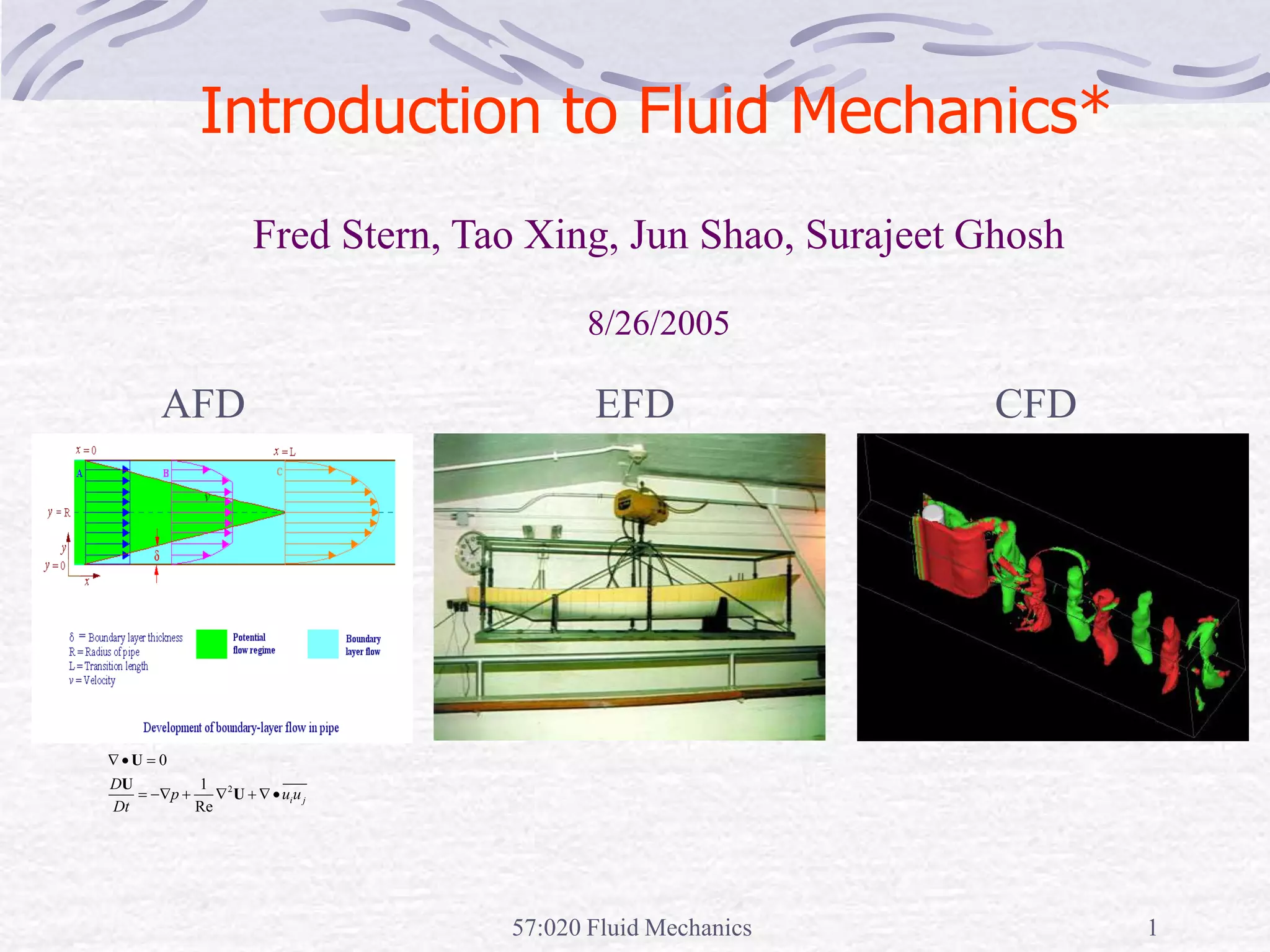
57:020 Fluid Mechanics 1
Introduction to Fluid Mechanics*
CFD
EFD
AFD
2
0
1
Re
i j
D
p u u
Dt
 
    
U
U
U
Fred Stern, Tao Xing, Jun Shao, Surajeet Ghosh
8/26/2005
57:020 Fluid Mechanics 2
Fluid Mechanics
• Fluids essential to life
• Human body 65% water
• Earth’s surface is 2/3 water
• Atmosphere extends 17km above the earth’s surface
• History shaped by fluid mechanics
• Geomorphology
• Human migration and civilization
• Modern scientific and mathematical theories and methods
• Warfare
• Affects every part of our lives
57:020 Fluid Mechanics 3
History
Faces of Fluid Mechanics
Archimedes
(C. 287-212 BC)
Newton
(1642-1727)
Leibniz
(1646-1716)
Euler
(1707-1783)
Navier
(1785-1836)
Stokes
(1819-1903)
Reynolds
(1842-1912)
Prandtl
(1875-1953)
Bernoulli
(1667-1748)
Taylor
(1886-1975)
57:020 Fluid Mechanics 4
Significance
• Fluids omnipresent
• Weather & climate
• Vehicles: automobiles, trains, ships, and
planes, etc.
• Environment
• Physiology and medicine
• Sports & recreation
• Many other examples!
57:020 Fluid Mechanics 5
Weather & Climate
Tornadoes
Hurricanes
Global Climate
Thunderstorm
57:020 Fluid Mechanics 6
Vehicles
Aircraft
Submarines
High-speed rail
Surface ships
57:020 Fluid Mechanics 7
Environment
Air pollution River hydraulics
57:020 Fluid Mechanics 8
Physiology and Medicine
Blood pump Ventricular assist device
57:020 Fluid Mechanics 9
Sports & Recreation
Water sports
Auto racing
Offshore racing
Cycling
Surfing
57:020 Fluid Mechanics 10
Fluids Engineering
2
2
P
B
UD 

2 2
s SM SN
U U U
 
Reality
Fluids Engineering System Components Idealized
EFD, Mathematical Physics Problem Formulation
AFD, CFD,
m
U
57:020 Fluid Mechanics 11
Analytical Fluid Dynamics
• The theory of mathematical physics
problem formulation
• Control volume & differential analysis
• Exact solutions only exist for simple
geometry and conditions
• Approximate solutions for practical
applications
• Linear
• Empirical relations using EFD data
57:020 Fluid Mechanics 12
Analytical Fluid Dynamics
• Lecture Part of Fluid Class
• Definition and fluids properties
• Fluid statics
• Fluids in motion
• Continuity, momentum, and energy principles
• Dimensional analysis and similitude
• Surface resistance
• Flow in conduits
• Drag and lift
57:020 Fluid Mechanics 13
Analytical Fluid Dynamics
Schematic
• Example: laminar pipe flow
Exact solution :
2 2
1
( ) ( )( )
4
p
u r R r
x


  

Friction factor:
8
8 64
Re
2 2
w
du
dy
w
f
V V


 
  
Assumptions: Fully developed, Low
Approach: Simplify momentum equation,
integrate, apply boundary conditions to
determine integration constants and use
energy equation to calculate head loss
x
g
y
u
x
u
x
p
Dt
Du
















 2
2
2
2

Head loss:
1 2
1 2 f
p p
z z h
 
   
2
2
32
2
f
L V LV
h f
D g D


 
UD
2000
Re 



0
0
0
57:020 Fluid Mechanics 14
Analytical Fluid Dynamics
• Example: turbulent flow in smooth pipe( )
0 5
y
 
1
ln
u y B

 
  5
20 10
y
 
*
0
1
U u r
f
u r
 

 
 
 
5
10
y

u y
 

    *
0
*
1
ln
u r r r u
B
u  

 
Re 3000

*
y yu 


*
u u u


*
w
u  

Three layer concept (using dimensional analysis)
1. Laminar sub-layer (viscous shear dominates)
2. Overlap layer (viscous and turbulent shear important)
3. Outer layer (turbulent shear dominates)
Assume log-law is valid across entire pipe:
Integration for average velocity and using EFD data to adjust constants:
 
1 2
1
2log Re .8
f
f
 
(k=0.41, B=5.5)
57:020 Fluid Mechanics 15
Analytical Fluid Dynamics
• Example: turbulent flow in rough pipe
 
u u y k
 

1
ln
y
u
k


 
1
2log
3.7
k D
f
 
 
1
ln 8.5 Re
y
u f
k


  
Three regimes of flow depending on k+
1. K+<5, hydraulically smooth (no effect of roughness)
2. 5 < K+< 70, transitional roughness (Re dependent)
3. K+> 70, fully rough (independent Re)
Both laminar sublayer and overlap layer
are affected by roughness
Inner layer:
Outer layer: unaffected
Overlap layer:
Friction factor:
For 3, using EFD data to adjust constants:
constant
57:020 Fluid Mechanics 16
Analytical Fluid Dynamics
• Example: Moody diagram for turbulent pipe flow
1 1 2
2
1 2.51
2log
3.7 Re
k D
f
f
 
  
 
 
Composite Log-Law for smooth and rough pipes is given by the Moody diagram:
57:020 Fluid Mechanics 17
Experimental Fluid Dynamics (EFD)
Definition:
Use of experimental methodology and procedures for solving fluids
engineering systems, including full and model scales, large and table
top facilities, measurement systems (instrumentation, data acquisition
and data reduction), uncertainty analysis, and dimensional analysis and
similarity.
EFD philosophy:
• Decisions on conducting experiments are governed by the ability of the
expected test outcome, to achieve the test objectives within allowable
uncertainties.
• Integration of UA into all test phases should be a key part of entire
experimental program
• test design
• determination of error sources
• estimation of uncertainty
• documentation of the results
57:020 Fluid Mechanics 18
Purpose
• Science & Technology: understand and investigate a
phenomenon/process, substantiate and validate a theory
(hypothesis)
• Research & Development: document a process/system,
provide benchmark data (standard procedures,
validations), calibrate instruments, equipment, and
facilities
• Industry: design optimization and analysis, provide data
for direct use, product liability, and acceptance
• Teaching: instruction/demonstration
57:020 Fluid Mechanics 19
Applications of EFD
Application in research & development
Tropic Wind Tunnel has the ability to create
temperatures ranging from 0 to 165 degrees
Fahrenheit and simulate rain
Application in science & technology
Picture of Karman vortex shedding
57:020 Fluid Mechanics 20
Applications of EFD (cont’d)
Example of industrial application
NASA's cryogenic wind tunnel simulates flight
conditions for scale models--a critical tool in
designing airplanes.
Application in teaching
Fluid dynamics laboratory
57:020 Fluid Mechanics 21
Full and model scale
• Scales: model, and full-scale
• Selection of the model scale: governed by dimensional analysis and similarity
57:020 Fluid Mechanics 22
Measurement systems
• Instrumentation
• Load cell to measure forces and moments
• Pressure transducers
• Pitot tubes
• Hotwire anemometry
• PIV, LDV
• Data acquisition
• Serial port devices
• Desktop PC’s
• Plug-in data acquisition boards
• Data Acquisition software - Labview
• Data analysis and data reduction
• Data reduction equations
• Spectral analysis
57:020 Fluid Mechanics 23
Instrumentation
Load cell
Pitot tube
Hotwire 3D - PIV
57:020 Fluid Mechanics 24
Data acquisition system
Hardware
Software - Labview
57:020 Fluid Mechanics 25
Data reduction methods
EXPERIMEN
RESULT
INDIVIDU
MEASUREM
SYSTEM
MEASUREM
OF INDIVID
VARIABL
DATA REDUC
EQUATIO
TEMPERATURE
WATER
TEMPERATURE
AIR
f
B , P
VENTURI
PRESSURE
PIPE
PRESSURE
f = F( , , z , Q =
  )
a
a
w
g D

8LQ


Q = F( z )

w
w
T
T
B T
, P
z
z
B , P
f f
SM
SM
w
w
DM
SM
2
2
5
a
T
T
B T
, P
a
a
zSM
z
z
B , P
DM
DM zDM
= F(T )


( )
w
= F(T )
a
z
SM i
- z
SM j
w
a
Example of data reduction equations
• Data reduction equations
• Spectral analysis
 
 








 Stat
SM
Stag
SM
a
w
z
r
z
g
r
u


2
)
(
57:020 Fluid Mechanics 26
Spectral analysis
FFT: Converts a function from amplitude as function
of time to amplitude as function of frequency
Aim: To analyze the natural
unsteadiness of the separated flow,
around a surface piercing
strut, using FFT.
Fast Fourier Transform
Surface piercing strut Power spectral density
of wave elevation
Free-surface wave
elevation contours
FFT of wave elevation
Time history of wave
elevation
57:020 Fluid Mechanics 27
Uncertainty analysis
r = r (X , X ,......, X )
1 2 J
1 2 J
MEASUREMENT
OF INDIVIDUAL
VARIABLES
INDIVIDUAL
MEASUREMENT
SYSTEMS
ELEMENTAL
ERROR SOURCES
DATA REDUCTION
EQUATION
EXPERIMENTAL
RESULT
X
B , P
1
1 1
X
B , P
2
2 2
X
B , P
J
J J
r
B , P
r r
Rigorous methodology for uncertainty assessment
using statistical and engineering concepts
57:020 Fluid Mechanics 28
Dimensional analysis
• Definition : Dimensional analysis is a process of formulating fluid mechanics problems in
in terms of non-dimensional variables and parameters.
• Why is it used :
• Reduction in variables ( If F(A1, A2, … , An) = 0, then f(P1, P2, … Pr < n) = 0,
where, F = functional form, Ai = dimensional variables, Pj = non-dimensional
parameters, m = number of important dimensions, n = number of dimensional variables, r
= n – m ). Thereby the number of experiments required to determine f vs. F is reduced.
• Helps in understanding physics
• Useful in data analysis and modeling
• Enables scaling of different physical dimensions and fluid properties
Example
Vortex shedding behind cylinder
Drag = f(V, L, r, m, c, t, e, T, etc.)
From dimensional analysis,
Examples of dimensionless quantities : Reynolds number, Froude
Number, Strouhal number, Euler number, etc.
57:020 Fluid Mechanics 29
Similarity and model testing
• Definition : Flow conditions for a model test are completely similar if all relevant
dimensionless parameters have the same corresponding values for model and prototype.
• Pi model = Pi prototype i = 1
• Enables extrapolation from model to full scale
• However, complete similarity usually not possible. Therefore, often it is necessary to
use Re, or Fr, or Ma scaling, i.e., select most important Pand accommodate others
as best possible.
• Types of similarity:
• Geometric Similarity : all body dimensions in all three coordinates have the same
linear-scale ratios.
• Kinematic Similarity : homologous (same relative position) particles lie at homologous
points at homologous times.
• Dynamic Similarity : in addition to the requirements for kinematic similarity the model
and prototype forces must be in a constant ratio.
57:020 Fluid Mechanics 30
EFD process
• “EFD process” is the steps to set up an experiment and
take data
Test
Set-up
Facility &
conditions
Install model
Prepare
measurement
systems
Data
Acquisition
Data
Reduction
Uncertainty
Analysis
Data
Analysis
Initialize data
acquisition
software
Run tests &
acquire data
Store data
Statistical
analysis
Estimate bias
limits
Compare results
with benchmark
data, CFD, and
/or AFD
Evaluate fluid
physics
Calibration
Prepare
experimental
procedures
Data reduction
equations
Estimate
precision limits
Estimate total
uncertainty
Prepare report
57:020 Fluid Mechanics 31
EFD – “hands on” experience
Lab1: Measurement of density and
kinematic viscosity of a fluid Lab2: Measurement of
flow rate, friction factor and
velocity profiles in smooth and
rough pipes.
Lab3: Measurement of surface pressure
Distribution, lift and drag coefficient for an airfoil
To
Scanivalve
Chord-wise
Pressure
Taps
Tygon
Tubing
Load Cell
Load Cell
L
D
57:020 Fluid Mechanics 32
Computational Fluid Dynamics
• CFD is use of computational methods for
solving fluid engineering systems, including
modeling (mathematical & Physics) and
numerical methods (solvers, finite differences,
and grid generations, etc.).
• Rapid growth in CFD technology since advent
of computer
ENIAC 1, 1946 IBM WorkStation
57:020 Fluid Mechanics 33
Purpose
• The objective of CFD is to model the continuous fluids
with Partial Differential Equations (PDEs) and
discretize PDEs into an algebra problem, solve it,
validate it and achieve simulation based design
instead of “build & test”
• Simulation of physical fluid phenomena that are
difficult to be measured by experiments: scale
simulations (full-scale ships, airplanes), hazards
(explosions,radiations,pollution), physics (weather
prediction, planetary boundary layer, stellar evolution).
57:020 Fluid Mechanics 34
Modeling
• Mathematical physics problem formulation of fluid
engineering system
• Governing equations: Navier-Stokes equations (momentum),
continuity equation, pressure Poisson equation, energy
equation, ideal gas law, combustions (chemical reaction
equation), multi-phase flows(e.g. Rayleigh equation), and
turbulent models (RANS, LES, DES).
• Coordinates: Cartesian, cylindrical and spherical coordinates
result in different form of governing equations
• Initial conditions(initial guess of the solution) and Boundary
Conditions (no-slip wall, free-surface, zero-gradient,
symmetry, velocity/pressure inlet/outlet)
• Flow conditions: Geometry approximation, domain, Reynolds
Number, and Mach Number, etc.
57:020 Fluid Mechanics 35
Modeling (examples)
Free surface animation for ship in
regular waves
Developing flame surface (Bell et al., 2001)
Evolution of a 2D mixing layer laden with particles of Stokes
Number 0.3 with respect to the vortex time scale (C.Narayanan)
57:020 Fluid Mechanics 36
Modeling (examples, cont’d)
3D vortex shedding behind a circular cylinder
(Re=100,DNS,J.Dijkstra)
DES,
Re=105, Iso-
surface of Q
criterion (0.4)
for turbulent
flow around
NACA12 with
angle of attack
60 degrees
LES of a turbulent jet. Back wall shows a slice of the dissipation rate and the
bottom wall shows a carpet plot of the mixture fraction in a slice through the jet
centerline, Re=21,000 (D. Glaze).
57:020 Fluid Mechanics 37
Numerical methods
• Finite difference methods:
using numerical scheme to
approximate the exact derivatives
in the PDEs
• Finite volume methods
• Grid generation: conformal
mapping, algebraic methods and
differential equation methods
• Grid types: structured,
unstructured
• Solvers: direct methods (Cramer’s
rule, Gauss elimination, LU
decomposition) and iterative
methods (Jacobi, Gauss-Seidel,
SOR)
Slice of 3D mesh of a fighter aircraft
o x
y
i i+1
i-1
j+1
j
j-1
imax
jmax
x

y

2
1 1
2 2
2
i i i
P P P
P
x x
 
 


 
2
1 1
2 2
2
j j j
P P P
P
y y
 
 


 
57:020 Fluid Mechanics 38
CFD process
Viscous Model
Boundary
Conditions
Initial
Conditions
Convergent
Limit
Contours
Precisions
(single/
double)
Numerical
Scheme
Vectors
Streamlines
Verification
Geometry
Select
Geometry
Geometry
Parameters
Physics Mesh Solve Post-
Processing
Compressible
ON/OFF
Flow
properties
Unstructured
(automatic/
manual)
Steady/
Unsteady
Forces Report
(lift/drag, shear
stress, etc)
XY Plot
Domain Shape
and Size
Heat Transfer
ON/OFF
Structured
(automatic/
manual)
Iterations/
Steps
Validation
Reports
57:020 Fluid Mechanics 39
Commercial software
• CFD software
1. FLUENT: http://www.fluent.com
2. FLOWLAB: http://www.flowlab.fluent.com
3. CFDRC: http://www.cfdrc.com
4. STAR-CD: http://www.cd-adapco.com
5. CFX/AEA: http://www.software.aeat.com/cfx
• Grid Generation software
1. Gridgen: http://www.pointwise.com
2. GridPro: http://www.gridpro.com
• Visualization software
1. Tecplot: http://www.amtec.com
2. Fieldview: http://www.ilight.com
57:020 Fluid Mechanics 40
“Hands-on” experience using CFD
Educational Interface (pipe template)
57:020 Fluid Mechanics 41
“Hands-on” experience using CFD
Educational Interface (airfoil template)
57:020 Fluid Mechanics 42
57:020 Fluid Mechanics
• Lectures cover basic concepts in fluid statics,
kinematics, and dynamics, control-volume, and
differential-equation analysis methods. Homework
assignments, tests, and complementary EFD/CFD
labs
• This class provides an introduction to all three tools:
AFD through lecture and CFD and EFD through labs
• ISTUE Teaching Modules
(http://www.iihr.uiowa.edu/~istue) (next two slides)
57:020 Fluid Mechanics 43
TM Descriptions
http://css.engineering.uiowa.edu/~fluids
Table 1: ISTUE Teaching Modules for Introductory Level Fluid Mechanics at Iowa
Teaching Modules TM for Fluid
Property
TM for Pipe Flow TM for Airfoil Flow
Overall Purpose Hands-on student
experience with table-top
facility and simple MS for
fluid property
measurement, including
comparison manufacturer
values and rigorous
implementation standard
EFD UA
Hands-on student experience
with complementary EFD, CFD,
and UA for Introductory Pipe
Flow, including friction factor
and mean velocity measurements
and comparisons benchmark
data, laminar and turbulent flow
CFD simulations, modeling and
verification studies, and
validation using AFD and EFD.
Hands-on student experience with
complementary EFD, CFD, and UA
for Introductory Airfoil Flow,
including lift and drag, surface
pressure, and mean and turbulent
wake velocity profile measurements
and comparisons benchmark data,
inviscid and turbulent flow
simulations, modeling and verification
studies, and validation using AFD and
EFD.
Educational Materials FM and EFD lecture; lab
report instructions; pre lab
questions, and EFD
exercise notes.
FM, EFD and CFD lectures; lab
report instructions; pre lab
questions, and EFD and CFD
exercise notes.
FM, EFD and CFD lectures; lab
report instructions; pre lab questions,
and EFD and CFD exercise notes.
ISTUE ASEE papers Paper 1 Paper2
FM Lecture Introduction to Fluid Mechanics
Lab Report Instructions EFD lab report Instructions CFD lab report Instructions
Continued in next slide…
57:020 Fluid Mechanics 44
TM Descriptions, cont’d
Teaching Modules TM for Fluid
Property
TM for Pipe Flow TM for Airfoil Flow
CFD CFD Lecture Introduction to CFD
Exercise Notes None CFD Prelab1
PreLab1 Questions
CFD Lab 1
Lab Concepts
EFD Data
CFD Prelab2
PreLab 2 Questions
CFD Lab2
Lab Concepts
EFD Data
EFD EFD
Lecture
EFD and UA
Exercise Notes PreLab1 Questions
Lab1 Lecture
Lab 1 exercise notes
Lab 1 data
reduction sheet
Lab concepts
PreLab2 Questions
Lab2 Lecture
Lab 2 exercise notes
Lab2 Data reduction
sheet (smooth & rough)
Lab concepts
PreLab3 Questions
Lab3 Lecture
Lab 3 exercise notes
Data Reduction Sheet
Lab concepts
UA(EFD) Lecture EFD UA Report
Exercise Notes Instructions UA
UA(CFD) Lecture
Exercise Notes None

FluidDynamics.ppt

  • 1.
    57:020 Fluid Mechanics1 Introduction to Fluid Mechanics* CFD EFD AFD 2 0 1 Re i j D p u u Dt        U U U Fred Stern, Tao Xing, Jun Shao, Surajeet Ghosh 8/26/2005
  • 2.
    57:020 Fluid Mechanics2 Fluid Mechanics • Fluids essential to life • Human body 65% water • Earth’s surface is 2/3 water • Atmosphere extends 17km above the earth’s surface • History shaped by fluid mechanics • Geomorphology • Human migration and civilization • Modern scientific and mathematical theories and methods • Warfare • Affects every part of our lives
  • 3.
    57:020 Fluid Mechanics3 History Faces of Fluid Mechanics Archimedes (C. 287-212 BC) Newton (1642-1727) Leibniz (1646-1716) Euler (1707-1783) Navier (1785-1836) Stokes (1819-1903) Reynolds (1842-1912) Prandtl (1875-1953) Bernoulli (1667-1748) Taylor (1886-1975)
  • 4.
    57:020 Fluid Mechanics4 Significance • Fluids omnipresent • Weather & climate • Vehicles: automobiles, trains, ships, and planes, etc. • Environment • Physiology and medicine • Sports & recreation • Many other examples!
  • 5.
    57:020 Fluid Mechanics5 Weather & Climate Tornadoes Hurricanes Global Climate Thunderstorm
  • 6.
    57:020 Fluid Mechanics6 Vehicles Aircraft Submarines High-speed rail Surface ships
  • 7.
    57:020 Fluid Mechanics7 Environment Air pollution River hydraulics
  • 8.
    57:020 Fluid Mechanics8 Physiology and Medicine Blood pump Ventricular assist device
  • 9.
    57:020 Fluid Mechanics9 Sports & Recreation Water sports Auto racing Offshore racing Cycling Surfing
  • 10.
    57:020 Fluid Mechanics10 Fluids Engineering 2 2 P B UD   2 2 s SM SN U U U   Reality Fluids Engineering System Components Idealized EFD, Mathematical Physics Problem Formulation AFD, CFD, m U
  • 11.
    57:020 Fluid Mechanics11 Analytical Fluid Dynamics • The theory of mathematical physics problem formulation • Control volume & differential analysis • Exact solutions only exist for simple geometry and conditions • Approximate solutions for practical applications • Linear • Empirical relations using EFD data
  • 12.
    57:020 Fluid Mechanics12 Analytical Fluid Dynamics • Lecture Part of Fluid Class • Definition and fluids properties • Fluid statics • Fluids in motion • Continuity, momentum, and energy principles • Dimensional analysis and similitude • Surface resistance • Flow in conduits • Drag and lift
  • 13.
    57:020 Fluid Mechanics13 Analytical Fluid Dynamics Schematic • Example: laminar pipe flow Exact solution : 2 2 1 ( ) ( )( ) 4 p u r R r x       Friction factor: 8 8 64 Re 2 2 w du dy w f V V        Assumptions: Fully developed, Low Approach: Simplify momentum equation, integrate, apply boundary conditions to determine integration constants and use energy equation to calculate head loss x g y u x u x p Dt Du                  2 2 2 2  Head loss: 1 2 1 2 f p p z z h       2 2 32 2 f L V LV h f D g D     UD 2000 Re     0 0 0
  • 14.
    57:020 Fluid Mechanics14 Analytical Fluid Dynamics • Example: turbulent flow in smooth pipe( ) 0 5 y   1 ln u y B      5 20 10 y   * 0 1 U u r f u r          5 10 y  u y        * 0 * 1 ln u r r r u B u      Re 3000  * y yu    * u u u   * w u    Three layer concept (using dimensional analysis) 1. Laminar sub-layer (viscous shear dominates) 2. Overlap layer (viscous and turbulent shear important) 3. Outer layer (turbulent shear dominates) Assume log-law is valid across entire pipe: Integration for average velocity and using EFD data to adjust constants:   1 2 1 2log Re .8 f f   (k=0.41, B=5.5)
  • 15.
    57:020 Fluid Mechanics15 Analytical Fluid Dynamics • Example: turbulent flow in rough pipe   u u y k    1 ln y u k     1 2log 3.7 k D f     1 ln 8.5 Re y u f k      Three regimes of flow depending on k+ 1. K+<5, hydraulically smooth (no effect of roughness) 2. 5 < K+< 70, transitional roughness (Re dependent) 3. K+> 70, fully rough (independent Re) Both laminar sublayer and overlap layer are affected by roughness Inner layer: Outer layer: unaffected Overlap layer: Friction factor: For 3, using EFD data to adjust constants: constant
  • 16.
    57:020 Fluid Mechanics16 Analytical Fluid Dynamics • Example: Moody diagram for turbulent pipe flow 1 1 2 2 1 2.51 2log 3.7 Re k D f f          Composite Log-Law for smooth and rough pipes is given by the Moody diagram:
  • 17.
    57:020 Fluid Mechanics17 Experimental Fluid Dynamics (EFD) Definition: Use of experimental methodology and procedures for solving fluids engineering systems, including full and model scales, large and table top facilities, measurement systems (instrumentation, data acquisition and data reduction), uncertainty analysis, and dimensional analysis and similarity. EFD philosophy: • Decisions on conducting experiments are governed by the ability of the expected test outcome, to achieve the test objectives within allowable uncertainties. • Integration of UA into all test phases should be a key part of entire experimental program • test design • determination of error sources • estimation of uncertainty • documentation of the results
  • 18.
    57:020 Fluid Mechanics18 Purpose • Science & Technology: understand and investigate a phenomenon/process, substantiate and validate a theory (hypothesis) • Research & Development: document a process/system, provide benchmark data (standard procedures, validations), calibrate instruments, equipment, and facilities • Industry: design optimization and analysis, provide data for direct use, product liability, and acceptance • Teaching: instruction/demonstration
  • 19.
    57:020 Fluid Mechanics19 Applications of EFD Application in research & development Tropic Wind Tunnel has the ability to create temperatures ranging from 0 to 165 degrees Fahrenheit and simulate rain Application in science & technology Picture of Karman vortex shedding
  • 20.
    57:020 Fluid Mechanics20 Applications of EFD (cont’d) Example of industrial application NASA's cryogenic wind tunnel simulates flight conditions for scale models--a critical tool in designing airplanes. Application in teaching Fluid dynamics laboratory
  • 21.
    57:020 Fluid Mechanics21 Full and model scale • Scales: model, and full-scale • Selection of the model scale: governed by dimensional analysis and similarity
  • 22.
    57:020 Fluid Mechanics22 Measurement systems • Instrumentation • Load cell to measure forces and moments • Pressure transducers • Pitot tubes • Hotwire anemometry • PIV, LDV • Data acquisition • Serial port devices • Desktop PC’s • Plug-in data acquisition boards • Data Acquisition software - Labview • Data analysis and data reduction • Data reduction equations • Spectral analysis
  • 23.
    57:020 Fluid Mechanics23 Instrumentation Load cell Pitot tube Hotwire 3D - PIV
  • 24.
    57:020 Fluid Mechanics24 Data acquisition system Hardware Software - Labview
  • 25.
    57:020 Fluid Mechanics25 Data reduction methods EXPERIMEN RESULT INDIVIDU MEASUREM SYSTEM MEASUREM OF INDIVID VARIABL DATA REDUC EQUATIO TEMPERATURE WATER TEMPERATURE AIR f B , P VENTURI PRESSURE PIPE PRESSURE f = F( , , z , Q =   ) a a w g D  8LQ   Q = F( z )  w w T T B T , P z z B , P f f SM SM w w DM SM 2 2 5 a T T B T , P a a zSM z z B , P DM DM zDM = F(T )   ( ) w = F(T ) a z SM i - z SM j w a Example of data reduction equations • Data reduction equations • Spectral analysis              Stat SM Stag SM a w z r z g r u   2 ) (
  • 26.
    57:020 Fluid Mechanics26 Spectral analysis FFT: Converts a function from amplitude as function of time to amplitude as function of frequency Aim: To analyze the natural unsteadiness of the separated flow, around a surface piercing strut, using FFT. Fast Fourier Transform Surface piercing strut Power spectral density of wave elevation Free-surface wave elevation contours FFT of wave elevation Time history of wave elevation
  • 27.
    57:020 Fluid Mechanics27 Uncertainty analysis r = r (X , X ,......, X ) 1 2 J 1 2 J MEASUREMENT OF INDIVIDUAL VARIABLES INDIVIDUAL MEASUREMENT SYSTEMS ELEMENTAL ERROR SOURCES DATA REDUCTION EQUATION EXPERIMENTAL RESULT X B , P 1 1 1 X B , P 2 2 2 X B , P J J J r B , P r r Rigorous methodology for uncertainty assessment using statistical and engineering concepts
  • 28.
    57:020 Fluid Mechanics28 Dimensional analysis • Definition : Dimensional analysis is a process of formulating fluid mechanics problems in in terms of non-dimensional variables and parameters. • Why is it used : • Reduction in variables ( If F(A1, A2, … , An) = 0, then f(P1, P2, … Pr < n) = 0, where, F = functional form, Ai = dimensional variables, Pj = non-dimensional parameters, m = number of important dimensions, n = number of dimensional variables, r = n – m ). Thereby the number of experiments required to determine f vs. F is reduced. • Helps in understanding physics • Useful in data analysis and modeling • Enables scaling of different physical dimensions and fluid properties Example Vortex shedding behind cylinder Drag = f(V, L, r, m, c, t, e, T, etc.) From dimensional analysis, Examples of dimensionless quantities : Reynolds number, Froude Number, Strouhal number, Euler number, etc.
  • 29.
    57:020 Fluid Mechanics29 Similarity and model testing • Definition : Flow conditions for a model test are completely similar if all relevant dimensionless parameters have the same corresponding values for model and prototype. • Pi model = Pi prototype i = 1 • Enables extrapolation from model to full scale • However, complete similarity usually not possible. Therefore, often it is necessary to use Re, or Fr, or Ma scaling, i.e., select most important Pand accommodate others as best possible. • Types of similarity: • Geometric Similarity : all body dimensions in all three coordinates have the same linear-scale ratios. • Kinematic Similarity : homologous (same relative position) particles lie at homologous points at homologous times. • Dynamic Similarity : in addition to the requirements for kinematic similarity the model and prototype forces must be in a constant ratio.
  • 30.
    57:020 Fluid Mechanics30 EFD process • “EFD process” is the steps to set up an experiment and take data Test Set-up Facility & conditions Install model Prepare measurement systems Data Acquisition Data Reduction Uncertainty Analysis Data Analysis Initialize data acquisition software Run tests & acquire data Store data Statistical analysis Estimate bias limits Compare results with benchmark data, CFD, and /or AFD Evaluate fluid physics Calibration Prepare experimental procedures Data reduction equations Estimate precision limits Estimate total uncertainty Prepare report
  • 31.
    57:020 Fluid Mechanics31 EFD – “hands on” experience Lab1: Measurement of density and kinematic viscosity of a fluid Lab2: Measurement of flow rate, friction factor and velocity profiles in smooth and rough pipes. Lab3: Measurement of surface pressure Distribution, lift and drag coefficient for an airfoil To Scanivalve Chord-wise Pressure Taps Tygon Tubing Load Cell Load Cell L D
  • 32.
    57:020 Fluid Mechanics32 Computational Fluid Dynamics • CFD is use of computational methods for solving fluid engineering systems, including modeling (mathematical & Physics) and numerical methods (solvers, finite differences, and grid generations, etc.). • Rapid growth in CFD technology since advent of computer ENIAC 1, 1946 IBM WorkStation
  • 33.
    57:020 Fluid Mechanics33 Purpose • The objective of CFD is to model the continuous fluids with Partial Differential Equations (PDEs) and discretize PDEs into an algebra problem, solve it, validate it and achieve simulation based design instead of “build & test” • Simulation of physical fluid phenomena that are difficult to be measured by experiments: scale simulations (full-scale ships, airplanes), hazards (explosions,radiations,pollution), physics (weather prediction, planetary boundary layer, stellar evolution).
  • 34.
    57:020 Fluid Mechanics34 Modeling • Mathematical physics problem formulation of fluid engineering system • Governing equations: Navier-Stokes equations (momentum), continuity equation, pressure Poisson equation, energy equation, ideal gas law, combustions (chemical reaction equation), multi-phase flows(e.g. Rayleigh equation), and turbulent models (RANS, LES, DES). • Coordinates: Cartesian, cylindrical and spherical coordinates result in different form of governing equations • Initial conditions(initial guess of the solution) and Boundary Conditions (no-slip wall, free-surface, zero-gradient, symmetry, velocity/pressure inlet/outlet) • Flow conditions: Geometry approximation, domain, Reynolds Number, and Mach Number, etc.
  • 35.
    57:020 Fluid Mechanics35 Modeling (examples) Free surface animation for ship in regular waves Developing flame surface (Bell et al., 2001) Evolution of a 2D mixing layer laden with particles of Stokes Number 0.3 with respect to the vortex time scale (C.Narayanan)
  • 36.
    57:020 Fluid Mechanics36 Modeling (examples, cont’d) 3D vortex shedding behind a circular cylinder (Re=100,DNS,J.Dijkstra) DES, Re=105, Iso- surface of Q criterion (0.4) for turbulent flow around NACA12 with angle of attack 60 degrees LES of a turbulent jet. Back wall shows a slice of the dissipation rate and the bottom wall shows a carpet plot of the mixture fraction in a slice through the jet centerline, Re=21,000 (D. Glaze).
  • 37.
    57:020 Fluid Mechanics37 Numerical methods • Finite difference methods: using numerical scheme to approximate the exact derivatives in the PDEs • Finite volume methods • Grid generation: conformal mapping, algebraic methods and differential equation methods • Grid types: structured, unstructured • Solvers: direct methods (Cramer’s rule, Gauss elimination, LU decomposition) and iterative methods (Jacobi, Gauss-Seidel, SOR) Slice of 3D mesh of a fighter aircraft o x y i i+1 i-1 j+1 j j-1 imax jmax x  y  2 1 1 2 2 2 i i i P P P P x x         2 1 1 2 2 2 j j j P P P P y y        
  • 38.
    57:020 Fluid Mechanics38 CFD process Viscous Model Boundary Conditions Initial Conditions Convergent Limit Contours Precisions (single/ double) Numerical Scheme Vectors Streamlines Verification Geometry Select Geometry Geometry Parameters Physics Mesh Solve Post- Processing Compressible ON/OFF Flow properties Unstructured (automatic/ manual) Steady/ Unsteady Forces Report (lift/drag, shear stress, etc) XY Plot Domain Shape and Size Heat Transfer ON/OFF Structured (automatic/ manual) Iterations/ Steps Validation Reports
  • 39.
    57:020 Fluid Mechanics39 Commercial software • CFD software 1. FLUENT: http://www.fluent.com 2. FLOWLAB: http://www.flowlab.fluent.com 3. CFDRC: http://www.cfdrc.com 4. STAR-CD: http://www.cd-adapco.com 5. CFX/AEA: http://www.software.aeat.com/cfx • Grid Generation software 1. Gridgen: http://www.pointwise.com 2. GridPro: http://www.gridpro.com • Visualization software 1. Tecplot: http://www.amtec.com 2. Fieldview: http://www.ilight.com
  • 40.
    57:020 Fluid Mechanics40 “Hands-on” experience using CFD Educational Interface (pipe template)
  • 41.
    57:020 Fluid Mechanics41 “Hands-on” experience using CFD Educational Interface (airfoil template)
  • 42.
    57:020 Fluid Mechanics42 57:020 Fluid Mechanics • Lectures cover basic concepts in fluid statics, kinematics, and dynamics, control-volume, and differential-equation analysis methods. Homework assignments, tests, and complementary EFD/CFD labs • This class provides an introduction to all three tools: AFD through lecture and CFD and EFD through labs • ISTUE Teaching Modules (http://www.iihr.uiowa.edu/~istue) (next two slides)
  • 43.
    57:020 Fluid Mechanics43 TM Descriptions http://css.engineering.uiowa.edu/~fluids Table 1: ISTUE Teaching Modules for Introductory Level Fluid Mechanics at Iowa Teaching Modules TM for Fluid Property TM for Pipe Flow TM for Airfoil Flow Overall Purpose Hands-on student experience with table-top facility and simple MS for fluid property measurement, including comparison manufacturer values and rigorous implementation standard EFD UA Hands-on student experience with complementary EFD, CFD, and UA for Introductory Pipe Flow, including friction factor and mean velocity measurements and comparisons benchmark data, laminar and turbulent flow CFD simulations, modeling and verification studies, and validation using AFD and EFD. Hands-on student experience with complementary EFD, CFD, and UA for Introductory Airfoil Flow, including lift and drag, surface pressure, and mean and turbulent wake velocity profile measurements and comparisons benchmark data, inviscid and turbulent flow simulations, modeling and verification studies, and validation using AFD and EFD. Educational Materials FM and EFD lecture; lab report instructions; pre lab questions, and EFD exercise notes. FM, EFD and CFD lectures; lab report instructions; pre lab questions, and EFD and CFD exercise notes. FM, EFD and CFD lectures; lab report instructions; pre lab questions, and EFD and CFD exercise notes. ISTUE ASEE papers Paper 1 Paper2 FM Lecture Introduction to Fluid Mechanics Lab Report Instructions EFD lab report Instructions CFD lab report Instructions Continued in next slide…
  • 44.
    57:020 Fluid Mechanics44 TM Descriptions, cont’d Teaching Modules TM for Fluid Property TM for Pipe Flow TM for Airfoil Flow CFD CFD Lecture Introduction to CFD Exercise Notes None CFD Prelab1 PreLab1 Questions CFD Lab 1 Lab Concepts EFD Data CFD Prelab2 PreLab 2 Questions CFD Lab2 Lab Concepts EFD Data EFD EFD Lecture EFD and UA Exercise Notes PreLab1 Questions Lab1 Lecture Lab 1 exercise notes Lab 1 data reduction sheet Lab concepts PreLab2 Questions Lab2 Lecture Lab 2 exercise notes Lab2 Data reduction sheet (smooth & rough) Lab concepts PreLab3 Questions Lab3 Lecture Lab 3 exercise notes Data Reduction Sheet Lab concepts UA(EFD) Lecture EFD UA Report Exercise Notes Instructions UA UA(CFD) Lecture Exercise Notes None