



Submitted by:-
Sanjesh Chhabra
Guided by:-
Dr.Sanjeev Naval
Head Of Civil
Engineering Department
DAVIET,JALANDHAR
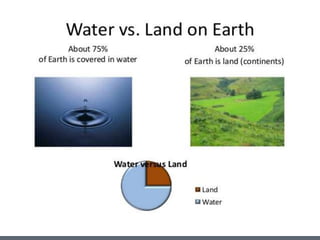
HOW MUCH OF
THE EARTH IS
COVERED WITH
LAND???
FLOATING
TECHNOLOGY
What Materials We
Can Opt For Making
Floating
Concrete???
The cement used is somewhat similar to
Ferrocement but, instead of steel wire mesh,
aluminium wire mesh is used possessing a light
weight than regular chicken mesh making an
innovative type of “Aluminicement”(Carbon fiber
mesh can also replace the aluminium mesh as it
is the best among the light weight but strong
meshes available). Pozzolanic Portland Cement
(PPC) reinforced with polypropylene fibers, for
increasing the binding among particles was
used.
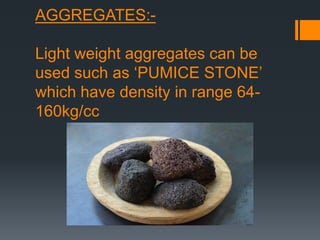
AGGREGATES:-
Light weight aggregates can be
used such as ‘PUMICE STONE’
which have density in range 64-
160kg/cc
Admixtures
 Aluminium fine powder is used as gas forming admixture. It
generates fluffiness in the concrete same as baking soda
does in a cake. This admixture when added to mortar or
concrete mixture react chemically with hydroxides present in
the cement & form minute bubbles of hydrogen gas of size
ranging from 0.1 to 1 mm throughout the cement-water.
 To shorten the setting time of the mix, the accelerating
admixture used is Calcium Chloride (CaCl2).
Mineral additives:-
 Since we have made a light weight concrete with density less
than that of water, it possesses a little less strength as
compared to the conventional concrete. So, to overcome this
drawback, nanotechnology is taken as a support.
 Nano-SiO2 having particle size less than 100 nm, has been
found to improve concrete workability & strength, increase
resistance to water penetration & to help control the leaching
of calcium, which is closely associated with various types of
concrete
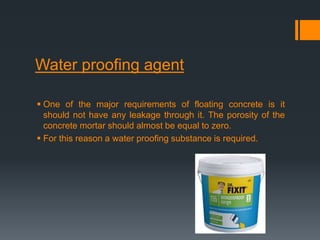
Water proofing agent
 One of the major requirements of floating concrete is it
should not have any leakage through it. The porosity of the
concrete mortar should almost be equal to zero.
 For this reason a water proofing substance is required.
PROPERTIES:-
Light Weight: Density range from 650 Kg/m3 to 1850
Kg/m3 as compared to 1800 Kg/m3 to 2400 Kg/m3 for
conventional brick and concrete respectively. Despite millions
of tiny air filled cells, it is strong and durable. There is
Lightweight advantage for the structure design, leading to
savings in supporting structures and foundation.
Excellent Acoustic Performance: It can be used
as effective sound barrier and for acoustic solutions. Hence,
highly suitable for partition walls, floor screens/roofing and
panel material in auditoriums.
Earthquake Resistant: Since lighter than concrete &
brick, the lightness of the material increases resistance against
earthquake.
Insulation: Superior thermal insulation properties compared
to that of conventional brick and concrete, so reduces the
heating and cooling expenses. In buildings, light-weight
concrete will produce a higher fire rated structure.
Workability: Products made from lightweight concrete are
lightweight, making them easy to place using less skilled labor.
The bricks can be sawed, drilled and shaped like wood using
standard hand tools, regular screws and nails. It is simpler than
brick or concrete.
Lifespan: Weather proof, termite resistant and fire proof.
Savings in Material: Reduces dead weight of filler walls
in framed structures by more than 50% as compared to brickwork
resulting in substantial savings. Due to the bigger and uniform
shape of blocks, there is a saving in bed mortar and plaster
thickness. In most cases the higher cost of the light-weight
concrete is offset by a reduction of structural elements, less
reinforcing steel and reduced volume of concrete.
Water Absorption: Closed cellular structures and hence
have lower water absorption.
Skim Coating: Do not require plaster and water
repellent paint suffices. Wallpapers and plasters can also be
applied directly to the surface.
Modulus of Elasticity: The modulus of elasticity of
the concrete with lightweight aggregates is lower, 0.5 – 0.75 to
that of the normal concrete.
 Therefore more deflection is there in lightweight concrete . To
prevent this we can use anchoring ropes.
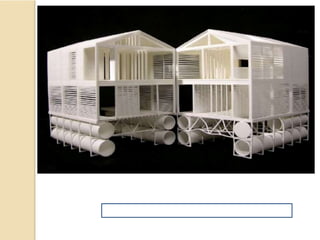
 The Netherlands is building houses that float on
w(720P_HD)-0-0-0-0.mp4
Limitations:-
 Doesn’t have much compressive strength then conventional
concrete but can be overcame by using nano-technolgy .
 Skilled labour is required.
 Cannot be construct in flooded and earthquake prone area.
Floating Concrete- Uses and Application

Floating Concrete- Uses and Application

  • 1.
    Submitted by:- Sanjesh Chhabra Guidedby:- Dr.Sanjeev Naval Head Of Civil Engineering Department DAVIET,JALANDHAR
  • 2.
    HOW MUCH OF THEEARTH IS COVERED WITH LAND???
  • 8.
  • 9.
    What Materials We CanOpt For Making Floating Concrete???
  • 10.
    The cement usedis somewhat similar to Ferrocement but, instead of steel wire mesh, aluminium wire mesh is used possessing a light weight than regular chicken mesh making an innovative type of “Aluminicement”(Carbon fiber mesh can also replace the aluminium mesh as it is the best among the light weight but strong meshes available). Pozzolanic Portland Cement (PPC) reinforced with polypropylene fibers, for increasing the binding among particles was used.
  • 11.
    AGGREGATES:- Light weight aggregatescan be used such as ‘PUMICE STONE’ which have density in range 64- 160kg/cc
  • 12.
    Admixtures  Aluminium finepowder is used as gas forming admixture. It generates fluffiness in the concrete same as baking soda does in a cake. This admixture when added to mortar or concrete mixture react chemically with hydroxides present in the cement & form minute bubbles of hydrogen gas of size ranging from 0.1 to 1 mm throughout the cement-water.  To shorten the setting time of the mix, the accelerating admixture used is Calcium Chloride (CaCl2).
  • 13.
    Mineral additives:-  Sincewe have made a light weight concrete with density less than that of water, it possesses a little less strength as compared to the conventional concrete. So, to overcome this drawback, nanotechnology is taken as a support.  Nano-SiO2 having particle size less than 100 nm, has been found to improve concrete workability & strength, increase resistance to water penetration & to help control the leaching of calcium, which is closely associated with various types of concrete
  • 14.
    Water proofing agent One of the major requirements of floating concrete is it should not have any leakage through it. The porosity of the concrete mortar should almost be equal to zero.  For this reason a water proofing substance is required.
  • 15.
    PROPERTIES:- Light Weight: Densityrange from 650 Kg/m3 to 1850 Kg/m3 as compared to 1800 Kg/m3 to 2400 Kg/m3 for conventional brick and concrete respectively. Despite millions of tiny air filled cells, it is strong and durable. There is Lightweight advantage for the structure design, leading to savings in supporting structures and foundation. Excellent Acoustic Performance: It can be used as effective sound barrier and for acoustic solutions. Hence, highly suitable for partition walls, floor screens/roofing and panel material in auditoriums.
  • 16.
    Earthquake Resistant: Sincelighter than concrete & brick, the lightness of the material increases resistance against earthquake. Insulation: Superior thermal insulation properties compared to that of conventional brick and concrete, so reduces the heating and cooling expenses. In buildings, light-weight concrete will produce a higher fire rated structure. Workability: Products made from lightweight concrete are lightweight, making them easy to place using less skilled labor. The bricks can be sawed, drilled and shaped like wood using standard hand tools, regular screws and nails. It is simpler than brick or concrete. Lifespan: Weather proof, termite resistant and fire proof.
  • 17.
    Savings in Material:Reduces dead weight of filler walls in framed structures by more than 50% as compared to brickwork resulting in substantial savings. Due to the bigger and uniform shape of blocks, there is a saving in bed mortar and plaster thickness. In most cases the higher cost of the light-weight concrete is offset by a reduction of structural elements, less reinforcing steel and reduced volume of concrete. Water Absorption: Closed cellular structures and hence have lower water absorption. Skim Coating: Do not require plaster and water repellent paint suffices. Wallpapers and plasters can also be applied directly to the surface. Modulus of Elasticity: The modulus of elasticity of the concrete with lightweight aggregates is lower, 0.5 – 0.75 to that of the normal concrete.  Therefore more deflection is there in lightweight concrete . To prevent this we can use anchoring ropes.
  • 18.
     The Netherlandsis building houses that float on w(720P_HD)-0-0-0-0.mp4
  • 19.
    Limitations:-  Doesn’t havemuch compressive strength then conventional concrete but can be overcame by using nano-technolgy .  Skilled labour is required.  Cannot be construct in flooded and earthquake prone area.