Flipped Classroom
Grace College of Education
Padanthalumoodu
Pedagogy of English
Presented By
Shajini S
Department of English
Flipped Classroom
 Flipped Classroom is an approach that allows teachers
to implement a methodology or various methodologies
in their classroom.
 It means school work at home and home work at
school.
 Flipped Classroom invert traditional teaching methods,
delivering instruction online outside of class and moving
homework into the classroom
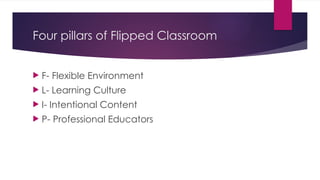
Four pillars of Flipped Classroom
 F- Flexible Environment
 L- Learning Culture
 I- Intentional Content
 P- Professional Educators
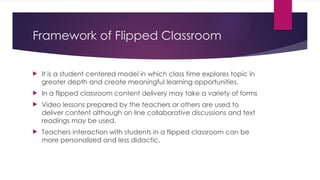
Framework of Flipped Classroom
 It is a student centered model in which class time explores topic in
greater depth and create meaningful learning opportunities.
 In a flipped classroom content delivery may take a variety of forms
 Video lessons prepared by the teachers or others are used to
deliver content although on line collaborative discussions and text
readings may be used.
 Teachers interaction with students in a flipped classroom can be
more personalized and less didactic.
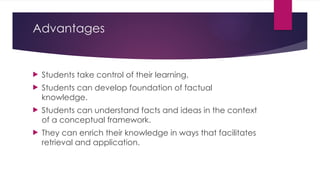
Advantages
 Students take control of their learning.
 Students can develop foundation of factual
knowledge.
 Students can understand facts and ideas in the context
of a conceptual framework.
 They can enrich their knowledge in ways that facilitates
retrieval and application.
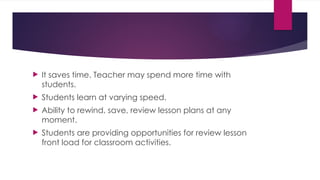
 It saves time. Teacher may spend more time with
students.
 Students learn at varying speed.
 Ability to rewind, save, review lesson plans at any
moment.
 Students are providing opportunities for review lesson
front load for classroom activities.
Thank you

Flipped Classroom...slideshare.pptx......

  • 1.
    Flipped Classroom Grace Collegeof Education Padanthalumoodu Pedagogy of English Presented By Shajini S Department of English
  • 2.
    Flipped Classroom  FlippedClassroom is an approach that allows teachers to implement a methodology or various methodologies in their classroom.  It means school work at home and home work at school.  Flipped Classroom invert traditional teaching methods, delivering instruction online outside of class and moving homework into the classroom
  • 3.
    Four pillars ofFlipped Classroom  F- Flexible Environment  L- Learning Culture  I- Intentional Content  P- Professional Educators
  • 4.
    Framework of FlippedClassroom  It is a student centered model in which class time explores topic in greater depth and create meaningful learning opportunities.  In a flipped classroom content delivery may take a variety of forms  Video lessons prepared by the teachers or others are used to deliver content although on line collaborative discussions and text readings may be used.  Teachers interaction with students in a flipped classroom can be more personalized and less didactic.
  • 5.
    Advantages  Students takecontrol of their learning.  Students can develop foundation of factual knowledge.  Students can understand facts and ideas in the context of a conceptual framework.  They can enrich their knowledge in ways that facilitates retrieval and application.
  • 6.
     It savestime. Teacher may spend more time with students.  Students learn at varying speed.  Ability to rewind, save, review lesson plans at any moment.  Students are providing opportunities for review lesson front load for classroom activities.
  • 7.