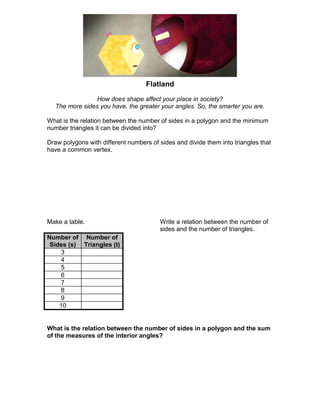
center34504900<br />Flatland<br />How does shape affect your place in society?<br />The more sides you have, the greater your angles. So, the smarter you are. <br />What is the relation between the number of sides in a polygon and the minimum number triangles it can be divided into?<br />Draw polygons with different numbers of sides and divide them into triangles that have a common vertex.<br />Make a table. Write a relation between the number of sides and the number of triangles.<br />Number of Sides (s)Number of Triangles (t)345678910<br />What is the relation between the number of sides in a polygon and the sum of the measures of the interior angles?<br />center34504900<br />Flatland<br />How does shape affect your place in society?<br />The more sides you have, the greater your angles. So, the smarter you are. <br />What is the relation between the number of sides in a polygon and the sum of the measures of the interior angles?<br />Flatland: The Movie Lesson Plan<br />BeforeGetting ReadyHave students watch Flatland: The Movie (35 minutes)Discuss topics of dimensions and thinking unconventionally or from a new perspectiveRe-play the first four minutes of the movieAsk students to focus on the axiom “Configuration makes the man” and the conversation between Arthur Square and Hex: “How does shape affect your place in society?”“The more sides you have, the greater your angles. So, the smarter you are.”Have students draw a hexagon and divide it into trianglesAsk students “What is the minimum number of triangles that a hexagon can be divided into?” (Hint: consider a rectangle)Have students explain their strategies (“Draw triangles that have a common vertex”)Present the problem: “What is the relation between the number of sides in a polygon and the sum of the measures of the interior angles?”Clarify expectationsDuringStudents Problem Solve Listen carefully & watch what is happening (students making tables, writing relations, creating graphs) Ask “prompting” questions such as“What is the relation between the number of sides and the number of triangles? How do you know?”“How many triangles can a 10-sided polygon be divided into? 100-sided?”“How can you organize the information?”“If you don’t want to make a table, what else could you do to explain the pattern?”Circulate & assessExtension: “How many triangles can a circle be divided into? What is interior angle sum of a circle?”AfterClass DiscussionShow & share student solutionsDebrief activity & help students make connections“What did you learn about angles in polygons?”
Flatland 2.0
Flatland 2.0

Flatland 2.0

  • 1.
    center34504900<br />Flatland<br />Howdoes shape affect your place in society?<br />The more sides you have, the greater your angles. So, the smarter you are. <br />What is the relation between the number of sides in a polygon and the minimum number triangles it can be divided into?<br />Draw polygons with different numbers of sides and divide them into triangles that have a common vertex.<br />Make a table. Write a relation between the number of sides and the number of triangles.<br />Number of Sides (s)Number of Triangles (t)345678910<br />What is the relation between the number of sides in a polygon and the sum of the measures of the interior angles?<br />center34504900<br />Flatland<br />How does shape affect your place in society?<br />The more sides you have, the greater your angles. So, the smarter you are. <br />What is the relation between the number of sides in a polygon and the sum of the measures of the interior angles?<br />Flatland: The Movie Lesson Plan<br />BeforeGetting ReadyHave students watch Flatland: The Movie (35 minutes)Discuss topics of dimensions and thinking unconventionally or from a new perspectiveRe-play the first four minutes of the movieAsk students to focus on the axiom “Configuration makes the man” and the conversation between Arthur Square and Hex: “How does shape affect your place in society?”“The more sides you have, the greater your angles. So, the smarter you are.”Have students draw a hexagon and divide it into trianglesAsk students “What is the minimum number of triangles that a hexagon can be divided into?” (Hint: consider a rectangle)Have students explain their strategies (“Draw triangles that have a common vertex”)Present the problem: “What is the relation between the number of sides in a polygon and the sum of the measures of the interior angles?”Clarify expectationsDuringStudents Problem Solve Listen carefully & watch what is happening (students making tables, writing relations, creating graphs) Ask “prompting” questions such as“What is the relation between the number of sides and the number of triangles? How do you know?”“How many triangles can a 10-sided polygon be divided into? 100-sided?”“How can you organize the information?”“If you don’t want to make a table, what else could you do to explain the pattern?”Circulate & assessExtension: “How many triangles can a circle be divided into? What is interior angle sum of a circle?”AfterClass DiscussionShow & share student solutionsDebrief activity & help students make connections“What did you learn about angles in polygons?”