Advanced Flask Patterns
                      PyCon Russia 2013

    — a presentation by Armin Ronacher
                              @mitsuhiko
-1   Who am I?
That's me
✤ Armin Ronacher

✤ @mitsuhiko

✤ Creator of Flask/Werkzeug/Jinja2
0   Focus & Caveats
Interrupt me
✤ Assumes some sense of Flask knowledge

✤ If too fast, interrupt me

✤ If not detailed enough, let me know
1   State Management
Flask States


✤ Setup State

✤ Application Context Bound

✤ Request Context Bound
Setup State


>>> from flask import g
>>> g.foo = 42
Traceback (most recent call last):
  File "<stdin>", line 1, in <module>
RuntimeError: working outside of application context
Application Bound


>>>   ctx = app.app_context()
>>>   ctx.push()
>>>   g.foo = 42
>>>   g.foo
42

>>> from flask import request
>>> request.args
Traceback (most recent call last):
  File "<stdin>", line 1, in <module>
RuntimeError: working outside of request context
Request Bound


>>> ctx = app.test_request_context()
>>> ctx.push()
>>> request.url
'http://localhost/'
>>> g.foo = 42
>>> g.foo
42
Lifetimes


✤ flask.current_app ⇝ application context

✤ flask.g ⇝ application context (as of 0.10)

✤ flask.request ⇝ request context

✤ flask.session ⇝ request context
Quick Overview


✤ Application contexts are fast to create/destroy

✤ Pushing request context pushes new application context

✤ Flask 0.10 binds g to the application context

✤ Bind resources to the application context
2   Resource Management
Basic Guide


✤ Create/Destroy Application Context == Task

✤ Bind resources task wise

✤ Resources: claimed database connections, caches
Teardown Illustrated
>>>   from flask import Flask
>>>   app = Flask(__name__)
>>>   @app.teardown_appcontext
...   def called_on_teardown(error=None):
...     print 'Tearing down, error:', error
...

>>> ctx = app.app_context()
>>> ctx.push()
>>>
>>> ctx.pop()
Tearing down, error: None

>>> with app.app_context():
... 1/0
...
Tearing down, error: integer division or modulo by zero
Traceback (most recent call last):
  File "<stdin>", line 2, in <module>
ZeroDivisionError: integer division or modulo by zero
Resource Management

def get_database_connection():
    con = getattr(g, 'database_connection', None)
    if con is None:
        g.con = con = connection_pool.get_connection()
    return con


@app.teardown_appcontext
def return_database_connection(error=None):
    con = getattr(g, 'database_connection', None)
    if con is not None:
        connection_pool.release_connection(con)
Responsive Resources


@app.teardown_appcontext
def return_database_connection(error=None):
    con = getattr(g, 'database_connection', None)
    if con is None:
        return
    if error is None:
        con.commit()
    else:
        con.rollback()
    connection_pool.release_connection(con)
Per-Task Callbacks


def after_commit(f):
    callbacks = getattr(g, 'on_commit_callbacks', None)
    if callbacks is None:
        g.on_commit_callbacks = callbacks = []
    callbacks.append(f)
    return f
Per-Task Callbacks

@app.teardown_appcontext
def return_database_connection(error=None):
    con = getattr(g, 'database_connection', None)
    if con is None:
        return
    if error is None:
        con.commit()
        callbacks = getattr(g, 'on_commit_callbacks', ())
        for callback in callbacks:
            callback()
    else:
        con.rollback()
    connection_pool.release_connection(con)
Per-Task Callbacks Example


def purchase_product(product, user):
    user.purchased_products.append(product)
    @after_commit
    def send_success_mail():
        body = render_template('mails/product_purchased.txt',
            user=user,
            product=product
        )
        send_mail(user.email_address, 'Product Purchased', body)
3   Response Creation
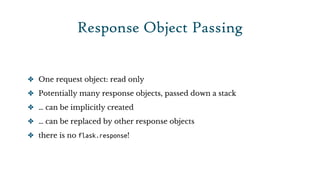
Response Object Passing


✤ One request object: read only

✤ Potentially many response objects, passed down a stack

✤ … can be implicitly created

✤ … can be replaced by other response objects

✤ there is no flask.response!
Implicit Response Creation


@app.route('/')
def index():
    return render_template('index.html')
Explicit Creation


from flask import make_response


@app.route('/')
def index():
    body = render_template('index.html')
    response = make_response(body)
    response.headers['X-Powered-By'] = 'Not-PHP/1.0'
    return response
Customized Creation


from flask import Flask, jsonify


class CustomFlask(Flask):

    def make_response(self, rv):
        if hasattr(rv, 'to_json'):
            return jsonify(rv.to_json())
        return Flask.make_response(self, rv)
Customized Creation Example
class User(object):

    def __init__(self, id, username):
        self.id = id
        self.username = username

    def to_json(self):
        return {
            'id': self.id,
            'username': self.username
        }


app = CustomFlask(__name__)

@app.route('/')
def index():
    return User(42, 'john')
4   Server Sent Events
Basic Overview


✤ Open Socket

✤ Sends "data: <data>rnrn" packets

✤ Good idea for gevent/eventlet, bad idea for kernel level concurrency
Subscribing
from redis import Redis
from flask import Response, stream_with_context


redis = Redis()


@app.route('/streams/interesting')
def stream():
    def generate():
        pubsub = redis.pubsub()
        pubsub.subscribe('interesting-channel')
        for event in pubsub.listen():
            if event['type'] == 'message':
                yield 'data: %srnrn' % event['data']
    return Response(stream_with_context(generate()),
                    direct_passthrough=True,
                    mimetype='text/event-stream')
Publishing


from flask import json, redirect, url_for


@app.route('/create-something', methods=['POST'])
def create_something():
    create_that_thing()
    redis.publish('interesting-channel', json.dumps({
        'event': 'created',
        'kind': 'something'
    }))
    return redirect(url_for('index'))
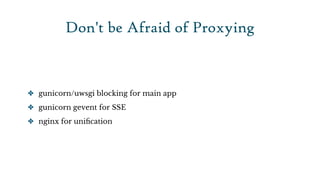
Don't be Afraid of Proxying


✤ gunicorn/uwsgi blocking for main app

✤ gunicorn gevent for SSE

✤ nginx for unification
5   Worker Separation
supervisor config


[program:worker-blocking]
command=gunicorn -w 4 yourapplication:app -b 0.0.0.0:8000

[program:worker-nonblocking]
command=gunicorn -k gevent -w 4 yourapplication:app -b 0.0.0.0:8001
nginx config

server {
    listen 80;
    server_name example.com;

    location /streams {
        proxy_set_header Host $http_host;
        proxy_pass http://localhost:8001/streams;
    }

    location / {
        proxy_set_header Host $http_host;
        proxy_pass http://localhost:8000/;
    }
}
6   Signing Stuff
Basic Overview


✤ Use itsdangerous for signing information that roundtrips

✤ Saves you from storing information in a database

✤ Especially useful for small pieces of information that need to stay
  around for long (any form of token etc.)
User Activation Example
from flask import abort
import itsdangerous


serializer = itsdangerous .URLSafeSerializer(secret_key=app.config['SECRET_KEY'])
ACTIVATION_SALT = 'x7fxfbxc2(;rxa8Ox16{'


def get_activation_link(user):
    return url_for('activate', code=serializer.dumps(user.user_id, salt=ACTIVATION_SALT))


@app.route('/activate/<code>')
def activate(code):
    try:
         user_id = serializer.loads(code, salt=ACTIVATION_SALT)
    except itsdangerous.BadSignature:
         abort(404)
    activate_the_user_with_id(user_id)
7   Customization
Simple Cache Busting

from hashlib import md5
import pkg_resources


ASSET_REVISION = md5(str(pkg_resources.get_distribution(
    'Package-Name').version)).hexdigest())[:14]


@app.url_defaults
def static_cache_buster(endpoint, values):
    if endpoint == 'static':
        values['_v'] = ASSET_REVISION
Disable Parsing


from flask import Flask, Request


class SimpleRequest(Request):
    want_form_data_parsed = False
    data = None


app = Flask(__name__)
app.request_class = SimpleRequest
8   Secure Redirects
Redirect Back
from urlparse import urlparse, urljoin

def is_safe_url(target):
    ref_url = urlparse(request.host_url)
    test_url = urlparse(urljoin(request.host_url, target))
    return test_url.scheme in ('http', 'https') and 
           ref_url.netloc == test_url.netloc

def is_different_url(url):
    this_parts = urlparse(request.url)
    other_parts = urlparse(url)
    return this_parts[:4] != other_parts[:4] and 
        url_decode(this_parts.query) != url_decode(other_parts.query)

def redirect_back(fallback):
    next = request.args.get('next') or request.referrer
    if next and is_safe_url(next) and is_different_url(next):
        return redirect(next)
    return redirect(fallback)
Q&A
 http://fireteam.net/ — Armin Ronacher — @mitsuhiko

Flask patterns

  • 1.
    Advanced Flask Patterns PyCon Russia 2013 — a presentation by Armin Ronacher @mitsuhiko
  • 2.
    -1 Who am I?
  • 3.
    That's me ✤ ArminRonacher ✤ @mitsuhiko ✤ Creator of Flask/Werkzeug/Jinja2
  • 4.
    0 Focus & Caveats
  • 5.
    Interrupt me ✤ Assumessome sense of Flask knowledge ✤ If too fast, interrupt me ✤ If not detailed enough, let me know
  • 6.
    1 State Management
  • 7.
    Flask States ✤ SetupState ✤ Application Context Bound ✤ Request Context Bound
  • 8.
    Setup State >>> fromflask import g >>> g.foo = 42 Traceback (most recent call last): File "<stdin>", line 1, in <module> RuntimeError: working outside of application context
  • 9.
    Application Bound >>> ctx = app.app_context() >>> ctx.push() >>> g.foo = 42 >>> g.foo 42 >>> from flask import request >>> request.args Traceback (most recent call last): File "<stdin>", line 1, in <module> RuntimeError: working outside of request context
  • 10.
    Request Bound >>> ctx= app.test_request_context() >>> ctx.push() >>> request.url 'http://localhost/' >>> g.foo = 42 >>> g.foo 42
  • 11.
    Lifetimes ✤ flask.current_app ⇝application context ✤ flask.g ⇝ application context (as of 0.10) ✤ flask.request ⇝ request context ✤ flask.session ⇝ request context
  • 12.
    Quick Overview ✤ Applicationcontexts are fast to create/destroy ✤ Pushing request context pushes new application context ✤ Flask 0.10 binds g to the application context ✤ Bind resources to the application context
  • 13.
    2 Resource Management
  • 14.
    Basic Guide ✤ Create/DestroyApplication Context == Task ✤ Bind resources task wise ✤ Resources: claimed database connections, caches
  • 15.
    Teardown Illustrated >>> from flask import Flask >>> app = Flask(__name__) >>> @app.teardown_appcontext ... def called_on_teardown(error=None): ... print 'Tearing down, error:', error ... >>> ctx = app.app_context() >>> ctx.push() >>> >>> ctx.pop() Tearing down, error: None >>> with app.app_context(): ... 1/0 ... Tearing down, error: integer division or modulo by zero Traceback (most recent call last): File "<stdin>", line 2, in <module> ZeroDivisionError: integer division or modulo by zero
  • 16.
    Resource Management def get_database_connection(): con = getattr(g, 'database_connection', None) if con is None: g.con = con = connection_pool.get_connection() return con @app.teardown_appcontext def return_database_connection(error=None): con = getattr(g, 'database_connection', None) if con is not None: connection_pool.release_connection(con)
  • 17.
    Responsive Resources @app.teardown_appcontext def return_database_connection(error=None): con = getattr(g, 'database_connection', None) if con is None: return if error is None: con.commit() else: con.rollback() connection_pool.release_connection(con)
  • 18.
    Per-Task Callbacks def after_commit(f): callbacks = getattr(g, 'on_commit_callbacks', None) if callbacks is None: g.on_commit_callbacks = callbacks = [] callbacks.append(f) return f
  • 19.
    Per-Task Callbacks @app.teardown_appcontext def return_database_connection(error=None): con = getattr(g, 'database_connection', None) if con is None: return if error is None: con.commit() callbacks = getattr(g, 'on_commit_callbacks', ()) for callback in callbacks: callback() else: con.rollback() connection_pool.release_connection(con)
  • 20.
    Per-Task Callbacks Example defpurchase_product(product, user): user.purchased_products.append(product) @after_commit def send_success_mail(): body = render_template('mails/product_purchased.txt', user=user, product=product ) send_mail(user.email_address, 'Product Purchased', body)
  • 21.
    3 Response Creation
  • 22.
    Response Object Passing ✤One request object: read only ✤ Potentially many response objects, passed down a stack ✤ … can be implicitly created ✤ … can be replaced by other response objects ✤ there is no flask.response!
  • 23.
    Implicit Response Creation @app.route('/') defindex(): return render_template('index.html')
  • 24.
    Explicit Creation from flaskimport make_response @app.route('/') def index(): body = render_template('index.html') response = make_response(body) response.headers['X-Powered-By'] = 'Not-PHP/1.0' return response
  • 25.
    Customized Creation from flaskimport Flask, jsonify class CustomFlask(Flask): def make_response(self, rv): if hasattr(rv, 'to_json'): return jsonify(rv.to_json()) return Flask.make_response(self, rv)
  • 26.
    Customized Creation Example classUser(object): def __init__(self, id, username): self.id = id self.username = username def to_json(self): return { 'id': self.id, 'username': self.username } app = CustomFlask(__name__) @app.route('/') def index(): return User(42, 'john')
  • 27.
    4 Server Sent Events
  • 28.
    Basic Overview ✤ OpenSocket ✤ Sends "data: <data>rnrn" packets ✤ Good idea for gevent/eventlet, bad idea for kernel level concurrency
  • 29.
    Subscribing from redis importRedis from flask import Response, stream_with_context redis = Redis() @app.route('/streams/interesting') def stream(): def generate(): pubsub = redis.pubsub() pubsub.subscribe('interesting-channel') for event in pubsub.listen(): if event['type'] == 'message': yield 'data: %srnrn' % event['data'] return Response(stream_with_context(generate()), direct_passthrough=True, mimetype='text/event-stream')
  • 30.
    Publishing from flask importjson, redirect, url_for @app.route('/create-something', methods=['POST']) def create_something(): create_that_thing() redis.publish('interesting-channel', json.dumps({ 'event': 'created', 'kind': 'something' })) return redirect(url_for('index'))
  • 31.
    Don't be Afraidof Proxying ✤ gunicorn/uwsgi blocking for main app ✤ gunicorn gevent for SSE ✤ nginx for unification
  • 32.
    5 Worker Separation
  • 33.
    supervisor config [program:worker-blocking] command=gunicorn -w4 yourapplication:app -b 0.0.0.0:8000 [program:worker-nonblocking] command=gunicorn -k gevent -w 4 yourapplication:app -b 0.0.0.0:8001
  • 34.
    nginx config server { listen 80; server_name example.com; location /streams { proxy_set_header Host $http_host; proxy_pass http://localhost:8001/streams; } location / { proxy_set_header Host $http_host; proxy_pass http://localhost:8000/; } }
  • 35.
    6 Signing Stuff
  • 36.
    Basic Overview ✤ Useitsdangerous for signing information that roundtrips ✤ Saves you from storing information in a database ✤ Especially useful for small pieces of information that need to stay around for long (any form of token etc.)
  • 37.
    User Activation Example fromflask import abort import itsdangerous serializer = itsdangerous .URLSafeSerializer(secret_key=app.config['SECRET_KEY']) ACTIVATION_SALT = 'x7fxfbxc2(;rxa8Ox16{' def get_activation_link(user): return url_for('activate', code=serializer.dumps(user.user_id, salt=ACTIVATION_SALT)) @app.route('/activate/<code>') def activate(code): try: user_id = serializer.loads(code, salt=ACTIVATION_SALT) except itsdangerous.BadSignature: abort(404) activate_the_user_with_id(user_id)
  • 38.
    7 Customization
  • 39.
    Simple Cache Busting fromhashlib import md5 import pkg_resources ASSET_REVISION = md5(str(pkg_resources.get_distribution( 'Package-Name').version)).hexdigest())[:14] @app.url_defaults def static_cache_buster(endpoint, values): if endpoint == 'static': values['_v'] = ASSET_REVISION
  • 40.
    Disable Parsing from flaskimport Flask, Request class SimpleRequest(Request): want_form_data_parsed = False data = None app = Flask(__name__) app.request_class = SimpleRequest
  • 41.
    8 Secure Redirects
  • 42.
    Redirect Back from urlparseimport urlparse, urljoin def is_safe_url(target): ref_url = urlparse(request.host_url) test_url = urlparse(urljoin(request.host_url, target)) return test_url.scheme in ('http', 'https') and ref_url.netloc == test_url.netloc def is_different_url(url): this_parts = urlparse(request.url) other_parts = urlparse(url) return this_parts[:4] != other_parts[:4] and url_decode(this_parts.query) != url_decode(other_parts.query) def redirect_back(fallback): next = request.args.get('next') or request.referrer if next and is_safe_url(next) and is_different_url(next): return redirect(next) return redirect(fallback)
  • 43.
    Q&A http://fireteam.net/ —Armin Ronacher — @mitsuhiko