Flask? No thanks!
by Alexey Popravka
About me
● 6+ years of Python
● Python developer / Tech Lead at Prom.ua
● Contributor of github.com/aio-libs
● github.com/popravich
What this talk is about?
● What is Flask
● What Flask is not (what is wrong)
● Alternatives
● Questions
What is Flask
“Flask is a microframework for Python based on
Werkzeug, Jinja 2 and good intentions.”
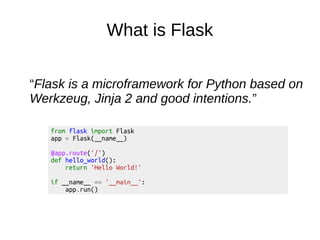
What is Flask
“Flask is a microframework for Python based on
Werkzeug, Jinja 2 and good intentions.”
from flask import Flask
app = Flask(__name__)
@app.route('/')
def hello_world():
return 'Hello World!'
if __name__ == '__main__':
app.run()
What is Flask
● Jinja2 templates out of the box
from flask import render_template
@app.route('/hello/')
@app.route('/hello/<name>')
def hello(name=None):
return render_template('hello.html', name=name)
<!doctype html>
<title>Hello from Flask</title>
{% if name %}
<h1>Hello {{ name }}!</h1>
{% else %}
<h1>Hello World!</h1>
{% endif %}
What is Flask
● Jinja2 templates
● Sessions
from flask import Flask, session, escape
app = Flask(__name__)
@app.route('/')
def index():
if 'username' in session:
return 'Logged in as %s' % escape(session['username'])
return 'You are not logged in'
What is Flask
● Jinja2 templates
● Sessions
● Static files serving
url_for('static', filename='style.css')
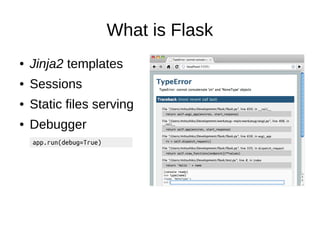
What is Flask
● Jinja2 templates
● Sessions
● Static files serving
● Debugger
app.run(debug=True)
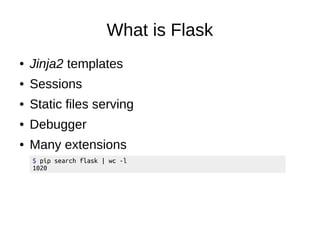
What is Flask
● Jinja2 templates
● Sessions
● Static files serving
● Debugger
● Many extensions
$ pip search flask | wc -l
1020
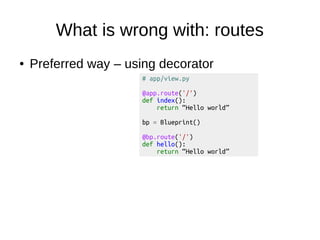
What is wrong with: routes
● Preferred way – using decorator
# app/view.py
@app.route('/')
def index():
return “Hello world”
bp = Blueprint()
@bp.route('/')
def hello():
return “Hello world”
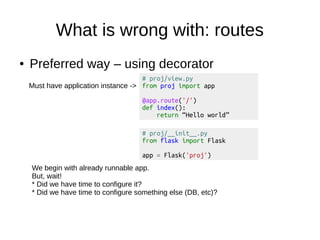
What is wrong with: routes
● Preferred way – using decorator
# proj/view.py
from proj import app
@app.route('/')
def index():
return “Hello world”
Must have application instance ->
# proj/__init__.py
from flask import Flask
app = Flask('proj')
We begin with already runnable app.
But, wait!
* Did we have time to configure it?
* Did we have time to configure something else (DB, etc)?
What is wrong with: routes
● Preferred way – using decorator?
# proj/view.py
from proj import app
if app.debug:
@app.route('/docs/')
def show_some_docs():
pass
How to control? ->
What is wrong with: composite apps
Say you need several apps not messing their
code:
# proj/app/__init__.py
from flask import Flask
app = Flask('proj.app')
@app.route('/')
def index():
return render_template(
'index.html')
# proj/admin/__init__.py
from flask import Flask
app = Flask('proj.admin')
@app.route('/')
def index():
return render_template(
'admin_index.html')
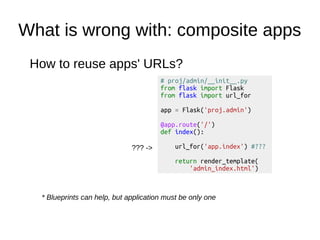
What is wrong with: composite apps
How to reuse apps' URLs?
# proj/admin/__init__.py
from flask import Flask
from flask import url_for
app = Flask('proj.admin')
@app.route('/')
def index():
url_for('app.index') #???
return render_template(
'admin_index.html')
??? ->
* Blueprints can help, but application must be only one
What is wrong with: jinja
Abused!
from celery import Celery
from flask import render_template
celery_app = Celery()
@celery_app.task
def send_periodic_email():
to = get_address()
html_body = render_template('mails/annoy.html')
send_mail(to, html_body)
Web Worker == Celery Worker
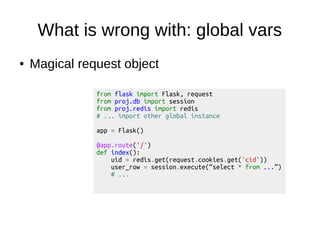
What is wrong with: global vars
● Magical request object
thread-local proxy object
from celery import Celery
from flask import render_template, session
celery_app = Celery()
@celery_app.task
def send_periodic_email():
to = get_address()
user_name = session['user_name']
html_body = render_template(
'mails/annoy.html',
{user_name: user_name})
send_mail(to, html_body)
Need request instance ->
What is wrong with: global vars
● Magical request object
from flask import Flask, request
from proj.db import session
from proj.redis import redis
# ... import other global instance
app = Flask()
@app.route('/')
def index():
uid = redis.get(request.cookies.get('cid'))
user_row = session.execute(“select * from ...”)
# ...
Alternatives
● Enough using WSGI, start using asyncio/aiohttp
Alternatives
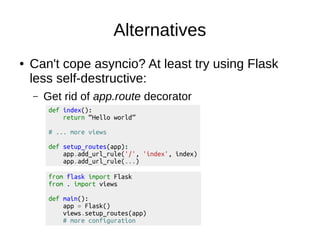
● Can't cope asyncio? At least try using Flask
less self-destructive:
– Get rid of app.route decorator
def index():
return “Hello world”
# ... more views
def setup_routes(app):
app.add_url_rule('/', 'index', index)
app.add_url_rule(...)
from flask import Flask
from . import views
def main():
app = Flask()
views.setup_routes(app)
# more configuration
Alternatives
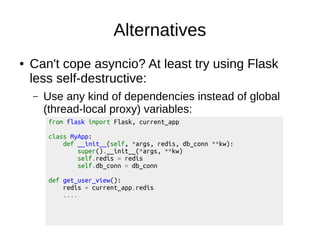
● Can't cope asyncio? At least try using Flask
less self-destructive:
– Use any kind of dependencies instead of global
(thread-local proxy) variables:
from flask import Flask, current_app
class MyApp:
def __init__(self, *args, redis, db_conn **kw):
super().__init__(*args, **kw)
self.redis = redis
self.db_conn = db_conn
def get_user_view():
redis = current_app.redis
....
Alternatives
● Still want to use Flask — use Werkzeug!
The End
Questions?
What Flask is not — it is not “micro framework” it is a “Werkzeug wrapper”

Kyiv.py #17 Flask talk

  • 1.
    Flask? No thanks! byAlexey Popravka
  • 2.
    About me ● 6+years of Python ● Python developer / Tech Lead at Prom.ua ● Contributor of github.com/aio-libs ● github.com/popravich
  • 3.
    What this talkis about? ● What is Flask ● What Flask is not (what is wrong) ● Alternatives ● Questions
  • 4.
    What is Flask “Flaskis a microframework for Python based on Werkzeug, Jinja 2 and good intentions.”
  • 5.
    What is Flask “Flaskis a microframework for Python based on Werkzeug, Jinja 2 and good intentions.” from flask import Flask app = Flask(__name__) @app.route('/') def hello_world(): return 'Hello World!' if __name__ == '__main__': app.run()
  • 6.
    What is Flask ●Jinja2 templates out of the box from flask import render_template @app.route('/hello/') @app.route('/hello/<name>') def hello(name=None): return render_template('hello.html', name=name) <!doctype html> <title>Hello from Flask</title> {% if name %} <h1>Hello {{ name }}!</h1> {% else %} <h1>Hello World!</h1> {% endif %}
  • 7.
    What is Flask ●Jinja2 templates ● Sessions from flask import Flask, session, escape app = Flask(__name__) @app.route('/') def index(): if 'username' in session: return 'Logged in as %s' % escape(session['username']) return 'You are not logged in'
  • 8.
    What is Flask ●Jinja2 templates ● Sessions ● Static files serving url_for('static', filename='style.css')
  • 9.
    What is Flask ●Jinja2 templates ● Sessions ● Static files serving ● Debugger app.run(debug=True)
  • 10.
    What is Flask ●Jinja2 templates ● Sessions ● Static files serving ● Debugger ● Many extensions $ pip search flask | wc -l 1020
  • 11.
    What is wrongwith: routes ● Preferred way – using decorator # app/view.py @app.route('/') def index(): return “Hello world” bp = Blueprint() @bp.route('/') def hello(): return “Hello world”
  • 12.
    What is wrongwith: routes ● Preferred way – using decorator # proj/view.py from proj import app @app.route('/') def index(): return “Hello world” Must have application instance -> # proj/__init__.py from flask import Flask app = Flask('proj') We begin with already runnable app. But, wait! * Did we have time to configure it? * Did we have time to configure something else (DB, etc)?
  • 13.
    What is wrongwith: routes ● Preferred way – using decorator? # proj/view.py from proj import app if app.debug: @app.route('/docs/') def show_some_docs(): pass How to control? ->
  • 14.
    What is wrongwith: composite apps Say you need several apps not messing their code: # proj/app/__init__.py from flask import Flask app = Flask('proj.app') @app.route('/') def index(): return render_template( 'index.html') # proj/admin/__init__.py from flask import Flask app = Flask('proj.admin') @app.route('/') def index(): return render_template( 'admin_index.html')
  • 15.
    What is wrongwith: composite apps How to reuse apps' URLs? # proj/admin/__init__.py from flask import Flask from flask import url_for app = Flask('proj.admin') @app.route('/') def index(): url_for('app.index') #??? return render_template( 'admin_index.html') ??? -> * Blueprints can help, but application must be only one
  • 16.
    What is wrongwith: jinja Abused! from celery import Celery from flask import render_template celery_app = Celery() @celery_app.task def send_periodic_email(): to = get_address() html_body = render_template('mails/annoy.html') send_mail(to, html_body) Web Worker == Celery Worker
  • 17.
    What is wrongwith: global vars ● Magical request object thread-local proxy object from celery import Celery from flask import render_template, session celery_app = Celery() @celery_app.task def send_periodic_email(): to = get_address() user_name = session['user_name'] html_body = render_template( 'mails/annoy.html', {user_name: user_name}) send_mail(to, html_body) Need request instance ->
  • 18.
    What is wrongwith: global vars ● Magical request object from flask import Flask, request from proj.db import session from proj.redis import redis # ... import other global instance app = Flask() @app.route('/') def index(): uid = redis.get(request.cookies.get('cid')) user_row = session.execute(“select * from ...”) # ...
  • 19.
    Alternatives ● Enough usingWSGI, start using asyncio/aiohttp
  • 20.
    Alternatives ● Can't copeasyncio? At least try using Flask less self-destructive: – Get rid of app.route decorator def index(): return “Hello world” # ... more views def setup_routes(app): app.add_url_rule('/', 'index', index) app.add_url_rule(...) from flask import Flask from . import views def main(): app = Flask() views.setup_routes(app) # more configuration
  • 21.
    Alternatives ● Can't copeasyncio? At least try using Flask less self-destructive: – Use any kind of dependencies instead of global (thread-local proxy) variables: from flask import Flask, current_app class MyApp: def __init__(self, *args, redis, db_conn **kw): super().__init__(*args, **kw) self.redis = redis self.db_conn = db_conn def get_user_view(): redis = current_app.redis ....
  • 22.
    Alternatives ● Still wantto use Flask — use Werkzeug!
  • 23.
    The End Questions? What Flaskis not — it is not “micro framework” it is a “Werkzeug wrapper”