and how to live with it
What is ServerlessWhat is Serverless
and how to live with it
Nikolay Markov, Pycon 2017
Shameless Plug
● My name is Nikolay Markov
● Senior Data Engineer at Aligned Research Group
● Used Python for 6+ years
● PyData Moscow Organizer
(http://meetup.com/PyData-Moscow/)
● Python, C++, Scala and FP are good, everything with
“java” in its title is bad, haven’t decided about Go yet
What is Data Engineering?
They said DevOps means everything and nothing at once
● And, of course, it’s different in every
company
● As Big Data is, isn’t it?
● Also, writing a good code is not a data
scientist’s job, but math and stats is
● So, what the hell is Serverless and what
Python has to do with all this?
Pipelines (+ ETL’s)
● Airflow/Luigi/Jenkins
● Bash
● RabbitMQ/Apache Kafka
● SQL
● MongoDB/HBase
● ELK
● …
● PROFIT
Enough marketing words!
Let’s talk about Clouds, Big Data and Microservices instead!
Let’s get ourselves some cloud
● Move the slider - get the
resources
● Cut the cloud into pieces
(VMs)
● Now let’s have DevOps guys
to support them…
● You see where this is going,
right?
So, what is Serverless then?
● An application that significantly or fully depend on 3rd party
cloud-based applications/services to manage server-side logic and state
(Backend as a Service).
● Parts of a business logic run in stateless compute containers that are
event-triggered, ephemeral (may only last for one invocation), and fully
managed by a 3rd party (Function as a Service).
https://martinfowler.com/articles/serverless.html
Typical cases: API
● Someone or something is querying your service
● You do some background magic and return the result
Typical cases: Storage
● Object storage
● Document storage
● Analytic storage
● BI/Data Warehouse
Typical cases: Mobile/IoT
● Sending messages and notifications
● Collecting data from a network of devices
● Launch events directly on devices
● Build cross-platform apps and firmwares
Typical cases: CI/CD and Security
● Run tests
● Simulate user traffic
● Security analysis
● Build packages
● Roll out updates
Typical cases: Distributed Computing
*aaS pandemia
FaaS to rule them all
Perks and advantages
● Decrease the load on DevOps
● Pay per usage time
● Just write your business logic
Bad stuff
● Tied to a particular vendor
● May become expensive at some point
● Limited resources
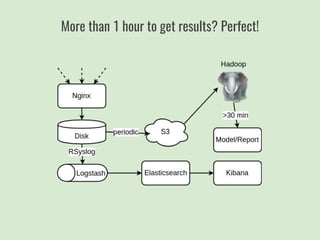
More than 1 hour to get results? Perfect!
More streamy-like should do it, right?
Bash pipe
~$ sleep 3 | echo “OK”
Link to my Bash pipeline talk slides (in Russian): http://bit.ly/2tfdUCG
To stream or not to stream?
Let’s run some code!
1.
Let’s run some code!
2.
Let’s run some code!
3.
Events and triggers
● Write code and pack it
with dependencies
● Bind to certain events
● Configure security policies
● …
● Manually it’s kinda hard
You need a framework!
Chalice
Here’s how it looks
+
Serverless:
~$ sls create -t aws-python3
Apex:
~$ apex init
(+ .tf files for Hashicorp Terraform)
Here’s how it looks
{
"name": "mycoolproject",
"description": "My cool
project that does stuff",
"runtime": "python3.6",
"memory": 128,
"timeout": 5,
"role":
"arn:aws:iam::SECRET:role/mycool
project_lambda_function",
"environment": {}
}
Apex:
service: aws-python3 provider:
name: aws
runtime: python3.6
functions:
hello:
handler: handler.do_stuff
events:
- http:
path: items/{item_id}
method: get
Serverless:
All you need after that is “import boto3”, write magic and
“sls deploy” or “apex deploy”
{
"dev": {
"app_function": "app.app",
"aws_region": "us-west-1",
"profile_name": "default",
"s3_bucket": "zappa-20d98oewi"
}
}
It’s similar with microservice frameworks
Zappa:
And your cloud-based Flask/Django/WSGI app runs as
fast as “zappa deploy”
Chalice:
Basically just Flask
import pywren
def myfunc(args):
# Do something!
return result
pwex = pywren.default_executor()
futures = pwex.map(myfunc, args)
results = pwex.get_all_results(futures)
PyWren
http://pywren.io/
Some gotchas
● Mind your library-dependent requirements! (install
serverless-python-requirements for Serverless)
Manually:
https://stackoverflow.com/questions/34749806/using-mo
viepy-scipy-and-numpy-in-amazon-lambda
Pre-built:
https://github.com/Miserlou/lambda-packages
● Nothing in Lambda console? Try CloudFormation!
Some limits of AWS Lambda
● <= 512 Mb HD
● Request size <= 6Mb (if Event - 128K)
● <= 1000 concurrent executions per region
● <= 50 Mb compressed deployment package size
● <= 250 Mb uncompressed
● <= 75 Gb total packages uploaded per region
● <= 5 minutes run per request
https://docs.aws.amazon.com/lambda/latest/dg/limits.htm
l
AWS Lambda pricing
● First 1 million requests per month are free
● $0.20 per 1 million requests thereafter ($0.0000002 per
request)
● The Lambda free tier includes 1M free requests per
month and 400,000 GB-seconds of compute time per
month.
● API Gateway: $3.50 per million API calls received, plus
the cost of data transfer out, in gigabytes.
https://aws.amazon.com/lambda/pricing/
https://aws.amazon.com/api-gateway/pricing/
How to test your serverless applications
Run lambdas:
https://github.com/lambci/docker-lambda
Mock Boto:
https://github.com/spulec/moto
«Что такое serverless-архитектура и как с ней жить?» Николай Марков, Aligned Research Group

«Что такое serverless-архитектура и как с ней жить?» Николай Марков, Aligned Research Group

  • 1.
    and how tolive with it What is ServerlessWhat is Serverless and how to live with it Nikolay Markov, Pycon 2017
  • 2.
    Shameless Plug ● Myname is Nikolay Markov ● Senior Data Engineer at Aligned Research Group ● Used Python for 6+ years ● PyData Moscow Organizer (http://meetup.com/PyData-Moscow/) ● Python, C++, Scala and FP are good, everything with “java” in its title is bad, haven’t decided about Go yet
  • 3.
    What is DataEngineering? They said DevOps means everything and nothing at once ● And, of course, it’s different in every company ● As Big Data is, isn’t it? ● Also, writing a good code is not a data scientist’s job, but math and stats is ● So, what the hell is Serverless and what Python has to do with all this?
  • 4.
    Pipelines (+ ETL’s) ●Airflow/Luigi/Jenkins ● Bash ● RabbitMQ/Apache Kafka ● SQL ● MongoDB/HBase ● ELK ● … ● PROFIT
  • 5.
    Enough marketing words! Let’stalk about Clouds, Big Data and Microservices instead!
  • 6.
    Let’s get ourselvessome cloud ● Move the slider - get the resources ● Cut the cloud into pieces (VMs) ● Now let’s have DevOps guys to support them… ● You see where this is going, right?
  • 7.
    So, what isServerless then? ● An application that significantly or fully depend on 3rd party cloud-based applications/services to manage server-side logic and state (Backend as a Service). ● Parts of a business logic run in stateless compute containers that are event-triggered, ephemeral (may only last for one invocation), and fully managed by a 3rd party (Function as a Service). https://martinfowler.com/articles/serverless.html
  • 8.
    Typical cases: API ●Someone or something is querying your service ● You do some background magic and return the result
  • 9.
    Typical cases: Storage ●Object storage ● Document storage ● Analytic storage ● BI/Data Warehouse
  • 10.
    Typical cases: Mobile/IoT ●Sending messages and notifications ● Collecting data from a network of devices ● Launch events directly on devices ● Build cross-platform apps and firmwares
  • 11.
    Typical cases: CI/CDand Security ● Run tests ● Simulate user traffic ● Security analysis ● Build packages ● Roll out updates
  • 12.
  • 13.
  • 14.
    FaaS to rulethem all
  • 15.
    Perks and advantages ●Decrease the load on DevOps ● Pay per usage time ● Just write your business logic Bad stuff ● Tied to a particular vendor ● May become expensive at some point ● Limited resources
  • 16.
    More than 1hour to get results? Perfect!
  • 17.
  • 18.
    Bash pipe ~$ sleep3 | echo “OK” Link to my Bash pipeline talk slides (in Russian): http://bit.ly/2tfdUCG
  • 19.
    To stream ornot to stream?
  • 20.
  • 21.
  • 22.
  • 23.
    Events and triggers ●Write code and pack it with dependencies ● Bind to certain events ● Configure security policies ● … ● Manually it’s kinda hard
  • 24.
    You need aframework! Chalice
  • 25.
    Here’s how itlooks + Serverless: ~$ sls create -t aws-python3 Apex: ~$ apex init (+ .tf files for Hashicorp Terraform)
  • 26.
    Here’s how itlooks { "name": "mycoolproject", "description": "My cool project that does stuff", "runtime": "python3.6", "memory": 128, "timeout": 5, "role": "arn:aws:iam::SECRET:role/mycool project_lambda_function", "environment": {} } Apex: service: aws-python3 provider: name: aws runtime: python3.6 functions: hello: handler: handler.do_stuff events: - http: path: items/{item_id} method: get Serverless: All you need after that is “import boto3”, write magic and “sls deploy” or “apex deploy”
  • 27.
    { "dev": { "app_function": "app.app", "aws_region":"us-west-1", "profile_name": "default", "s3_bucket": "zappa-20d98oewi" } } It’s similar with microservice frameworks Zappa: And your cloud-based Flask/Django/WSGI app runs as fast as “zappa deploy” Chalice: Basically just Flask
  • 28.
    import pywren def myfunc(args): #Do something! return result pwex = pywren.default_executor() futures = pwex.map(myfunc, args) results = pwex.get_all_results(futures) PyWren http://pywren.io/
  • 29.
    Some gotchas ● Mindyour library-dependent requirements! (install serverless-python-requirements for Serverless) Manually: https://stackoverflow.com/questions/34749806/using-mo viepy-scipy-and-numpy-in-amazon-lambda Pre-built: https://github.com/Miserlou/lambda-packages ● Nothing in Lambda console? Try CloudFormation!
  • 30.
    Some limits ofAWS Lambda ● <= 512 Mb HD ● Request size <= 6Mb (if Event - 128K) ● <= 1000 concurrent executions per region ● <= 50 Mb compressed deployment package size ● <= 250 Mb uncompressed ● <= 75 Gb total packages uploaded per region ● <= 5 minutes run per request https://docs.aws.amazon.com/lambda/latest/dg/limits.htm l
  • 31.
    AWS Lambda pricing ●First 1 million requests per month are free ● $0.20 per 1 million requests thereafter ($0.0000002 per request) ● The Lambda free tier includes 1M free requests per month and 400,000 GB-seconds of compute time per month. ● API Gateway: $3.50 per million API calls received, plus the cost of data transfer out, in gigabytes. https://aws.amazon.com/lambda/pricing/ https://aws.amazon.com/api-gateway/pricing/
  • 32.
    How to testyour serverless applications Run lambdas: https://github.com/lambci/docker-lambda Mock Boto: https://github.com/spulec/moto