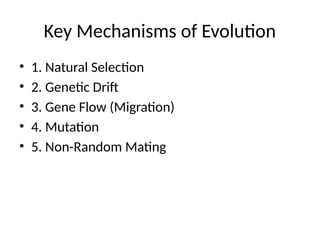
What is Evolution?
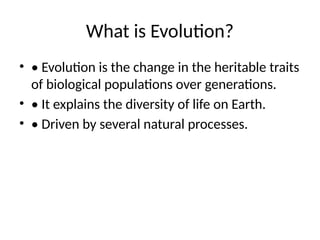
•• Evolution is the change in the heritable traits
of biological populations over generations.
• • It explains the diversity of life on Earth.
• • Driven by several natural processes.
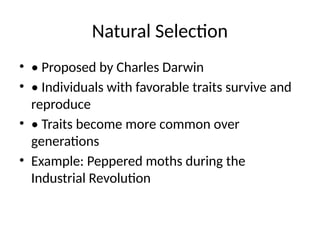
Natural Selection
• •Proposed by Charles Darwin
• • Individuals with favorable traits survive and
reproduce
• • Traits become more common over
generations
• Example: Peppered moths during the
Industrial Revolution
5.
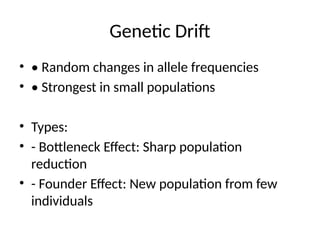
Genetic Drift
• •Random changes in allele frequencies
• • Strongest in small populations
• Types:
• - Bottleneck Effect: Sharp population
reduction
• - Founder Effect: New population from few
individuals
6.
Gene Flow (Migration)
•• Movement of genes between populations
• • Increases genetic variation
• • Can introduce new traits
• Example: Migration of animals between
isolated populations
7.
Mutation
• • Changesin DNA sequences
• • Source of new genetic variation
• • Can be beneficial, neutral, or harmful
• Example: Sickle cell trait providing malaria
resistance
8.
Non-Random Mating
• •Mating is not random – individuals select
mates
• • Affects which traits become common
• • Includes sexual selection
• Example: Peacock tails attracting mates
9.
Combined Effects
• •These mechanisms often work together
• Example: Mutation + natural selection
• Real-world case: Antibiotic resistance in
bacteria
10.
Recap and Summary
•• Evolution occurs through multiple
mechanisms
• • Leads to adaptation and speciation
• • Explains biodiversity on Earth
• Think About: How do these processes affect
humans today?
11.
Questions & Discussion
•• What examples of evolution can you observe
around you?
• • How does understanding evolution help in
medicine and conservation?
12.
References
• • CampbellBiology, 11th Edition
• • National Geographic
• • Khan Academy – Evolution
![Mechanisms of Evolution
Understanding How Species Change
Over Time
Presented by: [Your Name]](https://image.slidesharecdn.com/mechanismsofevolutionpresentation-250909062921-cb5296df/85/Five-Mechanisms_of_Evolution_Presentation-pptx-1-320.jpg)
![Mechanisms of Evolution
Understanding How Species Change
Over Time
Presented by: [Your Name]](https://image.slidesharecdn.com/mechanismsofevolutionpresentation-250909062921-cb5296df/75/Five-Mechanisms_of_Evolution_Presentation-pptx-1-2048.jpg)