MECHANISMS OF
EVOLUTION
• Biologists organize their thinking about biological
processes using evolution as the framework. There are
four key mechanisms that allow a population, a group of
interacting organisms of a single species, to exhibit a
change in allele frequency from one generation to the
next. These are evolution by: mutation, genetic drift,
natural selection, and gene flow.
What is an allele?
• Well, alleles are matching genes; one from our biological
mother, one from our biological father. We have two
copies of every gene.
• They can be identical, but they can often have slight
differences. Alleles, therefore, include all the variant forms
of a particular gene. This combination of similarities and
differences can have important effects within our body.
What makes these allele variations important? The way that
two different alleles interact with each other can sometimes
result in different, observable in a person.
• For example, a dominant allele can override the traits of
other recessive alleles, and it is these properties that help
decide things like a person's eye and hair color. In this
case, alleles that code for brown eyes are dominant over
the recessive alleles that code for blue eyes.
Allele frequency refers to how common an allele is in a
population.
These are the different types of mechanisms:
1. Mutation
2. Gene flow
3. Genetic drift
4. Natural selection
Mutation
A mutation is a change that occurs in our DNA sequence,
either due to mistakes when the DNA is copied or as the
result of environmental factors such as UV light and
cigarette smoke.
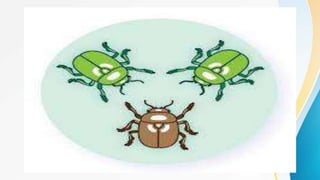
For example: A mutation could cause beetle parents with
genes for bright green coloration to have offspring with a
gene for brown coloration. That would make genes for
brown coloration more frequent in the population than they
were before the mutation.
Gene flow
• Gene flow is the movement of genes into or out of a
population. Such movement may be due to migration of
individual organisms that reproduce in their new
populations.
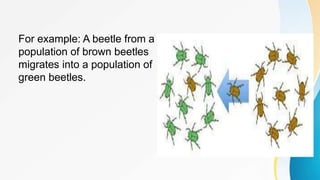
For example: A beetle from a
population of brown beetles
migrates into a population of
green beetles.
Genetic drift
• Genetic drift is a mechanism of evolution in which allele
frequencies of a population change over generations due
to chance (sampling error). Genetic drift occurs in all
populations of non-infinite size, but its effects are
strongest in small populations.
• Genetic drift can result in a bottleneck effect or founder
effect.
Example of Genetic drift
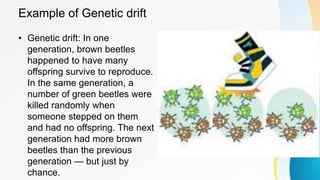
• Genetic drift: In one
generation, brown beetles
happened to have many
offspring survive to reproduce.
In the same generation, a
number of green beetles were
killed randomly when
someone stepped on them
and had no offspring. The next
generation had more brown
beetles than the previous
generation — but just by
chance.
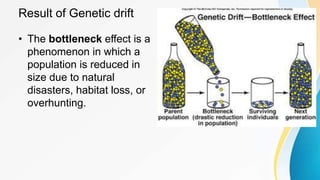
Result of Genetic drift
• The bottleneck effect is a
phenomenon in which a
population is reduced in
size due to natural
disasters, habitat loss, or
overhunting.
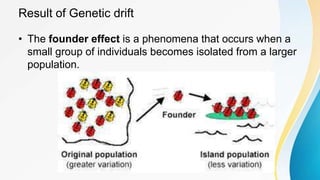
Result of Genetic drift
• The founder effect is a phenomena that occurs when a
small group of individuals becomes isolated from a larger
population.
Natural Selection
• Natural selection is a mechanism of evolution. Organisms
that are more adapted to their environment are more likely
to survive and pass on the genes that aided their success.
This process causes species to change and diverge over
time.
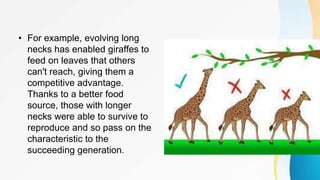
• For example, evolving long
necks has enabled giraffes to
feed on leaves that others
can't reach, giving them a
competitive advantage.
Thanks to a better food
source, those with longer
necks were able to survive to
reproduce and so pass on the
characteristic to the
succeeding generation.
Types of Natural Selection
• Directional selection.
• Disruptive selection.
• Stabilizing selection.
Directional selection
• In population genetics, directional selection, is a mode of
negative natural selection in which an extreme phenotype
is favored over other phenotypes, causing the allele
frequency to shift over time in the direction of that
phenotype.
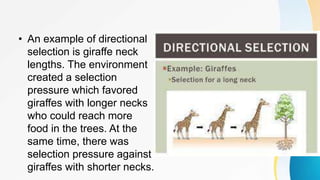
• An example of directional
selection is giraffe neck
lengths. The environment
created a selection
pressure which favored
giraffes with longer necks
who could reach more
food in the trees. At the
same time, there was
selection pressure against
giraffes with shorter necks.
Disruptive selection/ Diversifying selection
• Disruptive selection is an evolutionary force that drives a
population apart. The disruptive selection will cause
organsisms with intermediate traits to reproduce less, and
will allow those organisms with extreme traits to
reproduce more. This causes the alleles for the extreme
traits to increase in frequency. Over time, and with
enough disruptive selection, a population can be
completely divided. When this happens, the two
populations can become diverse enough to form separate
species.
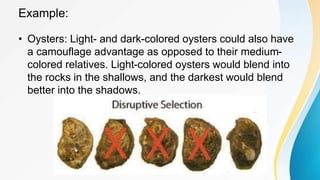
Example:
• Oysters: Light- and dark-colored oysters could also have
a camouflage advantage as opposed to their medium-
colored relatives. Light-colored oysters would blend into
the rocks in the shallows, and the darkest would blend
better into the shadows.
Stabilizing selection
• Stabilizing selection is a type of natural selection in which
the population mean stabilizes on a particular non-
extreme trait value. This is thought to be the most
common mechanism of action for natural selection
because most traits do not appear to change drastically
over time.
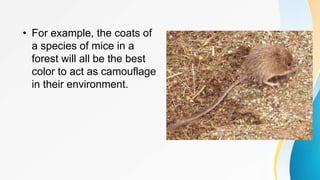
• For example, the coats of
a species of mice in a
forest will all be the best
color to act as camouflage
in their environment.
THANK YOU

MECHANISMS OF EVOLUTION.pptx

  • 1.
  • 2.
    • Biologists organizetheir thinking about biological processes using evolution as the framework. There are four key mechanisms that allow a population, a group of interacting organisms of a single species, to exhibit a change in allele frequency from one generation to the next. These are evolution by: mutation, genetic drift, natural selection, and gene flow.
  • 3.
    What is anallele? • Well, alleles are matching genes; one from our biological mother, one from our biological father. We have two copies of every gene. • They can be identical, but they can often have slight differences. Alleles, therefore, include all the variant forms of a particular gene. This combination of similarities and differences can have important effects within our body.
  • 4.
    What makes theseallele variations important? The way that two different alleles interact with each other can sometimes result in different, observable in a person. • For example, a dominant allele can override the traits of other recessive alleles, and it is these properties that help decide things like a person's eye and hair color. In this case, alleles that code for brown eyes are dominant over the recessive alleles that code for blue eyes. Allele frequency refers to how common an allele is in a population.
  • 5.
    These are thedifferent types of mechanisms: 1. Mutation 2. Gene flow 3. Genetic drift 4. Natural selection
  • 6.
    Mutation A mutation isa change that occurs in our DNA sequence, either due to mistakes when the DNA is copied or as the result of environmental factors such as UV light and cigarette smoke. For example: A mutation could cause beetle parents with genes for bright green coloration to have offspring with a gene for brown coloration. That would make genes for brown coloration more frequent in the population than they were before the mutation.
  • 8.
    Gene flow • Geneflow is the movement of genes into or out of a population. Such movement may be due to migration of individual organisms that reproduce in their new populations.
  • 9.
    For example: Abeetle from a population of brown beetles migrates into a population of green beetles.
  • 10.
    Genetic drift • Geneticdrift is a mechanism of evolution in which allele frequencies of a population change over generations due to chance (sampling error). Genetic drift occurs in all populations of non-infinite size, but its effects are strongest in small populations. • Genetic drift can result in a bottleneck effect or founder effect.
  • 11.
    Example of Geneticdrift • Genetic drift: In one generation, brown beetles happened to have many offspring survive to reproduce. In the same generation, a number of green beetles were killed randomly when someone stepped on them and had no offspring. The next generation had more brown beetles than the previous generation — but just by chance.
  • 12.
    Result of Geneticdrift • The bottleneck effect is a phenomenon in which a population is reduced in size due to natural disasters, habitat loss, or overhunting.
  • 13.
    Result of Geneticdrift • The founder effect is a phenomena that occurs when a small group of individuals becomes isolated from a larger population.
  • 14.
    Natural Selection • Naturalselection is a mechanism of evolution. Organisms that are more adapted to their environment are more likely to survive and pass on the genes that aided their success. This process causes species to change and diverge over time.
  • 15.
    • For example,evolving long necks has enabled giraffes to feed on leaves that others can't reach, giving them a competitive advantage. Thanks to a better food source, those with longer necks were able to survive to reproduce and so pass on the characteristic to the succeeding generation.
  • 16.
    Types of NaturalSelection • Directional selection. • Disruptive selection. • Stabilizing selection.
  • 17.
    Directional selection • Inpopulation genetics, directional selection, is a mode of negative natural selection in which an extreme phenotype is favored over other phenotypes, causing the allele frequency to shift over time in the direction of that phenotype.
  • 18.
    • An exampleof directional selection is giraffe neck lengths. The environment created a selection pressure which favored giraffes with longer necks who could reach more food in the trees. At the same time, there was selection pressure against giraffes with shorter necks.
  • 19.
    Disruptive selection/ Diversifyingselection • Disruptive selection is an evolutionary force that drives a population apart. The disruptive selection will cause organsisms with intermediate traits to reproduce less, and will allow those organisms with extreme traits to reproduce more. This causes the alleles for the extreme traits to increase in frequency. Over time, and with enough disruptive selection, a population can be completely divided. When this happens, the two populations can become diverse enough to form separate species.
  • 20.
    Example: • Oysters: Light-and dark-colored oysters could also have a camouflage advantage as opposed to their medium- colored relatives. Light-colored oysters would blend into the rocks in the shallows, and the darkest would blend better into the shadows.
  • 21.
    Stabilizing selection • Stabilizingselection is a type of natural selection in which the population mean stabilizes on a particular non- extreme trait value. This is thought to be the most common mechanism of action for natural selection because most traits do not appear to change drastically over time.
  • 22.
    • For example,the coats of a species of mice in a forest will all be the best color to act as camouflage in their environment.
  • 23.