Andrea Audine P. Jandongan
MPE – Sports Stream
Fitness Management
If one lives long enough, health problems
will develop, leading to an inability to function
independently and eventually causing death. One
aspect of an individual’s quality of life is to
prevent or delay the premature development of
these health problems, prolonging the healthy
and independent living portions of life.
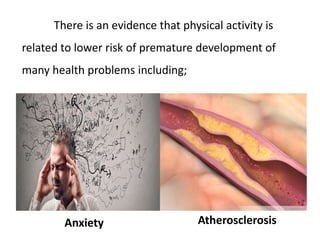
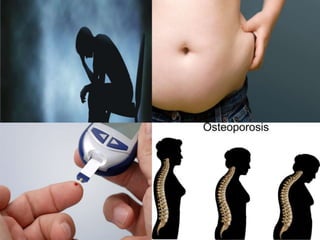
There is an evidence that physical activity is
related to lower risk of premature development of
many health problems including;
Anxiety Atherosclerosis
An active lifestyle is also related to estimates of
prolonged quality of life and independent living in
the elderly.
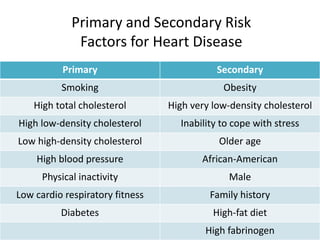
Primary and Secondary Risk
Factors for Heart Disease
Primary Secondary
Smoking Obesity
High total cholesterol High very low-density cholesterol
High low-density cholesterol Inability to cope with stress
Low high-density cholesterol Older age
High blood pressure African-American
Physical inactivity Male
Low cardio respiratory fitness Family history
Diabetes High-fat diet
High fabrinogen
Although this distinction has been helpful
in the past, the differentiation between
primary and secondary is increasingly difficult
to maintain. For example, earlier reviews
concluded that physical inactivity was a
secondary risk factor, and cardio respiratory
fitness was not listed under either category of
risk.
Later studies have found strong evidence
that both physical inactivity and low levels of
cardio respiratory fitness are primary risk
factors. For our purposes, the health fitness
instructor should know all the risk factors and,
more importantly, what individuals need to do
to lower their risks of developing health
problems.
Alterable and Unalterable Risk Factors
Another way to classify risk factors is to
distinguish between inherited risk factors that
cannot be altered and unhealthy lifestyle
behaviours that can be modified. The risk
factors that cannot be altered include the
family history of premature cardiovascular
disease, gender, race, and age.
Part of the risk associated with family
history and age cannot be changed. The good
news however is that some of the family
history risks can be changed. These alterable
family history risks include an unhealthy diet;
sedentary lifestyle; smoking; and poor stress-
coping behaviors that tend to be transmitted
from parents to children.
In terms of aging, many fitness characteristics
get worse with age; that is, if people from 20 to 80
years of age were tested and the results were
plotted against age, a steady deterioration would
occur with each decade. This decline starting in the
mid-20s, has been called the aging curve. A portion
of the deterioration seen in aging curves, however,
is caused by older individuals participating in less
activity-not by aging process itself. People who
maintain active lifestyles slow down the fitness
decline seen in typical aging curves.
Clinical evidence indicates that several risk
factors are associated with low - back
problems.
• Lack of abdominal muscle endurance
• Lack of flexibility in the midtrunk and
hamstrings
• Poor posture - lying, sitting, standing, and
moving
• Poor lifting habits
• Injury of low back
Risk factors - A characteristic, sign, symptom,
or test score that is associated with increased
probability of developing a health problem.
For example, people with hypertension have
increased risks of developing coronary heart
disease.
Low - back problems - Strong discomfort in
the low back area, often caused by lack of
muscular endurance and flexibility in the
midtrunk region, or improper posture or
lifting.

Fitness Management

  • 1.
    Andrea Audine P.Jandongan MPE – Sports Stream
  • 2.
  • 3.
    If one liveslong enough, health problems will develop, leading to an inability to function independently and eventually causing death. One aspect of an individual’s quality of life is to prevent or delay the premature development of these health problems, prolonging the healthy and independent living portions of life.
  • 4.
    There is anevidence that physical activity is related to lower risk of premature development of many health problems including; Anxiety Atherosclerosis
  • 7.
    An active lifestyleis also related to estimates of prolonged quality of life and independent living in the elderly.
  • 8.
    Primary and SecondaryRisk Factors for Heart Disease Primary Secondary Smoking Obesity High total cholesterol High very low-density cholesterol High low-density cholesterol Inability to cope with stress Low high-density cholesterol Older age High blood pressure African-American Physical inactivity Male Low cardio respiratory fitness Family history Diabetes High-fat diet High fabrinogen
  • 9.
    Although this distinctionhas been helpful in the past, the differentiation between primary and secondary is increasingly difficult to maintain. For example, earlier reviews concluded that physical inactivity was a secondary risk factor, and cardio respiratory fitness was not listed under either category of risk.
  • 10.
    Later studies havefound strong evidence that both physical inactivity and low levels of cardio respiratory fitness are primary risk factors. For our purposes, the health fitness instructor should know all the risk factors and, more importantly, what individuals need to do to lower their risks of developing health problems.
  • 11.
    Alterable and UnalterableRisk Factors Another way to classify risk factors is to distinguish between inherited risk factors that cannot be altered and unhealthy lifestyle behaviours that can be modified. The risk factors that cannot be altered include the family history of premature cardiovascular disease, gender, race, and age.
  • 12.
    Part of therisk associated with family history and age cannot be changed. The good news however is that some of the family history risks can be changed. These alterable family history risks include an unhealthy diet; sedentary lifestyle; smoking; and poor stress- coping behaviors that tend to be transmitted from parents to children.
  • 13.
    In terms ofaging, many fitness characteristics get worse with age; that is, if people from 20 to 80 years of age were tested and the results were plotted against age, a steady deterioration would occur with each decade. This decline starting in the mid-20s, has been called the aging curve. A portion of the deterioration seen in aging curves, however, is caused by older individuals participating in less activity-not by aging process itself. People who maintain active lifestyles slow down the fitness decline seen in typical aging curves.
  • 14.
    Clinical evidence indicatesthat several risk factors are associated with low - back problems. • Lack of abdominal muscle endurance • Lack of flexibility in the midtrunk and hamstrings • Poor posture - lying, sitting, standing, and moving • Poor lifting habits • Injury of low back
  • 15.
    Risk factors -A characteristic, sign, symptom, or test score that is associated with increased probability of developing a health problem. For example, people with hypertension have increased risks of developing coronary heart disease. Low - back problems - Strong discomfort in the low back area, often caused by lack of muscular endurance and flexibility in the midtrunk region, or improper posture or lifting.

Editor's Notes

  • #4 If one lives long enough, health problems will develop, leading to an inability to function independently and eventually causing death. One aspect of an individual’s quality of life is to prevent or delay the premature development of these health problems, prolonging the healthy and independent living portions of life.
  • #13 In terms of aging, many fitness characteristics get worse with age; that is, if people from 20 to 80 years of age were tested and the results were plotted against age, s steady deterioration would occur with each decade.