Women of Summa:  It’s Time for a Heart to Heart Vivian von Gruenigen, BSN, MD Chair Obstetrics and Gynecology Women’s Service Line Director Summa Akron City Hospital
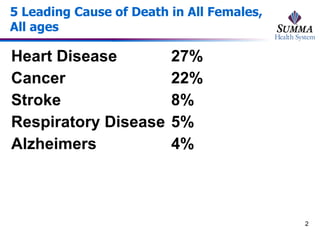
5 Leading Cause of Death in All Females, All ages Heart Disease 27% Cancer 22% Stroke 8% Respiratory Disease 5% Alzheimers 4%
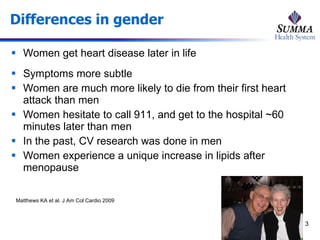
Differences in gender Women get heart disease later in life Symptoms more subtle Women are much more likely to die from their first heart attack than men Women hesitate to call 911, and get to the hospital ~60 minutes later than men In the past, CV research was done in men Women experience a unique increase in lipids after menopause Matthews KA et al. J Am Col Cardio 2009
Differences in Gender The signs and symptoms are more subtle than the obvious crushing chest pain often associated with heart attacks This may be because women tend to have blockages not only in their main arteries,  but also in the smaller arteries that supply blood to the heart  — a condition called small vessel heart disease.
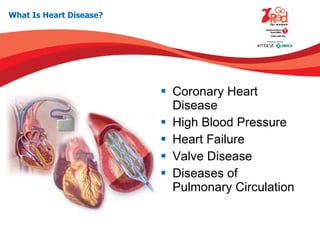
What Is Heart Disease? Coronary Heart Disease High Blood Pressure Heart Failure Valve Disease Diseases of Pulmonary Circulation
What Have We Learned? Risk Factors Factors leading to heart disease can start in young women and develop over time The Disease Heart disease can strike women at any age Prevention and Treatment Healthy lifestyle changes can prevent or postpone heart disease
Why Is It Important? Cardiovascular disease kills 1 in 3 women Tens of millions 64% of women who die suddenly from coronary heart disease have no previous symptoms 80% of cardiovascular disease is  preventable
What is a heart attack? A heart attack occurs when the blood flow to a  part  of the heart muscle is  blocked Most heart attacks start  slowly , with mild pain or discomfort Interrupted blood flow to your heart can damage or destroy a part of the  heart muscle .
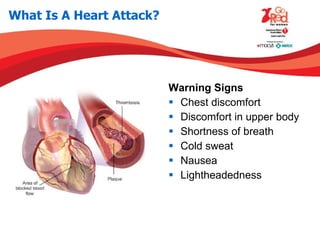
What Is A Heart Attack? Warning Signs Chest discomfort Discomfort in upper body Shortness of breath Cold sweat Nausea Lightheadedness
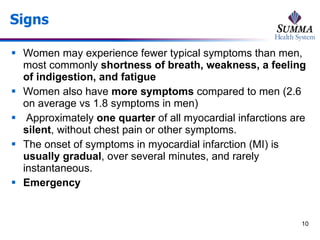
Signs Women may experience fewer typical symptoms than men, most commonly  shortness of breath, weakness, a feeling of indigestion, and fatigue Women also have  more symptoms  compared to men (2.6 on average vs 1.8 symptoms in men) Approximately  one quarter  of all myocardial infarctions are  silent , without chest pain or other symptoms. The onset of symptoms in myocardial infarction (MI) is  usually gradual , over several minutes, and rarely instantaneous. Emergency
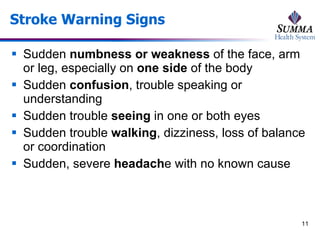
Stroke Warning Signs Sudden  numbness or weakness  of the face, arm or leg, especially on  one side  of the body     Sudden  confusion , trouble speaking or understanding     Sudden trouble  seeing  in one or both eyes     Sudden trouble  walking , dizziness, loss of balance or coordination     Sudden, severe  headach e with no known cause
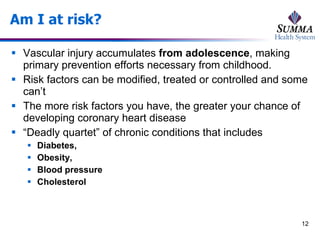
Am I at risk? Vascular injury accumulates  from adolescence , making primary prevention efforts necessary from childhood. Risk factors can be modified, treated or controlled and some can’t The more risk factors you have, the greater your chance of developing coronary heart disease “ Deadly quartet” of chronic conditions that includes Diabetes,  Obesity,  Blood pressure  Cholesterol
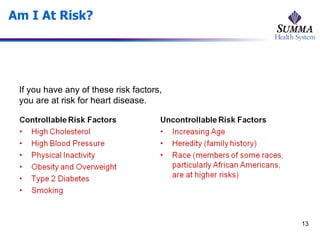
Am I At Risk? If you have any of these risk factors,  you are at risk for heart disease.
Your Risk:  High Blood Cholesterol Cholesterol is a soft,  fat-like substance  found in the bloodstream and in all your body’s cells The saturated fats, trans fats and cholesterol you  eat  may raise your blood cholesterol Cholesterol can build up in the walls of arteries,  narrowing the flow If a narrowed artery  gets blocked by a clot or other particle , the heart or brain loses its blood supply, resulting in a heart attack or stroke   www.3dchem.com
Your Risk:  High Cholesterol- Lipid Profile Includes: Total Cholesterol LDL [low-density lipoprotein]  (bad) HDL Cholesterol (good) Triglycerides
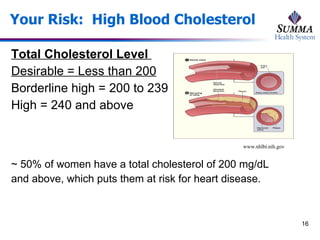
Your Risk:  High Blood Cholesterol Total Cholesterol Level  Desirable = Less than 200 Borderline high = 200 to 239 High = 240 and above ~ 50% of women have a total cholesterol of 200 mg/dL and above, which puts them at risk for heart disease. www.nhlbi.nih.gov
Your Risk:  High Blood Cholesterol HDL  – the higher your HDL, the better HDL Cholesterol Risk Levels Less than 50 mg/dL for women Therefore, want > 50 LDL  – is the main carrier of harmful cholesterol LDL Cholesterol Risk Levels > 130 mg/dL Borderline, >160 high, > 190 very high Therefore, want between 100-130
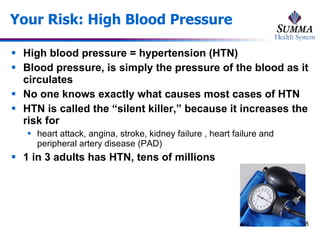
Your Risk: High Blood Pressure High blood pressure = hypertension (HTN) Blood pressure, is simply the pressure of the blood as it circulates No one knows exactly what causes most cases of HTN HTN is called the “silent killer,” because it increases the risk for  heart attack, angina, stroke, kidney failure , heart failure and peripheral artery disease (PAD) 1 in 3 adults has HTN, tens of millions
Your Risk: High Blood Pressure Risk Factors Genetics African Americans Over age 35 Overweight Physical inactivity Nutrition Salt, alcohol Diabetes, kidney disease Pregancy
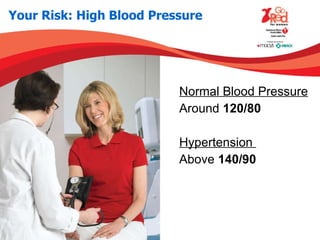
Your Risk: High Blood Pressure Normal Blood Pressure   Around  120/80 Hypertension  Above  140/90
Classification of Blood Pressure in Adults OPTIMAL: <120 systolic and <80 diastolic PREHYPERTENSION 120-139 systolic or 80-89 diastolic  STAGE 1 HYPERTENSION 140-159 systolic or 90-99 diastolic STAGE 2 HYPERTENSION >160 systolic or >100 diastolic
Your Risk: Diabetes Incidence is increasing Type I Diabetes – also called juvenile The body fails to make insulin Type II The most common  95% of Americans Middle-aged.  Linked with obesity and physical inactivity.  The body doesn’t make enough.
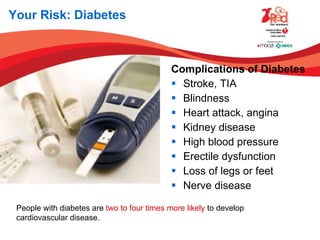
Your Risk: Diabetes Complications of Diabetes Stroke, TIA Blindness Heart attack, angina Kidney disease High blood pressure Erectile dysfunction Loss of legs or feet Nerve disease People with diabetes are  two to four times more likely  to develop  cardiovascular disease.
Your Risk: Diabetes Prevention and Control Control your weight and cholesterol (low-saturated fat and low-cholesterol diet) If you take medicine, take it exactly as directed Discuss exercise with your physician Nutritionist consult/team
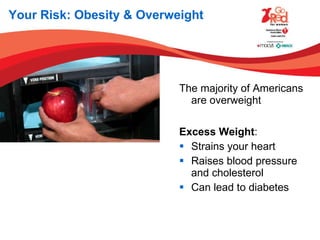
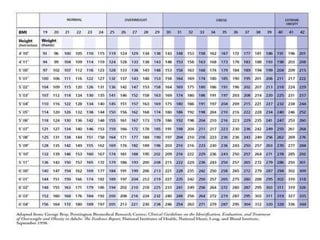
Your Risk: Obesity & Overweight The majority of Americans are overweight Excess Weight : Strains your heart Raises blood pressure  and cholesterol Can lead to diabetes
 
Your Risk: Obesity & Overweight Set goals, potential roadblocks Lifestyle change, not a diet You may need help or support Team approach Keeping weight off can be as challenging as losing it
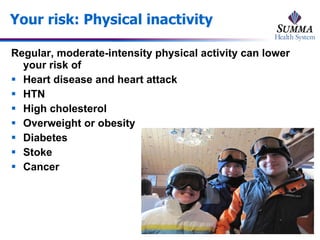
Your risk: Physical inactivity Regular, moderate-intensity physical activity can lower your risk of  Heart disease and heart attack HTN High cholesterol Overweight or obesity  Diabetes Stoke Cancer
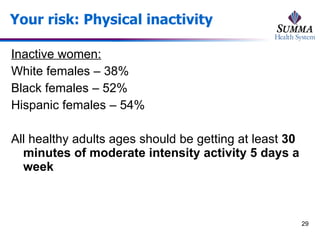
Your risk: Physical inactivity Inactive women: White females – 38% Black females – 52% Hispanic females – 54% All healthy adults ages should be getting at least  30 minutes of moderate intensity activity 5 days a week
Your risk: physical inactivity Most Americans favor walking as their favorite physical activity Many places - at home, local parks, YMCAs, travel… Many types – swim, resistance, ski, golf… Find your sole-mate or mates Family, friends, colleagues Stay motivated
 
Your Risk: Smoking Benefits of Quitting Within 1 to 2 years of quitting, the risk of coronary heart disease is substantially reduced  A smoker’s cough will go away It is easier to be physically active Second hand smoke is real
Your risk: Nutrition Quality Be aware of calories Low fat Lean meats Fiber, whole grains Low fat dairy Fruits and veggies Diversify your colors Whole foods versus processed White food…sugar Limit fast foods Super size me
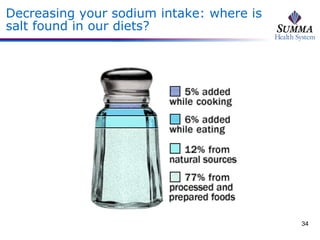
Decreasing your sodium intake: where is salt found in our diets?
Your risk:  Depression Depression is twice as common in women as in men, and it  increases the risk of heart  disease by 2-3 times Depression makes it difficult to maintain a healthy lifestyle and follow recommended treatment Talk to your doctor  if you're having symptoms of depression
Your risk:  HRT Can estrogen replacement therapy reduce my risk for heart disease? No. Estrogen replacement therapy, also called hormone replacement therapy (HRT New studies have shown that when it comes to heart health, HRT may do more harm than good.  If you’re taking HRT to help prevent heart disease, talk to your doctor about whether you should stop.
First aid Call for help Aspirin  Oxygen Nitroglycerin Automated external defibrillator (AED) Opiod painkillers Air travel kits
Women in Recovery and Rehabilitation after a Heart Attack The first year following a heart attack, women tend to have a  higher rate of disability and death , and show poorer psychological adaptation  than men. Social support and mood  were the best predictors of overall quality of life at one year for women Those with more social support tended to have a higher rate of persistency, while a  belief in the positive health benefits  of exercise increased the amount of exercise undertaken by the participant. Moore SM et al J Cardio Rehab 2003
What Can I Do To Prevent Heart Disease? Eat a  healthy diet  low in saturated fat, trans fat, cholesterol and sodium.  Keep your  weight  under control. Be  physically active  at least 30 minutes on most or all days of the week. Control your  blood pressure  and  cholesterol  levels.  Manage your blood sugar if you have  diabetes . Don’t smoke , and avoid tobacco smoke. Taking your  medicines  as directed by your physician
What Can I Do To Prevent Heart Disease? You are here You are an advocate You are educated Teach those who are not as fortunate Lead by example Grass roots
“ Women, whether subtly or vociferously, have always been a tremendous  power  in the destiny of the world.” Eleanor Roosevelt
Be the kind of woman that when your feet hit the floor each morning the devil says~~ &quot;Oh crap , She's up!“ Email from Aunt Jeanette 
Questions? YOU are beautiful, smart and have the power to make a difference

It's Time for a Heart to Heart

  • 1.
    Women of Summa: It’s Time for a Heart to Heart Vivian von Gruenigen, BSN, MD Chair Obstetrics and Gynecology Women’s Service Line Director Summa Akron City Hospital
  • 2.
    5 Leading Causeof Death in All Females, All ages Heart Disease 27% Cancer 22% Stroke 8% Respiratory Disease 5% Alzheimers 4%
  • 3.
    Differences in genderWomen get heart disease later in life Symptoms more subtle Women are much more likely to die from their first heart attack than men Women hesitate to call 911, and get to the hospital ~60 minutes later than men In the past, CV research was done in men Women experience a unique increase in lipids after menopause Matthews KA et al. J Am Col Cardio 2009
  • 4.
    Differences in GenderThe signs and symptoms are more subtle than the obvious crushing chest pain often associated with heart attacks This may be because women tend to have blockages not only in their main arteries, but also in the smaller arteries that supply blood to the heart — a condition called small vessel heart disease.
  • 5.
    What Is HeartDisease? Coronary Heart Disease High Blood Pressure Heart Failure Valve Disease Diseases of Pulmonary Circulation
  • 6.
    What Have WeLearned? Risk Factors Factors leading to heart disease can start in young women and develop over time The Disease Heart disease can strike women at any age Prevention and Treatment Healthy lifestyle changes can prevent or postpone heart disease
  • 7.
    Why Is ItImportant? Cardiovascular disease kills 1 in 3 women Tens of millions 64% of women who die suddenly from coronary heart disease have no previous symptoms 80% of cardiovascular disease is preventable
  • 8.
    What is aheart attack? A heart attack occurs when the blood flow to a part of the heart muscle is blocked Most heart attacks start slowly , with mild pain or discomfort Interrupted blood flow to your heart can damage or destroy a part of the heart muscle .
  • 9.
    What Is AHeart Attack? Warning Signs Chest discomfort Discomfort in upper body Shortness of breath Cold sweat Nausea Lightheadedness
  • 10.
    Signs Women mayexperience fewer typical symptoms than men, most commonly shortness of breath, weakness, a feeling of indigestion, and fatigue Women also have more symptoms compared to men (2.6 on average vs 1.8 symptoms in men) Approximately one quarter of all myocardial infarctions are silent , without chest pain or other symptoms. The onset of symptoms in myocardial infarction (MI) is usually gradual , over several minutes, and rarely instantaneous. Emergency
  • 11.
    Stroke Warning SignsSudden numbness or weakness of the face, arm or leg, especially on one side of the body    Sudden confusion , trouble speaking or understanding    Sudden trouble seeing in one or both eyes    Sudden trouble walking , dizziness, loss of balance or coordination    Sudden, severe headach e with no known cause
  • 12.
    Am I atrisk? Vascular injury accumulates from adolescence , making primary prevention efforts necessary from childhood. Risk factors can be modified, treated or controlled and some can’t The more risk factors you have, the greater your chance of developing coronary heart disease “ Deadly quartet” of chronic conditions that includes Diabetes, Obesity, Blood pressure Cholesterol
  • 13.
    Am I AtRisk? If you have any of these risk factors, you are at risk for heart disease.
  • 14.
    Your Risk: High Blood Cholesterol Cholesterol is a soft, fat-like substance found in the bloodstream and in all your body’s cells The saturated fats, trans fats and cholesterol you eat may raise your blood cholesterol Cholesterol can build up in the walls of arteries, narrowing the flow If a narrowed artery gets blocked by a clot or other particle , the heart or brain loses its blood supply, resulting in a heart attack or stroke www.3dchem.com
  • 15.
    Your Risk: High Cholesterol- Lipid Profile Includes: Total Cholesterol LDL [low-density lipoprotein] (bad) HDL Cholesterol (good) Triglycerides
  • 16.
    Your Risk: High Blood Cholesterol Total Cholesterol Level Desirable = Less than 200 Borderline high = 200 to 239 High = 240 and above ~ 50% of women have a total cholesterol of 200 mg/dL and above, which puts them at risk for heart disease. www.nhlbi.nih.gov
  • 17.
    Your Risk: High Blood Cholesterol HDL – the higher your HDL, the better HDL Cholesterol Risk Levels Less than 50 mg/dL for women Therefore, want > 50 LDL – is the main carrier of harmful cholesterol LDL Cholesterol Risk Levels > 130 mg/dL Borderline, >160 high, > 190 very high Therefore, want between 100-130
  • 18.
    Your Risk: HighBlood Pressure High blood pressure = hypertension (HTN) Blood pressure, is simply the pressure of the blood as it circulates No one knows exactly what causes most cases of HTN HTN is called the “silent killer,” because it increases the risk for heart attack, angina, stroke, kidney failure , heart failure and peripheral artery disease (PAD) 1 in 3 adults has HTN, tens of millions
  • 19.
    Your Risk: HighBlood Pressure Risk Factors Genetics African Americans Over age 35 Overweight Physical inactivity Nutrition Salt, alcohol Diabetes, kidney disease Pregancy
  • 20.
    Your Risk: HighBlood Pressure Normal Blood Pressure Around 120/80 Hypertension Above 140/90
  • 21.
    Classification of BloodPressure in Adults OPTIMAL: <120 systolic and <80 diastolic PREHYPERTENSION 120-139 systolic or 80-89 diastolic STAGE 1 HYPERTENSION 140-159 systolic or 90-99 diastolic STAGE 2 HYPERTENSION >160 systolic or >100 diastolic
  • 22.
    Your Risk: DiabetesIncidence is increasing Type I Diabetes – also called juvenile The body fails to make insulin Type II The most common 95% of Americans Middle-aged. Linked with obesity and physical inactivity. The body doesn’t make enough.
  • 23.
    Your Risk: DiabetesComplications of Diabetes Stroke, TIA Blindness Heart attack, angina Kidney disease High blood pressure Erectile dysfunction Loss of legs or feet Nerve disease People with diabetes are two to four times more likely to develop cardiovascular disease.
  • 24.
    Your Risk: DiabetesPrevention and Control Control your weight and cholesterol (low-saturated fat and low-cholesterol diet) If you take medicine, take it exactly as directed Discuss exercise with your physician Nutritionist consult/team
  • 25.
    Your Risk: Obesity& Overweight The majority of Americans are overweight Excess Weight : Strains your heart Raises blood pressure and cholesterol Can lead to diabetes
  • 26.
  • 27.
    Your Risk: Obesity& Overweight Set goals, potential roadblocks Lifestyle change, not a diet You may need help or support Team approach Keeping weight off can be as challenging as losing it
  • 28.
    Your risk: Physicalinactivity Regular, moderate-intensity physical activity can lower your risk of Heart disease and heart attack HTN High cholesterol Overweight or obesity Diabetes Stoke Cancer
  • 29.
    Your risk: Physicalinactivity Inactive women: White females – 38% Black females – 52% Hispanic females – 54% All healthy adults ages should be getting at least 30 minutes of moderate intensity activity 5 days a week
  • 30.
    Your risk: physicalinactivity Most Americans favor walking as their favorite physical activity Many places - at home, local parks, YMCAs, travel… Many types – swim, resistance, ski, golf… Find your sole-mate or mates Family, friends, colleagues Stay motivated
  • 31.
  • 32.
    Your Risk: SmokingBenefits of Quitting Within 1 to 2 years of quitting, the risk of coronary heart disease is substantially reduced A smoker’s cough will go away It is easier to be physically active Second hand smoke is real
  • 33.
    Your risk: NutritionQuality Be aware of calories Low fat Lean meats Fiber, whole grains Low fat dairy Fruits and veggies Diversify your colors Whole foods versus processed White food…sugar Limit fast foods Super size me
  • 34.
    Decreasing your sodiumintake: where is salt found in our diets?
  • 35.
    Your risk: Depression Depression is twice as common in women as in men, and it increases the risk of heart disease by 2-3 times Depression makes it difficult to maintain a healthy lifestyle and follow recommended treatment Talk to your doctor if you're having symptoms of depression
  • 36.
    Your risk: HRT Can estrogen replacement therapy reduce my risk for heart disease? No. Estrogen replacement therapy, also called hormone replacement therapy (HRT New studies have shown that when it comes to heart health, HRT may do more harm than good. If you’re taking HRT to help prevent heart disease, talk to your doctor about whether you should stop.
  • 37.
    First aid Callfor help Aspirin Oxygen Nitroglycerin Automated external defibrillator (AED) Opiod painkillers Air travel kits
  • 38.
    Women in Recoveryand Rehabilitation after a Heart Attack The first year following a heart attack, women tend to have a higher rate of disability and death , and show poorer psychological adaptation than men. Social support and mood were the best predictors of overall quality of life at one year for women Those with more social support tended to have a higher rate of persistency, while a belief in the positive health benefits of exercise increased the amount of exercise undertaken by the participant. Moore SM et al J Cardio Rehab 2003
  • 39.
    What Can IDo To Prevent Heart Disease? Eat a healthy diet low in saturated fat, trans fat, cholesterol and sodium. Keep your weight under control. Be physically active at least 30 minutes on most or all days of the week. Control your blood pressure and cholesterol levels. Manage your blood sugar if you have diabetes . Don’t smoke , and avoid tobacco smoke. Taking your medicines as directed by your physician
  • 40.
    What Can IDo To Prevent Heart Disease? You are here You are an advocate You are educated Teach those who are not as fortunate Lead by example Grass roots
  • 41.
    “ Women, whethersubtly or vociferously, have always been a tremendous power in the destiny of the world.” Eleanor Roosevelt
  • 42.
    Be the kindof woman that when your feet hit the floor each morning the devil says~~ &quot;Oh crap , She's up!“ Email from Aunt Jeanette 
  • 43.
    Questions? YOU arebeautiful, smart and have the power to make a difference

Editor's Notes

  • #6 Cardiovascular disease refers to the class of diseases that involve the heart or blood vessels ( arteries and veins ). While the term technically refers to any disease that affects the cardiovascular system , we usually speak of cardiovascular disease as related to atherosclerosis (plaque buildups in the arteries). [Source: Wikipedia – AHA Science approved]
  • #8 Heart disease is an equal opportunity killer. The most recent data (from 2004) shows that CVD killed 459,096 women in comparison to 410,628 men. Almost one in three women will die from cardiovascular disease. There are many types of cardiovascular diseases. Over 80 million Americans- or one in three- have one or more of them. Each year about 870,000 people die from them- about 36 percent of all deaths in the United States! Even more important to understand is the fact that heart disease is largely preventable. This presentation will help you assess your risk of heart disease and take action to prevent it. (NCHS. Compressed mortality file: underlying cause of death, 1979 to 2004; http://wonder.cdc.gov/mortSQL.html)
  • #10 Heart Attacks A heart attack occurs when the blood flow to a part of the heart muscle is blocked, usually by a blood clot as shown in this image. If this clot cuts off the blood flow completely, the part of the heart muscle supplied by that artery begins to die. Some heart attacks are sudden and intense — the &amp;quot;movie heart attack&amp;quot; where no one doubts what&apos;s happening. But most heart attacks start slowly, with mild pain or discomfort. Often people aren&apos;t sure what&apos;s wrong and wait too long before getting help. Here are some signs of a heart attack: Chest discomfort.  Most heart attacks involve discomfort in the center of the chest that lasts more than a few minutes, or that goes away and comes back. It can feel like uncomfortable pressure, squeezing, fullness or pain.    Discomfort in other areas of the upper body.  Symptoms can include pain or discomfort in one or both arms, the back, neck, jaw or stomach.    Shortness of breath with or without chest discomfort.   Other signs may include breaking out in a cold sweat, nausea or lightheadedness        Heart attack and stroke are life-and-death emergencies — every second counts. If you see or have any of the listed symptoms, immediately call 9-1-1. Heart Attack Warning Signs Some heart attacks are sudden and intense — the &amp;quot;movie heart attack,&amp;quot; where no one doubts what&apos;s happening. But most heart attacks start slowly, with mild pain or discomfort. Often people affected aren&apos;t sure what&apos;s wrong and wait too long before getting help. Here are signs that can mean a heart attack is happening: [Source: http://www.americanheart.org/presenter.jhtml?identifier=3053]
  • #14 Several factors increase the risk of coronary heart disease and heart attack. The American Heart Association has identified several risk factors. Some can be modified, treated or controlled, and some can&apos;t. The more risk factors you have, the greater your chance of developing coronary heart disease. And, the greater the level of each risk factor, the greater the risk.
  • #16 A lipoprotein profile gives you information about your total cholesterol, LDL cholesterol, HDL cholesterol, and triglycerides. Can you tell me the definition of total cholesterol, LDL cholesterol, HDL cholesterol and triglycerides? (Give time to answer then give out and review the cholesterol definition handout). Answers: Total cholesterol is the entire amount of cholesterol circulating in your blood. LDL cholesterol is just part of the total cholesterol. It is the Low Density Lipoprotein that increases risk for heart attack and stroke. HDL cholesterol or High Density Cholesterol is also just part of the total cholesterol, but this type of cholesterol protects you from cardiovascular disease. Triglycerides are blood fats that may also increase your risk for heart disease and stroke if they are high in your blood.
  • #21 is a condition in which blood pressure levels are above the normal range. Blood pressures of 120-139 mm Hg and/or 80-89 mm Hg are considered prehypertension. Blood pressure is considered high if it is 140 mm Hg and/or 90 mm Hg or higher. High blood pressure is called the “silent killer” because it increases the risk for heart attack, angina, stroke, kidney failure and peripheral artery disease (PAD). It may also increase the risk of developing fatty deposits in arteries (atherosclerosis). The risk of heart failure also increases due to the increased workload that high blood pressure places on the heart. About 73 million Americans (and 1 in 3 adults) have high blood pressure, but only 30% know their personal risk. No one knows exactly what causes most cases of high blood pressure. Some people are at higher risk of having high blood pressure. They include: • People with close blood relatives who have HBP • African Americans • People over age 35 • Overweight people • People who aren’t physically active • People who use too much salt • People who drink too much alcohol • People with diabetes, gout or kidney disease • Pregnant women • Women who take birth control pills and who are overweight, had HBP during pregnancy, have a family history of HBP or have mild kidney disease
  • #24 Type 1, or juvenile diabetes, usually starts early in life. It results from the body’s failure to produce insulin. People with it must take insulin each day to regulate levels of blood glucose (sugar). Type 2 is the most common. About 95 percent of Americans diagnosed with diabetes have type 2 diabetes. It most often develops in middle-aged and older adults, and is often linked with obesity and physical inactivity. Type 2 diabetes develops when the body doesn’t make enough insulin and doesn’t efficiently use the insulin it makes. Who Gets Diabetes Diabetes is increasing. This is because more people are obese, don’t get enough physical activity and are getting older. However, many younger people are developing diabetes at an alarming rate. This is probably because obesity and lack of physical activity are increasing problems for this group, too. People in several ethnic groups seem to be more likely to develop type 2 diabetes: • Hispanics • African Americans • Native Americans • Asians (especially South Asians) • Control your weight and blood cholesterol with a low-saturated-fat, low-cholesterol diet. • If you take medicine, take it exactly as directed. Specific medicines may help you control your blood pressure, cholesterol and blood glucose. Your doctor will advise you if one is right for you. If you have questions about the dosage or side effects, ask your doctor or pharmacist. Additional Talking Points on Diabetes: Insulin and Diabetes Most of the food we eat is turned into glucose, or sugar, for our bodies to use for energy. This happens because the hormone insulin converts sugar and other food into energy and helps glucose get into our bodies’ cells. When you have diabetes, your body doesn’t make enough insulin or can’t use its own insulin as well as it should, or both. This causes sugars to build up too high in your blood. [Source: GRFW Know Your Risk Fact Sheet, Diabetes, Content approved by AHA Science 9/07]
  • #26 Being overweight is another risk factor for heart disease. More than 142 million American adults are overweight. Of these, nearly 67 million are considered obese. People who are overweight or obese are more likely to develop heart disease and stroke, even if they have no other risk factors. Excess weight puts more strain on your heart. It can raise blood pressure and blood cholesterol and can lead to diabetes. Losing weight is one of the best ways to reduce your risk of heart problems and other diseases. Prepare yourself by setting goals and deciding how to deal with potential roadblocks. It’s never wise to follow fad diets, starve yourself or try to lose weight too fast. Remember, you didn’t become overweight overnight. It’s important to make changes over the long term and not get discouraged by setbacks. Start by changing your eating habits and working physical activity into your daily routine. Keeping extra weight off can be as challenging as losing it.
  • #32 It’s all a matter of math
  • #33 Smoking cigarettes is the most preventable major risk factor of our No. 1 killer —It’s never too late to quit! No matter how much or how long you’ve smoked, when you quit smoking, your risk of heart disease and stroke starts to drop. In time your risk will be about the same as if you’d never smoked. Quitting smoking isn’t easy, but it’s worth it! Quitting will drastically reduce your risk of developing heart and blood vessel diseases. It will also lower your chance of having lung disease and cancer. Most of all, quitting can save your life and the lives of nonsmokers around you.
  • #40 Reducing Your Heart Disease and Stroke Risk You can reduce your risk of heart disease and stroke. Here are some key steps you can take: • Eat a healthy diet low in saturated fat, trans fat, cholesterol and salt. • Keep your weight under control. • Be physically active at least 30 minutes on most or all days of the week. Don’t smoke, and avoid other people’s tobacco smoke. • Lower your blood pressure if you need to. Treat high blood pressure if you have it. • Control your blood sugar if you have diabetes. • Get regular medical check-ups. • Follow your doctor’s orders for taking medicine. [Source: GRFW Know Your Fact Sheet, Heart Disease and Stroke, AHA Science Review complete 9/07]