CLASSROOM RULES:
1. Be present everyday.
2. Share your ideas freely and accept
new knowledge through suggestions.
3. Talk when necessary.
REVIEW
Why is it important to follow
the proper procedure of
cleaning, sanitizing,
equipment and instruments?
At the end of the lesson, the learners are
expected to:
A. Identify fish processing activities
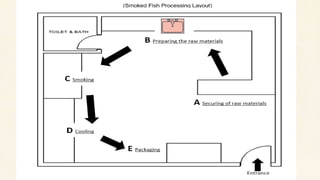
B. Interpret a layout plan
-What food is being
processed in the video?
-How is the fish being
processed?
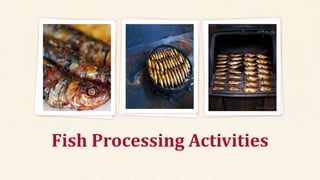
Fish Processing Activities
Fish processing
- refers to the processes associated
with fish and fish products between the
time fish are caught or harvested, and
the time the final product is delivered to
the customer.
Fish is a highly perishable food which
needs proper handling and preservation if
it is to have a long shelf life and retain a
desirable quality and nutritional value. The
central concern of fish processing is to
prevent fish from deteriorating.
In fact, Calbayog is known for
Tinapa or smoked fish production. This
food is a special delicacy of Brgy.
Matobato and this became the
livelihood of many residents.
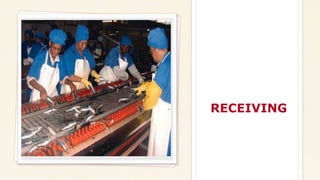
RECEIVING
RECEIVING
•This activity includes
sorting and grading of
raw materials according
to size, species, and
quality. It also includes
segregating suitable from
unsuitable ones.
PREPARATION
PREPARATION
•This includes the
preparatory steps such
as washing, eviscerating,
cutting, brining, and pre-
cooking the fish by
steaming, blanching, or
broiling.
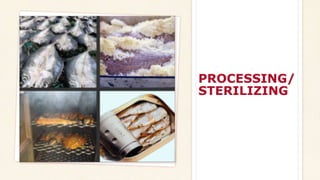
PROCESSING/
STERILIZING
PROCESSING/STERILIZING
•This activity involves the
final processing and
complete sterilization of
the processed finished
product.
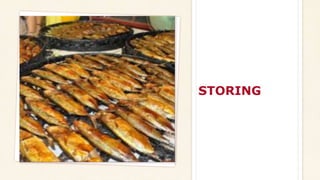
STORING
STORING
•Storage room is provided for
storing finished product such
as canned/ bottled fish,
smoked fish, salted fish,
pickled fish and other
processed fishery products.
Proper storage will also
extend the shelf life of the
product.
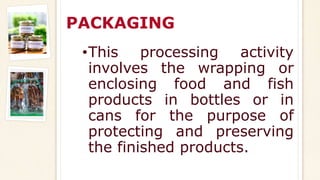
PACKAGING
PACKAGING
•This processing activity
involves the wrapping or
enclosing food and fish
products in bottles or in
cans for the purpose of
protecting and preserving
the finished products.
LABELING
LABELING
•The purpose of this activity
is to give the correct
information about the
product.
What are the
different activities in
fish processing?
- Group the class into three:
Group 1- Arrange chronologically the given
pictures in food processing activities. Label
each picture.
Group 2- Draw the different activities in
food processing and label them.
Group 3- Make a slogan on the importance
of fish processing.
Group 1 and 2 will be graded through
the given rubric:
CRITERIA FOR GRADING
Creativity- 20%
Content- 40%
Originality- 20%
Overall Impact- 20%
TOTAL- 100%
Directions: Identify the fish processing activity that is being
referred to in each item.
1.This activity includes sorting and grading of raw materials
according to size, species, and quality.
2.This processing activity involves the wrapping or enclosing
food and fish products in bottles or in cans.
3.This includes the preparatory steps such as washing,
eviscerating, cutting, brining, and pre-cooking the fish by
steaming, blanching, or broiling.
4.This activity involves the final processing and complete
sterilization of the processed finished product.
5.The purpose of this activity is to give the correct
information about the product.

Fish Processing Activities.pptx.......................

  • 1.
    CLASSROOM RULES: 1. Bepresent everyday. 2. Share your ideas freely and accept new knowledge through suggestions. 3. Talk when necessary.
  • 2.
    REVIEW Why is itimportant to follow the proper procedure of cleaning, sanitizing, equipment and instruments?
  • 3.
    At the endof the lesson, the learners are expected to: A. Identify fish processing activities B. Interpret a layout plan
  • 5.
    -What food isbeing processed in the video? -How is the fish being processed?
  • 6.
  • 7.
    Fish processing - refersto the processes associated with fish and fish products between the time fish are caught or harvested, and the time the final product is delivered to the customer.
  • 8.
    Fish is ahighly perishable food which needs proper handling and preservation if it is to have a long shelf life and retain a desirable quality and nutritional value. The central concern of fish processing is to prevent fish from deteriorating.
  • 9.
    In fact, Calbayogis known for Tinapa or smoked fish production. This food is a special delicacy of Brgy. Matobato and this became the livelihood of many residents.
  • 10.
  • 11.
    RECEIVING •This activity includes sortingand grading of raw materials according to size, species, and quality. It also includes segregating suitable from unsuitable ones.
  • 12.
  • 13.
    PREPARATION •This includes the preparatorysteps such as washing, eviscerating, cutting, brining, and pre- cooking the fish by steaming, blanching, or broiling.
  • 14.
  • 15.
    PROCESSING/STERILIZING •This activity involvesthe final processing and complete sterilization of the processed finished product.
  • 16.
  • 17.
    STORING •Storage room isprovided for storing finished product such as canned/ bottled fish, smoked fish, salted fish, pickled fish and other processed fishery products. Proper storage will also extend the shelf life of the product.
  • 18.
  • 19.
    PACKAGING •This processing activity involvesthe wrapping or enclosing food and fish products in bottles or in cans for the purpose of protecting and preserving the finished products.
  • 20.
  • 21.
    LABELING •The purpose ofthis activity is to give the correct information about the product.
  • 22.
    What are the differentactivities in fish processing?
  • 24.
    - Group theclass into three: Group 1- Arrange chronologically the given pictures in food processing activities. Label each picture. Group 2- Draw the different activities in food processing and label them. Group 3- Make a slogan on the importance of fish processing.
  • 25.
    Group 1 and2 will be graded through the given rubric: CRITERIA FOR GRADING Creativity- 20% Content- 40% Originality- 20% Overall Impact- 20% TOTAL- 100%
  • 27.
    Directions: Identify thefish processing activity that is being referred to in each item. 1.This activity includes sorting and grading of raw materials according to size, species, and quality. 2.This processing activity involves the wrapping or enclosing food and fish products in bottles or in cans. 3.This includes the preparatory steps such as washing, eviscerating, cutting, brining, and pre-cooking the fish by steaming, blanching, or broiling. 4.This activity involves the final processing and complete sterilization of the processed finished product. 5.The purpose of this activity is to give the correct information about the product.

Editor's Notes

  • #7 NOTE: To replace a picture, just select and delete it. Then use the Insert Picture icon to replace it with one of your own!