Fish
Fish are animals that live
and breathe in water.
Some fish live in the fresh
water of lakes and
streams. Some fish live in
the salt water of oceans.
A few fish can live in both
kinds of water.
All fishes are vertebrates
(animals with
backbones). Most fish
have a covering of scales
to protect their bodies.
KINDS OF FISH
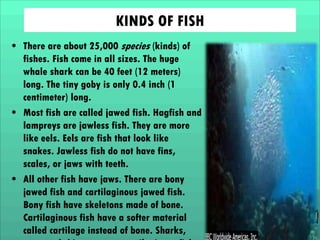
• There are about 25,000 species (kinds) of
fishes. Fish come in all sizes. The huge
whale shark can be 40 feet (12 meters)
long. The tiny goby is only 0.4 inch (1
centimeter) long.
• Most fish are called jawed fish. Hagfish and
lampreys are jawless fish. They are more
like eels. Eels are fish that look like
snakes. Jawless fish do not have fins,
scales, or jaws with teeth.
• All other fish have jaws. There are bony
jawed fish and cartilaginous jawed fish.
Bony fish have skeletons made of bone.
Cartilaginous fish have a softer material
called cartilage instead of bone. Sharks,
How Fish Swim?
• Most fish use their side,
back, and tail fins for
swimming. Fins are
movable, fanlike parts. A
fish moves through the
water by swinging its tail
fins back and forth. A fish
uses its other fins to steer
and to stop. Sometimes
the other fins also help it
go fast through the water.
How Fish Breathe
• You have lungs for breathing.
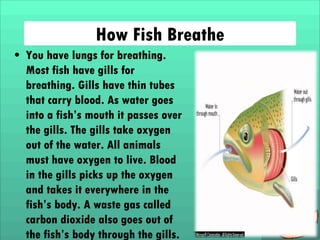
Most fish have gills for
breathing. Gills have thin tubes
that carry blood. As water goes
into a fish’s mouth it passes over
the gills. The gills take oxygen
out of the water. All animals
must have oxygen to live. Blood
in the gills picks up the oxygen
and takes it everywhere in the
fish’s body. A waste gas called
carbon dioxide also goes out of
the fish’s body through the gills.
Fish Senses
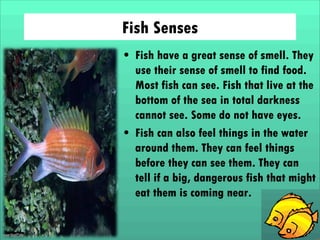
• Fish have a great sense of smell. They
use their sense of smell to find food.
Most fish can see. Fish that live at the
bottom of the sea in total darkness
cannot see. Some do not have eyes.
• Fish can also feel things in the water
around them. They can feel things
before they can see them. They can
tell if a big, dangerous fish that might
eat them is coming near.
What Fish Eat?
• Most fish eat meat. Some eat tiny
plants. Sharks and other big fish eat
smaller fish. Some sharks eat seals.
• Some fish have large, sharp teeth.
Sharks and other big fish grab their
prey and bite it. Other fish suck prey
into their mouths and use smaller
teeth to grind them up.
• Some fish do not have teeth. Their
mouths sift tiny plants and animals
from the water. In the deep ocean
where sunlight never reaches, the
bodies of some fishes have chemicals
that make a glowing light to attract
prey.
How Fish Reproduce?
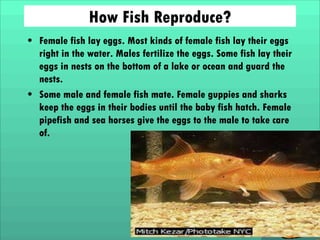
• Female fish lay eggs. Most kinds of female fish lay their eggs
right in the water. Males fertilize the eggs. Some fish lay their
eggs in nests on the bottom of a lake or ocean and guard the
nests.
• Some male and female fish mate. Female guppies and sharks
keep the eggs in their bodies until the baby fish hatch. Female
pipefish and sea horses give the eggs to the male to take care
of.
Fish and People
• Fish are very important to
people. People all over the
world eat fish. People catch
fish to sell. They catch fish for
sport. You can keep fish as
pets.
• In some parts of the ocean,
people are catching too many
fish. In some lakes and rivers,
pollution kills fish.
Governments pass laws to limit
fishing and clean up polluted
water. These laws help keep
fish from disappearing.
Thank You 
Presented by: Ann Janette c. Pascua (BEEd 3-2 day)

Fish -For our Field Study: Technology in the Learning Environment.

  • 1.
  • 2.
    Fish are animalsthat live and breathe in water. Some fish live in the fresh water of lakes and streams. Some fish live in the salt water of oceans. A few fish can live in both kinds of water. All fishes are vertebrates (animals with backbones). Most fish have a covering of scales to protect their bodies.
  • 3.
    KINDS OF FISH •There are about 25,000 species (kinds) of fishes. Fish come in all sizes. The huge whale shark can be 40 feet (12 meters) long. The tiny goby is only 0.4 inch (1 centimeter) long. • Most fish are called jawed fish. Hagfish and lampreys are jawless fish. They are more like eels. Eels are fish that look like snakes. Jawless fish do not have fins, scales, or jaws with teeth. • All other fish have jaws. There are bony jawed fish and cartilaginous jawed fish. Bony fish have skeletons made of bone. Cartilaginous fish have a softer material called cartilage instead of bone. Sharks,
  • 4.
    How Fish Swim? •Most fish use their side, back, and tail fins for swimming. Fins are movable, fanlike parts. A fish moves through the water by swinging its tail fins back and forth. A fish uses its other fins to steer and to stop. Sometimes the other fins also help it go fast through the water.
  • 5.
    How Fish Breathe •You have lungs for breathing. Most fish have gills for breathing. Gills have thin tubes that carry blood. As water goes into a fish’s mouth it passes over the gills. The gills take oxygen out of the water. All animals must have oxygen to live. Blood in the gills picks up the oxygen and takes it everywhere in the fish’s body. A waste gas called carbon dioxide also goes out of the fish’s body through the gills.
  • 6.
    Fish Senses • Fishhave a great sense of smell. They use their sense of smell to find food. Most fish can see. Fish that live at the bottom of the sea in total darkness cannot see. Some do not have eyes. • Fish can also feel things in the water around them. They can feel things before they can see them. They can tell if a big, dangerous fish that might eat them is coming near.
  • 7.
    What Fish Eat? •Most fish eat meat. Some eat tiny plants. Sharks and other big fish eat smaller fish. Some sharks eat seals. • Some fish have large, sharp teeth. Sharks and other big fish grab their prey and bite it. Other fish suck prey into their mouths and use smaller teeth to grind them up. • Some fish do not have teeth. Their mouths sift tiny plants and animals from the water. In the deep ocean where sunlight never reaches, the bodies of some fishes have chemicals that make a glowing light to attract prey.
  • 8.
    How Fish Reproduce? •Female fish lay eggs. Most kinds of female fish lay their eggs right in the water. Males fertilize the eggs. Some fish lay their eggs in nests on the bottom of a lake or ocean and guard the nests. • Some male and female fish mate. Female guppies and sharks keep the eggs in their bodies until the baby fish hatch. Female pipefish and sea horses give the eggs to the male to take care of.
  • 9.
    Fish and People •Fish are very important to people. People all over the world eat fish. People catch fish to sell. They catch fish for sport. You can keep fish as pets. • In some parts of the ocean, people are catching too many fish. In some lakes and rivers, pollution kills fish. Governments pass laws to limit fishing and clean up polluted water. These laws help keep fish from disappearing.
  • 10.
    Thank You  Presentedby: Ann Janette c. Pascua (BEEd 3-2 day)