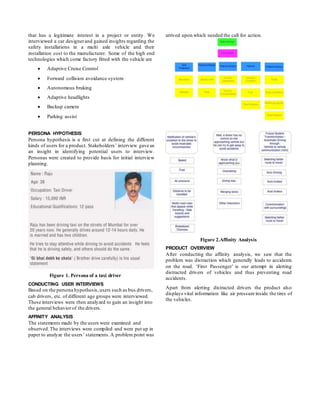
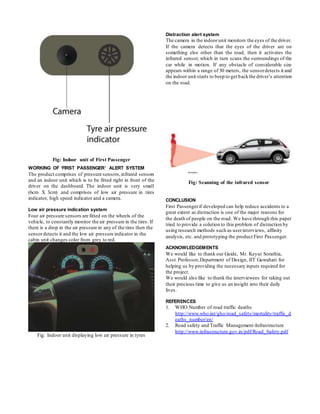
The document describes a proposed passenger alerting system called "First Passenger" that was designed by students at IIT Guwahati to help reduce accidents caused by distracted drivers. It works by monitoring a driver's eyes and the surroundings using a camera and infrared sensors, and alerts the driver with sounds and visuals if distractions are detected. The system would also monitor tire pressure and alert the driver of low pressure. Interviews with drivers and an affinity analysis were conducted to understand distractions and identify this as a key problem area. The goal of First Passenger is to help reduce the number of accidents and deaths on Indian roads by alerting distracted drivers.
![First Passenger- Driver Alerting System
Abhinab Sonowal
IIT Guwahati
Dept. of Design
abhinab@iitg.ac.in
Anmol Singh
IIT Guwahati
Dept. of Design
s.anmol@iitg.ac.in
Sruzan Lolla
IIT Guwahati
Dept. of Design
lolla.sruzan@iitg.ac.in
Manteshori Devi
IIT Guwahati
Dept. of Design
yengkhom@iitg.ac.in
ABSTRACT
The authors in this paper have tried to identify the major
causes of road accident through design research methods.
They have zeroed down on one of the many causes and have
tried to provide a solution in their capacity to reduce the
rising number of deaths every year in road accidents.
Keywords
Road Accidents, Drivers, Design research, Human
Computer Interaction
ACM Classification Keywords
H.5.2- User-Centered Design, H.5.5- Modelling.
INTRODUCTION
Road safety is a multi-sectorial and multi-dimensional
subject. It relies on modern traffic management systems and
practices, improved safety standards in design,construction,
operation and maintenance of roads, and production and
maintenance of safer vehicles. Owing to unsafe conditions
on roads, the rate of accidents in India has been high.
According to WHO statistics for 2010, out of about 1.24
million road accident deaths across the world, 231,087
deaths were reported from India alone [1]. The social cost of
road accidents in India at about 3 per cent of GDP.
Considering the gravity of the situation, there is consensus
that concerted measures are necessary for reducing this high
level of accident deaths and injuries through improved safety
measures and traffic management. In India with the
expansion in road network, motorization and urbanization in
the country, the number of road accidents have surged.Road
traffic injuries (RTIs) and fatalities have emerged as a major
public health concern, with RTIs having become one of the
leading causes of deaths, disabilities and hospitalizations
which impose severe socio- economic costs across the
world.[2]
CAUSES OF ROAD ACCIDENTS
Maximum of the road accidents are caused by human error.
The project specification called for a review of the following
causes [2]
Over Speeding
Drunken Driving
Distractions to Driver
Over Speeding
Most of the fatal accidents occurdue to over speeding.It is a
natural psyche of human to excel. If given a chance man is
sure to achieve infinity in speed. But when we are sharing
the road with otherusers we will always remain behind some
or other vehicle. Increase in speed multiplies the risk of
accident and severity of injury during accident.
Drunken Driving
Consumption of alcohol to celebrate any occasion it’s
common. But when mixed with driving it turns celebration
into a misfortune, Alcohol reduces concentration.
Distraction to Driver
The distraction while driving could be minor but it can cause
major accidents. Distraction could be outside or inside the
vehicle. The major distraction now a day is talking on mobile
while driving. Act of talking on phone occupies major
portion of brain and the smaller part handles the driving
skills.
Some of the distraction on road is
Adjusting mirrors while driving
Stereo/Radio in vehicle
Animals roaming on the road
Banners and billboards
SAFETY FEATURES IN VEHICLES
Over the years car manufacturing companies have
introduced various safety features to keep their customers
happy and safe. We wanted to know about the latest safety
feature existing in market, so we had to conduct stakeholder
interviews to know what was economically feasible. In a
business context, a "stakeholder" is a person or organization
© 1994, 1995,1998,2002,2009,2011, 2013by ACM, Inc. Permissionto
copy anddistribute this document is herebygranted providedthat this notice
is retainedonall copies, that copies are not altered, andthat ACMis credited
when the material is used to form other copyright policies.](https://image.slidesharecdn.com/final-150816145150-lva1-app6892/85/First-Passenger-1-320.jpg)
![First Passenger- Driver Alerting System
Abhinab Sonowal
IIT Guwahati
Dept. of Design
abhinab@iitg.ac.in
Anmol Singh
IIT Guwahati
Dept. of Design
s.anmol@iitg.ac.in
Sruzan Lolla
IIT Guwahati
Dept. of Design
lolla.sruzan@iitg.ac.in
Manteshori Devi
IIT Guwahati
Dept. of Design
yengkhom@iitg.ac.in
ABSTRACT
The authors in this paper have tried to identify the major
causes of road accident through design research methods.
They have zeroed down on one of the many causes and have
tried to provide a solution in their capacity to reduce the
rising number of deaths every year in road accidents.
Keywords
Road Accidents, Drivers, Design research, Human
Computer Interaction
ACM Classification Keywords
H.5.2- User-Centered Design, H.5.5- Modelling.
INTRODUCTION
Road safety is a multi-sectorial and multi-dimensional
subject. It relies on modern traffic management systems and
practices, improved safety standards in design,construction,
operation and maintenance of roads, and production and
maintenance of safer vehicles. Owing to unsafe conditions
on roads, the rate of accidents in India has been high.
According to WHO statistics for 2010, out of about 1.24
million road accident deaths across the world, 231,087
deaths were reported from India alone [1]. The social cost of
road accidents in India at about 3 per cent of GDP.
Considering the gravity of the situation, there is consensus
that concerted measures are necessary for reducing this high
level of accident deaths and injuries through improved safety
measures and traffic management. In India with the
expansion in road network, motorization and urbanization in
the country, the number of road accidents have surged.Road
traffic injuries (RTIs) and fatalities have emerged as a major
public health concern, with RTIs having become one of the
leading causes of deaths, disabilities and hospitalizations
which impose severe socio- economic costs across the
world.[2]
CAUSES OF ROAD ACCIDENTS
Maximum of the road accidents are caused by human error.
The project specification called for a review of the following
causes [2]
Over Speeding
Drunken Driving
Distractions to Driver
Over Speeding
Most of the fatal accidents occurdue to over speeding.It is a
natural psyche of human to excel. If given a chance man is
sure to achieve infinity in speed. But when we are sharing
the road with otherusers we will always remain behind some
or other vehicle. Increase in speed multiplies the risk of
accident and severity of injury during accident.
Drunken Driving
Consumption of alcohol to celebrate any occasion it’s
common. But when mixed with driving it turns celebration
into a misfortune, Alcohol reduces concentration.
Distraction to Driver
The distraction while driving could be minor but it can cause
major accidents. Distraction could be outside or inside the
vehicle. The major distraction now a day is talking on mobile
while driving. Act of talking on phone occupies major
portion of brain and the smaller part handles the driving
skills.
Some of the distraction on road is
Adjusting mirrors while driving
Stereo/Radio in vehicle
Animals roaming on the road
Banners and billboards
SAFETY FEATURES IN VEHICLES
Over the years car manufacturing companies have
introduced various safety features to keep their customers
happy and safe. We wanted to know about the latest safety
feature existing in market, so we had to conduct stakeholder
interviews to know what was economically feasible. In a
business context, a "stakeholder" is a person or organization
© 1994, 1995,1998,2002,2009,2011, 2013by ACM, Inc. Permissionto
copy anddistribute this document is herebygranted providedthat this notice
is retainedonall copies, that copies are not altered, andthat ACMis credited
when the material is used to form other copyright policies.](https://image.slidesharecdn.com/final-150816145150-lva1-app6892/75/First-Passenger-1-2048.jpg)