What is the first
Commandment?
A. The first Commandment is: I
am the Lord thy God: thou shalt
not have strange gods before
me.
What does the First Commandment
mean?
“You shall have no other gods before Me”
means we must put God first in our lives.
He is more important than anyone or
anything else.
God loves us deeply, and so we should love
Him with all our hearts.
What does the commandment mean by
"strange gods"?
By strange gods the commandment
means idols or false gods, which the
Israelites frequently worshipped when,
through their sins, they had abandoned
the true God.
How may we, in a sense, worship
strange gods?
A. We, in a sense, may worship
strange gods by giving up the
salvation of our souls for wealth,
honors, society, worldly pleasures,
etc., so that we would offend God,
renounce our faith or give up the
practice of our religion for their sake.
The first commandment we are
commanded:
to give God alone the worship that He
alone deserves.
What is the worship of God called?
adoration or latria (Latin adoratio,
Greek latreia, [λατρεία]), which is
due to God alone.
Latria – An act of adoration or
worship due to God (Holy Trinity)
alone .
Hyperdulia – An act of respect
towards the Blessed Virgin Mary
(Luke 1:48) Dulia – An act of
respect towards the saints
What is worship according to God?
To worship is to show a lot of love
and adoration for something.
Religious believers worship gods,
and people can worship other
people and things too. Worship is an
extreme form of love — it's a type of
unquestioning devotion.
what “other gods” do people put
before God?
“Other gods” can be anything—
possessions, desires, goals or even
people—that we treat as more
important than the true God.
The First Commandment reminds
us of God’s greatness and how
we should respond
The First Commandment is a
reminder to focus on the awesome
power and majesty of our Creator
God. God’s power was on display
when He thundered these
commandments from Mount Sinai.
The First Commandment embraces
the theological virtues:
faith,
hope,
and love.
How does commitment to the First
Commandment strengthen our
practice of the theological virtues?
Commitment to the First
Commandment encourages the practice
of faith, putting our trust in an
unchanging source of life and
goodness—in God, who is faithful to his
promises.
Commitment to the First
Commandment encourages the practice
of hope. Hope is expecting God’s
blessings in this life and the reward of
Heaven in the next.
Commitment to the First
Commandment leads to love: of God,
others, and self.
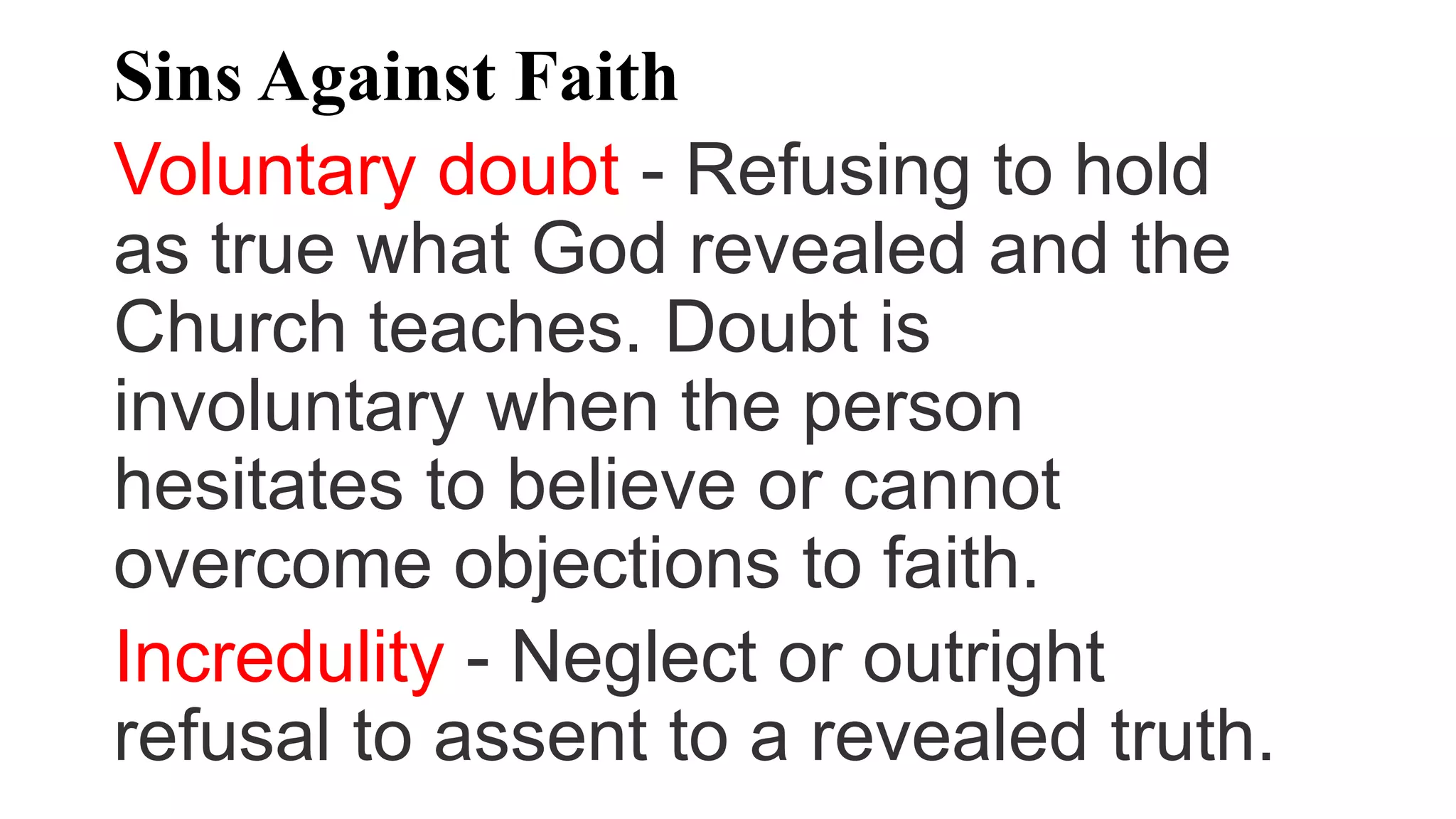
Sins Against Faith
Voluntary doubt - Refusing to hold
as true what God revealed and the
Church teaches. Doubt is
involuntary when the person
hesitates to believe or cannot
overcome objections to faith.
Incredulity - Neglect or outright
refusal to assent to a revealed truth.
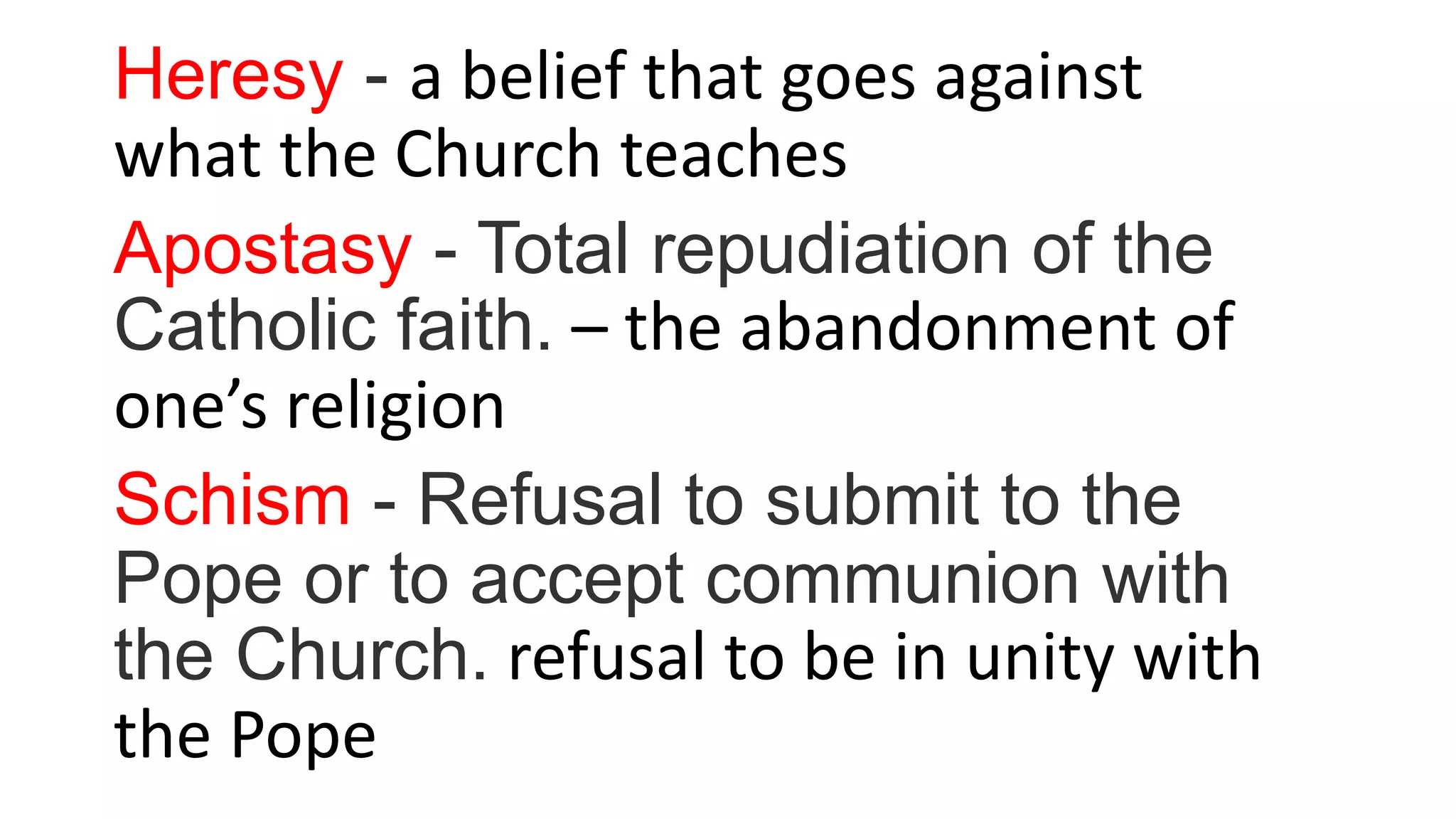
Heresy - a belief that goes against
what the Church teaches
Apostasy - Total repudiation of the
Catholic faith. – the abandonment of
one’s religion
Schism - Refusal to submit to the
Pope or to accept communion with
the Church. refusal to be in unity with
the Pope
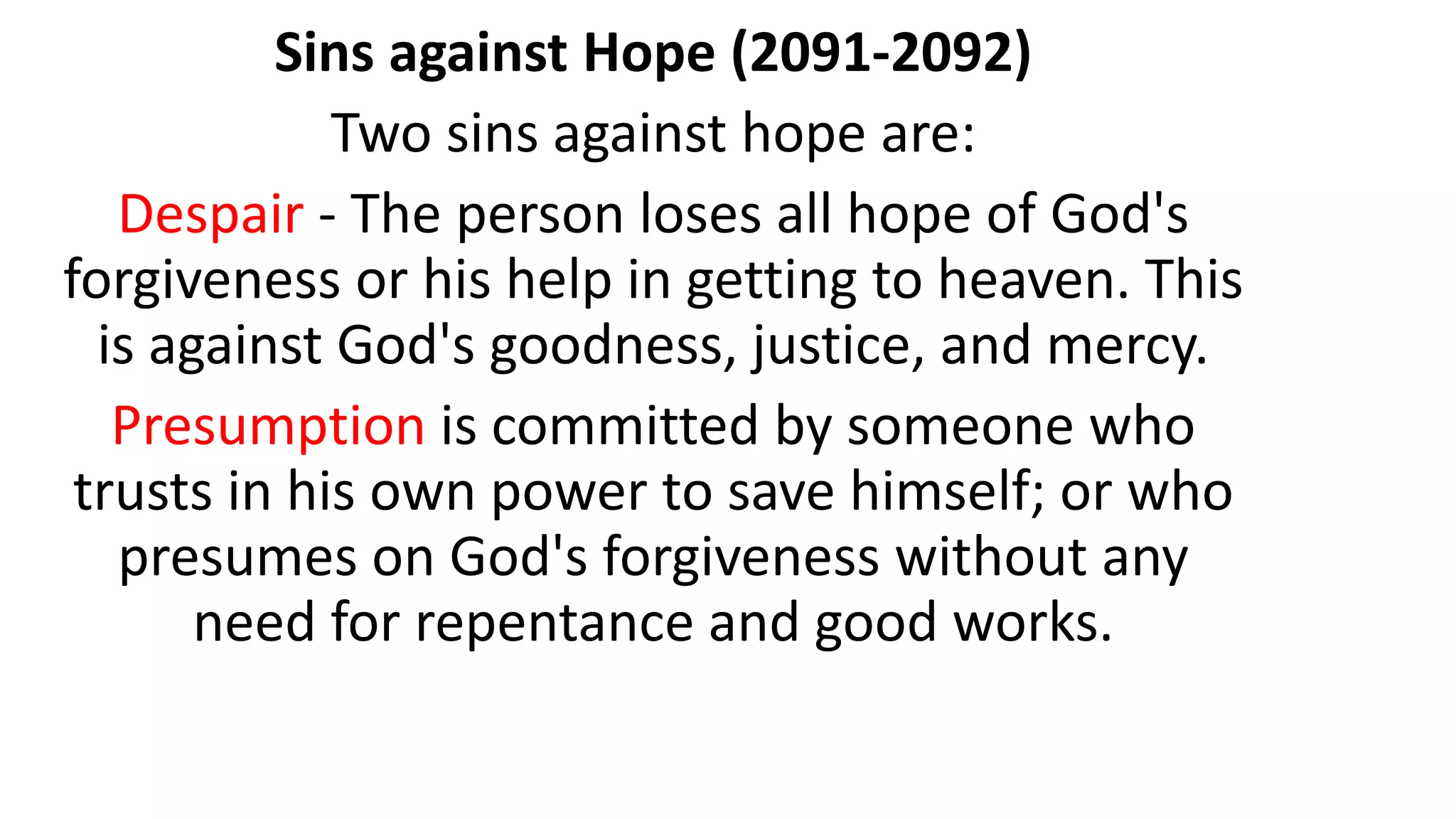
Sins against Hope (2091-2092)
Two sins against hope are:
Despair - The person loses all hope of God's
forgiveness or his help in getting to heaven. This
is against God's goodness, justice, and mercy.
Presumption is committed by someone who
trusts in his own power to save himself; or who
presumes on God's forgiveness without any
need for repentance and good works.
Sins against the First Commandment
include:
- sacrilege – disrespect toward sacred
things
(places, objects, persons,words, etc)
- simony - the buying or selling of
ecclesiastical
privileges (sacraments, position in the
Church, etc)
The First Commandment forbids:
- the occult – beliefs that are not of
God, but seek to control powers beyond
human nature
- superstition – an irrational belief that
an object, action, or circumstance not
logically related to acourse of events
influences its outcome
Examples of superstitious beliefs:
The number of steps of staircases at home
should not be divisible by three.
Turn your plate when someone leaves in the
middle of a meal.
Don't go straight home after attending a wake.
Siblings should not marry within the same year.
1.Friday the 13th.
2.No umbrellas inside. ...
3.Cross your fingers. ...
4.Make a wish on a wishbone. ...
5.Knock on wood. ...
6.666. ...
7.Careful with that mirror. ...
8.Bad luck comes in threes. ...
idolatry – the worship of false gods or
idols
- witchcraft– attempting to use
magical“formulas” to show power that
belongs only to God
- cult – a system of misguided beliefs
that center around a leader; these are
often dangerous

First commandment.pptx

  • 1.
    What is thefirst Commandment? A. The first Commandment is: I am the Lord thy God: thou shalt not have strange gods before me.
  • 2.
    What does theFirst Commandment mean? “You shall have no other gods before Me” means we must put God first in our lives. He is more important than anyone or anything else. God loves us deeply, and so we should love Him with all our hearts.
  • 3.
    What does thecommandment mean by "strange gods"? By strange gods the commandment means idols or false gods, which the Israelites frequently worshipped when, through their sins, they had abandoned the true God.
  • 4.
    How may we,in a sense, worship strange gods? A. We, in a sense, may worship strange gods by giving up the salvation of our souls for wealth, honors, society, worldly pleasures, etc., so that we would offend God, renounce our faith or give up the practice of our religion for their sake.
  • 5.
    The first commandmentwe are commanded: to give God alone the worship that He alone deserves.
  • 6.
    What is theworship of God called? adoration or latria (Latin adoratio, Greek latreia, [λατρεία]), which is due to God alone. Latria – An act of adoration or worship due to God (Holy Trinity) alone .
  • 7.
    Hyperdulia – Anact of respect towards the Blessed Virgin Mary (Luke 1:48) Dulia – An act of respect towards the saints
  • 8.
    What is worshipaccording to God? To worship is to show a lot of love and adoration for something. Religious believers worship gods, and people can worship other people and things too. Worship is an extreme form of love — it's a type of unquestioning devotion.
  • 9.
    what “other gods”do people put before God? “Other gods” can be anything— possessions, desires, goals or even people—that we treat as more important than the true God.
  • 10.
    The First Commandmentreminds us of God’s greatness and how we should respond The First Commandment is a reminder to focus on the awesome power and majesty of our Creator God. God’s power was on display when He thundered these commandments from Mount Sinai.
  • 11.
    The First Commandmentembraces the theological virtues: faith, hope, and love.
  • 12.
    How does commitmentto the First Commandment strengthen our practice of the theological virtues? Commitment to the First Commandment encourages the practice of faith, putting our trust in an unchanging source of life and goodness—in God, who is faithful to his promises.
  • 13.
    Commitment to theFirst Commandment encourages the practice of hope. Hope is expecting God’s blessings in this life and the reward of Heaven in the next. Commitment to the First Commandment leads to love: of God, others, and self.
  • 14.
    Sins Against Faith Voluntarydoubt - Refusing to hold as true what God revealed and the Church teaches. Doubt is involuntary when the person hesitates to believe or cannot overcome objections to faith. Incredulity - Neglect or outright refusal to assent to a revealed truth.
  • 15.
    Heresy - abelief that goes against what the Church teaches Apostasy - Total repudiation of the Catholic faith. – the abandonment of one’s religion Schism - Refusal to submit to the Pope or to accept communion with the Church. refusal to be in unity with the Pope
  • 16.
    Sins against Hope(2091-2092) Two sins against hope are: Despair - The person loses all hope of God's forgiveness or his help in getting to heaven. This is against God's goodness, justice, and mercy. Presumption is committed by someone who trusts in his own power to save himself; or who presumes on God's forgiveness without any need for repentance and good works.
  • 18.
    Sins against theFirst Commandment include: - sacrilege – disrespect toward sacred things (places, objects, persons,words, etc) - simony - the buying or selling of ecclesiastical privileges (sacraments, position in the Church, etc)
  • 19.
    The First Commandmentforbids: - the occult – beliefs that are not of God, but seek to control powers beyond human nature - superstition – an irrational belief that an object, action, or circumstance not logically related to acourse of events influences its outcome
  • 20.
    Examples of superstitiousbeliefs: The number of steps of staircases at home should not be divisible by three. Turn your plate when someone leaves in the middle of a meal. Don't go straight home after attending a wake. Siblings should not marry within the same year.
  • 21.
    1.Friday the 13th. 2.Noumbrellas inside. ... 3.Cross your fingers. ... 4.Make a wish on a wishbone. ... 5.Knock on wood. ... 6.666. ... 7.Careful with that mirror. ... 8.Bad luck comes in threes. ...
  • 22.
    idolatry – theworship of false gods or idols - witchcraft– attempting to use magical“formulas” to show power that belongs only to God - cult – a system of misguided beliefs that center around a leader; these are often dangerous