Archives, museums,
depository, libraries,
safes
Archives
High storehouses,
freezers, ammo
stocks etc.
Storages
Technical rooms,
cabel tunnels, power
plants
Other
Datacenters, servers,
server cabinets
IT
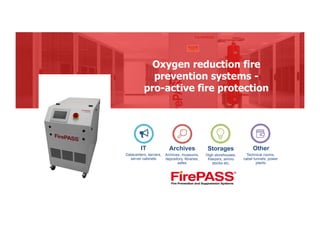
Oxygen reduction fire
prevention systems -
pro-active fire protection
Basic information
About FirePASS system
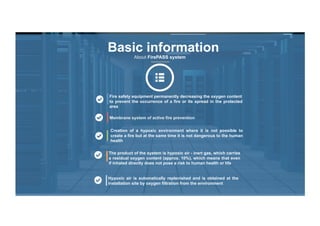
Fire safety equipment permanently decreasing the oxygen content
to prevent the occurrence of a fire or its spread in the protected
area
Membrane system of active fire prevention
Creation of a hypoxic environment where it is not possible to
create a fire but at the same time it is not dangerous to the human
health
The product of the system is hypoxic air - inert gas, which carries
a residual oxygen content (approx. 10%), which means that even
if inhaled directly does not pose a risk to human health or life
Hypoxic air is automatically replenished and is obtained at the
installation site by oxygen filtration from the environment
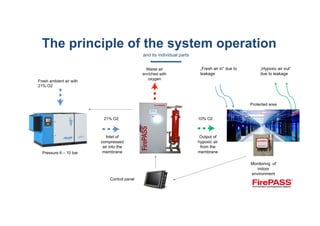
Pressure 6 – 10 bar
Fresh ambient air with
21% O2
Inlet of
compressed
air into the
membrane
Waste air
enriched with
oxygen
Protected area
Output of
hypoxic air
from the
membrane
21% O2 10% O2
„Hypoxic air out“
due to leakage
Monitoring of
indoor
environment
Control panel
„Fresh air in“ due to
leakage
The principle of the system operation
and its individual parts
78%
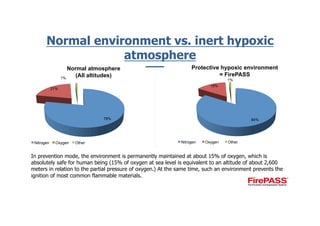
In prevention mode, the environment is permanently maintained at about 15% of oxygen, which is
absolutely safe for human being (15% of oxygen at sea level is equivalent to an altitude of about 2,600
meters in relation to the partial pressure of oxygen.) At the same time, such an environment prevents the
ignition of most common flammable materials.
78%
21%
1%
Normal atmosphere
(All altitudes)
Nitrogen Oxygen Other
84%
15%
1%
Protective hypoxic environment
= FirePASS
Nitrogen Oxygen Other
Normal environment vs. inert hypoxic
atmosphere
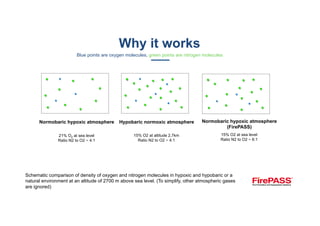
Why it works
Blue points are oxygen molecules, green points are nitrogen molecules
Schematic comparison of density of oxygen and nitrogen molecules in hypoxic and hypobaric or a
natural environment at an altitude of 2700 m above sea level. (To simplify, other atmospheric gases
are ignored)
Hypobaric normoxic atmosphere
15% O2 at altitude 2,7km
Ratio N2 to O2 ~ 4:1
Normobaric hypoxic atmosphere
21% O2 at sea level
Ratio N2 to O2 ~ 4:1
Normobaric hypoxic atmosphere
(FirePASS)
15% O2 at sea level
Ratio N2 to O2 ~ 6:1
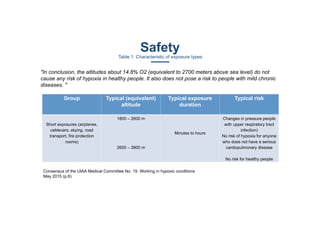
Safety
Table 1: Characteristic of exposure types
"In conclusion, the altitudes about 14.8% O2 (equivalent to 2700 meters above sea level) do not
cause any risk of hypoxia in healthy people. It also does not pose a risk to people with mild chronic
diseases. "
Group Typical (equivalent)
altitude
Typical exposure
duration
Typical risk
Short exposures (airplanes,
cablecars, skying, road
transport, fire protection
rooms)
1800 – 2600 m
2600 – 3800 m
Minutes to hours
Changes in pressure people
with upper respiratory tract
infection)
No risk of hypoxia for anyone
who does not have a serious
cardiopulmonary disease
No risk for healthy people
Consensus of the UIAA Medical Committee No. 15: Working in hypoxic conditions
May 2015 (p.6)
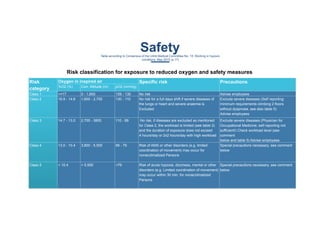
SafetyTable according to Consensus of the UIAA Medical Committee No. 15: Working in hypoxic
conditions, May 2015 (p.17)
Risk classification for exposure to reduced oxygen and safety measures
Risk
category
Oxygen in inspired air Specific risk Precautions
%O2 (%) Corr. Altitude (m) pO2 (mmHg)
Class 1 >=17 0 - 1,600 159 - 130 No risk Advise employees
Class 2 16.9 - 14.8 1,600 - 2,700 130 - 110 No risk for a full days shift if severe diseases of
the lungs or heart and severe anaemia is
Excluded
Exclude severe diseases (Self reporting:
minimum requirements climbing 2 floors
without dyspnoea, see also table 5)
Advise employees
Class 3 14.7 - 13.0 2,700 - 3800 110 - 99 No risk, if diseases are excluded as mentioned
for Class 2, the workload is limited (see table 3)
and the duration of exposure does not exceed
4 hours/day or 2x2 hours/day with high workload
Exclude severe diseases (Physician for
Occupational Medicine; self-reporting not
sufficient!) Check workload level (see
comment
below and table 5) Advise employees
Class 4 13.0 - 10.4 3,800 - 5,500 99 - 79 Risk of AMS or other disorders (e.g. limited
coordination of movement) may occur for
nonacclimatized Persons
Special precautions necessary, see comment
below
Class 5 < 10.4 > 5,500 <79 Risk of acute hypoxia, dizziness, mental or other
disorders (e.g. Limited coordination of movement)
may occur within 30 min. for nonacclimatized
Persons
Special precautions necessary, see comment
below
0
5
10
15
20
25
30
35
40
45
50
January February March April May
Ensure that the leakage of the enclosure does not
exceed 20% of the total volume per 24 hours
(0.83% per hour)
Double doors / gates are always recommended
Ensuring adequate cooling and ventilation of the
compressor + drainage for condensate drainage
Piping from the compressor to the generator, then
from the generator to the room (hypoxic air) and
out of the building (hyperoxic air)
Project requirements
Lorem ipsum dolor sit amet, consectetur adipiscing elit. Ut
efficitur ipsum vitae tortor accumsan, a pulvinar lorem lacinia.
Donec eu arcu justo. Fusce eget consequat risus Proin est lacus,
interdum vitae feugiat quis, faucibus vel mi.
Vivamus accumsan nisi vel nulla viverra semper. Donec purus
enim, sollicitudin vitae porta a, commodo sodales justo. Sed
iaculis rutrum molestie.
Installation of sensors according to cubature
according to EN 16750; 2017
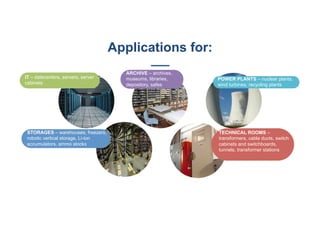
IT – datecenters, servers, server
cabinets
ARCHIVE – archives,
museums, libraries,
depository, safes
POWER PLANTS – nuclear plants,
wind turbines, recycling plants
STORAGES – warehouses, freezers,
robotic vertical storage, Li-ion
accumulators, ammo stocks
TECHNICAL ROOMS –
transformers, cable ducts, switch
cabinets and switchboards,
tunnels, transformer stations
Applications for:
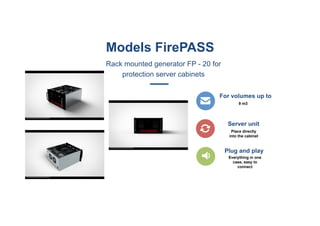
Models FirePASS
Rack mounted generator FP - 20 for
protection server cabinets
For volumes up to
9 m3
Server unit
Plug and play
Everything in one
case, easy to
connect
Place directly
into the cabinet
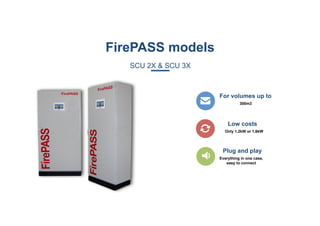
FirePASS models
SCU 2X & SCU 3X
For volumes up to
300m3
Low costs
Only 1,2kW or 1,6kW
Plug and play
Everything in one case,
easy to connect
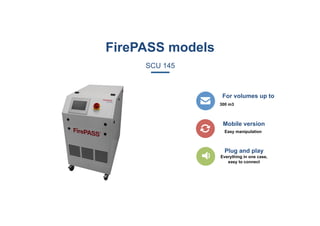
For volumes up to
300 m3
Mobile version
Easy manipulation
Plug and play
Everything in one case,
easy to connect
FirePASS models
SCU 145
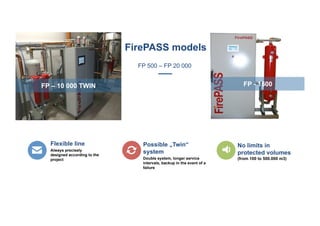
FP – 10 000 TWIN FP - 1500
Flexible line
Always precisely
designed according to the
project
Possible „Twin“
system
Double system, longer service
intervals, backup in the event of a
failure
No limits in
protected volumes
(from 100 to 500.000 m3)
FirePASS models
FP 500 – FP 20 000
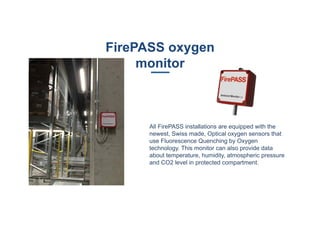
FirePASS oxygen
monitor
All FirePASS installations are equipped with the
newest, Swiss made, Optical oxygen sensors that
use Fluorescence Quenching by Oxygen
technology. This monitor can also provide data
about temperature, humidity, atmospheric pressure
and CO2 level in protected compartment.
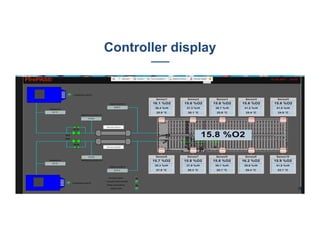
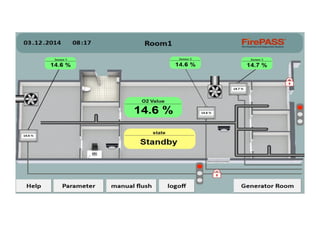
Controller display
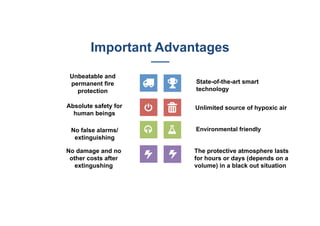
State-of-the-art smart
technology
Unlimited source of hypoxic air
Environmental friendly
The protective atmosphere lasts
for hours or days (depends on a
volume) in a black out situation
Unbeatable and
permanent fire
protection
Absolute safety for
human beings
No false alarms/
extinguishing
No damage and no
other costs after
extingushing
Important Advantages

Firepass en-presentation

  • 1.
    Archives, museums, depository, libraries, safes Archives Highstorehouses, freezers, ammo stocks etc. Storages Technical rooms, cabel tunnels, power plants Other Datacenters, servers, server cabinets IT Oxygen reduction fire prevention systems - pro-active fire protection
  • 2.
    Basic information About FirePASSsystem Fire safety equipment permanently decreasing the oxygen content to prevent the occurrence of a fire or its spread in the protected area Membrane system of active fire prevention Creation of a hypoxic environment where it is not possible to create a fire but at the same time it is not dangerous to the human health The product of the system is hypoxic air - inert gas, which carries a residual oxygen content (approx. 10%), which means that even if inhaled directly does not pose a risk to human health or life Hypoxic air is automatically replenished and is obtained at the installation site by oxygen filtration from the environment
  • 3.
    Pressure 6 –10 bar Fresh ambient air with 21% O2 Inlet of compressed air into the membrane Waste air enriched with oxygen Protected area Output of hypoxic air from the membrane 21% O2 10% O2 „Hypoxic air out“ due to leakage Monitoring of indoor environment Control panel „Fresh air in“ due to leakage The principle of the system operation and its individual parts
  • 4.
    78% In prevention mode,the environment is permanently maintained at about 15% of oxygen, which is absolutely safe for human being (15% of oxygen at sea level is equivalent to an altitude of about 2,600 meters in relation to the partial pressure of oxygen.) At the same time, such an environment prevents the ignition of most common flammable materials. 78% 21% 1% Normal atmosphere (All altitudes) Nitrogen Oxygen Other 84% 15% 1% Protective hypoxic environment = FirePASS Nitrogen Oxygen Other Normal environment vs. inert hypoxic atmosphere
  • 5.
    Why it works Bluepoints are oxygen molecules, green points are nitrogen molecules Schematic comparison of density of oxygen and nitrogen molecules in hypoxic and hypobaric or a natural environment at an altitude of 2700 m above sea level. (To simplify, other atmospheric gases are ignored) Hypobaric normoxic atmosphere 15% O2 at altitude 2,7km Ratio N2 to O2 ~ 4:1 Normobaric hypoxic atmosphere 21% O2 at sea level Ratio N2 to O2 ~ 4:1 Normobaric hypoxic atmosphere (FirePASS) 15% O2 at sea level Ratio N2 to O2 ~ 6:1
  • 6.
    Safety Table 1: Characteristicof exposure types "In conclusion, the altitudes about 14.8% O2 (equivalent to 2700 meters above sea level) do not cause any risk of hypoxia in healthy people. It also does not pose a risk to people with mild chronic diseases. " Group Typical (equivalent) altitude Typical exposure duration Typical risk Short exposures (airplanes, cablecars, skying, road transport, fire protection rooms) 1800 – 2600 m 2600 – 3800 m Minutes to hours Changes in pressure people with upper respiratory tract infection) No risk of hypoxia for anyone who does not have a serious cardiopulmonary disease No risk for healthy people Consensus of the UIAA Medical Committee No. 15: Working in hypoxic conditions May 2015 (p.6)
  • 7.
    SafetyTable according toConsensus of the UIAA Medical Committee No. 15: Working in hypoxic conditions, May 2015 (p.17) Risk classification for exposure to reduced oxygen and safety measures Risk category Oxygen in inspired air Specific risk Precautions %O2 (%) Corr. Altitude (m) pO2 (mmHg) Class 1 >=17 0 - 1,600 159 - 130 No risk Advise employees Class 2 16.9 - 14.8 1,600 - 2,700 130 - 110 No risk for a full days shift if severe diseases of the lungs or heart and severe anaemia is Excluded Exclude severe diseases (Self reporting: minimum requirements climbing 2 floors without dyspnoea, see also table 5) Advise employees Class 3 14.7 - 13.0 2,700 - 3800 110 - 99 No risk, if diseases are excluded as mentioned for Class 2, the workload is limited (see table 3) and the duration of exposure does not exceed 4 hours/day or 2x2 hours/day with high workload Exclude severe diseases (Physician for Occupational Medicine; self-reporting not sufficient!) Check workload level (see comment below and table 5) Advise employees Class 4 13.0 - 10.4 3,800 - 5,500 99 - 79 Risk of AMS or other disorders (e.g. limited coordination of movement) may occur for nonacclimatized Persons Special precautions necessary, see comment below Class 5 < 10.4 > 5,500 <79 Risk of acute hypoxia, dizziness, mental or other disorders (e.g. Limited coordination of movement) may occur within 30 min. for nonacclimatized Persons Special precautions necessary, see comment below
  • 8.
    0 5 10 15 20 25 30 35 40 45 50 January February MarchApril May Ensure that the leakage of the enclosure does not exceed 20% of the total volume per 24 hours (0.83% per hour) Double doors / gates are always recommended Ensuring adequate cooling and ventilation of the compressor + drainage for condensate drainage Piping from the compressor to the generator, then from the generator to the room (hypoxic air) and out of the building (hyperoxic air) Project requirements Lorem ipsum dolor sit amet, consectetur adipiscing elit. Ut efficitur ipsum vitae tortor accumsan, a pulvinar lorem lacinia. Donec eu arcu justo. Fusce eget consequat risus Proin est lacus, interdum vitae feugiat quis, faucibus vel mi. Vivamus accumsan nisi vel nulla viverra semper. Donec purus enim, sollicitudin vitae porta a, commodo sodales justo. Sed iaculis rutrum molestie. Installation of sensors according to cubature according to EN 16750; 2017
  • 9.
    IT – datecenters,servers, server cabinets ARCHIVE – archives, museums, libraries, depository, safes POWER PLANTS – nuclear plants, wind turbines, recycling plants STORAGES – warehouses, freezers, robotic vertical storage, Li-ion accumulators, ammo stocks TECHNICAL ROOMS – transformers, cable ducts, switch cabinets and switchboards, tunnels, transformer stations Applications for:
  • 10.
    Models FirePASS Rack mountedgenerator FP - 20 for protection server cabinets For volumes up to 9 m3 Server unit Plug and play Everything in one case, easy to connect Place directly into the cabinet
  • 11.
    FirePASS models SCU 2X& SCU 3X For volumes up to 300m3 Low costs Only 1,2kW or 1,6kW Plug and play Everything in one case, easy to connect
  • 12.
    For volumes upto 300 m3 Mobile version Easy manipulation Plug and play Everything in one case, easy to connect FirePASS models SCU 145
  • 13.
    FP – 10000 TWIN FP - 1500 Flexible line Always precisely designed according to the project Possible „Twin“ system Double system, longer service intervals, backup in the event of a failure No limits in protected volumes (from 100 to 500.000 m3) FirePASS models FP 500 – FP 20 000
  • 14.
    FirePASS oxygen monitor All FirePASSinstallations are equipped with the newest, Swiss made, Optical oxygen sensors that use Fluorescence Quenching by Oxygen technology. This monitor can also provide data about temperature, humidity, atmospheric pressure and CO2 level in protected compartment.
  • 15.
  • 17.
    State-of-the-art smart technology Unlimited sourceof hypoxic air Environmental friendly The protective atmosphere lasts for hours or days (depends on a volume) in a black out situation Unbeatable and permanent fire protection Absolute safety for human beings No false alarms/ extinguishing No damage and no other costs after extingushing Important Advantages