EGRESS AND FIRE
RESISTANT ASSEMBLIES
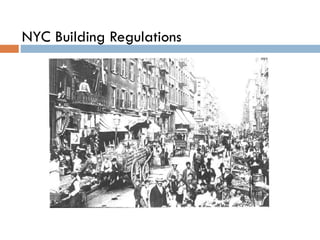
NYC Building Regulations
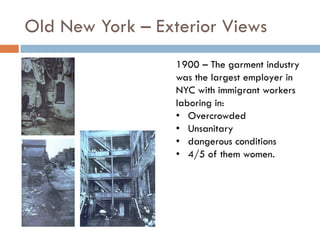
Old New York – Exterior Views
1900 – The garment industry
was the largest employer in
NYC with immigrant workers
laboring in:
• Overcrowded
• Unsanitary
• dangerous conditions
• 4/5 of them women.
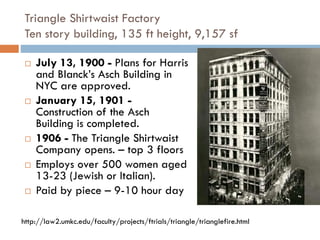
Triangle Shirtwaist Factory
Ten story building, 135 ft height, 9,157 sf
 July 13, 1900 - Plans for Harris
and Blanck’s Asch Building in
NYC are approved.
 January 15, 1901 -
Construction of the Asch
Building is completed.
 1906 - The Triangle Shirtwaist
Company opens. – top 3 floors
 Employs over 500 women aged
13-23 (Jewish or Italian).
 Paid by piece – 9-10 hour day
http://law2.umkc.edu/faculty/projects/ftrials/triangle/trianglefire.html
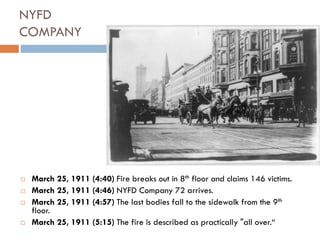
NYFD
COMPANY
 March 25, 1911 (4:40) Fire breaks out in 8th floor and claims 146 victims.
 March 25, 1911 (4:46) NYFD Company 72 arrives.
 March 25, 1911 (4:57) The last bodies fall to the sidewalk from the 9th
floor.
 March 25, 1911 (5:15) The fire is described as practically "all over.“
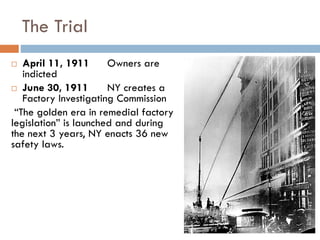
The Trial
 April 11, 1911 Owners are
indicted
 June 30, 1911 NY creates a
Factory Investigating Commission
“The golden era in remedial factory
legislation” is launched and during
the next 3 years, NY enacts 36 new
safety laws.
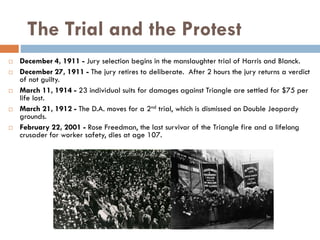
The Trial and the Protest
 December 4, 1911 - Jury selection begins in the manslaughter trial of Harris and Blanck.
 December 27, 1911 - The jury retires to deliberate. After 2 hours the jury returns a verdict
of not guilty.
 March 11, 1914 - 23 individual suits for damages against Triangle are settled for $75 per
life lost.
 March 21, 1912 - The D.A. moves for a 2nd trial, which is dismissed on Double Jeopardy
grounds.
 February 22, 2001 - Rose Freedman, the last survivor of the Triangle fire and a lifelong
crusader for worker safety, dies at age 107.
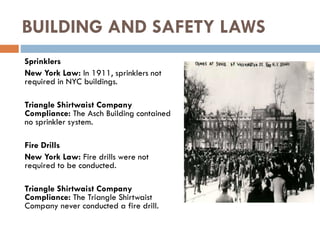
BUILDING AND SAFETY LAWS
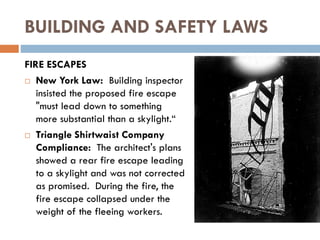
FIRE ESCAPES
 New York Law: Building inspector
insisted the proposed fire escape
"must lead down to something
more substantial than a skylight.“
 Triangle Shirtwaist Company
Compliance: The architect's plans
showed a rear fire escape leading
to a skylight and was not corrected
as promised. During the fire, the
fire escape collapsed under the
weight of the fleeing workers.
BUILDING AND SAFETY LAWS
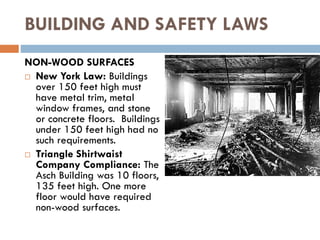
NON-WOOD SURFACES
 New York Law: Buildings
over 150 feet high must
have metal trim, metal
window frames, and stone
or concrete floors. Buildings
under 150 feet high had no
such requirements.
 Triangle Shirtwaist
Company Compliance: The
Asch Building was 10 floors,
135 feet high. One more
floor would have required
non-wood surfaces.
BUILDING AND
SAFETY LAWS
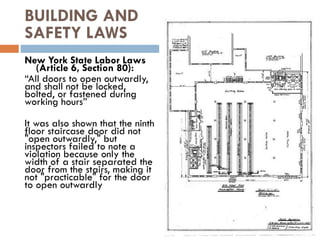
New York State Labor Laws
(Article 6, Section 80):
“All doors to open outwardly,
and shall not be locked,
bolted, or fastened during
working hours”
It was also shown that the ninth
floor staircase door did not
"open outwardly," but
inspectors failed to note a
violation because only the
width of a stair separated the
door from the stairs, making it
not "practicable" for the door
to open outwardly
BUILDING AND
SAFETY LAWS
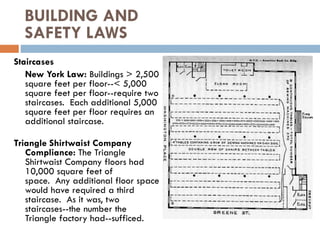
Staircases
New York Law: Buildings > 2,500
square feet per floor--< 5,000
square feet per floor--require two
staircases. Each additional 5,000
square feet per floor requires an
additional staircase.
Triangle Shirtwaist Company
Compliance: The Triangle
Shirtwaist Company floors had
10,000 square feet of
space. Any additional floor space
would have required a third
staircase. As it was, two
staircases--the number the
Triangle factory had--sufficed.
Sprinklers
New York Law: In 1911, sprinklers not
required in NYC buildings.
Triangle Shirtwaist Company
Compliance: The Asch Building contained
no sprinkler system.
Fire Drills
New York Law: Fire drills were not
required to be conducted.
Triangle Shirtwaist Company
Compliance: The Triangle Shirtwaist
Company never conducted a fire drill.
BUILDING AND SAFETY LAWS
 Ultimate goal of a fire related code is to
 Contain a fire within a space
 Limit the spread of fire
 Give occupants time to escape
 Give the firefighters time to control the fire
 Codes provide for both fire and SMOKE protection
 Smoke travels fast
 Causes asphyxiation
 Obstructs vision
 Causes disorientation
 Requirements on materials used to construct the
building
 Building Construction type places restrictions on the
hourly rating of structural members
 Other areas of the code places restrictions on other
interior construction materials, wiring, plumbing, and
finishes – as they can feed a fire.
Code requires various systems for fire safety
 Passive systems – also known as prevention systems
 Prohibit and contain fires
 Once in place – no action required for their function
 Active systems
 Need to be activated in order to work against fires
 Exiting systems
 Building elements that assist in directing occupants to
safe
 Passive systems
 Fire and smoke barriers – walls
 Horizontal assemblies – floors and ceilings
 Opening protectives – windows and doors
 Through – penetrations – firestops, dampers
 Finishes and furniture
 Active systems
 Detection systems – alarms
 Extinguishing systems – sprinklers
 Emergency lighting
 Exiting systems
 Means of egress
 Exit communication
 Compartmentation – separation of areas in a building
to control fire and smoke by the use of wall, floor, and
ceiling assemblies
 Compartments are created by fire-resistance –rated
assemblies
 Codes also require the use of smoke barriers and smoke
partitions in some cases
 Fire rating controlled by building construction type and
occupancy classification of building and tenants
 Presence of an automatic sprinkler system can affect fire
rating requirements
 Fire walls are used to provide complete vertical
separation between areas in a building
 Must have a separate foundation and extend to the roof
 Separate two separate types of construction
 Allow larger building area
 Minimum 2 hour rating – typically 3 and 4 hour rating
usually dependent on occupancy
 If a fire wall needs to be penetrated, research needs to be
done so that the fire resistance rating is maintained

fire resistant assemblies

  • 1.
  • 2.
  • 3.
    Old New York– Exterior Views 1900 – The garment industry was the largest employer in NYC with immigrant workers laboring in: • Overcrowded • Unsanitary • dangerous conditions • 4/5 of them women.
  • 4.
    Triangle Shirtwaist Factory Tenstory building, 135 ft height, 9,157 sf  July 13, 1900 - Plans for Harris and Blanck’s Asch Building in NYC are approved.  January 15, 1901 - Construction of the Asch Building is completed.  1906 - The Triangle Shirtwaist Company opens. – top 3 floors  Employs over 500 women aged 13-23 (Jewish or Italian).  Paid by piece – 9-10 hour day http://law2.umkc.edu/faculty/projects/ftrials/triangle/trianglefire.html
  • 5.
    NYFD COMPANY  March 25,1911 (4:40) Fire breaks out in 8th floor and claims 146 victims.  March 25, 1911 (4:46) NYFD Company 72 arrives.  March 25, 1911 (4:57) The last bodies fall to the sidewalk from the 9th floor.  March 25, 1911 (5:15) The fire is described as practically "all over.“
  • 6.
    The Trial  April11, 1911 Owners are indicted  June 30, 1911 NY creates a Factory Investigating Commission “The golden era in remedial factory legislation” is launched and during the next 3 years, NY enacts 36 new safety laws.
  • 7.
    The Trial andthe Protest  December 4, 1911 - Jury selection begins in the manslaughter trial of Harris and Blanck.  December 27, 1911 - The jury retires to deliberate. After 2 hours the jury returns a verdict of not guilty.  March 11, 1914 - 23 individual suits for damages against Triangle are settled for $75 per life lost.  March 21, 1912 - The D.A. moves for a 2nd trial, which is dismissed on Double Jeopardy grounds.  February 22, 2001 - Rose Freedman, the last survivor of the Triangle fire and a lifelong crusader for worker safety, dies at age 107.
  • 8.
    BUILDING AND SAFETYLAWS FIRE ESCAPES  New York Law: Building inspector insisted the proposed fire escape "must lead down to something more substantial than a skylight.“  Triangle Shirtwaist Company Compliance: The architect's plans showed a rear fire escape leading to a skylight and was not corrected as promised. During the fire, the fire escape collapsed under the weight of the fleeing workers.
  • 9.
    BUILDING AND SAFETYLAWS NON-WOOD SURFACES  New York Law: Buildings over 150 feet high must have metal trim, metal window frames, and stone or concrete floors. Buildings under 150 feet high had no such requirements.  Triangle Shirtwaist Company Compliance: The Asch Building was 10 floors, 135 feet high. One more floor would have required non-wood surfaces.
  • 10.
    BUILDING AND SAFETY LAWS NewYork State Labor Laws (Article 6, Section 80): “All doors to open outwardly, and shall not be locked, bolted, or fastened during working hours” It was also shown that the ninth floor staircase door did not "open outwardly," but inspectors failed to note a violation because only the width of a stair separated the door from the stairs, making it not "practicable" for the door to open outwardly
  • 11.
    BUILDING AND SAFETY LAWS Staircases NewYork Law: Buildings > 2,500 square feet per floor--< 5,000 square feet per floor--require two staircases. Each additional 5,000 square feet per floor requires an additional staircase. Triangle Shirtwaist Company Compliance: The Triangle Shirtwaist Company floors had 10,000 square feet of space. Any additional floor space would have required a third staircase. As it was, two staircases--the number the Triangle factory had--sufficed.
  • 12.
    Sprinklers New York Law:In 1911, sprinklers not required in NYC buildings. Triangle Shirtwaist Company Compliance: The Asch Building contained no sprinkler system. Fire Drills New York Law: Fire drills were not required to be conducted. Triangle Shirtwaist Company Compliance: The Triangle Shirtwaist Company never conducted a fire drill. BUILDING AND SAFETY LAWS
  • 13.
     Ultimate goalof a fire related code is to  Contain a fire within a space  Limit the spread of fire  Give occupants time to escape  Give the firefighters time to control the fire
  • 14.
     Codes providefor both fire and SMOKE protection  Smoke travels fast  Causes asphyxiation  Obstructs vision  Causes disorientation
  • 15.
     Requirements onmaterials used to construct the building  Building Construction type places restrictions on the hourly rating of structural members  Other areas of the code places restrictions on other interior construction materials, wiring, plumbing, and finishes – as they can feed a fire.
  • 16.
    Code requires varioussystems for fire safety  Passive systems – also known as prevention systems  Prohibit and contain fires  Once in place – no action required for their function  Active systems  Need to be activated in order to work against fires  Exiting systems  Building elements that assist in directing occupants to safe
  • 17.
     Passive systems Fire and smoke barriers – walls  Horizontal assemblies – floors and ceilings  Opening protectives – windows and doors  Through – penetrations – firestops, dampers  Finishes and furniture
  • 18.
     Active systems Detection systems – alarms  Extinguishing systems – sprinklers  Emergency lighting
  • 19.
     Exiting systems Means of egress  Exit communication
  • 20.
     Compartmentation –separation of areas in a building to control fire and smoke by the use of wall, floor, and ceiling assemblies  Compartments are created by fire-resistance –rated assemblies  Codes also require the use of smoke barriers and smoke partitions in some cases  Fire rating controlled by building construction type and occupancy classification of building and tenants  Presence of an automatic sprinkler system can affect fire rating requirements
  • 21.
     Fire wallsare used to provide complete vertical separation between areas in a building  Must have a separate foundation and extend to the roof  Separate two separate types of construction  Allow larger building area  Minimum 2 hour rating – typically 3 and 4 hour rating usually dependent on occupancy  If a fire wall needs to be penetrated, research needs to be done so that the fire resistance rating is maintained