By: Asia Johnson
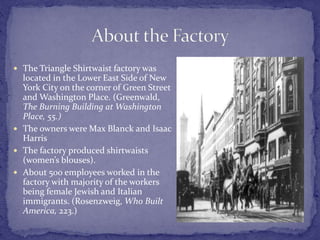
 The Triangle Shirtwaist factory was 
located in the Lower East Side of New 
York City on the corner of Green Street 
and Washington Place. (Greenwald, 
The Burning Building at Washington 
Place, 55.) 
 The owners were Max Blanck and Isaac 
Harris 
 The factory produced shirtwaists 
(women’s blouses). 
 About 500 employees worked in the 
factory with majority of the workers 
being female Jewish and Italian 
immigrants. (Rosenzweig, Who Built 
America, 223.)
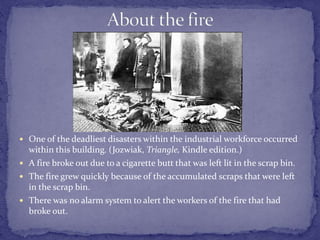
 One of the deadliest disasters within the industrial workforce occurred 
within this building. (Jozwiak, Triangle, Kindle edition.) 
 A fire broke out due to a cigarette butt that was left lit in the scrap bin. 
 The fire grew quickly because of the accumulated scraps that were left 
in the scrap bin. 
 There was no alarm system to alert the workers of the fire that had 
broke out.
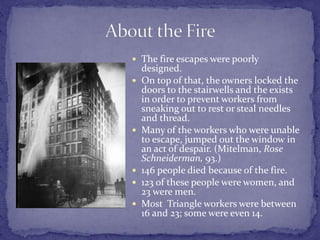
 The fire escapes were poorly 
designed. 
 On top of that, the owners locked the 
doors to the stairwells and the exists 
in order to prevent workers from 
sneaking out to rest or steal needles 
and thread. 
 Many of the workers who were unable 
to escape, jumped out the window in 
an act of despair. (Mitelman, Rose 
Schneiderman, 93.) 
 146 people died because of the fire. 
 123 of these people were women, and 
23 were men. 
 Most Triangle workers were between 
16 and 23; some were even 14.
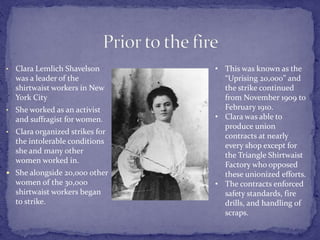
• Clara Lemlich Shavelson 
was a leader of the 
shirtwaist workers in New 
York City 
• She worked as an activist 
and suffragist for women. 
• Clara organized strikes for 
the intolerable conditions 
she and many other 
women worked in. 
 She alongside 20,000 other 
women of the 30,000 
shirtwaist workers began 
to strike. 
• This was known as the 
“Uprising 20,000” and 
the strike continued 
from November 1909 to 
February 1910. 
• Clara was able to 
produce union 
contracts at nearly 
every shop except for 
the Triangle Shirtwaist 
Factory who opposed 
these unionized efforts. 
• The contracts enforced 
safety standards, fire 
drills, and handling of 
scraps.
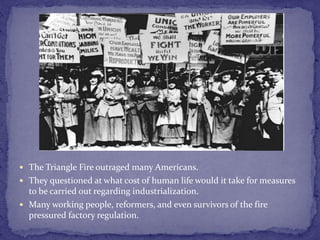
 The Triangle Fire outraged many Americans. 
 They questioned at what cost of human life would it take for measures 
to be carried out regarding industrialization. 
 Many working people, reformers, and even survivors of the fire 
pressured factory regulation.
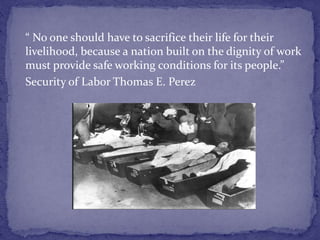
“ No one should have to sacrifice their life for their 
livelihood, because a nation built on the dignity of work 
must provide safe working conditions for its people.” 
Security of Labor Thomas E. Perez
 On June 1911, New York created a Factory Investigation 
Commission which looked into factories for fire hazards, 
unsanitary conditions, and many other matters. 
 The commission was very thorough. It investigated 3, 385 
workplaces, conducted 59 hearings, and heard testimonies 
from 472 witnesses. (U.S. Department of Labor) 
 Thanks to the Factory Investigation Commission, 20 laws 
were enacted that provided stricter regulation on health 
and safety conditions. 
 Specifically these laws required better building access, and 
exits, fire extinguishers, alarm systems, automatic 
sprinklers and fireproofing technology. 
 The American Society of Safety Engineers was also founded 
October 14, 1911.
 National Labor Relations Act of 1935 (Wagner Act) prohibited 
employers from discriminating against workers who joined unions and 
assured the rights to negotiate terms of their employment. 
 The Fair Labor Standards Act in 1938 helped established minimum 
wage. It also established a 40 hour work week, so if people worked past 
those 40 hours, they would receive overtime which is time-and-a-half. 
Lastly, it established a minimum age to work certain jobs seeing as how 
some young kids were working dangerous jobs when they shouldn’t 
have been. (U.S. Department of Labor) 
 The number of deaths in the workplace decreased dramatically after 
these reforms were carried out but some owners still broke the rules. 
 In 1991, a poultry plant in North Carolina caught fire and 25 workers 
died because the doors were locked.
 Below is the hyperlink to a video that compares 
garment workers of today with the garment 
workers during the time of the Triangle Shirtwaist 
Factory. It gives you insight on how these factories 
are set up. To this day, majority of immigrant 
women fulfill these garment industry jobs just 
hoping to entering the work force in America. 
 http://www.nytimes.com/video/nyregion/1000000 
00735431/garmentlabor.html
 The Triangle Fire as devastating as it was, really served as a 
turning point in industrial history. So many people worked 
in horrible unsafe conditions without so much as a say to 
improve these conditions. This tragedy awakened many 
reformers and workers to fight against such cruelty. 146 
deaths could have been prevented had a door simply been 
unlocked the day of the Triangle Fire. American has greatly 
improved their working conditions especially in 
comparison to the 1900s, but many factories like this still 
exist in other countries and reform needs to happen in 
these countries in order to avoid such tragedy once more.
1. Roy Rosenzweig, Nelson Lichtenstein, Joshua Brown, and David Jaffee, Who 
Built America: Working People and the Nation’s History, 1877 to present 
(Boston: Bedford/ St. Martin’s, 2008), 223-244 
2. Elizabeth Jozwiak, Triangle: The Fire That Changed America, 1909-1919 (New 
York, (NY) 2006) Kindle Edition 
3. Bonnie Mitelman, “Rose Schneiderman and the Triangle Fire” American 
History Illustrated (1981): 93-95. 
4. Richard A. Greenwald, ‘‘The Burning Building at 23 Washington Place”: The 
Triangle Fire, Workers, and Reformers in Proressive Era New York. New York 
History (2002): 55-91 
5. ‘’The New York Factory Investigating Commission” U.S. Department of Labor, 
accessed November 27, 2014, 
http://www.dol.gov/oasam/programs/history/mono-regsafepart07.htm

Triangle Fire, a turning point

  • 1.
  • 2.
     The TriangleShirtwaist factory was located in the Lower East Side of New York City on the corner of Green Street and Washington Place. (Greenwald, The Burning Building at Washington Place, 55.)  The owners were Max Blanck and Isaac Harris  The factory produced shirtwaists (women’s blouses).  About 500 employees worked in the factory with majority of the workers being female Jewish and Italian immigrants. (Rosenzweig, Who Built America, 223.)
  • 3.
     One ofthe deadliest disasters within the industrial workforce occurred within this building. (Jozwiak, Triangle, Kindle edition.)  A fire broke out due to a cigarette butt that was left lit in the scrap bin.  The fire grew quickly because of the accumulated scraps that were left in the scrap bin.  There was no alarm system to alert the workers of the fire that had broke out.
  • 4.
     The fireescapes were poorly designed.  On top of that, the owners locked the doors to the stairwells and the exists in order to prevent workers from sneaking out to rest or steal needles and thread.  Many of the workers who were unable to escape, jumped out the window in an act of despair. (Mitelman, Rose Schneiderman, 93.)  146 people died because of the fire.  123 of these people were women, and 23 were men.  Most Triangle workers were between 16 and 23; some were even 14.
  • 5.
    • Clara LemlichShavelson was a leader of the shirtwaist workers in New York City • She worked as an activist and suffragist for women. • Clara organized strikes for the intolerable conditions she and many other women worked in.  She alongside 20,000 other women of the 30,000 shirtwaist workers began to strike. • This was known as the “Uprising 20,000” and the strike continued from November 1909 to February 1910. • Clara was able to produce union contracts at nearly every shop except for the Triangle Shirtwaist Factory who opposed these unionized efforts. • The contracts enforced safety standards, fire drills, and handling of scraps.
  • 6.
     The TriangleFire outraged many Americans.  They questioned at what cost of human life would it take for measures to be carried out regarding industrialization.  Many working people, reformers, and even survivors of the fire pressured factory regulation.
  • 7.
    “ No oneshould have to sacrifice their life for their livelihood, because a nation built on the dignity of work must provide safe working conditions for its people.” Security of Labor Thomas E. Perez
  • 8.
     On June1911, New York created a Factory Investigation Commission which looked into factories for fire hazards, unsanitary conditions, and many other matters.  The commission was very thorough. It investigated 3, 385 workplaces, conducted 59 hearings, and heard testimonies from 472 witnesses. (U.S. Department of Labor)  Thanks to the Factory Investigation Commission, 20 laws were enacted that provided stricter regulation on health and safety conditions.  Specifically these laws required better building access, and exits, fire extinguishers, alarm systems, automatic sprinklers and fireproofing technology.  The American Society of Safety Engineers was also founded October 14, 1911.
  • 9.
     National LaborRelations Act of 1935 (Wagner Act) prohibited employers from discriminating against workers who joined unions and assured the rights to negotiate terms of their employment.  The Fair Labor Standards Act in 1938 helped established minimum wage. It also established a 40 hour work week, so if people worked past those 40 hours, they would receive overtime which is time-and-a-half. Lastly, it established a minimum age to work certain jobs seeing as how some young kids were working dangerous jobs when they shouldn’t have been. (U.S. Department of Labor)  The number of deaths in the workplace decreased dramatically after these reforms were carried out but some owners still broke the rules.  In 1991, a poultry plant in North Carolina caught fire and 25 workers died because the doors were locked.
  • 10.
     Below isthe hyperlink to a video that compares garment workers of today with the garment workers during the time of the Triangle Shirtwaist Factory. It gives you insight on how these factories are set up. To this day, majority of immigrant women fulfill these garment industry jobs just hoping to entering the work force in America.  http://www.nytimes.com/video/nyregion/1000000 00735431/garmentlabor.html
  • 11.
     The TriangleFire as devastating as it was, really served as a turning point in industrial history. So many people worked in horrible unsafe conditions without so much as a say to improve these conditions. This tragedy awakened many reformers and workers to fight against such cruelty. 146 deaths could have been prevented had a door simply been unlocked the day of the Triangle Fire. American has greatly improved their working conditions especially in comparison to the 1900s, but many factories like this still exist in other countries and reform needs to happen in these countries in order to avoid such tragedy once more.
  • 12.
    1. Roy Rosenzweig,Nelson Lichtenstein, Joshua Brown, and David Jaffee, Who Built America: Working People and the Nation’s History, 1877 to present (Boston: Bedford/ St. Martin’s, 2008), 223-244 2. Elizabeth Jozwiak, Triangle: The Fire That Changed America, 1909-1919 (New York, (NY) 2006) Kindle Edition 3. Bonnie Mitelman, “Rose Schneiderman and the Triangle Fire” American History Illustrated (1981): 93-95. 4. Richard A. Greenwald, ‘‘The Burning Building at 23 Washington Place”: The Triangle Fire, Workers, and Reformers in Proressive Era New York. New York History (2002): 55-91 5. ‘’The New York Factory Investigating Commission” U.S. Department of Labor, accessed November 27, 2014, http://www.dol.gov/oasam/programs/history/mono-regsafepart07.htm