FIRE ESCAPE LIGHTING CONTROL
Presented By -
Id. Hetvi Trada
M.I.D, SMAID
SMAID
Charutar Vidhya Mandal University
SHANTABEN MANUBHAI PATEL
SCHOOL OF STUDIES & RESEARCH IN
ARCHITECTURE AND INTERIOR DESIGN
OUTLINE
― Emergency Lighting Chart
― Definitions
― Introduction To Emergency Lighting
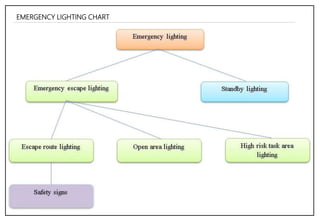
― Emergency Escape Lighting
― Standby Lighting
― Escape Route Lighting
― Open Area Lighting
― High Risk Task Area Lighting
― Spare lighting
― Photometric Design Of Escape Route And Open Area Lighting
― Types Of Emergency Lighting
― Illuminated Safety Signs
― Illumination Requirements
― Lighting Of Workstations With Increased Risk
― Emergency Escape Lighting Powered By Gas And Other Means (Not Electricity)
― Lighitng Condition For Stairs
― The Values Of The Evacuation Lighting Operating Intensity Acc. Standards En 1838
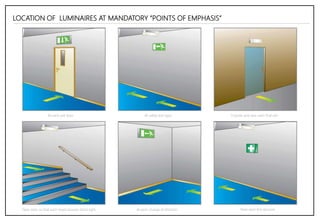
― Location Of Luminaires At Mandatory “Points Of Emphasis”
― Location Of Luminaires At Following Essential Areas In Buildings
― An Emergency Light Can Cater The Following Purposes
― Wiring Installation
― Servicing And Testing
― General Information About Emergency Light Testing
― Law On Emergency Lighitng
EMERGENCY LIGHTING CHART
― ESCAPE ROUTE :- A route designated for escape to a place of safety in the event of an emergency.
― EMERGENCY ESCAPE ROUTE LIGHTING :- That part of emergency escape lighting provided to ensure that the
means of escape can be effectively identified and safely used at all times when the premises are occupied.
― OPEN AREA (ANTI-PANIC) :- Areas of undefined escape routes in halls or premises larger than 60m2 floor area
or smaller areas if there is additional hazard such as use by a large number of people.
― EMERGENCY EXIT :- A way out that is used during an emergency
― FINAL EXIT :- The terminal point of an escape route.
― MAINTAINED EMERGENCY LUMINAIRE :- Luminaire in which the emergency lighting lamps are energized at all
times when normal lighting or emergency lighting is required
― NON-MAINTAINED EMERGENCY LUMINAIRE :- Luminaire in which the emergency lighting lamps are in
operation only when the mains supply to the normal lighting fails.
― HIGH-RISK TASK AREA LIGHTING :- That part of emergency escape lighting that provides illumination for the
safety of people involved in a potentially dangerous area, process or situation and to enable proper shut down
procedures for the safety of the operator and other occupants of the premises.
― RATED DURATION OF EMERGENCY OPERATION :- Time, in hours, as claimed by the manufacturer, that the
rated emergency lumen output is provided.
DEFINITIONS
INTRODUCTION TO EMERGENCY LIGHTING
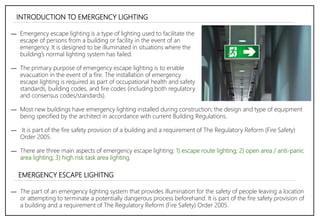
― Emergency escape lighting is a type of lighting used to facilitate the
escape of persons from a building or facility in the event of an
emergency. It is designed to be illuminated in situations where the
building’s normal lighting system has failed.
― The primary purpose of emergency escape lighting is to enable
evacuation in the event of a fire. The installation of emergency
escape lighting is required as part of occupational health and safety
standards, building codes, and fire codes (including both regulatory
and consensus codes/standards).
― Most new buildings have emergency lighting installed during construction; the design and type of equipment
being specified by the architect in accordance with current Building Regulations.
― It is part of the fire safety provision of a building and a requirement of The Regulatory Reform (Fire Safety)
Order 2005.
― There are three main aspects of emergency escape lighting: 1) escape route lighting; 2) open area / anti-panic
area lighting; 3) high risk task area lighting.
EMERGENCY ESCAPE LIGHITNG
― The part of an emergency lighting system that provides illumination for the safety of people leaving a location
or attempting to terminate a potentially dangerous process beforehand. It is part of the fire safety provision of
a building and a requirement of The Regulatory Reform (Fire Safety) Order 2005.
― the part of an emergency lighting system provided to enable normal activities
to continue substantially unchanged.
― This guide does not include standby lighting as it is not a legal requirement
and is a facility that may or may not be needed, depending on the use and
occupancy of the premises.
― Emergency escape lighting is itself sub-divided into: 1. escape route lighting
2. open area lighting 3. high risk task area lighting.
STANDBY LIGHTING
ESCAPE ROUTE LIGHTING
― Its purpose is to ensure safe leaving the place of stay, as well as to ensure visibility
and easy locating and use of fire equipment and safety equipment. Illumination of
escape routes should be designed so that the damage of even one light fitting does
not cause the road to become dark.
REQUIREMENTS
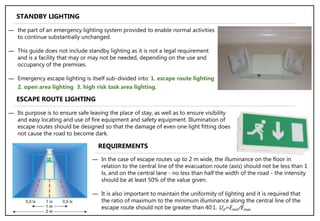
― In the case of escape routes up to 2 m wide, the illuminance on the floor in
relation to the central line of the evacuation route (axis) should not be less than 1
lx, and on the central lane - no less than half the width of the road - the intensity
should be at least 50% of the value given.
― It is also important to maintain the uniformity of lighting and it is required that
the ratio of maximum to the minimum illuminance along the central line of the
escape route should not be greater than 40:1. Ud=Emin/Emax.
OPEN AREA LIGHITNG/ANTI-PANIC LIGHTING
― The purpose of lighting the open zone is to reduce the likelihood of
panic, to facilitate the identification of evacuation directions and to
allow safe movement of people towards escape routes.
― This lighting is used in zones with unspecified evacuation routes in
halls or in facilities with a floor area of more than 60 m2 or smaller, if
there is an additional threat caused by the presence of a large
number of people.
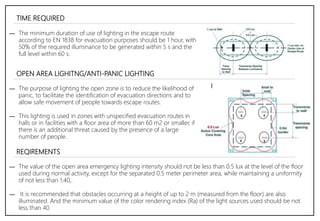
― The minimum duration of use of lighting in the escape route
according to EN 1838 for evacuation purposes should be 1 hour, with
50% of the required illuminance to be generated within 5 s and the
full level within 60 s.
TIME REQUIRED
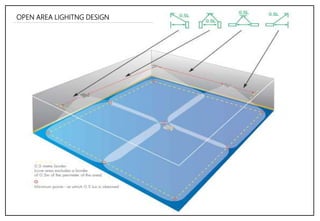
― The value of the open area emergency lighting intensity should not be less than 0.5 lux at the level of the floor
used during normal activity, except for the separated 0.5 meter perimeter area, while maintaining a uniformity
of not less than 1:40,.
― It is recommended that obstacles occurring at a height of up to 2 m (measured from the floor) are also
illuminated. And the minimum value of the color rendering index (Ra) of the light sources used should be not
less than 40.
REQIREMENTS
― Its purpose is to increase the safety of people who take part in a potentially dangerous process or are in a
potentially dangerous situation, as well as to allow proper completion of actions and moving people towards the
escape route. Workplaces with a particular threat could include works, works at heights, as well as work with
hazardous materials. Ud=Emin/Emedium.
― The minimum duration of lighting for evacuation should be 1 hour, whereas in the open area 50% of the required
lighting should be generated within 5 seconds and the full level within 60 seconds.
HIGH RISK TASK AREA LIGHTING
TIME REQUIRED
― In high-risk zones, the back-lighting intensity on the reference plane should not be less than 10% of the
operational illuminance required for the operations concerned, however, it should not be less than 15 lux. The
stroboscopic effect must be eliminated. The uniformity of illuminance in a high risk zone should not be greater
than 10:1.
REQUIREMNETS
― The minimum working time of high-risk zone lighting is the time when there is a risk to people in a given process.
It is determined individually by the employer. This lighting should provide 100% of the required illuminance after
0.5 seconds from commissioning.
TIME REQUIRED
SPARE LIGHTING
― Part of emergency lighting, enabling the continuation of normal activities. It can be used as an escape lighting,
but must meet all requirements as for emergency lighting in accordance with EN 1838. If the illumination is less
than the minimum level under basic lighting, then the lighting can be used only to complete the task or to
interrupt the work.
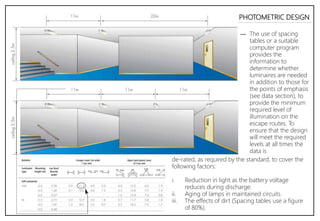
PHOTOMETRIC DESIGN
― The use of spacing
tables or a suitable
computer program
provides the
information to
determine whether
luminaires are needed
in addition to those for
the points of emphasis
(see data section), to
provide the minimum
required level of
illumination on the
escape routes. To
ensure that the design
will meet the required
levels at all times the
data is
de-rated, as required by the standard, to cover the
following factors:
i. Reduction in light as the battery voltage
reduces during discharge.
ii. Aging of lamps in maintained circuits.
iii. The effects of dirt (Spacing tables use a figure
of 80%).
OPEN AREA LIGHITNG DESIGN
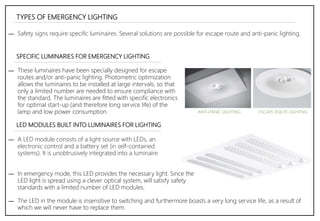
TYPES OF EMERGENCY LIGHTING
― Safety signs require specific luminaires. Several solutions are possible for escape route and anti-panic lighting.
SPECIFIC LUMINARIES FOR EMERGENCY LIGHTING
― These luminaires have been specially designed for escape
routes and/or anti-panic lighting. Photometric optimization
allows the luminaires to be installed at large intervals, so that
only a limited number are needed to ensure compliance with
the standard. The luminaires are fitted with specific electronics
for optimal start-up (and therefore long service life) of the
lamp and low power consumption. ANTI-PANIC LIGHTING ESCAPE ROUTE LIGHITNG
LED MODULES BUILT INTO LUMINAIRES FOR LIGHTING
― A LED module consists of a light source with LEDs, an
electronic control and a battery set (in self-contained
systems). It is unobtrusively integrated into a luminaire.
― In emergency mode, this LED provides the necessary light. Since the
LED light is spread using a clever optical system, will satisfy safety
standards with a limited number of LED modules.
― The LED in the module is insensitive to switching and furthermore boasts a very long service life, as a result of
which we will never have to replace them.
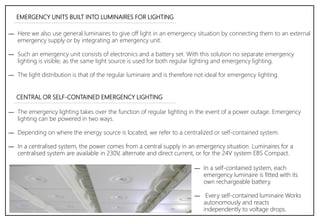
EMERGENCY UNITS BUILT INTO LUMINAIRES FOR LIGHTING
― Here we also use general luminaires to give off light in an emergency situation by connecting them to an external
emergency supply or by integrating an emergency unit.
― Such an emergency unit consists of electronics and a battery set. With this solution no separate emergency
lighting is visible, as the same light source is used for both regular lighting and emergency lighting.
― The light distribution is that of the regular luminaire and is therefore not ideal for emergency lighting.
CENTRAL OR SELF-CONTAINED EMERGENCY LIGHTING
― The emergency lighting takes over the function of regular lighting in the event of a power outage. Emergency
lighting can be powered in two ways.
― Depending on where the energy source is located, we refer to a centralized or self-contained system.
― In a centralised system, the power comes from a central supply in an emergency situation. Luminaires for a
centralised system are available in 230V, alternate and direct current, or for the 24V system EBS Compact.
― In a self-contained system, each
emergency luminaire is fitted with its
own rechargeable battery.
― Every self-contained luminaire Works
autonomously and reacts
independently to voltage drops.
AUTONOMY
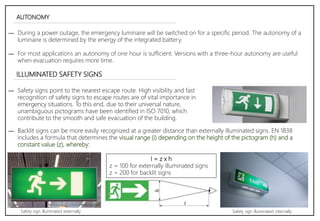
― During a power outage, the emergency luminaire will be switched on for a specific period. The autonomy of a
luminaire is determined by the energy of the integrated battery.
― For most applications an autonomy of one hour is sufficient. Versions with a three-hour autonomy are useful
when evacuation requires more time.
ILLUMINATED SAFETY SIGNS
― Safety signs point to the nearest escape route. High visibility and fast
recognition of safety signs to escape routes are of vital importance in
emergency situations. To this end, due to their universal nature,
unambiguous pictograms have been identified in ISO 7010, which
contribute to the smooth and safe evacuation of the building.
― Backlit signs can be more easily recognized at a greater distance than externally illuminated signs. EN 1838
includes a formula that determines the visual range (i) depending on the height of the pictogram (h) and a
constant value (z), whereby:
I = z x h
z = 100 for externally illuminated signs
z = 200 for backlit signs
Safety sign illuminated externally Safety sign illuminated internally
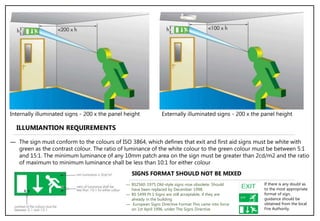
Internally illuminated signs - 200 x the panel height Externally illuminated signs - 200 x the panel height
ILLUMIANTION REQUIREMENTS
― The sign must conform to the colours of ISO 3864, which defines that exit and first aid signs must be white with
green as the contrast colour. The ratio of luminance of the white colour to the green colour must be between 5:1
and 15:1. The minimum luminance of any 10mm patch area on the sign must be greater than 2cd/m2 and the ratio
of maximum to minimum luminance shall be less than 10:1 for either colour
SIGNS FORMAT SHOULD NOT BE MIXED
― BS2560: 1975 Old-style signs now obsolete. Should
have been replaced by December 1998.
― BS 5499 Pt 1 Signs are still acceptable, if they are
already in the building
― European Signs Directive Format This came into force
on 1st April 1996, under The Signs Directive
If there is any doubt as
to the most appropriate
format of sign,
guidance should be
obtained from the local
Fire Authority.
LIGHTING OF WORKSTATIONS WITH INCREASED RISK
― The lighting of workstations with increased risk (10% of the normal required level,
never less than 15 lux) is aimed at ensuring safety in locations where a potentially
dangerous activity is carried out.
― Dangerous workstations include, for example places with high temperatures,
were harmful vapors are released, where moving equipment is stored or where
high-voltage is used.
― In buildings where emergency escape lighting is powered by gas or other means apart from electricity, the
existing system is not so different from one that is powered by electricity.
― These systems should still be maintained regularly and appropriately. In regards to repair, certain safety
measures should be taken such as emergency shut-off, knowing the location of combustible materials and
protection from draughts.
EMERGENCY ESCAPE LIGHTING POWERED BY GAS AND OTHER MEANS (NOT ELECTRICITY)
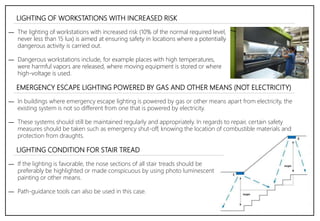
― If the lighting is favorable, the nose sections of all stair treads should be
preferably be highlighted or made conspicuous by using photo luminescent
painting or other means.
― Path-guidance tools can also be used in this case.
LIGHTING CONDITION FOR STAIR TREAD
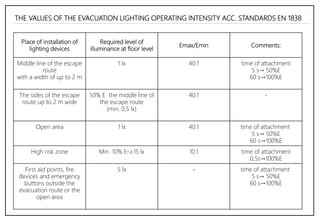
Place of installation of
lighting devices
Required level of
illuminance at floor level
Emax/Emin Comments:
Middle line of the escape
route
with a width of up to 2 m
1 lx 40:1 time of attachment
5 s→ 50%E
60 s→100%E
The sides of the escape
route up to 2 m wide
50% E the middle line of
the escape route
(min. 0,5 lx)
40:1 -
Open area 1 lx 40:1 time of attachment
5 s→ 50%E
60 s→100%E
High risk zone Min. 10% En≥15 lx 10:1 time of attachment
0,5s→100%E
First aid points, fire
devices and emergency
buttons outside the
evacuation route or the
open area
5 lx - time of attachment
5 s→ 50%E
60 s→100%E
THE VALUES OF THE EVACUATION LIGHTING OPERATING INTENSITY ACC. STANDARDS EN 1838
LOCATION OF LUMINAIRES AT MANDATORY “POINTS OF EMPHASIS”
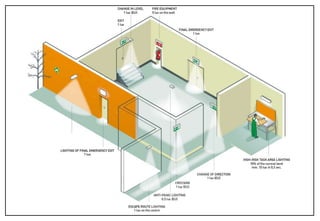
At each exit door All safety exit signs Outside and near each final exit
Near stairs so that each tread receives direct light Near each first aid post
At each change of direction
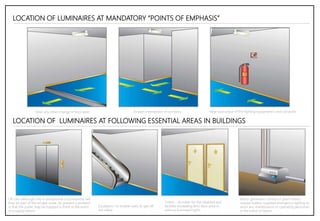
LOCATION OF LUMINAIRES AT MANDATORY “POINTS OF EMPHASIS”
LOCATION OF LUMINAIRES AT FOLLOWING ESSENTIAL AREAS IN BUILDINGS
Lift cars-although only in exceptional circumstances will
they be part of the escape route, do present a problem
in that the public may be trapped in them in the event
of a supply failure.
Escalators –to enable users to get off
the safely
Toilets - all toilets for the disabled and
facilities exceeding 8m2 floor area or
without borrowed lights.
Motor generator, control or plant rooms -
require battery supplied emergency lighting to
assist any maintenance or operating personnel
in the event of failure.
Near any other change of floor level At each intersection of corridors Near each piece of fire fighting equipment's and call point
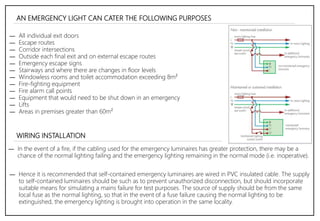
AN EMERGENCY LIGHT CAN CATER THE FOLLOWING PURPOSES
― All individual exit doors
― Escape routes
― Corridor intersections
― Outside each final exit and on external escape routes
― Emergency escape signs
― Stairways and where there are changes in floor levels
― Windowless rooms and toilet accommodation exceeding 8m²
― Fire-fighting equipment
― Fire alarm call points
― Equipment that would need to be shut down in an emergency
― Lifts
― Areas in premises greater than 60m²
― In the event of a fire, if the cabling used for the emergency luminaires has greater protection, there may be a
chance of the normal lighting failing and the emergency lighting remaining in the normal mode (i.e. inoperative).
WIRING INSTALLATION
― Hence it is recommended that self-contained emergency luminaires are wired in PVC insulated cable. The supply
to self-contained luminaires should be such as to prevent unauthorized disconnection, but should incorporate
suitable means for simulating a mains failure for test purposes. The source of supply should be from the same
local fuse as the normal lighting, so that in the event of a fuse failure causing the normal lighting to be
extinguished, the emergency lighting is brought into operation in the same locality.
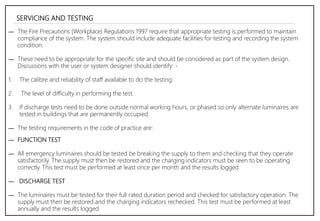
SERVICING AND TESTING
― The Fire Precautions (Workplace) Regulations 1997 require that appropriate testing is performed to maintain
compliance of the system. The system should include adequate facilities for testing and recording the system
condition.
― These need to be appropriate for the specific site and should be considered as part of the system design.
Discussions with the user or system designer should identify: -
1. The calibre and reliability of staff available to do the testing.
2. The level of difficulty in performing the test.
3. If discharge tests need to be done outside normal working hours, or phased so only alternate luminaires are
tested in buildings that are permanently occupied.
― The testing requirements in the code of practice are:
― FUNCTION TEST
― All emergency luminaires should be tested be breaking the supply to them and checking that they operate
satisfactorily. The supply must then be restored and the charging indicators must be seen to be operating
correctly. This test must be performed at least once per month and the results logged
― DISCHARGE TEST
― The luminaires must be tested for their full rated duration period and checked for satisfactory operation. The
supply must then be restored and the charging indicators rechecked. This test must be performed at least
annually and the results logged
― If manual testing is utilized, the following points should be considered: -
― Is a single switch to be used?
― Unless the whole building is to be switched off, a separate switch should be used for each final circuit. As the feed
to non-maintained circuits must be taken from the switch this will probably mean that the building will have to be
walked around twice, once to check the luminaires and once to check that they are recharging.
― Are luminaires to be individually switched?
― In practice, only a single walk around the building will be needed. However, the test switches could spoil the décor
of the building and they must be of a type that is tamper proof. After the tests, the performance of the luminaires
must be logged.
MANUAL TESTING
AUTOMATIC TEST SYSTEM
― If the costs of an engineer time and the disruption caused by manual testing are excessive, automatic systems
should be considered. Different formats are available to match particular site requirements. Cooper Lighting and
Security offer two alternative testing systems:
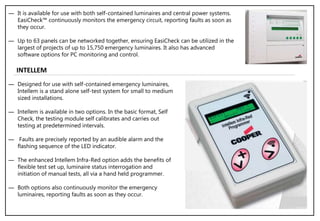
― EASICHECK™ Particularly suited to medium to large sized installations, EasiCheck™ is a versatile addressable
emergency lighting system that uses a central control panel to perform automatic test schedules, initiate manual
tests and download event logs and test reports.
― It is available for use with both self-contained luminaires and central power systems.
EasiCheck™ continuously monitors the emergency circuit, reporting faults as soon as
they occur.
― Up to 63 panels can be networked together, ensuring EasiCheck can be utilized in the
largest of projects of up to 15,750 emergency luminaires. It also has advanced
software options for PC monitoring and control.
INTELLEM
― Designed for use with self-contained emergency luminaires,
Intellem is a stand alone self-test system for small to medium
sized installations.
― Intellem is available in two options. In the basic format, Self
Check, the testing module self calibrates and carries out
testing at predetermined intervals.
― Faults are precisely reported by an audible alarm and the
flashing sequence of the LED indicator.
― The enhanced Intellem Infra-Red option adds the benefits of
flexible test set up, luminaire status interrogation and
initiation of manual tests, all via a hand held programmer.
― Both options also continuously monitor the emergency
luminaires, reporting faults as soon as they occur.
― BS EN 50172 / BS 5266-8 (Emergency escape lighting systems) specify the minimum provision and testing of
emergency lighting for different premises. Additional information on servicing can be found in BS 5266-1: (Code of
practice for the emergency lighting of premises).
― Discharge tests need to be undertaken outside normal working hours. In buildings that are permanently occupied,
the test should be phased so only alternate luminaires are tested.
― Regular servicing is essential. The occupier / owner of the premises shall appoint a competent person to supervise
servicing of the system. This person shall be given sufficient authority to ensure the carrying out of any work
necessary to maintain the system in correct operational mode.
― Because of the possibility of a failure of the normal lighting supply occurring shortly after a period of testing of the
emergency lighting system or during the subsequent recharge period, all full duration tests shall, wherever possible,
be undertaken just before a time of low risk to allow for battery recharge. Alternatively, suitable temporary
arrangements shall be made until the batteries have been recharged.
― The following minimum inspections and tests shall be carried out at the intervals recommended below. The
regulating authority may require specific tests.
GENERAL INFORMATION ABOUT EMERGENCY LIGHT TESTING
― This check only applies to emergency lighting systems with a central back-up battery system. In this case, there is a
daily visual inspection of indicators on the central power supply to identify that the system is operational. No test of
operation is required.
DAILY EMERGENCY LIGHTING INSPECTION (ONLY FOR CENTRAL BACK-UP SYSTEMS)
MONTHLY EMERGENCY LIGHTING TESTING
― All emergency lighting systems must be tested monthly. The test is a short functional test in accordance with BS
EN 50172 / BS 5266-8.
― The period of simulated failure should be sufficient for the purpose of this test while minimizing damage to the
system components, e.g. lamps. During this period, all luminaires and signs shall be checked to ensure that they
are present, clean and functioning correctly.
ANNUAL EMERGENCY LIGHTING TESTING
― A test for the full rated duration of the emergency lights (e.g. 3 hours) must be carried out. The emergency lights
must still be working at the end of this test.
― The result of the monthly and annual tests must be recorded and, if failures are detected, these must be
remedied as soon as possible. It is common for fire alarm servicing companies to carry out the annual
emergency light ‘drain’ test at the same time as they carry out fire alarm system maintenance, as this fills the
waiting time of the ‘drain’ test with useful activity.
WHAT IS THE LAW ON EMERGENCY ESCAPE LIGHTING
― The Regulatory Reform (Fire Safety) Order 2005 makes anyone in charge of commercial premises and the
common areas of a House in Multiple Occupation (HMO) responsible for the safety of everyone who works, visits
or lives in the building. This duty of care includes the provision of emergency lighting.
― The legal requirement is that non-domestic buildings must be safe at all times, including in the event that mains
power failure occurs. For this reason, almost all such buildings must have emergency lighting fitted.
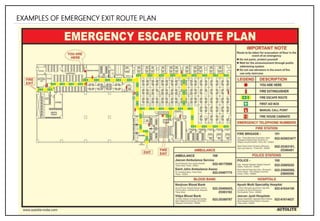
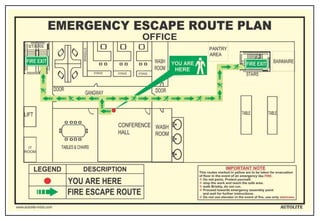
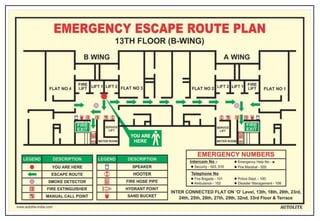
EXAMPLES OF EMERGENCY EXIT ROUTE PLAN
― Author :dorota kolakowska,adam Szczepanik
Emergency lighting (Accessed - 30TH DEC.2020.)
https://www.sonel.pl/en/knowledge-centre/press-articles/illuminance-measurements/measurement-
lighting-emergency-evacuation/
― Orlight -from source to site ,July 2013 Emergency light guide (Accessed-29th dec.2020)
https://www.orlight.com/resources/res/32/Orlight_guide_on_Emergency_Lighting_1.pdf
― Safeopedia,Emergency Escape Lighting ,August 26, 2019 (Accessed-27th dec.2020)
https://www.safeopedia.com/definition/7785/emergency-escape-lighting
― Fire safety advice centre ,11 nov 2019 (Accessed-30th dec.2020)
https://www.firesafe.org.uk/emergency-lighting/
― Emergency lighting design guide (Accessed-31st dec.2020)
https://hosting.iar.unicamp.br/lab/luz/ld/Seguran%E7a/emergency_lighting_design_guide.pdf
― ETAP LIGHTING SOLUTIONS,TYPES OF EMERGENCY LIGHTING(Accessed-30th dec.2020)
https://www.etaplighting.com/en/emergency-lighting
― Emergency Escape Lighting Introduction ,Small and Medium Places of Assembly(Accessed-30th dec.2020)
https://fire-risk-assessment-network.com/blog/emergency-escape-lighting/
― Autolite emergency lighting system (Accessed-2ndJan.2021)
https://autolite-india.com/emergency-escape-route-plan
REFERENCES
THANK YOU

Fire escape lighting control

  • 1.
    FIRE ESCAPE LIGHTINGCONTROL Presented By - Id. Hetvi Trada M.I.D, SMAID SMAID Charutar Vidhya Mandal University SHANTABEN MANUBHAI PATEL SCHOOL OF STUDIES & RESEARCH IN ARCHITECTURE AND INTERIOR DESIGN
  • 2.
    OUTLINE ― Emergency LightingChart ― Definitions ― Introduction To Emergency Lighting ― Emergency Escape Lighting ― Standby Lighting ― Escape Route Lighting ― Open Area Lighting ― High Risk Task Area Lighting ― Spare lighting ― Photometric Design Of Escape Route And Open Area Lighting ― Types Of Emergency Lighting ― Illuminated Safety Signs ― Illumination Requirements ― Lighting Of Workstations With Increased Risk ― Emergency Escape Lighting Powered By Gas And Other Means (Not Electricity) ― Lighitng Condition For Stairs ― The Values Of The Evacuation Lighting Operating Intensity Acc. Standards En 1838 ― Location Of Luminaires At Mandatory “Points Of Emphasis” ― Location Of Luminaires At Mandatory “Points Of Emphasis” ― Location Of Luminaires At Following Essential Areas In Buildings ― An Emergency Light Can Cater The Following Purposes ― Wiring Installation ― Servicing And Testing ― General Information About Emergency Light Testing ― Law On Emergency Lighitng
  • 3.
  • 5.
    ― ESCAPE ROUTE:- A route designated for escape to a place of safety in the event of an emergency. ― EMERGENCY ESCAPE ROUTE LIGHTING :- That part of emergency escape lighting provided to ensure that the means of escape can be effectively identified and safely used at all times when the premises are occupied. ― OPEN AREA (ANTI-PANIC) :- Areas of undefined escape routes in halls or premises larger than 60m2 floor area or smaller areas if there is additional hazard such as use by a large number of people. ― EMERGENCY EXIT :- A way out that is used during an emergency ― FINAL EXIT :- The terminal point of an escape route. ― MAINTAINED EMERGENCY LUMINAIRE :- Luminaire in which the emergency lighting lamps are energized at all times when normal lighting or emergency lighting is required ― NON-MAINTAINED EMERGENCY LUMINAIRE :- Luminaire in which the emergency lighting lamps are in operation only when the mains supply to the normal lighting fails. ― HIGH-RISK TASK AREA LIGHTING :- That part of emergency escape lighting that provides illumination for the safety of people involved in a potentially dangerous area, process or situation and to enable proper shut down procedures for the safety of the operator and other occupants of the premises. ― RATED DURATION OF EMERGENCY OPERATION :- Time, in hours, as claimed by the manufacturer, that the rated emergency lumen output is provided. DEFINITIONS
  • 6.
    INTRODUCTION TO EMERGENCYLIGHTING ― Emergency escape lighting is a type of lighting used to facilitate the escape of persons from a building or facility in the event of an emergency. It is designed to be illuminated in situations where the building’s normal lighting system has failed. ― The primary purpose of emergency escape lighting is to enable evacuation in the event of a fire. The installation of emergency escape lighting is required as part of occupational health and safety standards, building codes, and fire codes (including both regulatory and consensus codes/standards). ― Most new buildings have emergency lighting installed during construction; the design and type of equipment being specified by the architect in accordance with current Building Regulations. ― It is part of the fire safety provision of a building and a requirement of The Regulatory Reform (Fire Safety) Order 2005. ― There are three main aspects of emergency escape lighting: 1) escape route lighting; 2) open area / anti-panic area lighting; 3) high risk task area lighting. EMERGENCY ESCAPE LIGHITNG ― The part of an emergency lighting system that provides illumination for the safety of people leaving a location or attempting to terminate a potentially dangerous process beforehand. It is part of the fire safety provision of a building and a requirement of The Regulatory Reform (Fire Safety) Order 2005.
  • 7.
    ― the partof an emergency lighting system provided to enable normal activities to continue substantially unchanged. ― This guide does not include standby lighting as it is not a legal requirement and is a facility that may or may not be needed, depending on the use and occupancy of the premises. ― Emergency escape lighting is itself sub-divided into: 1. escape route lighting 2. open area lighting 3. high risk task area lighting. STANDBY LIGHTING ESCAPE ROUTE LIGHTING ― Its purpose is to ensure safe leaving the place of stay, as well as to ensure visibility and easy locating and use of fire equipment and safety equipment. Illumination of escape routes should be designed so that the damage of even one light fitting does not cause the road to become dark. REQUIREMENTS ― In the case of escape routes up to 2 m wide, the illuminance on the floor in relation to the central line of the evacuation route (axis) should not be less than 1 lx, and on the central lane - no less than half the width of the road - the intensity should be at least 50% of the value given. ― It is also important to maintain the uniformity of lighting and it is required that the ratio of maximum to the minimum illuminance along the central line of the escape route should not be greater than 40:1. Ud=Emin/Emax.
  • 8.
    OPEN AREA LIGHITNG/ANTI-PANICLIGHTING ― The purpose of lighting the open zone is to reduce the likelihood of panic, to facilitate the identification of evacuation directions and to allow safe movement of people towards escape routes. ― This lighting is used in zones with unspecified evacuation routes in halls or in facilities with a floor area of more than 60 m2 or smaller, if there is an additional threat caused by the presence of a large number of people. ― The minimum duration of use of lighting in the escape route according to EN 1838 for evacuation purposes should be 1 hour, with 50% of the required illuminance to be generated within 5 s and the full level within 60 s. TIME REQUIRED ― The value of the open area emergency lighting intensity should not be less than 0.5 lux at the level of the floor used during normal activity, except for the separated 0.5 meter perimeter area, while maintaining a uniformity of not less than 1:40,. ― It is recommended that obstacles occurring at a height of up to 2 m (measured from the floor) are also illuminated. And the minimum value of the color rendering index (Ra) of the light sources used should be not less than 40. REQIREMENTS
  • 9.
    ― Its purposeis to increase the safety of people who take part in a potentially dangerous process or are in a potentially dangerous situation, as well as to allow proper completion of actions and moving people towards the escape route. Workplaces with a particular threat could include works, works at heights, as well as work with hazardous materials. Ud=Emin/Emedium. ― The minimum duration of lighting for evacuation should be 1 hour, whereas in the open area 50% of the required lighting should be generated within 5 seconds and the full level within 60 seconds. HIGH RISK TASK AREA LIGHTING TIME REQUIRED ― In high-risk zones, the back-lighting intensity on the reference plane should not be less than 10% of the operational illuminance required for the operations concerned, however, it should not be less than 15 lux. The stroboscopic effect must be eliminated. The uniformity of illuminance in a high risk zone should not be greater than 10:1. REQUIREMNETS ― The minimum working time of high-risk zone lighting is the time when there is a risk to people in a given process. It is determined individually by the employer. This lighting should provide 100% of the required illuminance after 0.5 seconds from commissioning. TIME REQUIRED SPARE LIGHTING ― Part of emergency lighting, enabling the continuation of normal activities. It can be used as an escape lighting, but must meet all requirements as for emergency lighting in accordance with EN 1838. If the illumination is less than the minimum level under basic lighting, then the lighting can be used only to complete the task or to interrupt the work.
  • 10.
    PHOTOMETRIC DESIGN ― Theuse of spacing tables or a suitable computer program provides the information to determine whether luminaires are needed in addition to those for the points of emphasis (see data section), to provide the minimum required level of illumination on the escape routes. To ensure that the design will meet the required levels at all times the data is de-rated, as required by the standard, to cover the following factors: i. Reduction in light as the battery voltage reduces during discharge. ii. Aging of lamps in maintained circuits. iii. The effects of dirt (Spacing tables use a figure of 80%).
  • 11.
  • 12.
    TYPES OF EMERGENCYLIGHTING ― Safety signs require specific luminaires. Several solutions are possible for escape route and anti-panic lighting. SPECIFIC LUMINARIES FOR EMERGENCY LIGHTING ― These luminaires have been specially designed for escape routes and/or anti-panic lighting. Photometric optimization allows the luminaires to be installed at large intervals, so that only a limited number are needed to ensure compliance with the standard. The luminaires are fitted with specific electronics for optimal start-up (and therefore long service life) of the lamp and low power consumption. ANTI-PANIC LIGHTING ESCAPE ROUTE LIGHITNG LED MODULES BUILT INTO LUMINAIRES FOR LIGHTING ― A LED module consists of a light source with LEDs, an electronic control and a battery set (in self-contained systems). It is unobtrusively integrated into a luminaire. ― In emergency mode, this LED provides the necessary light. Since the LED light is spread using a clever optical system, will satisfy safety standards with a limited number of LED modules. ― The LED in the module is insensitive to switching and furthermore boasts a very long service life, as a result of which we will never have to replace them.
  • 13.
    EMERGENCY UNITS BUILTINTO LUMINAIRES FOR LIGHTING ― Here we also use general luminaires to give off light in an emergency situation by connecting them to an external emergency supply or by integrating an emergency unit. ― Such an emergency unit consists of electronics and a battery set. With this solution no separate emergency lighting is visible, as the same light source is used for both regular lighting and emergency lighting. ― The light distribution is that of the regular luminaire and is therefore not ideal for emergency lighting. CENTRAL OR SELF-CONTAINED EMERGENCY LIGHTING ― The emergency lighting takes over the function of regular lighting in the event of a power outage. Emergency lighting can be powered in two ways. ― Depending on where the energy source is located, we refer to a centralized or self-contained system. ― In a centralised system, the power comes from a central supply in an emergency situation. Luminaires for a centralised system are available in 230V, alternate and direct current, or for the 24V system EBS Compact. ― In a self-contained system, each emergency luminaire is fitted with its own rechargeable battery. ― Every self-contained luminaire Works autonomously and reacts independently to voltage drops.
  • 14.
    AUTONOMY ― During apower outage, the emergency luminaire will be switched on for a specific period. The autonomy of a luminaire is determined by the energy of the integrated battery. ― For most applications an autonomy of one hour is sufficient. Versions with a three-hour autonomy are useful when evacuation requires more time. ILLUMINATED SAFETY SIGNS ― Safety signs point to the nearest escape route. High visibility and fast recognition of safety signs to escape routes are of vital importance in emergency situations. To this end, due to their universal nature, unambiguous pictograms have been identified in ISO 7010, which contribute to the smooth and safe evacuation of the building. ― Backlit signs can be more easily recognized at a greater distance than externally illuminated signs. EN 1838 includes a formula that determines the visual range (i) depending on the height of the pictogram (h) and a constant value (z), whereby: I = z x h z = 100 for externally illuminated signs z = 200 for backlit signs Safety sign illuminated externally Safety sign illuminated internally
  • 15.
    Internally illuminated signs- 200 x the panel height Externally illuminated signs - 200 x the panel height ILLUMIANTION REQUIREMENTS ― The sign must conform to the colours of ISO 3864, which defines that exit and first aid signs must be white with green as the contrast colour. The ratio of luminance of the white colour to the green colour must be between 5:1 and 15:1. The minimum luminance of any 10mm patch area on the sign must be greater than 2cd/m2 and the ratio of maximum to minimum luminance shall be less than 10:1 for either colour SIGNS FORMAT SHOULD NOT BE MIXED ― BS2560: 1975 Old-style signs now obsolete. Should have been replaced by December 1998. ― BS 5499 Pt 1 Signs are still acceptable, if they are already in the building ― European Signs Directive Format This came into force on 1st April 1996, under The Signs Directive If there is any doubt as to the most appropriate format of sign, guidance should be obtained from the local Fire Authority.
  • 16.
    LIGHTING OF WORKSTATIONSWITH INCREASED RISK ― The lighting of workstations with increased risk (10% of the normal required level, never less than 15 lux) is aimed at ensuring safety in locations where a potentially dangerous activity is carried out. ― Dangerous workstations include, for example places with high temperatures, were harmful vapors are released, where moving equipment is stored or where high-voltage is used. ― In buildings where emergency escape lighting is powered by gas or other means apart from electricity, the existing system is not so different from one that is powered by electricity. ― These systems should still be maintained regularly and appropriately. In regards to repair, certain safety measures should be taken such as emergency shut-off, knowing the location of combustible materials and protection from draughts. EMERGENCY ESCAPE LIGHTING POWERED BY GAS AND OTHER MEANS (NOT ELECTRICITY) ― If the lighting is favorable, the nose sections of all stair treads should be preferably be highlighted or made conspicuous by using photo luminescent painting or other means. ― Path-guidance tools can also be used in this case. LIGHTING CONDITION FOR STAIR TREAD
  • 17.
    Place of installationof lighting devices Required level of illuminance at floor level Emax/Emin Comments: Middle line of the escape route with a width of up to 2 m 1 lx 40:1 time of attachment 5 s→ 50%E 60 s→100%E The sides of the escape route up to 2 m wide 50% E the middle line of the escape route (min. 0,5 lx) 40:1 - Open area 1 lx 40:1 time of attachment 5 s→ 50%E 60 s→100%E High risk zone Min. 10% En≥15 lx 10:1 time of attachment 0,5s→100%E First aid points, fire devices and emergency buttons outside the evacuation route or the open area 5 lx - time of attachment 5 s→ 50%E 60 s→100%E THE VALUES OF THE EVACUATION LIGHTING OPERATING INTENSITY ACC. STANDARDS EN 1838
  • 18.
    LOCATION OF LUMINAIRESAT MANDATORY “POINTS OF EMPHASIS” At each exit door All safety exit signs Outside and near each final exit Near stairs so that each tread receives direct light Near each first aid post At each change of direction
  • 19.
    LOCATION OF LUMINAIRESAT MANDATORY “POINTS OF EMPHASIS” LOCATION OF LUMINAIRES AT FOLLOWING ESSENTIAL AREAS IN BUILDINGS Lift cars-although only in exceptional circumstances will they be part of the escape route, do present a problem in that the public may be trapped in them in the event of a supply failure. Escalators –to enable users to get off the safely Toilets - all toilets for the disabled and facilities exceeding 8m2 floor area or without borrowed lights. Motor generator, control or plant rooms - require battery supplied emergency lighting to assist any maintenance or operating personnel in the event of failure. Near any other change of floor level At each intersection of corridors Near each piece of fire fighting equipment's and call point
  • 20.
    AN EMERGENCY LIGHTCAN CATER THE FOLLOWING PURPOSES ― All individual exit doors ― Escape routes ― Corridor intersections ― Outside each final exit and on external escape routes ― Emergency escape signs ― Stairways and where there are changes in floor levels ― Windowless rooms and toilet accommodation exceeding 8m² ― Fire-fighting equipment ― Fire alarm call points ― Equipment that would need to be shut down in an emergency ― Lifts ― Areas in premises greater than 60m² ― In the event of a fire, if the cabling used for the emergency luminaires has greater protection, there may be a chance of the normal lighting failing and the emergency lighting remaining in the normal mode (i.e. inoperative). WIRING INSTALLATION ― Hence it is recommended that self-contained emergency luminaires are wired in PVC insulated cable. The supply to self-contained luminaires should be such as to prevent unauthorized disconnection, but should incorporate suitable means for simulating a mains failure for test purposes. The source of supply should be from the same local fuse as the normal lighting, so that in the event of a fuse failure causing the normal lighting to be extinguished, the emergency lighting is brought into operation in the same locality.
  • 21.
    SERVICING AND TESTING ―The Fire Precautions (Workplace) Regulations 1997 require that appropriate testing is performed to maintain compliance of the system. The system should include adequate facilities for testing and recording the system condition. ― These need to be appropriate for the specific site and should be considered as part of the system design. Discussions with the user or system designer should identify: - 1. The calibre and reliability of staff available to do the testing. 2. The level of difficulty in performing the test. 3. If discharge tests need to be done outside normal working hours, or phased so only alternate luminaires are tested in buildings that are permanently occupied. ― The testing requirements in the code of practice are: ― FUNCTION TEST ― All emergency luminaires should be tested be breaking the supply to them and checking that they operate satisfactorily. The supply must then be restored and the charging indicators must be seen to be operating correctly. This test must be performed at least once per month and the results logged ― DISCHARGE TEST ― The luminaires must be tested for their full rated duration period and checked for satisfactory operation. The supply must then be restored and the charging indicators rechecked. This test must be performed at least annually and the results logged
  • 22.
    ― If manualtesting is utilized, the following points should be considered: - ― Is a single switch to be used? ― Unless the whole building is to be switched off, a separate switch should be used for each final circuit. As the feed to non-maintained circuits must be taken from the switch this will probably mean that the building will have to be walked around twice, once to check the luminaires and once to check that they are recharging. ― Are luminaires to be individually switched? ― In practice, only a single walk around the building will be needed. However, the test switches could spoil the décor of the building and they must be of a type that is tamper proof. After the tests, the performance of the luminaires must be logged. MANUAL TESTING AUTOMATIC TEST SYSTEM ― If the costs of an engineer time and the disruption caused by manual testing are excessive, automatic systems should be considered. Different formats are available to match particular site requirements. Cooper Lighting and Security offer two alternative testing systems: ― EASICHECK™ Particularly suited to medium to large sized installations, EasiCheck™ is a versatile addressable emergency lighting system that uses a central control panel to perform automatic test schedules, initiate manual tests and download event logs and test reports.
  • 23.
    ― It isavailable for use with both self-contained luminaires and central power systems. EasiCheck™ continuously monitors the emergency circuit, reporting faults as soon as they occur. ― Up to 63 panels can be networked together, ensuring EasiCheck can be utilized in the largest of projects of up to 15,750 emergency luminaires. It also has advanced software options for PC monitoring and control. INTELLEM ― Designed for use with self-contained emergency luminaires, Intellem is a stand alone self-test system for small to medium sized installations. ― Intellem is available in two options. In the basic format, Self Check, the testing module self calibrates and carries out testing at predetermined intervals. ― Faults are precisely reported by an audible alarm and the flashing sequence of the LED indicator. ― The enhanced Intellem Infra-Red option adds the benefits of flexible test set up, luminaire status interrogation and initiation of manual tests, all via a hand held programmer. ― Both options also continuously monitor the emergency luminaires, reporting faults as soon as they occur.
  • 24.
    ― BS EN50172 / BS 5266-8 (Emergency escape lighting systems) specify the minimum provision and testing of emergency lighting for different premises. Additional information on servicing can be found in BS 5266-1: (Code of practice for the emergency lighting of premises). ― Discharge tests need to be undertaken outside normal working hours. In buildings that are permanently occupied, the test should be phased so only alternate luminaires are tested. ― Regular servicing is essential. The occupier / owner of the premises shall appoint a competent person to supervise servicing of the system. This person shall be given sufficient authority to ensure the carrying out of any work necessary to maintain the system in correct operational mode. ― Because of the possibility of a failure of the normal lighting supply occurring shortly after a period of testing of the emergency lighting system or during the subsequent recharge period, all full duration tests shall, wherever possible, be undertaken just before a time of low risk to allow for battery recharge. Alternatively, suitable temporary arrangements shall be made until the batteries have been recharged. ― The following minimum inspections and tests shall be carried out at the intervals recommended below. The regulating authority may require specific tests. GENERAL INFORMATION ABOUT EMERGENCY LIGHT TESTING ― This check only applies to emergency lighting systems with a central back-up battery system. In this case, there is a daily visual inspection of indicators on the central power supply to identify that the system is operational. No test of operation is required. DAILY EMERGENCY LIGHTING INSPECTION (ONLY FOR CENTRAL BACK-UP SYSTEMS)
  • 25.
    MONTHLY EMERGENCY LIGHTINGTESTING ― All emergency lighting systems must be tested monthly. The test is a short functional test in accordance with BS EN 50172 / BS 5266-8. ― The period of simulated failure should be sufficient for the purpose of this test while minimizing damage to the system components, e.g. lamps. During this period, all luminaires and signs shall be checked to ensure that they are present, clean and functioning correctly. ANNUAL EMERGENCY LIGHTING TESTING ― A test for the full rated duration of the emergency lights (e.g. 3 hours) must be carried out. The emergency lights must still be working at the end of this test. ― The result of the monthly and annual tests must be recorded and, if failures are detected, these must be remedied as soon as possible. It is common for fire alarm servicing companies to carry out the annual emergency light ‘drain’ test at the same time as they carry out fire alarm system maintenance, as this fills the waiting time of the ‘drain’ test with useful activity. WHAT IS THE LAW ON EMERGENCY ESCAPE LIGHTING ― The Regulatory Reform (Fire Safety) Order 2005 makes anyone in charge of commercial premises and the common areas of a House in Multiple Occupation (HMO) responsible for the safety of everyone who works, visits or lives in the building. This duty of care includes the provision of emergency lighting. ― The legal requirement is that non-domestic buildings must be safe at all times, including in the event that mains power failure occurs. For this reason, almost all such buildings must have emergency lighting fitted.
  • 26.
    EXAMPLES OF EMERGENCYEXIT ROUTE PLAN
  • 29.
    ― Author :dorotakolakowska,adam Szczepanik Emergency lighting (Accessed - 30TH DEC.2020.) https://www.sonel.pl/en/knowledge-centre/press-articles/illuminance-measurements/measurement- lighting-emergency-evacuation/ ― Orlight -from source to site ,July 2013 Emergency light guide (Accessed-29th dec.2020) https://www.orlight.com/resources/res/32/Orlight_guide_on_Emergency_Lighting_1.pdf ― Safeopedia,Emergency Escape Lighting ,August 26, 2019 (Accessed-27th dec.2020) https://www.safeopedia.com/definition/7785/emergency-escape-lighting ― Fire safety advice centre ,11 nov 2019 (Accessed-30th dec.2020) https://www.firesafe.org.uk/emergency-lighting/ ― Emergency lighting design guide (Accessed-31st dec.2020) https://hosting.iar.unicamp.br/lab/luz/ld/Seguran%E7a/emergency_lighting_design_guide.pdf ― ETAP LIGHTING SOLUTIONS,TYPES OF EMERGENCY LIGHTING(Accessed-30th dec.2020) https://www.etaplighting.com/en/emergency-lighting ― Emergency Escape Lighting Introduction ,Small and Medium Places of Assembly(Accessed-30th dec.2020) https://fire-risk-assessment-network.com/blog/emergency-escape-lighting/ ― Autolite emergency lighting system (Accessed-2ndJan.2021) https://autolite-india.com/emergency-escape-route-plan REFERENCES
  • 30.