FINGER PRINT RECOGANIZTION IN
BLOCKCHAIN
RECORD AUTHENTICATION
Presented by
• Avanthika S - 210919205009
• Karthik V - 210920205019
• Kishore I - 210920205021
• Vasanth K - 201920205055
• Loyola institute of technology
ABSTRACT
Biometrics, with its uniqueness to every individual, has been adapted as a security authentication
feature by many institutions. These biometric data are processed into templates that are saved on
databases, and a central authority centralizes and controls these databases. This form of storing
biometric data, or in our case fingerprint template, is asymmetric and prone to three main security
attacks, such as fake template input, template modification or deletion, and channel interception by a
malicious attacker.
Keywords:
blockchain;
IPFS;
fingerprint
hashing;
decentralization;
biometrics;
encryption
CONTENT
• Introduction
• Literature survey
• Example literature
• Exitsting system
• Disadvantages
• Architectural diagram
• proposed system
• Advantages
• Modules
• System recruitment
OBJECTIVE
To provide safe and convenient identification and authentication with a human touch.By
utilizing the unique properties of biometrics, Fingerprints’ solutions create an easier and more
secure life. The value contribution is based on a sensitivity to the need of the market,
employees with expertise, financial capital and good relations.
INTRODUCTION
• Biometric is the science of technology of measuring and analysing biological
data
• Biometrics are automated methods Roncognition person based on
physiological behave wear behaviour characteristics.
• As the level of security decrease And transition fraud increases, the need for
highly b identification and personal verification Technologies more
• Biometric Based solutions or able to provide for confidential transaction
for data privacy
LITERATURE SURVEY
• Those quality metrics can be simply summarised in several points: quality metrics
based on the orientation of fingerprint pattern; algorithms that rely on the variation of
Gabor responses; approaches in frequency domain; measurements based on pixel
information and quality indexes rely on classification with multi-feature. In addition, that
study also analysed quality metrics mainly in terms of the linearity between them.
EXAMPLE LITERATURE
• In this study, we classify the existing studies into several frameworks in terms
of their implementation to show the difference and some potential problems
that need to be considered. As mentioned above, the quality metrics that had
been proposed so far are all dependent on one or several features. According
to how they are carried out, this study categorises them as: (i) segmentation-
based approaches; (ii) a single feature-based quality index; and (iii) solutions
rely on a combination of multi-features or indexes, which is further divided
into methods based on linear fusion and classification
EXITING SYSTEM
• Banking solutions and the payment technologies available today use a wide
range of biometric modalities: fingerprints, iris, voice, face, fingerprint, palm
veins, behavior, and other types of biometric recognition are all used alone or
combined in a multifactorial manner as a system, to lock accounts and serve
against .
DISADVANTAGES
• Costs – Significant investment needed in biometrics for security.
• Data breaches – Biometric databases can still be hacked.
• Tracking and data – Biometric devices like facial recognition systems can limit
privacy for users.
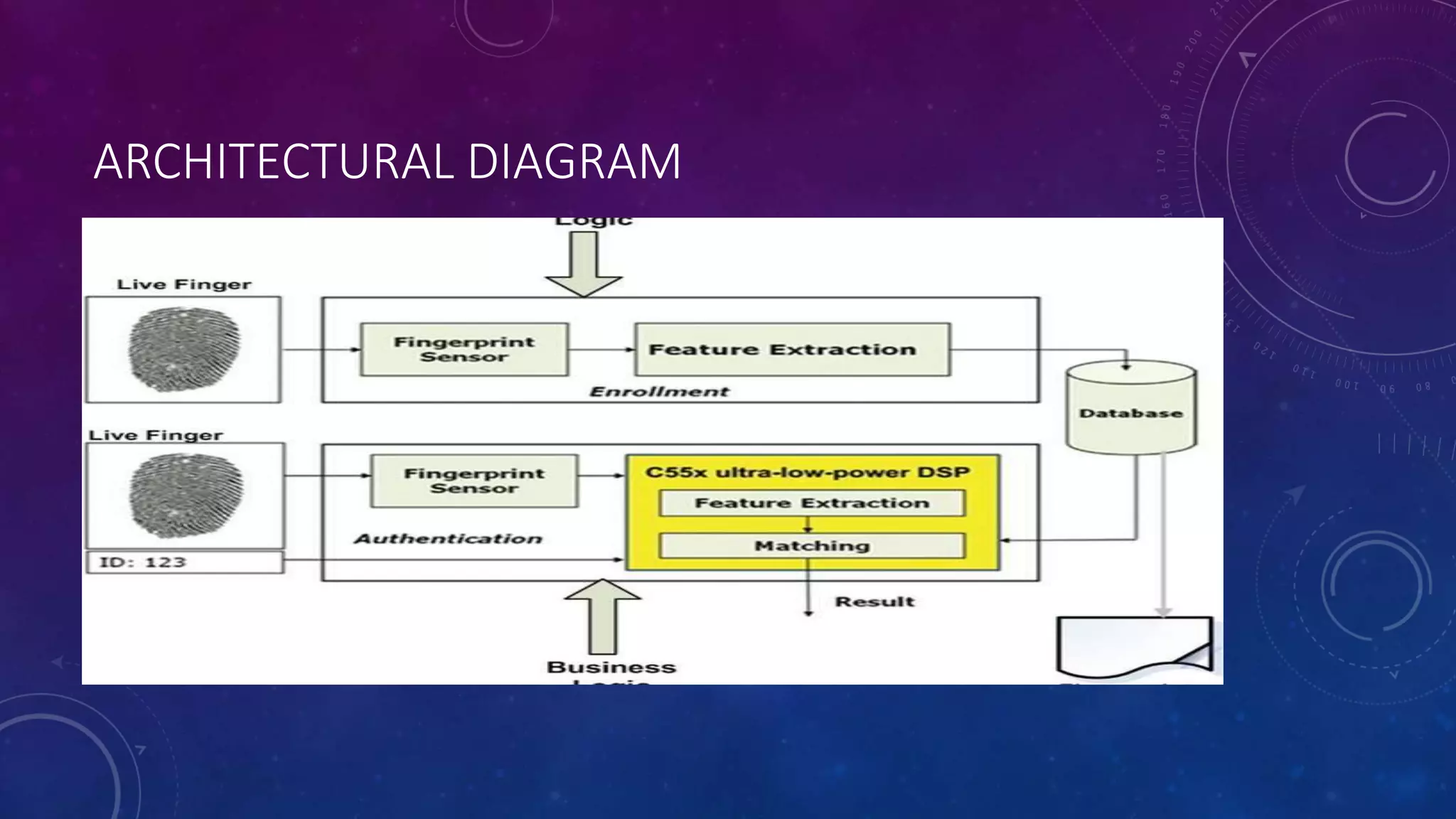
ARCHITECTURAL DIAGRAM
PROPOSED SYSTEM
• Biometric data also need to be secured as any breach the biometric data can
result in rendering it permanently damaged and unusable . This is because the
moment a stored biometric data is compromised it is rendered insecure for
authentication purposes for the entire life of the user
ADVANTAGES
• High security and assurance – Biometric identification provides the answers to
“something a person has and is” and helps verify identity.
• User Experience – Convenient and fast.
• Non-transferrable – Everyone has access to a unique set of biometrics.
MODULES
• There are two types of fingerprint sensor module: optical and capacitive
• A fingerprint is an impression of the pattern of ridges on the last joint of a person’s
finger. Properties that make a fingerprint useful for identification are.
• (1) its unique, characteristic ridges;
• (2) its consistency over a person’s lifetime;
• The systematic classification used for fingerprints.
SYSTEM RECRUITMENT
• Fingerprint recognition systems work by examining a finger pressed
against a smooth surface. The finger’s ridges and valleys are scanned, and
a series of distinct points, where ridges and valleys end or meet, are called
minutiae. These minutiae are the points the fingerprint recognition
system uses for comparison.
REFERENCE
• W. Badler, “Dermatoglyphics: Sciencetransition, vol9, pp95, 1991.
• M. Kuchen, C. Newell, “A Model for fingerprint formation, “Europhysletters, vol.68, No.1,
pp.141-447, 2004.
• L. Hong, Y. Wang, A. K. Jain, Fingerprint image enhancement: Algorithm and performance
evaluation, Transactionson vol. PAMI21 No.4, pp.777-789, 1998
• S. Greenberg, M. Aladjem, D. Kogan, I. Dimitrov, Fingerprint image enhancement using
filtering techniques, in: International Conference on Pattern Recognition, Vol.3, pp.326-329,
2000.
• L.O’Gormann, J.V. Nickerson, Anapproachto fingerprint filter design, Pattern Recognition 22
No. 1, pp.29-38, 1989.

Presentation-1.pptx

  • 1.
    FINGER PRINT RECOGANIZTIONIN BLOCKCHAIN RECORD AUTHENTICATION Presented by • Avanthika S - 210919205009 • Karthik V - 210920205019 • Kishore I - 210920205021 • Vasanth K - 201920205055 • Loyola institute of technology
  • 2.
    ABSTRACT Biometrics, with itsuniqueness to every individual, has been adapted as a security authentication feature by many institutions. These biometric data are processed into templates that are saved on databases, and a central authority centralizes and controls these databases. This form of storing biometric data, or in our case fingerprint template, is asymmetric and prone to three main security attacks, such as fake template input, template modification or deletion, and channel interception by a malicious attacker. Keywords: blockchain; IPFS; fingerprint hashing; decentralization; biometrics; encryption
  • 3.
    CONTENT • Introduction • Literaturesurvey • Example literature • Exitsting system • Disadvantages • Architectural diagram • proposed system • Advantages • Modules • System recruitment
  • 4.
    OBJECTIVE To provide safeand convenient identification and authentication with a human touch.By utilizing the unique properties of biometrics, Fingerprints’ solutions create an easier and more secure life. The value contribution is based on a sensitivity to the need of the market, employees with expertise, financial capital and good relations.
  • 5.
    INTRODUCTION • Biometric isthe science of technology of measuring and analysing biological data • Biometrics are automated methods Roncognition person based on physiological behave wear behaviour characteristics. • As the level of security decrease And transition fraud increases, the need for highly b identification and personal verification Technologies more • Biometric Based solutions or able to provide for confidential transaction for data privacy
  • 6.
    LITERATURE SURVEY • Thosequality metrics can be simply summarised in several points: quality metrics based on the orientation of fingerprint pattern; algorithms that rely on the variation of Gabor responses; approaches in frequency domain; measurements based on pixel information and quality indexes rely on classification with multi-feature. In addition, that study also analysed quality metrics mainly in terms of the linearity between them.
  • 7.
    EXAMPLE LITERATURE • Inthis study, we classify the existing studies into several frameworks in terms of their implementation to show the difference and some potential problems that need to be considered. As mentioned above, the quality metrics that had been proposed so far are all dependent on one or several features. According to how they are carried out, this study categorises them as: (i) segmentation- based approaches; (ii) a single feature-based quality index; and (iii) solutions rely on a combination of multi-features or indexes, which is further divided into methods based on linear fusion and classification
  • 8.
    EXITING SYSTEM • Bankingsolutions and the payment technologies available today use a wide range of biometric modalities: fingerprints, iris, voice, face, fingerprint, palm veins, behavior, and other types of biometric recognition are all used alone or combined in a multifactorial manner as a system, to lock accounts and serve against .
  • 9.
    DISADVANTAGES • Costs –Significant investment needed in biometrics for security. • Data breaches – Biometric databases can still be hacked. • Tracking and data – Biometric devices like facial recognition systems can limit privacy for users.
  • 10.
  • 11.
    PROPOSED SYSTEM • Biometricdata also need to be secured as any breach the biometric data can result in rendering it permanently damaged and unusable . This is because the moment a stored biometric data is compromised it is rendered insecure for authentication purposes for the entire life of the user
  • 12.
    ADVANTAGES • High securityand assurance – Biometric identification provides the answers to “something a person has and is” and helps verify identity. • User Experience – Convenient and fast. • Non-transferrable – Everyone has access to a unique set of biometrics.
  • 13.
    MODULES • There aretwo types of fingerprint sensor module: optical and capacitive • A fingerprint is an impression of the pattern of ridges on the last joint of a person’s finger. Properties that make a fingerprint useful for identification are. • (1) its unique, characteristic ridges; • (2) its consistency over a person’s lifetime; • The systematic classification used for fingerprints.
  • 14.
    SYSTEM RECRUITMENT • Fingerprintrecognition systems work by examining a finger pressed against a smooth surface. The finger’s ridges and valleys are scanned, and a series of distinct points, where ridges and valleys end or meet, are called minutiae. These minutiae are the points the fingerprint recognition system uses for comparison.
  • 15.
    REFERENCE • W. Badler,“Dermatoglyphics: Sciencetransition, vol9, pp95, 1991. • M. Kuchen, C. Newell, “A Model for fingerprint formation, “Europhysletters, vol.68, No.1, pp.141-447, 2004. • L. Hong, Y. Wang, A. K. Jain, Fingerprint image enhancement: Algorithm and performance evaluation, Transactionson vol. PAMI21 No.4, pp.777-789, 1998 • S. Greenberg, M. Aladjem, D. Kogan, I. Dimitrov, Fingerprint image enhancement using filtering techniques, in: International Conference on Pattern Recognition, Vol.3, pp.326-329, 2000. • L.O’Gormann, J.V. Nickerson, Anapproachto fingerprint filter design, Pattern Recognition 22 No. 1, pp.29-38, 1989.