Finding the General Term
of a Linear Sequence
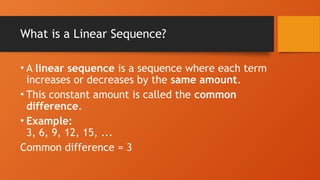
What is a Linear Sequence?
• A linear sequence is a sequence where each term
increases or decreases by the same amount.
• This constant amount is called the common
difference.
• Example:
3, 6, 9, 12, 15, ...
Common difference = 3
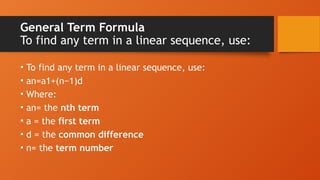
General Term Formula
To find any term in a linear sequence, use:
• To find any term in a linear sequence, use:
• an=a1+(n−1)d
• Where:
• an= the nth term
• a = the first term
• d = the common difference
• n= the term number
Step-by-Step Example
• Sequence: 5, 8, 11, 14, ...
• First term a=5
• Common difference d=3
• Formula: an=a1+(n−1)d
• an=5+(n−1)3
• Simplify:
• an=5+3n−3=3n+2
• So, the general term is:
• an=3n+2
Why Find the General Term?
• Helps you find any term in the sequence without
listing all terms
• Useful in real-life situations like budgeting,
schedules, and planning
Practice Question 1
• Sequence: 2, 7, 12, 17, ...
• First term a=2
• Common difference d=5
• Find the general term
• Answer:
• an=2+(n−1)×5=5n−3
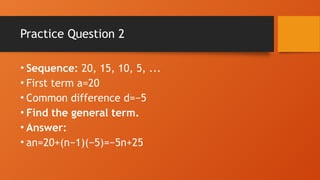
Practice Question 2
• Sequence: 20, 15, 10, 5, ...
• First term a=20
• Common difference d=−5
• Find the general term.
• Answer:
• an=20+(n−1)(−5)=−5n+25
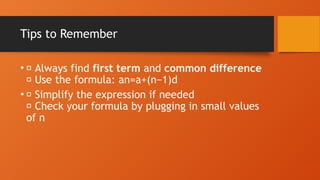
Tips to Remember
• ✅ Always find first term and common difference
✅ Use the formula: an=a+(n−1)d
• ✅ Simplify the expression if needed
✅ Check your formula by plugging in small values
of n
Summary
•The general term lets you find any term in a linear
sequence
•It's written as:
an=a+(n−1)d
•Practice helps build speed and accuracy!


Finding the General Term of a Linear Sequence.pptx

  • 1.
    Finding the GeneralTerm of a Linear Sequence
  • 2.
    What is aLinear Sequence? • A linear sequence is a sequence where each term increases or decreases by the same amount. • This constant amount is called the common difference. • Example: 3, 6, 9, 12, 15, ... Common difference = 3
  • 3.
    General Term Formula Tofind any term in a linear sequence, use: • To find any term in a linear sequence, use: • an=a1+(n−1)d • Where: • an= the nth term • a = the first term • d = the common difference • n= the term number
  • 4.
    Step-by-Step Example • Sequence:5, 8, 11, 14, ... • First term a=5 • Common difference d=3 • Formula: an=a1+(n−1)d • an=5+(n−1)3 • Simplify: • an=5+3n−3=3n+2 • So, the general term is: • an=3n+2
  • 5.
    Why Find theGeneral Term? • Helps you find any term in the sequence without listing all terms • Useful in real-life situations like budgeting, schedules, and planning
  • 6.
    Practice Question 1 •Sequence: 2, 7, 12, 17, ... • First term a=2 • Common difference d=5 • Find the general term • Answer: • an=2+(n−1)×5=5n−3
  • 7.
    Practice Question 2 •Sequence: 20, 15, 10, 5, ... • First term a=20 • Common difference d=−5 • Find the general term. • Answer: • an=20+(n−1)(−5)=−5n+25
  • 8.
    Tips to Remember •✅ Always find first term and common difference ✅ Use the formula: an=a+(n−1)d • ✅ Simplify the expression if needed ✅ Check your formula by plugging in small values of n
  • 9.
    Summary •The general termlets you find any term in a linear sequence •It's written as: an=a+(n−1)d •Practice helps build speed and accuracy!