ARITHMETIC
SEQUENCESequence
A Sequence is a set of things (usually numbers) that are in 
order.
Each number in the sequence is called a term (or sometimes 
"element" or "member"), read Sequences and Series for more 
details.
Arithmetic Sequence
In an Arithmetic Sequence the difference between one term 
and the next is a constant.
In other words, we just add the same value each time ... 
infinitely.
✩Arithmetic sequences and series
✩An arithmetic sequence is a sequence of numbers such that the difference of any two successive members of
the sequence is a constant.
✩Example
✩2,4,6,8,10….is an arithmetic sequence with the common difference 2.
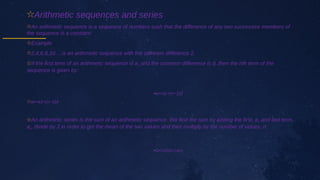
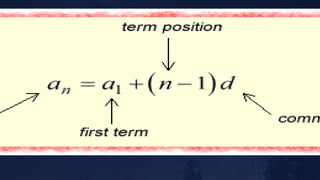
✩If the first term of an arithmetic sequence is a1 and the common difference is d, then the nth term of the
sequence is given by:
-an=a1+(n−1)d
✩an=a1+(n−1)d
✩An arithmetic series is the sum of an arithmetic sequence. We find the sum by adding the first, a1 and last term,
an, divide by 2 in order to get the mean of the two values and then multiply by the number of values, n:
-Sn=n2(a1+an)
✩The Formula of Arithmetic Sequence
✩ If you wish to find any term (also known as the nth term) in the arithmetic
sequence, the arithmetic sequence formula should help you to do so. The critical
step is to be able to identify or extract known values from the problem that will
eventually be substituted into the formula itself.
✩ Let’s start by examining the essential parts of the formula:
Aritmetic sequence
Aritmetic sequence
Aritmetic sequence

Aritmetic sequence