Financing
Locally-Led
Climate Action
(FLLoCA)
Program
Achievement Notes,
February 2024
Presentation
Outline
Introduction
✓Achievements
Lessons Learned
Challenges
Next Steps
It is not too late
to respond.
To tackle this
threat, we must
act urgently to
keep global
heating levels
below 1.5oC, help
those in need and
end addiction to
fossil fuels.”
H.E. Dr. William Ruto, CGH
(President, Republic Of Kenya)
1. INTRODUCTION
Programme Summary
Part of the Devolution Support Program for Results
Financing : Total $295 million Coverage: 47 Counties
Duration: 5 years Effectiveness
date: February 1, 2022
Expected closure: 31-Dec-2026
Executing Agency: National
Treasury & Economic Planning
▪ WB IDA - US$150m
▪ Denmark, Sweden,
Netherlands - $21.4m -
▪ GoK – $80KfW targeting 16
Counties in Western Kenya -
$33.5m
WHAT IS FLLoCA?
Pioneering the
first national
model of
decentralizing
funds to counties
and devolving
decisions to the
local
communities to
have greater
influence
investments and
solutions.
Emerged out of
pilots on County
Climate Change
funds and WB
technical
assistance on
devolution.
Supports
devolution
and deepens
community
participation and
citizen
engagement
below county level
to reach wards
and villages.
Platform for GOK
multi-sector and lti-
donor engagement to
step up and translate
Kenya’s climate
ambitions into act on
on the
ground (NCCAP).
Program Development Objective
Deliver locally-led climate resilience actions and strengthen
National and County Governments’ capacities to manage
climate risk.
Multi donor funding to supplement existing National Climate
Policy Framework Resources (e.g NAP, NCCAP III)
Principles for locally-led climate action
Design
Led by the National Treasury and Planning in collaboration with
Ministry of Environment (CCD), CoG other relevant MDA’s.
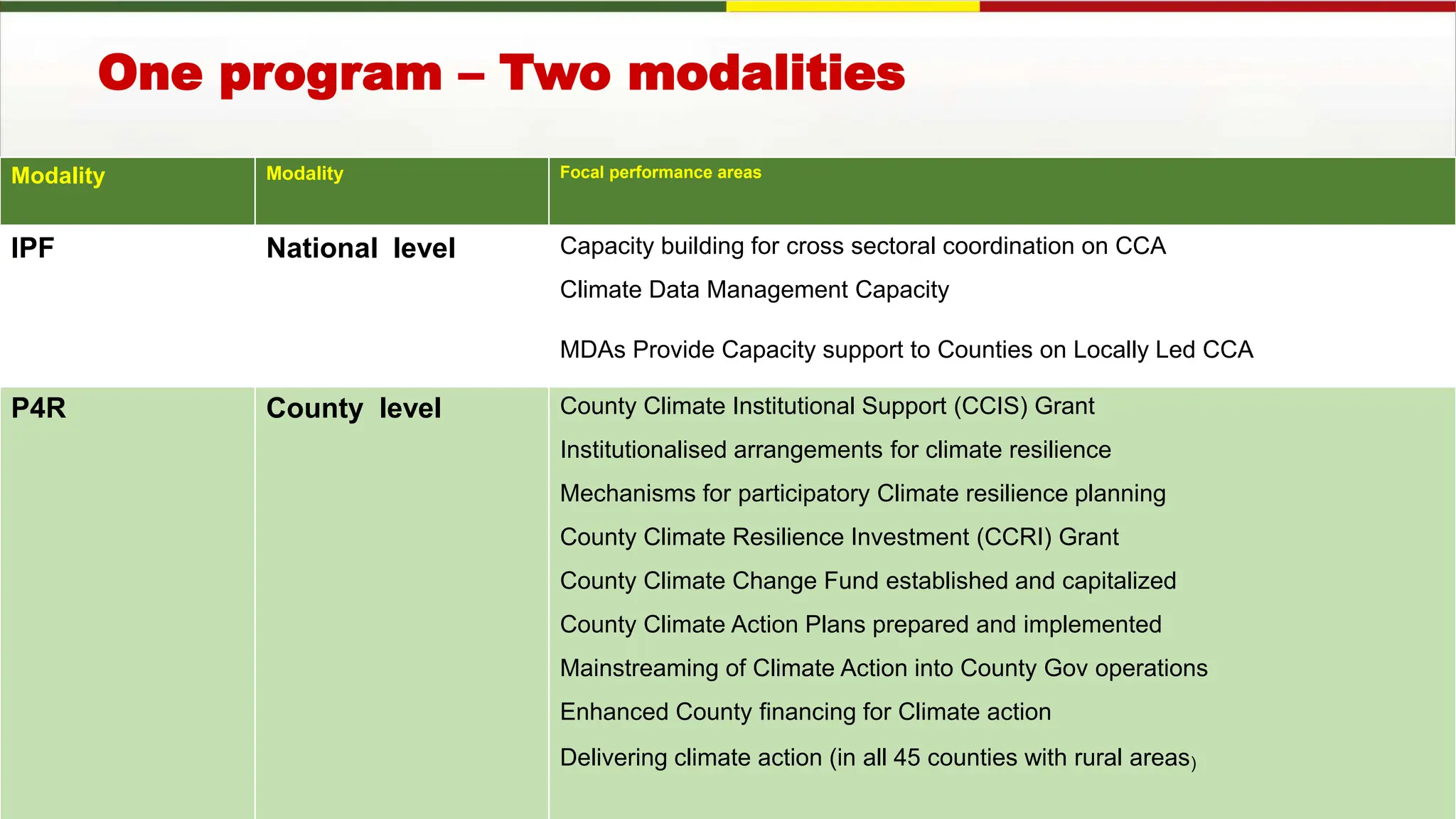
Modality Modality Focal performance areas
IPF National level Capacity building for cross sectoral coordination on CCA
Climate Data Management Capacity
MDAs Provide Capacity support to Counties on Locally Led CCA
P4R County level County Climate Institutional Support (CCIS) Grant
Institutionalised arrangements for climate resilience
Mechanisms for participatory Climate resilience planning
County Climate Resilience Investment (CCRI) Grant
County Climate Change Fund established and capitalized
County Climate Action Plans prepared and implemented
Mainstreaming of Climate Action into County Gov operations
Enhanced County financing for Climate action
Delivering climate action (in all 45 counties with rural areas)
One program – Two modalities
P4R: Two grants to incentivise the performance areas
County Climate Institutional
Support (CCIS) grant
1. 2.
County Climate Resilience
Investment (CCRI) grant
▪ USD 100,000 per county per year for
3 years starting 2022/23
▪ A provision for county governments
notably to
▪ Put institutional arrangements for
County Climate Action in place
▪ Meet the Access conditions and
score well on the performance
measures for the, much larger,
County Climate Resilience
Investment grant
▪ On average USD 1.25 million per
qualifying county government per
year; KFW counties have an
average $2million.
▪ Allocated amounts based on (i)
formula and (ii) performance
scores; hence actual amounts per
county vary (from USD 600K to
2.1M +/- impact scores)
▪ CCRI Grant to fund implementation
of the County Climate Action Plans
whilst triggering enhanced own
county funding for its County
Climate Change Fund and
mainstreaming of climate action
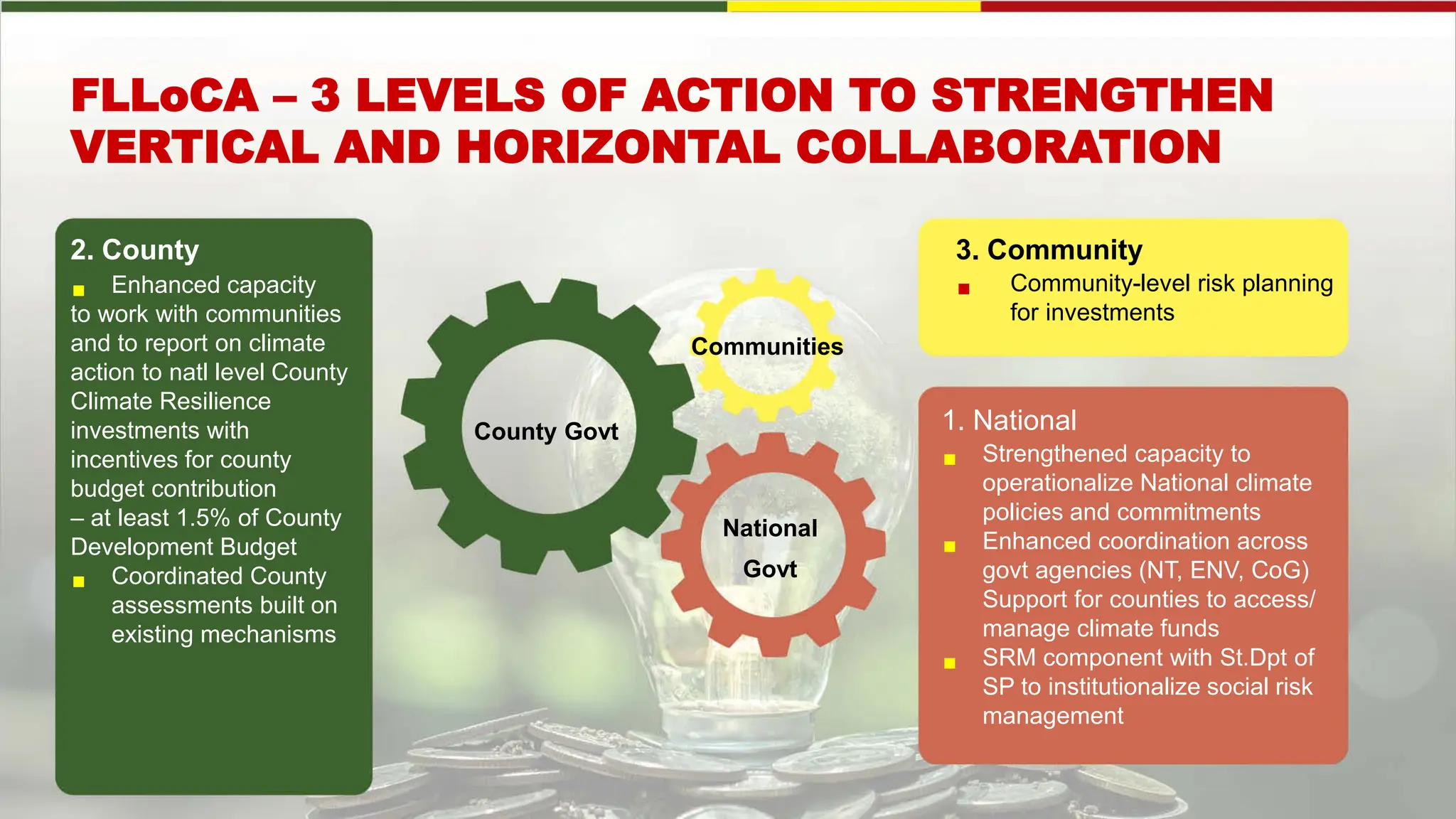
FLLoCA – 3 LEVELS OF ACTION TO STRENGTHEN
VERTICAL AND HORIZONTAL COLLABORATION
2. County
▪ Enhanced capacity
to work with communities
and to report on climate
action to natl level County
Climate Resilience
investments with
incentives for county
budget contribution
– at least 1.5% of County
Development Budget
▪ Coordinated County
assessments built on
existing mechanisms
County Govt
Communities
National
Govt
3. Community
▪ Community-level risk planning
for investments
1. National
▪ Strengthened capacity to
operationalize National climate
policies and commitments
▪ Enhanced coordination across
govt agencies (NT, ENV, CoG)
Support for counties to access/
manage climate funds
▪ SRM component with St.Dpt of
SP to institutionalize social risk
management
Governor
CECM
Chief Officer
Director (Climate
Change)/CCU
County Climate
Change Steering
Committee
County Climate Change Planning
Committee (includes sectoral
departments)
Climate
Change
Directorate
County
Assembly
Council of
Governors
Regional
Blocks
CC Officer 1
(Fund
Administrator)
CC Officer 2
(M&E,
Learning)
CC Officer 3
(Communication)
Ward Climate Change Planning Committees
Planning
process
County institutional capacity
building for locally-led climate action
RESULT AREA
01
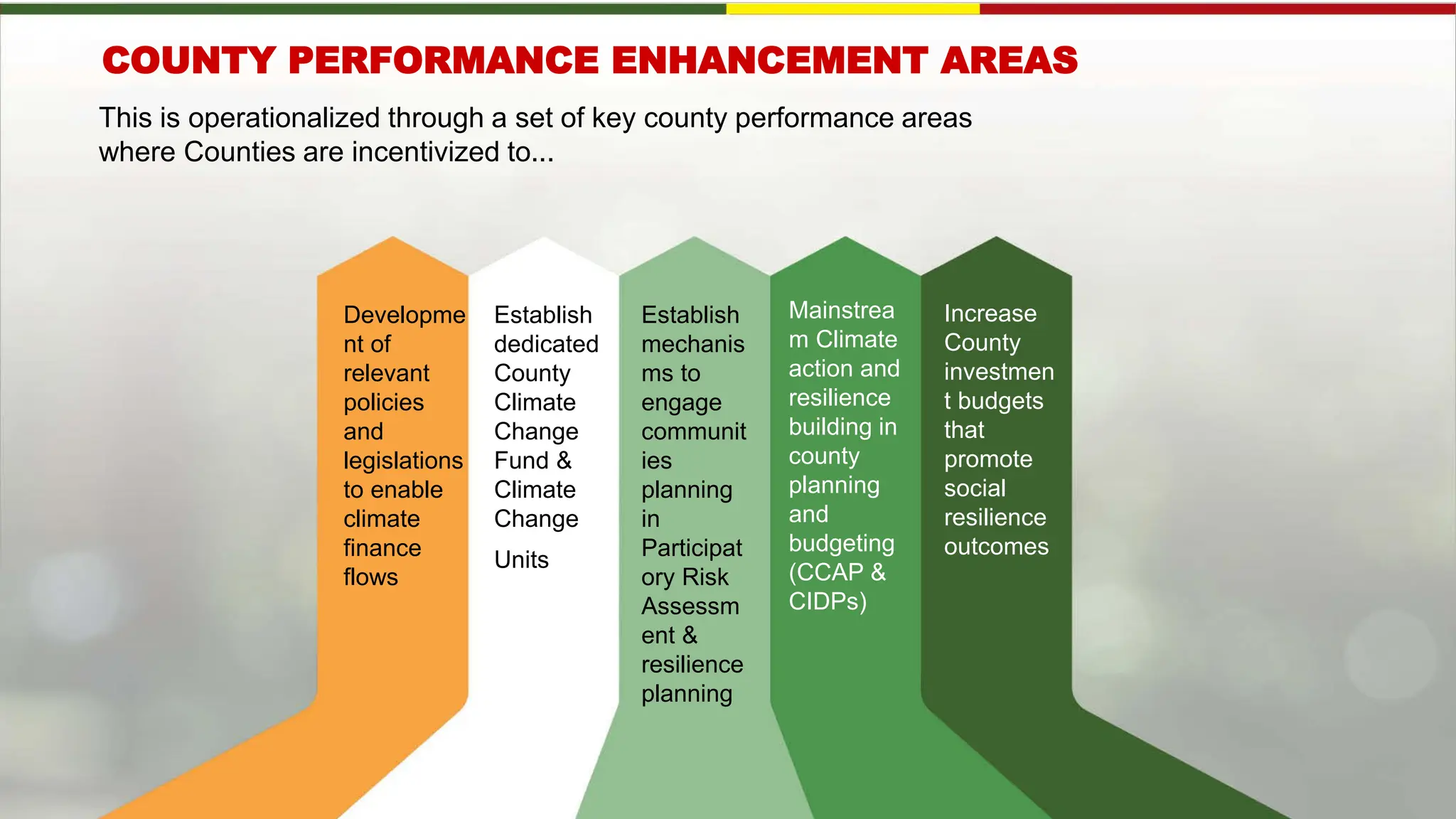
COUNTY PERFORMANCE ENHANCEMENT AREAS
This is operationalized through a set of key county performance areas
where Counties are incentivized to...
Developme
nt of
relevant
policies
and
legislations
to enable
climate
finance
flows
Establish
dedicated
County
Climate
Change
Fund &
Climate
Change
Units
Establish
mechanis
ms to
engage
communit
ies
planning
in
Participat
ory Risk
Assessm
ent &
resilience
planning
Mainstrea
m Climate
action and
resilience
building in
county
planning
and
budgeting
(CCAP &
CIDPs)
Increase
County
investmen
t budgets
that
promote
social
resilience
outcomes
County Capacity
Building and
Institutional
Strengthening
Counties have carried out numerous institutional
strengthening and capacity building actions:
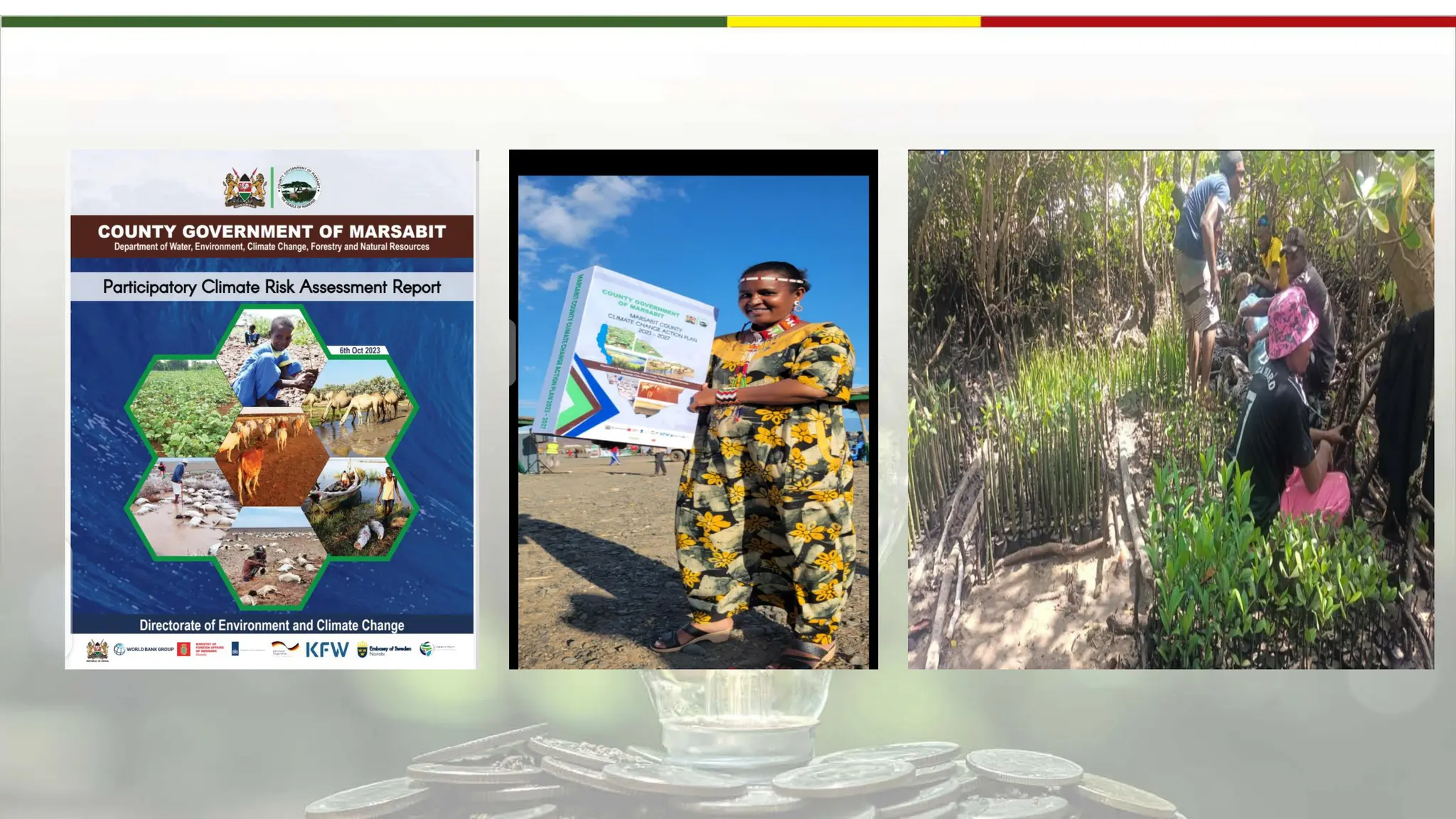
1) PCRAs and CCCAP development
2) Establishment and training of county climate
change units ward steering and planning
committees, and ward-level project management
committees (PMCs)
3) investment in county capacity to carry out
environmental and social (E&S) screening of sub-
projects,
4) operate the county grievance redress
mechanisms (GRMs),
5) inclusion of females and marginalized groups
Locally-led Climate
Resilience Actions
RESULT AREA
02
WHAT THE CCRI GRANT/CCCF IS USED FOR?
Agriculture and Livestock
▪ Agro-forestry and
reforestation
▪ Climate smart
agriculture
▪ Rehabilitation of
degraded rangelands,
local landscape
management
▪ Activities that enhance
agricultural and
pastoralist/livestock
productivity in a low
carbon fashion
Water
▪ Activities that
improve
(community)
access to
water.
▪ Activities that
promote
water
conservation
and more
efficient use
of water
Environment
▪ Activities related to
natural resource
management and
environmental
conservation/communit
y forestry
▪ Rehabilitation of
degraded lands, for
example through tree
planting
▪ Promotion of renewable
energy sources,
including uptake of
clean cooking solutions
1 2 3 4
Other (including Rural
Infrastructure and Disaster
Risk Management
▪ Activities in preparedness
and response to climate-
related disasters and
hazards
▪ Activities that make public
infrastructure more
resistant to droughts,
floods, and other climate
driven disasters
▪ Early warning systems
and preparedness
Program Participatory Climate Risk
Aims to empower communities to understand the climate risks they face and assess their
ability to manage these risks and undertaking concrete local climate actions.
Assessment and Action Planning Model
KEY
STEPS
OF THE
MODEL:
Community/Ward-
level sensitization
and participatory
climate risk
assessments:
Facilitates
participants in
community
consultation for a at
ward level to discuss
and develop a set of
storylines and
corresponding
adaptation activities
Ward climate
action plan
development:
Involves
prioritization of
actions to
strengthen
resilience to
develop ward-
level climate
action plan.
1
County Climate
Resilience
Investment
(CCRI) Plans.
2 3 4 5
A technical
review of the
proposals meet
the technical and
strategic criteria
of CCCF, and any
adjustments
required based
on the technical
review agreed at
the Ward level.
Provides the
basis for
communities to
propose priority
investments as
part of the
participatory
planning
process.
45 counties received the two cycles of US$100,000 tranche for Yr 1-2
while 41 Counties received 3rd cycle.’
(Total disbursed ;- Ksh. 1,430,000,000)
APA 1 completed and APA 2 commenced as a process for
determining the allocation of CCRI grant for investment to the
counties.
Each of the 45 Counties received average $
1.25 Million (IDA) and Euro 600,000 for 16
Agroecological Zone Counties
The Kshs. 7.387 billion was shared amongst
the 45 counties
For Each County
minimum
Performance
Conditions
Counties
CCIS Grants
CCRI
Investment
$1.25m
45
Strengthen
National
Government
Capacity to
Manage
Climate Risks
IPF component
Progress towards PDO Statement:
Strengthen national government
)
• MDAs have been supporting Counties in various subjects:-
1. GRM
2. Environmental and Social Safeguards Screening
3. Climate Information Services
4. Stakeholder Engagement
5. Social Risks and Impacts Assessment (SRIM) Policy
6. SRIM curriculum development
7. Climate Smart Agriculture
capacity to manage climate risk
2. LESSON LEARNT
Equity: Directs resources to marginalized
communities often excluded from traditional
climate funding
FLLOCA exemplifies how
collaborative, bottom-up
approaches can drive meaningful
climate action while addressing
poverty and inequality. Its success is
inspiring similar models in other
climate-vulnerable
Sustainability: Embodies the "localization"
principle of the Paris Agreement, ensuring
solutions are context-specific and owned by
communities.
Resilience: Builds adaptive capacity to
protect livelihoods in a country where
climate change threatens 70% of GDP.
a) Why FLLoCA
Matters
1
2
3
4
5
Stakeholder
Engagement
forum are key to
coordinated,
financing,
planning and
implementation
of climate actions
cross-sectoral
multi-stakeholder
task teams are a
critical enabler
Communities
are very
resourceful in
Climate
Change
matters
County
Climate
Resilience
Investment
(CCRI)
Plans.
Mainstreaming
of climate
actions needs
to start at the
community
level during
county
budgeting and
planning
process
Leveraging of
available
technology to
enhance
climate
adaptation is
key to
building
resilience.
b) Citizen Engagement
3. CHALLENGES
Prioritization of Climate Smart Investment
Actions
High Community Expectations
High Staff Turnover for those whose
capacity has been built
Delayed disbursement of funds
Delay in procurement of goods and
services in counties
Some Counties are not conducting
Environmental and Social Screening
of Climate Investments
Transferring funds from the CRF
account to the Climate Change Fund
Special Purpose Account
1
2
3
4
5
4. NEXT STEPS
• Enhanced Linkages through AFDAN
• Scalability and replicability of Best
Practices and Lessons Learnt on
FLLoCA at the Continental Level
• Implementation of the Green Fiscal
Incentive Framework of Sessional
Paper No.5 of 2024 and Green Bonds
Framework approved by the Cabinet
• Establishment of the Kenya Green
Investment Bank to capitalize USD$
100 billion for 10 year period
M&E System
• Results Framework
• M&E Plan
• M&E Manual
• Data Collection Reporting
• MDAs and Counties reporting template
• 2 progress reports (Semi and Annual Progress reports)
• GEMS/M&E Dashboard
• APA
• Community Satisfaction Survey
THANK YOU

Financing Locally-Led Climate Action (FLLoCA) Program

  • 1.
  • 2.
    Presentation Outline Introduction ✓Achievements Lessons Learned Challenges Next Steps Itis not too late to respond. To tackle this threat, we must act urgently to keep global heating levels below 1.5oC, help those in need and end addiction to fossil fuels.” H.E. Dr. William Ruto, CGH (President, Republic Of Kenya)
  • 3.
  • 4.
    Programme Summary Part ofthe Devolution Support Program for Results Financing : Total $295 million Coverage: 47 Counties Duration: 5 years Effectiveness date: February 1, 2022 Expected closure: 31-Dec-2026 Executing Agency: National Treasury & Economic Planning ▪ WB IDA - US$150m ▪ Denmark, Sweden, Netherlands - $21.4m - ▪ GoK – $80KfW targeting 16 Counties in Western Kenya - $33.5m
  • 5.
    WHAT IS FLLoCA? Pioneeringthe first national model of decentralizing funds to counties and devolving decisions to the local communities to have greater influence investments and solutions. Emerged out of pilots on County Climate Change funds and WB technical assistance on devolution. Supports devolution and deepens community participation and citizen engagement below county level to reach wards and villages. Platform for GOK multi-sector and lti- donor engagement to step up and translate Kenya’s climate ambitions into act on on the ground (NCCAP).
  • 6.
    Program Development Objective Deliverlocally-led climate resilience actions and strengthen National and County Governments’ capacities to manage climate risk. Multi donor funding to supplement existing National Climate Policy Framework Resources (e.g NAP, NCCAP III) Principles for locally-led climate action Design Led by the National Treasury and Planning in collaboration with Ministry of Environment (CCD), CoG other relevant MDA’s.
  • 7.
    Modality Modality Focalperformance areas IPF National level Capacity building for cross sectoral coordination on CCA Climate Data Management Capacity MDAs Provide Capacity support to Counties on Locally Led CCA P4R County level County Climate Institutional Support (CCIS) Grant Institutionalised arrangements for climate resilience Mechanisms for participatory Climate resilience planning County Climate Resilience Investment (CCRI) Grant County Climate Change Fund established and capitalized County Climate Action Plans prepared and implemented Mainstreaming of Climate Action into County Gov operations Enhanced County financing for Climate action Delivering climate action (in all 45 counties with rural areas) One program – Two modalities
  • 8.
    P4R: Two grantsto incentivise the performance areas County Climate Institutional Support (CCIS) grant 1. 2. County Climate Resilience Investment (CCRI) grant ▪ USD 100,000 per county per year for 3 years starting 2022/23 ▪ A provision for county governments notably to ▪ Put institutional arrangements for County Climate Action in place ▪ Meet the Access conditions and score well on the performance measures for the, much larger, County Climate Resilience Investment grant ▪ On average USD 1.25 million per qualifying county government per year; KFW counties have an average $2million. ▪ Allocated amounts based on (i) formula and (ii) performance scores; hence actual amounts per county vary (from USD 600K to 2.1M +/- impact scores) ▪ CCRI Grant to fund implementation of the County Climate Action Plans whilst triggering enhanced own county funding for its County Climate Change Fund and mainstreaming of climate action
  • 9.
    FLLoCA – 3LEVELS OF ACTION TO STRENGTHEN VERTICAL AND HORIZONTAL COLLABORATION 2. County ▪ Enhanced capacity to work with communities and to report on climate action to natl level County Climate Resilience investments with incentives for county budget contribution – at least 1.5% of County Development Budget ▪ Coordinated County assessments built on existing mechanisms County Govt Communities National Govt 3. Community ▪ Community-level risk planning for investments 1. National ▪ Strengthened capacity to operationalize National climate policies and commitments ▪ Enhanced coordination across govt agencies (NT, ENV, CoG) Support for counties to access/ manage climate funds ▪ SRM component with St.Dpt of SP to institutionalize social risk management
  • 11.
    Governor CECM Chief Officer Director (Climate Change)/CCU CountyClimate Change Steering Committee County Climate Change Planning Committee (includes sectoral departments) Climate Change Directorate County Assembly Council of Governors Regional Blocks CC Officer 1 (Fund Administrator) CC Officer 2 (M&E, Learning) CC Officer 3 (Communication) Ward Climate Change Planning Committees Planning process
  • 12.
    County institutional capacity buildingfor locally-led climate action RESULT AREA 01
  • 13.
    COUNTY PERFORMANCE ENHANCEMENTAREAS This is operationalized through a set of key county performance areas where Counties are incentivized to... Developme nt of relevant policies and legislations to enable climate finance flows Establish dedicated County Climate Change Fund & Climate Change Units Establish mechanis ms to engage communit ies planning in Participat ory Risk Assessm ent & resilience planning Mainstrea m Climate action and resilience building in county planning and budgeting (CCAP & CIDPs) Increase County investmen t budgets that promote social resilience outcomes
  • 14.
    County Capacity Building and Institutional Strengthening Countieshave carried out numerous institutional strengthening and capacity building actions: 1) PCRAs and CCCAP development 2) Establishment and training of county climate change units ward steering and planning committees, and ward-level project management committees (PMCs) 3) investment in county capacity to carry out environmental and social (E&S) screening of sub- projects, 4) operate the county grievance redress mechanisms (GRMs), 5) inclusion of females and marginalized groups
  • 15.
  • 16.
    WHAT THE CCRIGRANT/CCCF IS USED FOR? Agriculture and Livestock ▪ Agro-forestry and reforestation ▪ Climate smart agriculture ▪ Rehabilitation of degraded rangelands, local landscape management ▪ Activities that enhance agricultural and pastoralist/livestock productivity in a low carbon fashion Water ▪ Activities that improve (community) access to water. ▪ Activities that promote water conservation and more efficient use of water Environment ▪ Activities related to natural resource management and environmental conservation/communit y forestry ▪ Rehabilitation of degraded lands, for example through tree planting ▪ Promotion of renewable energy sources, including uptake of clean cooking solutions 1 2 3 4 Other (including Rural Infrastructure and Disaster Risk Management ▪ Activities in preparedness and response to climate- related disasters and hazards ▪ Activities that make public infrastructure more resistant to droughts, floods, and other climate driven disasters ▪ Early warning systems and preparedness
  • 17.
    Program Participatory ClimateRisk Aims to empower communities to understand the climate risks they face and assess their ability to manage these risks and undertaking concrete local climate actions. Assessment and Action Planning Model KEY STEPS OF THE MODEL: Community/Ward- level sensitization and participatory climate risk assessments: Facilitates participants in community consultation for a at ward level to discuss and develop a set of storylines and corresponding adaptation activities Ward climate action plan development: Involves prioritization of actions to strengthen resilience to develop ward- level climate action plan. 1 County Climate Resilience Investment (CCRI) Plans. 2 3 4 5 A technical review of the proposals meet the technical and strategic criteria of CCCF, and any adjustments required based on the technical review agreed at the Ward level. Provides the basis for communities to propose priority investments as part of the participatory planning process.
  • 19.
    45 counties receivedthe two cycles of US$100,000 tranche for Yr 1-2 while 41 Counties received 3rd cycle.’ (Total disbursed ;- Ksh. 1,430,000,000) APA 1 completed and APA 2 commenced as a process for determining the allocation of CCRI grant for investment to the counties. Each of the 45 Counties received average $ 1.25 Million (IDA) and Euro 600,000 for 16 Agroecological Zone Counties The Kshs. 7.387 billion was shared amongst the 45 counties For Each County minimum Performance Conditions Counties CCIS Grants CCRI Investment $1.25m 45
  • 21.
  • 22.
    Progress towards PDOStatement: Strengthen national government ) • MDAs have been supporting Counties in various subjects:- 1. GRM 2. Environmental and Social Safeguards Screening 3. Climate Information Services 4. Stakeholder Engagement 5. Social Risks and Impacts Assessment (SRIM) Policy 6. SRIM curriculum development 7. Climate Smart Agriculture capacity to manage climate risk
  • 23.
  • 24.
    Equity: Directs resourcesto marginalized communities often excluded from traditional climate funding FLLOCA exemplifies how collaborative, bottom-up approaches can drive meaningful climate action while addressing poverty and inequality. Its success is inspiring similar models in other climate-vulnerable Sustainability: Embodies the "localization" principle of the Paris Agreement, ensuring solutions are context-specific and owned by communities. Resilience: Builds adaptive capacity to protect livelihoods in a country where climate change threatens 70% of GDP. a) Why FLLoCA Matters 1 2 3 4 5
  • 25.
    Stakeholder Engagement forum are keyto coordinated, financing, planning and implementation of climate actions cross-sectoral multi-stakeholder task teams are a critical enabler Communities are very resourceful in Climate Change matters County Climate Resilience Investment (CCRI) Plans. Mainstreaming of climate actions needs to start at the community level during county budgeting and planning process Leveraging of available technology to enhance climate adaptation is key to building resilience.
  • 26.
  • 27.
  • 28.
    Prioritization of ClimateSmart Investment Actions High Community Expectations High Staff Turnover for those whose capacity has been built Delayed disbursement of funds Delay in procurement of goods and services in counties Some Counties are not conducting Environmental and Social Screening of Climate Investments Transferring funds from the CRF account to the Climate Change Fund Special Purpose Account 1 2 3 4 5
  • 29.
  • 30.
    • Enhanced Linkagesthrough AFDAN • Scalability and replicability of Best Practices and Lessons Learnt on FLLoCA at the Continental Level • Implementation of the Green Fiscal Incentive Framework of Sessional Paper No.5 of 2024 and Green Bonds Framework approved by the Cabinet • Establishment of the Kenya Green Investment Bank to capitalize USD$ 100 billion for 10 year period
  • 31.
    M&E System • ResultsFramework • M&E Plan • M&E Manual • Data Collection Reporting • MDAs and Counties reporting template • 2 progress reports (Semi and Annual Progress reports) • GEMS/M&E Dashboard • APA • Community Satisfaction Survey
  • 32.