Financial Statement Analysis 11th Edition
Subramanyam Solutions Manual download
https://testbankdeal.com/product/financial-statement-
analysis-11th-edition-subramanyam-solutions-manual/
Explore and download more test bank or solution manual
at testbankdeal.com
We believe these products will be a great fit for you. Click
the link to download now, or visit testbankdeal.com
to discover even more!
Financial Statement Analysis 11th Edition Subramanyam Test
Bank
https://testbankdeal.com/product/financial-statement-analysis-11th-
edition-subramanyam-test-bank/
Financial Statement Analysis 10th Edition Subramanyam Test
Bank
https://testbankdeal.com/product/financial-statement-analysis-10th-
edition-subramanyam-test-bank/
Financial Statement Analysis International Edition 13th
Edition Gibson Solutions Manual
https://testbankdeal.com/product/financial-statement-analysis-
international-edition-13th-edition-gibson-solutions-manual/
Andersons Business Law and the Legal Environment Standard
Volume 22nd Edition Twomey Test Bank
https://testbankdeal.com/product/andersons-business-law-and-the-legal-
environment-standard-volume-22nd-edition-twomey-test-bank/
Principles of Environmental Science Inquiry and
Applications 7th Edition Cunningham Test Bank
https://testbankdeal.com/product/principles-of-environmental-science-
inquiry-and-applications-7th-edition-cunningham-test-bank/
Understanding American Government 14th Edition Welch Test
Bank
https://testbankdeal.com/product/understanding-american-
government-14th-edition-welch-test-bank/
Physics for Scientists and Engineers 9th Edition Serway
Solutions Manual
https://testbankdeal.com/product/physics-for-scientists-and-
engineers-9th-edition-serway-solutions-manual/
Business Communication Building Critical Skills 6th
Edition Locker Test Bank
https://testbankdeal.com/product/business-communication-building-
critical-skills-6th-edition-locker-test-bank/
Sexuality Now Embracing Diversity 5th Edition Carroll Test
Bank
https://testbankdeal.com/product/sexuality-now-embracing-
diversity-5th-edition-carroll-test-bank/
Organizational Behavior Key Concepts Skills and Best
Practices 5th Edition Kinicki Solutions Manual
https://testbankdeal.com/product/organizational-behavior-key-concepts-
skills-and-best-practices-5th-edition-kinicki-solutions-manual/
Chapter 07 - Cash Flow Analysis
7-1
Copyright © 2014 McGraw-Hill Education. All rights reserved. No reproduction or distribution without the prior written consent of McGraw-Hill
Education.
Chapter 7
Cash Flow Analysis
REVIEW
Cash is the residual of cash inflows less cash outflows for all prior periods of a company.
Net cash flows, or simply cash flows, refer to the current period's cash inflows less cash
outflows. Cash flows are different from accrual measures of performance. Cash flow
measures recognize inflows when cash is received not necessarily earned, and outflows
when cash is paid not necessarily incurred. The statement of cash flows reports cash flow
measures for three primary business activities: operating, investing, and financing.
Operating cash flows, or cash flows from operations, is the cash basis counterpart to
accrual net income. Information on cash flows helps us assess a company's ability to meet
obligations, pay dividends, increase capacity, and raise financing. It also helps us assess
the quality of earnings and the dependence of income on estimates and assumptions
regarding future cash flows. This chapter describes cash flows and their relevance to our
analysis of financial statements. We describe current reporting requirements and their
implications for our analysis of cash flows. We explain useful analytical adjustments to cash
flows using financial data to improve our analysis. We direct special attention to transaction
reconstruction, T-account, and conversion analyses.
Chapter 07 - Cash Flow Analysis
7-2
Copyright © 2014 McGraw-Hill Education. All rights reserved. No reproduction or distribution without the prior written consent of McGraw-Hill
Education.
OUTLINE
• Statement of Cash Flows
Relevance of Cash
Reporting by Activities
Constructing the Cash Flow Statement
Special Topics
• Reporting Cash Flows from Operations
Indirect Method
Direct Method
Converting from Indirect to Direct Method
Adjustments to Cash Flow Components
Additional Disclosures and Adjustments
• Analysis Implications of Cash Flows
Limitations in Cash Flow Reporting
Interpreting Cash Flows and Net Income
Alternative Cash Flow Measures
Company and Economic Conditions
Free Cash Flow
Cash Flows as Validators
• Specialized Cash Flow Ratios
Cash Flow Adequacy Ratio
Cash Reinvestment Ratio
• Appendix 7A Analytical Cash Flow Worksheets
Chapter 07 - Cash Flow Analysis
7-3
Copyright © 2014 McGraw-Hill Education. All rights reserved. No reproduction or distribution without the prior written consent of McGraw-Hill
Education.
ANALYSIS OBJECTIVES
• Explain the relevance of cash flows in analyzing business activities.
• Describe reporting of cash flows by business activities.
• Describe the preparation and analysis of the statement of cash flows.
• Interpret cash flows from operating activities.
• Analyze cash flows under alternative company and business conditions.
• Describe alternative measures of cash flows and their usefulness.
• Illustrate an analytical tool in evaluating cash flows (Appendix 7A).
Chapter 07 - Cash Flow Analysis
7-4
Copyright © 2014 McGraw-Hill Education. All rights reserved. No reproduction or distribution without the prior written consent of McGraw-Hill
Education.
QUESTIONS
1. The term cash flow was probably first coined by analysts. They recognized that the
accrual system of income measurement permits the introduction of a variety of
alternative accounting treatments and consequent distortions. The crude concept of
cash flow—net income plus major noncash expenses (such as depreciation)—was
derived to bypass these distortions and bring income measurement closer to the
discipline of actual cash flows. This cash flow measure, still a popular surrogate for cash
from operations (CFO), is crude because it falls short of reliably approximating in most
cases the correct measure of CFO.
Confusion with the term cash flow derives from several sources. One source of
confusion stems from the initial and incorrect computation of the crude measure of cash
flow as income plus major noncash expenses. The figure fails to reflect actual cash
flows. Another and more serious confusion arises from the assertion by some, and
particularly by managers dissatisfied by the level of their reported net income, that cash
flow is a measure of performance superior to or more valid than net income. This
assertion implicitly assumes that depreciation, and other noncash costs, are not genuine
expenses. Experience shows that only net income is properly regarded as a measure of
performance and can be related to the equity investment as an indicator of operating
performance. If we add back depreciation to net income and compute the resulting return
on investment, we are, in effect, confusing the return on investment with an element of
return on investment in fixed assets.
2. While fragmentary information on the sources and uses of cash can be obtained from
comparative balance sheets and from income statements, a comprehensive picture of
this important area of activity can be gained only from a statement of cash flows (SCF).
The SCF provides information to help answer questions such as:
• What amount of cash is generated by operations?
• What utilization is made of cash provided by operations?
• What is the source of cash invested in new plant and equipment?
• What use is made of cash from a new bond issue or the issuance of common stock?
• How is it possible to continue the regular dividend in the face of an operating loss?
• How is debt repayment achieved?
• What is the source of cash used to redeem the preferred stock?
• How is the increase in investments financed?
• Why, despite record profits, is the cash position lower than last year?
3. SFAS 95 requires that the statement of cash flows classify cash receipts and cash
payments by operating, financing and investing activities.
Operating activities encompass all the earning-related activities of the enterprise. They
encompass, in addition to all the income and expense items found on the income
statement, all the net inflows and outflows of cash that operations impose on the
enterprise. Such operations include activities such as the extension of credit to
customers, investment in inventories, and obtaining credit from suppliers. This means
operating activities relate to all items in the statement of income (with minor exceptions)
as well as to balance sheet items that relate to operations mostly working capital
accounts such as accounts receivable, inventories, prepayments, accounts payable, and
Chapter 07 - Cash Flow Analysis
7-5
Copyright © 2014 McGraw-Hill Education. All rights reserved. No reproduction or distribution without the prior written consent of McGraw-Hill
Education.
accruals. SFAS 95 also specifies that operating activities include all transactions and
events that are not of an investing or financing nature.
Financing activities include obtaining resources from owners and providing them with a
return of or a return on (dividends) their investment. They also include obtaining
resources from creditors and repaying the amounts borrowed or otherwise settling the
obligations.
Investing activities include acquiring and selling or otherwise disposing of both
securities that are not cash equivalents and productive assets that are expected to
generate revenues over the long-term. They also include lending money and collecting
on such loans.
4. We can distinguish among three categories of adjustments that convert accrual basis net
income to cash from operations: (i) Expenses, losses, revenues, and gains that do not
use or generate cash such as those involving noncash accounts (except those in ii), (ii)
Net changes in noncash accounts (mostly in the operating working capital group) that
relate to operations—these modify the accrual-based revenue and expense items
included in income, (iii) Gains and losses (such as on sales of assets) that are
transferred to other sections of the SCF so as to show the entire cash proceeds of the
sale.
5. The two methods of reporting cash flow from operations are:
Indirect Method: Under this method net income is adjusted for noncash items required to
convert it to CFO. The advantage of this method is that it is a reconciliation that
discloses the differences between net income and CFO. Some analysts estimate future
cash flows by first estimating future income levels and then adjusting these for leads
and lags between income and CFO (that is, noncash adjustments).
Direct (or Inflow-Outflow) Method: This method lists the gross cash receipts and
disbursements related to operations. Most respondents to the Exposure Draft that
preceded SFAS 95 preferred this method because this presentation discloses the total
amount of cash that flows into the enterprise and out of the enterprise due to operations.
This gives analysts a better measure of the size of cash inflows and outflows over which
management has some degree of discretion. As the risks that lenders are exposed to
relate more to fluctuations in CFO than to fluctuations in net income, information on the
amounts of operating cash receipts and payments is important in assessing the nature
of those fluctuations.
6. The function of the income statement is to measure the profitability of the enterprise for
a given period. This is done by matching expenses and losses with the revenues and
gains earned. While no other statement measures profitability as well as the income
statement, it does not show the timing of cash flows and the effect of operations on
liquidity and solvency. The latter is reported on by the SCF. Cash from operations (CFO)
reflects a broader concept of operations relative to net income. It encompasses all
earning-related activities of the enterprise. CFO is concerned not only with expenses and
revenues but also with the cash demands of these activities, such as investments in
customer receivables and in inventories as well as the financing provided by suppliers of
goods and services. CFO focuses on the liquidity aspect of operations and is not a
measure of profitability because it does not include important costs such as the use of
long-lived assets in operations or important revenues such as the equity in the earnings
of nonconsolidated subsidiaries or affiliates.
Chapter 07 - Cash Flow Analysis
7-6
Copyright © 2014 McGraw-Hill Education. All rights reserved. No reproduction or distribution without the prior written consent of McGraw-Hill
Education.
7. The SCF sheds light on (i) the effects of earning activities on cash resources, (ii) what
assets are acquired, and (iii) how assets are financed. It also can highlight more clearly
the distinction between net income and cash provided by operations. The ability of an
enterprise to generate cash from operations on a consistent basis is an important
indicator of financial health. No business can survive over the long run without
generating cash from its operations. However, the interpretation of CFO figures and
trends must be made with care and with a full understanding of all surrounding
circumstances.
Prosperous as well as failing entities can find themselves unable to generate cash from
operations at any given time, but for different reasons. The entity caught in the
"prosperity squeeze" of having to invest its cash in receivables and inventories to meet
ever-increasing customer demand will often find that its profitability will facilitate
financing by equity as well as by debt. That same profitability should ultimately turn CFO
into a positive figure. The unsuccessful firm, on the other hand, will find its cash drained
by slowdowns in receivable and inventory turnovers, by operating losses, or by a
combination of these factors. These conditions usually contain the seeds of further
losses and cash drains and also can lead to difficulties in obtaining trade credit. In such
cases, a lack of CFO has different implications. The unsuccessful or financially pressed
firm can increase its CFO by reducing accounts receivable and inventories, but usually
this is done at the expense of services to customers that can further depress future
profitability. Even if the unsuccessful firm manages to borrow, the costs of borrowing
only magnify the ultimate drains of its cash. Thus, profitability is a key consideration,
and while it does not insure CFO in the short run, it is essential to a healthy financial
condition in the long run.
Changes in operating working capital items must be similarly interpreted in light of
attending circumstances. An increase in receivables can mean expanding consumer
demand for enterprise products or it can mean an inability to collect amounts due in a
timely fashion. Similarly, an increase in inventories (and particularly of the raw material
component) can imply preparations for an increase in production in response to
consumer demand. It also can imply (particularly if the finished goods component of
inventories is increasing) an inability to sell due to, say, when anticipated demand did
not materialize.
8. A valuable analytical derivative of the SCF is "free cash flow." As with any other
analytical measure, analysts must pay careful attention to components of this
computation. Here, as in the case of any cash flow measures, ulterior motives may
sometimes affect the validity of the computation. One of the analytically most useful
computations of free cash flow is:
Cash from Operations (CFO)
- Capital expenditures required to maintain productive capacity used in generating income
- Dividends (on preferred stock and maintenance of desired payout on common stock)
= Free Cash Flow (FCF)
Chapter 07 - Cash Flow Analysis
7-7
Copyright © 2014 McGraw-Hill Education. All rights reserved. No reproduction or distribution without the prior written consent of McGraw-Hill
Education.
Positive FCF implies that this is the amount available for company purposes after
provisions for financing outlays and expenditures to maintain productive capacity at
current levels. Internal growth and financial flexibility depend on an adequate amount of
FCF. Note that the amount of capital expenditures needed to maintain productive
capacity at current levels is generally not disclosed by companies. It is included in total
capital expenditures, which also can include outlays for expansion of productive
capacity. Breaking down capital expenditures between these two components is difficult.
The FASB considered this issue, but in SFAS 95 it decided not to require classification of
investment expenditures into maintenance and expansion categories.
9. For financial statement analysis, the SCF provides clues to important matters such as:
• Feasibility of financing capital expenditures and possible sources of such financing.
• Sources of cash to finance an expansion in the business.
• Dependence of the firm on external sources of financing (such as debt or equity).
• Future dividend policies.
• Ability to meet future debt service requirements.
• Financial flexibility, that is, the firm's ability to generate sufficient cash so as to
respond to unanticipated needs and opportunities.
• Insight into the financial habits of management and indications of future policies.
• Signals regarding the quality of earnings.
Chapter 07 - Cash Flow Analysis
7-8
Copyright © 2014 McGraw-Hill Education. All rights reserved. No reproduction or distribution without the prior written consent of McGraw-Hill
Education.
EXERCISES
Exercise 7-1 (20 minutes)
The Year 11 CFO of Campbell is higher (by $403.7 million) than its Year 11 net
income for two main reasons:
1. Some items decreased net income but did not use cash—specifically:
a. Depreciation and amortization are expenses not requiring a cash outlay
($208.6).
b. Deferred income taxes are an expense that has no present cash payment
($35.5).
c. Several charges and expenses did not require outlays of cash ($63.2).
d. A decrease in inventory implies that cost of sales are charged by reducing
inventory levels rather than by making cash payments of $48.7.
2. Some items generated operating cash inflow did not enter into the determination
of net income—specifically:
a. The decrease in accounts receivable means that cash is collected beyond the
amounts recognized as sales revenue in the income statement ($17.1).
b. There are several other items that had a similar effect, amounting to $30.6.
Exercise 7-2 (40 minutes)
a. SFAS 95 requires that the SCF classify cash receipts and payments by operating,
financing, and investing activities.
(1) Operating activities encompass all the earning-related activities of the
enterprise. They encompass, in addition to all the income and expense items
found on the income statement, all the net inflows and outflows of cash that
operations impose on the enterprise. Such operations include activities such as
the extension of credit to customers, investment in inventories, and obtaining
credit from suppliers. This means operating activities relate to all items in the
statement of income (with minor exceptions) as well as to balance sheet items
that relate to operations mostly working capital accounts such as accounts
receivable, inventories, prepayments, accounts payable, and accruals. SFAS 95
also specifies that operating activities include all transactions and events that are
not of an investing or financing nature.
(2) Financing activities include obtaining resources from owners and providing
them with a return of or a return on (dividends) their investment. They also
include obtaining resources from creditors and repaying the amounts borrowed
or otherwise settling the obligations.
(3) Investing activities include acquiring and selling or otherwise disposing of
both securities that are not cash equivalents and productive assets that are
expected to generate revenues over the long-term. They also include lending
money and collecting on such loans.
Chapter 07 - Cash Flow Analysis
7-9
Copyright © 2014 McGraw-Hill Education. All rights reserved. No reproduction or distribution without the prior written consent of McGraw-Hill
Education.
Exercise 7-2—concluded
b. SFAS 95 requires that all significant financing and investing activities be
disclosed. For example, noncash transactions that include the conversion of debt
to equity, the acquisition of assets through the issuance of debt, and exchanges
of assets or liabilities, should be disclosed in a separate schedule of noncash
investing and financing activities.
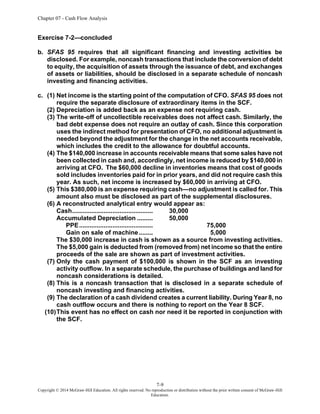
c. (1) Net income is the starting point of the computation of CFO. SFAS 95 does not
require the separate disclosure of extraordinary items in the SCF.
(2) Depreciation is added back as an expense not requiring cash.
(3) The write-off of uncollectible receivables does not affect cash. Similarly, the
bad debt expense does not require an outlay of cash. Since this corporation
uses the indirect method for presentation of CFO, no additional adjustment is
needed beyond the adjustment for the change in the net accounts receivable,
which includes the credit to the allowance for doubtful accounts.
(4) The $140,000 increase in accounts receivable means that some sales have not
been collected in cash and, accordingly, net income is reduced by $140,000 in
arriving at CFO. The $60,000 decline in inventories means that cost of goods
sold includes inventories paid for in prior years, and did not require cash this
year. As such, net income is increased by $60,000 in arriving at CFO.
(5) This $380,000 is an expense requiring cash—no adjustment is called for. This
amount also must be disclosed as part of the supplemental disclosures.
(6) A reconstructed analytical entry would appear as:
Cash.............................................. 30,000
Accumulated Depreciation ......... 50,000
PPE.......................................... 75,000
Gain on sale of machine........ 5,000
The $30,000 increase in cash is shown as a source from investing activities.
The $5,000 gain is deducted from (removed from) net income so that the entire
proceeds of the sale are shown as part of investment activities.
(7) Only the cash payment of $100,000 is shown in the SCF as an investing
activity outflow. In a separate schedule, the purchase of buildings and land for
noncash considerations is detailed.
(8) This is a noncash transaction that is disclosed in a separate schedule of
noncash investing and financing activities.
(9) The declaration of a cash dividend creates a current liability. During Year 8, no
cash outflow occurs and there is nothing to report on the Year 8 SCF.
(10)This event has no effect on cash nor need it be reported in conjunction with
the SCF.
Chapter 07 - Cash Flow Analysis
7-10
Copyright © 2014 McGraw-Hill Education. All rights reserved. No reproduction or distribution without the prior written consent of McGraw-Hill
Education.
Exercise 7-3 (30 minutes)
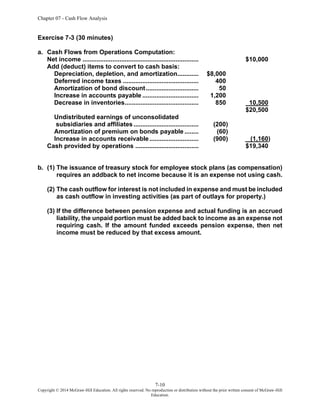
a. Cash Flows from Operations Computation:
Net income .................................................................. $10,000
Add (deduct) items to convert to cash basis:
Depreciation, depletion, and amortization............ $8,000
Deferred income taxes ........................................... 400
Amortization of bond discount.............................. 50
Increase in accounts payable ................................ 1,200
Decrease in inventories.......................................... 850 10,500
$20,500
Undistributed earnings of unconsolidated
subsidiaries and affiliates..................................... (200)
Amortization of premium on bonds payable ........ (60)
Increase in accounts receivable............................ (900) (1,160)
Cash provided by operations .................................... $19,340
b. (1) The issuance of treasury stock for employee stock plans (as compensation)
requires an addback to net income because it is an expense not using cash.
(2) The cash outflow for interest is not included in expense and must be included
as cash outflow in investing activities (as part of outlays for property.)
(3) If the difference between pension expense and actual funding is an accrued
liability, the unpaid portion must be added back to income as an expense not
requiring cash. If the amount funded exceeds pension expense, then net
income must be reduced by that excess amount.
Visit https://testbankdead.com
now to explore a rich
collection of testbank,
solution manual and enjoy
exciting offers!
Chapter 07 - Cash Flow Analysis
7-11
Copyright © 2014 McGraw-Hill Education. All rights reserved. No reproduction or distribution without the prior written consent of McGraw-Hill
Education.
Exercise 7-4 (30 minutes)
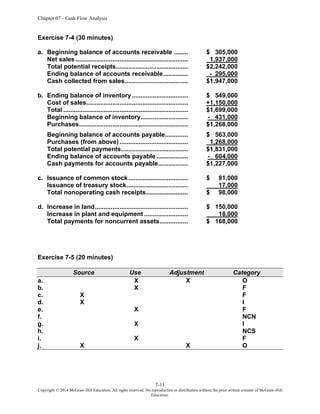
a. Beginning balance of accounts receivable ........ $ 305,000
Net sales................................................................ 1,937,000
Total potential receipts......................................... $2,242,000
Ending balance of accounts receivable.............. - 295,000
Cash collected from sales.................................... $1,947,000
b. Ending balance of inventory................................ $ 549,000
Cost of sales.......................................................... +1,150,000
Total ....................................................................... $1,699,000
Beginning balance of inventory........................... - 431,000
Purchases.............................................................. $1,268,000
Beginning balance of accounts payable............. $ 563,000
Purchases (from above)....................................... 1,268,000
Total potential payments...................................... $1,831,000
Ending balance of accounts payable.................. - 604,000
Cash payments for accounts payable................. $1,227,000
c. Issuance of common stock.................................. $ 81,000
Issuance of treasury stock................................... 17,000
Total nonoperating cash receipts........................ $ 98,000
d. Increase in land..................................................... $ 150,000
Increase in plant and equipment ......................... 18,000
Total payments for noncurrent assets................ $ 168,000
Exercise 7-5 (20 minutes)
Source Use Adjustment Category
a. X X O
b. X F
c. X F
d. X I
e. X F
f. NCN
g. X I
h. NCS
i. X F
j. X X O
Chapter 07 - Cash Flow Analysis
7-12
Copyright © 2014 McGraw-Hill Education. All rights reserved. No reproduction or distribution without the prior written consent of McGraw-Hill
Education.
Exercise 7-6 (20 minutes)
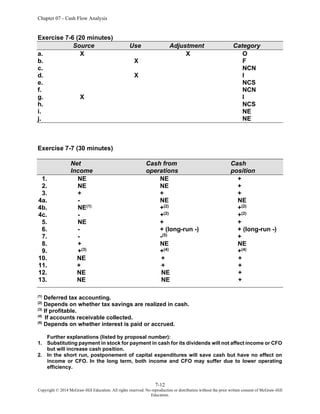
Source Use Adjustment Category
a. X X O
b. X F
c. NCN
d. X I
e. NCS
f. NCN
g. X I
h. NCS
i. NE
j. NE
Exercise 7-7 (30 minutes)
Net Cash from Cash
Income operations position
1. NE NE +
2. NE NE +
3. + + +
4a. - NE NE
4b. NE(1) +(2) +(2)
4c. - +(2)
+(2)
5. NE + +
6. - + (long-run -) + (long-run -)
7. - -(5) +
8. + NE NE
9. +(3)
+(4)
+(4)
10. NE + +
11. + + +
12. NE NE +
13. NE NE +
(1)
Deferred tax accounting.
(2)
Depends on whether tax savings are realized in cash.
(3)
If profitable.
(4)
If accounts receivable collected.
(5)
Depends on whether interest is paid or accrued.
Further explanations (listed by proposal number):
1. Substituting payment in stock for payment in cash for its dividends will not affect income or CFO
but will increase cash position.
2. In the short run, postponement of capital expenditures will save cash but have no effect on
income or CFO. In the long term, both income and CFO may suffer due to lower operating
efficiency.
Chapter 07 - Cash Flow Analysis
7-13
Copyright © 2014 McGraw-Hill Education. All rights reserved. No reproduction or distribution without the prior written consent of McGraw-Hill
Education.
Exercise 7-7—continued
3. Cash not spent on repair and maintenance will increase all three measures. However, the
skimping on necessary discretionary costs will adversely impact future operating efficiency and,
hence, profitability.
4. Managers advocating an increase in depreciation may have spoken in the mistaken belief that
depreciation is a source of cash and that consequently increasing it would result in a higher cash
inflow. In fact, the level of depreciation expense has no effect on cash flow—the same amount of
depreciation deducted in arriving at net income is added back in arriving at CFO. On the other
hand, increasing depreciation for tax purposes will in all cases result in at least a short-term
savings.
5. Quicker collections will not affect income but will increase CFO because of lower accounts
receivable. Cash will also increase by the speedier conversion of receivables into cash. In the
longer run this stiffening in the terms of sale to customers may result in sales lost to competition.
6. Payments stretched-out will lower income because of lost discounts but does positively affect
CFO by increasing the level of accounts payable. Cash conservation will result in a higher cash
position. Relations with suppliers may be affected adversely. Note: Long-term cash outflow will be
higher because of the lost discount.
7. Borrowing will result in interest costs that will decrease income and CFO. Cash position will
increase.
8. This change in depreciation method will increase income in the early stages of an asset's life. The
opposite may hold true in the later stages of the asset's life.
9. In the short term, higher sales to dealers will result in higher profits (assuming we sell above
costs) and, if they pay promptly, both CFO and cash will increase. However, unless the dealers
are able to sell to consumers, such sales will be made at the expense of future sales.
10. This will lead to less income from pension assets in the future which could cause future pension
expense to increase.
11. The cost of funding inventory will be reduced in the future. In the current period net income may
also be increased by a LIFO liquidation from reduced inventory levels.
12. The current period decline in the value of the trading securities has been reflected in current
period income, as has the previous gain. Although the sale will increase cash, it will have no
effect on current period income. If the current period decline is deemed to be temporary, the
company is selling a potentially profitable security for a short-term cash gain.
13. Reissuance of treasury shares will increase cash, but will have no effect on current period income
as any “gain” or “loss” is reflected in additional paid in capital, not income. If the stock price is
considered to be temporarily depressed, the company is foregoing a future sale at a greater
market price and is, thus, suffering current dilution of shareholder value.
Chapter 07 - Cash Flow Analysis
7-14
Copyright © 2014 McGraw-Hill Education. All rights reserved. No reproduction or distribution without the prior written consent of McGraw-Hill
Education.
Exercise 7-8 (20 minutes)
a. Depreciation is neither a source nor a use of cash. Instead, depreciation is an
allocation of the cost of an asset over its useful life.
b. A major cause of the belief that depreciation is a source of cash is the "add back"
presentation in the SCF prepared using the indirect format. This presentation
adds depreciation to net income and gives the erroneous impression that it
increases cash from operations.
c. There is one sense in which depreciation is a source of cash, and for this reason
we must not overemphasize the idea that depreciation is not a source of cash.
Namely, when selling prices are sufficient to recover the depreciation expense
allocated to products sold, then revenues do provide management with a
discretionary, even if temporary, inflow of cash (assuming no significant change
in operating working capital). Normally, management will have to invest this cash
in fixed assets replacements to continue in business on a long-term basis.
However, in the event of a financial crisis or cash shortfall, management has the
option of diverting such cash to uses that will avert a liquidity crisis. This is the
one exception that may allow one to regard depreciation as a temporary “source
of cash.”
Chapter 07 - Cash Flow Analysis
7-15
Copyright © 2014 McGraw-Hill Education. All rights reserved. No reproduction or distribution without the prior written consent of McGraw-Hill
Education.
Exercise 7-9 (60 minutes)
a. Cash Collections Computation:
Accounts Receivable (Net)
Beg [a] 564.1
Sales [13] 6205.8 6145.4 Cash collections [b]
End [33] 624.5
Notes:
[a] Balance at 7/29/Year 10............................................ $624.5 [33]
Less: increase in Year 10......................................... (60.4) [61]
$564.1
[b]This amount is overstated by the provision for doubtful accounts expense that is included in
another expense category.
b. Cash Dividends Paid Computation:
Dividends Payable
Dividend paid [77] 137.5 32.3 Beg [43]
142.2 Dividend declared [a] [89]
37.0 End [43]
Note [a]: Item [89] represents dividends declared, not dividends paid (see also Item [77]).
c. Cost of Goods and Services Produced Computation:
Inventories
Beg [34] 819.8
Amount to balance 3982.4
4095.5 Cost of products sold [14]
End [34] 706.7
d. The entry for the income tax provision for Year 11 is:
Income tax expense [27] ...................................... 265.9
Deferred income tax (current) plug.................. 12.1
Income tax payable............................................. 230.4
Deferred income tax (noncurrent) [a] ............... 23.4
Notes:
(1) The entry increases current liabilities by $12.1 since deferred income tax (current) is credited
by this amount. It also increases current liabilities by $230.4 [124A], the amount of income taxes
payable.
(2) The [a] is the difference in the balance of the noncurrent deferred income tax item [176] =
$258.5 - $235.1 = $23.4.
(3) Also, $23.4 + $12.1 = $35.5, which is total deferred tax [59] or [127A]
Other documents randomly have
different content
As these immense distances had to be covered in one 'bound,' speed
was essential. The 4th and 5th Divisions, were, therefore, ordered to
move up the coast on a wide front, and sweep over the Jelameh-
Liktera positions with the sword and lance. If unexpectedly strong
opposition was encountered there, the Australian Division was
available, immediately in rear, to reinforce. The crossing of the
Carmel Range was to be carried out as rapidly as possible, as it was
recognised that our troops could only move in very narrow columns
over the mountains, especially through the Musmus Pass, and flank
guards would be out of the question. The 5th Division was, however,
directed to drop a small force on the Sindiane-Abu Shusheh track, at
the top of the range, to protect the left flank of the other two
divisions, while they were passing through the defile.
The 20th Corps, in the hills north of Jerusalem, was ordered to attack
all along its front on the day after the attack in the coastal plain, and
drive the enemy northwards into the arms of the cavalry, while, in
the Jordan Valley, Chaytor's Force had first to seize the bridge over
the river at El Damieh, and then to cross the Jordan for the third and
last time, and advance on Amman.
FOOTNOTES:
[22] Dated October 31, 1918.
[23] Despatch dated October 31, 1918.
CHAPTER XVI
ARMAGEDDON
By the evening of the 18th of September all troops were in readiness
for the attack. The 4th, 5th, and Australian Cavalry Divisions were
hidden in the orange and olive groves at Sarona, Selmeh, and Ludd
respectively. Their Horse Artillery batteries had moved up into the
line on the night of the 17th, to take part in the preliminary
bombardment.
Before daylight on the 19th the three divisions commenced their
march up to the front, the 5th Division riding along the sea shore, at
the foot of the high cliffs that fringe the coast in this part, the 4th via
Jelil and El Haram, and the Australians on Tabsor. The two first-
named divisions sent dismounted pioneer parties from each brigade
forward with the infantry, to cut gaps in the wire, and to flag
passages through it for their brigades. Their horses were led as close
behind them as possible, and liaison with their brigades was
maintained by gallopers.
At 4.30 A.M. the 400 guns concentrated on the front of attack
opened an intense fire on the Turkish positions, and the five infantry
divisions dashed forward to the attack.
The enemy was taken completely by surprise, and our infantry broke
through the Turkish lines with hardly a pause, the guns maintaining a
creeping barrage in front of them till they were through the first
position. About 50,000 shells were put over during the short time
that the bombardment and barrage lasted. At eight minutes past five
the whole of the front line was reported taken, and by eighteen
minutes to six the whole of the first position was in our hands, and
our line began to wheel to the right.
The 5th Cavalry Division, being sheltered from view by the high cliffs
of the sea shore, was able to ride right on the heels of the infantry,
and the 13th Brigade, acting as advance guard, was across the Nahr
el Falik by half-past eight, and riding hard up the plain towards
Mukhalid. A strong patrol from this brigade was sent forward to
reconnoitre Liktera.
The 4th Division, being in the open, had to wait till the El Tire-Nahr
el Falik line had been cleared, so as not to interfere with our infantry,
and thus did not cross the Falik till about ten o'clock. The 12th
Brigade led through the enemy positions, but, as soon as they were
clear of the wire, the 10th and 11th Brigades came up on the left,
and the division advanced in line of brigade columns, each finding its
own advance guard. The Australian Division was then about five
miles farther back, passing through the enemy defences at Tabsor.
Each division had picked up its artillery on the way.
The advance of the infantry had been so rapid that there had been
very little time to collect prisoners, and as the cavalry advanced they
came across numerous small parties of Turks, wandering about
disconsolate and bewildered. They were quite disorganised, and did
not attempt to interfere with our troops, and later on were all
gathered in by 'mopping up' parties, and taken to the collecting
cages in rear. Farther east, disorganised parties of the enemy were
streaming across the plain towards Tul Keram, pursued by the 5th
A.L.H. Brigade, but these were out of sight of the rest of the cavalry
as they crossed the line. Looking at the strong defences as we
passed through them, deserted and quiet, it was hard to believe that,
only a few hours before, these positions had been held by a
numerous and well-organised enemy.
While the 5th Division was crossing the Nahr el Falik, the patrol
which had been sent on towards Liktera reported a small force of
enemy cavalry some two miles in front. This force at once made off
in a north-easterly direction, and was not seen again. About the
same time, a contact aeroplane reported some enemy infantry
holding a position near Birket Ata. The 9th Hodson's Horse, which
was vanguard to the 13th Brigade, reached this position about half-
past ten, and at once charged and dispersed the enemy, taking about
250 prisoners and four guns. Pressing on at once, the regiment
reached Liktera, half an hour later, where the Turkish Commandant
surrendered at discretion, with his small garrison. The first objective
having thus been secured without difficulty, the division closed up
and halted on the line of the Nahr Mefjir, to water and feed. A
squadron, supported by two armoured cars, was sent ahead to
reconnoitre the Sindiane-Abu Shusheh track.
The 4th Division, which had been somewhat delayed finding a way
through the enemy's wire, crossed the Nahr Iskanderuneh about
11.30, and, shortly afterwards, the leading regiment of the 11th
Brigade, the 36th Jacob's Horse, came under fire from some Turks
holding a portion of the enemy's entrenched position, just south of
Zelefe. The regiment charged immediately, and the Turks broke and
fled, leaving 200 prisoners in our hands. About the same time the 6th
Cavalry, leading the 12th Brigade on the right, encountered a small
enemy rearguard near Jett. This force was likewise promptly charged
and dispersed. A marked map, found on a prisoner captured here,
indicated that the enemy intended to hold a line from Arara, through
Kefr Kara and Kannir to Mamas, covering both routes over the
mountains. The 10th Brigade was, therefore, sent on at once with an
armoured car battery to seize the Musmus Pass, the rest of the
division remaining at El Mejdel and Tel el Dhrur to water and feed.
The Australian Mounted Division was ordered to halt for a time near
Jelil, till word was received that the infantry, advancing to the line
Hableh-Tul Keram, were progressing satisfactorily. This information
came in about mid-day, and the division was then directed by the
Corps Commander to push on at once towards the Nahr
Iskanderuneh. The advanced guard reached the river at ten o'clock
at night, without encountering any opposition, and the rest of the
division, with the advanced Headquarters of the Corps, got in about
an hour later. Horses were watered and fed, and the march was
resumed at one o'clock in the morning.
The two leading divisions had marched again about six in the
evening. The patrol from the 5th Division, which had gone ahead to
reconnoitre the Sindiane track, reported that it was unfit for wheels.
The divisional transport was, therefore, directed to cross by the
Musmus Pass, in rear of the Australian Mounted Division, the 15th
Brigade to remain at Liktera for the night, and cross by the Sindiane
track, with the artillery of the division, the following day. The rest of
the division, led by the 13th Brigade, reached Sindiane long after
dark, and was soon involved in a tangle of hills, with no defined track
visible, but innumerable, shadowy paths leading in all directions. Our
maps showed a fairly direct track, which had been reported by
natives as feasible for cavalry and light guns. Their information was,
however, merely hearsay, as we had not been able, before starting,
to find any natives who actually knew the track.
Fortunately the 13th Brigade had in its commander[24] an officer who
had had ten years' service in the Egyptian cavalry, and spoke Arabic
fluently. From time to time, during the night, he came across a few
Arabs from whom he was able to get some information. His long
experience of marching in uncharted country, and a natural aptitude
for finding his way, stood him in good stead, and he successfully led
the two brigades over the range in the dark, marching in single file
most of the time. Two squadrons were dropped at Jarak, as left flank
guard for the remainder of the Corps, while passing the Musmus
defile.
The two brigades reached Abu Shusheh about half-past two in the
morning, and continued the march across the plain in the darkness,
crossing and cutting the Afule-Haifa Railway near Warakani, about
half an hour later. The moon was nearly full, and the light good. On
arriving at the foothills, the 14th Brigade halted till daylight, and the
13th pushed on up the track via Jebata and El Mujeidil, towards
Nazareth.
On nearing El Mujeidil, a native guide, who had been picked up on
Mount Carmel, stated that the place was Nazareth. Though feeling
sure that he was either mistaken or funked going any farther, the
Brigadier decided to seize the place. He directed the 18th Lancers to
surround it, which they did, and, having blocked all exits, sent a
couple of troops into the village. By now it was clear that it was
much too small a place to be Nazareth, but it was thought worth
while to search it hurriedly, as a result of which 200 sleepy Turks
were dug out of a large house. The brigade then passed on up the
main road, the Gloucester Yeomanry taking the lead.
Shortly afterwards the houses of Nazareth appeared in front,
gleaming white and silent in the moonlight. The advanced guard now
halted, and the troop leaders were given their instructions. The town
lies in a cup-shaped hollow, and straggles up the steep and rocky
hills surrounding it. The principal houses, in one of which the enemy
G.H.Q. would probably be located, are situated in the centre of the
town at the bottom of the hollow, and on the northern slopes. The
only information we had as to the exact location of G.H.Q. was that it
was near a big motor-lorry park. Two troops were directed to make
for the centre of the town, find the lorry park, and rush any big
houses near by. Others were directed to gallop on, and seize tactical
points on the northern slope, and block the roads leading north-east
to Tiberias and north-west to Haifa.
Just as day was breaking the regiment drew swords and galloped
into the town, causing the most indescribable confusion amongst the
enemy troops, mostly German, there. Liman von Sanders himself
only just made his escape in time. His housekeeper, whom we
questioned later, declared that, at the first alarm, he dashed down
the stairs of his house and out into the street in his pyjamas, and
made off in a car along the Tiberias road.
The brigade had some hard street fighting, after the enemy had
recovered from his first consternation, but the Germans and Turks
were driven out of the town to the north-east. Here, however, a
number of them got into some houses on the Tiberias road, and put
up a good fight.
Several machine guns, mounted in a big convent which overlooked
the centre of the town from the northern slope, made things very
unpleasant, and it soon became evident that a deliberate dismounted
attack would be necessary to dislodge them. Meanwhile the troops
detailed for the duty had found and entered the enemy G.H.Q. They
made a hurried search of the premises, covered by the rest of the
regiment on the north and north-east, and by Hodson's Horse
standing by, and seized all the more important documents. As soon
as this work was finished, the advanced troops fell back fighting, and
the brigade withdrew down the Afule road, taking with it 1200
prisoners. Before leaving, our troops put out of action all the motor
cars of the enemy G.H.Q., and the lorries of the German lorry park.
These were all afterwards repaired and used by us. On reaching the
plain again, the brigade occupied Junjar, Tel Shadud and Jebata,
holding the southern exits from Nazareth.
The 14th Brigade was occupied after daylight clearing the north-
western portion of the plain of small parties of enemy troops, and
entered Afule later on in the morning.
The 15th Brigade, with the guns and transport of the division, left the
Nahr Iskanderuneh soon after dawn on the 20th, and marched by
the same route to Afule. The gunners had a very rough passage over
the mountains, and had to spend many hours making a roadway for
the guns, so that they did not reach the station till about eleven at
night.
The 4th Division left the Nahr Mefjir about the same time as the 5th,
the 10th Brigade having gone on in advance to secure the Musmus
Pass. The 2nd Lancers and an armoured car battery, acting as
vanguard, entered the Pass, and reached Khurbet Arah without
encountering any opposition. They placed outposts covering the
cross roads here, and sent back a report to the 10th Brigade.
Unfortunately this brigade had lost its way in the darkness, before
moon-rise, and was now somewhere north of Kerkur. On learning the
state of affairs, General Barrow ordered the 12th Brigade up to the
support of the 2nd Lancers, and himself motored up to Khurbet Arah,
and directed the regiment to push on at once through the defile to
Lejjun. This place was reached without opposition about eleven at
night, the 12th Brigade arriving some hours later. The 11th Brigade,
followed by the 10th, which had regained the road, came in at five
o'clock in the morning.
As soon as it was light enough to see, the troops commenced to
move out into the Plain of Esdraelon. They were none too soon. As
the 12th Brigade, forming the advanced guard of the division,
debouched from the defile, a Turkish battalion, with several machine
guns, was deploying in the plain below.
The 2nd Lancers were leading, accompanied by the armoured cars.
Taking in the situation at a glance, Captain Davison, commanding the
regiment, ordered the cars to engage the enemy in front with their
machine guns, supported by one squadron of his regiment. Taking
the other two squadrons with him, he galloped along a slight
depression to the right, and charged the Turks on their left flank. The
two squadrons went right through the enemy from left to right,
killing forty-six with the lance. The survivors of the battalion, about
500 in all, were taken prisoners. The Turks fought well, firing steadily
till they were ridden down, but the rapid work of the cavalry gave
them no chance. The whole action did not take more than five
minutes, and furnished a perfect little example of sound shock tactics
—movement and fire at right angles to one another.
Had our cavalry been a few hours later, this battalion would have
been at the defile at the top of the pass, and might have caused a
delay that would have been fatal to the success of the operations.
The battalion came from Afule, and had been ordered to cross the
mountains and move down the coast to the support of the enemy
right wing. The Turks knew that their line had been broken on the
coast, but they had absolutely no idea that our cavalry were through
the gap.
Without a pause the 12th Brigade poured out of the pass and
cantered across the plain towards Afule. The leading troops charged
into the station at eight o'clock, capturing the place with little
opposition. A squadron from the 14th Brigade (4th Division) rode in
from the north about the same time. The garrison of the place
having just been disposed of at Lejjun, few enemy troops were found
here, but the Germans had an aerodrome close to the station, and
this was captured intact, with three aeroplanes and their pilots and
all the mechanical staff. A fourth aeroplane succeeded in getting
away in the general confusion. So unconscious was the enemy of the
fact that our cavalry were on the plain, that, shortly after this, an
enemy aeroplane, returning from a reconnaissance, actually landed
on this aerodrome, and was promptly captured intact with its pilot
and observer!
Afule proved a valuable prize. In addition to ten locomotives and fifty
railway trucks, which were found standing in the station, there was a
fully equipped hospital, with a quantity of excellent drugs. One of the
most valuable finds was a great store of petrol, which was discovered
in an underground cave.
While the 12th Brigade was 'mopping up,' the armoured cars were
having the time of their lives chasing twelve German motor lorries
down the track leading to Beisan. They captured them all, and
brought the drivers back to the station. Unfortunately no men could
be spared to guard these lorries, and, when the 5th Division arrived
shortly afterwards, and tried to drive them back to the station, it was
found that the natives had been there in the meantime, and cut open
every petrol tank to get the spirit. They were afterwards repaired,
however, and did good service for us later on.
Having sent the prisoners back to Lejjun under a small escort, the
4th Division pressed on towards Beisan, after cutting the railway
east, west, and south of Afule.
Riding fast all day down the Valley of Jezreel, the division reached
Beisan about half-past four in the afternoon, having rounded up
another 800 prisoners on the way. The Lancers made short work of
the small garrison they met with here, galloping over the Turks, and
taking 100 prisoners and three 5·9-inch howitzers. These guns were
in position to defend the town against an attack from the east, an
eloquent testimony to the manner in which the enemy had been
deceived. Our troops then occupied the bridge over the Jordan at Jisr
el Sheikh Hussein, and placed outposts south and east of Beisan.
The division had now marched eighty-five miles in thirty-four hours,
fought two skirmishes, and captured 1400 prisoners, but its day's
work was not yet quite finished. At six in the evening, after having
watered and fed, the 19th Lancers (12th Brigade) set out in the dark,
along a difficult mountain track west of the railway, to Jisr Mejamie,
the railway bridge over the Jordan, twelve miles north of Beisan. This
they reached and seized at dawn next morning, having covered
ninety-seven miles since the commencement of their march.
The Australians, who had left the Nahr Iskanderuneh at one o'clock
in the morning, reached Kerkur and Beidus just after dawn, and thus
made the crossing of the Carmel Range in daylight. They were
rewarded by the magnificent view from the top of the pass, across
the Plain of Esdraelon to Mount Tabor and Nazareth, and over the
Nazarene hills to the great mass of Mount Hermon, poised against
the sky sixty miles to the north-east. Scattered along the track were
a number of derelict Turkish transport wagons, which had been
abandoned as they were being driven over the pass, when the 4th
Division came upon them in the dark. Many of the Turks who had
accompanied these wagons, came back to the track after daylight,
preferring capture by the British to facing the tender mercies of their
inveterate enemies, the local Arabs. In this way the division had
collected about 100 stragglers by the time it reached Lejjun. Near the
top of the pass a large gang of natives was discovered at work on an
excellently graded road, which was being built to the village of Umm
el Fahm. It appeared that the Germans had intended to build a
sanatorium there, in connection with their hospitals at Afule and
Jenin. The natives employed making the road had gone to work as
usual that morning, all unaware that the Germans and Turks were no
longer masters in the land. When they learned the true state of
affairs, their first thought was for their wages, which had not been
paid, and they were not at all grateful to us for having driven their
paymasters out of the country!
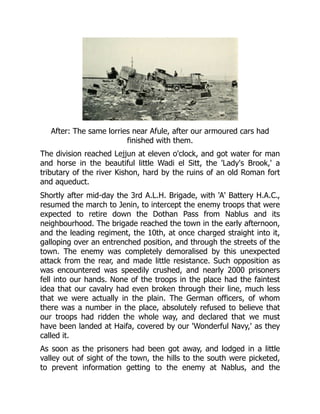
Before: German motor lorries at Nazareth.
(From an enemy photograph.)
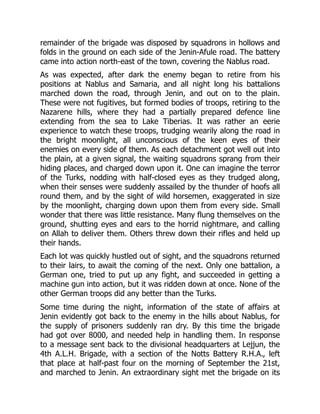
After: The same lorries near Afule, after our armoured cars had
finished with them.
The division reached Lejjun at eleven o'clock, and got water for man
and horse in the beautiful little Wadi el Sitt, the 'Lady's Brook,' a
tributary of the river Kishon, hard by the ruins of an old Roman fort
and aqueduct.
Shortly after mid-day the 3rd A.L.H. Brigade, with 'A' Battery H.A.C.,
resumed the march to Jenin, to intercept the enemy troops that were
expected to retire down the Dothan Pass from Nablus and its
neighbourhood. The brigade reached the town in the early afternoon,
and the leading regiment, the 10th, at once charged straight into it,
galloping over an entrenched position, and through the streets of the
town. The enemy was completely demoralised by this unexpected
attack from the rear, and made little resistance. Such opposition as
was encountered was speedily crushed, and nearly 2000 prisoners
fell into our hands. None of the troops in the place had the faintest
idea that our cavalry had even broken through their line, much less
that we were actually in the plain. The German officers, of whom
there was a number in the place, absolutely refused to believe that
our troops had ridden the whole way, and declared that we must
have been landed at Haifa, covered by our 'Wonderful Navy,' as they
called it.
As soon as the prisoners had been got away, and lodged in a little
valley out of sight of the town, the hills to the south were picketed,
to prevent information getting to the enemy at Nablus, and the
remainder of the brigade was disposed by squadrons in hollows and
folds in the ground on each side of the Jenin-Afule road. The battery
came into action north-east of the town, covering the Nablus road.
As was expected, after dark the enemy began to retire from his
positions at Nablus and Samaria, and all night long his battalions
marched down the road, through Jenin, and out on to the plain.
These were not fugitives, but formed bodies of troops, retiring to the
Nazarene hills, where they had a partially prepared defence line
extending from the sea to Lake Tiberias. It was rather an eerie
experience to watch these troops, trudging wearily along the road in
the bright moonlight, all unconscious of the keen eyes of their
enemies on every side of them. As each detachment got well out into
the plain, at a given signal, the waiting squadrons sprang from their
hiding places, and charged down upon it. One can imagine the terror
of the Turks, nodding with half-closed eyes as they trudged along,
when their senses were suddenly assailed by the thunder of hoofs all
round them, and by the sight of wild horsemen, exaggerated in size
by the moonlight, charging down upon them from every side. Small
wonder that there was little resistance. Many flung themselves on the
ground, shutting eyes and ears to the horrid nightmare, and calling
on Allah to deliver them. Others threw down their rifles and held up
their hands.
Each lot was quickly hustled out of sight, and the squadrons returned
to their lairs, to await the coming of the next. Only one battalion, a
German one, tried to put up any fight, and succeeded in getting a
machine gun into action, but it was ridden down at once. None of the
other German troops did any better than the Turks.
Some time during the night, information of the state of affairs at
Jenin evidently got back to the enemy in the hills about Nablus, for
the supply of prisoners suddenly ran dry. By this time the brigade
had got over 8000, and needed help in handling them. In response
to a message sent back to the divisional headquarters at Lejjun, the
4th A.L.H. Brigade, with a section of the Notts Battery R.H.A., left
that place at half-past four on the morning of September the 21st,
and marched to Jenin. An extraordinary sight met the brigade on its
arrival. The whole plain seemed to be covered with prisoners, motor
cars, lorries, wagons, animals, and stores, in an inextricable
confusion. In and out of this mass the sorely tried Australian troopers
pushed their way, sweating and swearing, every now and then riding
savagely at the hordes of natives hovering on the outskirts of the
crowd like a flock of vultures, and looting the stores that strewed the
ground; anon pressing into the throng again, to round up a group of
straying prisoners. Over all presided the stocky figure of the
brigadier,[25] like the leader of a gigantic school picnic, unhurried and
efficient.
Jenin was the enemy's main supply and ordnance depot for his VIIth
and VIIIth Armies, and very large quantities of valuable stores of all
sorts were captured here, together with several well-equipped
workshops and three hospitals. There were twenty-four burnt
aeroplanes, and one intact, on the aerodrome, and a number of
engines and a quantity of rolling stock in the station. In some caves
near by were found large stores of German beer and wine, and a lot
of excellent tinned food, and, in a wagon abandoned on the road,
there were nearly £20,000 in gold. The two troopers who were
detailed to guard this money sat on the boxes of bullion all day,
without knowing what was in them, and have been kicking
themselves ever since! This gold was of the greatest use to the Corps
later on, when we were living on the country, and had to buy all our
food and forage. Among the minor captures was a quantity of
photographic negatives belonging to the official photographer with
the German forces, one of which depicted some of our guns which
were lost in the second Amman raid. Also a British motor cycle,
captured from us at the first battle of Gaza, eighteen months before.
The chief medical officer of the German hospital in the town
volunteered the information that all ranks there, German as well as
Turkish, were secretly glad to be captured. For the past ten days, he
said, British aeroplanes had hovered over the place almost
continually, and a rain of bombs had fallen all the time on the station,
aerodrome, and workshops. Most of the troops left the town every
day before dawn, and spent the hours of daylight in caves in the
hills. All work was practically at a standstill, and none of the German
aeroplanes had ever ventured to leave the ground. He was very
puzzled by the fact that we had never bombed the town itself, and,
when one of our officers replied that it was not the British custom to
bomb undefended native villages, he shrugged his shoulders and
remarked that such ideas were inadmissible in war. The Germans
never brought themselves to believe that we were serious in our
determination to observe the rules of civilised warfare in this respect.
They realised, however, that we never bombed hospitals, a fact of
which they were not slow to take advantage. Later on, when
Nazareth was reoccupied, it was found that every house that
harboured German troops, which is to say nearly every house of
substance in the town, had a red cross, or its Turkish equivalent a
red crescent, painted on the roof.
FOOTNOTES:
[24] Brigadier-General P.J.V. Kelly, C.M.G., D.S.O., 3rd Hussars. He
commanded the Egyptian troops in the brilliantly successful little
Darfur Campaign of 1916.
[25] Brigadier-General L. Wilson, C.M.G., D.S.O., A.I.F.
CHAPTER XVII
DÉBÂCLE
While the cavalry were racing for the Plain of Esdraelon on the 19th
September the 21st Corps, continuing its wheel to the right, drove
the enemy into the hills. The 5th A.L.H. Brigade, riding on the left
flank of the Corps, and some distance in advance of it, approached
Tul Keram about mid-day.
The orders to the brigade were to seize the town, if possible, or,
failing that, to engage the enemy there, and endeavour to prevent
him withdrawing his troops and guns till the arrival of our infantry.
Knowing the moral effect on the Turks of a threat to their rear,
General Onslow decided to throw a portion of his brigade across the
Tul Keram-Nablus road, the only exit from the town to the east. He
despatched the 14th A.L.H. regiment and part of the brigade
machine-gun squadron, with instructions to find a way through the
hills north of the town, and descend on to the road some two miles
to the north-east. With the remainder of his brigade he approached
the town from the north-west, and was met by a very heavy fire from
the enemy there. Tul Keram was a railway and store depot of
considerable importance. It had been fortified, and now served the
enemy as a strong point, on which his troops, defeated in the coastal
plain, might rally, and so save his right flank. He was, of course, still
in ignorance of the fact that three divisions of cavalry were already
well on their way up the coast.
As the 5th Brigade approached the town, the Royal Air Force swept
down out of the blue sky, and commenced an intense and systematic
bombing of the enemy positions around the town, and the closely
packed column of transport and guns slowly retiring along the road
to Nablus. The utmost confusion broke out in the enemy ranks.
About three o'clock the 14th A.L.H. Regiment, which had moved with
extraordinary rapidity, descended on the Nablus road about two miles
from Tul Keram. The Turks were now faced simultaneously with the
three things they most feared. Their retreat was cut off; they were
being heavily attacked from the air; and they were threatened on
both sides with a cavalry charge. The demoralisation on the road was
complete. Not knowing the strength of the cavalry force which had
suddenly appeared on the road in front of them, and evidently
deceived by the volume of fire poured on them from our machine
guns and automatic rifles, the enemy troops and transport on the
road made no attempt to break through, but turned back towards Tul
Keram. The persistent attacks of our aeroplanes soon destroyed all
semblance of discipline in the column, and a disordered mass of
fugitives streamed back into Tul Keram, increasing the confusion
there. The Turks in the positions surrounding the town, however, still
fought on gallantly enough, and General Onslow, unable to advance
his brigade over the open ground without encountering losses which
would not have been justified, contented himself with holding the
enemy in check on the north, east and west, and awaited the arrival
of our infantry. A brigade of the 60th Division came up about half-
past five, having marched and fought over sixteen miles of heavy
country since dawn, and rushed the town from the south-west.
General Onslow now reassembled his brigade, and succeeded in
watering all the horses, which was something of a feat, considering
the darkness and confusion. At two in the morning the brigade
started off for its second objective, the Messudieh-Jenin Railway east
of Ajje.
Regarded merely as a march, this expedition, carried out in the dark
and without guides, over unknown and almost trackless mountain
country, ranks as one of the finest episodes of the campaign. Unable
to use the road or railway, along which Turkish reinforcements were
known to be hurrying towards Tul Keram, the brigade struck straight
across the mountains to the north-east, and, passed through Deir el
Ghusn, Ellar, Kefr Ruai, and Fahme. From the last-named place a
moderate pack road led through Ajje to the railway, which was
reached at seven in the morning by the brigade headquarters and a
demolition party, who blew up a section of the line.
Dawn found the brigade strung out over fifteen miles of country. Its
work was done, and, as it would have taken several hours to
reassemble the regiments at Ajje, the Brigadier at once turned back
along the track by which he had come, picking up his scattered units
on the way, and returned to Tul Keram. It was seven o'clock in the
evening before the whole brigade was again concentrated there.
In accordance with the Commander-in-Chief's plan, the 20th Corps
had taken no part in the advance during the first day, beyond seizing
one or two tactical points, to facilitate its operations on the following
day, but on the 20th it was thrown into the battle, and the whole line
became hotly engaged. The enemy fought stubbornly, especially in
the centre of his line, where most of the German troops were
concentrated. His positions were of great natural strength, and had
been excellently entrenched and wired during the summer. By
nightfall, however, his resistance had been broken all along the front,
and our infantry had advanced as far as the line Anebta (five miles
east of Tul Keram)-Beit Lid-Funduk-Kefr Harries-El Lubban (on the
Nablus-Jerusalem road, eleven miles south of Nablus) to Dome. The
enemy had thus been turned out of nearly all his entrenched
positions.
Owing to the breakdown of their communications, and the virtual
destruction of their air force, the Turks had not yet realised that our
cavalry were behind them, and that all their lines of retreat to the
north were thus closed. The only way of escape still left open for
their trapped armies was by the two difficult tracks from Nablus and
Ain el Subian (on the Nablus-Beisan road) to Jisr el Damieh.
Chaytor's Force was fighting hard in the Jordan Valley to reach and
block the lower end of these roads.
Our infantry resumed the attack at daylight on the 21st. The 20th
Corps made rapid progress, and, by nightfall, had established itself
across the Nablus-Jisr el Damieh track about Beit Dejan.
On the 21st Corps front, the advance was slower. The enemy in this
part of the field was not yet demoralised, and his rearguards put up a
stubborn fight, especially about Nablus. The 5th A.L.H. Brigade,
moving along the main road from Tul Keram, with an armoured car
battery, was usefully employed protecting the left flank of the Corps
during the day. General Onslow turned the Turks and Germans out of
a series of strong rearguard positions astride the road, by using his
machine guns and armoured cars on the road, to hold the enemy in
front with their fire, while dismounted parties from the brigade
worked round his flanks. The French regiment particularly
distinguished itself in this fighting, and earned generous praise from
the Australians.
In the early afternoon some of the guns of the 3rd (Lahore) Division
succeeded in reaching a position overlooking Nablus from the south-
west, and their vigorous shelling, coupled with the converging
attacks of the 10th and 53rd Divisions, drove the Turkish rearguards
out of their positions. The 5th Brigade rode into the town hard on the
heels of the retreating enemy, and took 700 prisoners. One squadron
pushed on down the Jerusalem road, and gained touch with the 20th
Corps cavalry regiment, the Worcester Yeomanry, about Balata. The
following day the brigade marched to Jenin to rejoin the Australian
Mounted Division, having accounted for 3500 prisoners during the
three days.
Both at Tul Keram and in Nablus great quantities of valuable stores,
which the enemy had been unable to remove or destroy, fell into our
hands. Especially welcome were the many railway engines and trucks
found intact at the former place, which were very soon employed on
the repaired railway, carrying ammunition and stores to our troops.
Here, too, a troop of the 15th A.L.H. Regiment rounded up and
captured a detachment of the Turkish Field Treasury, with about
£5000 in gold and a quantity of notes.
Throughout the day complete confusion had reigned in the enemy
rear. Camps and stores were hurriedly abandoned or set on fire.
Many heavy guns were dropped over precipices to save them from
falling intact into the hands of the British. Driven out of their
organised positions, and unable to keep touch with one another in
this difficult, mountain country, the enemy regiments retired
independently. Most of them made either for Beisan or Jisr el
Damieh, but every wadi leading down to the Jordan was congested
with troops. The confusion was increased by the repeated attacks of
our aeroplanes, especially along the Nablus-Beisan road, which was
packed with a dense column of troops and transport. Part of this
column continued along the road to Beisan, where it fell into the
hands of the 4th Cavalry Division. The greater part turned off at Ain
el Subian, and made for Jisr el Damieh, along the Wadi Farah track.
About a mile beyond Ain Shibleh, this track passes through a deep
gorge. The transport at the head of the column was caught by our
aeroplanes in this gorge, and heavily bombed. A general panic
ensued. Drivers abandoned their vehicles, and fled into the hills;
wagons, lorries, and guns were smashed or overturned, and in a
short time the road was completely blocked. The remainder of the
column turned off at Ain Shibleh, along a narrow track leading to
Beisan. Still harassed by our aeroplanes, it broke up ultimately into
isolated parties, which scattered into the hills, and were gathered in
by the 4th Cavalry Division during the next two days.
Our infantry and the Royal Air Force had done their work well, in face
of great difficulties. To the cavalry now fell the task of gathering up
the remnants of the two Turkish armies.
There was little cavalry movement of importance on the 21st. The
4th Division established posts right across the Jordan Valley, east of
the river, and pushed patrols along the roads leading south and
south-west from Beisan. Shortly after dark, the first body of retiring
enemy troops was encountered on the Nablus road. It was at once
charged in the moonlight by the Central India Force (10th Brigade)
and dispersed, leaving a number of prisoners in our hands. There
was no serious fighting during the night, but the division had very
hard work, and got over 3000 prisoners before daybreak.
not
right
Diagram illustrating the Situation on the evening or the 20th of
November
The 5th Cavalry Division had sent the 14th Brigade to Jenin, at
daylight, to assist the two brigades of the Australian Mounted
Division there in dealing with the large number of prisoners, and to
help protect the captured enemy stores from the natives. By the
afternoon, however, the prisoners had been got away under escort to
Lejjun, and the brigade was able to return to Afule. The 14th and
15th Brigades then established a line of pickets along the railway to
near Beisan, in touch with the 4th Division.
Meanwhile the 13th Brigade, with 'B' Battery H.A.C., had been sent
off early in the morning to reoccupy Nazareth.
The 9th Hodson's Horse marched straight up the Afule-Nazareth road
with the guns, and entered the town from the south. The other two
regiments, leaving the road some distance south of the town, made
their way through the hills to the Tiberias road, and attacked from
the east and north. All three regiments attacked dismounted. There
was a good deal of fighting of a difficult nature in the narrow,
tortuous streets of the town, but most of the enemy troops
remaining after our raid of the previous day had already evacuated
the town, and those still left were soon overpowered. By ten o'clock
the 13th Brigade had possession of the town. The roads leading
west, north, and east were then picketed, and strong patrols were
pushed out as far as Seffurie and Kefr Kenna.
Shortly after midnight a Turkish battalion, marching from Haifa,
attacked the outposts of the brigade on the Acre road. The 18th
Lancers promptly charged the Turks in the moonlight, and chased
them for two miles down the road, killing sixty with the lance and
taking over 300 prisoners.
The Australian Mounted Division remained in the neighbourhood of
Jenin and Lejjun during the day.
The large numbers of prisoners taken by the cavalry during the past
twenty-four hours were a serious encumbrance, and the feeding of
them became a very difficult problem. The Corps ration convoy that
arrived at Jenin on the 21st had to hand over all its rations to them.
As our own men carried three-days men's and two-days horses'
rations on the man and horse, they did not actually have to go
hungry, but the food question had become acute, and, until the
prisoners could be got away, no further move forward could be
contemplated. Fortunately, on the following day, it was found
possible to send most of them back to Kakon, near Tul Keram, where
they were taken over by a brigade of the 60th Division.
The Commander-in-Chief motored to Lejjun on the morning of the
22nd, and met General Chauvel.
'Well, how are you getting on?' was his greeting.
'Pretty well, Sir, pretty well,' replied the General; 'we've got 13,000
prisoners so far.'
'No ... good to me!' exclaimed the Chief, with a laugh; 'I want 30,000
from you before you've done.'
He was to have over 80,000 from the Corps before the operations
ended.
The 5th Cavalry Division concentrated at Nazareth on the 22nd,
preparatory to an advance on Haifa and Acre, its place at Afule being
taken by the 3rd A.L.H. Brigade. The 5th A.L.H. Brigade rejoined the
Australian Mounted Division at Jenin during the day.
In the early hours of the morning an enemy column, with transport
and guns, was reported by our aeroplanes to be moving north along
the Ain Shibleh-Beisan track, its head being then nine miles south of
Beisan. This was part of the force that had been caught and heavily
bombed by our aeroplanes the day before in the gorge of the Wadi
Farah, as it was trying to escape towards the Jordan.
The 4th Cavalry Division at once sent a force from Beisan along the
Ain Shibleh track to intercept the column, and despatched Jacob's
Horse over the bridge of Jisr el Sheikh Hussein to push patrols down
the track which follows the Jordan on its east bank, so as to secure
any parties which might escape across the river. At the same time the
20th Corps cavalry regiment, the Worcester Yeomanry, was ordered
to advance northwards from Ain Shibleh, supported by infantry, to
collect stragglers, and to drive any formed bodies into the arms of
the 4th Cavalry Division.
Our airmen then proceeded to attack the column with bombs and
machine guns, and, in a short time, had completely broken it up. The
enemy scattered in panic into the hills in small parties, which were
rounded up by the 4th Division next day. The Worcester Yeomanry
rode as far as the gorge where the ill-fated column had been caught
by our aeroplanes, and here its farther advance was stopped, as the
track was completely blocked by overturned vehicles and the dead
bodies of men and horses. On one stretch of the track just here,
under five miles long, eighty-seven guns and 900 motor lorries and
other vehicles were afterwards found by the infantry, when clearing
up the area.
About mid-day the 11th and 12th Light Armoured Car Batteries were
sent to occupy Haifa, which was believed to have been evacuated by
the enemy. With them went the General commanding the artillery of
the Cavalry Corps, in a large and beautiful Rolls-Royce car, with the
Commander-in-Chiefs Union Jack on the bonnet, and a proclamation
in his pocket to read to the peaceful inhabitants.
He met with a warm reception. As the cars neared the town, several
enemy batteries opened fire on them, while machine guns on Mount
Carmel swept the road. The batteries had evidently registered
carefully, for almost the first salvo hit the General's car, knocking it
into the ditch and smashing the flag. The General himself, with his
staff, had to take cover in the same ditch, and quickly too, and there
they lay, getting the proclamation covered with mud, till the
armoured cars succeeded in retrieving them. It was a shocking affair,
and showed a sad lack of respect on the part of the enemy. The
'Haifa Annexation Expedition,' as it was irreverently called, returned
to Afule in somewhat chastened mood, but fortunately without any
serious casualties.
The chief movement of the day took place in the Jordan Valley. Early
in the morning the New Zealand Mounted Brigade succeeded in
getting astride the Nablus-Jisr el Damieh roads at El Makhruk, after a
sharp fight, taking 500 prisoners, including a divisional commander.
About an hour previously the 38th Royal Fusiliers, one of the two
Jewish battalions with the force, had captured the enemy position
covering the river ford at Umm el Shert, while, about half-past ten,
the New Zealand Brigade, with a West Indies battalion, seized the
bridge at Jisr el Damieh, and crossed to the east bank. In the attack
on the bridgehead the New Zealanders and the 'coloured gentlemen'
both charged the Turks simultaneously, and had a severe hand-to-
hand struggle before achieving their object. The 2nd A.L.H. Brigade
also crossed the river at Ghoraniyeh, and, in conjunction with the
20th Indian Infantry Brigade, drove in the Turkish outposts, and, by
nightfall, was facing the main enemy position at Shunet Nimrin.
Early in the night it became clear that a general retirement of the
Turkish IVth Army had begun, and orders were issued for the force to
follow it vigorously on the morrow.
German aircraft captured intact at Afule. Mount Tabor in the
background.
In the hands of the enemy! Some of our Horse Artillery guns
captured in the second trans-Jordan raid.
(From an enemy photograph.)
CHAPTER XVIII
DESTRUCTION
Next day, September the 23rd, Chaytor's Force was on the move at
daylight, following up the retreating IVth Army east of the Jordan.
The 3rd A.L.H. Regiment (1st Brigade), with the 2nd B.W.I.
Regiment, had a sharp fight at the ford of Mafid Jozeleh, half way
between El Damieh and Ghoraniyeh, where the Turks had left a
rearguard. The enemy was dispersed, and the Australians crossed
the river at six o'clock. The remainder of the 1st A.L.H. Brigade
crossed at Umm el Shert, and moved on El Salt up the Wadi
Arseniyet track. The 2nd A.L.H. Brigade, having crossed the Jordan at
Ghoraniyeh, pressed on up the Wadi Kefrein, and seized Kabr
Mujahid at five o'clock, rounding up the small force there after a
lively fight, and then turned north along the very difficult mountain
track towards El Sir. Meanwhile the New Zealand Brigade, having
crossed at El Damieh, rode hard up the mountain track, and occupied
El Salt about seven in the evening. The only opposition met with was
from a small, wired-in post on the El Damieh-El Salt track. A brigade
of Indian infantry reached Shunet Nimrin in the evening, and found it
evacuated by the enemy. One battalion of the B.W.I. Regiment and
one squadron of cavalry were left at El Damieh, to gain touch with
patrols of the 4th Cavalry Division moving down the Jordan.
Orders were issued to the force in the evening by G.H.Q., to push on
next day, harass the enemy, and try to cut his line of retreat to the
north; also to gain touch with the Arab Army advancing from the
south.
The 4th Cavalry Division also had a busy day. Early in the morning
our aeroplanes reported that the enemy had found a ford over the
Jordan about six miles south of Beisan and was crossing the river in
large numbers. The 11th Brigade, with the Hants Battery R.H.A., was
at once sent off to intercept them, and moved south along both
banks of the Jordan. The 1/1 County of London Yeomanry and the
29th Lancers marched along the west bank, and Jacob's Horse east
of the river. At half-past eight, patrols of the 29th Lancers,
approaching the ford of Makhadet Abu Naj, seven miles south-east of
Beisan, were fired on by a party of Turks covering the passage of a
large force of the enemy over the river. A considerable portion of this
force was already across. The 29th Lancers and part of the brigade
machine-gun squadron engaged the Turks on the north, while the
Yeomanry pushed round the left flank of the enemy force, in order to
take it in rear. The ground was very difficult, and the Yeomanry were
subjected to a considerable fire from a low hill on the west bank, on
which the Turks had a number of machine guns. This hill was the
central point of resistance of the enemy bridgehead.
As soon as the Yeomanry were clear of the enemy's flank, the 29th
remounted and charged the hill. The charge was completely
successful. Large numbers of the Turks were speared, and 800
prisoners and no less than twenty-five machine guns were taken.
Like all the work of these veteran Indian cavalry regiments in the
campaign, this charge was admirably carried out, but that it
succeeded in getting home in the face of such a potential volume of
machine-gun and rifle fire is an indication of the state of
demoralisation to which the enemy was now reduced.
Meanwhile, on the east bank, Jacob's Horse, which was a little way
behind, rode up and instantly charged the large force of Turks on
that side. This charge, however, was held up by a deep wadi, and the
intense fire of the enemy compelled our troops to retire and take
cover. The regiment re-formed, and again attempted to charge the
enemy, but was again stopped by bad ground, and suffered severe
casualties.
The Hants Battery, on the west bank, coming up just at this moment,
immediately galloped into action, and opened a rapid and accurate
fire on the masses of Turks across the river. It was at once hotly
engaged by two concealed enemy batteries on the east bank, and in
a few minutes every one of the guns had been hit. None were put
out of action, however, and all continued firing most gallantly. The
enemy's fire was so heavy that General Gregory ordered a troop of
cavalry out into the open to try and draw the fire of the Turkish guns,
and so enable the battery to withdraw and take up a concealed
position. Before the guns could be moved, however, the situation was
cleared by one of the Yeomanry squadrons, which had worked its
way south of the enemy position. This squadron succeeded in
crossing the river at Makhadet Fath Allah, and, wading across the
river, charged and captured the enemy guns.
Meanwhile a squadron of the 29th had been sent across the river, a
little farther north, to assist Jacob's Horse. Thus reinforced, the
regiment attacked again, and this attack, coupled with the loss of
their guns, broke the resistance of the Turks. Most of them
surrendered. A few succeeded in escaping for the time, amid the
broken ground on both banks of the river. 3000 prisoners, including a
divisional commander, ten guns, and thirty machine guns fell into our
hands.
After the action, the brigade continued its march south, to Ras el
Humeiyir, where it bivouacked for the night, with outposts south and
west, along the Wadi el Sherar and east of the Jordan.
During the night a troop of the 29th Lancers was sent off into the
hills to the west, to try and gain touch with the 20th Corps, about
Khurbet Atuf. This troop marched all night, along a very difficult
footpath, and met the 20th Corps cavalry regiment (Worcester
Yeomanry) at Atuf early in the morning. It rejoined the 11th Brigade
near Ras Umm Zoka during the day.
The task assigned to the 5th Cavalry Division on the 23rd was the
capture of Acre and Haifa. The 13th Brigade, with a Light Armoured
Car Battery and a light car patrol, left Nazareth at five in the
morning. Marching via Seffurie and Shefa Amr, the force reached
Acre about mid-day, and captured it without difficulty, the small
enemy garrison showing little inclination to fight. 260 prisoners and
two guns were taken here.
The remainder of the division left Nazareth at the same hour, and
reached the Kishon railway bridge, near El Harithie, about mid-day.
The 14th Brigade remained here, while the 15th Brigade, with 'B'
Battery H.A.C., moved on Haifa along the Afule-Haifa road, which
skirts the north-eastern edge of the Mount Carmel Range. There
were only two regiments with the brigade, as the Hyderabad Lancers
were absent, escorting prisoners back from Lejjun. They rejoined the
brigade late in the afternoon, just after Haifa had been captured.
The Mysore Lancers, advance guard to the brigade, reached the
village of Belled el Sheikh about ten o'clock, and, on emerging from
the trees that surround the village, came under heavy fire from a
number of guns on Mount Carmel, and from machine guns and rifles
in the hills north-west of the village. Patrols sent out to the north
drew fire from a large number of machine guns about Tel Abu
Hawam, and concealed among trees and shrubs near the main road
south of that place. It was evident that the position was strongly
held.
General Harbord had arrived at Belled el Sheikh, and received the
report of his advance guard. He had a difficult task before him. South
of the road the rocky wall of Carmel rose steeply, 1500 feet above
the plain. To the north, the country was flat and open, and afforded
little or no cover for troops, except along that portion of the Nahr el
Mukatta (the river Kishon) which runs east and west a mile and a
half north of Belled el Sheikh, which was bordered with trees and
scrub. The Wadi Ashlul el Wawy is practically dry at this time of year,
but the Nahr el Mukatta is a perennial stream, the banks of which are
very marshy.
The Brigadier decided that the first thing to be done was to silence
the guns on Mount Carmel. He accordingly despatched a squadron of
the Mysore Lancers, with a couple of machine guns, to climb the
mountain by a goat path, which follows the Wadi el Tabil from Belled
el Sheikh, and joins the road running along the backbone of the
range. This squadron was ordered to move along this road to the
north, locate the guns, and attack them. With the remainder of his
force the Brigadier decided to make a mounted attack from the east
on the enemy positions about Tel Abu Hawam, supported by his guns
and machine guns from the south-east. 'B' Battery H.A.C. came into
action close to the road, about half a mile north of Belled el Sheikh,
and the remainder of the machine-gun squadron, with two squadrons
Mysore Lancers, a little farther north, along the Acre Railway. The 4th
squadron Mysore Lancers was sent up the road running north from
near El Harbaj, with instructions to turn westwards at Tel El Subat,
and make for the mouth of the Nahr el Mukatta. It was then to push
along the sea shore, so as to take the enemy positions in reverse.
The Jodhpur Lancers took up a position of readiness, about 500
yards north-east of Belled el Sheikh, preparatory to making a dash
for the wooded portion of the Mukatta. They were to cross this, and
then wheel to the left, and charge the enemy on his left flank.
These dispositions were soon completed, and the troops then set
themselves to wait until the Mysore Lancers' squadron had dealt with
the enemy guns on Mount Carmel. Meanwhile our artillery and
machine guns searched the palm groves and scrub about Tel Abu
Huwam and along the banks of the Mukatta. Observation was
difficult, as the enemy was well concealed.
Shortly before mid-day General Harbord received a welcome
reinforcement in the Sherwood Rangers Yeomanry, which had been
sent up from El Harithie. He at once despatched a squadron of this
regiment to the assistance of the Mysore Lancers' squadron on
Carmel.
Desultory firing continued for the next two hours, but there was no
sign of any slackening of the enemy's artillery activity. At last the
Brigadier came to the conclusion that his troops on Carmel had either
been unable to fulfil their task of silencing the enemy guns, or had
lost their way. Time was running on, and he decided that he could
wait no longer. The Jodhpur Lancers were ordered out to the attack.
Moving off in column of squadrons, in line of troop columns, they
cantered out into the open towards the stream, coming under
intense fire as they crossed the Acre Railway. The fire, however,
appeared ill-directed, which was probably due to the vigorous action
of our artillery and machine guns supporting the attack.
Owing to the exposed nature of the ground, it had not been possible
to reconnoitre the Mukatta beforehand, and, when the Jodhpur
Lancers reached it, they found it quite impassable. Two ground
scouts, who jumped into the bed of the stream, disappeared
instantaneously into the quicksands. The regiment, was, however,
now committed to the attack, and it was impossible to turn back.
Changing direction left, the four squadrons charged straight at the
enemy.
The leading squadron, 'B,' galloping over the two branches of the
Wadi Ashlul el Wawy, dashed into the enemy machine guns, killed
the crews, and opened the defile between the Wadi Selman and the
mountain. The second squadron, 'D,' charged and captured the
enemy guns and machine guns about Tel Abu Hawam and north of it.
The remaining two squadrons galloped through the defile, straight on
into the town. Meanwhile, after clearing the defile, 'B' squadron
made its way along the lower slopes of Mount Carmel, and charged
into the German Colony west of Haifa, capturing several guns, and
killing large numbers of Turks and Germans. 'D' squadron, after
clearing up the Tel Abu Hawam area, galloped up the east bank of
the Wadi Selman and along the beach, entering the town on the
north-east. All four squadrons thus entered Haifa about the same
moment.
As soon as the charge got home, the two squadrons Mysore Lancers,
who had supported the attack with their fire, mounted, and followed
at a gallop into the town. Of the two detached squadrons of this
regiment, that on the north had been held up about half a mile west
of El Suriyeh. This squadron now mounted, and charged a body of
the enemy in position near the mouth of the Mukatta, capturing two
guns and 100 prisoners.
The squadron on Mount Carmel, after riding nearly six miles over
very bad country, had at last located the enemy guns at Karmelheim,
much farther north than had been expected. Dropping his machine
guns and all his Hotchkiss rifles on the track, to provide covering fire,
the squadron leader led the remainder of his troops away to the left
to charge the guns. Owing to casualties on the way up the range,
and to some of his men having been delayed by the difficulties of the
track, he found that, after providing for his Hotchkiss rifles, he had
only fifteen lances for the charge. Nevertheless, he decided to attack
at once, rightly judging that even an unsuccessful charge would
probably divert the fire of the enemy guns long enough to permit the
Jodhpur Lancers to make their attack in the plain. His machine guns
and Hotchkiss rifles had got close to the guns unseen, and now
opened a sudden and accurate fire on them. The fifteen men then
galloped in from the flank, and actually succeeded in silencing the
battery. The crews of two of the guns were killed, but the battery
escort then came up, and it might have gone hardly with the gallant
little band of cavalry had not the squadron of the Sherwood Rangers
arrived just in the nick of time to complete the work. By a fortunate
coincidence, this charge took place just as the Jodhpur Lancers
attacked in the plain.
1351 prisoners, seventeen guns, and eleven machine guns were
collected at Haifa after the action. The captured artillery included two
six-inch naval guns, which the Germans had mounted on the top of
Mount Carmel, to engage our warships in the event of an attempted
landing.
The Turks had fought well, firing until they were ridden down, but
once our cavalry were through the defile, the fight was practically
over. They galloped through the town, riding down with the lance any
bodies of the enemy who showed fight, and, in twenty minutes, had
overcome all opposition.
The Australian Mounted Division had a day of comparative rest. The
3rd A.L.H. Brigade relieved the 5th Cavalry Division at Nazareth, and
the rest of the division remained at Afule, sending patrols eastwards
as far as Beisan, to bring in the prisoners taken on the two previous
days by the 4th Cavalry Division. Towards evening the 'bag' began to
arrive, and, long after darkness fell, the endless column of captives
was still winding its way up the Valley of Jezreel.
Most of these prisoners had marched over twenty miles since their
capture, and no one knows how many more before they fell into our
hands. Their dragging feet raised a heavy cloud of dust, through
which they had trudged all the long, hot march, and they came in
raging with thirst. In anticipation of their arrival, several large canvas
tanks had been set up and filled with water, and elaborate
arrangements had been made by the capable and energetic water
officer of the Australian Division. Each man was to file past the tanks,
have a drink, fill his water bottle, and move on to the concentration
area with a gentle sigh of satisfaction. The water officer had eight
orderlies. There were 8000 prisoners, and, as soon as they smelt the
water, the 8000 charged the eight. The charge was successful, and
the prisoners thereupon all tried to get into the water together. In a
few seconds the tanks were trampled down, and the frenzied Turks
struggled and fought with one another in the darkness round the
muddy ruins. Eventually they had to be driven back at the point of
the sword. More water was procured, and the prisoners were
marched up to it in small parties under escort. It took all night to
supply them all.
The following day the 4th Cavalry Division continued its 'mopping up'
operations in the Jordan Valley.
Early in the morning an observation post of the London Yeomanry,
who were on outpost duty, observed a large force of the enemy
making for the ford of El Masudi. A squadron at once galloped for the
ford, but the enemy got there first, and held it up. Another squadron,
coming up in support, several times charged the Turks debouching
from the hills, and captured a large number of them. The Yeomen
had the greatest difficulty in dealing with their prisoners, who, after
surrendering and throwing down their rifles when charged,
repeatedly picked them up again, and went on fighting.
The Hants Battery now came up, and got into action at close range
against the enemy holding the ford. Its rapid and accurate fire
completely disconcerted the demoralised Turks, and the 29th Lancers
took prompt advantage of the fact to charge them. The enemy, worn
out and dispirited, made but a poor fight of it, and the action was
soon over. 4000 Turks, including Rushdi Bey, Commander of the 16th
Division, were taken prisoner, and another 1000 were rounded up
later on in the course of the day. Very few escaped.
The horses of the 11th Brigade were now in a very exhausted
condition, and the ammunition of the battery was running low.
General Barrow, therefore, ordered the Brigadier only to continue his
southward movement as far as Ras Umm Zoka and the Wadi Kafrinji,
sending patrols along the Jordan, to gain touch with Chaytor's Force.
This action completed the destruction of the VIIth and VIIIth Turkish
Armies. A few stragglers escaped across the river, to wander
miserably in the barren, waterless country to the east, at the mercy
of hostile Arabs. With the exception of these, the entire enemy force
west of the Jordan had been captured or killed, and all its guns,
transport, and stores had fallen into our hands.
The IVth Army, east of Jordan, and the 2nd Corps (Hedjaz Force)
about Maan, remained to be dealt with. Both these forces were in full
retreat to the north, the former pursued by Chaytor's Force and the
northern portion of the Arab Army, the latter harried by the southern
detachment of the Arabs. As the Hedjaz Railway had been cut at
Deraa, no supplies could reach these enemy forces, and they had to
depend for their food on a sparsely populated country, already
almost denuded of supplies by Turkish requisitions, and inhabited by
bitterly hostile tribes.
As the action of Chaytor's Force formed a separate episode in the
operations, it will be convenient to follow its fortunes to the
conclusion of its work.
Welcome to our website – the perfect destination for book lovers and
knowledge seekers. We believe that every book holds a new world,
offering opportunities for learning, discovery, and personal growth.
That’s why we are dedicated to bringing you a diverse collection of
books, ranging from classic literature and specialized publications to
self-development guides and children's books.
More than just a book-buying platform, we strive to be a bridge
connecting you with timeless cultural and intellectual values. With an
elegant, user-friendly interface and a smart search system, you can
quickly find the books that best suit your interests. Additionally,
our special promotions and home delivery services help you save time
and fully enjoy the joy of reading.
Join us on a journey of knowledge exploration, passion nurturing, and
personal growth every day!
testbankdeal.com


Financial Statement Analysis 11th Edition Subramanyam Solutions Manual

  • 1.
    Financial Statement Analysis11th Edition Subramanyam Solutions Manual download https://testbankdeal.com/product/financial-statement- analysis-11th-edition-subramanyam-solutions-manual/ Explore and download more test bank or solution manual at testbankdeal.com
  • 2.
    We believe theseproducts will be a great fit for you. Click the link to download now, or visit testbankdeal.com to discover even more! Financial Statement Analysis 11th Edition Subramanyam Test Bank https://testbankdeal.com/product/financial-statement-analysis-11th- edition-subramanyam-test-bank/ Financial Statement Analysis 10th Edition Subramanyam Test Bank https://testbankdeal.com/product/financial-statement-analysis-10th- edition-subramanyam-test-bank/ Financial Statement Analysis International Edition 13th Edition Gibson Solutions Manual https://testbankdeal.com/product/financial-statement-analysis- international-edition-13th-edition-gibson-solutions-manual/ Andersons Business Law and the Legal Environment Standard Volume 22nd Edition Twomey Test Bank https://testbankdeal.com/product/andersons-business-law-and-the-legal- environment-standard-volume-22nd-edition-twomey-test-bank/
  • 3.
    Principles of EnvironmentalScience Inquiry and Applications 7th Edition Cunningham Test Bank https://testbankdeal.com/product/principles-of-environmental-science- inquiry-and-applications-7th-edition-cunningham-test-bank/ Understanding American Government 14th Edition Welch Test Bank https://testbankdeal.com/product/understanding-american- government-14th-edition-welch-test-bank/ Physics for Scientists and Engineers 9th Edition Serway Solutions Manual https://testbankdeal.com/product/physics-for-scientists-and- engineers-9th-edition-serway-solutions-manual/ Business Communication Building Critical Skills 6th Edition Locker Test Bank https://testbankdeal.com/product/business-communication-building- critical-skills-6th-edition-locker-test-bank/ Sexuality Now Embracing Diversity 5th Edition Carroll Test Bank https://testbankdeal.com/product/sexuality-now-embracing- diversity-5th-edition-carroll-test-bank/
  • 4.
    Organizational Behavior KeyConcepts Skills and Best Practices 5th Edition Kinicki Solutions Manual https://testbankdeal.com/product/organizational-behavior-key-concepts- skills-and-best-practices-5th-edition-kinicki-solutions-manual/
  • 5.
    Chapter 07 -Cash Flow Analysis 7-1 Copyright © 2014 McGraw-Hill Education. All rights reserved. No reproduction or distribution without the prior written consent of McGraw-Hill Education. Chapter 7 Cash Flow Analysis REVIEW Cash is the residual of cash inflows less cash outflows for all prior periods of a company. Net cash flows, or simply cash flows, refer to the current period's cash inflows less cash outflows. Cash flows are different from accrual measures of performance. Cash flow measures recognize inflows when cash is received not necessarily earned, and outflows when cash is paid not necessarily incurred. The statement of cash flows reports cash flow measures for three primary business activities: operating, investing, and financing. Operating cash flows, or cash flows from operations, is the cash basis counterpart to accrual net income. Information on cash flows helps us assess a company's ability to meet obligations, pay dividends, increase capacity, and raise financing. It also helps us assess the quality of earnings and the dependence of income on estimates and assumptions regarding future cash flows. This chapter describes cash flows and their relevance to our analysis of financial statements. We describe current reporting requirements and their implications for our analysis of cash flows. We explain useful analytical adjustments to cash flows using financial data to improve our analysis. We direct special attention to transaction reconstruction, T-account, and conversion analyses.
  • 6.
    Chapter 07 -Cash Flow Analysis 7-2 Copyright © 2014 McGraw-Hill Education. All rights reserved. No reproduction or distribution without the prior written consent of McGraw-Hill Education. OUTLINE • Statement of Cash Flows Relevance of Cash Reporting by Activities Constructing the Cash Flow Statement Special Topics • Reporting Cash Flows from Operations Indirect Method Direct Method Converting from Indirect to Direct Method Adjustments to Cash Flow Components Additional Disclosures and Adjustments • Analysis Implications of Cash Flows Limitations in Cash Flow Reporting Interpreting Cash Flows and Net Income Alternative Cash Flow Measures Company and Economic Conditions Free Cash Flow Cash Flows as Validators • Specialized Cash Flow Ratios Cash Flow Adequacy Ratio Cash Reinvestment Ratio • Appendix 7A Analytical Cash Flow Worksheets
  • 7.
    Chapter 07 -Cash Flow Analysis 7-3 Copyright © 2014 McGraw-Hill Education. All rights reserved. No reproduction or distribution without the prior written consent of McGraw-Hill Education. ANALYSIS OBJECTIVES • Explain the relevance of cash flows in analyzing business activities. • Describe reporting of cash flows by business activities. • Describe the preparation and analysis of the statement of cash flows. • Interpret cash flows from operating activities. • Analyze cash flows under alternative company and business conditions. • Describe alternative measures of cash flows and their usefulness. • Illustrate an analytical tool in evaluating cash flows (Appendix 7A).
  • 8.
    Chapter 07 -Cash Flow Analysis 7-4 Copyright © 2014 McGraw-Hill Education. All rights reserved. No reproduction or distribution without the prior written consent of McGraw-Hill Education. QUESTIONS 1. The term cash flow was probably first coined by analysts. They recognized that the accrual system of income measurement permits the introduction of a variety of alternative accounting treatments and consequent distortions. The crude concept of cash flow—net income plus major noncash expenses (such as depreciation)—was derived to bypass these distortions and bring income measurement closer to the discipline of actual cash flows. This cash flow measure, still a popular surrogate for cash from operations (CFO), is crude because it falls short of reliably approximating in most cases the correct measure of CFO. Confusion with the term cash flow derives from several sources. One source of confusion stems from the initial and incorrect computation of the crude measure of cash flow as income plus major noncash expenses. The figure fails to reflect actual cash flows. Another and more serious confusion arises from the assertion by some, and particularly by managers dissatisfied by the level of their reported net income, that cash flow is a measure of performance superior to or more valid than net income. This assertion implicitly assumes that depreciation, and other noncash costs, are not genuine expenses. Experience shows that only net income is properly regarded as a measure of performance and can be related to the equity investment as an indicator of operating performance. If we add back depreciation to net income and compute the resulting return on investment, we are, in effect, confusing the return on investment with an element of return on investment in fixed assets. 2. While fragmentary information on the sources and uses of cash can be obtained from comparative balance sheets and from income statements, a comprehensive picture of this important area of activity can be gained only from a statement of cash flows (SCF). The SCF provides information to help answer questions such as: • What amount of cash is generated by operations? • What utilization is made of cash provided by operations? • What is the source of cash invested in new plant and equipment? • What use is made of cash from a new bond issue or the issuance of common stock? • How is it possible to continue the regular dividend in the face of an operating loss? • How is debt repayment achieved? • What is the source of cash used to redeem the preferred stock? • How is the increase in investments financed? • Why, despite record profits, is the cash position lower than last year? 3. SFAS 95 requires that the statement of cash flows classify cash receipts and cash payments by operating, financing and investing activities. Operating activities encompass all the earning-related activities of the enterprise. They encompass, in addition to all the income and expense items found on the income statement, all the net inflows and outflows of cash that operations impose on the enterprise. Such operations include activities such as the extension of credit to customers, investment in inventories, and obtaining credit from suppliers. This means operating activities relate to all items in the statement of income (with minor exceptions) as well as to balance sheet items that relate to operations mostly working capital accounts such as accounts receivable, inventories, prepayments, accounts payable, and
  • 9.
    Chapter 07 -Cash Flow Analysis 7-5 Copyright © 2014 McGraw-Hill Education. All rights reserved. No reproduction or distribution without the prior written consent of McGraw-Hill Education. accruals. SFAS 95 also specifies that operating activities include all transactions and events that are not of an investing or financing nature. Financing activities include obtaining resources from owners and providing them with a return of or a return on (dividends) their investment. They also include obtaining resources from creditors and repaying the amounts borrowed or otherwise settling the obligations. Investing activities include acquiring and selling or otherwise disposing of both securities that are not cash equivalents and productive assets that are expected to generate revenues over the long-term. They also include lending money and collecting on such loans. 4. We can distinguish among three categories of adjustments that convert accrual basis net income to cash from operations: (i) Expenses, losses, revenues, and gains that do not use or generate cash such as those involving noncash accounts (except those in ii), (ii) Net changes in noncash accounts (mostly in the operating working capital group) that relate to operations—these modify the accrual-based revenue and expense items included in income, (iii) Gains and losses (such as on sales of assets) that are transferred to other sections of the SCF so as to show the entire cash proceeds of the sale. 5. The two methods of reporting cash flow from operations are: Indirect Method: Under this method net income is adjusted for noncash items required to convert it to CFO. The advantage of this method is that it is a reconciliation that discloses the differences between net income and CFO. Some analysts estimate future cash flows by first estimating future income levels and then adjusting these for leads and lags between income and CFO (that is, noncash adjustments). Direct (or Inflow-Outflow) Method: This method lists the gross cash receipts and disbursements related to operations. Most respondents to the Exposure Draft that preceded SFAS 95 preferred this method because this presentation discloses the total amount of cash that flows into the enterprise and out of the enterprise due to operations. This gives analysts a better measure of the size of cash inflows and outflows over which management has some degree of discretion. As the risks that lenders are exposed to relate more to fluctuations in CFO than to fluctuations in net income, information on the amounts of operating cash receipts and payments is important in assessing the nature of those fluctuations. 6. The function of the income statement is to measure the profitability of the enterprise for a given period. This is done by matching expenses and losses with the revenues and gains earned. While no other statement measures profitability as well as the income statement, it does not show the timing of cash flows and the effect of operations on liquidity and solvency. The latter is reported on by the SCF. Cash from operations (CFO) reflects a broader concept of operations relative to net income. It encompasses all earning-related activities of the enterprise. CFO is concerned not only with expenses and revenues but also with the cash demands of these activities, such as investments in customer receivables and in inventories as well as the financing provided by suppliers of goods and services. CFO focuses on the liquidity aspect of operations and is not a measure of profitability because it does not include important costs such as the use of long-lived assets in operations or important revenues such as the equity in the earnings of nonconsolidated subsidiaries or affiliates.
  • 10.
    Chapter 07 -Cash Flow Analysis 7-6 Copyright © 2014 McGraw-Hill Education. All rights reserved. No reproduction or distribution without the prior written consent of McGraw-Hill Education. 7. The SCF sheds light on (i) the effects of earning activities on cash resources, (ii) what assets are acquired, and (iii) how assets are financed. It also can highlight more clearly the distinction between net income and cash provided by operations. The ability of an enterprise to generate cash from operations on a consistent basis is an important indicator of financial health. No business can survive over the long run without generating cash from its operations. However, the interpretation of CFO figures and trends must be made with care and with a full understanding of all surrounding circumstances. Prosperous as well as failing entities can find themselves unable to generate cash from operations at any given time, but for different reasons. The entity caught in the "prosperity squeeze" of having to invest its cash in receivables and inventories to meet ever-increasing customer demand will often find that its profitability will facilitate financing by equity as well as by debt. That same profitability should ultimately turn CFO into a positive figure. The unsuccessful firm, on the other hand, will find its cash drained by slowdowns in receivable and inventory turnovers, by operating losses, or by a combination of these factors. These conditions usually contain the seeds of further losses and cash drains and also can lead to difficulties in obtaining trade credit. In such cases, a lack of CFO has different implications. The unsuccessful or financially pressed firm can increase its CFO by reducing accounts receivable and inventories, but usually this is done at the expense of services to customers that can further depress future profitability. Even if the unsuccessful firm manages to borrow, the costs of borrowing only magnify the ultimate drains of its cash. Thus, profitability is a key consideration, and while it does not insure CFO in the short run, it is essential to a healthy financial condition in the long run. Changes in operating working capital items must be similarly interpreted in light of attending circumstances. An increase in receivables can mean expanding consumer demand for enterprise products or it can mean an inability to collect amounts due in a timely fashion. Similarly, an increase in inventories (and particularly of the raw material component) can imply preparations for an increase in production in response to consumer demand. It also can imply (particularly if the finished goods component of inventories is increasing) an inability to sell due to, say, when anticipated demand did not materialize. 8. A valuable analytical derivative of the SCF is "free cash flow." As with any other analytical measure, analysts must pay careful attention to components of this computation. Here, as in the case of any cash flow measures, ulterior motives may sometimes affect the validity of the computation. One of the analytically most useful computations of free cash flow is: Cash from Operations (CFO) - Capital expenditures required to maintain productive capacity used in generating income - Dividends (on preferred stock and maintenance of desired payout on common stock) = Free Cash Flow (FCF)
  • 11.
    Chapter 07 -Cash Flow Analysis 7-7 Copyright © 2014 McGraw-Hill Education. All rights reserved. No reproduction or distribution without the prior written consent of McGraw-Hill Education. Positive FCF implies that this is the amount available for company purposes after provisions for financing outlays and expenditures to maintain productive capacity at current levels. Internal growth and financial flexibility depend on an adequate amount of FCF. Note that the amount of capital expenditures needed to maintain productive capacity at current levels is generally not disclosed by companies. It is included in total capital expenditures, which also can include outlays for expansion of productive capacity. Breaking down capital expenditures between these two components is difficult. The FASB considered this issue, but in SFAS 95 it decided not to require classification of investment expenditures into maintenance and expansion categories. 9. For financial statement analysis, the SCF provides clues to important matters such as: • Feasibility of financing capital expenditures and possible sources of such financing. • Sources of cash to finance an expansion in the business. • Dependence of the firm on external sources of financing (such as debt or equity). • Future dividend policies. • Ability to meet future debt service requirements. • Financial flexibility, that is, the firm's ability to generate sufficient cash so as to respond to unanticipated needs and opportunities. • Insight into the financial habits of management and indications of future policies. • Signals regarding the quality of earnings.
  • 12.
    Chapter 07 -Cash Flow Analysis 7-8 Copyright © 2014 McGraw-Hill Education. All rights reserved. No reproduction or distribution without the prior written consent of McGraw-Hill Education. EXERCISES Exercise 7-1 (20 minutes) The Year 11 CFO of Campbell is higher (by $403.7 million) than its Year 11 net income for two main reasons: 1. Some items decreased net income but did not use cash—specifically: a. Depreciation and amortization are expenses not requiring a cash outlay ($208.6). b. Deferred income taxes are an expense that has no present cash payment ($35.5). c. Several charges and expenses did not require outlays of cash ($63.2). d. A decrease in inventory implies that cost of sales are charged by reducing inventory levels rather than by making cash payments of $48.7. 2. Some items generated operating cash inflow did not enter into the determination of net income—specifically: a. The decrease in accounts receivable means that cash is collected beyond the amounts recognized as sales revenue in the income statement ($17.1). b. There are several other items that had a similar effect, amounting to $30.6. Exercise 7-2 (40 minutes) a. SFAS 95 requires that the SCF classify cash receipts and payments by operating, financing, and investing activities. (1) Operating activities encompass all the earning-related activities of the enterprise. They encompass, in addition to all the income and expense items found on the income statement, all the net inflows and outflows of cash that operations impose on the enterprise. Such operations include activities such as the extension of credit to customers, investment in inventories, and obtaining credit from suppliers. This means operating activities relate to all items in the statement of income (with minor exceptions) as well as to balance sheet items that relate to operations mostly working capital accounts such as accounts receivable, inventories, prepayments, accounts payable, and accruals. SFAS 95 also specifies that operating activities include all transactions and events that are not of an investing or financing nature. (2) Financing activities include obtaining resources from owners and providing them with a return of or a return on (dividends) their investment. They also include obtaining resources from creditors and repaying the amounts borrowed or otherwise settling the obligations. (3) Investing activities include acquiring and selling or otherwise disposing of both securities that are not cash equivalents and productive assets that are expected to generate revenues over the long-term. They also include lending money and collecting on such loans.
  • 13.
    Chapter 07 -Cash Flow Analysis 7-9 Copyright © 2014 McGraw-Hill Education. All rights reserved. No reproduction or distribution without the prior written consent of McGraw-Hill Education. Exercise 7-2—concluded b. SFAS 95 requires that all significant financing and investing activities be disclosed. For example, noncash transactions that include the conversion of debt to equity, the acquisition of assets through the issuance of debt, and exchanges of assets or liabilities, should be disclosed in a separate schedule of noncash investing and financing activities. c. (1) Net income is the starting point of the computation of CFO. SFAS 95 does not require the separate disclosure of extraordinary items in the SCF. (2) Depreciation is added back as an expense not requiring cash. (3) The write-off of uncollectible receivables does not affect cash. Similarly, the bad debt expense does not require an outlay of cash. Since this corporation uses the indirect method for presentation of CFO, no additional adjustment is needed beyond the adjustment for the change in the net accounts receivable, which includes the credit to the allowance for doubtful accounts. (4) The $140,000 increase in accounts receivable means that some sales have not been collected in cash and, accordingly, net income is reduced by $140,000 in arriving at CFO. The $60,000 decline in inventories means that cost of goods sold includes inventories paid for in prior years, and did not require cash this year. As such, net income is increased by $60,000 in arriving at CFO. (5) This $380,000 is an expense requiring cash—no adjustment is called for. This amount also must be disclosed as part of the supplemental disclosures. (6) A reconstructed analytical entry would appear as: Cash.............................................. 30,000 Accumulated Depreciation ......... 50,000 PPE.......................................... 75,000 Gain on sale of machine........ 5,000 The $30,000 increase in cash is shown as a source from investing activities. The $5,000 gain is deducted from (removed from) net income so that the entire proceeds of the sale are shown as part of investment activities. (7) Only the cash payment of $100,000 is shown in the SCF as an investing activity outflow. In a separate schedule, the purchase of buildings and land for noncash considerations is detailed. (8) This is a noncash transaction that is disclosed in a separate schedule of noncash investing and financing activities. (9) The declaration of a cash dividend creates a current liability. During Year 8, no cash outflow occurs and there is nothing to report on the Year 8 SCF. (10)This event has no effect on cash nor need it be reported in conjunction with the SCF.
  • 14.
    Chapter 07 -Cash Flow Analysis 7-10 Copyright © 2014 McGraw-Hill Education. All rights reserved. No reproduction or distribution without the prior written consent of McGraw-Hill Education. Exercise 7-3 (30 minutes) a. Cash Flows from Operations Computation: Net income .................................................................. $10,000 Add (deduct) items to convert to cash basis: Depreciation, depletion, and amortization............ $8,000 Deferred income taxes ........................................... 400 Amortization of bond discount.............................. 50 Increase in accounts payable ................................ 1,200 Decrease in inventories.......................................... 850 10,500 $20,500 Undistributed earnings of unconsolidated subsidiaries and affiliates..................................... (200) Amortization of premium on bonds payable ........ (60) Increase in accounts receivable............................ (900) (1,160) Cash provided by operations .................................... $19,340 b. (1) The issuance of treasury stock for employee stock plans (as compensation) requires an addback to net income because it is an expense not using cash. (2) The cash outflow for interest is not included in expense and must be included as cash outflow in investing activities (as part of outlays for property.) (3) If the difference between pension expense and actual funding is an accrued liability, the unpaid portion must be added back to income as an expense not requiring cash. If the amount funded exceeds pension expense, then net income must be reduced by that excess amount.
  • 15.
    Visit https://testbankdead.com now toexplore a rich collection of testbank, solution manual and enjoy exciting offers!
  • 16.
    Chapter 07 -Cash Flow Analysis 7-11 Copyright © 2014 McGraw-Hill Education. All rights reserved. No reproduction or distribution without the prior written consent of McGraw-Hill Education. Exercise 7-4 (30 minutes) a. Beginning balance of accounts receivable ........ $ 305,000 Net sales................................................................ 1,937,000 Total potential receipts......................................... $2,242,000 Ending balance of accounts receivable.............. - 295,000 Cash collected from sales.................................... $1,947,000 b. Ending balance of inventory................................ $ 549,000 Cost of sales.......................................................... +1,150,000 Total ....................................................................... $1,699,000 Beginning balance of inventory........................... - 431,000 Purchases.............................................................. $1,268,000 Beginning balance of accounts payable............. $ 563,000 Purchases (from above)....................................... 1,268,000 Total potential payments...................................... $1,831,000 Ending balance of accounts payable.................. - 604,000 Cash payments for accounts payable................. $1,227,000 c. Issuance of common stock.................................. $ 81,000 Issuance of treasury stock................................... 17,000 Total nonoperating cash receipts........................ $ 98,000 d. Increase in land..................................................... $ 150,000 Increase in plant and equipment ......................... 18,000 Total payments for noncurrent assets................ $ 168,000 Exercise 7-5 (20 minutes) Source Use Adjustment Category a. X X O b. X F c. X F d. X I e. X F f. NCN g. X I h. NCS i. X F j. X X O
  • 17.
    Chapter 07 -Cash Flow Analysis 7-12 Copyright © 2014 McGraw-Hill Education. All rights reserved. No reproduction or distribution without the prior written consent of McGraw-Hill Education. Exercise 7-6 (20 minutes) Source Use Adjustment Category a. X X O b. X F c. NCN d. X I e. NCS f. NCN g. X I h. NCS i. NE j. NE Exercise 7-7 (30 minutes) Net Cash from Cash Income operations position 1. NE NE + 2. NE NE + 3. + + + 4a. - NE NE 4b. NE(1) +(2) +(2) 4c. - +(2) +(2) 5. NE + + 6. - + (long-run -) + (long-run -) 7. - -(5) + 8. + NE NE 9. +(3) +(4) +(4) 10. NE + + 11. + + + 12. NE NE + 13. NE NE + (1) Deferred tax accounting. (2) Depends on whether tax savings are realized in cash. (3) If profitable. (4) If accounts receivable collected. (5) Depends on whether interest is paid or accrued. Further explanations (listed by proposal number): 1. Substituting payment in stock for payment in cash for its dividends will not affect income or CFO but will increase cash position. 2. In the short run, postponement of capital expenditures will save cash but have no effect on income or CFO. In the long term, both income and CFO may suffer due to lower operating efficiency.
  • 18.
    Chapter 07 -Cash Flow Analysis 7-13 Copyright © 2014 McGraw-Hill Education. All rights reserved. No reproduction or distribution without the prior written consent of McGraw-Hill Education. Exercise 7-7—continued 3. Cash not spent on repair and maintenance will increase all three measures. However, the skimping on necessary discretionary costs will adversely impact future operating efficiency and, hence, profitability. 4. Managers advocating an increase in depreciation may have spoken in the mistaken belief that depreciation is a source of cash and that consequently increasing it would result in a higher cash inflow. In fact, the level of depreciation expense has no effect on cash flow—the same amount of depreciation deducted in arriving at net income is added back in arriving at CFO. On the other hand, increasing depreciation for tax purposes will in all cases result in at least a short-term savings. 5. Quicker collections will not affect income but will increase CFO because of lower accounts receivable. Cash will also increase by the speedier conversion of receivables into cash. In the longer run this stiffening in the terms of sale to customers may result in sales lost to competition. 6. Payments stretched-out will lower income because of lost discounts but does positively affect CFO by increasing the level of accounts payable. Cash conservation will result in a higher cash position. Relations with suppliers may be affected adversely. Note: Long-term cash outflow will be higher because of the lost discount. 7. Borrowing will result in interest costs that will decrease income and CFO. Cash position will increase. 8. This change in depreciation method will increase income in the early stages of an asset's life. The opposite may hold true in the later stages of the asset's life. 9. In the short term, higher sales to dealers will result in higher profits (assuming we sell above costs) and, if they pay promptly, both CFO and cash will increase. However, unless the dealers are able to sell to consumers, such sales will be made at the expense of future sales. 10. This will lead to less income from pension assets in the future which could cause future pension expense to increase. 11. The cost of funding inventory will be reduced in the future. In the current period net income may also be increased by a LIFO liquidation from reduced inventory levels. 12. The current period decline in the value of the trading securities has been reflected in current period income, as has the previous gain. Although the sale will increase cash, it will have no effect on current period income. If the current period decline is deemed to be temporary, the company is selling a potentially profitable security for a short-term cash gain. 13. Reissuance of treasury shares will increase cash, but will have no effect on current period income as any “gain” or “loss” is reflected in additional paid in capital, not income. If the stock price is considered to be temporarily depressed, the company is foregoing a future sale at a greater market price and is, thus, suffering current dilution of shareholder value.
  • 19.
    Chapter 07 -Cash Flow Analysis 7-14 Copyright © 2014 McGraw-Hill Education. All rights reserved. No reproduction or distribution without the prior written consent of McGraw-Hill Education. Exercise 7-8 (20 minutes) a. Depreciation is neither a source nor a use of cash. Instead, depreciation is an allocation of the cost of an asset over its useful life. b. A major cause of the belief that depreciation is a source of cash is the "add back" presentation in the SCF prepared using the indirect format. This presentation adds depreciation to net income and gives the erroneous impression that it increases cash from operations. c. There is one sense in which depreciation is a source of cash, and for this reason we must not overemphasize the idea that depreciation is not a source of cash. Namely, when selling prices are sufficient to recover the depreciation expense allocated to products sold, then revenues do provide management with a discretionary, even if temporary, inflow of cash (assuming no significant change in operating working capital). Normally, management will have to invest this cash in fixed assets replacements to continue in business on a long-term basis. However, in the event of a financial crisis or cash shortfall, management has the option of diverting such cash to uses that will avert a liquidity crisis. This is the one exception that may allow one to regard depreciation as a temporary “source of cash.”
  • 20.
    Chapter 07 -Cash Flow Analysis 7-15 Copyright © 2014 McGraw-Hill Education. All rights reserved. No reproduction or distribution without the prior written consent of McGraw-Hill Education. Exercise 7-9 (60 minutes) a. Cash Collections Computation: Accounts Receivable (Net) Beg [a] 564.1 Sales [13] 6205.8 6145.4 Cash collections [b] End [33] 624.5 Notes: [a] Balance at 7/29/Year 10............................................ $624.5 [33] Less: increase in Year 10......................................... (60.4) [61] $564.1 [b]This amount is overstated by the provision for doubtful accounts expense that is included in another expense category. b. Cash Dividends Paid Computation: Dividends Payable Dividend paid [77] 137.5 32.3 Beg [43] 142.2 Dividend declared [a] [89] 37.0 End [43] Note [a]: Item [89] represents dividends declared, not dividends paid (see also Item [77]). c. Cost of Goods and Services Produced Computation: Inventories Beg [34] 819.8 Amount to balance 3982.4 4095.5 Cost of products sold [14] End [34] 706.7 d. The entry for the income tax provision for Year 11 is: Income tax expense [27] ...................................... 265.9 Deferred income tax (current) plug.................. 12.1 Income tax payable............................................. 230.4 Deferred income tax (noncurrent) [a] ............... 23.4 Notes: (1) The entry increases current liabilities by $12.1 since deferred income tax (current) is credited by this amount. It also increases current liabilities by $230.4 [124A], the amount of income taxes payable. (2) The [a] is the difference in the balance of the noncurrent deferred income tax item [176] = $258.5 - $235.1 = $23.4. (3) Also, $23.4 + $12.1 = $35.5, which is total deferred tax [59] or [127A]
  • 21.
    Other documents randomlyhave different content
  • 22.
    As these immensedistances had to be covered in one 'bound,' speed was essential. The 4th and 5th Divisions, were, therefore, ordered to move up the coast on a wide front, and sweep over the Jelameh- Liktera positions with the sword and lance. If unexpectedly strong opposition was encountered there, the Australian Division was available, immediately in rear, to reinforce. The crossing of the Carmel Range was to be carried out as rapidly as possible, as it was recognised that our troops could only move in very narrow columns over the mountains, especially through the Musmus Pass, and flank guards would be out of the question. The 5th Division was, however, directed to drop a small force on the Sindiane-Abu Shusheh track, at the top of the range, to protect the left flank of the other two divisions, while they were passing through the defile. The 20th Corps, in the hills north of Jerusalem, was ordered to attack all along its front on the day after the attack in the coastal plain, and drive the enemy northwards into the arms of the cavalry, while, in the Jordan Valley, Chaytor's Force had first to seize the bridge over the river at El Damieh, and then to cross the Jordan for the third and last time, and advance on Amman. FOOTNOTES: [22] Dated October 31, 1918. [23] Despatch dated October 31, 1918. CHAPTER XVI ARMAGEDDON By the evening of the 18th of September all troops were in readiness for the attack. The 4th, 5th, and Australian Cavalry Divisions were hidden in the orange and olive groves at Sarona, Selmeh, and Ludd
  • 23.
    respectively. Their HorseArtillery batteries had moved up into the line on the night of the 17th, to take part in the preliminary bombardment. Before daylight on the 19th the three divisions commenced their march up to the front, the 5th Division riding along the sea shore, at the foot of the high cliffs that fringe the coast in this part, the 4th via Jelil and El Haram, and the Australians on Tabsor. The two first- named divisions sent dismounted pioneer parties from each brigade forward with the infantry, to cut gaps in the wire, and to flag passages through it for their brigades. Their horses were led as close behind them as possible, and liaison with their brigades was maintained by gallopers. At 4.30 A.M. the 400 guns concentrated on the front of attack opened an intense fire on the Turkish positions, and the five infantry divisions dashed forward to the attack. The enemy was taken completely by surprise, and our infantry broke through the Turkish lines with hardly a pause, the guns maintaining a creeping barrage in front of them till they were through the first position. About 50,000 shells were put over during the short time that the bombardment and barrage lasted. At eight minutes past five the whole of the front line was reported taken, and by eighteen minutes to six the whole of the first position was in our hands, and our line began to wheel to the right. The 5th Cavalry Division, being sheltered from view by the high cliffs of the sea shore, was able to ride right on the heels of the infantry, and the 13th Brigade, acting as advance guard, was across the Nahr el Falik by half-past eight, and riding hard up the plain towards Mukhalid. A strong patrol from this brigade was sent forward to reconnoitre Liktera. The 4th Division, being in the open, had to wait till the El Tire-Nahr el Falik line had been cleared, so as not to interfere with our infantry, and thus did not cross the Falik till about ten o'clock. The 12th Brigade led through the enemy positions, but, as soon as they were clear of the wire, the 10th and 11th Brigades came up on the left,
  • 24.
    and the divisionadvanced in line of brigade columns, each finding its own advance guard. The Australian Division was then about five miles farther back, passing through the enemy defences at Tabsor. Each division had picked up its artillery on the way. The advance of the infantry had been so rapid that there had been very little time to collect prisoners, and as the cavalry advanced they came across numerous small parties of Turks, wandering about disconsolate and bewildered. They were quite disorganised, and did not attempt to interfere with our troops, and later on were all gathered in by 'mopping up' parties, and taken to the collecting cages in rear. Farther east, disorganised parties of the enemy were streaming across the plain towards Tul Keram, pursued by the 5th A.L.H. Brigade, but these were out of sight of the rest of the cavalry as they crossed the line. Looking at the strong defences as we passed through them, deserted and quiet, it was hard to believe that, only a few hours before, these positions had been held by a numerous and well-organised enemy. While the 5th Division was crossing the Nahr el Falik, the patrol which had been sent on towards Liktera reported a small force of enemy cavalry some two miles in front. This force at once made off in a north-easterly direction, and was not seen again. About the same time, a contact aeroplane reported some enemy infantry holding a position near Birket Ata. The 9th Hodson's Horse, which was vanguard to the 13th Brigade, reached this position about half- past ten, and at once charged and dispersed the enemy, taking about 250 prisoners and four guns. Pressing on at once, the regiment reached Liktera, half an hour later, where the Turkish Commandant surrendered at discretion, with his small garrison. The first objective having thus been secured without difficulty, the division closed up and halted on the line of the Nahr Mefjir, to water and feed. A squadron, supported by two armoured cars, was sent ahead to reconnoitre the Sindiane-Abu Shusheh track. The 4th Division, which had been somewhat delayed finding a way through the enemy's wire, crossed the Nahr Iskanderuneh about 11.30, and, shortly afterwards, the leading regiment of the 11th
  • 25.
    Brigade, the 36thJacob's Horse, came under fire from some Turks holding a portion of the enemy's entrenched position, just south of Zelefe. The regiment charged immediately, and the Turks broke and fled, leaving 200 prisoners in our hands. About the same time the 6th Cavalry, leading the 12th Brigade on the right, encountered a small enemy rearguard near Jett. This force was likewise promptly charged and dispersed. A marked map, found on a prisoner captured here, indicated that the enemy intended to hold a line from Arara, through Kefr Kara and Kannir to Mamas, covering both routes over the mountains. The 10th Brigade was, therefore, sent on at once with an armoured car battery to seize the Musmus Pass, the rest of the division remaining at El Mejdel and Tel el Dhrur to water and feed. The Australian Mounted Division was ordered to halt for a time near Jelil, till word was received that the infantry, advancing to the line Hableh-Tul Keram, were progressing satisfactorily. This information came in about mid-day, and the division was then directed by the Corps Commander to push on at once towards the Nahr Iskanderuneh. The advanced guard reached the river at ten o'clock at night, without encountering any opposition, and the rest of the division, with the advanced Headquarters of the Corps, got in about an hour later. Horses were watered and fed, and the march was resumed at one o'clock in the morning. The two leading divisions had marched again about six in the evening. The patrol from the 5th Division, which had gone ahead to reconnoitre the Sindiane track, reported that it was unfit for wheels. The divisional transport was, therefore, directed to cross by the Musmus Pass, in rear of the Australian Mounted Division, the 15th Brigade to remain at Liktera for the night, and cross by the Sindiane track, with the artillery of the division, the following day. The rest of the division, led by the 13th Brigade, reached Sindiane long after dark, and was soon involved in a tangle of hills, with no defined track visible, but innumerable, shadowy paths leading in all directions. Our maps showed a fairly direct track, which had been reported by natives as feasible for cavalry and light guns. Their information was,
  • 26.
    however, merely hearsay,as we had not been able, before starting, to find any natives who actually knew the track. Fortunately the 13th Brigade had in its commander[24] an officer who had had ten years' service in the Egyptian cavalry, and spoke Arabic fluently. From time to time, during the night, he came across a few Arabs from whom he was able to get some information. His long experience of marching in uncharted country, and a natural aptitude for finding his way, stood him in good stead, and he successfully led the two brigades over the range in the dark, marching in single file most of the time. Two squadrons were dropped at Jarak, as left flank guard for the remainder of the Corps, while passing the Musmus defile. The two brigades reached Abu Shusheh about half-past two in the morning, and continued the march across the plain in the darkness, crossing and cutting the Afule-Haifa Railway near Warakani, about half an hour later. The moon was nearly full, and the light good. On arriving at the foothills, the 14th Brigade halted till daylight, and the 13th pushed on up the track via Jebata and El Mujeidil, towards Nazareth. On nearing El Mujeidil, a native guide, who had been picked up on Mount Carmel, stated that the place was Nazareth. Though feeling sure that he was either mistaken or funked going any farther, the Brigadier decided to seize the place. He directed the 18th Lancers to surround it, which they did, and, having blocked all exits, sent a couple of troops into the village. By now it was clear that it was much too small a place to be Nazareth, but it was thought worth while to search it hurriedly, as a result of which 200 sleepy Turks were dug out of a large house. The brigade then passed on up the main road, the Gloucester Yeomanry taking the lead. Shortly afterwards the houses of Nazareth appeared in front, gleaming white and silent in the moonlight. The advanced guard now halted, and the troop leaders were given their instructions. The town lies in a cup-shaped hollow, and straggles up the steep and rocky hills surrounding it. The principal houses, in one of which the enemy
  • 27.
    G.H.Q. would probablybe located, are situated in the centre of the town at the bottom of the hollow, and on the northern slopes. The only information we had as to the exact location of G.H.Q. was that it was near a big motor-lorry park. Two troops were directed to make for the centre of the town, find the lorry park, and rush any big houses near by. Others were directed to gallop on, and seize tactical points on the northern slope, and block the roads leading north-east to Tiberias and north-west to Haifa. Just as day was breaking the regiment drew swords and galloped into the town, causing the most indescribable confusion amongst the enemy troops, mostly German, there. Liman von Sanders himself only just made his escape in time. His housekeeper, whom we questioned later, declared that, at the first alarm, he dashed down the stairs of his house and out into the street in his pyjamas, and made off in a car along the Tiberias road. The brigade had some hard street fighting, after the enemy had recovered from his first consternation, but the Germans and Turks were driven out of the town to the north-east. Here, however, a number of them got into some houses on the Tiberias road, and put up a good fight. Several machine guns, mounted in a big convent which overlooked the centre of the town from the northern slope, made things very unpleasant, and it soon became evident that a deliberate dismounted attack would be necessary to dislodge them. Meanwhile the troops detailed for the duty had found and entered the enemy G.H.Q. They made a hurried search of the premises, covered by the rest of the regiment on the north and north-east, and by Hodson's Horse standing by, and seized all the more important documents. As soon as this work was finished, the advanced troops fell back fighting, and the brigade withdrew down the Afule road, taking with it 1200 prisoners. Before leaving, our troops put out of action all the motor cars of the enemy G.H.Q., and the lorries of the German lorry park. These were all afterwards repaired and used by us. On reaching the plain again, the brigade occupied Junjar, Tel Shadud and Jebata, holding the southern exits from Nazareth.
  • 28.
    The 14th Brigadewas occupied after daylight clearing the north- western portion of the plain of small parties of enemy troops, and entered Afule later on in the morning. The 15th Brigade, with the guns and transport of the division, left the Nahr Iskanderuneh soon after dawn on the 20th, and marched by the same route to Afule. The gunners had a very rough passage over the mountains, and had to spend many hours making a roadway for the guns, so that they did not reach the station till about eleven at night. The 4th Division left the Nahr Mefjir about the same time as the 5th, the 10th Brigade having gone on in advance to secure the Musmus Pass. The 2nd Lancers and an armoured car battery, acting as vanguard, entered the Pass, and reached Khurbet Arah without encountering any opposition. They placed outposts covering the cross roads here, and sent back a report to the 10th Brigade. Unfortunately this brigade had lost its way in the darkness, before moon-rise, and was now somewhere north of Kerkur. On learning the state of affairs, General Barrow ordered the 12th Brigade up to the support of the 2nd Lancers, and himself motored up to Khurbet Arah, and directed the regiment to push on at once through the defile to Lejjun. This place was reached without opposition about eleven at night, the 12th Brigade arriving some hours later. The 11th Brigade, followed by the 10th, which had regained the road, came in at five o'clock in the morning. As soon as it was light enough to see, the troops commenced to move out into the Plain of Esdraelon. They were none too soon. As the 12th Brigade, forming the advanced guard of the division, debouched from the defile, a Turkish battalion, with several machine guns, was deploying in the plain below. The 2nd Lancers were leading, accompanied by the armoured cars. Taking in the situation at a glance, Captain Davison, commanding the regiment, ordered the cars to engage the enemy in front with their machine guns, supported by one squadron of his regiment. Taking the other two squadrons with him, he galloped along a slight
  • 29.
    depression to theright, and charged the Turks on their left flank. The two squadrons went right through the enemy from left to right, killing forty-six with the lance. The survivors of the battalion, about 500 in all, were taken prisoners. The Turks fought well, firing steadily till they were ridden down, but the rapid work of the cavalry gave them no chance. The whole action did not take more than five minutes, and furnished a perfect little example of sound shock tactics —movement and fire at right angles to one another. Had our cavalry been a few hours later, this battalion would have been at the defile at the top of the pass, and might have caused a delay that would have been fatal to the success of the operations. The battalion came from Afule, and had been ordered to cross the mountains and move down the coast to the support of the enemy right wing. The Turks knew that their line had been broken on the coast, but they had absolutely no idea that our cavalry were through the gap. Without a pause the 12th Brigade poured out of the pass and cantered across the plain towards Afule. The leading troops charged into the station at eight o'clock, capturing the place with little opposition. A squadron from the 14th Brigade (4th Division) rode in from the north about the same time. The garrison of the place having just been disposed of at Lejjun, few enemy troops were found here, but the Germans had an aerodrome close to the station, and this was captured intact, with three aeroplanes and their pilots and all the mechanical staff. A fourth aeroplane succeeded in getting away in the general confusion. So unconscious was the enemy of the fact that our cavalry were on the plain, that, shortly after this, an enemy aeroplane, returning from a reconnaissance, actually landed on this aerodrome, and was promptly captured intact with its pilot and observer! Afule proved a valuable prize. In addition to ten locomotives and fifty railway trucks, which were found standing in the station, there was a fully equipped hospital, with a quantity of excellent drugs. One of the most valuable finds was a great store of petrol, which was discovered in an underground cave.
  • 30.
    While the 12thBrigade was 'mopping up,' the armoured cars were having the time of their lives chasing twelve German motor lorries down the track leading to Beisan. They captured them all, and brought the drivers back to the station. Unfortunately no men could be spared to guard these lorries, and, when the 5th Division arrived shortly afterwards, and tried to drive them back to the station, it was found that the natives had been there in the meantime, and cut open every petrol tank to get the spirit. They were afterwards repaired, however, and did good service for us later on. Having sent the prisoners back to Lejjun under a small escort, the 4th Division pressed on towards Beisan, after cutting the railway east, west, and south of Afule. Riding fast all day down the Valley of Jezreel, the division reached Beisan about half-past four in the afternoon, having rounded up another 800 prisoners on the way. The Lancers made short work of the small garrison they met with here, galloping over the Turks, and taking 100 prisoners and three 5·9-inch howitzers. These guns were in position to defend the town against an attack from the east, an eloquent testimony to the manner in which the enemy had been deceived. Our troops then occupied the bridge over the Jordan at Jisr el Sheikh Hussein, and placed outposts south and east of Beisan. The division had now marched eighty-five miles in thirty-four hours, fought two skirmishes, and captured 1400 prisoners, but its day's work was not yet quite finished. At six in the evening, after having watered and fed, the 19th Lancers (12th Brigade) set out in the dark, along a difficult mountain track west of the railway, to Jisr Mejamie, the railway bridge over the Jordan, twelve miles north of Beisan. This they reached and seized at dawn next morning, having covered ninety-seven miles since the commencement of their march. The Australians, who had left the Nahr Iskanderuneh at one o'clock in the morning, reached Kerkur and Beidus just after dawn, and thus made the crossing of the Carmel Range in daylight. They were rewarded by the magnificent view from the top of the pass, across the Plain of Esdraelon to Mount Tabor and Nazareth, and over the
  • 31.
    Nazarene hills tothe great mass of Mount Hermon, poised against the sky sixty miles to the north-east. Scattered along the track were a number of derelict Turkish transport wagons, which had been abandoned as they were being driven over the pass, when the 4th Division came upon them in the dark. Many of the Turks who had accompanied these wagons, came back to the track after daylight, preferring capture by the British to facing the tender mercies of their inveterate enemies, the local Arabs. In this way the division had collected about 100 stragglers by the time it reached Lejjun. Near the top of the pass a large gang of natives was discovered at work on an excellently graded road, which was being built to the village of Umm el Fahm. It appeared that the Germans had intended to build a sanatorium there, in connection with their hospitals at Afule and Jenin. The natives employed making the road had gone to work as usual that morning, all unaware that the Germans and Turks were no longer masters in the land. When they learned the true state of affairs, their first thought was for their wages, which had not been paid, and they were not at all grateful to us for having driven their paymasters out of the country! Before: German motor lorries at Nazareth. (From an enemy photograph.)
  • 32.
    After: The samelorries near Afule, after our armoured cars had finished with them. The division reached Lejjun at eleven o'clock, and got water for man and horse in the beautiful little Wadi el Sitt, the 'Lady's Brook,' a tributary of the river Kishon, hard by the ruins of an old Roman fort and aqueduct. Shortly after mid-day the 3rd A.L.H. Brigade, with 'A' Battery H.A.C., resumed the march to Jenin, to intercept the enemy troops that were expected to retire down the Dothan Pass from Nablus and its neighbourhood. The brigade reached the town in the early afternoon, and the leading regiment, the 10th, at once charged straight into it, galloping over an entrenched position, and through the streets of the town. The enemy was completely demoralised by this unexpected attack from the rear, and made little resistance. Such opposition as was encountered was speedily crushed, and nearly 2000 prisoners fell into our hands. None of the troops in the place had the faintest idea that our cavalry had even broken through their line, much less that we were actually in the plain. The German officers, of whom there was a number in the place, absolutely refused to believe that our troops had ridden the whole way, and declared that we must have been landed at Haifa, covered by our 'Wonderful Navy,' as they called it. As soon as the prisoners had been got away, and lodged in a little valley out of sight of the town, the hills to the south were picketed, to prevent information getting to the enemy at Nablus, and the
  • 33.
    remainder of thebrigade was disposed by squadrons in hollows and folds in the ground on each side of the Jenin-Afule road. The battery came into action north-east of the town, covering the Nablus road. As was expected, after dark the enemy began to retire from his positions at Nablus and Samaria, and all night long his battalions marched down the road, through Jenin, and out on to the plain. These were not fugitives, but formed bodies of troops, retiring to the Nazarene hills, where they had a partially prepared defence line extending from the sea to Lake Tiberias. It was rather an eerie experience to watch these troops, trudging wearily along the road in the bright moonlight, all unconscious of the keen eyes of their enemies on every side of them. As each detachment got well out into the plain, at a given signal, the waiting squadrons sprang from their hiding places, and charged down upon it. One can imagine the terror of the Turks, nodding with half-closed eyes as they trudged along, when their senses were suddenly assailed by the thunder of hoofs all round them, and by the sight of wild horsemen, exaggerated in size by the moonlight, charging down upon them from every side. Small wonder that there was little resistance. Many flung themselves on the ground, shutting eyes and ears to the horrid nightmare, and calling on Allah to deliver them. Others threw down their rifles and held up their hands. Each lot was quickly hustled out of sight, and the squadrons returned to their lairs, to await the coming of the next. Only one battalion, a German one, tried to put up any fight, and succeeded in getting a machine gun into action, but it was ridden down at once. None of the other German troops did any better than the Turks. Some time during the night, information of the state of affairs at Jenin evidently got back to the enemy in the hills about Nablus, for the supply of prisoners suddenly ran dry. By this time the brigade had got over 8000, and needed help in handling them. In response to a message sent back to the divisional headquarters at Lejjun, the 4th A.L.H. Brigade, with a section of the Notts Battery R.H.A., left that place at half-past four on the morning of September the 21st, and marched to Jenin. An extraordinary sight met the brigade on its
  • 34.
    arrival. The wholeplain seemed to be covered with prisoners, motor cars, lorries, wagons, animals, and stores, in an inextricable confusion. In and out of this mass the sorely tried Australian troopers pushed their way, sweating and swearing, every now and then riding savagely at the hordes of natives hovering on the outskirts of the crowd like a flock of vultures, and looting the stores that strewed the ground; anon pressing into the throng again, to round up a group of straying prisoners. Over all presided the stocky figure of the brigadier,[25] like the leader of a gigantic school picnic, unhurried and efficient. Jenin was the enemy's main supply and ordnance depot for his VIIth and VIIIth Armies, and very large quantities of valuable stores of all sorts were captured here, together with several well-equipped workshops and three hospitals. There were twenty-four burnt aeroplanes, and one intact, on the aerodrome, and a number of engines and a quantity of rolling stock in the station. In some caves near by were found large stores of German beer and wine, and a lot of excellent tinned food, and, in a wagon abandoned on the road, there were nearly £20,000 in gold. The two troopers who were detailed to guard this money sat on the boxes of bullion all day, without knowing what was in them, and have been kicking themselves ever since! This gold was of the greatest use to the Corps later on, when we were living on the country, and had to buy all our food and forage. Among the minor captures was a quantity of photographic negatives belonging to the official photographer with the German forces, one of which depicted some of our guns which were lost in the second Amman raid. Also a British motor cycle, captured from us at the first battle of Gaza, eighteen months before. The chief medical officer of the German hospital in the town volunteered the information that all ranks there, German as well as Turkish, were secretly glad to be captured. For the past ten days, he said, British aeroplanes had hovered over the place almost continually, and a rain of bombs had fallen all the time on the station, aerodrome, and workshops. Most of the troops left the town every day before dawn, and spent the hours of daylight in caves in the
  • 35.
    hills. All workwas practically at a standstill, and none of the German aeroplanes had ever ventured to leave the ground. He was very puzzled by the fact that we had never bombed the town itself, and, when one of our officers replied that it was not the British custom to bomb undefended native villages, he shrugged his shoulders and remarked that such ideas were inadmissible in war. The Germans never brought themselves to believe that we were serious in our determination to observe the rules of civilised warfare in this respect. They realised, however, that we never bombed hospitals, a fact of which they were not slow to take advantage. Later on, when Nazareth was reoccupied, it was found that every house that harboured German troops, which is to say nearly every house of substance in the town, had a red cross, or its Turkish equivalent a red crescent, painted on the roof. FOOTNOTES: [24] Brigadier-General P.J.V. Kelly, C.M.G., D.S.O., 3rd Hussars. He commanded the Egyptian troops in the brilliantly successful little Darfur Campaign of 1916. [25] Brigadier-General L. Wilson, C.M.G., D.S.O., A.I.F. CHAPTER XVII DÉBÂCLE While the cavalry were racing for the Plain of Esdraelon on the 19th September the 21st Corps, continuing its wheel to the right, drove the enemy into the hills. The 5th A.L.H. Brigade, riding on the left flank of the Corps, and some distance in advance of it, approached Tul Keram about mid-day.
  • 36.
    The orders tothe brigade were to seize the town, if possible, or, failing that, to engage the enemy there, and endeavour to prevent him withdrawing his troops and guns till the arrival of our infantry. Knowing the moral effect on the Turks of a threat to their rear, General Onslow decided to throw a portion of his brigade across the Tul Keram-Nablus road, the only exit from the town to the east. He despatched the 14th A.L.H. regiment and part of the brigade machine-gun squadron, with instructions to find a way through the hills north of the town, and descend on to the road some two miles to the north-east. With the remainder of his brigade he approached the town from the north-west, and was met by a very heavy fire from the enemy there. Tul Keram was a railway and store depot of considerable importance. It had been fortified, and now served the enemy as a strong point, on which his troops, defeated in the coastal plain, might rally, and so save his right flank. He was, of course, still in ignorance of the fact that three divisions of cavalry were already well on their way up the coast. As the 5th Brigade approached the town, the Royal Air Force swept down out of the blue sky, and commenced an intense and systematic bombing of the enemy positions around the town, and the closely packed column of transport and guns slowly retiring along the road to Nablus. The utmost confusion broke out in the enemy ranks. About three o'clock the 14th A.L.H. Regiment, which had moved with extraordinary rapidity, descended on the Nablus road about two miles from Tul Keram. The Turks were now faced simultaneously with the three things they most feared. Their retreat was cut off; they were being heavily attacked from the air; and they were threatened on both sides with a cavalry charge. The demoralisation on the road was complete. Not knowing the strength of the cavalry force which had suddenly appeared on the road in front of them, and evidently deceived by the volume of fire poured on them from our machine guns and automatic rifles, the enemy troops and transport on the road made no attempt to break through, but turned back towards Tul Keram. The persistent attacks of our aeroplanes soon destroyed all semblance of discipline in the column, and a disordered mass of
  • 37.
    fugitives streamed backinto Tul Keram, increasing the confusion there. The Turks in the positions surrounding the town, however, still fought on gallantly enough, and General Onslow, unable to advance his brigade over the open ground without encountering losses which would not have been justified, contented himself with holding the enemy in check on the north, east and west, and awaited the arrival of our infantry. A brigade of the 60th Division came up about half- past five, having marched and fought over sixteen miles of heavy country since dawn, and rushed the town from the south-west. General Onslow now reassembled his brigade, and succeeded in watering all the horses, which was something of a feat, considering the darkness and confusion. At two in the morning the brigade started off for its second objective, the Messudieh-Jenin Railway east of Ajje. Regarded merely as a march, this expedition, carried out in the dark and without guides, over unknown and almost trackless mountain country, ranks as one of the finest episodes of the campaign. Unable to use the road or railway, along which Turkish reinforcements were known to be hurrying towards Tul Keram, the brigade struck straight across the mountains to the north-east, and, passed through Deir el Ghusn, Ellar, Kefr Ruai, and Fahme. From the last-named place a moderate pack road led through Ajje to the railway, which was reached at seven in the morning by the brigade headquarters and a demolition party, who blew up a section of the line. Dawn found the brigade strung out over fifteen miles of country. Its work was done, and, as it would have taken several hours to reassemble the regiments at Ajje, the Brigadier at once turned back along the track by which he had come, picking up his scattered units on the way, and returned to Tul Keram. It was seven o'clock in the evening before the whole brigade was again concentrated there. In accordance with the Commander-in-Chief's plan, the 20th Corps had taken no part in the advance during the first day, beyond seizing one or two tactical points, to facilitate its operations on the following day, but on the 20th it was thrown into the battle, and the whole line
  • 38.
    became hotly engaged.The enemy fought stubbornly, especially in the centre of his line, where most of the German troops were concentrated. His positions were of great natural strength, and had been excellently entrenched and wired during the summer. By nightfall, however, his resistance had been broken all along the front, and our infantry had advanced as far as the line Anebta (five miles east of Tul Keram)-Beit Lid-Funduk-Kefr Harries-El Lubban (on the Nablus-Jerusalem road, eleven miles south of Nablus) to Dome. The enemy had thus been turned out of nearly all his entrenched positions. Owing to the breakdown of their communications, and the virtual destruction of their air force, the Turks had not yet realised that our cavalry were behind them, and that all their lines of retreat to the north were thus closed. The only way of escape still left open for their trapped armies was by the two difficult tracks from Nablus and Ain el Subian (on the Nablus-Beisan road) to Jisr el Damieh. Chaytor's Force was fighting hard in the Jordan Valley to reach and block the lower end of these roads. Our infantry resumed the attack at daylight on the 21st. The 20th Corps made rapid progress, and, by nightfall, had established itself across the Nablus-Jisr el Damieh track about Beit Dejan. On the 21st Corps front, the advance was slower. The enemy in this part of the field was not yet demoralised, and his rearguards put up a stubborn fight, especially about Nablus. The 5th A.L.H. Brigade, moving along the main road from Tul Keram, with an armoured car battery, was usefully employed protecting the left flank of the Corps during the day. General Onslow turned the Turks and Germans out of a series of strong rearguard positions astride the road, by using his machine guns and armoured cars on the road, to hold the enemy in front with their fire, while dismounted parties from the brigade worked round his flanks. The French regiment particularly distinguished itself in this fighting, and earned generous praise from the Australians.
  • 39.
    In the earlyafternoon some of the guns of the 3rd (Lahore) Division succeeded in reaching a position overlooking Nablus from the south- west, and their vigorous shelling, coupled with the converging attacks of the 10th and 53rd Divisions, drove the Turkish rearguards out of their positions. The 5th Brigade rode into the town hard on the heels of the retreating enemy, and took 700 prisoners. One squadron pushed on down the Jerusalem road, and gained touch with the 20th Corps cavalry regiment, the Worcester Yeomanry, about Balata. The following day the brigade marched to Jenin to rejoin the Australian Mounted Division, having accounted for 3500 prisoners during the three days. Both at Tul Keram and in Nablus great quantities of valuable stores, which the enemy had been unable to remove or destroy, fell into our hands. Especially welcome were the many railway engines and trucks found intact at the former place, which were very soon employed on the repaired railway, carrying ammunition and stores to our troops. Here, too, a troop of the 15th A.L.H. Regiment rounded up and captured a detachment of the Turkish Field Treasury, with about £5000 in gold and a quantity of notes. Throughout the day complete confusion had reigned in the enemy rear. Camps and stores were hurriedly abandoned or set on fire. Many heavy guns were dropped over precipices to save them from falling intact into the hands of the British. Driven out of their organised positions, and unable to keep touch with one another in this difficult, mountain country, the enemy regiments retired independently. Most of them made either for Beisan or Jisr el Damieh, but every wadi leading down to the Jordan was congested with troops. The confusion was increased by the repeated attacks of our aeroplanes, especially along the Nablus-Beisan road, which was packed with a dense column of troops and transport. Part of this column continued along the road to Beisan, where it fell into the hands of the 4th Cavalry Division. The greater part turned off at Ain el Subian, and made for Jisr el Damieh, along the Wadi Farah track. About a mile beyond Ain Shibleh, this track passes through a deep gorge. The transport at the head of the column was caught by our
  • 40.
    aeroplanes in thisgorge, and heavily bombed. A general panic ensued. Drivers abandoned their vehicles, and fled into the hills; wagons, lorries, and guns were smashed or overturned, and in a short time the road was completely blocked. The remainder of the column turned off at Ain Shibleh, along a narrow track leading to Beisan. Still harassed by our aeroplanes, it broke up ultimately into isolated parties, which scattered into the hills, and were gathered in by the 4th Cavalry Division during the next two days. Our infantry and the Royal Air Force had done their work well, in face of great difficulties. To the cavalry now fell the task of gathering up the remnants of the two Turkish armies. There was little cavalry movement of importance on the 21st. The 4th Division established posts right across the Jordan Valley, east of the river, and pushed patrols along the roads leading south and south-west from Beisan. Shortly after dark, the first body of retiring enemy troops was encountered on the Nablus road. It was at once charged in the moonlight by the Central India Force (10th Brigade) and dispersed, leaving a number of prisoners in our hands. There was no serious fighting during the night, but the division had very hard work, and got over 3000 prisoners before daybreak.
  • 41.
    not right Diagram illustrating theSituation on the evening or the 20th of November The 5th Cavalry Division had sent the 14th Brigade to Jenin, at daylight, to assist the two brigades of the Australian Mounted Division there in dealing with the large number of prisoners, and to help protect the captured enemy stores from the natives. By the afternoon, however, the prisoners had been got away under escort to Lejjun, and the brigade was able to return to Afule. The 14th and
  • 42.
    15th Brigades thenestablished a line of pickets along the railway to near Beisan, in touch with the 4th Division. Meanwhile the 13th Brigade, with 'B' Battery H.A.C., had been sent off early in the morning to reoccupy Nazareth. The 9th Hodson's Horse marched straight up the Afule-Nazareth road with the guns, and entered the town from the south. The other two regiments, leaving the road some distance south of the town, made their way through the hills to the Tiberias road, and attacked from the east and north. All three regiments attacked dismounted. There was a good deal of fighting of a difficult nature in the narrow, tortuous streets of the town, but most of the enemy troops remaining after our raid of the previous day had already evacuated the town, and those still left were soon overpowered. By ten o'clock the 13th Brigade had possession of the town. The roads leading west, north, and east were then picketed, and strong patrols were pushed out as far as Seffurie and Kefr Kenna. Shortly after midnight a Turkish battalion, marching from Haifa, attacked the outposts of the brigade on the Acre road. The 18th Lancers promptly charged the Turks in the moonlight, and chased them for two miles down the road, killing sixty with the lance and taking over 300 prisoners. The Australian Mounted Division remained in the neighbourhood of Jenin and Lejjun during the day. The large numbers of prisoners taken by the cavalry during the past twenty-four hours were a serious encumbrance, and the feeding of them became a very difficult problem. The Corps ration convoy that arrived at Jenin on the 21st had to hand over all its rations to them. As our own men carried three-days men's and two-days horses' rations on the man and horse, they did not actually have to go hungry, but the food question had become acute, and, until the prisoners could be got away, no further move forward could be contemplated. Fortunately, on the following day, it was found possible to send most of them back to Kakon, near Tul Keram, where they were taken over by a brigade of the 60th Division.
  • 43.
    The Commander-in-Chief motoredto Lejjun on the morning of the 22nd, and met General Chauvel. 'Well, how are you getting on?' was his greeting. 'Pretty well, Sir, pretty well,' replied the General; 'we've got 13,000 prisoners so far.' 'No ... good to me!' exclaimed the Chief, with a laugh; 'I want 30,000 from you before you've done.' He was to have over 80,000 from the Corps before the operations ended. The 5th Cavalry Division concentrated at Nazareth on the 22nd, preparatory to an advance on Haifa and Acre, its place at Afule being taken by the 3rd A.L.H. Brigade. The 5th A.L.H. Brigade rejoined the Australian Mounted Division at Jenin during the day. In the early hours of the morning an enemy column, with transport and guns, was reported by our aeroplanes to be moving north along the Ain Shibleh-Beisan track, its head being then nine miles south of Beisan. This was part of the force that had been caught and heavily bombed by our aeroplanes the day before in the gorge of the Wadi Farah, as it was trying to escape towards the Jordan. The 4th Cavalry Division at once sent a force from Beisan along the Ain Shibleh track to intercept the column, and despatched Jacob's Horse over the bridge of Jisr el Sheikh Hussein to push patrols down the track which follows the Jordan on its east bank, so as to secure any parties which might escape across the river. At the same time the 20th Corps cavalry regiment, the Worcester Yeomanry, was ordered to advance northwards from Ain Shibleh, supported by infantry, to collect stragglers, and to drive any formed bodies into the arms of the 4th Cavalry Division. Our airmen then proceeded to attack the column with bombs and machine guns, and, in a short time, had completely broken it up. The enemy scattered in panic into the hills in small parties, which were rounded up by the 4th Division next day. The Worcester Yeomanry
  • 44.
    rode as faras the gorge where the ill-fated column had been caught by our aeroplanes, and here its farther advance was stopped, as the track was completely blocked by overturned vehicles and the dead bodies of men and horses. On one stretch of the track just here, under five miles long, eighty-seven guns and 900 motor lorries and other vehicles were afterwards found by the infantry, when clearing up the area. About mid-day the 11th and 12th Light Armoured Car Batteries were sent to occupy Haifa, which was believed to have been evacuated by the enemy. With them went the General commanding the artillery of the Cavalry Corps, in a large and beautiful Rolls-Royce car, with the Commander-in-Chiefs Union Jack on the bonnet, and a proclamation in his pocket to read to the peaceful inhabitants. He met with a warm reception. As the cars neared the town, several enemy batteries opened fire on them, while machine guns on Mount Carmel swept the road. The batteries had evidently registered carefully, for almost the first salvo hit the General's car, knocking it into the ditch and smashing the flag. The General himself, with his staff, had to take cover in the same ditch, and quickly too, and there they lay, getting the proclamation covered with mud, till the armoured cars succeeded in retrieving them. It was a shocking affair, and showed a sad lack of respect on the part of the enemy. The 'Haifa Annexation Expedition,' as it was irreverently called, returned to Afule in somewhat chastened mood, but fortunately without any serious casualties. The chief movement of the day took place in the Jordan Valley. Early in the morning the New Zealand Mounted Brigade succeeded in getting astride the Nablus-Jisr el Damieh roads at El Makhruk, after a sharp fight, taking 500 prisoners, including a divisional commander. About an hour previously the 38th Royal Fusiliers, one of the two Jewish battalions with the force, had captured the enemy position covering the river ford at Umm el Shert, while, about half-past ten, the New Zealand Brigade, with a West Indies battalion, seized the bridge at Jisr el Damieh, and crossed to the east bank. In the attack on the bridgehead the New Zealanders and the 'coloured gentlemen'
  • 45.
    both charged theTurks simultaneously, and had a severe hand-to- hand struggle before achieving their object. The 2nd A.L.H. Brigade also crossed the river at Ghoraniyeh, and, in conjunction with the 20th Indian Infantry Brigade, drove in the Turkish outposts, and, by nightfall, was facing the main enemy position at Shunet Nimrin. Early in the night it became clear that a general retirement of the Turkish IVth Army had begun, and orders were issued for the force to follow it vigorously on the morrow. German aircraft captured intact at Afule. Mount Tabor in the background. In the hands of the enemy! Some of our Horse Artillery guns captured in the second trans-Jordan raid. (From an enemy photograph.)
  • 46.
    CHAPTER XVIII DESTRUCTION Next day,September the 23rd, Chaytor's Force was on the move at daylight, following up the retreating IVth Army east of the Jordan. The 3rd A.L.H. Regiment (1st Brigade), with the 2nd B.W.I. Regiment, had a sharp fight at the ford of Mafid Jozeleh, half way between El Damieh and Ghoraniyeh, where the Turks had left a rearguard. The enemy was dispersed, and the Australians crossed the river at six o'clock. The remainder of the 1st A.L.H. Brigade crossed at Umm el Shert, and moved on El Salt up the Wadi Arseniyet track. The 2nd A.L.H. Brigade, having crossed the Jordan at Ghoraniyeh, pressed on up the Wadi Kefrein, and seized Kabr Mujahid at five o'clock, rounding up the small force there after a lively fight, and then turned north along the very difficult mountain track towards El Sir. Meanwhile the New Zealand Brigade, having crossed at El Damieh, rode hard up the mountain track, and occupied El Salt about seven in the evening. The only opposition met with was from a small, wired-in post on the El Damieh-El Salt track. A brigade of Indian infantry reached Shunet Nimrin in the evening, and found it evacuated by the enemy. One battalion of the B.W.I. Regiment and one squadron of cavalry were left at El Damieh, to gain touch with patrols of the 4th Cavalry Division moving down the Jordan. Orders were issued to the force in the evening by G.H.Q., to push on next day, harass the enemy, and try to cut his line of retreat to the north; also to gain touch with the Arab Army advancing from the south. The 4th Cavalry Division also had a busy day. Early in the morning our aeroplanes reported that the enemy had found a ford over the Jordan about six miles south of Beisan and was crossing the river in large numbers. The 11th Brigade, with the Hants Battery R.H.A., was at once sent off to intercept them, and moved south along both banks of the Jordan. The 1/1 County of London Yeomanry and the
  • 47.
    29th Lancers marchedalong the west bank, and Jacob's Horse east of the river. At half-past eight, patrols of the 29th Lancers, approaching the ford of Makhadet Abu Naj, seven miles south-east of Beisan, were fired on by a party of Turks covering the passage of a large force of the enemy over the river. A considerable portion of this force was already across. The 29th Lancers and part of the brigade machine-gun squadron engaged the Turks on the north, while the Yeomanry pushed round the left flank of the enemy force, in order to take it in rear. The ground was very difficult, and the Yeomanry were subjected to a considerable fire from a low hill on the west bank, on which the Turks had a number of machine guns. This hill was the central point of resistance of the enemy bridgehead. As soon as the Yeomanry were clear of the enemy's flank, the 29th remounted and charged the hill. The charge was completely successful. Large numbers of the Turks were speared, and 800 prisoners and no less than twenty-five machine guns were taken. Like all the work of these veteran Indian cavalry regiments in the campaign, this charge was admirably carried out, but that it succeeded in getting home in the face of such a potential volume of machine-gun and rifle fire is an indication of the state of demoralisation to which the enemy was now reduced. Meanwhile, on the east bank, Jacob's Horse, which was a little way behind, rode up and instantly charged the large force of Turks on that side. This charge, however, was held up by a deep wadi, and the intense fire of the enemy compelled our troops to retire and take cover. The regiment re-formed, and again attempted to charge the enemy, but was again stopped by bad ground, and suffered severe casualties. The Hants Battery, on the west bank, coming up just at this moment, immediately galloped into action, and opened a rapid and accurate fire on the masses of Turks across the river. It was at once hotly engaged by two concealed enemy batteries on the east bank, and in a few minutes every one of the guns had been hit. None were put out of action, however, and all continued firing most gallantly. The enemy's fire was so heavy that General Gregory ordered a troop of
  • 48.
    cavalry out intothe open to try and draw the fire of the Turkish guns, and so enable the battery to withdraw and take up a concealed position. Before the guns could be moved, however, the situation was cleared by one of the Yeomanry squadrons, which had worked its way south of the enemy position. This squadron succeeded in crossing the river at Makhadet Fath Allah, and, wading across the river, charged and captured the enemy guns. Meanwhile a squadron of the 29th had been sent across the river, a little farther north, to assist Jacob's Horse. Thus reinforced, the regiment attacked again, and this attack, coupled with the loss of their guns, broke the resistance of the Turks. Most of them surrendered. A few succeeded in escaping for the time, amid the broken ground on both banks of the river. 3000 prisoners, including a divisional commander, ten guns, and thirty machine guns fell into our hands. After the action, the brigade continued its march south, to Ras el Humeiyir, where it bivouacked for the night, with outposts south and west, along the Wadi el Sherar and east of the Jordan. During the night a troop of the 29th Lancers was sent off into the hills to the west, to try and gain touch with the 20th Corps, about Khurbet Atuf. This troop marched all night, along a very difficult footpath, and met the 20th Corps cavalry regiment (Worcester Yeomanry) at Atuf early in the morning. It rejoined the 11th Brigade near Ras Umm Zoka during the day. The task assigned to the 5th Cavalry Division on the 23rd was the capture of Acre and Haifa. The 13th Brigade, with a Light Armoured Car Battery and a light car patrol, left Nazareth at five in the morning. Marching via Seffurie and Shefa Amr, the force reached Acre about mid-day, and captured it without difficulty, the small enemy garrison showing little inclination to fight. 260 prisoners and two guns were taken here. The remainder of the division left Nazareth at the same hour, and reached the Kishon railway bridge, near El Harithie, about mid-day. The 14th Brigade remained here, while the 15th Brigade, with 'B'
  • 49.
    Battery H.A.C., movedon Haifa along the Afule-Haifa road, which skirts the north-eastern edge of the Mount Carmel Range. There were only two regiments with the brigade, as the Hyderabad Lancers were absent, escorting prisoners back from Lejjun. They rejoined the brigade late in the afternoon, just after Haifa had been captured. The Mysore Lancers, advance guard to the brigade, reached the village of Belled el Sheikh about ten o'clock, and, on emerging from the trees that surround the village, came under heavy fire from a number of guns on Mount Carmel, and from machine guns and rifles in the hills north-west of the village. Patrols sent out to the north drew fire from a large number of machine guns about Tel Abu Hawam, and concealed among trees and shrubs near the main road south of that place. It was evident that the position was strongly held. General Harbord had arrived at Belled el Sheikh, and received the report of his advance guard. He had a difficult task before him. South of the road the rocky wall of Carmel rose steeply, 1500 feet above the plain. To the north, the country was flat and open, and afforded little or no cover for troops, except along that portion of the Nahr el Mukatta (the river Kishon) which runs east and west a mile and a half north of Belled el Sheikh, which was bordered with trees and scrub. The Wadi Ashlul el Wawy is practically dry at this time of year, but the Nahr el Mukatta is a perennial stream, the banks of which are very marshy. The Brigadier decided that the first thing to be done was to silence the guns on Mount Carmel. He accordingly despatched a squadron of the Mysore Lancers, with a couple of machine guns, to climb the mountain by a goat path, which follows the Wadi el Tabil from Belled el Sheikh, and joins the road running along the backbone of the range. This squadron was ordered to move along this road to the north, locate the guns, and attack them. With the remainder of his force the Brigadier decided to make a mounted attack from the east on the enemy positions about Tel Abu Hawam, supported by his guns and machine guns from the south-east. 'B' Battery H.A.C. came into action close to the road, about half a mile north of Belled el Sheikh,
  • 50.
    and the remainderof the machine-gun squadron, with two squadrons Mysore Lancers, a little farther north, along the Acre Railway. The 4th squadron Mysore Lancers was sent up the road running north from near El Harbaj, with instructions to turn westwards at Tel El Subat, and make for the mouth of the Nahr el Mukatta. It was then to push along the sea shore, so as to take the enemy positions in reverse. The Jodhpur Lancers took up a position of readiness, about 500 yards north-east of Belled el Sheikh, preparatory to making a dash for the wooded portion of the Mukatta. They were to cross this, and then wheel to the left, and charge the enemy on his left flank. These dispositions were soon completed, and the troops then set themselves to wait until the Mysore Lancers' squadron had dealt with the enemy guns on Mount Carmel. Meanwhile our artillery and machine guns searched the palm groves and scrub about Tel Abu Huwam and along the banks of the Mukatta. Observation was difficult, as the enemy was well concealed. Shortly before mid-day General Harbord received a welcome reinforcement in the Sherwood Rangers Yeomanry, which had been sent up from El Harithie. He at once despatched a squadron of this regiment to the assistance of the Mysore Lancers' squadron on Carmel. Desultory firing continued for the next two hours, but there was no sign of any slackening of the enemy's artillery activity. At last the Brigadier came to the conclusion that his troops on Carmel had either been unable to fulfil their task of silencing the enemy guns, or had lost their way. Time was running on, and he decided that he could wait no longer. The Jodhpur Lancers were ordered out to the attack. Moving off in column of squadrons, in line of troop columns, they cantered out into the open towards the stream, coming under intense fire as they crossed the Acre Railway. The fire, however, appeared ill-directed, which was probably due to the vigorous action of our artillery and machine guns supporting the attack. Owing to the exposed nature of the ground, it had not been possible to reconnoitre the Mukatta beforehand, and, when the Jodhpur
  • 51.
    Lancers reached it,they found it quite impassable. Two ground scouts, who jumped into the bed of the stream, disappeared instantaneously into the quicksands. The regiment, was, however, now committed to the attack, and it was impossible to turn back. Changing direction left, the four squadrons charged straight at the enemy. The leading squadron, 'B,' galloping over the two branches of the Wadi Ashlul el Wawy, dashed into the enemy machine guns, killed the crews, and opened the defile between the Wadi Selman and the mountain. The second squadron, 'D,' charged and captured the enemy guns and machine guns about Tel Abu Hawam and north of it. The remaining two squadrons galloped through the defile, straight on into the town. Meanwhile, after clearing the defile, 'B' squadron made its way along the lower slopes of Mount Carmel, and charged into the German Colony west of Haifa, capturing several guns, and killing large numbers of Turks and Germans. 'D' squadron, after clearing up the Tel Abu Hawam area, galloped up the east bank of the Wadi Selman and along the beach, entering the town on the north-east. All four squadrons thus entered Haifa about the same moment. As soon as the charge got home, the two squadrons Mysore Lancers, who had supported the attack with their fire, mounted, and followed at a gallop into the town. Of the two detached squadrons of this regiment, that on the north had been held up about half a mile west of El Suriyeh. This squadron now mounted, and charged a body of the enemy in position near the mouth of the Mukatta, capturing two guns and 100 prisoners. The squadron on Mount Carmel, after riding nearly six miles over very bad country, had at last located the enemy guns at Karmelheim, much farther north than had been expected. Dropping his machine guns and all his Hotchkiss rifles on the track, to provide covering fire, the squadron leader led the remainder of his troops away to the left to charge the guns. Owing to casualties on the way up the range, and to some of his men having been delayed by the difficulties of the track, he found that, after providing for his Hotchkiss rifles, he had
  • 52.
    only fifteen lancesfor the charge. Nevertheless, he decided to attack at once, rightly judging that even an unsuccessful charge would probably divert the fire of the enemy guns long enough to permit the Jodhpur Lancers to make their attack in the plain. His machine guns and Hotchkiss rifles had got close to the guns unseen, and now opened a sudden and accurate fire on them. The fifteen men then galloped in from the flank, and actually succeeded in silencing the battery. The crews of two of the guns were killed, but the battery escort then came up, and it might have gone hardly with the gallant little band of cavalry had not the squadron of the Sherwood Rangers arrived just in the nick of time to complete the work. By a fortunate coincidence, this charge took place just as the Jodhpur Lancers attacked in the plain.
  • 53.
    1351 prisoners, seventeenguns, and eleven machine guns were collected at Haifa after the action. The captured artillery included two six-inch naval guns, which the Germans had mounted on the top of Mount Carmel, to engage our warships in the event of an attempted landing. The Turks had fought well, firing until they were ridden down, but once our cavalry were through the defile, the fight was practically over. They galloped through the town, riding down with the lance any bodies of the enemy who showed fight, and, in twenty minutes, had overcome all opposition.
  • 54.
    The Australian MountedDivision had a day of comparative rest. The 3rd A.L.H. Brigade relieved the 5th Cavalry Division at Nazareth, and the rest of the division remained at Afule, sending patrols eastwards as far as Beisan, to bring in the prisoners taken on the two previous days by the 4th Cavalry Division. Towards evening the 'bag' began to arrive, and, long after darkness fell, the endless column of captives was still winding its way up the Valley of Jezreel. Most of these prisoners had marched over twenty miles since their capture, and no one knows how many more before they fell into our hands. Their dragging feet raised a heavy cloud of dust, through which they had trudged all the long, hot march, and they came in raging with thirst. In anticipation of their arrival, several large canvas tanks had been set up and filled with water, and elaborate arrangements had been made by the capable and energetic water officer of the Australian Division. Each man was to file past the tanks, have a drink, fill his water bottle, and move on to the concentration area with a gentle sigh of satisfaction. The water officer had eight orderlies. There were 8000 prisoners, and, as soon as they smelt the water, the 8000 charged the eight. The charge was successful, and the prisoners thereupon all tried to get into the water together. In a few seconds the tanks were trampled down, and the frenzied Turks struggled and fought with one another in the darkness round the muddy ruins. Eventually they had to be driven back at the point of the sword. More water was procured, and the prisoners were marched up to it in small parties under escort. It took all night to supply them all. The following day the 4th Cavalry Division continued its 'mopping up' operations in the Jordan Valley. Early in the morning an observation post of the London Yeomanry, who were on outpost duty, observed a large force of the enemy making for the ford of El Masudi. A squadron at once galloped for the ford, but the enemy got there first, and held it up. Another squadron, coming up in support, several times charged the Turks debouching from the hills, and captured a large number of them. The Yeomen had the greatest difficulty in dealing with their prisoners, who, after
  • 55.
    surrendering and throwingdown their rifles when charged, repeatedly picked them up again, and went on fighting. The Hants Battery now came up, and got into action at close range against the enemy holding the ford. Its rapid and accurate fire completely disconcerted the demoralised Turks, and the 29th Lancers took prompt advantage of the fact to charge them. The enemy, worn out and dispirited, made but a poor fight of it, and the action was soon over. 4000 Turks, including Rushdi Bey, Commander of the 16th Division, were taken prisoner, and another 1000 were rounded up later on in the course of the day. Very few escaped. The horses of the 11th Brigade were now in a very exhausted condition, and the ammunition of the battery was running low. General Barrow, therefore, ordered the Brigadier only to continue his southward movement as far as Ras Umm Zoka and the Wadi Kafrinji, sending patrols along the Jordan, to gain touch with Chaytor's Force. This action completed the destruction of the VIIth and VIIIth Turkish Armies. A few stragglers escaped across the river, to wander miserably in the barren, waterless country to the east, at the mercy of hostile Arabs. With the exception of these, the entire enemy force west of the Jordan had been captured or killed, and all its guns, transport, and stores had fallen into our hands. The IVth Army, east of Jordan, and the 2nd Corps (Hedjaz Force) about Maan, remained to be dealt with. Both these forces were in full retreat to the north, the former pursued by Chaytor's Force and the northern portion of the Arab Army, the latter harried by the southern detachment of the Arabs. As the Hedjaz Railway had been cut at Deraa, no supplies could reach these enemy forces, and they had to depend for their food on a sparsely populated country, already almost denuded of supplies by Turkish requisitions, and inhabited by bitterly hostile tribes. As the action of Chaytor's Force formed a separate episode in the operations, it will be convenient to follow its fortunes to the conclusion of its work.
  • 56.
    Welcome to ourwebsite – the perfect destination for book lovers and knowledge seekers. We believe that every book holds a new world, offering opportunities for learning, discovery, and personal growth. That’s why we are dedicated to bringing you a diverse collection of books, ranging from classic literature and specialized publications to self-development guides and children's books. More than just a book-buying platform, we strive to be a bridge connecting you with timeless cultural and intellectual values. With an elegant, user-friendly interface and a smart search system, you can quickly find the books that best suit your interests. Additionally, our special promotions and home delivery services help you save time and fully enjoy the joy of reading. Join us on a journey of knowledge exploration, passion nurturing, and personal growth every day! testbankdeal.com