• Activity 1………….Why Do You Need A Bank?
• Activity 2………The Many Services of a Bank
• Activity 3….The ABCs of a Checking Account
• Activity 4……….Opening a Checking Account
• Activity 5………………….How to Write a Check
• Activity 6…..Maintaining a Checking Account
• Activity 7……The ABCs of a Savings Account
Basic Banking Services - Activity 1
ACTIVITY 1
Why Do You
Need a Bank?
Overview
• Purposes of banks
• The differences between banks and
credit unions
• Safety of financial institutions
• Banks as money management tools
• The Earned Income Tax Credit
2
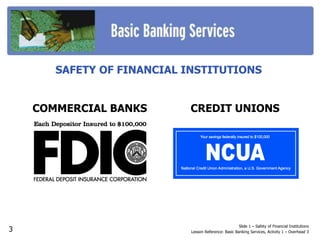
SAFETY OF FINANCIAL INSTITUTIONS
COMMERCIAL BANKS CREDIT UNIONS
Slide 1 – Safety of Financial Institutions
Lesson Reference: Basic Banking Services, Activity 1 – Overhead 33
THE EARNED INCOME TAX CREDIT
The Earned Income Tax Credit (EITC) is a federal income tax credit for low-
income workers. The credit reduces the amount of tax an individual owes,
and may be returned to the taxpayer in the form of a refund. Some states
offer additional forms of EITC.
Eligible workers must have an annual income and investment income that
falls below a certain level. In tax year 2005, for example, if you are married,
have two or more children, and are filing your taxes jointly, your combined
annual income must not exceed $37,263. You must have a Social Security
Number to receive the EITC.
In tax year 2005, a family with two or more children could receive up to a
$4,400 refund through the EITC.*
Slide 2 – EITC
Lesson Reference: Basic Banking Services, Activity 1 – Handout 24
Basic Banking Services - Activity 2
ACTIVITY 2
The Many Services
of a Bank
Overview
• Financial services provided by a bank
• Bank employees
• Services that might be of personal benefit
• The impact of state and federal regulations
upon the security of a bank
5
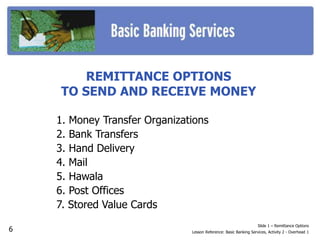
REMITTANCE OPTIONS
TO SEND AND RECEIVE MONEY
1. Money Transfer Organizations
2. Bank Transfers
3. Hand Delivery
4. Mail
5. Hawala
6. Post Offices
7. Stored Value Cards
Slide 1 – Remittance Options
Lesson Reference: Basic Banking Services, Activity 2 - Overhead 16
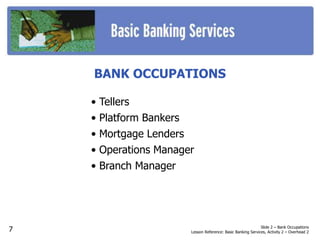
BANK OCCUPATIONS
• Tellers
• Platform Bankers
• Mortgage Lenders
• Operations Manager
• Branch Manager
Slide 2 – Bank Occupations
Lesson Reference: Basic Banking Services, Activity 2 – Overhead 27
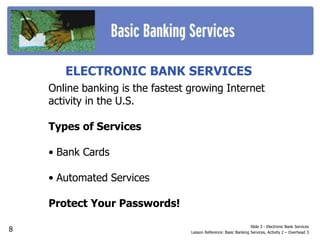
ELECTRONIC BANK SERVICES
Online banking is the fastest growing Internet
activity in the U.S.
Types of Services
• Bank Cards
• Automated Services
Protect Your Passwords!
Slide 3 - Electronic Bank Services
Lesson Reference: Basic Banking Services, Activity 2 – Overhead 3
8
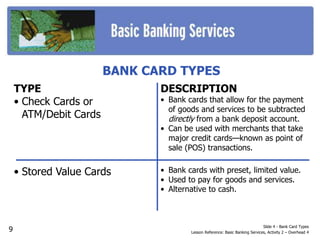
BANK CARD TYPES
Slide 4 - Bank Card Types
Lesson Reference: Basic Banking Services, Activity 2 – Overhead 4
TYPE
• Check Cards or
ATM/Debit Cards
• Stored Value Cards
DESCRIPTION
• Bank cards that allow for the payment
of goods and services to be subtracted
directly from a bank deposit account.
• Can be used with merchants that take
major credit cards—known as point of
sale (POS) transactions.
• Bank cards with preset, limited value.
• Used to pay for goods and services.
• Alternative to cash.
9
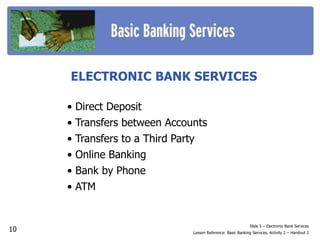
ELECTRONIC BANK SERVICES
• Direct Deposit
• Transfers between Accounts
• Transfers to a Third Party
• Online Banking
• Bank by Phone
• ATM
Slide 5 – Electronic Bank Services
Lesson Reference: Basic Banking Services, Activity 2 – Handout 3
10
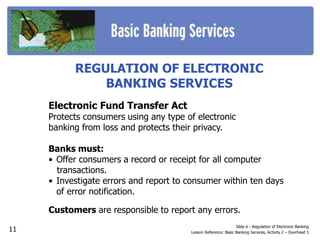
REGULATION OF ELECTRONIC
BANKING SERVICES
Electronic Fund Transfer Act
Protects consumers using any type of electronic
banking from loss and protects their privacy.
Banks must:
• Offer consumers a record or receipt for all computer
transactions.
• Investigate errors and report to consumer within ten days
of error notification.
Customers are responsible to report any errors.
Slide 6 - Regulation of Electronic Banking
Lesson Reference: Basic Banking Services, Activity 2 – Overhead 5
11
Basic Banking Services - Activity 3
ACTIVITY 3
The ABCs of a
Checking Account
Overview
• Purposes of a checking account
• Shopping for and comparing checking accounts
12
Slide 1 - Checking Account Terms
Lesson Reference: Basic Banking Services, Activity 3 – Handout 1
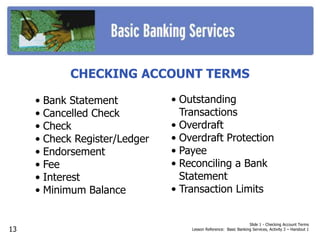
CHECKING ACCOUNT TERMS
• Bank Statement
• Cancelled Check
• Check
• Check Register/Ledger
• Endorsement
• Fee
• Interest
• Minimum Balance
• Outstanding
Transactions
• Overdraft
• Overdraft Protection
• Payee
• Reconciling a Bank
Statement
• Transaction Limits
13
Slide 2 - Shopping Around
Lesson Reference: Basic Banking Services, Activity 3 - Handout 2
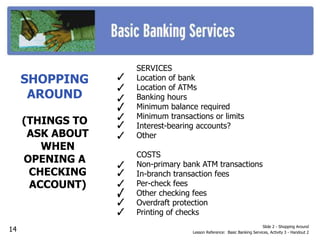
SHOPPING
AROUND
(THINGS TO
ASK ABOUT
WHEN
OPENING A
CHECKING
ACCOUNT)
SERVICES
Location of bank
Location of ATMs
Banking hours
Minimum balance required
Minimum transactions or limits
Interest-bearing accounts?
Other
COSTS
Non-primary bank ATM transactions
In-branch transaction fees
Per-check fees
Other checking fees
Overdraft protection
Printing of checks
14
Basic Banking Services - Activity 4
ACTIVITY 4
Opening a Checking
Account
Overview
• Checking Account Application Process
• The Application
• Acceptable Forms of ID
• The Signature Authorization Card
• The PATRIOT Act
15
Slide 1 – Opening a Checking Account
Lesson Reference: Basic Banking Services, Activity 4 – Handout 1
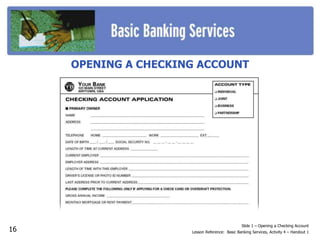
OPENING A CHECKING ACCOUNT
16
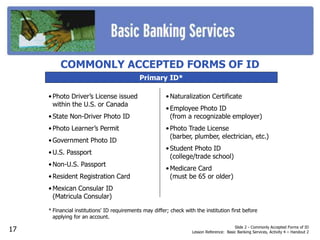
Slide 2 - Commonly Accepted Forms of ID
Lesson Reference: Basic Banking Services, Activity 4 – Handout 2
Primary ID*
• Photo Driver’s License issued
within the U.S. or Canada
• State Non-Driver Photo ID
• Photo Learner’s Permit
• Government Photo ID
• U.S. Passport
• Non-U.S. Passport
• Resident Registration Card
• Mexican Consular ID
(Matricula Consular)
* Financial institutions' ID requirements may differ; check with the institution first before
applying for an account.
COMMONLY ACCEPTED FORMS OF ID
• Naturalization Certificate
• Employee Photo ID
(from a recognizable employer)
• Photo Trade License
(barber, plumber, electrician, etc.)
• Student Photo ID
(college/trade school)
• Medicare Card
(must be 65 or older)
17
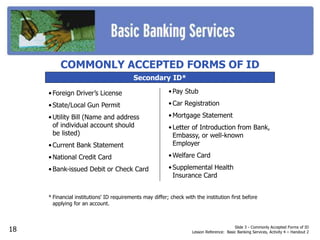
Slide 3 - Commonly Accepted Forms of ID
Lesson Reference: Basic Banking Services, Activity 4 – Handout 2
Secondary ID*
• Pay Stub
• Car Registration
• Mortgage Statement
• Letter of Introduction from Bank,
Embassy, or well-known
Employer
• Welfare Card
• Supplemental Health
Insurance Card
* Financial institutions' ID requirements may differ; check with the institution first before
applying for an account.
COMMONLY ACCEPTED FORMS OF ID
• Foreign Driver’s License
• State/Local Gun Permit
• Utility Bill (Name and address
of individual account should
be listed)
• Current Bank Statement
• National Credit Card
• Bank-issued Debit or Check Card
18
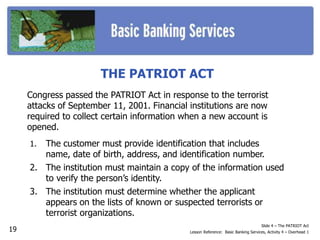
THE PATRIOT ACT
Congress passed the PATRIOT Act in response to the terrorist
attacks of September 11, 2001. Financial institutions are now
required to collect certain information when a new account is
opened.
Slide 4 – The PATRIOT Act
Lesson Reference: Basic Banking Services, Activity 4 – Overhead 1
1. The customer must provide identification that includes
name, date of birth, address, and identification number.
2. The institution must maintain a copy of the information used
to verify the person’s identity.
3. The institution must determine whether the applicant
appears on the lists of known or suspected terrorists or
terrorist organizations.
19
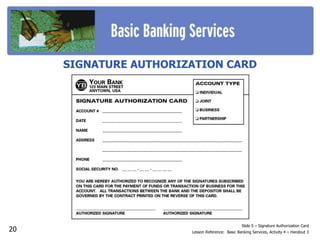
Slide 5 – Signature Authorization Card
Lesson Reference: Basic Banking Services, Activity 4 – Handout 3
SIGNATURE AUTHORIZATION CARD
20
Basic Banking Services - Activity 5
ACTIVITY 5
How to Write a Check
21
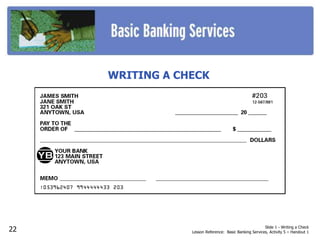
Slide 1 - Writing a Check
Lesson Reference: Basic Banking Services, Activity 5 – Handout 1
WRITING A CHECK
22
Basic Banking Services - Activity 6
ACTIVITY 6
Maintaining a
Checking Account
Overview
• Check 21
• Keeping a check register
• Making a deposit into a checking account
• Reconciling a bank statement
• Maintaining a checking account
• Avoiding Overdrafts
23
Slide 1 – Check 21
Lesson Reference: Basic Banking Services, Activity 6 – Handout 1
CHECK 21
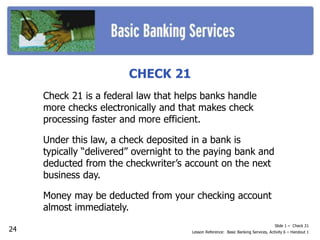
Check 21 is a federal law that helps banks handle
more checks electronically and that makes check
processing faster and more efficient.
Under this law, a check deposited in a bank is
typically “delivered” overnight to the paying bank and
deducted from the checkwriter’s account on the next
business day.
Money may be deducted from your checking account
almost immediately.
24
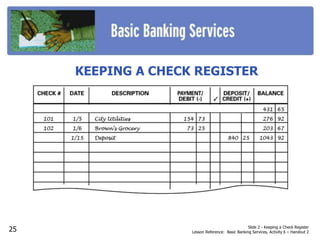
KEEPING A CHECK REGISTER
Slide 2 - Keeping a Check Register
Lesson Reference: Basic Banking Services, Activity 6 – Handout 225
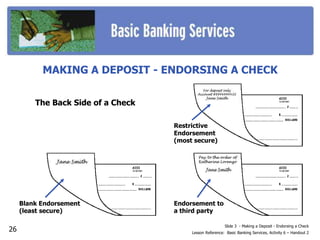
Slide 3 - Making a Deposit - Endorsing a Check
Lesson Reference: Basic Banking Services, Activity 6 – Handout 2
MAKING A DEPOSIT - ENDORSING A CHECK
Restrictive
Endorsement
(most secure)
Blank Endorsement
(least secure)
Endorsement to
a third party
The Back Side of a Check
26
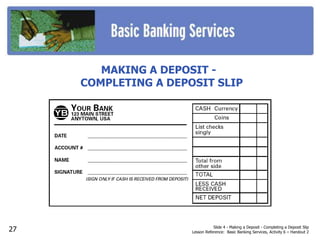
Slide 4 - Making a Deposit - Completing a Deposit Slip
Lesson Reference: Basic Banking Services, Activity 6 – Handout 2
MAKING A DEPOSIT -
COMPLETING A DEPOSIT SLIP
27
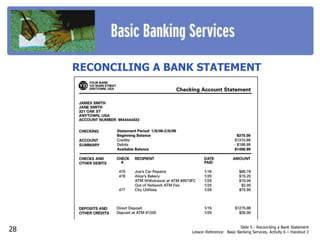
Slide 5 - Reconciling a Bank Statement
Lesson Reference: Basic Banking Services, Activity 6 – Handout 2
RECONCILING A BANK STATEMENT
28
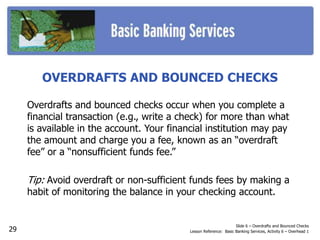
OVERDRAFTS AND BOUNCED CHECKS
Overdrafts and bounced checks occur when you complete a
financial transaction (e.g., write a check) for more than what
is available in the account. Your financial institution may pay
the amount and charge you a fee, known as an “overdraft
fee” or a “nonsufficient funds fee.”
Tip: Avoid overdraft or non-sufficient funds fees by making a
habit of monitoring the balance in your checking account.
Slide 6 – Overdrafts and Bounced Checks
Lesson Reference: Basic Banking Services, Activity 6 – Overhead 129
Basic Banking Services - Activity 7
ACTIVITY 7
The ABCs of a
Savings Account
Overview
• Purpose of a savings account
• Shopping for a savings account
• Applying for a savings account
• Monthly bank statement checkup
30
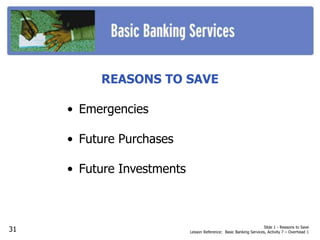
REASONS TO SAVE
• Emergencies
• Future Purchases
• Future Investments
Slide 1 - Reasons to Save
Lesson Reference: Basic Banking Services, Activity 7 – Overhead 131
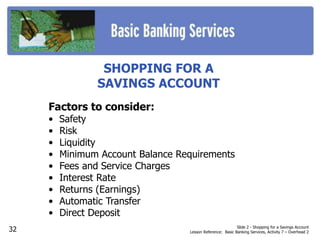
SHOPPING FOR A
SAVINGS ACCOUNT
Factors to consider:
• Safety
• Risk
• Liquidity
• Minimum Account Balance Requirements
• Fees and Service Charges
• Interest Rate
• Returns (Earnings)
• Automatic Transfer
• Direct Deposit
Slide 2 - Shopping for a Savings Account
Lesson Reference: Basic Banking Services, Activity 7 – Overhead 232
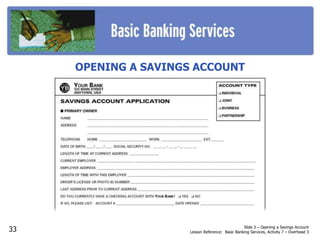
OPENING A SAVINGS ACCOUNT
Slide 3 – Opening a Savings Account
Lesson Reference: Basic Banking Services, Activity 7 – Overhead 333
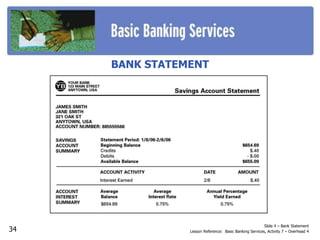
Slide 4 – Bank Statement
Lesson Reference: Basic Banking Services, Activity 7 – Overhead 4
BANK STATEMENT
34

Financial services

  • 1.
    • Activity 1………….WhyDo You Need A Bank? • Activity 2………The Many Services of a Bank • Activity 3….The ABCs of a Checking Account • Activity 4……….Opening a Checking Account • Activity 5………………….How to Write a Check • Activity 6…..Maintaining a Checking Account • Activity 7……The ABCs of a Savings Account
  • 2.
    Basic Banking Services- Activity 1 ACTIVITY 1 Why Do You Need a Bank? Overview • Purposes of banks • The differences between banks and credit unions • Safety of financial institutions • Banks as money management tools • The Earned Income Tax Credit 2
  • 3.
    SAFETY OF FINANCIALINSTITUTIONS COMMERCIAL BANKS CREDIT UNIONS Slide 1 – Safety of Financial Institutions Lesson Reference: Basic Banking Services, Activity 1 – Overhead 33
  • 4.
    THE EARNED INCOMETAX CREDIT The Earned Income Tax Credit (EITC) is a federal income tax credit for low- income workers. The credit reduces the amount of tax an individual owes, and may be returned to the taxpayer in the form of a refund. Some states offer additional forms of EITC. Eligible workers must have an annual income and investment income that falls below a certain level. In tax year 2005, for example, if you are married, have two or more children, and are filing your taxes jointly, your combined annual income must not exceed $37,263. You must have a Social Security Number to receive the EITC. In tax year 2005, a family with two or more children could receive up to a $4,400 refund through the EITC.* Slide 2 – EITC Lesson Reference: Basic Banking Services, Activity 1 – Handout 24
  • 5.
    Basic Banking Services- Activity 2 ACTIVITY 2 The Many Services of a Bank Overview • Financial services provided by a bank • Bank employees • Services that might be of personal benefit • The impact of state and federal regulations upon the security of a bank 5
  • 6.
    REMITTANCE OPTIONS TO SENDAND RECEIVE MONEY 1. Money Transfer Organizations 2. Bank Transfers 3. Hand Delivery 4. Mail 5. Hawala 6. Post Offices 7. Stored Value Cards Slide 1 – Remittance Options Lesson Reference: Basic Banking Services, Activity 2 - Overhead 16
  • 7.
    BANK OCCUPATIONS • Tellers •Platform Bankers • Mortgage Lenders • Operations Manager • Branch Manager Slide 2 – Bank Occupations Lesson Reference: Basic Banking Services, Activity 2 – Overhead 27
  • 8.
    ELECTRONIC BANK SERVICES Onlinebanking is the fastest growing Internet activity in the U.S. Types of Services • Bank Cards • Automated Services Protect Your Passwords! Slide 3 - Electronic Bank Services Lesson Reference: Basic Banking Services, Activity 2 – Overhead 3 8
  • 9.
    BANK CARD TYPES Slide4 - Bank Card Types Lesson Reference: Basic Banking Services, Activity 2 – Overhead 4 TYPE • Check Cards or ATM/Debit Cards • Stored Value Cards DESCRIPTION • Bank cards that allow for the payment of goods and services to be subtracted directly from a bank deposit account. • Can be used with merchants that take major credit cards—known as point of sale (POS) transactions. • Bank cards with preset, limited value. • Used to pay for goods and services. • Alternative to cash. 9
  • 10.
    ELECTRONIC BANK SERVICES •Direct Deposit • Transfers between Accounts • Transfers to a Third Party • Online Banking • Bank by Phone • ATM Slide 5 – Electronic Bank Services Lesson Reference: Basic Banking Services, Activity 2 – Handout 3 10
  • 11.
    REGULATION OF ELECTRONIC BANKINGSERVICES Electronic Fund Transfer Act Protects consumers using any type of electronic banking from loss and protects their privacy. Banks must: • Offer consumers a record or receipt for all computer transactions. • Investigate errors and report to consumer within ten days of error notification. Customers are responsible to report any errors. Slide 6 - Regulation of Electronic Banking Lesson Reference: Basic Banking Services, Activity 2 – Overhead 5 11
  • 12.
    Basic Banking Services- Activity 3 ACTIVITY 3 The ABCs of a Checking Account Overview • Purposes of a checking account • Shopping for and comparing checking accounts 12
  • 13.
    Slide 1 -Checking Account Terms Lesson Reference: Basic Banking Services, Activity 3 – Handout 1 CHECKING ACCOUNT TERMS • Bank Statement • Cancelled Check • Check • Check Register/Ledger • Endorsement • Fee • Interest • Minimum Balance • Outstanding Transactions • Overdraft • Overdraft Protection • Payee • Reconciling a Bank Statement • Transaction Limits 13
  • 14.
    Slide 2 -Shopping Around Lesson Reference: Basic Banking Services, Activity 3 - Handout 2 SHOPPING AROUND (THINGS TO ASK ABOUT WHEN OPENING A CHECKING ACCOUNT) SERVICES Location of bank Location of ATMs Banking hours Minimum balance required Minimum transactions or limits Interest-bearing accounts? Other COSTS Non-primary bank ATM transactions In-branch transaction fees Per-check fees Other checking fees Overdraft protection Printing of checks 14
  • 15.
    Basic Banking Services- Activity 4 ACTIVITY 4 Opening a Checking Account Overview • Checking Account Application Process • The Application • Acceptable Forms of ID • The Signature Authorization Card • The PATRIOT Act 15
  • 16.
    Slide 1 –Opening a Checking Account Lesson Reference: Basic Banking Services, Activity 4 – Handout 1 OPENING A CHECKING ACCOUNT 16
  • 17.
    Slide 2 -Commonly Accepted Forms of ID Lesson Reference: Basic Banking Services, Activity 4 – Handout 2 Primary ID* • Photo Driver’s License issued within the U.S. or Canada • State Non-Driver Photo ID • Photo Learner’s Permit • Government Photo ID • U.S. Passport • Non-U.S. Passport • Resident Registration Card • Mexican Consular ID (Matricula Consular) * Financial institutions' ID requirements may differ; check with the institution first before applying for an account. COMMONLY ACCEPTED FORMS OF ID • Naturalization Certificate • Employee Photo ID (from a recognizable employer) • Photo Trade License (barber, plumber, electrician, etc.) • Student Photo ID (college/trade school) • Medicare Card (must be 65 or older) 17
  • 18.
    Slide 3 -Commonly Accepted Forms of ID Lesson Reference: Basic Banking Services, Activity 4 – Handout 2 Secondary ID* • Pay Stub • Car Registration • Mortgage Statement • Letter of Introduction from Bank, Embassy, or well-known Employer • Welfare Card • Supplemental Health Insurance Card * Financial institutions' ID requirements may differ; check with the institution first before applying for an account. COMMONLY ACCEPTED FORMS OF ID • Foreign Driver’s License • State/Local Gun Permit • Utility Bill (Name and address of individual account should be listed) • Current Bank Statement • National Credit Card • Bank-issued Debit or Check Card 18
  • 19.
    THE PATRIOT ACT Congresspassed the PATRIOT Act in response to the terrorist attacks of September 11, 2001. Financial institutions are now required to collect certain information when a new account is opened. Slide 4 – The PATRIOT Act Lesson Reference: Basic Banking Services, Activity 4 – Overhead 1 1. The customer must provide identification that includes name, date of birth, address, and identification number. 2. The institution must maintain a copy of the information used to verify the person’s identity. 3. The institution must determine whether the applicant appears on the lists of known or suspected terrorists or terrorist organizations. 19
  • 20.
    Slide 5 –Signature Authorization Card Lesson Reference: Basic Banking Services, Activity 4 – Handout 3 SIGNATURE AUTHORIZATION CARD 20
  • 21.
    Basic Banking Services- Activity 5 ACTIVITY 5 How to Write a Check 21
  • 22.
    Slide 1 -Writing a Check Lesson Reference: Basic Banking Services, Activity 5 – Handout 1 WRITING A CHECK 22
  • 23.
    Basic Banking Services- Activity 6 ACTIVITY 6 Maintaining a Checking Account Overview • Check 21 • Keeping a check register • Making a deposit into a checking account • Reconciling a bank statement • Maintaining a checking account • Avoiding Overdrafts 23
  • 24.
    Slide 1 –Check 21 Lesson Reference: Basic Banking Services, Activity 6 – Handout 1 CHECK 21 Check 21 is a federal law that helps banks handle more checks electronically and that makes check processing faster and more efficient. Under this law, a check deposited in a bank is typically “delivered” overnight to the paying bank and deducted from the checkwriter’s account on the next business day. Money may be deducted from your checking account almost immediately. 24
  • 25.
    KEEPING A CHECKREGISTER Slide 2 - Keeping a Check Register Lesson Reference: Basic Banking Services, Activity 6 – Handout 225
  • 26.
    Slide 3 -Making a Deposit - Endorsing a Check Lesson Reference: Basic Banking Services, Activity 6 – Handout 2 MAKING A DEPOSIT - ENDORSING A CHECK Restrictive Endorsement (most secure) Blank Endorsement (least secure) Endorsement to a third party The Back Side of a Check 26
  • 27.
    Slide 4 -Making a Deposit - Completing a Deposit Slip Lesson Reference: Basic Banking Services, Activity 6 – Handout 2 MAKING A DEPOSIT - COMPLETING A DEPOSIT SLIP 27
  • 28.
    Slide 5 -Reconciling a Bank Statement Lesson Reference: Basic Banking Services, Activity 6 – Handout 2 RECONCILING A BANK STATEMENT 28
  • 29.
    OVERDRAFTS AND BOUNCEDCHECKS Overdrafts and bounced checks occur when you complete a financial transaction (e.g., write a check) for more than what is available in the account. Your financial institution may pay the amount and charge you a fee, known as an “overdraft fee” or a “nonsufficient funds fee.” Tip: Avoid overdraft or non-sufficient funds fees by making a habit of monitoring the balance in your checking account. Slide 6 – Overdrafts and Bounced Checks Lesson Reference: Basic Banking Services, Activity 6 – Overhead 129
  • 30.
    Basic Banking Services- Activity 7 ACTIVITY 7 The ABCs of a Savings Account Overview • Purpose of a savings account • Shopping for a savings account • Applying for a savings account • Monthly bank statement checkup 30
  • 31.
    REASONS TO SAVE •Emergencies • Future Purchases • Future Investments Slide 1 - Reasons to Save Lesson Reference: Basic Banking Services, Activity 7 – Overhead 131
  • 32.
    SHOPPING FOR A SAVINGSACCOUNT Factors to consider: • Safety • Risk • Liquidity • Minimum Account Balance Requirements • Fees and Service Charges • Interest Rate • Returns (Earnings) • Automatic Transfer • Direct Deposit Slide 2 - Shopping for a Savings Account Lesson Reference: Basic Banking Services, Activity 7 – Overhead 232
  • 33.
    OPENING A SAVINGSACCOUNT Slide 3 – Opening a Savings Account Lesson Reference: Basic Banking Services, Activity 7 – Overhead 333
  • 34.
    Slide 4 –Bank Statement Lesson Reference: Basic Banking Services, Activity 7 – Overhead 4 BANK STATEMENT 34