1
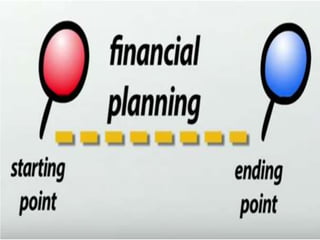
• Financial planning is the process of allocating
financial resources to maximize the
profitablity and wealth of the company.
What is company's current financial position?
Where does company wants to go?
How does the company get to its ending point/goal?
• Company managers use financial statement analysis
to understand the company's financial perfomance
and make an assessment of perfomance.
• Financial statement company comprises of:
• INCOME STATEMENT
• BALANCE SHEET
• CASH FLOW STATEMENT.
• Financial statement helps in analysing & identfying
trends & changes in companies financial position.
• Financial feasiblity is an analysis
whereby you determine if a particular
venture by taking into account the total
cost of it & probable revenues generated
from it.
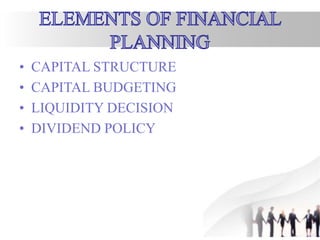
• CAPITAL STRUCTURE
• CAPITAL BUDGETING
• LIQUIDITY DECISION
• DIVIDEND POLICY
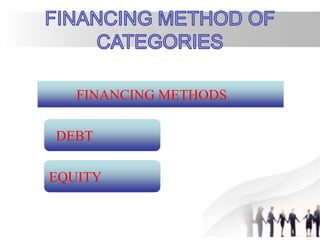
FINANCING METHODS
EQUITY
DEBT
• Equity shares
• Preference shares
• Internal Accurals
• Equity capital represents ownership capital as
equity shareholder collectively own the
company.
• They enjoy the reward & bear the risk of
ownerships.
• It is a hybrid of financing- it partakes some
characterstics of equity & some attributes of
debentures.
• Dividend is payable only out of distributable
profits , not an obligatory payment & dividend
rate on preferance capital is usually fixed.
• The internal accurals of a firms consists of
depriciation chareges & retained earnings
• DEPRICIATION-
• RETAINED EARNINGS- Retained earnings
are that portion of equity earning which are
ploughed back in the firm.
• BONDS
• TERM LOANS
• WORKING CAPITAL ADVANCES
• MISCELLANEOUS RESOURCES
• It is a debt security under which issuer owes
the holder of debt & depending on the terms of
bond is obiliged to pay them intrest and/or to
repay the principal at the later date.
• FIXED RATE
• FLOATING RATE
• ZERO CUPON BONDS
• HIGH YIELD BONDS
• CONVERTABLE BONDS
• EXCHANGEABLE BONDS
• INFLATION INDEXED BONDS
• BEARER BONDS
•GOVERNMENT BOND
•SERIAL BOND
• DUAL CURRENCY BONDS
• Loan is a debt provided by one entity to
another entity at an intrest rate, & evidenced
by the notes which specifies among other
things, the principal amount ,intrest rate & date
of repayment.
• TERM LOAN
• BANK OVERDRAFT FACILITY
• LETTER OF CREDIT
• Working capital advances by commercial
banks represents the most importanr source for
financing current assests.
Working capital advances is provided by banks
in 3 primrary ways:
i) Cash credit overdrafts
ii) Loans
iii) Purchase / discount of bills.
• Deferred credit
• Lease & Hire purchase finance
• Unsecured loans & deposits
• Special schemes of institution
• Subsidies & sales tax deferments
• Short term loan from financial institutions
• Commercial paper
• Factoring
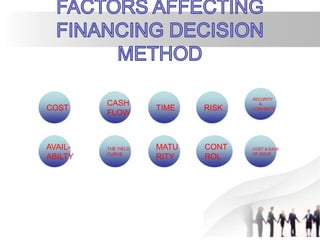
COST
AVAIL-
ABILTY
CASH
FLOW
THE YIELD
CURVE
TIME
MATU
RITY
RISK
CONT
ROL
SECURITY
&
CONVENTS
COST & EASE
OF ISSUE
• ALL CATEGORY COST SHOSUSLD BE
CONSIDERD NOT ONLY IN SHORT RUN
BUT ALSO IN LONG RUN SUCH AS:
• i)Intrest rate ii) NPV iii) ROI iv) Taxation
consideration v) Accounting balance sheet &
stimulation benefit vi) oppourunity costs
vii) BEP
COST COMAPRISION SHOULD BE DONE
B/W METHODS.
• If owners are able to generate the sufficent
cash flow then they must use debt financing
.However, if they are engaged in heavy R&D
work are not able to generate sufficent cash
flow then they must opt for equity.
• As one of the major constraints time is very
important.
• TIME IS MONEY MONEY IS TIME.
• Risk should be kept at the level where the
shareholder and other key shareholder are
content.
• Total Risk = Business Risk + Financial Risk
• If debt is to be raised,security may be required.
• CONVENTS-imposes an obiligations on the
company to maintain a certain liquidity level
Availabilty of finance must be considered
when recommending a suitable financial
resource.
• Basically duration of financing methods
• Term of finance should match the term of
need.
If debt is raised then there will be no change
control.
• Debt is usually cheeper & easier to raise
than equity.
Consideration should be given to time
structure of intrest rate.
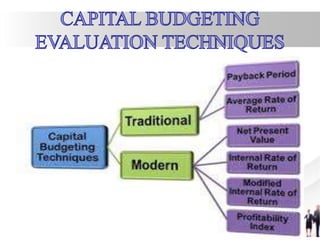
• Capital Budgeting process by which
organisation evaluates and select long
term investment projects.
• Ex: Purchase or lease of building,
Investments in capital equipment
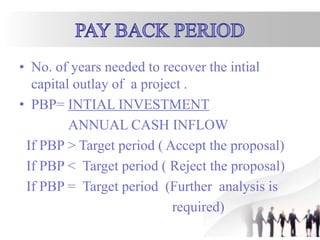
• No. of years needed to recover the intial
capital outlay of a project .
• PBP= INTIAL INVESTMENT
ANNUAL CASH INFLOW
If PBP > Target period ( Accept the proposal)
If PBP < Target period ( Reject the proposal)
If PBP = Target period (Further analysis is
required)
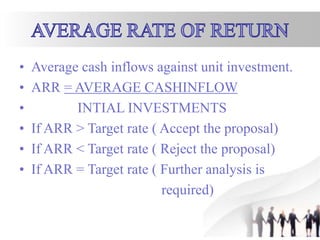
• Average cash inflows against unit investment.
• ARR = AVERAGE CASHINFLOW
• INTIAL INVESTMENTS
• If ARR > Target rate ( Accept the proposal)
• If ARR < Target rate ( Reject the proposal)
• If ARR = Target rate ( Further analysis is
required)
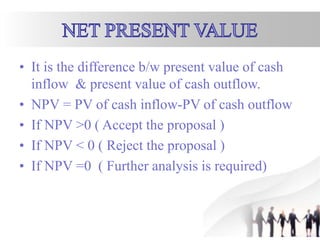
• It is the difference b/w present value of cash
inflow & present value of cash outflow.
• NPV = PV of cash inflow-PV of cash outflow
• If NPV >0 ( Accept the proposal )
• If NPV < 0 ( Reject the proposal )
• If NPV =0 ( Further analysis is required)
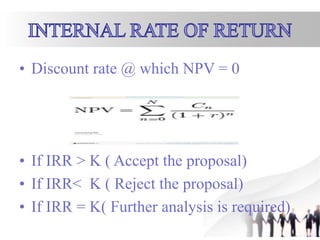
• Discount rate @ which NPV = 0
• If IRR > K ( Accept the proposal)
• If IRR< K ( Reject the proposal)
• If IRR = K( Further analysis is required)
• The profitability index is the present value of
an anticish inflows divided by the intial
investpated cament.
• PI = PRESENT VALUE OF CASH INFLOW
• PRESENT VALUE OFCASH OUTFLOW
Liquidity describes the degree to which an asset
can be quickly bought & sold in the market
without affecting the asset price.
FEW RATIO WHICH HELPS IN MAKING
LIQUIDITY DECISION
1) Quick ratio
2) Current ratio
3) Debtor turnover ratio
4) Creditor turnover ratio
• Dividend plicy refers to the policy that
managements formulates in regards to earnings
for distribution as dividend among
shareholders.
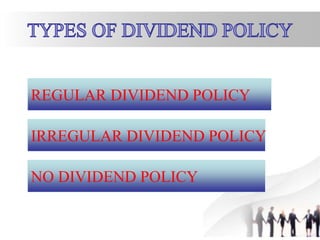
REGULAR DIVIDEND POLICY
IRREGULAR DIVIDEND POLICY
NO DIVIDEND POLICY

Financial Planning

  • 1.
  • 2.
    • Financial planningis the process of allocating financial resources to maximize the profitablity and wealth of the company.
  • 3.
    What is company'scurrent financial position? Where does company wants to go? How does the company get to its ending point/goal?
  • 4.
    • Company managersuse financial statement analysis to understand the company's financial perfomance and make an assessment of perfomance. • Financial statement company comprises of: • INCOME STATEMENT • BALANCE SHEET • CASH FLOW STATEMENT. • Financial statement helps in analysing & identfying trends & changes in companies financial position.
  • 7.
    • Financial feasiblityis an analysis whereby you determine if a particular venture by taking into account the total cost of it & probable revenues generated from it.
  • 8.
    • CAPITAL STRUCTURE •CAPITAL BUDGETING • LIQUIDITY DECISION • DIVIDEND POLICY
  • 10.
  • 11.
    • Equity shares •Preference shares • Internal Accurals
  • 12.
    • Equity capitalrepresents ownership capital as equity shareholder collectively own the company. • They enjoy the reward & bear the risk of ownerships.
  • 13.
    • It isa hybrid of financing- it partakes some characterstics of equity & some attributes of debentures. • Dividend is payable only out of distributable profits , not an obligatory payment & dividend rate on preferance capital is usually fixed.
  • 14.
    • The internalaccurals of a firms consists of depriciation chareges & retained earnings • DEPRICIATION- • RETAINED EARNINGS- Retained earnings are that portion of equity earning which are ploughed back in the firm.
  • 15.
    • BONDS • TERMLOANS • WORKING CAPITAL ADVANCES • MISCELLANEOUS RESOURCES
  • 16.
    • It isa debt security under which issuer owes the holder of debt & depending on the terms of bond is obiliged to pay them intrest and/or to repay the principal at the later date.
  • 17.
    • FIXED RATE •FLOATING RATE • ZERO CUPON BONDS • HIGH YIELD BONDS • CONVERTABLE BONDS • EXCHANGEABLE BONDS • INFLATION INDEXED BONDS
  • 18.
    • BEARER BONDS •GOVERNMENTBOND •SERIAL BOND • DUAL CURRENCY BONDS
  • 19.
    • Loan isa debt provided by one entity to another entity at an intrest rate, & evidenced by the notes which specifies among other things, the principal amount ,intrest rate & date of repayment.
  • 20.
    • TERM LOAN •BANK OVERDRAFT FACILITY • LETTER OF CREDIT
  • 21.
    • Working capitaladvances by commercial banks represents the most importanr source for financing current assests. Working capital advances is provided by banks in 3 primrary ways: i) Cash credit overdrafts ii) Loans iii) Purchase / discount of bills.
  • 22.
    • Deferred credit •Lease & Hire purchase finance • Unsecured loans & deposits • Special schemes of institution • Subsidies & sales tax deferments • Short term loan from financial institutions • Commercial paper • Factoring
  • 24.
  • 25.
    • ALL CATEGORYCOST SHOSUSLD BE CONSIDERD NOT ONLY IN SHORT RUN BUT ALSO IN LONG RUN SUCH AS: • i)Intrest rate ii) NPV iii) ROI iv) Taxation consideration v) Accounting balance sheet & stimulation benefit vi) oppourunity costs vii) BEP COST COMAPRISION SHOULD BE DONE B/W METHODS.
  • 26.
    • If ownersare able to generate the sufficent cash flow then they must use debt financing .However, if they are engaged in heavy R&D work are not able to generate sufficent cash flow then they must opt for equity.
  • 27.
    • As oneof the major constraints time is very important. • TIME IS MONEY MONEY IS TIME.
  • 28.
    • Risk shouldbe kept at the level where the shareholder and other key shareholder are content. • Total Risk = Business Risk + Financial Risk
  • 29.
    • If debtis to be raised,security may be required. • CONVENTS-imposes an obiligations on the company to maintain a certain liquidity level Availabilty of finance must be considered when recommending a suitable financial resource.
  • 30.
    • Basically durationof financing methods • Term of finance should match the term of need. If debt is raised then there will be no change control.
  • 31.
    • Debt isusually cheeper & easier to raise than equity. Consideration should be given to time structure of intrest rate.
  • 32.
    • Capital Budgetingprocess by which organisation evaluates and select long term investment projects. • Ex: Purchase or lease of building, Investments in capital equipment
  • 34.
    • No. ofyears needed to recover the intial capital outlay of a project . • PBP= INTIAL INVESTMENT ANNUAL CASH INFLOW If PBP > Target period ( Accept the proposal) If PBP < Target period ( Reject the proposal) If PBP = Target period (Further analysis is required)
  • 35.
    • Average cashinflows against unit investment. • ARR = AVERAGE CASHINFLOW • INTIAL INVESTMENTS • If ARR > Target rate ( Accept the proposal) • If ARR < Target rate ( Reject the proposal) • If ARR = Target rate ( Further analysis is required)
  • 36.
    • It isthe difference b/w present value of cash inflow & present value of cash outflow. • NPV = PV of cash inflow-PV of cash outflow • If NPV >0 ( Accept the proposal ) • If NPV < 0 ( Reject the proposal ) • If NPV =0 ( Further analysis is required)
  • 37.
    • Discount rate@ which NPV = 0 • If IRR > K ( Accept the proposal) • If IRR< K ( Reject the proposal) • If IRR = K( Further analysis is required)
  • 39.
    • The profitabilityindex is the present value of an anticish inflows divided by the intial investpated cament. • PI = PRESENT VALUE OF CASH INFLOW • PRESENT VALUE OFCASH OUTFLOW
  • 40.
    Liquidity describes thedegree to which an asset can be quickly bought & sold in the market without affecting the asset price. FEW RATIO WHICH HELPS IN MAKING LIQUIDITY DECISION 1) Quick ratio 2) Current ratio 3) Debtor turnover ratio 4) Creditor turnover ratio
  • 41.
    • Dividend plicyrefers to the policy that managements formulates in regards to earnings for distribution as dividend among shareholders.
  • 42.
    REGULAR DIVIDEND POLICY IRREGULARDIVIDEND POLICY NO DIVIDEND POLICY