CS&E 1111 ExFin
Microsoft Excel Financial Functions
Objectives:
Understanding and using
Financial Functions
•the time value of money
•PV, FV, Rate, NPER, PMT
•problem solving
CS&E 1111 ExFin
Simple Interest vs. Compound
Interest
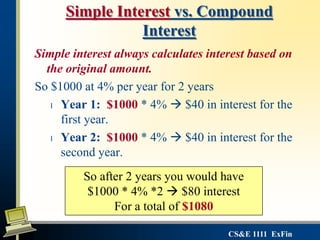
Simple interest always calculates interest based on
the original amount.
So $1000 at 4% per year for 2 years
l Year 1: $1000 * 4%  $40 in interest for the
first year.
l Year 2: $1000 * 4%  $40 in interest for the
second year.
So after 2 years you would have
$1000 * 4% *2  $80 interest
For a total of $1080
CS&E 1111 ExFin
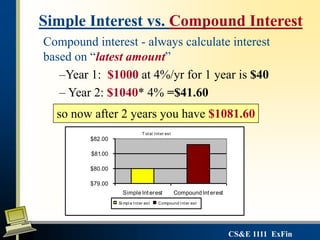
Compound interest - always calculate interest
based on “latest amount”
–Year 1: $1000 at 4%/yr for 1 year is $40
– Year 2: $1040* 4% =$41.60
Simple Interest vs. Compound Interest
T otal Inter est
$79.00
$80.00
$81.00
$82.00
Simple Interest Compound Interest
Si mpl e Inter est Compound Inter est
so now after 2 years you have $1081.60
CS&E 1111 ExFin
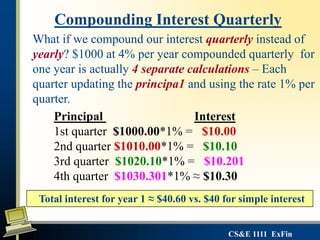
What if we compound our interest quarterly instead of
yearly? $1000 at 4% per year compounded quarterly for
one year is actually 4 separate calculations – Each
quarter updating the principa1 and using the rate 1% per
quarter.
Compounding Interest Quarterly
Principal Interest
1st quarter $1000.00*1% = $10.00
2nd quarter $1010.00*1% = $10.10
3rd quarter $1020.10*1% = $10.201
4th quarter $1030.301*1% ≈ $10.30
Total interest for year 1 ≈ $40.60 vs. $40 for simple interest
CS&E 1111 ExFin
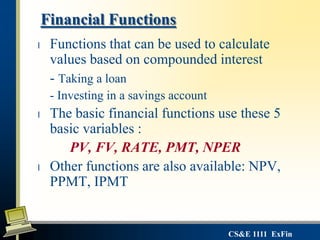
l Functions that can be used to calculate
values based on compounded interest
- Taking a loan
- Investing in a savings account
l The basic financial functions use these 5
basic variables :
PV, FV, RATE, PMT, NPER
l Other functions are also available: NPV,
PPMT, IPMT
Financial Functions
CS&E 1111 ExFin
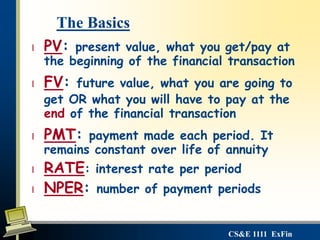
l PV: present value, what you get/pay at
the beginning of the financial transaction
l FV: future value, what you are going to
get OR what you will have to pay at the
end of the financial transaction
l PMT: payment made each period. It
remains constant over life of annuity
l RATE: interest rate per period
l NPER: number of payment periods
The Basics
CS&E 1111 ExFin
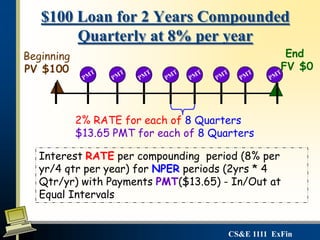
$100 Loan for 2 Years Compounded
Quarterly at 8% per year
Beginning
PV $100
End
FV $0
Interest RATE per compounding period (8% per
yr/4 qtr per year) for NPER periods (2yrs * 4
Qtr/yr) with Payments PMT($13.65) - In/Out at
Equal Intervals
2% RATE for each of 8 Quarters
$13.65 PMT for each of 8 Quarters
CS&E 1111 ExFin
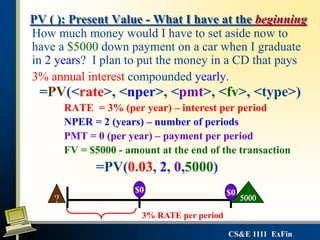
How much money would I have to set aside now to
have a $5000 down payment on a car when I graduate
in 2 years? I plan to put the money in a CD that pays
3% annual interest compounded yearly.
=PV(<rate>, <nper>, <pmt>, <fv>, <type>)
RATE = 3% (per year) – interest per period
NPER = 2 (years) – number of periods
PMT = 0 (per year) – payment per period
FV = $5000 - amount at the end of the transaction
=PV(0.03, 2, 0,5000)
PV ( ): Present Value - What I have at the beginning
? 5000
$0 $0
3% RATE per period
CS&E 1111 ExFin
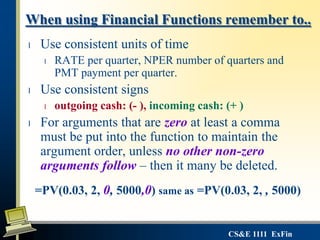
When using Financial Functions remember to..
l Use consistent units of time
l RATE per quarter, NPER number of quarters and
PMT payment per quarter.
l Use consistent signs
l outgoing cash: (- ), incoming cash: (+ )
l For arguments that are zero at least a comma
must be put into the function to maintain the
argument order, unless no other non-zero
arguments follow – then it many be deleted.
=PV(0.03, 2, 0, 5000,0) same as =PV(0.03, 2, , 5000)
CS&E 1111 ExFin
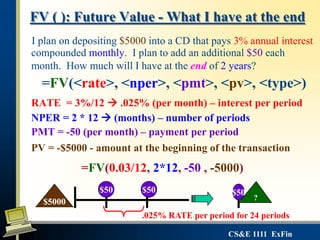
I plan on depositing $5000 into a CD that pays 3% annual interest
compounded monthly. I plan to add an additional $50 each
month. How much will I have at the end of 2 years?
=FV(<rate>, <nper>, <pmt>, <pv>, <type>)
RATE = 3%/12  .025% (per month) – interest per period
NPER = 2 * 12  (months) – number of periods
PMT = -50 (per month) – payment per period
PV = -$5000 - amount at the beginning of the transaction
FV ( ): Future Value - What I have at the end
$5000 ?
$50 $50
.025% RATE per period for 24 periods
$50
=FV(0.03/12, 2*12, -50 , -5000)
CS&E 1111 ExFin
PMT( ): Returns the periodic payment
I have been offered a 5 year car loan of $15,000 at 9% annual
interest rate compounded monthly. What is the monthly payment
needed to completely pay off the loan at the end of the 5 years?
=PMT(<rate>, <nper>, <pv>, <fv>, <type>)
=PMT(B3/B5, B4*B5, B1, B2)
:
Will your payment be a positive or negative value?
1
2
3
4
5
6
A B
Original Loan Value 15,000
$
Ending Loan Value -
$
Yearly Interest Rate 9%
Number of Years 5
Compounding Periods per Year 12
Monthly Payment ($311.38)
CS&E 1111 ExFin
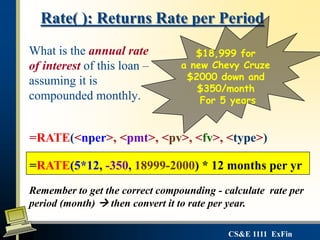
What is the annual rate
of interest of this loan –
assuming it is
compounded monthly.
Rate( ): Returns Rate per Period
$18,999 for
a new Chevy Cruze
$2000 down and
$350/month
For 5 years
=RATE(<nper>, <pmt>, <pv>, <fv>, <type>)
=RATE(5*12, -350, 18999-2000) * 12 months per yr
Remember to get the correct compounding - calculate rate per
period (month)  then convert it to rate per year.
CS&E 1111 ExFin
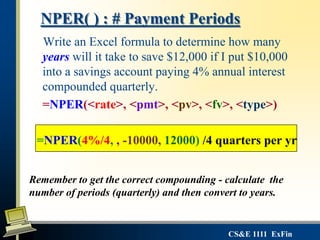
NPER( ) : # Payment Periods
Write an Excel formula to determine how many
years will it take to save $12,000 if I put $10,000
into a savings account paying 4% annual interest
compounded quarterly.
=NPER(<rate>, <pmt>, <pv>, <fv>, <type>)
=NPER(4%/4, , -10000, 12000) /4 quarters per yr
Remember to get the correct compounding - calculate the
number of periods (quarterly) and then convert to years.
CS&E 1111 ExFin
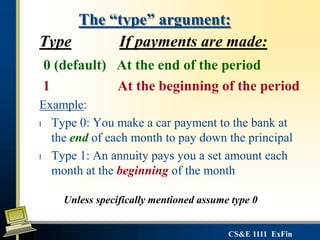
The “type” argument:
Type If payments are made:
0 (default) At the end of the period
1 At the beginning of the period
Example:
l Type 0: You make a car payment to the bank at
the end of each month to pay down the principal
l Type 1: An annuity pays you a set amount each
month at the beginning of the month
Unless specifically mentioned assume type 0
CS&E 1111 ExFin
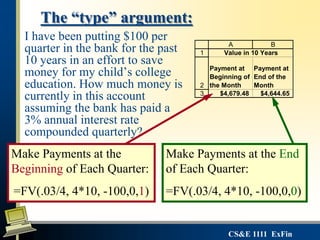
The “type” argument:
I have been putting $100 per
quarter in the bank for the past
10 years in an effort to save
money for my child’s college
education. How much money is
currently in this account
assuming the bank has paid a
3% annual interest rate
compounded quarterly?
Make Payments at the End
of Each Quarter:
=FV(.03/4, 4*10, -100,0,0)
Make Payments at the
Beginning of Each Quarter:
=FV(.03/4, 4*10, -100,0,1)
1
2
3
A B
Payment at
Beginning of
the Month
Payment at
End of the
Month
$4,679.48 $4,644.65
Value in 10 Years
CS&E 1111 ExFin
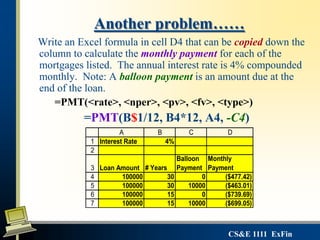
Another problem……
Write an Excel formula in cell D4 that can be copied down the
column to calculate the monthly payment for each of the
mortgages listed. The annual interest rate is 4% compounded
monthly. Note: A balloon payment is an amount due at the
end of the loan.
=PMT(<rate>, <nper>, <pv>, <fv>, <type>)
=PMT(B$1/12, B4*12, A4, -C4)
1
2
3
4
5
6
7
A B C D
Interest Rate 4%
Loan Amount # Years
Balloon
Payment
Monthly
Payment
100000 30 0 ($477.42)
100000 30 10000 ($463.01)
100000 15 0 ($739.69)
100000 15 10000 ($699.05)
CS&E 1111 ExFin
A Summary of Financial Functions
l Financial Function can be used to calculate
financial transactions with compound interest.
l PV, FV, PMT, NPER, RATE are all dependent
on the values of the other four
l Use positive values for cash flow back to you,
and negative values for cash flow from you to
a financial institution..
l Use correct compounding periods for your
values of NPER, PMT and RATE.
l Use the correct type argument

Financial Functions.ppt

  • 1.
    CS&E 1111 ExFin MicrosoftExcel Financial Functions Objectives: Understanding and using Financial Functions •the time value of money •PV, FV, Rate, NPER, PMT •problem solving
  • 2.
    CS&E 1111 ExFin SimpleInterest vs. Compound Interest Simple interest always calculates interest based on the original amount. So $1000 at 4% per year for 2 years l Year 1: $1000 * 4%  $40 in interest for the first year. l Year 2: $1000 * 4%  $40 in interest for the second year. So after 2 years you would have $1000 * 4% *2  $80 interest For a total of $1080
  • 3.
    CS&E 1111 ExFin Compoundinterest - always calculate interest based on “latest amount” –Year 1: $1000 at 4%/yr for 1 year is $40 – Year 2: $1040* 4% =$41.60 Simple Interest vs. Compound Interest T otal Inter est $79.00 $80.00 $81.00 $82.00 Simple Interest Compound Interest Si mpl e Inter est Compound Inter est so now after 2 years you have $1081.60
  • 4.
    CS&E 1111 ExFin Whatif we compound our interest quarterly instead of yearly? $1000 at 4% per year compounded quarterly for one year is actually 4 separate calculations – Each quarter updating the principa1 and using the rate 1% per quarter. Compounding Interest Quarterly Principal Interest 1st quarter $1000.00*1% = $10.00 2nd quarter $1010.00*1% = $10.10 3rd quarter $1020.10*1% = $10.201 4th quarter $1030.301*1% ≈ $10.30 Total interest for year 1 ≈ $40.60 vs. $40 for simple interest
  • 5.
    CS&E 1111 ExFin lFunctions that can be used to calculate values based on compounded interest - Taking a loan - Investing in a savings account l The basic financial functions use these 5 basic variables : PV, FV, RATE, PMT, NPER l Other functions are also available: NPV, PPMT, IPMT Financial Functions
  • 6.
    CS&E 1111 ExFin lPV: present value, what you get/pay at the beginning of the financial transaction l FV: future value, what you are going to get OR what you will have to pay at the end of the financial transaction l PMT: payment made each period. It remains constant over life of annuity l RATE: interest rate per period l NPER: number of payment periods The Basics
  • 7.
    CS&E 1111 ExFin $100Loan for 2 Years Compounded Quarterly at 8% per year Beginning PV $100 End FV $0 Interest RATE per compounding period (8% per yr/4 qtr per year) for NPER periods (2yrs * 4 Qtr/yr) with Payments PMT($13.65) - In/Out at Equal Intervals 2% RATE for each of 8 Quarters $13.65 PMT for each of 8 Quarters
  • 8.
    CS&E 1111 ExFin Howmuch money would I have to set aside now to have a $5000 down payment on a car when I graduate in 2 years? I plan to put the money in a CD that pays 3% annual interest compounded yearly. =PV(<rate>, <nper>, <pmt>, <fv>, <type>) RATE = 3% (per year) – interest per period NPER = 2 (years) – number of periods PMT = 0 (per year) – payment per period FV = $5000 - amount at the end of the transaction =PV(0.03, 2, 0,5000) PV ( ): Present Value - What I have at the beginning ? 5000 $0 $0 3% RATE per period
  • 9.
    CS&E 1111 ExFin Whenusing Financial Functions remember to.. l Use consistent units of time l RATE per quarter, NPER number of quarters and PMT payment per quarter. l Use consistent signs l outgoing cash: (- ), incoming cash: (+ ) l For arguments that are zero at least a comma must be put into the function to maintain the argument order, unless no other non-zero arguments follow – then it many be deleted. =PV(0.03, 2, 0, 5000,0) same as =PV(0.03, 2, , 5000)
  • 10.
    CS&E 1111 ExFin Iplan on depositing $5000 into a CD that pays 3% annual interest compounded monthly. I plan to add an additional $50 each month. How much will I have at the end of 2 years? =FV(<rate>, <nper>, <pmt>, <pv>, <type>) RATE = 3%/12  .025% (per month) – interest per period NPER = 2 * 12  (months) – number of periods PMT = -50 (per month) – payment per period PV = -$5000 - amount at the beginning of the transaction FV ( ): Future Value - What I have at the end $5000 ? $50 $50 .025% RATE per period for 24 periods $50 =FV(0.03/12, 2*12, -50 , -5000)
  • 11.
    CS&E 1111 ExFin PMT(): Returns the periodic payment I have been offered a 5 year car loan of $15,000 at 9% annual interest rate compounded monthly. What is the monthly payment needed to completely pay off the loan at the end of the 5 years? =PMT(<rate>, <nper>, <pv>, <fv>, <type>) =PMT(B3/B5, B4*B5, B1, B2) : Will your payment be a positive or negative value? 1 2 3 4 5 6 A B Original Loan Value 15,000 $ Ending Loan Value - $ Yearly Interest Rate 9% Number of Years 5 Compounding Periods per Year 12 Monthly Payment ($311.38)
  • 12.
    CS&E 1111 ExFin Whatis the annual rate of interest of this loan – assuming it is compounded monthly. Rate( ): Returns Rate per Period $18,999 for a new Chevy Cruze $2000 down and $350/month For 5 years =RATE(<nper>, <pmt>, <pv>, <fv>, <type>) =RATE(5*12, -350, 18999-2000) * 12 months per yr Remember to get the correct compounding - calculate rate per period (month)  then convert it to rate per year.
  • 13.
    CS&E 1111 ExFin NPER() : # Payment Periods Write an Excel formula to determine how many years will it take to save $12,000 if I put $10,000 into a savings account paying 4% annual interest compounded quarterly. =NPER(<rate>, <pmt>, <pv>, <fv>, <type>) =NPER(4%/4, , -10000, 12000) /4 quarters per yr Remember to get the correct compounding - calculate the number of periods (quarterly) and then convert to years.
  • 14.
    CS&E 1111 ExFin The“type” argument: Type If payments are made: 0 (default) At the end of the period 1 At the beginning of the period Example: l Type 0: You make a car payment to the bank at the end of each month to pay down the principal l Type 1: An annuity pays you a set amount each month at the beginning of the month Unless specifically mentioned assume type 0
  • 15.
    CS&E 1111 ExFin The“type” argument: I have been putting $100 per quarter in the bank for the past 10 years in an effort to save money for my child’s college education. How much money is currently in this account assuming the bank has paid a 3% annual interest rate compounded quarterly? Make Payments at the End of Each Quarter: =FV(.03/4, 4*10, -100,0,0) Make Payments at the Beginning of Each Quarter: =FV(.03/4, 4*10, -100,0,1) 1 2 3 A B Payment at Beginning of the Month Payment at End of the Month $4,679.48 $4,644.65 Value in 10 Years
  • 16.
    CS&E 1111 ExFin Anotherproblem…… Write an Excel formula in cell D4 that can be copied down the column to calculate the monthly payment for each of the mortgages listed. The annual interest rate is 4% compounded monthly. Note: A balloon payment is an amount due at the end of the loan. =PMT(<rate>, <nper>, <pv>, <fv>, <type>) =PMT(B$1/12, B4*12, A4, -C4) 1 2 3 4 5 6 7 A B C D Interest Rate 4% Loan Amount # Years Balloon Payment Monthly Payment 100000 30 0 ($477.42) 100000 30 10000 ($463.01) 100000 15 0 ($739.69) 100000 15 10000 ($699.05)
  • 17.
    CS&E 1111 ExFin ASummary of Financial Functions l Financial Function can be used to calculate financial transactions with compound interest. l PV, FV, PMT, NPER, RATE are all dependent on the values of the other four l Use positive values for cash flow back to you, and negative values for cash flow from you to a financial institution.. l Use correct compounding periods for your values of NPER, PMT and RATE. l Use the correct type argument