What is the FATF ?
• FATF is an inter-governmental policy-making body established in 1989.
• It comprised of over 200 countries, that has a ministerial mandate to establish
international standards for combating money laundering and terrorist financing.
• Over 180 jurisdictions have joined the FATF or an FATF‐style regional body, and
committed at the ministerial level to implementing the FATF standards and having
their anti‐money laundering (AML)/counter‐terrorist financing (CFT) systems
assessed.
What are the FATF Recommendations ?
The internationally endorsed global standards for implementing
effective AML/CFT measures. They increase the
transparency of the financial system (making it easier to
detect criminal activity) and give countries the capacity to
successfully take action against money launderers and
terrorist financiers.
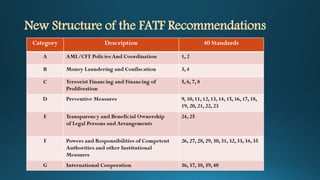
New Structure of the FATF Recommendations
What must a country do to implement the
FATF Recommendations effectively?
Successfully investigate and prosecute money laundering and terroristfinancing.
Criminalize money laundering and terrorist financing. Properly train law
enforcement and prosecutorial authorities, and equip them with sufficient
powers and resources.
Deprive criminals of their criminal proceeds and the resources needed to finance
their illicitactivities. Implement effective mechanisms to freeze, seize and confiscate
criminal assets.
Ensure that financial institutions and other businesses and professions comply
with AML/CFT requirements. Implement monitoring and supervision
mechanisms, including powers to sanction financial institutions and other
What mustacountrydo to implementthe FATF
Recommendations effectively?
Require financial institutions and other businesses and professions to implement effective measures
to detect and prevent money laundering and terroristfinancing. Ensure that the required range of
persons and entities in both the financial and non‐financial sectors implement the AML/CFT
preventative measureslisted below.
 Customer due diligence: Prevent criminals from operating anonymously or under false identities
b
y accurately identifying customers and knowing enough about their business to be able to
differentiate between legitimate business and criminalactivity.
 Record keeping: Keep accurate customer identification and transaction records that can be
promptly accessed by the authorities and enable customer transactions to be traced.
 Suspicious transaction reporting: Monitor customer relationships and promptly report any
suspicious transactions to the financial intelligence unit for analysis and possible dissemination
to law
enforcement authorities.
What mustacountrydo to implementthe FATF
Recommendations effectively?
Enhance the transparency of legal persons andarrangements. Prevent legal
persons and arrangements from being abused by criminals by ensuring that the
appropriate authorities have timely access to accurate and current information
concerning the ownership and control of legal persons and arrangements.
Implement mechanisms to facilitate cooperation and co‐ordination of AML/CFT
efforts at the international and domesticlevel. Ensure that there are no safe havens
for criminals by implementing mechanisms for effective co‐operation with
countries in a timely manner when investigating and prosecuting money
laundering and terrorist financing.
What arethebenefitsof implementingthe FATF
Recommendations?
Securinga more transparent and stable financial systemthat is more attractiveto foreign
investors.
Corrupt and opaque financial systems are inherently unstable. Excessive money
laundering can cause increased volatility of international capital flows and exchange rates,
market disparities, and distortions of investment and trade flows.
Ensurethat financialinstitutions are not vulnerable to infiltration or abuse by organised
crimegroups.
Financial institutions that are exploited in this manner are exposed to reputational risk,
financial instability, diminished public confidence, threats to safety and soundness, and
direct losses.
Build the capacityto fight terrorism andtraceterrorist money.
Terrorists need money to finance attacks. Tracing this money is one of the few preventive
tools that governments have against terrorism.
What are the benefits of implementing the
FATFRecommendations?
Meet binding international obligations, and avoid the risk of sanctions or
other action by the international community.
The international community—through numerous international treaties,
United Nations Security Council Resolutions and best practices—has
endorsed the FATF Recommendations at the highest political level.
Avoid becoming a haven forcriminals.
Countries with weak AML/CFT systems are attractive to criminals because
they provide an environment in which criminals can enjoy the profits of
their crimes and finance their illicit activities with little fear of facing
punishment.

Financial action task force / fatf

  • 2.
    What is theFATF ? • FATF is an inter-governmental policy-making body established in 1989. • It comprised of over 200 countries, that has a ministerial mandate to establish international standards for combating money laundering and terrorist financing. • Over 180 jurisdictions have joined the FATF or an FATF‐style regional body, and committed at the ministerial level to implementing the FATF standards and having their anti‐money laundering (AML)/counter‐terrorist financing (CFT) systems assessed.
  • 3.
    What are theFATF Recommendations ? The internationally endorsed global standards for implementing effective AML/CFT measures. They increase the transparency of the financial system (making it easier to detect criminal activity) and give countries the capacity to successfully take action against money launderers and terrorist financiers.
  • 4.
    New Structure ofthe FATF Recommendations
  • 5.
    What must acountry do to implement the FATF Recommendations effectively? Successfully investigate and prosecute money laundering and terroristfinancing. Criminalize money laundering and terrorist financing. Properly train law enforcement and prosecutorial authorities, and equip them with sufficient powers and resources. Deprive criminals of their criminal proceeds and the resources needed to finance their illicitactivities. Implement effective mechanisms to freeze, seize and confiscate criminal assets. Ensure that financial institutions and other businesses and professions comply with AML/CFT requirements. Implement monitoring and supervision mechanisms, including powers to sanction financial institutions and other
  • 6.
    What mustacountrydo toimplementthe FATF Recommendations effectively? Require financial institutions and other businesses and professions to implement effective measures to detect and prevent money laundering and terroristfinancing. Ensure that the required range of persons and entities in both the financial and non‐financial sectors implement the AML/CFT preventative measureslisted below.  Customer due diligence: Prevent criminals from operating anonymously or under false identities b y accurately identifying customers and knowing enough about their business to be able to differentiate between legitimate business and criminalactivity.  Record keeping: Keep accurate customer identification and transaction records that can be promptly accessed by the authorities and enable customer transactions to be traced.  Suspicious transaction reporting: Monitor customer relationships and promptly report any suspicious transactions to the financial intelligence unit for analysis and possible dissemination to law enforcement authorities.
  • 7.
    What mustacountrydo toimplementthe FATF Recommendations effectively? Enhance the transparency of legal persons andarrangements. Prevent legal persons and arrangements from being abused by criminals by ensuring that the appropriate authorities have timely access to accurate and current information concerning the ownership and control of legal persons and arrangements. Implement mechanisms to facilitate cooperation and co‐ordination of AML/CFT efforts at the international and domesticlevel. Ensure that there are no safe havens for criminals by implementing mechanisms for effective co‐operation with countries in a timely manner when investigating and prosecuting money laundering and terrorist financing.
  • 8.
    What arethebenefitsof implementingtheFATF Recommendations? Securinga more transparent and stable financial systemthat is more attractiveto foreign investors. Corrupt and opaque financial systems are inherently unstable. Excessive money laundering can cause increased volatility of international capital flows and exchange rates, market disparities, and distortions of investment and trade flows. Ensurethat financialinstitutions are not vulnerable to infiltration or abuse by organised crimegroups. Financial institutions that are exploited in this manner are exposed to reputational risk, financial instability, diminished public confidence, threats to safety and soundness, and direct losses. Build the capacityto fight terrorism andtraceterrorist money. Terrorists need money to finance attacks. Tracing this money is one of the few preventive tools that governments have against terrorism.
  • 9.
    What are thebenefits of implementing the FATFRecommendations? Meet binding international obligations, and avoid the risk of sanctions or other action by the international community. The international community—through numerous international treaties, United Nations Security Council Resolutions and best practices—has endorsed the FATF Recommendations at the highest political level. Avoid becoming a haven forcriminals. Countries with weak AML/CFT systems are attractive to criminals because they provide an environment in which criminals can enjoy the profits of their crimes and finance their illicit activities with little fear of facing punishment.